Trump’s Reported Offer to Sell China Weapons: A Policy Timeline
Did Trump offer to sell China weapons? Perdue's account, Trump's denial and the State Dept line, set against the 1979 Taiwan law and 1989 arms embargo.
Latest Story
Who should America arm, and who should it refuse? For 47 years the answer has been split in two: Washington recognizes Beijing but arms Taiwan under U.S. law, and since 1989 it has kept an arms embargo on mainland China. On 27 September 2026 Ambassador David Perdue said President Trump had asked Xi Jinping whether China would like to buy U.S. weapons. Trump disputed it the next day, and the State Department said there was no offer or plan. This timeline explains Trump’s reported offer to sell China weapons and the policy it collided with.
💡 Short Answer
There is no U.S. offer to sell weapons to China on the record. Ambassador David Perdue said on 27 September 2026 that Trump had asked Xi Jinping whether China wanted to buy U.S. arms. Trump disputed it on 28 September, and the State Department said U.S. law prohibits arms sales to China. That ban dates from June 1989, while Taiwan keeps receiving U.S. weapons under the 1979 Taiwan Relations Act.
Trump, China and U.S. Weapons: Key Questions
What to Know Before You Share the Headline
- One source: the claim rests on Ambassador Perdue’s television account. No document, weapons list or Chinese reply exists in public.
- Disputed within a day: Trump said “we didn’t discuss it” and suggested Perdue meant Taiwan, but also said “maybe it’s a good idea”.
- Officially denied: the State Department said U.S. law prohibits arms sales to China and there is no offer or plan.
- The ban is statutory: Bush suspended sales on 5 June 1989; Congress made the U.S. Munitions List ban law on 16 February 1990.
- The ban is enforced: Boeing paid a $51 million settlement in 2024 partly for exporting defense data to China, a “proscribed destination”.
- There was a before: from 1984 to 1989 the U.S. did sell arms to China, including the $550 million Peace Pearl fighter upgrade.
- Taiwan is separate: the 1979 Taiwan Relations Act commits the U.S. to supply defensive arms; the largest package, $11.1 billion, came in December 2025.
- The real 2026 shift is on Taiwan: a $14 billion package has been frozen since May, and Trump called Taiwan arms a “negotiating chip”.
- Policy unchanged, for now: Taiwan’s defense minister said on 29 September 2026 that he had received no notice of any change.
What Happened: Three Accounts in 48 Hours
The exact words matter, so here they are.
The episode began after Xi Jinping’s state visit to Washington on 23 to 25 September 2026. On Fox News Sunday on 27 September, the U.S. ambassador to China was asked about American arms sales to Taiwan. His answer moved, unprompted, to China itself.
“He actually asked President Xi, would he like to buy some, at one point.”
Ambassador David Perdue, Fox News Sunday, 27 September 2026, describing Trump’s conversations with Xi
“To China? You mean to Taiwan? … So maybe it’s a good idea. But we didn’t discuss it.”
President Donald Trump, Oval Office, 28 September 2026
“U.S. law prohibits arms sales to China and there is no offer or plan to sell arms to China.”
U.S. State Department statement, 28 September 2026
The evidence supports one description: a reported conversational remark attributed to Trump, disputed by Trump, with no U.S. policy or sale resulting from it. Calling it a “Trump-China weapons deal” goes beyond anything on the record. It is still news, because a president musing that selling arms to China “maybe” is a good idea runs against a structure every administration since 1989 has kept.
Taiwan: armed. China: denied. So what happened in September 2026?
Pick the answer that the public record supports.
Tap A, B or C.
Two Lanes: How U.S. Policy Split Taiwan and China
Everything in one picture before the detail.
The Full Timeline, 1972 to 2026
Newest first. Tags mark what is on the record and what is a disputed account.
2026
Taiwan: “no notice of any changes”On the record
Taiwan’s defense minister Wellington Koo says Taipei is “in continuous discussions with the Americans” on arms sales and has “not received any notice of any changes to sales or our cooperation”. U.S. officials, he says, have assured Taiwan that policy is unchanged. The record $14 billion package stays on hold. Koo adds that Taiwan’s 66 new F-16 Block 70 jets, first due in 2024, have reached the stage where they are ready for delivery.
2026
State Department: “no offer or plan”On the record
The State Department draws the legal line: “U.S. law prohibits arms sales to China and there is no offer or plan to sell arms to China.” A U.S. official separately tells ABC News that the government has no plans to sell weapons to China. No official explains what, if anything, was said to Xi.
2026
Trump: “To China? You mean to Taiwan?”On the record
Asked about Perdue’s account, Trump says “I never heard of that one” and “we didn’t discuss it”, and suggests Perdue “probably was talking about Taiwan”. In the same answer he muses: “So maybe it’s a good idea. But we didn’t discuss it.” The denial and the musing, together, keep the story alive.
2026
Perdue: Trump asked Xi if China wanted to buy U.S. armsDisputed account
Discussing arms sales to Taiwan, Ambassador David Perdue says Trump keeps telling Xi that the U.S. sells weapons all over the world, then adds: “He actually asked President Xi, would he like to buy some, at one point.” He gives no date, no weapons, no price and no reply from Xi, and in the same interview calls Trump “as strong on Taiwan as I’ve ever seen anybody”.
2026
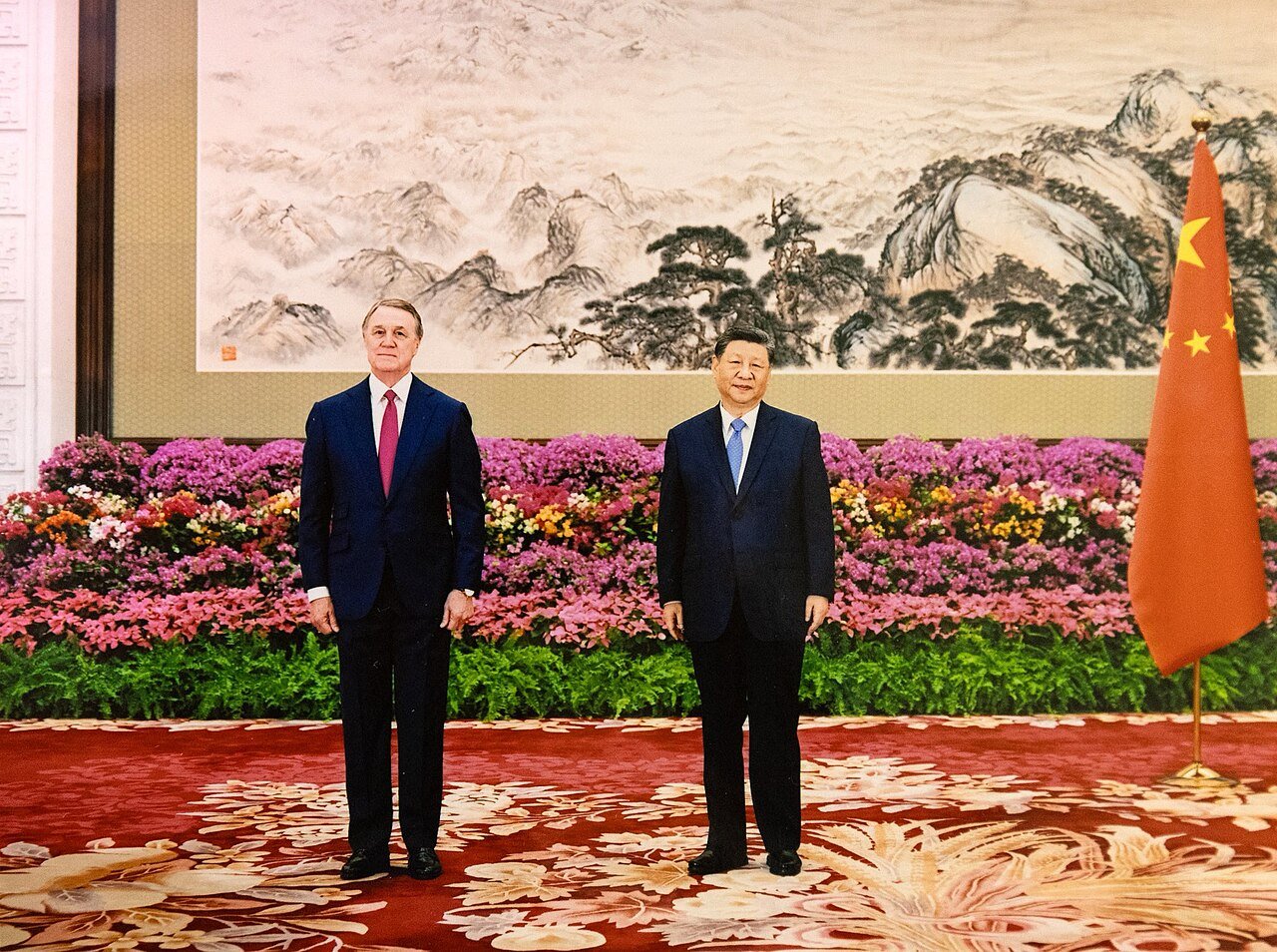
Xi’s state visit to Washington
Xi Jinping makes his first U.S. state visit in more than a decade. After 90 minutes of Oval Office talks, the sides extend their trade truce to 10 January 2027, set up an AI dialogue and announce youth exchanges and two pandas for Zoo Atlanta. According to Xinhua, Xi urges Trump to “adhere to the correct position of opposing Taiwan independence”. Trump says: “We didn’t talk about it too much. Right now, it’s fine.”
The $14 billion Taiwan package is frozen
On 11 May Trump says he will discuss arms sales to Taiwan with Xi, something the U.S. promised Taiwan in 1982 it would not do. At the Beijing summit on 13–15 May China presses him to halt sales, and afterwards he calls a Taiwan package a “very good negotiating chip”. Later in May, acting Navy Secretary Hung Cao tells senators a record $14 billion package is paused to protect U.S. munitions stocks for the Iran war. Trump says the sales are in “abeyance” and that it “depends on China”.
2025
The largest Taiwan package to date: $11.1 billion
The second Trump administration notifies Congress of eight sales to Taiwan worth about $11.1 billion: 82 HIMARS launchers and 420 ATACMS missiles, 60 M109A7 self-propelled howitzers, ALTIUS loitering drones, tactical network software, 1,050 Javelin and 1,545 TOW anti-tank missiles, and helicopter parts. Beijing condemns it.
2024
Boeing fined $51 million, China named as proscribed
Settling 199 export violations, the State Department cites Boeing’s unauthorised exports of defense technical data to the People’s Republic of China, “a proscribed destination under ITAR §126.1”. The case shows the embargo is not a relic: it is enforced against America’s own largest exporters, down to technical drawings.
Missiles, rockets and drones for Taiwan
In three weeks the State Department approves 11 HIMARS launchers ($436 million), 135 SLAM-ER missiles (about $1 billion), F-16 reconnaissance pods, a Harpoon coastal-defense system of 100 launchers and 400 missiles ($2.37 billion) and four MQ-9B drones ($600 million). The emphasis shifts from prestige platforms to mobile weapons suited to deterring an invasion.
66 new F-16 Block 70 jets for Taiwan
The first Trump administration approves 66 F-16C/D Block 70 fighters, Taiwan’s biggest aircraft purchase in decades. Beijing threatens sanctions on U.S. firms. Deliveries slip from the original 2024 target because of pandemic and production problems.
Big packages under Bush and Obama
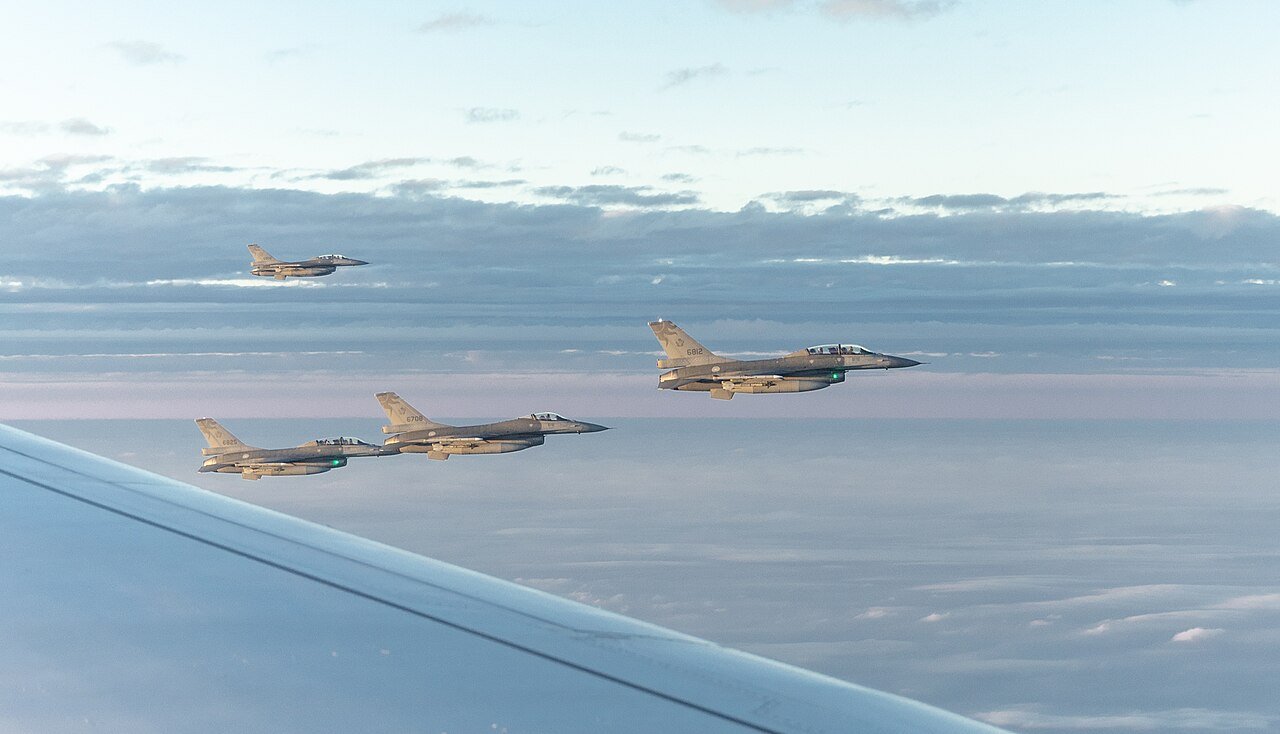
President George W. Bush offers Taiwan destroyers, P-3C patrol aircraft and help acquiring diesel submarines in April 2001. Barack Obama notifies a $6.4 billion package in January 2010 and, in September 2011, a $5.85 billion program to upgrade Taiwan’s F-16A/B fleet to the F-16V standard instead of selling new jets. Each package draws a Chinese protest; none changes the embargo on the mainland.
The Taiwan Strait missile crisis
After Taiwan’s President Lee Teng-hui visits Cornell in June 1995, China fires missiles into waters near Taiwan and repeats the exercise before Taiwan’s first direct presidential election in March 1996. The Clinton administration sends two aircraft carrier groups. Arms sales stop being a bookkeeping question and become part of deterrence.
1992
150 F-16s for Taiwan
Three years after suspending arms sales to Beijing, Bush sells Taiwan 150 F-16A/B fighters. China says it violates the 1982 promise to reduce sales. Washington argues that China’s own arms buildup changed the balance. The pattern is set: one side of the Strait is embargoed, the other armed.
1990
Congress writes the embargo into law
The Foreign Relations Authorization Act for FY1990–91 turns Bush’s executive sanctions into statute. Section 902 bars export licences for U.S. Munitions List items to China, alongside curbs on crime-control equipment, satellites and nuclear cooperation. The President may lift a ban by telling Congress it is in the national interest. The munitions ban has never been lifted.
1989
Tiananmen: Bush suspends military sales
A day after troops clear Tiananmen Square, President George H. W. Bush suspends all government-to-government military sales and commercial arms exports to China, freezing about $600 million in government deals. “It’s not business as usual,” he says, while adding that he does not want “a total break”. On 27 June European Community leaders in Madrid agree an arms embargo of their own.
The brief era of selling arms to Beijing
With the Soviet Union as a common rival, President Reagan makes China eligible for Foreign Military Sales in June 1984. Cases follow for artillery-ammunition production technology, Mk-46 torpedoes, artillery-locating radars and Peace Pearl, a program of about $550 million to fit U.S. avionics to Chinese J-8II interceptors. It is the high point of U.S.-China military cooperation.
1982
The arms-sales communiqué
The United States says it does not seek a long-term policy of arms sales to Taiwan, that sales will not exceed recent levels, and that it intends to reduce them gradually. Beijing reads that as a path to ending sales. Washington privately links any reduction to China’s commitment to a peaceful approach. The ambiguity is deliberate.
The Six Assurances to Taiwan
Weeks before the communiqué, Washington tells Taipei it has not agreed to set an end date for arms sales, will not consult Beijing about them, will not mediate, will not revise the Taiwan Relations Act, has not changed its position on sovereignty and will not press Taiwan to negotiate.
1979
The Taiwan Relations Act
Congress answers normalization with a law. The Taiwan Relations Act keeps unofficial relations and commits the U.S. to make available “defense articles and defense services in such quantity as may be necessary to enable Taiwan to maintain a sufficient self-defense capability”, with needs decided by the President and Congress.
1979
Washington recognizes Beijing
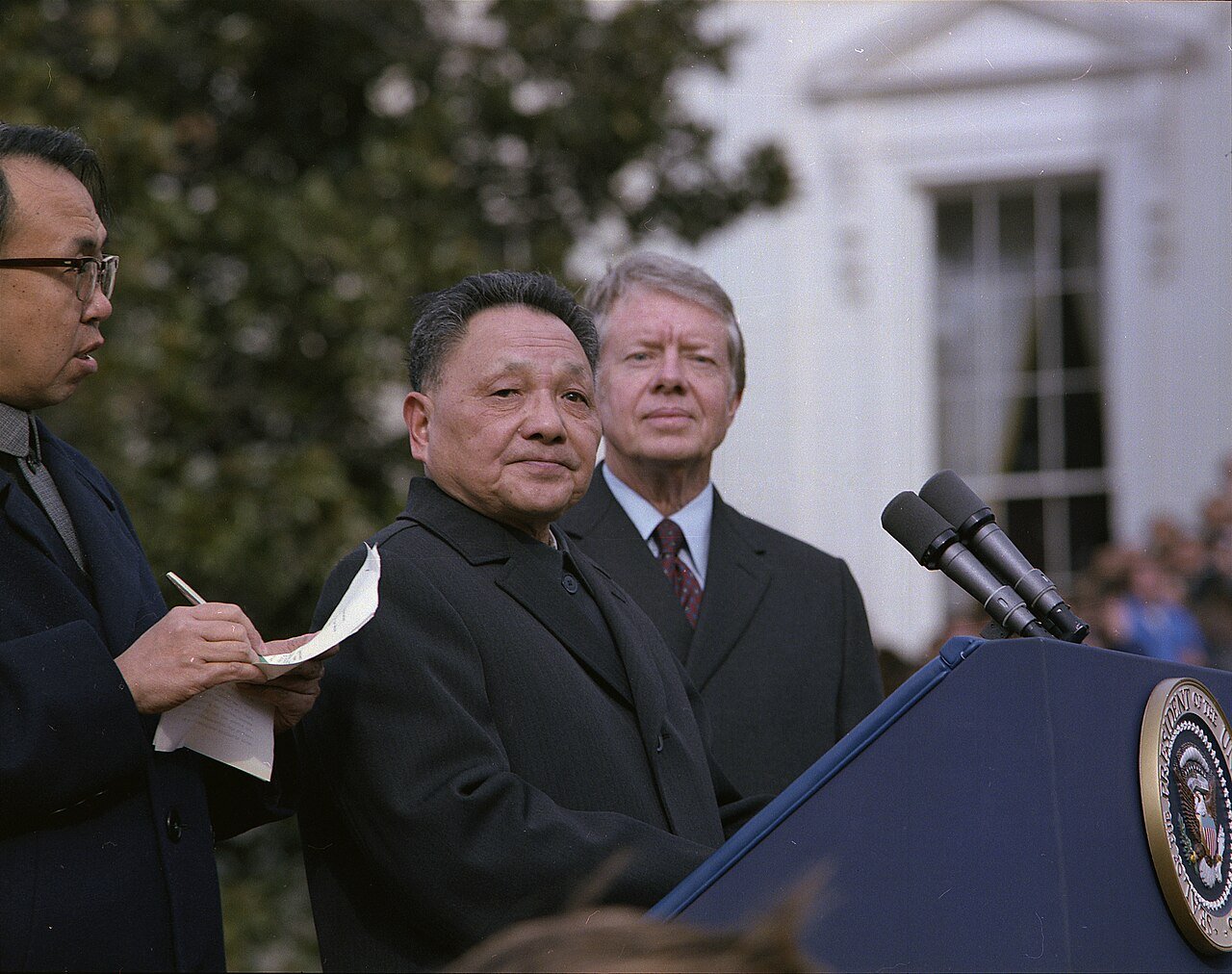
The United States recognizes the People’s Republic of China as the sole legal government of China, ends formal ties with Taipei and gives notice to end the 1954 mutual defense treaty. Deng Xiaoping visits the White House four weeks later.
1972
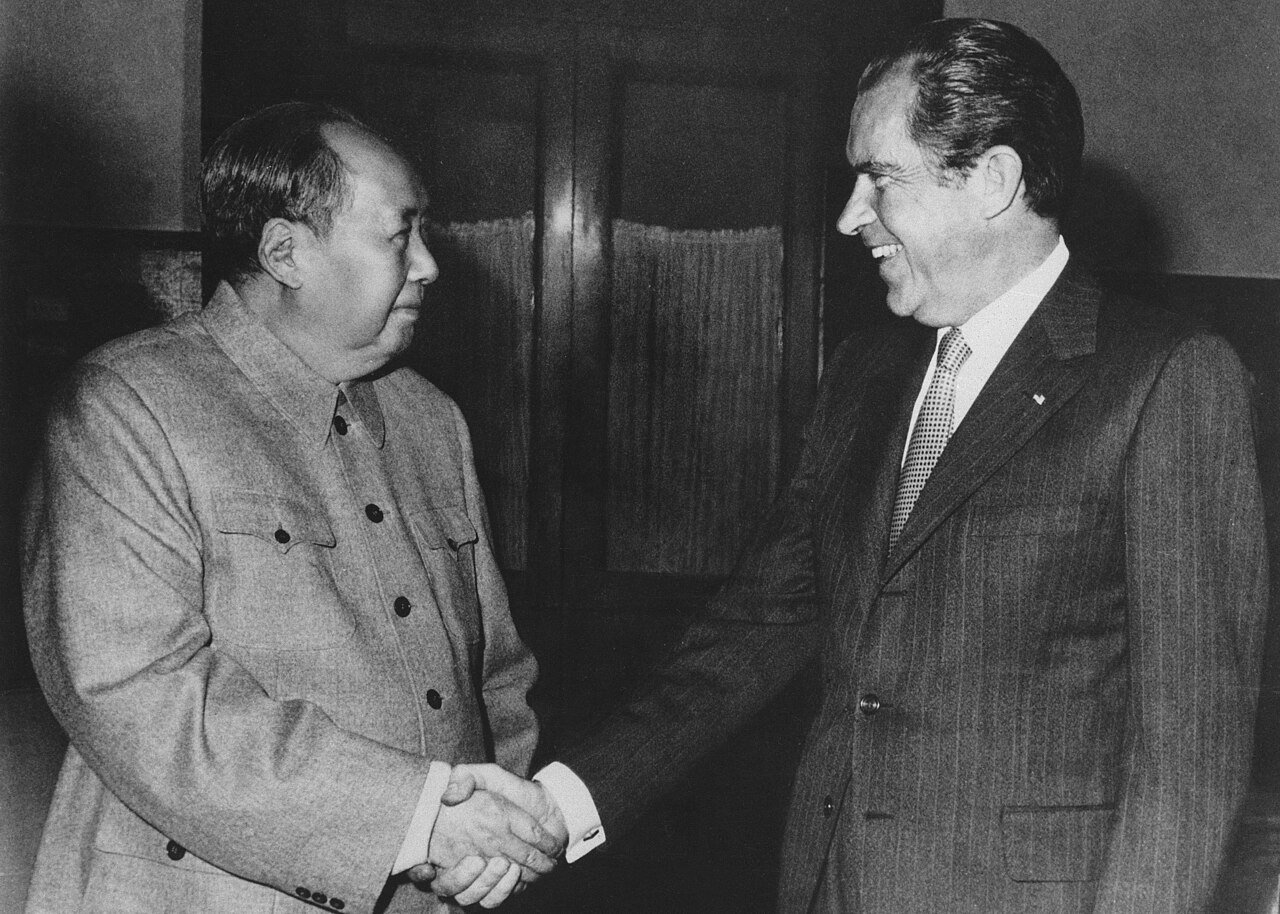
The Shanghai Communiqué
Ending two decades without contact, Richard Nixon meets Mao Zedong. The communiqué records that the U.S. “acknowledges” that Chinese on both sides of the Strait maintain there is one China, and states the aim of withdrawing U.S. forces from Taiwan as tension eases. Taiwan’s future is left open.
What U.S. Law Actually Says
“U.S. law prohibits arms sales to China” rests on two layers.
Layer one is a statute. Section 902 of the Foreign Relations Authorization Act for Fiscal Years 1990 and 1991 (Public Law 101-246) suspends export licences for defense articles on the U.S. Munitions List to China. Most of the other Tiananmen sanctions have since been waived or overtaken. The munitions ban has stayed.
Layer two is a regulation. Under 22 CFR §126.1 of the International Traffic in Arms Regulations, China is listed among destinations subject to a policy of denial for defense articles and defense services. The rule covers hardware and technical data, and the State Department enforces it: its 2024 Boeing settlement called the PRC “a proscribed destination under ITAR §126.1”.
On top of both sits the Arms Export Control Act. Any major sale, to anyone, must be formally notified to Congress, which can try to block it. A presidential comment changes none of these.
| Document | Covers | Force | Key effect |
|---|---|---|---|
| Taiwan Relations Act (1979) | Taiwan | Statute | Defensive arms for Taiwan |
| Six Assurances (1982) | Taiwan | Policy | No end date; no consulting Beijing on Taiwan sales |
| August 17 Communiqué (1982) | Taiwan arms | Joint statement | Intent to reduce Taiwan sales gradually |
| Section 902, Public Law 101-246 (1990) | China | Statute, waivable | No U.S. Munitions List export licences |
| ITAR §126.1 | China | Regulation | Policy of denial for defense articles and services |
| Arms Export Control Act, section 36 | Any buyer | Statute | Congress must be notified of major sales |
Tap a document to see what it governs.
The Taiwan question and the China embargo sit in different documents. That is why the September 2026 remark confused so many people.
Question: which one directly governs a U.S. arms export to mainland China today?
Think about it, then tap Reveal.
The Forgotten Chapter: When the U.S. Did Sell Arms to China
The embargo is so familiar that it is easy to forget it had a beginning. In the late Cold War, Washington and Beijing shared a rival in Moscow. In June 1984 President Reagan made China eligible for Foreign Military Sales. Small cases followed: technology to modernize an artillery-ammunition plant, Mk-46 anti-submarine torpedoes and artillery-locating radars.
The biggest was Peace Pearl, agreed in 1986: about $550 million to fit U.S. radar and avionics to roughly 50 Chinese J-8II interceptors. All of it ran in parallel with continued sales to Taiwan. Then came 4 June 1989. Bush suspended sales the next day, with about $600 million in government deals frozen, and China quit Peace Pearl in 1990 as costs rose.
So the correct history is not “America never armed China”. It is that America armed China briefly, stopped after Tiananmen, and wrote the stop into law.
Meanwhile, Taiwan: The Packages Since 2019
The other lane kept moving, including under both Trump administrations.
| Date | What | Value | Status / administration |
|---|---|---|---|
| Aug 2019 | 66 F-16C/D Block 70 fighters | about $8.0B | Trump (1st term) |
| Oct 2020 | 11 HIMARS launchers | $436M | Trump (1st term) |
| Oct 2020 | 135 SLAM-ER missiles | about $1.0B | Trump (1st term) |
| Oct 2020 | Harpoon coastal defense: 100 launchers, 400 missiles | $2.37B | Trump (1st term) |
| Nov 2020 | 4 MQ-9B drones | $600M | Trump (1st term) |
| Dec 2025 | Eight notifications: HIMARS/ATACMS, M109A7, ALTIUS, Javelin, TOW and more | about $11.1B | Trump (2nd term) |
| 2026 | Proposed package, reported record size | about $14B | On hold since May 2026 |
Both Trump administrations have been among the biggest sellers of arms to Taiwan. That is why the 2026 story is double-edged. On one side, a frozen $14 billion package and a “negotiating chip” remark. On the other, the largest single notification in history just nine months earlier. Taiwan’s own planning has not stopped: Defense Minister Koo said the 66 new F-16s were ready for delivery.
Taiwan vs China in U.S. Arms Policy
Two Destinations, Two Rulebooks
What Would Have to Change for a Real China Arms Sale?
A remark leaves no footprint. A policy change would leave a large one.
- A presidential waiver of the 1990 law. Section 902 lets the President lift a ban by reporting to Congress that doing so is in the national interest. That report would be public.
- An ITAR amendment. China would have to come off, or be carved out of, the §126.1 policy of denial through a published rule change.
- A notification to Congress for each major sale under the Arms Export Control Act, with a review period in which lawmakers could try to block it.
- A decision about Taiwan. Arming both sides of the Strait would force the administration to explain how it squares with the Taiwan Relations Act and the Six Assurances.
- Congressional acceptance. Congress could legislate a new, unwaivable ban; bipartisan China hawks have backed tougher export controls for years.
As of 29 September 2026, none of these steps has happened. There is no waiver, no rule change and no notification.
Who’s Who
Donald Trump
Disputed Perdue’s account but said selling to China “maybe” is a good idea; called Taiwan arms a “negotiating chip” in May 2026.
Xi Jinping
Made a state visit to Washington, 23–25 September 2026; urged Trump to oppose Taiwan independence. No public response on buying U.S. arms.
David Perdue
Former Georgia senator. His Fox News Sunday remark is the only source for the reported question to Xi.
Wellington Koo
Said on 29 September 2026 that Taiwan had no notice of any change and that arms talks continue.
Hung Cao
Told senators in May 2026 that the $14 billion Taiwan package was paused to protect munitions stocks for the Iran war.
State Department (DDTC)
Administers ITAR, including the §126.1 China denial; issued the 28 September “no offer or plan” statement.
Did You Know?
- Europe too: European Community leaders agreed their own China arms embargo in Madrid on 27 June 1989. It is still in force.
- Same week, other lane: Bush suspended sales to Beijing in June 1989 and sold Taiwan 150 F-16s three years later.
- The F-16V jets seen escorting Taiwan’s president are older F-16A/Bs upgraded under a 2011 U.S. program, not the 66 new Block 70s still awaiting delivery.
- “Acknowledges” is the key verb of the 1972 Shanghai Communiqué: the U.S. noted the one-China position without endorsing Beijing’s claim.
- Four summits: the May Beijing summit was billed as the first of four Trump-Xi meetings planned for 2026.
Test Yourself: U.S.–China Arms Policy Quiz
1. What did Ambassador Perdue say on 27 September 2026?
2. Who did Trump suggest Perdue meant?
3. When did the U.S. suspend military sales to China?
4. Which law put the China arms ban into statute?
5. What was Peace Pearl?
6. Which of the Six Assurances matters most to the 2026 story?
7. How much was the December 2025 Taiwan package worth?
8. Why was the $14 billion package paused, according to the acting Navy Secretary?
Explore More Timelines
People Also Ask
Frequently Asked Questions
Related AiTimeline Stories
⚠️ Editorial Note
This article uses “reported offer” and “Perdue’s account” deliberately: as of 29 September 2026 there is no public evidence of a formal offer, contract, weapons list or Chinese acceptance. Quotes from 27–29 September 2026 follow AP, ABC News and the Boston Globe. Historical documents follow the State Department’s Office of the Historian, the text of the Taiwan Relations Act and 22 CFR §126.1. Corrections and additions to circulating summaries: the “U.S. law” cited is section 902 of Public Law 101-246 (1990), not only the 1989 executive suspension; the U.S. did sell arms to China from 1984 to 1989; the Six Assurances of July 1982 belong alongside the August 1982 communiqué; and the May 2026 pause was officially attributed to Iran-war munitions needs as well as to diplomacy. This is not legal advice.
Sources & further reading
Every dated entry above was checked against these references. Last reviewed 29 September 2026.
- U.S. State Department statement via ABC News: no plans to sell weapons to China (28 Sep 2026)
- AP: Taiwan says US arms sales are unchanged, but a $14B package remains on hold (29 Sep 2026)
- eCFR: 22 CFR 126.1, prohibited exports, imports and sales to or from certain countries
- Congress.gov: H.R. 2479, Taiwan Relations Act (Public Law 96-8)
- Office of the Historian: The August 17, 1982 U.S.-China Communique on Arms Sales to Taiwan
- Office of the Historian: China Policy, 1977-1980 (normalization and the Taiwan Relations Act)
- Congressional Research Service: China, Economic Sanctions (R44605), Tiananmen sanctions
- U.S. Department of State: $51 million Boeing settlement for export violations (2024)