Soviet Union Collapse Timeline: Key Events of 1991
Soviet Union collapse timeline: the August 1991 coup, Ukraine's independence vote, the Belavezha Accords, Gorbachev's resignation and the end of the USSR.
Latest Story
This Soviet Union collapse timeline follows 1991, the year a superpower that had shaped world politics for nearly seven decades disappeared. On 25 December Mikhail Gorbachev resigned as president, the Soviet flag came down over the Kremlin, and on 26 December the Soviet of the Republics acknowledged that the Union had ceased to exist. The collapse had no single cause: reforms, rising national movements, the Gorbachev-Yeltsin rivalry, the failed August coup and Ukraine’s 1 December vote all pushed the same way. By year’s end 15 independent states had emerged. For earlier Cold War crises, see the Berlin Wall, the Cuban Missile Crisis and the Berlin Airlift.
💡 Short Answer
The USSR ended in stages in 1991. A hard-liner coup failed on 21 August, republics declared independence, Ukraine voted for independence on 1 December, Russia, Ukraine and Belarus signed the Belavezha Accords on 8 December, 11 republics endorsed the end at Alma-Ata on 21 December, Gorbachev resigned on 25 December and the Soviet of the Republics acknowledged the end on 26 December.
Soviet Collapse: Key Questions
The Soviet Collapse in Ten Points
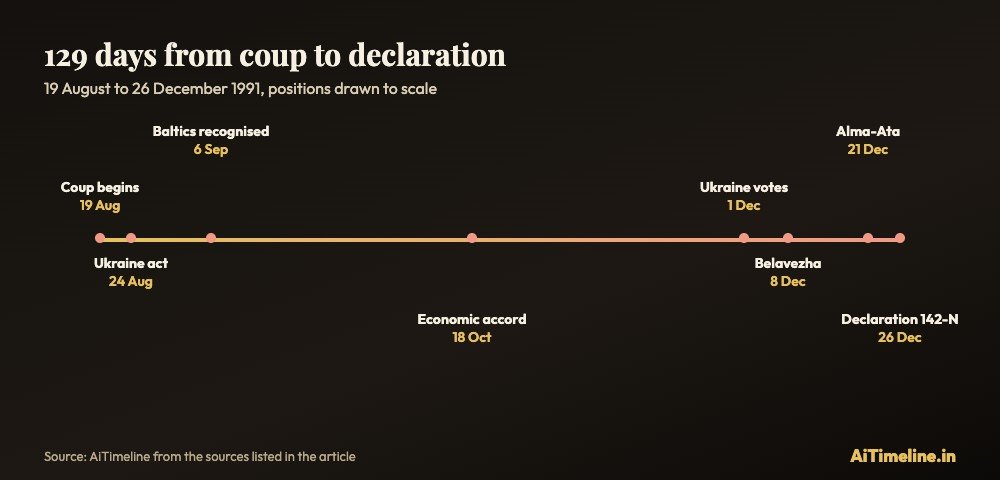
- The span: 129 days from the coup (19 August) to Declaration 142-N (26 December).
- The reforms: perestroika and glasnost opened politics faster than institutions could adapt.
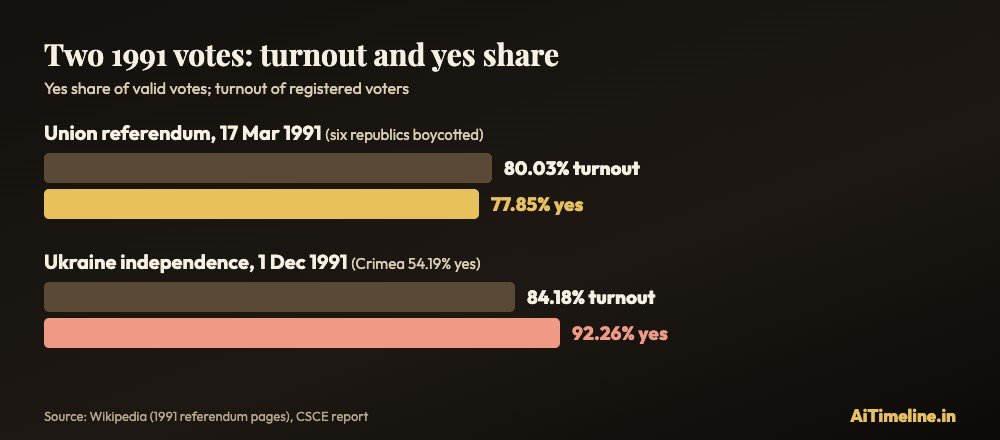
- The vote: on 17 March 1991, 77.85% backed a renewed union, but six republics boycotted.
- The rivalry: Yeltsin’s election on 12 June gave Russia an elected leader; Gorbachev had none.
- The coup: it began on 19 August, failed by 21 August and left Gorbachev weakened.
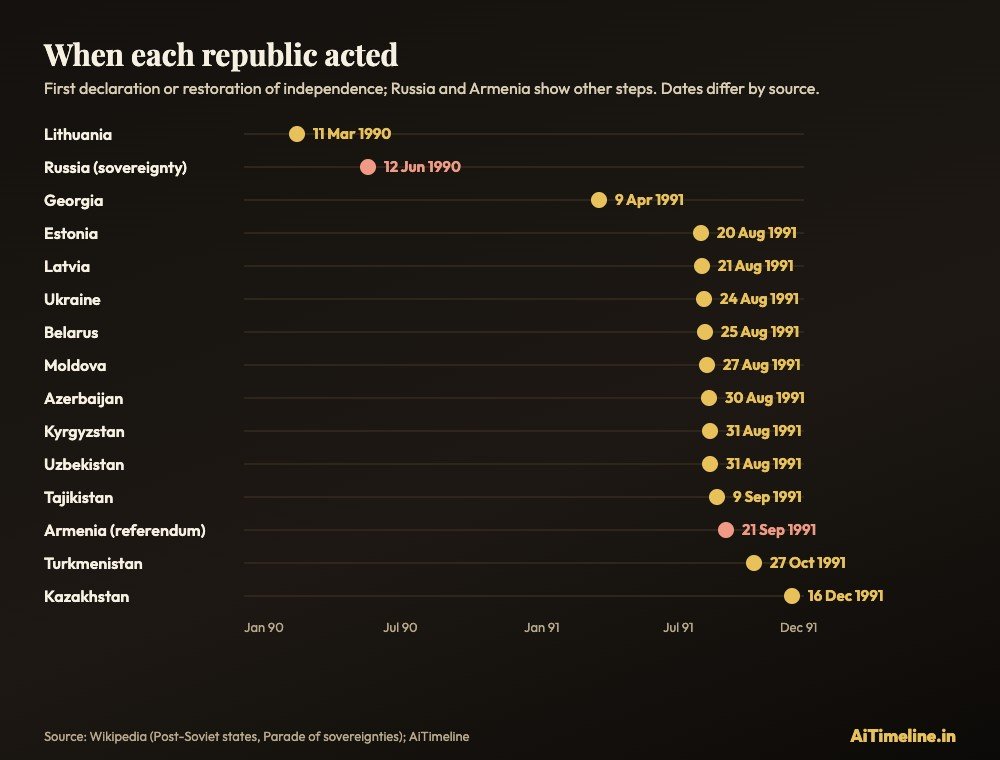
- The wave: eight republics declared or restored independence between 20 and 31 August.
- Ukraine: over 90% of participants backed independence on 1 December.
- Belavezha: the three founding republics said the USSR was ceasing its existence on 8 December.
- Alma-Ata: 11 republics endorsed the end on 21 December; Georgia and the Baltics stayed out.
- Two dates: 25 December ended the presidency; 26 December was the legislative acknowledgement.
Soviet Union Collapse Timeline, Latest First
Each entry is tagged by thread and ends with why it matters. Use the filter to isolate the Kremlin, the coup, the votes or the republics.
Kremlin, coup, votes or republics? Filter the timeline by thread.
–
26
The Soviet of the Republics acknowledges the end of the USSR Kremlin and centre
The Soviet of the Republics, the upper chamber of the Soviet parliament, adopted Declaration No. 142-N on 26 December 1991, recognising the independence of the former republics and acknowledging that the Soviet Union had ceased to exist (Wikipedia). Russia had recalled its deputies on 12 December, and most accounts say the other chamber, the Soviet of the Union, could no longer muster a quorum. Most accounts count this as the formal legal conclusion, the day after Gorbachev’s resignation.
Two dates, two roles. The resignation (25 December) ended the presidency; this vote (26 December) is the institutional acknowledgement. AiTimeline could not retrieve the verbatim Russian text of the declaration, so the wording here follows secondary summaries.
25
Gorbachev resigns and the Soviet flag comes down Kremlin and centre
Mikhail Gorbachev announced his resignation as president of the Soviet Union in a televised address on 25 December 1991, and transferred his powers, including control of the nuclear launch codes, to Boris Yeltsin (Wikipedia). That evening the Soviet flag was lowered from the Kremlin for the last time (US Department of State).
Less than two hours before his address, Gorbachev telephoned President George H. W. Bush at Camp David. It was the last conversation between the two leaders as heads of the superpowers (National Security Archive).
21
Eleven republics endorse the Alma-Ata agreements Republics
Leaders of 11 republics signed the Alma-Ata protocols on 21 December 1991: Russia, Belarus, Ukraine, Armenia, Azerbaijan, Kazakhstan, Kyrgyzstan, Moldova, Tajikistan, Turkmenistan and Uzbekistan (Wikipedia). They confirmed that the Soviet Union had ceased to exist and set up the Commonwealth of Independent States (CIS) on a wider basis than the original three. A separate treaty on nuclear weapons was signed by Belarus, Kazakhstan, Russia and Ukraine.
Georgia did not take part and the three Baltic states, which regard their 1940 incorporation as illegal, stayed out. Georgia joined the CIS in 1993 and left in 2009.
12
Russia ratifies Belavezha and denounces the 1922 treaty Kremlin and centre
Ukraine’s Verkhovna Rada and Belarus’s Supreme Council ratified the Belavezha agreement on 10 December. On 12 December Russia’s Supreme Soviet ratified it, denounced the 1922 Treaty on the Creation of the USSR, and recalled Russia’s deputies from the Soviet parliament (Wikipedia). Some Russian lawmakers disputed the constitutional basis of the vote.
8
The Belavezha Accords declare the USSR over Republics
Boris Yeltsin and Gennady Burbulis (Russia), Leonid Kravchuk and Vitold Fokin (Ukraine), and Stanislav Shushkevich and Vyacheslav Kebich (Belarus) signed the accords at a state dacha near Viskuli in the Belovezhskaya Pushcha forest. The preamble states that the USSR, “as a subject of international law and a geopolitical reality, is ceasing its existence,” and the text created the CIS (Wikipedia).
Within minutes Yeltsin telephoned Bush, saying that Gorbachev did not yet know the results (National Security Archive). Gorbachev objected that “the fate of the multinational state cannot be determined by the will of the leaders of three republics.”
1
Ukraine votes for independence Votes
Ukrainians voted on the 24 August independence act on 1 December 1991. The CSCE’s contemporary report says about 84% of eligible voters took part and over 90% of participants backed independence; Leonid Kravchuk won the presidency in the first round with about 60% (CSCE report). The official tally was 92.26% yes of valid votes, with 54.19% yes in Crimea and 83.90% in Donetsk oblast (Wikipedia).
6
Yeltsin bans the Communist Party in Russia Kremlin and centre
Yeltsin issued a decree on 6 November 1991 banning the Communist Party of the Soviet Union in Russia (Wikipedia). Talks on a looser “Union of Sovereign States” continued through November without a settlement that Ukraine and Russia would both sign.
18
Eight republics sign an economic community agreement Kremlin and centre
Gorbachev and representatives of eight republics signed an agreement on a new economic community on 18 October 1991. Ukraine, Georgia, Moldova, Azerbaijan and the three Baltic states did not take part (Wikipedia; AiTimeline did not find a second source for the list of non-signatories). Azerbaijan’s Supreme Soviet adopted its independence act the same day.
6
The State Council recognises Baltic independence Republics
The USSR State Council, formed after the coup, recognised the independence of Estonia, Latvia and Lithuania on 6 September 1991 (OmniAtlas summary). Tajikistan declared independence on 9 September and Armenia held its independence referendum on 21 September (Wikipedia).
29
The Supreme Soviet suspends Communist Party activity Kremlin and centre
On 29 August 1991 the Supreme Soviet suspended the activities of the Communist Party across the Soviet Union, and Vladimir Ivashko resigned as the party’s deputy leader (Wikipedia). Gorbachev had resigned as General Secretary on 24 August.
20-31
Republics declare or restore independence Republics
Estonia reinstated its independence on the night of 20 August (11:03 pm) and Latvia on 21 August, followed by Ukraine (24 August), Belarus (25 August), Moldova (27 August), Azerbaijan (30 August) and Kyrgyzstan and Uzbekistan (31 August) (Wikipedia). Georgia had already declared independence on 9 April 1991, and Lithuania restored its independence on 11 March 1990.
Dates vary by source because several republics made a declaration first and a constitutional act later. The full table is further down.
24
Ukraine adopts its Act of Independence Republics
Ukraine’s parliament adopted the Act of Declaration of Independence on 24 August 1991, citing the danger revealed by the attempted coup, and set a referendum for 1 December to confirm it. The same day Gorbachev resigned as General Secretary of the Communist Party and urged its Central Committee to dissolve itself.
21-22
The coup collapses and Gorbachev returns August coup
Three civilians were killed in a clash near the Russian parliament building at about 1 am on 21 August. Troops began to leave Moscow that morning and the committee’s leader, Gennady Yanayev, dissolved it at about 5 pm. Gorbachev flew back from Crimea overnight and landed at Vnukovo at about 2 am on 22 August (Wikipedia). The draft brief placed his return on 21 August; the flight and landing were on 22 August.
19
Hard-liners launch a coup against Gorbachev August coup
On 19 August 1991 the State Committee for the State of Emergency announced emergency rule from 4 am Moscow time. Gorbachev, on holiday at Foros in Crimea, had lost telephone contact the previous afternoon. Tanks entered Moscow, and Yeltsin climbed a tank outside the Russian parliament to denounce the coup (Wikipedia). The signing of the New Union Treaty, planned for 20 August, never took place.
12
Yeltsin wins Russia’s first presidential election Votes
Boris Yeltsin was elected the first president of Russia on 12 June 1991 with roughly 57% to 59% of the vote depending on how the total is counted (TASS reports 57.3%; Wikipedia 58.56%), ahead of Nikolai Ryzhkov (about 17%) and Vladimir Zhirinovsky (about 8%) (Wikipedia; Moscow Times). Gorbachev, by contrast, had been chosen by the Congress of People’s Deputies, not by voters.
23
The “9+1” agreement at Novo-Ogaryovo Kremlin and centre
Gorbachev and the leaders of nine republics reached the so-called 9+1 agreement on 23 April 1991 to draft a new union treaty (Michigan State University archive; Wikipedia). The Baltic states, Armenia, Georgia and Moldova stayed out. By August eight of the nine had approved a draft with conditions, while Ukraine had not agreed its terms.
17
A union-wide referendum on a renewed federation Votes
Voters were asked whether the USSR should be preserved as a “renewed federation of equal sovereign republics.” Turnout was 80.03% and 77.85% voted yes. Authorities in six republics, Armenia, Estonia, Georgia, Latvia, Lithuania and Moldova, boycotted it (Wikipedia). Ukraine added its own question on a union of sovereign states (81.69% yes), and Russia added a question on creating an elected presidency. The draft brief said only that the Baltic states “did not participate in the same way”; six republics, not three, stayed out.
Violence in Vilnius and Riga Republics
On 13 January 1991 Soviet forces stormed the television tower and broadcasting centre in Vilnius; 14 civilians died and more than 700 were wounded (RFE/RL). A Vilnius court in 2019 found former defence minister Dmitry Yazov and more than 60 others guilty of war crimes and crimes against humanity. On 20 January Soviet OMON troops attacked Latvia’s Interior Ministry in Riga, and five people were killed, according to Latvian sources (Wikipedia).
Republics assert sovereignty over Moscow Republics
Lithuania restored its independence on 11 March 1990. In the same week the Congress of People’s Deputies ended the Communist Party’s constitutional monopoly (Article 6) and elected Gorbachev to the new post of president. Russia adopted its Declaration of State Sovereignty on 12 June 1990, one of the “parade of sovereignties” in which republic after republic claimed priority for its own laws (Wikipedia).
-89
Gorbachev’s reforms change the system Kremlin and centre
Gorbachev became General Secretary in March 1985 and introduced perestroika (economic restructuring) and glasnost (openness), meant to renew Soviet socialism, not end the state. Public debate exposed grievances, politics became competitive and economic problems were harder to hide. In 1989 communist governments across Eastern Europe fell (US Department of State); see the Berlin Wall timeline.
The Soviet Union is founded Kremlin and centre
The Union was created in December 1922 by a treaty among the Russian, Ukrainian, Belorussian and Transcaucasian republics. That is the treaty Russia’s Supreme Soviet denounced on 12 December 1991. By 1991 the USSR consisted of 15 union republics.
The 15 Republics at a Glance
Tap a republic for its key date and a short explanation; the table below lists them all.
Tap a republic to see its key date and what happened there.
Choose a republic above.
| Republic | Key date | Signed Alma-Ata, 21 Dec 1991? | Note |
|---|---|---|---|
| Armenia | 21 Sep 1991 (referendum) | Yes | Boycotted the March union vote |
| Azerbaijan | 30 Aug / 18 Oct 1991 | Yes | Declaration, then Supreme Soviet act |
| Belarus | 25 Aug 1991 | Yes | Hosted Belavezha; founding signatory |
| Estonia | 20 Aug 1991 | No | Restoration; recognised 6 Sep 1991 |
| Georgia | 9 Apr 1991 | No | Joined the CIS in 1993 |
| Kazakhstan | 16 Dec 1991 | Yes | Last to declare; hosted Alma-Ata |
| Kyrgyzstan | 31 Aug 1991 | Yes | |
| Latvia | 21 Aug 1991 | No | Restoration; recognised 6 Sep 1991 |
| Lithuania | 11 Mar 1990 | No | First to restore independence |
| Moldova | 27 Aug 1991 | Yes | Boycotted the March union vote |
| Russia | 12 Jun 1990 (sovereignty) | Yes | Ratified Belavezha 12 Dec 1991 |
| Tajikistan | 9 Sep 1991 | Yes | |
| Turkmenistan | 27 Oct 1991 | Yes | |
| Ukraine | 24 Aug 1991 | Yes | Referendum 1 Dec 1991 |
| Uzbekistan | 31 Aug 1991 | Yes | Celebrated 1 Sep |
Why Did the Soviet Union Collapse?
No single explanation fits; several pressures reinforced one another.
1. Economic stagnation and shortages. Long-running weaknesses, supply problems and declining confidence made it harder for the government to hold public support.
2. Political reforms weakened the old system. Glasnost widened debate and the Communist Party lost its constitutional monopoly in 1990, so criticism and demands for accountability became visible.
3. National independence movements grew. Republics asserted sovereignty and, in several cases, independence. The Baltic states and Ukraine were especially important in challenging the union.
4. Gorbachev and Yeltsin competed for power. Gorbachev sought a reformed union; Yeltsin built authority through Russia’s institutions and election, which made it harder for the centre to command Russia itself.
5. The August coup backfired. It discredited hard-liners, damaged Gorbachev and accelerated the transfer of power to the republics. The US State Department’s historical overview treats it as a decisive blow to the Union’s survival (US Department of State).
6. Ukraine’s vote changed the equation. The 1 December referendum made a renewed federation far less viable, and the Belavezha and Alma-Ata agreements followed within three weeks.
The December Agreements, Document by Document
What each step did, and what it did not do.
| Date | Document or act | Who acted | What it did | What it did not do |
|---|---|---|---|---|
| 1 Dec 1991 | Ukrainian independence referendum | Ukrainian voters | Confirmed the 24 August Act of Independence | Did not itself dissolve the USSR |
| 8 Dec 1991 | Belavezha Accords | Russia, Ukraine, Belarus (signed at Viskuli) | Stated the USSR was ceasing its existence; created the CIS | Gorbachev was not a party; other republics had not yet joined |
| 10 Dec 1991 | Ratification | Ukraine and Belarus legislatures | Ratified the accords | Russia had not yet voted |
| 12 Dec 1991 | Russian ratification | Russian Supreme Soviet | Ratified the accords; denounced the 1922 treaty; recalled Russian deputies | Some deputies disputed the constitutional basis of the vote |
| 21 Dec 1991 | Alma-Ata protocols | Leaders of 11 republics | Confirmed the end of the USSR; widened the CIS; nuclear treaty among four republics | Georgia and the Baltic states did not take part |
| 25 Dec 1991 | Gorbachev resigns | The Soviet president | Ended the presidency; powers incl. nuclear authority passed to Yeltsin | Not itself the legal act dissolving the state |
| 26 Dec 1991 | Declaration No. 142-N | Soviet of the Republics (upper chamber) | Recognised the independence of the former republics and acknowledged the end of the Union | Verbatim Russian text not retrieved by AiTimeline |
The 1991 Votes in Numbers
Four votes, four different questions.
| Vote | Date | Turnout | Result | Notes |
|---|---|---|---|---|
| Union referendum | 17 Mar 1991 | 80.03% | 77.85% yes | Six republics boycotted: Armenia, Estonia, Georgia, Latvia, Lithuania, Moldova |
| Ukraine, union question | 17 Mar 1991 | – | 81.69% yes | Asked about a union of sovereign states |
| Russian presidency | 12 Jun 1991 | about 75% | Yeltsin about 57-59% | TASS 57.3%; Wikipedia 58.56% |
| Ukraine independence | 1 Dec 1991 | 84.18% | 92.26% yes of valid votes | CSCE: over 90%; Crimea 54.19% yes |
129 Days: From the Coup to the Declaration
The sequence of 1991, counted from 19 August.
| Date (1991) | Event | Days after 19 Aug |
|---|---|---|
| 19 Aug | Emergency committee announces rule | 0 |
| 21 Aug | Coup collapses; committee dissolved | 2 |
| 22 Aug | Gorbachev lands in Moscow at about 2 am | 3 |
| 24 Aug | Ukraine adopts independence act; Gorbachev quits as party chief | 5 |
| 29 Aug | Supreme Soviet suspends the Communist Party | 10 |
| 6 Sep | State Council recognises the Baltic states | 18 |
| 18 Oct | Eight republics sign economic community agreement | 60 |
| 6 Nov | Yeltsin decree bans the party in Russia | 79 |
| 1 Dec | Ukraine votes for independence | 104 |
| 8 Dec | Belavezha Accords | 111 |
| 21 Dec | Alma-Ata protocols | 124 |
| 25 Dec | Gorbachev resigns | 128 |
| 26 Dec | Declaration No. 142-N | 129 |
What Happened After the Soviet Union Collapsed?
Russia became the principal successor state, continuing the Soviet Union’s UN membership and Security Council seat. Fifteen independent states emerged, and the Cold War’s geopolitical structure ended even though its consequences continued.
Economic transition brought major disruption as the new states moved to new political and economic systems. Nuclear security became an international concern because weapons and infrastructure were spread across Russia, Ukraine, Belarus and Kazakhstan; the Alma-Ata meeting produced a treaty on nuclear arms among those four.
The end of the Union did not end every conflict associated with it. Disputes over borders, national identity and political power continued across the former Soviet space, including the war covered in the Ukraine war front-line timeline and the Russia-Ukraine war timeline. For the bigger picture, see global conflicts and shifting alliances.
The Story at a Glance
Dates from the sources listed below.
| Date | Event | Detail |
|---|---|---|
| 11 Mar 1990 | Lithuania restores independence | First republic to do so |
| 12 Jun 1990 | Russia declares sovereignty | Parade of sovereignties |
| 13 Jan 1991 | Vilnius crackdown | 14 civilians killed |
| 17 Mar 1991 | Union referendum | 77.85% yes; six boycotts |
| 12 Jun 1991 | Yeltsin elected | About 57-59% |
| 19 Aug 1991 | Coup begins | Collapses 21 Aug |
| 24 Aug 1991 | Ukraine independence act | Referendum 1 Dec |
| 8 Dec 1991 | Belavezha Accords | CIS created |
| 21 Dec 1991 | Alma-Ata protocols | 11 republics |
| 25 Dec 1991 | Gorbachev resigns | Flag lowered |
| 26 Dec 1991 | Declaration No. 142-N | End acknowledged |
| Term | Meaning | Why it matters here |
|---|---|---|
| Perestroika | Economic and political restructuring | Gorbachev’s attempt to renew the system |
| Glasnost | Openness in public debate | Made grievances and nationalism visible |
| Union republic | One of the 15 constituent republics | All became independent states |
| New Union Treaty | A draft looser federation | Signing was due 20 Aug 1991, the day after the coup began |
| GKChP | State Committee for the State of Emergency | The coup committee of 19-21 Aug 1991 |
| CIS | Commonwealth of Independent States | Created at Belavezha, widened at Alma-Ata |
| Belavezha Accords | The 8 Dec 1991 agreement of Russia, Ukraine, Belarus | Declared the USSR ceasing to exist |
| Supreme Soviet | The USSR’s standing legislature | Its upper chamber adopted Declaration 142-N |
Who Is Who in the Story
Mikhail Gorbachev
General Secretary from 1985 and president from 1990; held in Crimea during the coup; resigned on 25 December 1991.
Boris Yeltsin
Elected on 12 June 1991; resisted the coup; signed Belavezha; received Gorbachev’s powers on 25 December.
Leonid Kravchuk
Elected on 1 December 1991 with about 60%; signed Belavezha for Ukraine.
Stanislav Shushkevich
Chaired the Supreme Council; hosted and signed the Belavezha Accords.
Nursultan Nazarbayev
His republic declared independence last, on 16 December, and hosted Alma-Ata on 21 December.
Gennady Yanayev
Led the emergency committee of 19-21 August and dissolved it on 21 August.
Gennady Burbulis
First deputy prime minister who signed Belavezha with Yeltsin.
George H. W. Bush
Spoke with Yeltsin on 8 December and with Gorbachev shortly before his resignation.
The Popular Story vs the Record
| Popular version | What the record shows |
|---|---|
| The coup alone destroyed the USSR | It accelerated the collapse, but economic strain, reforms, republican sovereignty and Ukraine’s vote all mattered. The plotters wanted to preserve the system |
| Gorbachev dissolved the Soviet Union | He tried to preserve a reformed union and objected to Belavezha. He resigned on 25 December after the republics had already decided |
| Three leaders in a forest ended it overnight | Belavezha was decisive, but it followed the August coup, republican declarations and Ukraine’s 1 December vote, and it was widened at Alma-Ata |
| All republics followed the same path | The Baltic states restored independence, Georgia declared early, others held referendums or declared in August-October, and Kazakhstan was last on 16 December |
| The March 1991 referendum showed the union would survive | A majority of voters in nine republics backed a renewed union, but six republics boycotted and the question did not settle how the union would work |
| The Soviet collapse was entirely peaceful | The formal end was by agreement, but there was violence in Vilnius and Riga in January 1991 and armed conflicts later in parts of the former USSR |
| 25 December and 26 December are the same event | One was a resignation, the other a parliamentary declaration. Sources choose differently between them as “the end” |
Explore More Timelines
People Also Ask
Frequently Asked Questions
Sources and Further Reading
- US Department of State, Office of the Historian: The Collapse of the Soviet Union
- National Security Archive: The End of the Soviet Union, 1991
- CSCE: Report on Ukraine’s referendum on independence and presidential election
- Wikipedia: Dissolution of the Soviet Union
- Wikipedia: Belavezha Accords
- Wikipedia: Alma-Ata Protocol
- Wikipedia: 1991 Soviet Union referendum
- Wikipedia: 1991 Soviet coup d’etat attempt
- Wikipedia: 1991 Ukrainian independence referendum
- Wikipedia: Post-Soviet states
- Wikipedia: 1991 Russian presidential election
- The Moscow Times: On this day in 1991, Boris Yeltsin elected president
- RFE/RL: Thirty years after the Soviet crackdown in Lithuania
- Wikipedia: Barricades Defenders Remembrance Day
- Michigan State University: The Nine Plus One Agreement
- Wikipedia: Parade of sovereignties
Related AiTimeline Stories
⚠️ Editorial Note
Last updated 22 October 2026. The Soviet Union’s end involved several dates and legal steps. This timeline separates Gorbachev’s resignation on 25 December from the Soviet of the Republics’ acknowledgement on 26 December, and it does not describe the August coup as the sole cause or suggest that all republics followed the same path to independence. Corrections to the draft brief: Gorbachev flew back to Moscow overnight and landed at about 2 am on 22 August, not 21 August; six republics (Armenia, Estonia, Georgia, Latvia, Lithuania, Moldova) boycotted the March referendum, which had 80.03% turnout and 77.85% yes; the Russian legislature also recalled its deputies on 12 December; the Alma-Ata meeting is a protocol signed by 11 republics; the brief’s two Commission on Security and Cooperation in Europe links (the Soviet referendum page and the Ukraine page) returned HTTP 404, so the CSCE’s Ukraine report is cited at its current address and the Soviet referendum figures come from Wikipedia. The Verkhovna Rada’s legal database page did not load from our connection, so the 24 August Act is cited from secondary summaries. Not independently verified: the verbatim text of Declaration No. 142-N and of the Belavezha and Alma-Ata documents (summaries and quoted preamble only); the list of republics that did not sign the 18 October economic agreement; republic declaration dates, which differ by source because several republics acted in two stages; and Yeltsin’s exact vote share (57.3% in TASS, 58.56% in Wikipedia). Verify against primary documents before republishing.
Sources & further reading
Every dated entry above was checked against these references. Last reviewed 22 October 2026.
- US Department of State, Office of the Historian: The Collapse of the Soviet Union
- National Security Archive: The End of the Soviet Union, 1991
- CSCE: Report on Ukraine's referendum on independence and presidential election
- Wikipedia: Dissolution of the Soviet Union
- Wikipedia: Belavezha Accords
- Wikipedia: Alma-Ata Protocol
- Wikipedia: 1991 Soviet Union referendum
- Wikipedia: 1991 Soviet coup d'etat attempt
- Wikipedia: 1991 Ukrainian independence referendum
- Wikipedia: Post-Soviet states
- Wikipedia: 1991 Russian presidential election
- The Moscow Times: On this day in 1991, Boris Yeltsin elected president
- RFE/RL: Thirty years after the Soviet crackdown in Lithuania
- Wikipedia: Barricades Defenders Remembrance Day
- Michigan State University: The Nine Plus One Agreement
- Wikipedia: Parade of sovereignties