Yom Kippur War Timeline: The 1973 Surprise Attack That Exposed Israel’s Intelligence Failure
Yom Kippur War timeline: how Egypt and Syria surprised Israel on 6 October 1973, the missed warnings, the Agranat inquiry and the US review compared.
Latest Story
The Yom Kippur War intelligence failure was not a lack of information. On 6 October 1973 Egypt and Syria attacked Israel at about 14:00 on the holiest day of the Jewish year, although Israeli and American analysts had indicators in front of them. Israeli Military Intelligence leaned on an assumption known as the Concept, rated war “lower than low” the day before, and the clearest warning, from a Mossad source, arrived only hours ahead. The fighting ended in stages between 22 and 25 October, the Agranat Commission removed senior officers, and Golda Meir resigned in April 1974. The United States made a separate set of errors, which its own December 1973 post-mortem described. For the regional background, see AiTimeline’s Middle East tensions timeline; for another famous warning failure, Pearl Harbor.
💡 Short Answer
Israel was surprised because its intelligence chiefs believed Egypt and Syria would not attack, and read the evidence through that belief. Warning signs included a US memo in May, Soviet departures in early October, and a Mossad warning relayed on 5–6 October. The attack began on 6 October 1973; ceasefires took effect between 22 and 25 October. The Agranat Commission, which reported from April 1974, held the military leadership responsible and cleared Meir of direct responsibility.
Yom Kippur War: Key Questions
The 1973 Surprise in Ten Points
- The attack: 6 October 1973, about 14:00, on Yom Kippur and in Ramadan.
- The ceasefire: adopted on 22 and 23 October, effective 24–25 October, not on one date.
- The assumption: the Concept, an Israeli belief about when Egypt and Syria would fight.
- The odds: Zeira said “lower than low” on 5 October.
- The warning: Marwan’s message, dated 5 October, said “dusk”; the war began at 14:00.
- The decision: on 6 October Meir chose a larger mobilisation and rejected a pre-emptive strike.
- The inquiry: Agranat, appointed 18 November 1973; interim report 1 April 1974.
- The politics: Meir announced her resignation on 11 April 1974.
- The US: its own post-mortem found analysis, not collection, failed.
- The caution: casualty totals vary by source; this page does not endorse one figure.
Yom Kippur War Timeline, Latest First
Each entry is tagged by thread and ends with why it matters. Use the filter to isolate the warnings, the fighting, the inquiry or the diplomacy.
Warnings, the fighting, the inquiry or the diplomacy? Filter the timeline by thread.
–
A reported Israeli investigation reopens the Marwan question Inquiry
Wikipedia reports that a 2025 Israeli investigation concluded Ashraf Marwan was a central figure in an Egyptian deception campaign and that his final warning before the war was imprecise and came too late to be useful (Wikipedia). Other accounts treat him as a genuine Mossad source: historian Uri Bar-Joseph concluded he was real, and in 2022 a former Egyptian intelligence officer said he was not a double agent.
AiTimeline has not read the 2025 report and treats this as disputed. The debate matters because it shows the 1973 warning was still being argued over five decades on.
Israel’s State Archives release Zamir’s 5 October communique Inquiry
A declassified Mossad communique dated 5 October 1973 from chief Zvi Zamir said the Egyptian and Syrian armies were “poised to launch an attack on Israel on Saturday 6.10.73 at dusk,” and quoted the source, Ashraf Marwan, as putting the chance of attack at 99 percent. Zamir said the military secretary held the message for about ten hours before passing it to Golda Meir (The Times of Israel). The same release included General Staff transcripts from the day before the war.
The attack began at about 14:00, not at dusk. The warning was specific and mostly right, but its timing was off, which is one reason the question of how much it should have changed Israeli decisions is still argued.
Egypt and Israel sign a peace treaty after Camp David Diplomacy
The Camp David Accords were signed on 17 September 1978 and Egypt and Israel signed their peace treaty in Washington on 26 March 1979 (Wikipedia; Wikipedia). Israel completed its withdrawal from Sinai in 1982.
The 1973 war did not end the conflict, but it changed the calculation on both sides: Egypt had shown it could fight and Israel had been shown it could be surprised.
The Agranat Commission delivers its later reports Inquiry
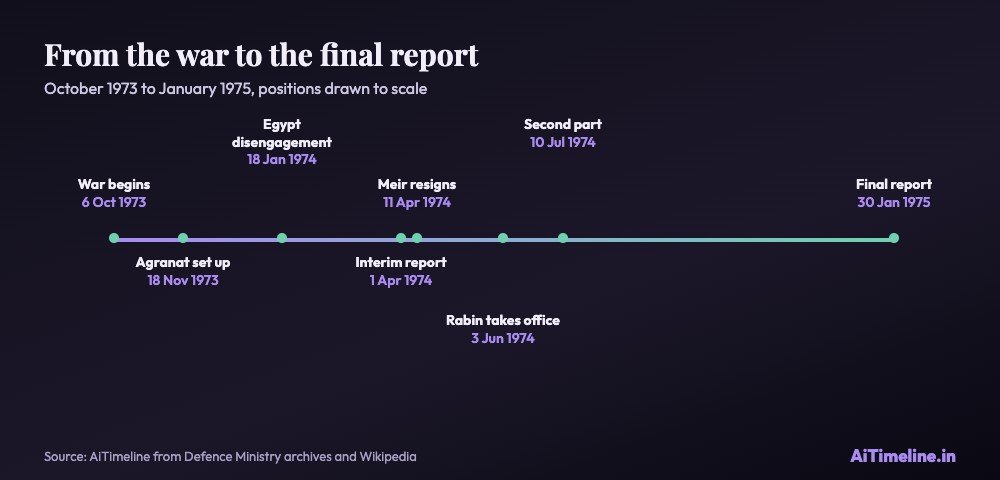
The commission published a second part on 10 July 1974 and presented its final report on 30 January 1975 (Wikipedia). Israel’s Defence Ministry archive says the final report ran to more than 1,500 pages and that only its introduction was made public (IDF and Defence Establishment Archives).
Most of the evidence therefore remained closed for decades, which is why later releases such as the 2018 communique drew so much attention.
Syria disengages and Rabin succeeds Meir Diplomacy
An Israel-Syria disengagement agreement ended fighting on the Golan front on 31 May 1974 (Wikipedia). Yitzhak Rabin succeeded Golda Meir as prime minister on 3 June 1974 (Wikipedia).
Golda Meir announces her resignation Inquiry
Golda Meir resigned as prime minister on 11 April 1974 (the Agranat interim report was nine days earlier; some accounts date the announcement to 10 April). She said: “Five years are sufficient … It is beyond my strength to continue carrying this burden” (Wikipedia). The commission had cleared her of direct responsibility for the early failures.
She was not found responsible by the commission, but public anger and the political fallout still ended her government.
The Agranat Commission publishes its interim findings Inquiry
The first report found that Chief of Staff David Elazar “bears personal responsibility for the assessment of the situation and the preparedness of the IDF” and recommended his removal; Elazar resigned straight after (Wikipedia). It recommended removing four military-intelligence officers: Maj. Gen. Eli Zeira, his deputy Brig. Aryeh Shalev, Lt. Col. Yona Bendman and Lt. Col. David Gedalia, as well as Southern Command chief Shmuel Gonen (Wikipedia).
The commission said it could not judge Defence Minister Moshe Dayan and, in the words quoted on Wikipedia, held that a minister who relies on his advisers “does not bear any personal responsibility.” That limit on its scope became a lasting part of the controversy.
Egypt and Israel agree on a disengagement of forces Diplomacy
An Egypt-Israel disengagement agreement was signed on 18 January 1974 and sporadic fighting on the Egyptian front ended (Wikipedia).
The US intelligence community publishes its post-mortem Inquiry
A preliminary US post-mortem concluded there had been an intelligence failure: analysts “did not perceive the growing possibility of an Arab attack or warn of its imminence,” although collection was adequate and the warning material was “plentiful, ominous, and often accurate,” if not conclusive (Office of the Historian). It blamed preconceptions about Arab weakness, a “cry wolf” effect and heavy reliance on Israeli assessments that were nearly unanimous that war was unlikely.
This is a separate American finding. It does not describe Israel’s internal intelligence process, which the Agranat Commission examined.
Israel appoints the Agranat Commission Inquiry
Israel’s government set up a commission of inquiry on 18 November 1973 to examine the intelligence on Egyptian and Syrian intentions, how it was analysed and the IDF’s readiness, especially on 5 October (IDF and Defence Establishment Archives). Wikipedia dates it 21 November; AiTimeline uses the ministry archive. The members were Chief Justice Shimon Agranat, Justice Moshe Landau, State Comptroller Yitzhak Nebenzahl and former chiefs of staff Yigael Yadin and Chaim Laskov (Wikipedia).
Egypt and Israel sign a ceasefire agreement at Kilometre 101 Diplomacy
Generals Aharon Yariv for Israel and Mohamed el-Gamasy for Egypt signed a six-point agreement at kilometre 101 on the Cairo-Suez road on 11 November 1973, covering supplies to the city of Suez, an exchange of prisoners and replacing Israeli checkpoints with UN ones (Jewish Virtual Library).
UN-backed ceasefires end the fighting Diplomacy
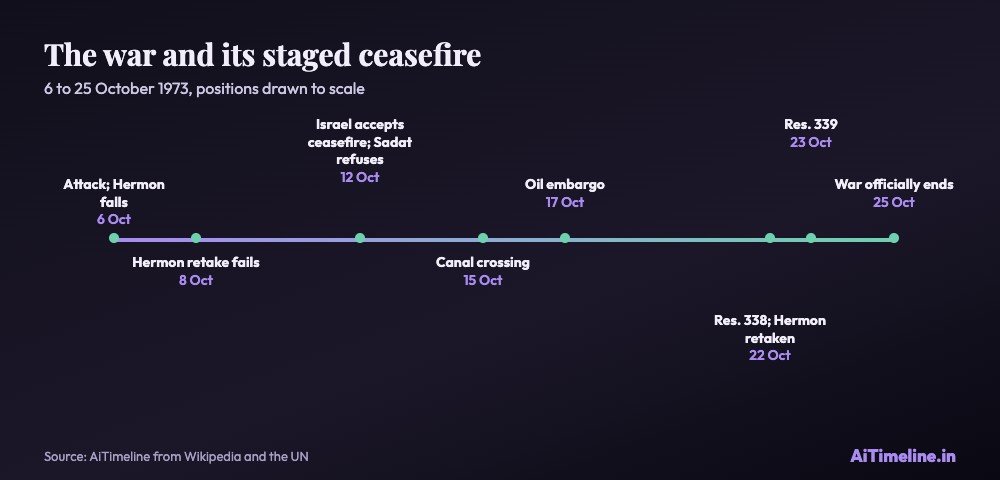
Security Council Resolution 338 was adopted on 22 October by 14–0 and the ceasefire was due to take effect at 6:52 pm Israeli time, but fighting continued. Resolution 339 followed on 23 October, adopted 14–0 with China not voting (Wikipedia). A fresh ceasefire on 24 October halted the Israeli advance toward Cairo, and a second on 25 October officially ended the conflict (Wikipedia). Golani and Sayeret Matkal commandos retook the Hermon outpost on 22 October.
The war began on 6 October; the ceasefire took effect in stages between 22 and 25 October, not on a single day.
Arab oil exporters announce an embargo Diplomacy
OAPEC announced an oil embargo and production cuts against countries backing Israel on 17 October 1973; some sources date the start to 16 October. It ended in March 1974, after the price of oil had risen close to threefold (Wikipedia). See AiTimeline’s OPEC timeline.
Israeli forces cross the Suez Canal The fighting
Israeli paratroopers crossed the Suez Canal on the night of 15 October, north of the Great Bitter Lake, in what Wikipedia calls Operation Gazelle, and the bridgehead on the west bank threatened Egyptian supply lines (Wikipedia).
Israel tries to retake Hermon and accepts a ceasefire in place The fighting
An Israeli attempt to retake the Hermon outpost on 8 October failed. On 12 October Israel accepted a ceasefire in place, and Sadat refused (Wikipedia).
Egypt and Syria attack on Yom Kippur The fighting
Operation Badr began at 14:00 with an air strike of more than 200 Egyptian aircraft, followed by a 53-minute artillery barrage. Egyptian infantry crossed the canal from 14:05 in twelve waves, about 32,000 men by 17:30 (Wikipedia). Syrian forces attacked on the Golan. Syrian paratroopers took the Israeli observation base on Mount Hermon around 17:00 on the first day, 6 October; the AiTimeline draft brief dated it 7 October.
The date fell on Yom Kippur and in Ramadan. Early Israeli losses showed the cost of limited warning and a partly mobilised army.
Meir, Dayan and Elazar decide how far to mobilise The fighting
At a meeting from 08:05 Chief of Staff Elazar proposed calling up the whole air force and four armoured divisions (100,000–120,000 troops); Dayan proposed the air force and two divisions (about 70,000). Meir chose Elazar’s plan and decided against a pre-emptive strike (Wikipedia). Elazar had wanted air strikes at 11:00 (Wikipedia). Meir told US Ambassador Kenneth Keating that morning that Israel had called up “some reserves” but not declared general mobilisation, and would not strike first (Office of the Historian).
Mobilisation takes hours. A system designed around days of warning received a few.
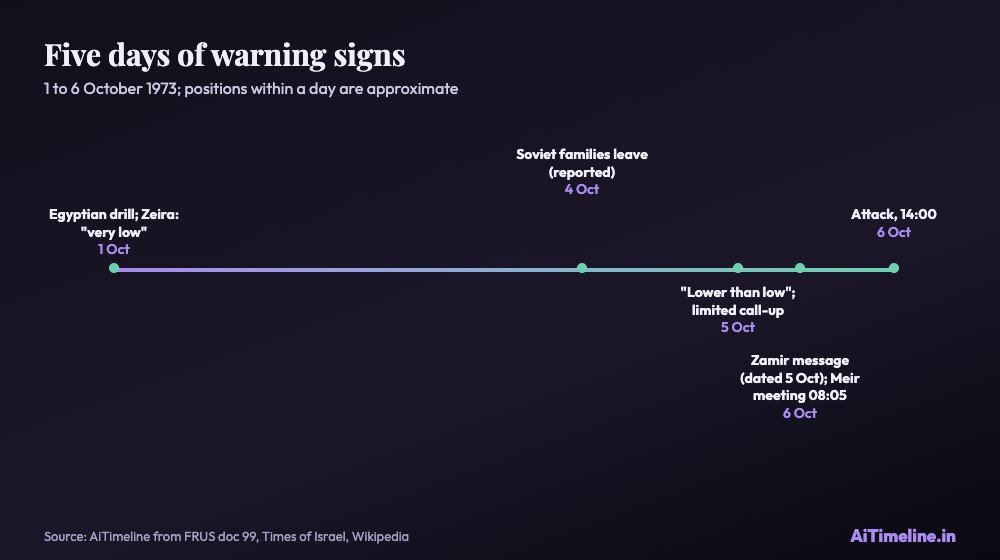
Zamir’s source warns of an imminent attack Warning signs
Ashraf Marwan, a confidant of Anwar Sadat, warned Mossad that Egypt and Syria would attack, and Zamir sent word to Israel. His communique is dated 5 October and says the attack would come on Saturday “at dusk” (The Times of Israel). Accounts differ on when the message reached Meir: Zamir said the military secretary held it about ten hours. Zeira argued Marwan could be a double agent; Bar-Joseph and others disagree (Wikipedia).
The brief’s “5 October” is the communique date; the warning reached decision-makers only in the early hours or morning of 6 October.
Military Intelligence rates war “lower than low” Warning signs
Transcripts from the General Staff meeting held the day before the war record Military Intelligence chief Eli Zeira putting the odds of a coordinated Egyptian-Syrian attack at “lower than low” (The Times of Israel). Elazar asked for a general reserve call-up; Dayan refused, and Elazar ordered a limited call-up from 5 October (Wikipedia). The US post-mortem found Israel “stayed relatively relaxed until the evening of October 5” (Office of the Historian).
The assessment mattered because it governed how much of the army was called up.
Soviet families leave Egypt and Syria Warning signs
A US memo of 6 October records that “as many as 1,000 Soviet dependents have left Egypt” and that Soviet advisers were also leaving Egypt and Syria (Office of the Historian). It gave two readings: a prelude to hostilities, or a Soviet-Arab rift with advisers being pulled out under cover of a war scare. US intelligence leaned toward the second.
The start date of 3–4 October comes from CIA material AiTimeline could not open; it is given as reported.
An Egyptian exercise passes with a “very low” rating Warning signs
After an Egyptian drill on 1 October, Zeira rated the threat of war “very low,” according to Wikipedia’s account of his record (Wikipedia). The US post-mortem found a “cry wolf” effect: repeated earlier alarms led analysts to discount most signs of hostile intent.
A State Department memo warns that war may come by autumn Warning signs
The US State Department’s Bureau of Intelligence and Research, in a memo from director Ray Cline written by Roger Merrick, judged a “better than even bet” that war would occur “by autumn,” with Sadat seeking to force diplomacy rather than win outright. Other US offices disagreed (National Security Archive). The post-mortem later said analysts “were examining events as they happened” and did not revisit that reasoning (Office of the Historian).
This is an American assessment, not an Israeli one, and not every US agency agreed with it.
The Six-Day War shapes a belief that Arab armies cannot win Warning signs
Israel captured Sinai and the Golan Heights in the Six-Day War (Wikipedia). Brookings argues the victory reinforced Israeli intelligence’s assumption that Arab states would not start a war they could not win (Brookings), and the CIA’s own review says analysts believed Arab military inferiority would discourage an attack (CIA).
What Caused the Yom Kippur War Intelligence Failure?
The problem was interpretation and timing, not a lack of information.
1. The Concept hardened into a rule. Israeli Military Intelligence held that Egypt would not go to war without the capabilities it lacked, in particular air power, and that Syria would not act without Egypt. Brookings calls the belief that Arab states would not start a war they could not win the main reason for the failure to warn, reinforced by the 1967 victory.
2. Analysts missed the political motive. Sadat wanted a limited war to break the stalemate. The CIA’s own review says analysis did not consider that leaders might go to war for political goals even at the risk of losing, and Brookings gives the same reading of Egypt’s aims.
3. Signals could be read two ways. The Soviet departures were read by US intelligence as a Soviet-Arab rift, and repeated earlier alarms produced a “cry wolf” effect, per the US post-mortem.
4. The best warning came late and was imprecise. Marwan’s message gave “dusk” for the attack, and Zamir said it was held for about ten hours before reaching Meir. Zeira doubted Marwan’s reliability.
5. Readiness assumed days of warning. Mobilisation takes hours; a partly called-up army met a two-front attack. The decision-makers disagreed on how large a call-up to order, and Meir chose the larger one only on the morning of 6 October.
Brookings’ recommendations, including outside challenge sessions and a coherent alternative hypothesis, are a useful reminder that assumptions cannot be avoided but can be made explicit. The same pattern appears in later security failures covered by AiTimeline, such as the 26/11 attacks and the 2001 Parliament attack.
The Warning Signs, Day by Day
From the May memo to the afternoon of 6 October.
| Date (1973) | Indicator or decision | Source |
|---|---|---|
| 31 May | US State Department INR: war by autumn a “better than even bet” | National Security Archive |
| 1 Oct | Egyptian exercise; Zeira rates war threat “very low” | Wikipedia (Zeira) |
| 3-4 Oct | Soviet dependents begin leaving Egypt and Syria (as reported) | US memo, 6 Oct |
| 5 Oct | General Staff meets; Zeira says odds “lower than low”; limited call-up begins | Times of Israel; Wikipedia (Elazar) |
| 5 Oct | Zamir communique: attack on 6 Oct “at dusk”, source puts chance at 99 percent | Times of Israel |
| 6 Oct, 08:05 | Meir, Dayan, Elazar meet; larger mobilisation chosen; no pre-emptive strike | Wikipedia |
| 6 Oct, 14:00 | Egypt and Syria attack | Wikipedia |
Israeli Intelligence Failure vs the US Intelligence Review
Two systems, two inquiries, different shortcomings.
| Israeli intelligence (Aman) | US intelligence community | |
|---|---|---|
| Core error | Relied on the Concept: Egypt would not attack without the capabilities it lacked; Syria not without Egypt | Discounted military indicators; assumed Arab military weakness after 1967 would deter war |
| Warnings available | Zamir’s source, troop and exercise reports, Soviet departures | Plentiful, “ominous, and often accurate” material, per its own post-mortem; INR memo of 31 May |
| Dissent | Zamir and Marwan’s warning did not change the assessment in time | INR (State) warned in May; NEA and other offices disagreed |
| Reliance on the other | Held the primary assessment | Relied heavily on Israeli assessments passed through liaison channels |
| Inquiry | Agranat Commission: reports of 1 Apr 1974, 10 Jul 1974, 30 Jan 1975 | Intelligence Community Staff post-mortem, 20 Dec 1973 |
| Outcome for people | Officers removed; Elazar resigned; Meir government fell | No equivalent dismissals found in the sources checked |
The two failures were linked but not identical. The US post-mortem says Israeli assessments passed through liaison channels were nearly unanimous that war was unlikely, and that this reinforced American analysts’ preconceptions. That is a US finding about reliance; it is not the Agranat Commission’s account of Israel’s own process. Nor did all US agencies agree: INR had warned on 31 May.
Who Was Held Responsible, and How?
The commission’s findings on the military and political leaders, kept apart.
| Person | Role in 1973 | What the record says |
|---|---|---|
| Eli Zeira | Head of Military Intelligence (Aman) | Rated war “very low” on 1 Oct and “lower than low” on 5 Oct; commission recommended removing him; left the IDF in 1974 |
| David Elazar | Chief of Staff | Report: bears personal responsibility for the assessment and preparedness; resigned after the 1 Apr 1974 report; died 15 Apr 1976 |
| Aryeh Shalev, Yona Bendman, David Gedalia | Deputy chief and two intelligence officers | Recommended for removal in the interim report |
| Shmuel Gonen | Southern Command chief | Recommended for removal in the interim report |
| Moshe Dayan | Defence Minister | Commission said it could not rule on his responsibility and held that a minister relying on advisers bears none |
| Golda Meir | Prime Minister | Cleared of direct responsibility; announced resignation 11 Apr 1974 |
| Zvi Zamir | Mossad chief | Relayed Marwan’s warning; later accused Zeira of leaking Marwan’s identity (2004) |
The War and the Ceasefire, in Stages
The war began on 6 October; no single date ended it.
| Date (1973) | Stage | Detail |
|---|---|---|
| 6 Oct | Attack | Badr begins at 14:00; Hermon outpost falls about 17:00 |
| 8 Oct | Counter-attack | Israeli attempt to retake Hermon fails |
| 12 Oct | First ceasefire offer | Israel accepts a ceasefire in place; Sadat refuses |
| 15-16 Oct | Canal crossing | Paratroopers cross north of the Great Bitter Lake |
| 17 Oct | Embargo | OAPEC announces oil embargo |
| 22 Oct | Resolution 338 | Adopted 14-0; ceasefire due 6:52 pm; Hermon retaken |
| 23 Oct | Resolution 339 | Adopted 14-0, China not voting |
| 24-25 Oct | Ceasefires hold | Israeli advance toward Cairo halted; war officially ends 25 Oct |
| 11 Nov | Km 101 agreement | First Egypt-Israel agreement since 1949 |
What Changed After the Yom Kippur War?
An inquiry with consequences. The Agranat Commission recommended removing the chief of staff, the head of Military Intelligence and other officers, and its work, along with public anger, helped end Meir’s government.
More challenge inside the system. Brookings notes that Mossad and the Foreign Ministry received added analytic responsibilities after the war; AiTimeline did not independently verify other reforms.
A new diplomatic phase. The Km 101 agreement, the January 1974 disengagement and Camp David followed. See also the Abraham Accords and the OPEC timeline for later consequences.
The Story at a Glance
Dates from the sources listed below.
| Date | Event | Detail |
|---|---|---|
| 5-10 Jun 1967 | Six-Day War | Israel takes Sinai and the Golan |
| 31 May 1973 | INR memo | War by autumn a better-than-even bet |
| 5 Oct 1973 | General Staff meeting | Odds “lower than low” |
| 6 Oct 1973 | Attack | About 14:00; Hermon falls about 17:00 |
| 15-16 Oct 1973 | Suez crossing | West-bank bridgehead |
| 22-25 Oct 1973 | Ceasefires | Resolutions 338 and 339 |
| 11 Nov 1973 | Km 101 agreement | Egypt and Israel |
| 18 Nov 1973 | Agranat Commission set up | Wikipedia says 21 Nov |
| 20 Dec 1973 | US post-mortem | Separate American finding |
| 1 Apr 1974 | Interim report | Elazar and four intelligence officers |
| 11 Apr 1974 | Meir resigns | Some accounts say 10 Apr |
| 30 Jan 1975 | Final report | Only the introduction public |
| 26 Mar 1979 | Peace treaty | After Camp David |
The Lasting Legacy of the 1973 Surprise
The war remains a standard case study in how an intelligence system can have information and still misjudge. The lesson is not that warnings should always be believed, but that confident assumptions should be tested, alternative explanations kept alive and readiness tied to risk rather than certainty. The same logic appears in the Cold War crisis told in the Cuban Missile Crisis timeline and in the shipping lane that the war reopened, Suez and the Red Sea chokepoints. AiTimeline has no standalone stories yet on the Six-Day War or the Camp David Accords; the nearest related reading is the Middle East tensions timeline.
| Term | Meaning | Why it matters here |
|---|---|---|
| The Concept | Israeli assumption that Egypt would not attack without certain capabilities and Syria not without Egypt | Shaped how warning signs were read |
| Aman | Israel’s military intelligence directorate | Headed by Eli Zeira in 1973 |
| Mossad | Israel’s external intelligence service | Zvi Zamir relayed the 5-6 October warning |
| Agranat Commission | State commission of inquiry | Examined intelligence and readiness |
| INR | US State Department Bureau of Intelligence and Research | Wrote the 31 May 1973 warning |
| Pre-emptive strike | Striking first on expected attack | Rejected by Meir on 6 Oct |
| Mobilisation | Calling up reserve forces | Takes hours; Israel’s army relied on days of warning |
| Disengagement | Agreed pullback of forces | Egypt: 18 Jan 1974; Syria: 31 May 1974 |
Who Is Who in the Story
Golda Meir
Chose the larger mobilisation on 6 October and rejected a pre-emptive strike; resigned in April 1974.
Moshe Dayan
Opposed a general call-up and the pre-emptive strike; the commission made no ruling on him.
David Elazar
Wanted a general call-up and air strikes; held responsible for assessment and preparedness; resigned in 1974.
Eli Zeira
Held to the Concept; rated war “lower than low” on 5 October.
Zvi Zamir
Relayed the final warning from Ashraf Marwan.
Ashraf Marwan
Sadat confidant; his role is disputed; died in London in 2007.
Anwar Sadat
Planned a limited war to break the stalemate; later signed the 1979 treaty.
Shimon Agranat
Chief Justice who chaired the national commission of inquiry.
The Popular Story vs the Record
| Popular version | What the record shows |
|---|---|
| Israel had no warning at all | Several indicators existed, including a high-level warning on 5-6 October. The failure was in how they were weighed and how late the clearest one arrived |
| The US and Israel failed in the same way | Both missed the attack, but the US post-mortem stressed analysts’ preconceptions and reliance on Israeli views; Israel’s failure centred on the Concept and decisions on readiness |
| Every US agency dismissed the risk | State’s INR warned on 31 May 1973 that war by autumn was a better-than-even bet, though other offices disagreed |
| Marwan was certainly a loyal Israeli agent | Zeira thought he might be a double agent; Bar-Joseph and others disagree; a reported 2025 investigation points the other way again. The matter is disputed |
| The Agranat Commission blamed Golda Meir | It cleared her of direct responsibility. She resigned on 11 April 1974 after the political fallout |
| The ceasefire came on one date | Ceasefires were adopted on 22 and 23 October, took hold on 24 and 25 October, and the Km 101 agreement followed on 11 November |
| Casualty totals are settled | Estimates differ by source and by whose losses are counted; a single figure should not be quoted without its source |
Explore More Timelines
People Also Ask
Frequently Asked Questions
Sources and Further Reading
- US Office of the Historian: Preliminary post-mortem on intelligence before the 6 Oct 1973 war, 20 Dec 1973 (FRUS 1969-76 XXV, doc 412)
- US Office of the Historian: Memorandum, Quandt to Scowcroft, 6 Oct 1973 (FRUS doc 99)
- National Security Archive: US State Department intelligence warning, May 1973
- IDF and Defence Establishment Archives: The Agranat Commission
- The Times of Israel: Declassified papers highlight intel failures in Yom Kippur War, 17 Sep 2018
- Brookings: The fog of certainty, learning from the intelligence failures of the 1973 war
- CIA: President Nixon and the role of intelligence in the 1973 Arab-Israeli War
- Jewish Virtual Library: The six-point agreement, November 1973
- Wikipedia: Yom Kippur War
- Wikipedia: Agranat Commission
- Wikipedia: Ashraf Marwan
- Wikipedia: Eli Zeira
- Wikipedia: David Elazar
- Wikipedia: Golda Meir
- Wikipedia: UN Security Council Resolution 339
- Wikipedia: 1973 oil crisis
- Wikipedia: Six-Day War
- Wikipedia: Camp David Accords
- Wikipedia: Egypt-Israel peace treaty
Related AiTimeline Stories
⚠️ Editorial Note
Last updated 22 October 2026. This page separates Israeli intelligence from the US intelligence review, and intelligence assessments from confirmed events. The war began on 6 October 1973; ceasefires were adopted on 22 and 23 October and took hold on 24–25 October. Corrections to the draft brief: Syrian forces took the Hermon outpost on 6 October, not 7 October; Marwan’s communique is dated 5 October but reached decision-makers around the early hours or morning of 6 October, and sources differ; the Agranat Commission was appointed on 18 November 1973 per the Defence Ministry archive (Wikipedia says 21 November); Meir’s resignation is dated 11 April 1974 on Wikipedia, with some accounts saying 10 April; the interim report did not rule on Dayan and cleared Meir of direct responsibility; the “1975” entry is the final report of 30 January 1975, only its introduction being public. Added: the 1 October exercise, the 5 October General Staff meeting, the 6 October mobilisation meeting, the US post-mortem, the Km 101 agreement, the OAPEC embargo and the 2018 documents release. Not independently verified: the start date of the Soviet departures (3–4 October, from CIA material we could not open); the 2025 investigation of Marwan, known to us only through Wikipedia; Zeira’s dismissal versus resignation (accounts differ); casualty totals, which vary widely by source. AiTimeline has no existing stories on the Six-Day War, the Arab-Israeli conflict as a whole or the Camp David Accords, so none are linked. This is not legal or military advice. Verify before republishing.
Sources & further reading
Every dated entry above was checked against these references. Last reviewed 22 October 2026.
- US Office of the Historian: Preliminary post-mortem on intelligence before the 6 Oct 1973 war, 20 Dec 1973 (FRUS 1969-76 XXV, doc 412)
- US Office of the Historian: Memorandum, Quandt to Scowcroft, 6 Oct 1973 (FRUS doc 99)
- National Security Archive: US State Department intelligence warning, May 1973
- IDF and Defence Establishment Archives: The Agranat Commission
- The Times of Israel: Declassified papers highlight intel failures in Yom Kippur War, 17 Sep 2018
- Brookings: The fog of certainty, learning from the intelligence failures of the 1973 war
- CIA: President Nixon and the role of intelligence in the 1973 Arab-Israeli War
- Jewish Virtual Library: The six-point agreement, November 1973
- Wikipedia: Yom Kippur War
- Wikipedia: Agranat Commission
- Wikipedia: Ashraf Marwan
- Wikipedia: Eli Zeira
- Wikipedia: David Elazar
- Wikipedia: Golda Meir
- Wikipedia: UN Security Council Resolution 339
- Wikipedia: 1973 oil crisis
- Wikipedia: Six-Day War
- Wikipedia: Camp David Accords
- Wikipedia: Egypt-Israel peace treaty