Satyam Accounting Fraud: Timeline, Impact, and Legacy in India
Satyam accounting fraud timeline: the Maytas deal, Raju's 7 January 2009 confession, Tech Mahindra rescue, 2015 convictions and SEBI and PwC cases.
Latest Story
The Satyam accounting fraud began to unravel on 16 December 2008, when the board of Satyam Computer Services approved a $1.6 billion purchase of two companies tied to its founder’s family and reversed within a day under investor pressure. On 7 January 2009 chairman B. Ramalinga Raju wrote to the board that the accounts had been falsified. The scandal led to a government takeover of the board, a rescue by Tech Mahindra, criminal convictions in 2015 and a set of regulatory, auditor and tax cases that were still being argued in 2025. It is often compared with the Enron scandal; for other Indian accountability cases see the 2G spectrum scam, the Harshad Mehta scam and the Mundhra scandal.
💡 Short Answer
Satyam’s chairman admitted on 7 January 2009 that the company’s balance sheet carried ₹5,040 crore of cash that did not exist, among other falsifications. Tech Mahindra bought control on 13 April 2009. Raju and nine others were convicted on 9 April 2015. SEBI’s disgorgement order of 30 November 2023 and its appeal against the PwC ruling still depend on the Supreme Court.
Satyam Scam: Key Questions
The Satyam Fraud in Ten Points
- The warning: the Maytas deal was approved on 16 December 2008 and withdrawn on 17 December.
- The letter: ₹5,040 crore of the ₹5,361 crore cash on the books did not exist.
- The total: the letter states none; the four items sum to ₹7,136 crore.
- The rescue: the Government replaced the board and Tech Mahindra won the auction on 13 April 2009.
- The denial: in July 2010 Raju’s lawyers said he never wrote the letter.
- The verdict: 10 convicted on 9 April 2015; sentences suspended on 11 May 2015.
- The auditors: US penalties in 2011 and ICAI removal, but SEBI’s bar was quashed in 2019.
- The money: SEBI’s 2023 order computes ₹624.1 crore and takes effect only as the Supreme Court directs.
- The tax: the Telangana High Court ordered fresh assessments on 31 January 2025.
- Separate tracks: criminal, SEBI, auditor and tax outcomes should never be merged into one.
Satyam Accounting Fraud Timeline, Latest First
Each entry is tagged by thread and ends with why it matters. Use the filter to isolate the fraud, the rescue, the criminal case or the regulators.
Fraud, rescue, criminal case or regulators? Filter the Satyam timeline by thread.
–
Telangana High Court sets aside the tax department’s refusal to recompute Satyam’s income Regulators, auditors and tax
In Satyam Computer Services Ltd. v. Central Board of Direct Taxes, a bench of Justices P. Sam Koshy and N. Tukaramji allowed Satyam’s writ petitions against the CBDT’s 11 July 2011 rejection of its request to recompute income for assessment years 2003-04 to 2008-09, because that income included fictitious sales and interest (Indian Kanoon). The court declared the assessment orders for those years void, directed fresh assessments based on revised financial statements for the year to 31 March 2009, and barred recovery until the recomputation is done. It preserved the Revenue’s right to start proceedings afterwards.
Correction to the draft brief: the court is the Telangana High Court at Hyderabad, not the Andhra Pradesh High Court. AiTimeline did not check whether the ruling has been appealed.
SEBI re-decides the disgorgement and restraint against the Raju family and executives Regulators, auditors and tax
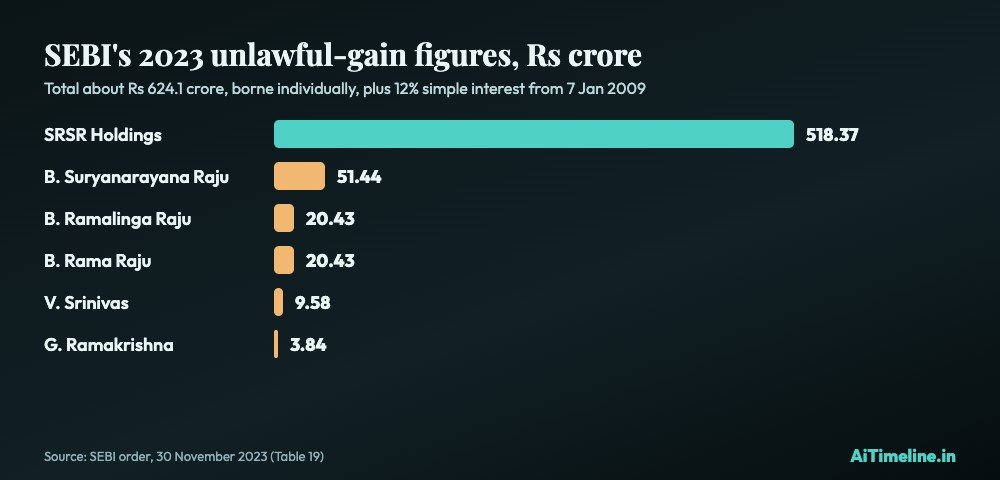
On remand from the Securities Appellate Tribunal, SEBI whole-time member Ananth Narayan G. computed unlawful gains of about ₹624.1 crore across six noticees using an “intrinsic value” method: SRSR Holdings ₹518.37 crore, B. Suryanarayana Raju ₹51.44 crore, B. Ramalinga Raju and B. Rama Raju ₹20.43 crore each, V. Srinivas ₹9.58 crore and G. Ramakrishna ₹3.84 crore. Each pays individually, with 12% simple interest from 7 January 2009 (SEBI order).
The two Raju brothers are restrained from the securities market until 14 July 2028; the other four get no fresh restraint. The order says it takes effect only from the date the Supreme Court directs, because appeals against the earlier SAT orders are pending there.
The Securities Appellate Tribunal sends SEBI’s 2018 orders back Regulators, auditors and tax
SAT set aside SEBI’s 2 November 2018 orders, which had imposed 14-year restraints and disgorgement on the Raju brothers, Suryanarayana Raju and SRSR Holdings. It held that no reasons were given for choosing 14 years and that the gains had to be calculated individually, not jointly (LiveLaw; Bar and Bench). It told SEBI to decide again.
SEBI’s later order records that SAT directed the unlawful gain “to be borne individually” (SEBI order). Bar and Bench reports that the Supreme Court told SEBI to decide afresh but not to give effect to the result without its permission.
The Supreme Court issues notice on SEBI’s appeal against SAT’s PwC ruling Regulators, auditors and tax
SEBI appealed SAT’s September 2019 order. The Supreme Court issued notice and stayed the part of SAT’s ruling that held SEBI had no power to bar auditors (Business Standard; LiveLaw, 22 Nov 2019). It did not itself reinstate the two-year ban.
Status check (22 October 2026): AiTimeline searched for a later Supreme Court judgment or withdrawal and found none. Treat the appeal as unresolved unless the Supreme Court’s case-status portal shows otherwise.
SAT quashes SEBI’s two-year bar on the Price Waterhouse firms Regulators, auditors and tax
SAT set aside SEBI’s January 2018 order restraining specified Price Waterhouse firms from auditing listed companies for two years. It held that SEBI could not take that action against auditors, calling the measure “remedial and not punitive,” but it upheld the direction to give up about ₹13 crore in audit fees (SCC Online; LiveLaw).
SEBI re-issues its orders on remand Regulators, auditors and tax
After the SAT remands of 2017, SEBI’s order of 16 October 2018 restrained V. Srinivas and G. Ramakrishna for seven years and quantified their disgorgement at ₹15.66 crore and ₹11.5 crore. Its order of 2 November 2018 restrained the Raju brothers, Suryanarayana Raju and SRSR Holdings for 14 years and set disgorgement at ₹26.63 crore, ₹29.54 crore, ₹81.84 crore and ₹675.39 crore respectively (SEBI order, para 10-12). Both orders said they would take effect only as the Supreme Court directed.
2018
The National Financial Reporting Authority is constituted Rescue and reform
The Government constituted the NFRA on 1 October 2018 under section 132 of the Companies Act, 2013, as an independent body for accounting and auditing standards and oversight (NFRA). Satyam was one of several cases that fed the debate on audit regulation; it was not the only influence on the 2013 Act or on the NFRA.
The Supreme Court upholds the finding against SRSR Holdings and Suryanarayana Raju Regulators, auditors and tax
Hearing appeals against SAT’s second order, the Supreme Court exonerated all appellants except SRSR Holdings and B. Suryanarayana Raju, and agreed with SAT on those two. About Suryanarayana Raju it said the SFIO report and the CBI court judgment “clearly and unmistakably point to his complicity” (quoted in SEBI’s 2023 order). The court said SRSR was a front entity used to offload shares.
SEBI bars Price Waterhouse firms from auditing listed companies for two years Regulators, auditors and tax
SEBI restrained specified Price Waterhouse firms (practising under the PwC brand) from issuing audit certificates for listed companies for two years and ordered disgorgement of audit fees of ₹13.09 crore with interest at 12% a year (LiveLaw; Wikipedia reports 11 January). SEBI had found the audit failed to detect the fraud.
The bar is often described as a settled ban. It was not: SAT quashed it in September 2019.
SAT upholds SEBI’s findings but remands the Raju family orders Regulators, auditors and tax
SAT’s first order (12 May 2017) upheld SEBI’s findings against the Raju brothers, Srinivas and Ramakrishna but sent back the period of restraint and the amounts, saying 14 years could not be imposed uniformly without reasons. Its second order (11 August 2017) did the same for Suryanarayana Raju and SRSR Holdings (SEBI order, para 5-6).
SEBI orders the Raju relatives and SRSR Holdings to disgorge Regulators, auditors and tax
SEBI’s second order (10 September 2015) directed relatives and associates, including B. Suryanarayana Raju and SRSR Holdings, to disgorge unlawful gains and restrained them for seven years. It made the two Raju brothers jointly and severally liable for those gains (SEBI order, para 3).
A sessions court suspends the sentences and grants bail Criminal case
On 21 April 2015 the Metropolitan Sessions Court had held the convicts’ appeal not maintainable and the accused remained in Cherlapally prison (The News Minute). On 11 May 2015 the same court suspended the seven-year sentences of Raju and nine others and granted bail on personal bonds, on condition they cooperate for early disposal of their appeals (Business Today).
AiTimeline did not find a reported final decision on the appeals. The sentences should be described as convictions under appeal, with sentence suspended.
Ramalinga Raju and nine others are convicted Criminal case
A special CBI court in Hyderabad convicted B. Ramalinga Raju, B. Rama Raju and eight others and sentenced each to seven years’ rigorous imprisonment (Business Standard; ICAI). The two brothers were also fined; reports give ₹5 crore and ₹5.5 crore each, so the exact figure is unconfirmed here.
It was the first criminal judgment in the case, six years and three months after the letter.
SEBI’s first order: 14-year restraint and disgorgement Regulators, auditors and tax
SEBI restrained B. Ramalinga Raju, B. Rama Raju, V. Srinivas and G. Ramakrishna from the securities market for 14 years and ordered disgorgement with 12% simple interest from 7 January 2009: ₹543.93 crore from share sales and ₹1,258.88 crore from pledges for the two brothers, ₹29.5 crore for Srinivas and ₹11.5 crore for Ramakrishna (SEBI order, para 2).
ICAI’s disciplinary proceedings against the auditors reach finality Regulators, auditors and tax
ICAI began disciplinary proceedings in January 2009. They finished in October 2010 in all cases but one and reached finality in October 2013. Its press release says the Disciplinary Committee found the audit partners S. Gopalakrishnan and S. Talluri, two audit in-charges, former CFO V. Srinivasu and the internal-audit head V. S. Prabhakara Gupta guilty of professional misconduct and removed them permanently from the register of members with a fine of ₹5 lakh each (ICAI press release, 9 Apr 2015).
Mahindra Satyam is merged into Tech Mahindra Rescue and reform
Tech Mahindra announced the merger with Mahindra Satyam on 21 March 2012 and it was legally completed on 25 June 2013 (Wikipedia). The company had been renamed Mahindra Satyam in July 2009.
The SEC and PCAOB penalise the PwC India firms Regulators, auditors and tax
The US SEC charged five India-based PwC affiliates for deficient audits of Satyam and obtained $6 million, which it described as the largest ever paid by a foreign-based accounting firm in an SEC action. It found staff did not confirm cash, cash equivalents or receivables, and that this “resulted in the fraud at Satyam going undetected.” The PCAOB separately fined Lovelock & Lewes and Price Waterhouse Bangalore $1.5 million combined (SEC press release 2011-82).
Raju’s lawyers say he never wrote the confession letter Criminal case
The CBI charged that Raju sent the letter on 7 January 2009. In July 2010 his lawyers told the court he had not written it, and the defence called it a hoax; they also argued separate teams handled the accounts (The News Minute). The 2015 conviction followed a full trial.
Tech Mahindra wins the auction for Satyam Rescue and reform
Tech Mahindra, through a subsidiary, won the public auction on 13 April 2009 and bought a 31% controlling stake (Wikipedia). On 22 April it made the public announcement of an open offer at ₹58 a share, when the market price was ₹46.9 (SEBI order, annex).
Correction to the draft brief: the bid was won on 13 April; 22 April is the open-offer announcement.
The Government replaces the board and agencies open their investigations Rescue and reform
On a Government petition the Company Law Board suspended Satyam’s board. The Government nominated Deepak Parekh, Kiran Karnik and C. Achuthan on 11 January, and by 24 February told the Rajya Sabha that six new directors had been appointed. The SFIO, CBI, SEBI, ICAI and the income-tax authorities were all investigating (Ministry of Corporate Affairs, PIB; Wikipedia). NSE removed Satyam from the Nifty 50 on 12 January, and on 14 January Price Waterhouse said its audit reports might be “inaccurate and unreliable.”
2009
Raju is arrested and the shares collapse Criminal case
Andhra Pradesh police arrested B. Ramalinga Raju on 9 January 2009; reports say his brother Rama Raju was taken into custody around the same time. The shares fell to ₹6.30, their lowest since March 1998, from a 2008 high of ₹544 (Wikipedia; Rediff chronology).
2009
Raju tells the board the accounts were false Fraud and confession
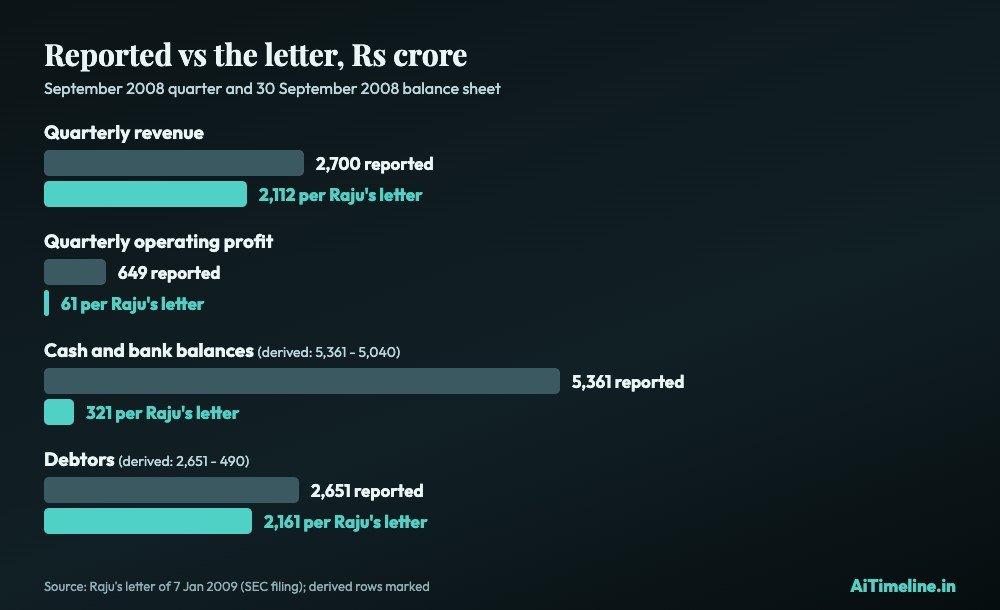
In a letter to Satyam’s board that the company filed with the US SEC, B. Ramalinga Raju said the 30 September 2008 balance sheet carried inflated cash and bank balances of ₹5,040 crore (the books showed ₹5,361 crore), non-existent accrued interest of ₹376 crore, liabilities understated by ₹1,230 crore and debtors overstated by ₹490 crore. For the September 2008 quarter he gave actual revenue of ₹2,112 crore against ₹2,700 crore reported, and operating profit of ₹61 crore (3% margin) against ₹649 crore (24%). He called Maytas “the last attempt to fill the fictitious assets with real ones” and wrote: “It was like riding a tiger, not knowing how to get off without being eaten” (letter as filed with the SEC).
On the “₹7,000 crore” figure: the letter states no total. The four balance-sheet items sum to ₹7,136 crore, which press reports round to ₹7,000 crore. The items are not all the same kind of error, and the figure is not an amount stolen.
Satyam proposes to buy two Maytas companies and reverses within a day Fraud and confession
On 16 December 2008 Satyam’s board approved buying Maytas Infra and Maytas Properties, companies linked to the founder’s family, in a deal reported at about $1.6 billion. Investors objected and the plan was scrapped on 17 December (Business Standard; Rediff chronology). Raju’s January letter called it a last attempt to turn fictitious assets into real ones.
Satyam receives a Golden Peacock award for corporate governance Fraud and confession
Satyam was given the 2008 Golden Peacock Global Award for Excellence in Corporate Governance on 23 September 2008. After the confession the jury withdrew it, according to a report of 8 January 2009 (reproduced on a forum; AiTimeline did not find the original).
SEBI says the manipulation of the books began Fraud and confession
SEBI’s investigation found that Raju, Rama Raju, Srinivas, Ramakrishna and the head of internal audit V. S. Prabhakara Gupta had, since January 2001, colluded in overstating and falsifying the books of account and financial statements (SEBI order, para 1). This is SEBI’s allegation as recorded in its order and as upheld by SAT on the violation findings; it is not the same as the criminal judgment.
Five Moments That Define the Case
Tap a moment for the date and a short explanation.
Tap a moment to see the date and what happened.
Choose a moment above.
How the Satyam Accounting Fraud Worked
What the letter said, in one table.
| Item (30 Sep 2008 / Sep 2008 quarter) | As reported | Per Raju’s letter | Gap |
|---|---|---|---|
| Quarterly revenue | ₹2,700 crore | ₹2,112 crore | ₹588 crore |
| Quarterly operating profit | ₹649 crore (24%) | ₹61 crore (3%) | ₹588 crore |
| Cash and bank balances | ₹5,361 crore | About ₹321 crore (derived) | ₹5,040 crore inflated |
| Accrued interest | ₹376 crore | Non-existent | ₹376 crore |
| Debtors | ₹2,651 crore | About ₹2,161 crore (derived) | ₹490 crore overstated |
| Liabilities | Understated | Funds arranged by Raju | ₹1,230 crore understated |
The false figures made Satyam look stronger than it was. By SEBI’s account the manipulation ran from January 2001 and involved the chairman, his brother the managing director, the chief financial officer, a finance vice president and the head of internal audit (SEBI order). Raju’s letter says the gap grew until it could no longer be hidden, and that he saw the Maytas purchase as a way to replace fictitious assets with real ones.
Warning signs for investors (general lessons, not proof of fraud at any other company): cash and bank balances that cannot be reconciled; large related-party deals with insiders’ firms; boards that approve them unanimously; reliance on awards and reputation; and audits that do not obtain independent confirmation of cash and receivables, which is what the SEC said went wrong at the PwC India firms.
Where Each Satyam Case Stands
As verified on 22 October 2026. A “not found” means AiTimeline could not find a report, not that nothing happened.
| Track | Body | Latest outcome AiTimeline verified | Final? |
|---|---|---|---|
| Criminal trial | Special CBI court, Hyderabad | 10 convicted, 9 Apr 2015; sentences suspended 11 May 2015 | Appeal outcome not found |
| Securities market, Raju family and executives | SEBI, SAT, Supreme Court | SEBI order 30 Nov 2023; takes effect only as Supreme Court directs | No: appeals pending per the order |
| Securities market, PwC firms | SEBI, SAT, Supreme Court | SAT quashed the bar 9 Sep 2019; Supreme Court stayed SAT’s finding on SEBI’s power, Nov 2019 | No final judgment found |
| US regulators, PwC India | SEC, PCAOB | $6 million and $1.5 million, 5 Apr 2011 | Yes (settled) |
| Professional discipline | ICAI | Members removed from the register permanently; final Oct 2013 | Yes |
| Income tax | Telangana High Court | CBDT order set aside; fresh assessments, 31 Jan 2025 | Appeal status not checked |
| Rescue of the business | Government, Company Law Board | Tech Mahindra bought control, Apr 2009; merger completed 25 Jun 2013 | Yes |
SEBI’s Orders, Order by Order
How the same case produced five sets of numbers.
| Date | SEBI order | Who | Restraint | Disgorgement (with 12% simple interest from 7 Jan 2009) |
|---|---|---|---|---|
| 15 Jul 2014 | First order | Ramalinga Raju, Rama Raju, Srinivas, Ramakrishna | 14 years | ₹543.93 crore (sales) + ₹1,258.88 crore (pledges) for the brothers; ₹29.5 crore; ₹11.5 crore |
| 10 Sep 2015 | Second order | Relatives and associates incl. Suryanarayana Raju, SRSR Holdings | 7 years | Quantified per person; brothers jointly liable |
| 16 Oct 2018 | Third order (remand) | Srinivas, Ramakrishna | 7 years | ₹15.66 crore; ₹11.5 crore |
| 2 Nov 2018 | Fourth order (remand) | Brothers, Suryanarayana Raju, SRSR | 14 years | ₹26.63 crore; ₹29.54 crore; ₹81.84 crore; ₹675.39 crore |
| 30 Nov 2023 | Order after SAT remand | All six noticees | Brothers until 14 Jul 2028 | ₹624.1 crore in total; effective only as the Supreme Court directs |
The Impact of the Satyam Scam on India
Investors. The shares fell to ₹6.30 on 9 January 2009 from a 2008 high of ₹544, and Satyam was dropped from the Nifty 50 on 12 January.
Employees and clients. The Government replaced the board and arranged a sale so the business could keep operating. The CID told a court in January 2009 that headcount was about 40,000 against 53,000 reported, an allegation as reported by Wikipedia.
Auditors. The audit firm faced US penalties, a bar in India that was later quashed, and ICAI discipline against named partners. These outcomes differ and should not be merged.
Regulators. SEBI’s orders were sent back by SAT more than once, which shows how hard it is to compute and recover gains years after the event.
The Legacy: What Changed After Satyam?
Companies Act, 2013 and NFRA. Section 132 of the Companies Act, 2013 provided for the National Financial Reporting Authority, which was constituted on 1 October 2018 (NFRA). Satyam was one input into the debate on audit committees, independent directors and auditor independence, alongside other cases and a wider legislative process.
Better questions for boards. Directors and audit committees must ask whether reported cash, revenue and profit can be independently verified, and challenge related-party transactions.
Accountability takes time. More than 17 years after the confession, civil, regulatory and tax questions remain open. For another large accounting collapse see the Enron timeline, and for a banking-sector view see the Indian bad loans crisis.
The Story at a Glance
Dates from the sources listed below.
| Date | Event | Detail |
|---|---|---|
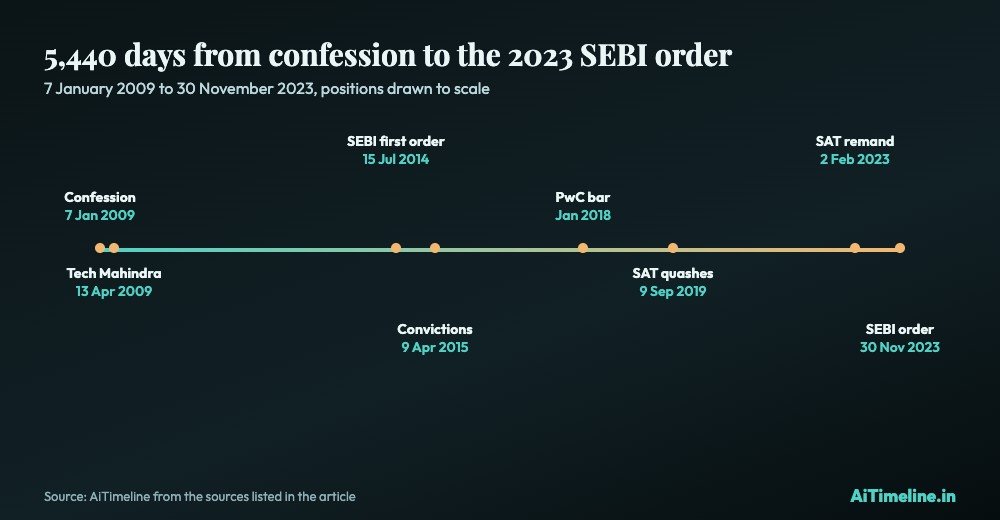
| Jan 2001 | SEBI says manipulation began | Per its investigation |
| 23 Sep 2008 | Golden Peacock governance award | Withdrawn after the confession |
| 16-17 Dec 2008 | Maytas deal approved, then withdrawn | About $1.6 billion |
| 7 Jan 2009 | Raju’s letter | Cash ₹5,040 crore inflated |
| 9 Jan 2009 | Raju arrested | Shares at ₹6.30 |
| 13 Apr 2009 | Tech Mahindra wins auction | 31% stake; ₹58 open offer 22 Apr |
| 5 Apr 2011 | SEC and PCAOB penalise PwC India | $6 million + $1.5 million |
| 15 Jul 2014 | SEBI first order | 14-year restraint |
| 9 Apr 2015 | Raju and nine others convicted | Seven years each |
| Jan 2018 | SEBI bars Price Waterhouse firms | Quashed by SAT, 9 Sep 2019 |
| 2 Feb 2023 | SAT remands SEBI’s 2018 orders | Individual calculation |
| 30 Nov 2023 | SEBI order | ₹624.1 crore; effective as Supreme Court directs |
| 31 Jan 2025 | Telangana High Court tax ruling | Fresh assessments |
| Term | Meaning | Why it matters here |
|---|---|---|
| Disgorgement | Giving up unlawful gains | The money SEBI says the accused must repay, with 12% simple interest from 7 Jan 2009 |
| Restraint | A bar on dealing in securities | The Raju brothers are barred until 14 Jul 2028 under the 2023 order |
| Remand | A higher forum sends a matter back | SAT sent SEBI’s orders back in 2017 and 2023 to fix reasons and arithmetic |
| SAT | Securities Appellate Tribunal | Hears appeals from SEBI; quashed the PwC bar in Sep 2019 |
| Intrinsic value method | Stripping out the fraud-inflated part of the sale price | SEBI used 23.25% (58/249.5) in 2023 |
| SRSR Holdings | Holding company of the Raju family | Held and pledged the family’s Satyam shares |
| Related-party transaction | A deal with a company linked to insiders | The Maytas acquisition was one |
| NFRA | National Financial Reporting Authority | Audit regulator constituted 1 Oct 2018 |
Who Is Who in the Story
B. Ramalinga Raju
Wrote the 7 January 2009 letter, resigned and was arrested on 9 January; convicted on 9 April 2015 with sentence suspended from May 2015.
B. Rama Raju
Raju’s brother; convicted in 2015 and restrained by SEBI until 14 July 2028.
Vadlamani Srinivas
Named by SEBI with Raju; restrained for seven years and ordered to disgorge ₹9.58 crore in 2023.
G. Ramakrishna
Named by SEBI; seven-year restraint; ₹3.84 crore in the 2023 computation.
B. Suryanarayana Raju
The Supreme Court in 2018 cited the SFIO report and CBI judgment as pointing to his complicity.
S. Gopalakrishnan and S. Talluri
Removed permanently from ICAI’s register of members after disciplinary proceedings that ended in 2013.
Deepak Parekh
Named on 11 January 2009 with Kiran Karnik and C. Achuthan to the new board.
Tech Mahindra
Won the auction on 13 April 2009 and absorbed Mahindra Satyam in 2013.
The Popular Story vs the Record
| Popular version | What the record shows |
|---|---|
| Raju stole ₹7,000 crore | The letter describes a falsified balance sheet and states no total. The four items sum to ₹7,136 crore, but they are inflated assets and understated liabilities, not an amount taken |
| PwC was banned from auditing in India | SEBI ordered a two-year bar in 2018, but SAT quashed it in 2019. The Supreme Court stayed only SAT’s finding that SEBI lacked the power. No final judgment was found |
| Raju is serving seven years | The sentence was suspended on 11 May 2015 and bail granted while appeals are heard. No final appeal outcome was found |
| One verdict settled the case | The 2015 conviction is a criminal outcome. SEBI, SAT, ICAI, the SEC and the tax courts ran separate cases with different results |
| Tech Mahindra bought the whole company | It bought a 31% controlling stake in the April 2009 auction and then made an open offer at ₹58 a share |
| The Maytas deal was the fraud | It was the failed related-party deal that exposed the problem. Raju’s letter and SEBI date the false accounting to years earlier |
| Satyam alone produced the Companies Act, 2013 | It fed the debate on audit and governance, but the Act came from a wider legislative process |
Explore More Timelines
People Also Ask
Frequently Asked Questions
Sources and Further Reading
- SEBI: Order in the matter of Satyam Computer Services Ltd., 30 November 2023
- Satyam Computer Services: Raju’s resignation letter of 7 January 2009 (SEC filing)
- US SEC: Press release 2011-82, charges against PwC India affiliates
- Ministry of Corporate Affairs via PIB: Findings of Investigations into the Satyam Fraud
- ICAI: Press release on the Satyam verdict, 9 April 2015
- Business Standard: Timeline of the Satyam case
- Business Standard: SC stays SAT order on SEBI’s power to bar auditors
- LiveLaw: SC issues notice on SEBI’s appeal against SAT’s PwC ruling
- SCC Online: SAT quashes SEBI’s two-year ban on PwC
- LiveLaw: SAT sets aside order barring Ramalinga Raju
- Bar and Bench: Satyam scam, an inconclusive saga
- Indian Kanoon: Satyam Computer Services v. CBDT, Telangana High Court, 31 January 2025
- Business Today: Raju and nine others get bail, sentences suspended
- The News Minute: Hyderabad court dismisses Satyam convicts’ appeal
- The News Minute: The confession letter Raju wrote in 2009 and later denied
- Business Standard: Investors force Satyam to call off acquisitions
- Rediff: Satyam scam, chronology of events
- Wikipedia: Satyam scandal
- NFRA: About the Authority
Related AiTimeline Stories
⚠️ Editorial Note
Last updated 22 October 2026. This is editorial information, not legal or investment advice. Criminal convictions, SEBI orders, auditor proceedings and tax rulings are separate outcomes and are reported separately. Corrections to the draft brief: Tech Mahindra won the auction on 13 April 2009, and 22 April was the open-offer announcement; the January 2025 tax ruling is from the Telangana High Court (31 January 2025), not the Andhra Pradesh High Court; SEBI’s later order is dated 30 November 2023 and takes effect only as the Supreme Court directs; the 2019 Supreme Court step was notice plus a stay of SAT’s finding on SEBI’s power, not a reinstatement of the ban; Raju’s letter states no total, so ₹7,000 crore (reports) and ₹7,136 crore (sum of its four items) are not amounts stolen; and the brief’s SEBI Annual Report 2008-09 link could not be read, so it is not cited. Not verified: the current status of SEBI’s appeal against SAT’s PwC order (no judgment found after 2019), of the criminal appeals, and of any appeal against the 2025 tax ruling; the exact fines on the Raju brothers (reports differ between ₹5 crore and ₹5.5 crore); the Golden Peacock withdrawal (forum repost only); and Rama Raju’s arrest date. Check the Supreme Court and High Court case-status portals before relying on any of these.
Sources & further reading
Every dated entry above was checked against these references. Last reviewed 22 October 2026.
- SEBI: Order in the matter of Satyam Computer Services Ltd., 30 November 2023
- Satyam Computer Services: Raju's resignation letter of 7 January 2009 (SEC filing)
- US SEC: Press release 2011-82, charges against PwC India affiliates
- Ministry of Corporate Affairs via PIB: Findings of Investigations into the Satyam Fraud
- ICAI: Press release on the Satyam verdict, 9 April 2015
- Business Standard: Timeline of the Satyam case
- Business Standard: SC stays SAT order on SEBI's power to bar auditors
- LiveLaw: SC issues notice on SEBI's appeal against SAT's PwC ruling
- SCC Online: SAT quashes SEBI's two-year ban on PwC
- LiveLaw: SAT sets aside order barring Ramalinga Raju
- Bar and Bench: Satyam scam, an inconclusive saga
- Indian Kanoon: Satyam Computer Services v. CBDT, Telangana High Court, 31 January 2025
- Business Today: Raju and nine others get bail, sentences suspended
- The News Minute: Hyderabad court dismisses Satyam convicts' appeal
- The News Minute: The confession letter Raju wrote in 2009 and later denied
- Business Standard: Investors force Satyam to call off acquisitions
- Rediff: Satyam scam, chronology of events
- Wikipedia: Satyam scandal
- NFRA: About the Authority