World Toilet Day History: Swachh Bharat & India’s Sanitation Survey Timeline
World Toilet Day history, Swachh Bharat's 2014 launch, NARSS survey findings on toilet access/usage, and how ODF became ODF Plus in India, 2001-2026.
Latest Story
World Toilet Day falls every November 19, and it exists because sanitation had a visibility problem: for decades, hundreds of millions of people practised open defecation while almost nobody discussed it in public. India held the largest share of that problem in the early 2010s. Then, through World Toilet Organization founding in 2001, a 2013 UN resolution, and India’s Swachh Bharat Mission launched on October 2, 2014, “does your household have a toilet” became one of the most closely surveyed questions in the country. This is the record of what was built, what independent surveys actually found, and why India’s sanitation mission moved from counting toilets to managing ODF Plus waste streams.
🔋 Did India Actually Become “ODF”?
Under Swachh Bharat Mission-Grameen, all rural villages, districts, states and Union Territories declared themselves Open Defecation Free by October 2, 2019, with more than 10 crore rural household toilets built since the October 2014 launch. But “declared ODF” and “independently verified” are different claims. The government’s own third-party survey, NARSS 2018-19, found 93.1% household toilet access and 96.5% usage among households that had access — not 96.5% of all households. Since 2020, the mission has moved into Phase II: ODF Plus, which asks whether ODF status is sustained and where solid and liquid waste actually goes. As of September 2026, official dashboards report 569,838 of 586,944 villages declared ODF Plus, but only a fraction of the 527,548 declared ODF Plus Model villages have been independently re-verified.
World Toilet Day & Swachh Bharat: Key Questions
What to know about India’s sanitation timeline
- World Toilet Day predates its UN status by 12 years: the World Toilet Organization created it in 2001; the UN General Assembly only designated it officially on July 24, 2013.
- India’s rural sanitation coverage roughly doubled in under four years — from ~39% at the October 2014 Swachh Bharat launch to 85%+ by June 2018.
- “Toilet built,” “toilet access,” “toilet usage,” “ODF” and “ODF Plus” are five different metrics — treating any two as interchangeable is the single most common sanitation-data error.
- NARSS 2017-18 and 2018-19 moved in different directions on different metrics: access and usage-among-access both rose, but ODF re-confirmation actually fell from 95.6% to 90.7% — independent verification exists precisely to catch that kind of gap.
- All Indian villages declared ODF by October 2, 2019, Mahatma Gandhi’s 150th birth anniversary — the mission’s original five-year deadline, met on schedule.
- “ODF” was never the finish line — Phase II (2020 onward) asks whether that status is sustained and where solid and liquid waste actually goes, not just whether a toilet exists.
- Declaration and independent verification are tracked separately, and they diverge sharply: as of September 2026, government dashboards show 527,548 declared ODF Plus Model villages but only 90,789 (17.2%) independently verified.
- India’s urban and rural sanitation cleanliness are measured by different survey families — Swachh Survekshan (urban) and Swachh Survekshan Grameen (rural) are not the same exercise as NARSS.
- The 2024 World Toilet Day campaign, “Hamara Shauchalay, Hamara Samman,” reported mobilising 38+ lakh participants across 50,500+ events and refurbishing 1.5+ lakh community sanitary complexes.
The Sanitation Chain: Where Does It Actually Go?
A toilet is the start of a system, not the end of one
A safe sanitation system needs more than a working toilet. It needs a route for waste to travel safely from that toilet to somewhere it can no longer contaminate water, soil or food. If any single link in that chain fails, the sanitation outcome can fail with it — even after a toilet has been built and used correctly.
2001–2013: How World Toilet Day Began
Turning a taboo into an annual global observance
The World Toilet Organization established World Toilet Day in 2001, picking a deliberately attention-grabbing name for a subject people routinely avoided discussing in public — roads, electricity and hospitals were fair conversation; toilets were not. Through the 2000s, as the world pursued the Millennium Development Goals, water and sanitation became major development indicators, yet progress lagged and open defecation stayed widespread, with consequences reaching well beyond smell: faecal contamination, diarrhoeal disease, unsafe water, and for women and girls specifically, risks to privacy, safety and menstrual hygiene.
On July 24, 2013, the UN General Assembly adopted resolution A/RES/67/291, proposed by Singapore under the banner “Sanitation for All,” formally designating November 19 as World Toilet Day — adopted by consensus and co-sponsored by more than 100 countries. The first official UN-recognised World Toilet Day followed that November. At the time, WHO estimated around 600 million people in India alone were still practising open defecation — a scale that made India central to the entire global sanitation conversation.
World Toilet Day theme, by year
- 2024: India’s own campaign, “Hamara Shauchalay, Hamara Samman” (“Our Toilet, Our Dignity”)
- 2025: “Sanitation in a changing world” — coping with population growth, climate stress and ageing infrastructure
- 2026: “Sanitation and gender equality,” campaign “Safe toilets. Equal futures.”
1986–2013: India’s Road to Swachh Bharat
Four programmes, one recurring lesson — hardware alone isn’t enough
India had tried rural sanitation programmes long before Swachh Bharat. Names changed, subsidies evolved, toilets were built — but open defecation remained enormous, and the problem was never just “no toilet exists.” It also involved design, water availability, maintenance, social norms and whether a built facility stayed functional and actually got used.
Central Rural Sanitation Programme
India’s first dedicated rural sanitation programme, emphasising construction of sanitary facilities — an important starting point, but hardware-first.
Total Sanitation Campaign
Restructured the approach around community participation, information and demand generation — shifting from “give a toilet” toward “create sanitation behaviour.”
Nirmal Gram Puraskar
Introduced rewards for local bodies achieving open-defecation-free outcomes — the unit of success shifted from one household’s toilet to the whole community.
Nirmal Bharat Abhiyan
The Total Sanitation Campaign’s successor, still aiming at universal coverage and eliminating open defecation — India remained far from that goal.
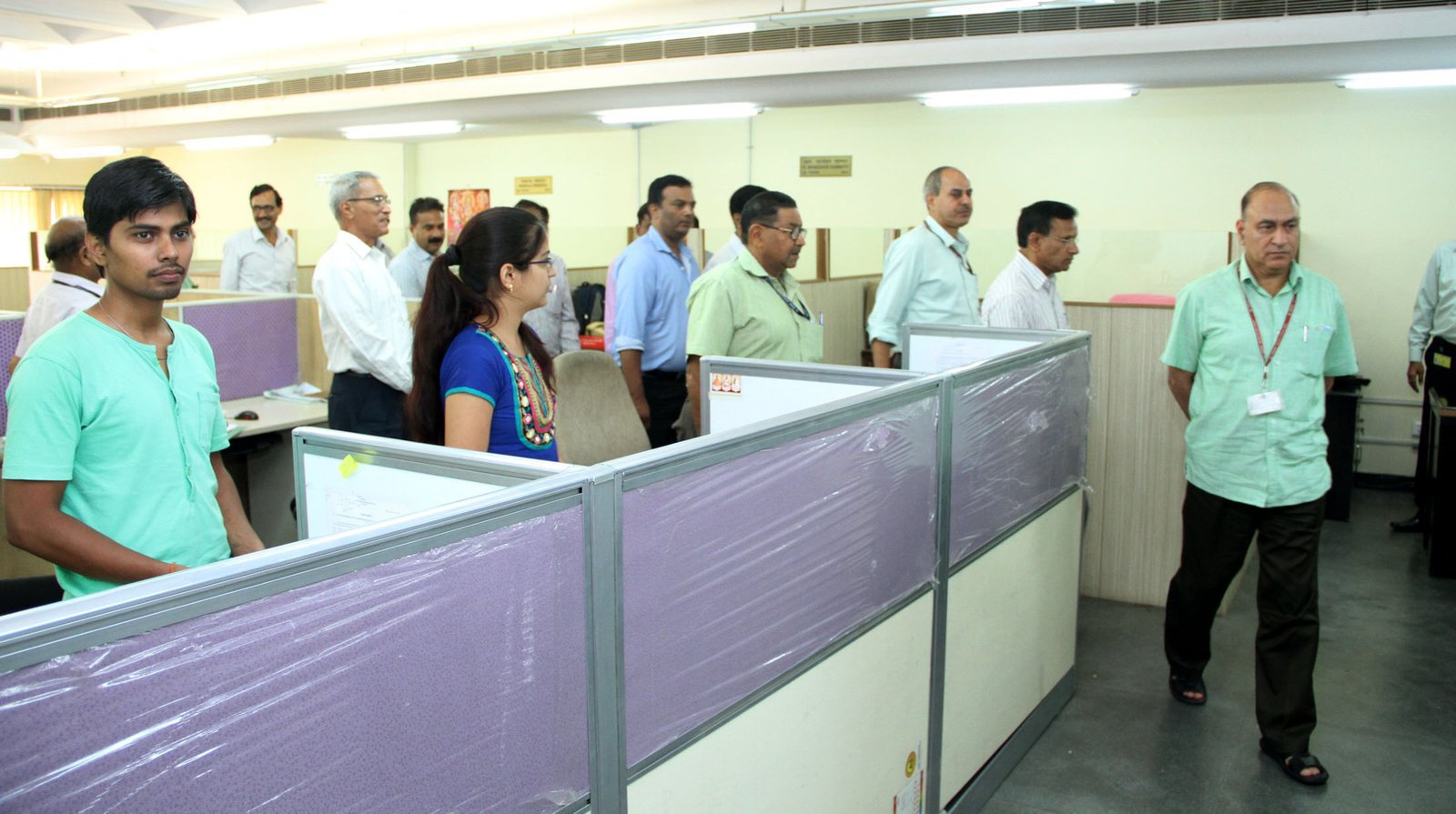
The Home Secretary inspects premises under the newly announced Swachh Bharat Abhiyaan, New Delhi, October 1, 2014 — one day before the mission’s official launch. (Ministry of Home Affairs / GODL-India, via Wikimedia Commons)
October 2, 2014: Swachh Bharat Mission Launches
A five-year clock, on Mahatma Gandhi’s birth anniversary
On October 2, 2014 — Mahatma Gandhi’s birth anniversary — India launched the Swachh Bharat Mission, split into a rural arm (SBM-Grameen) and an urban arm (SBM-Urban). For rural India, the mission set an extraordinarily ambitious target: eliminate open defecation by October 2, 2019, Gandhi’s 150th birth anniversary — five years, almost to the day. Government mission data put rural sanitation coverage at launch around 39%, meaning the goal wasn’t a modest improvement but a push toward universal coverage across hundreds of thousands of villages within five years.
The target also carried a conceptual shift that turned out to matter more than the deadline itself: attention moved from “how many toilets did we build” to “is open defecation actually eliminated.” A toilet being built is an output. A household using it, and a village with no member still defecating in the open, is an outcome — and the two are not the same number.
2016–2019: Independent Surveys Test Access and Usage
NARSS — the National Annual Rural Sanitation Survey
As construction accelerated, a harder question emerged: were the toilets actually being used? India increasingly turned to independent, third-party verification — the National Annual Rural Sanitation Survey (NARSS), conducted for the government by an Independent Verification Agency under World Bank support. Two rounds, run about a year apart, give the clearest before/after picture in the mission’s history.
| Metric | NARSS 2017–18 | NARSS 2018–19 |
|---|---|---|
| Survey period | Nov 2017 – Mar 2018 | Nov 2018 – Feb 2019 |
| Sample | 92,040 households, 6,136 villages | 92,040 households, 6,136 villages |
| Household toilet access | 77% | 93.1% |
| Usage among households with access | 93.4% | 96.5% |
| Previously declared/verified ODF villages reconfirmed | 95.6% (1,204 of 1,259) | 90.7% |
October 2, 2019: The ODF Milestone
Five years after launch, on the original deadline
By July 2018, government reporting put coverage at 88.9%, with 7.94 crore toilets built since October 2014 and 4.06 lakh villages declared ODF. The pace continued: by July 2019, more than 9.5 crore toilets and over 5.5 lakh ODF villages. On October 2, 2019 — Gandhi’s 150th birth anniversary, exactly the original target date — villages, Gram Panchayats, districts, states and Union Territories across SBM-Grameen declared themselves Open Defecation Free, with government reporting crediting more than 10 crore rural toilets constructed during the mission’s first phase.
That declaration was the mission’s central milestone — and also the point at which a harder second question opened up: a toilet can break, a pit can fill, behaviour can change back, and waste has to go somewhere. Could India actually keep its villages ODF?
2020–2026: From ODF to ODF Plus
Phase II asks whether the status holds, and where the waste goes
Swachh Bharat Mission-Grameen Phase II, running 2020–21 through 2026–27, changed the objective. Phase I asked whether everyone had toilet access and whether open defecation had ended. Phase II asks whether that ODF status is sustained, and what happens to solid and liquid waste — expanding the mission from a toilet-construction programme into a broader sanitation-system programme covering waste segregation, greywater, faecal sludge and visual village cleanliness.
ODF Plus — Aspiring
ODF status sustained, with arrangements for either solid waste management OR liquid waste management.
ODF Plus — Rising
ODF status sustained, with arrangements for BOTH solid and liquid waste management.
ODF Plus — Model
ODF sustained, solid AND liquid waste management, visual cleanliness, and required sanitation messaging — the current finish line.
WASH becomes pandemic response
Handwashing, clean water and sanitation shifted from development metrics to public-health necessities almost overnight.
Progress was fast by the milestone the government tracks most closely: from roughly 1 lakh ODF Plus villages in December 2022 to more than 5.61 lakh by December 27, 2024 — officially reported as a 460% increase in two years, with over 95% of India’s villages declared ODF Plus and more than 69% declared ODF Plus Model. That December 2024 review also credited the “Hamara Shauchalay, Hamara Samman” World Toilet Day campaign (“Our Toilet, Our Dignity”) with mobilising more than 38 lakh participants across 50,500+ events, improving the functionality of more than 1.54 lakh Community Sanitary Complexes.
The Survey Family Tree
Different surveys answer different questions — don’t mix them
India’s sanitation statistics sometimes appear to conflict simply because they measure different things. Knowing which survey answers which question avoids most of the confusion.
| Ask this question | Use this source |
|---|---|
| How many toilets were constructed? | SBM-G administrative/MIS data |
| Were declared ODF villages independently reconfirmed? | NARSS |
| How are cities performing on cleanliness? | Swachh Survekshan (urban) |
| How is rural cleanliness/ODF Plus tracking? | Swachh Survekshan Grameen |
| How many villages report ODF Plus status? | SBM-G Phase II MIS/dashboard |
Urban India runs its own parallel track. Swachh Survekshan, India’s national urban cleanliness survey, launched in 2016 covering 73 cities and has since expanded into a closely watched annual ranking, giving sanitation something it rarely had before: public, city-versus-city visibility.
Full Timeline: 2001 to 2026
Reverse chronological — newest first
World Toilet Day theme: “Sanitation and gender equality”
What happened: UN-Water’s 2026 campaign, “Safe toilets. Equal futures,” focuses on how safe sanitation, water and menstrual hygiene facilities protect women’s and girls’ health, safety, dignity and opportunity. SBM-G’s live dashboard shows 569,838 of 586,944 villages declared ODF Plus, but only 90,789 of 527,548 declared ODF Plus Model villages independently verified.
World Toilet Day theme: “Sanitation in a changing world”
What happened: The global theme turned to how sanitation infrastructure copes with population growth, urbanisation, climate stress and ageing systems — a toilet built today has to keep working tomorrow.
Over 95% of villages declared ODF Plus
What happened: Government reporting credited a 460% rise in ODF Plus villages — from ~1 lakh in December 2022 to 5.61+ lakh — with over 69% reaching “ODF Plus Model” status. The World Toilet Day campaign “Hamara Shauchalay, Hamara Samman” mobilised 38+ lakh participants across 50,500+ events and improved 1.54+ lakh Community Sanitary Complexes.
India passes 1 lakh ODF Plus villages
What happened: A major early Phase II milestone, against a rural universe of nearly 6 lakh villages nationwide — the second sanitation transformation had only just begun.
Swachh Survekshan Grameen expands its lens
What happened: The rural cleanliness survey broadened beyond “do you have a toilet” to public-place cleanliness, waste management, and ODF Plus indicators — the measurement expanded alongside the mission itself.
SBM-Grameen Phase II begins — ODF Plus introduced
What happened: The mission’s objective shifted from “has open defecation ended” to “is that status sustained, and is solid/liquid waste being managed.” COVID-19 the same year reinforced WASH (water, sanitation, hygiene) as core public-health infrastructure, not just a development metric.
India’s villages declare Open Defecation Free
What happened: On the original five-year deadline, villages, Gram Panchayats, districts, states and Union Territories under SBM-Grameen declared themselves ODF. Government reporting credited more than 10 crore rural toilets built since the mission’s October 2014 launch.
NARSS Round 2: access and usage rise, ODF reconfirmation falls
What happened: India’s second National Annual Rural Sanitation Survey found 93.1% household toilet access and 96.5% usage among households with access — both up sharply from Round 1 — while reconfirmation of previously declared/verified ODF villages actually fell, to 90.7%.
Coverage crosses 88.9%
What happened: 7.94 crore toilets built since October 2014, 4.06 lakh villages declared ODF across 419 districts, 19 states/UTs already declared ODF — the mission entered its final sprint toward the October 2019 deadline.
NARSS Round 1: the first independent verification
What happened: India’s first National Annual Rural Sanitation Survey found 77% household toilet access, 93.4% usage among households with access, and reconfirmed ODF status for 95.6% (1,204 of 1,259) of previously declared/verified ODF villages.
Swachh Survekshan launches for urban India
What happened: India’s national urban cleanliness survey began, letting cities be measured and compared on sanitation and cleanliness — giving urban sanitation public visibility it had rarely had before.
Swachh Bharat Mission launches
What happened: India launched SBM-Grameen (rural) and SBM-Urban, setting a target to eliminate rural open defecation by October 2, 2019. Rural sanitation coverage at launch stood at roughly 39%.
UN General Assembly designates World Toilet Day
What happened: The UN General Assembly adopted, by consensus with over 100 co-sponsors, a resolution proposed by Singapore formally designating November 19 as World Toilet Day — the first time the observance carried official UN status, 12 years after it was created.
Nirmal Bharat Abhiyan
What happened: India’s rural sanitation programme was restructured again, still targeting universal coverage and elimination of open defecation — the country remained far from that goal.
Nirmal Gram Puraskar introduced
What happened: The government began rewarding local bodies for achieving sanitation outcomes, shifting the unit of success from a single household toilet to the whole community becoming open-defecation free.
World Toilet Day is created
What happened: The World Toilet Organization established World Toilet Day on November 19, using a deliberately blunt name to force public conversation about a subject most people preferred not to discuss.
Total Sanitation Campaign
What happened: India’s approach shifted toward community participation, information and demand generation — the idea evolving from “give a toilet” toward “create sanitation behaviour.”
Central Rural Sanitation Programme launches
What happened: India launched its first national programme focused on constructing rural sanitary facilities — an important starting point, though policymakers would later recognise that building hardware alone doesn’t change open-defecation outcomes.
Explore More Timelines
People Also Ask
Frequently Asked Questions
⚠️ Editorial Note
This article compiles publicly available United Nations and UN-Water records, official Government of India sources (Swachh Bharat Mission-Grameen, the Department of Drinking Water and Sanitation, PIB press releases) and the published NARSS survey reports. Programme/MIS figures (SBM-G dashboard) are reported by States/UTs and are distinct from independently verified household-survey estimates (NARSS) — this article labels each figure by its actual source rather than treating them as interchangeable. Live dashboard figures reflect a September 2026 snapshot and fluctuate as states update their data. This is editorial history and current-affairs writing, not an official government record, and may contain inaccuracies; readers researching specific figures should consult the primary sources linked in this article.
Sources & further reading
Every dated entry above was checked against these references. Last reviewed 21 September 2026.
- UN News — General Assembly designates 19 November as World Toilet Day
- United Nations — World Toilet Day observance page
- Swachh Bharat Mission — NARSS 2017-18 Report
- Swachh Bharat Mission — NARSS 2018-19 Report
- PIB — Independent Verification of Swachh Bharat Grameen confirms over 96% usage
- PIB — Year End Review: Dept. of Drinking Water and Sanitation (ODF Plus milestone)
- SBM-G Phase II Dashboard (live)