Hathras Case Timeline: Justice, Court Verdict and Political Impact
Hathras case timeline: the 2020 assault and death, the night cremation, CBI probe, 2023 court verdict and the 2026 order on the family's relocation.
Latest Story
The Hathras case timeline begins on 14 September 2020, when a 19-year-old Dalit woman was attacked in a field in Uttar Pradesh’s Hathras district. She died at Safdarjung Hospital in Delhi on 29 September, and her body was cremated in the early hours of 30 September in what her family says was a cremation without their consent. The CBI charged four men with gang rape and murder; in March 2023 a special court convicted one of culpable homicide not amounting to murder and SC/ST Act offences, and acquitted three. The case did not end there: in August 2026 the Allahabad High Court gave the state three months to relocate her family. This page keeps allegations, official claims and court findings apart. For related cases, see AiTimeline’s timelines of the Nirbhaya case, the Ankita Bhandari case and the Ishrat Jahan encounter case.
Tap a stage. The key point: the verdict was narrower than the charge sheet.
Choose a stage above.
💡 Short Answer
A 19-year-old Dalit woman from Hathras was assaulted on 14 September 2020 and died on 29 September; police cremated her body at about 2:30 am on 30 September. The CBI charged four men with gang rape and murder in December 2020. On 2 March 2023 a special court convicted Sandeep of culpable homicide and SC/ST Act offences (life term) and acquitted three; no one was convicted of rape or murder. In August 2026 the Allahabad High Court ordered the family relocated to Ghaziabad or Noida within three months.
Hathras Case Status, as of 23 October 2026
Last updated: 23 October 2026. Kept separate from the timeline because each proceeding has its own outcome. “Not verified” means AiTimeline could not confirm the latest position from published reports.
| Question or proceeding | Court or authority | Latest position AiTimeline verified | Status |
|---|---|---|---|
| Criminal trial of the four accused (CBI charge sheet, 18 Dec 2020) | Special SC/ST court, Hathras | Sandeep convicted under s.304 IPC and the SC/ST Act, life term and ₹50,000 fine; Ravi, Luv Kush and Ramu acquitted, 2 Mar 2023 | Verdict delivered |
| Appeals against the verdict | Allahabad High Court | Both the family and Sandeep’s lawyer said in Mar 2023 they would appeal; AiTimeline found no report of an appeal being decided | Not verified; check the High Court record |
| Suo motu case “In Re: Right to decent and dignified last rites/cremation” (PIL 16150/2020) | Allahabad High Court, Lucknow bench | Hearing on the cremation issue on merits deferred until the relocation order is complied with | Pending |
| Relocation of the family to Ghaziabad or Noida | Allahabad High Court | Ordered 24 Aug 2026 within three months; compliance affidavit due from the Additional Chief Secretary (Home) | Deadline running; next listing 30 Nov 2026 |
| Government job for one family member | Allahabad High Court; Supreme Court | Ordered 26 Jul 2022; state’s appeal dismissed 27 Mar 2023; to follow relocation under the Aug 2026 order | Not reported as given |
| Family’s plea to move to Delhi | Supreme Court | Disposed of 21 Apr 2026; High Court asked to decide quickly | Sent back to the High Court |
| Case against the then station house officer, Chandpa (ss.166A, 167 IPC) | Trial court; Allahabad High Court | Discharge refused 17 Aug 2023; High Court refused to quash, Apr 2025 | Trial continuing; not convicted |
| UAPA case against journalist Siddique Kappan and others | Supreme Court; trial court, Lucknow | Bail granted 9 Sep 2022 | Separate case; on bail |
Hathras Case: Key Questions
The Hathras Case in Ten Points
- The assault: 14 September 2020; the first FIR named one man for attempt to murder.
- Her statement: recorded by a magistrate on 22 September; gang rape was alleged and four men were arrested.
- The cremation: about 2:30 am on 30 September, which the family says was without their consent.
- Official claims: a senior officer said on 1 October that forensic tests showed no rape; experts disputed the reasoning.
- The courts: the High Court opened a dignified-last-rites case on 1 October; the Supreme Court ordered CRPF protection on 27 October.
- The CBI: took over on 11 October and charged all four with gang rape and murder on 18 December 2020.
- The verdict: 2 March 2023, one convicted of culpable homicide and SC/ST Act offences, three acquitted, no rape conviction.
- Police conduct: five officers suspended in 2020; the station officer’s criminal case continues after the High Court refused to quash it in 2025.
- The family: job and relocation ordered in 2022, upheld by the Supreme Court in 2023, still being enforced in 2026.
- The caution: a charge sheet is an allegation and an acquittal is a finding; neither should be reported as the other.
Hathras Case Timeline, Latest First
Each entry is tagged by type and ends with why it matters. Court orders and allegations are labelled as such.
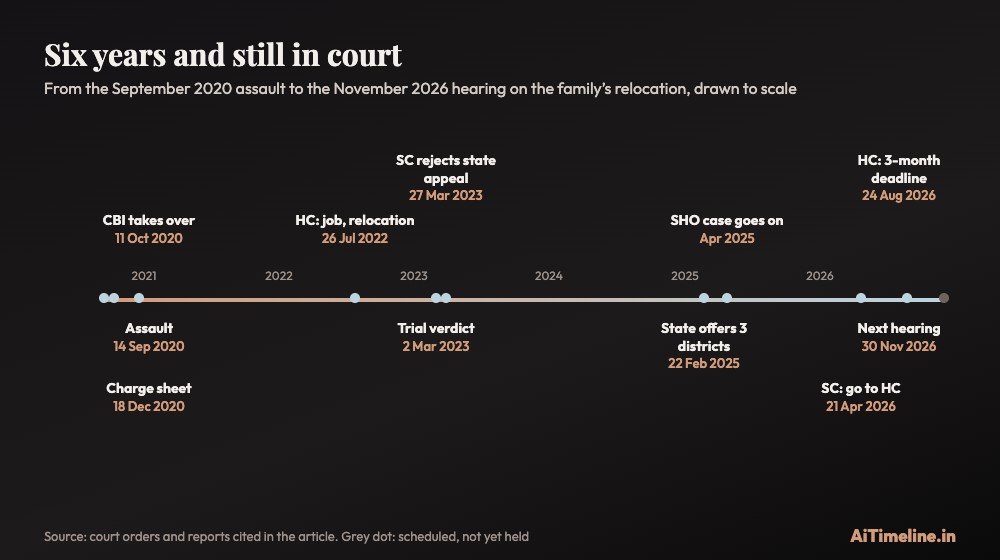
Show only court orders, the investigation, police conduct, the family’s relief, politics, or the assault itself.
–
2026
The High Court orders the state to relocate the family to Ghaziabad or Noida within three months The family’s relief
In the suo motu case it opened in 2020, the Lucknow bench set aside the state’s 22 February 2025 decision and directed the government to “rehabilitate and relocate the victim’s family in Ghaziabad or Noida, as the case may be, positively within three months” (LiveLaw). It found “unnecessary resistance by the State” to its orders of 26 September 2024, 14 November 2024 and 8 January 2025, and called the February 2025 decision “no decision in the eyes of law” because it did not mention the family’s request.
Once the family is relocated, a member must also get the job ordered on 26 July 2022. The Additional Chief Secretary (Home) must file the compliance affidavit and appear in person if the order is not obeyed. The bench said it had meant to hear the cremation issue on merits but would first secure compliance. The matter is listed for 30 November 2026 (LawBeat).
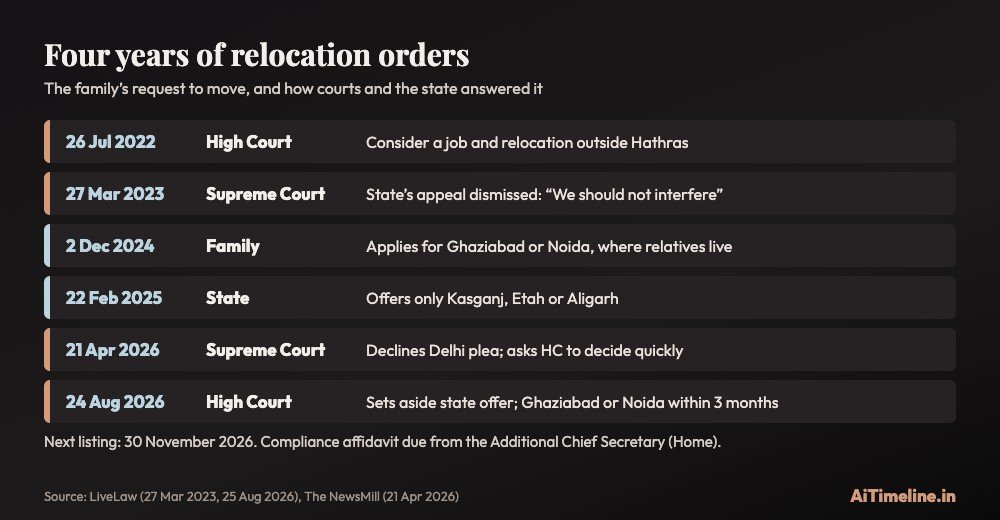
2026
The Supreme Court declines the family’s plea to be moved to Delhi The family’s relief
The family had asked the Supreme Court to move them from Uttar Pradesh to Delhi for safety, citing the contingency-plan rule under the SC/ST Act. The bench asked why the plea was continuing “when it is pending before the High Court”, disposed of it and requested the High Court to decide the pending application quickly and consider a contingency plan for the family (The NewsMill). The state’s counsel said it had proposed relocation within the state, such as to Aligarh or Kasganj.
The High Court refuses to quash the case against the suspended station officer Police and administration
Dinesh Kumar Verma, the suspended station house officer of Chandpa police station, asked the High Court to quash the CBI’s supplementary charge sheet against him under sections 166A(b)(c) and 167 of the IPC. The court dismissed his petition the week before 28 April 2025, saying the facts “not only indicate lack of sensitivity but dereliction of duty” (LiveLaw).
According to the CBI’s case as summarised in the order, he let the media film the victim inside the police station, recorded a video on his own phone instead of a formal statement, did not send her for a medical examination despite her saying “jabardasti” (force), and let her go to hospital in a shared auto; a false General Diary entry also recorded a woman constable as accompanying her (SCC Times). He was summoned on 9 January 2023 and his discharge plea was rejected on 17 August 2023. The ruling only allows the case to go to trial; it is not a finding of guilt.
2025
The state offers Kasganj, Etah or Aligarh, not the family’s choice The family’s relief
Deciding the family’s application, the state again offered relocation only to Kasganj, Etah or Aligarh, with a job for one member at the chosen place. The High Court later found the decision did not contain “even a cursory reference” to the request for Ghaziabad or Gautam Buddh Nagar (Noida), where relatives live (LiveLaw).
2024
The family formally applies to move to Ghaziabad or Noida The family’s relief
The family had first asked to be moved to Delhi, then told the High Court, without giving up its plea in the Supreme Court, that it would accept Ghaziabad or Noida. On 14 November 2024 the court told it to apply formally to the District Magistrate of Hathras, and it did so on 2 December 2024 (LiveLaw).
2023
The Supreme Court refuses the state’s appeal against the job and relocation order The family’s relief
Uttar Pradesh challenged the High Court’s July 2022 directions, arguing that whether the victim’s married elder brother was a “dependent” was a question of law. The bench dismissed the plea in the “special facts and circumstances” of the case. “These are facilities provided to the family. We should not interfere. State should not come up in these matters,” the Chief Justice said (LiveLaw).
This was a ruling on relief for the family, not on the criminal case.
2023
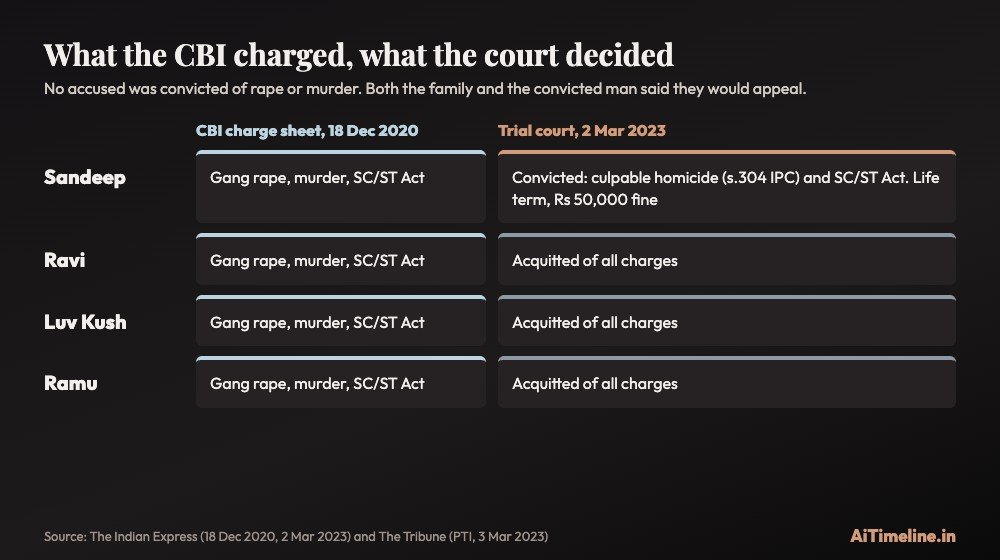
The trial verdict: one accused convicted of culpable homicide, three acquitted, no rape conviction Court order or verdict
The special court convicted Sandeep under section 304 of the IPC (culpable homicide not amounting to murder) and under the SC/ST (Prevention of Atrocities) Act, and acquitted Ravi, Luv Kush and Ramu of all charges (The Indian Express). It sentenced Sandeep to life imprisonment and a fine of ₹50,000; his lawyer said the rape and murder charges “could not be proved” (The Tribune).
Both sides said they would appeal to the Allahabad High Court: the family’s lawyer, Seema Kushwaha, said the court had not considered several facts, and Sandeep’s lawyer said he would seek acquittal on the same grounds as the other three (National Herald). AiTimeline could not find a report of an appeal being decided.
2022
The Supreme Court grants bail to journalist Siddique Kappan Politics and press
Kerala journalist Siddique Kappan was arrested with three others on 5 October 2020 while travelling to Hathras, and charged under the anti-terror UAPA with conspiring to incite violence over the case. After almost two years in custody and the Allahabad High Court’s refusal of bail, the Supreme Court granted him bail on 9 September 2022, saying every person has the right to free expression (The Leaflet). He stayed in jail for some time longer because of a separate money-laundering case.
2022
The High Court directs the state to consider a job and relocation for the family The family’s relief
Reading the SC/ST Act and its rules, the court held that the family had a legal basis to claim relocation and a job, and rejected the state’s argument that a job would breach Articles 14 and 16. It noted that the village was mostly upper caste and that the family, even under CRPF guard, faced abuse when they went out, and directed the state to consider moving them outside Hathras and giving a member a job matching their qualifications (LiveLaw).
2020
The CBI charges all four accused with gang rape and murder Investigation
The CBI filed its charge sheet against Sandeep, Ravi, Luv Kush and Ramu under IPC sections 354, 376A, 376D and 302 and the SC/ST Act (The Indian Express). The finding embarrassed senior Uttar Pradesh police officers who had said forensic tests showed no rape. The charge sheet relied on call records and alleged that the assault followed the victim rebuffing Sandeep (The Indian Express).
A charge sheet sets out the prosecution’s case. It is an allegation, not proof of guilt, and the trial court later reached a different result.
2020
The Supreme Court leaves monitoring to the High Court and orders CRPF protection Court order or verdict
Hearing petitions for a court-monitored probe and a trial in Delhi, the court said it saw no need to take the case from the Allahabad High Court, which would monitor the CBI investigation. “Only as a confidence building measure” it directed that the CRPF guard the family and witnesses within a week. It kept the question of moving the trial out of Uttar Pradesh open “if need arises”, and asked the High Court to remove the family’s names from its 12 October order (Supreme Court judgment).
2020
Officials and the family appear before the High Court over the cremation Court order or verdict
The family told the court the cremation took place without their consent and that police presence in the village was so heavy that law and order was no reason for haste. The District Magistrate said the administration had inputs of a “huge law and order problem” the next morning and accepted responsibility for the decision. The family asked for the case to be moved out of the state and for security until the end of the proceedings (Sabrang India).
2020
The CBI takes over the investigation Investigation
The state government itself asked for a CBI investigation. According to the Supreme Court’s judgment, the CBI accepted the request on 10 October 2020 and started investigating on 11 October (Supreme Court judgment). It registered a fresh FIR under sections 307, 376D and 302 of the IPC and the SC/ST Act (SCC Times).
2020
The state tells the Supreme Court the night cremation avoided “large scale violence” Police and administration
The state’s affidavit said the victim was cremated at night “to avoid large scale violence in the morning” after intelligence reports that the issue would be given a “caste/communal colour”. It said all four accused were in Aligarh jail under sections 307 and 376D and the SC/ST Act, and claimed that the medical and forensic reports did not show rape (Deccan Herald).
2020
The state suspends the district police chief and four officers Police and administration
On the preliminary findings of a three-member Special Investigation Team set up on 30 September, the government suspended Hathras Superintendent of Police Vikrant Vir, the circle officer, the station house officer, a sub-inspector and a head constable for negligence and lax supervision. It also ordered polygraph and narco tests for the victim’s family as well as the accused and police, an order lawyers said was unconstitutional if compelled (The Leaflet).
2020
The High Court opens a case on the right to dignified last rites Court order or verdict
Acting on its own, the bench registered a public interest case titled “In Re: Right to decent and dignified last rites/cremation”, calling the matter “extremely sensitive”. It summoned the Additional Chief Secretary (Home), the Director General of Police, the ADG (Law and Order), and the District Magistrate and Superintendent of Police of Hathras for 12 October, called the family to give its version, and ordered that no “coercion, influence or pressure” be exerted on them (LiveLaw).
2020
A senior police officer says forensic tests show “no rape”; opposition leaders are stopped Politics and press
ADG Prashant Kumar said the forensic report found no sperm in the samples and that “some people twisted the matter to stir caste-based tension”. Experts pointed out that samples collected days after an assault would not show sperm, and the autopsy recorded strangulation and a neck injury (Scroll). The CBI’s charge sheet later alleged gang rape.
The same day, police stopped Rahul Gandhi and Priyanka Gandhi Vadra on the Yamuna Expressway as they walked towards Hathras, detained them and booked them for breaking prohibitory orders (Scroll). They were allowed through with a small delegation and met the family on 3 October (Deccan Herald).
2020
The body is cremated in the early hours, without the family Police and administration
The body was driven from Delhi to her village and cremated in the early hours of 30 September. The family said it was done without their consent and that they were kept from the last rites. Police officers said the cremation was carried out “as per the wishes of the family” (The Indian Express), and the administration later cited law-and-order inputs. The High Court noted media reports that it took place at about 2 to 2:30 am and that the body was not handed to the family (LiveLaw).
2020
She dies at Safdarjung Hospital, Delhi The assault and death
After two weeks in hospital in Aligarh, she was moved to Safdarjung Hospital in Delhi on 28 September and died the next day (SCC Times). Protests followed across the country, with Dalit organisations, women’s groups and opposition parties demanding an independent investigation.
2020
A magistrate records her statement; gang rape is alleged Investigation
She regained partial consciousness on 16 September and said the first man and two others had assaulted her; this was reported to the Superintendent of Police on 17 September. A magistrate recorded her statement at the hospital on 22 September (SCC Times). By early October all four accused had been arrested under sections 307 and 376D of the IPC and the SC/ST Act (Deccan Herald).
How quickly the police acted on her account, and how the medical evidence was collected, became central questions in the case.
2020
A 19-year-old Dalit woman is attacked in a field The assault and death
She was cutting fodder with her mother when she was attacked; her mother’s shouts made the attacker run. Her brother filed an FIR at about 10:30 am against one man for attempt to murder (section 307 IPC) and under the SC/ST Act (SCC Times). According to the CBI’s later case, she was taken to the police station and then to hospital without a medical examination for sexual assault being ordered.
What Did the CBI Allege, and What Did the Court Decide?
The prosecution’s case and the trial court’s findings are different stages and should not be confused.
| Issue | CBI prosecution case (Dec 2020) | Trial court outcome (2 Mar 2023) |
|---|---|---|
| Gang rape | All four charged with gang rape (s.376D IPC) | No accused convicted of rape or gang rape |
| Murder | All four charged with murder (s.302 IPC) | No accused convicted of murder |
| Sandeep | Charged with gang rape, murder and SC/ST Act offences | Convicted of culpable homicide not amounting to murder (s.304 IPC) and SC/ST Act offences; life term |
| Ravi, Luv Kush and Ramu | Charged with the same offences | Acquitted of all charges |
| What it means | An allegation by investigators | A trial finding, open to appeal |
The verdict should not be rewritten as a conviction for rape and murder, and it should not be used to erase the victim’s statement, the investigation or the concerns about how the case was handled. The accurate account is that the court reached a narrower outcome than the CBI’s charge sheet sought (The Indian Express; The Tribune). The CBI’s case relied on call records and alleged the assault followed the victim rebuffing Sandeep; those are allegations that the trial court weighed.
Why Did the Hathras Case Have Such a Political Impact?
Five reasons, each tied to the record.
1. Caste and access to justice. The victim was Dalit; the accused were reported to be from an upper-caste community in a village the High Court noted was mostly upper caste. The trial ran in a special court under the SC/ST (Prevention of Atrocities) Act, and that Act is also the legal basis for the family’s job and relocation claims (LiveLaw). For the longer history of caste and policy, see AiTimeline’s Mandal Commission timeline.
2. Women’s safety and sexual-assault procedure. The questions were about how quickly the police acted on her account, whether she was sent for a medical examination, why samples were collected late, and whether the media was allowed to film her in the police station. The CBI’s case against the station officer turns on several of these (SCC Times). The Nirbhaya case had changed the law on these duties in 2013.
3. Police accountability and independent investigation. The state suspended five officers on 2 October 2020 and handed the case to the CBI; the Supreme Court then left monitoring to the High Court and put CRPF in charge of the family’s security as a “confidence building measure” (Supreme Court judgment).
4. Political confrontation and the press. Rahul Gandhi and Priyanka Gandhi Vadra were stopped and booked on 1 October 2020 and met the family on 3 October (Scroll). The state told the Supreme Court a “false narrative” was being pushed to incite caste unrest (Deccan Herald), and journalist Siddique Kappan spent nearly two years in custody under the UAPA before the Supreme Court bailed him (The Leaflet). Political responses were separate from the judicial process that decided criminal liability.
5. The right to dignified last rites. The night cremation is the issue the High Court took up on its own on 1 October 2020, and it is the case under which the court still orders relief for the family in 2026 (LiveLaw; LiveLaw).
What Remains Unresolved?
As of 23 October 2026.
Relocation and the job. The High Court’s three-month deadline from 24 August 2026 runs to late November; the matter is listed for 30 November 2026, when the Additional Chief Secretary (Home) must show compliance or appear in person (LiveLaw). This page will be updated after that hearing.
The appeals. Both sides announced appeals in March 2023 (National Herald). AiTimeline could not confirm the current status of any appeal from published reports; do not assume one succeeded or failed.
The cremation on merits. The High Court has not yet given a final ruling on whether the night cremation violated the family’s rights; it chose to secure compliance on relocation first.
Police conduct. The station officer’s case is at trial. He is presumed innocent until a court decides otherwise.
Claim, Allegation or Finding?
The same story, sorted by who said it and how strong it is.
| Statement | Who said it | Type | What the record shows |
|---|---|---|---|
| She was gang-raped by four men | The victim, in her statement to a magistrate; the CBI charge sheet | Statement and prosecution allegation | The trial court did not convict anyone of rape |
| Forensic tests show there was no rape | ADG Prashant Kumar, 1 Oct 2020; state affidavit, 6 Oct 2020 | Police claim | Experts said late samples cannot show this; the CBI charged gang rape |
| The cremation followed the family’s wishes | Local police officers | Official claim | The family says it was without consent; the High Court opened a case on dignified last rites |
| The cremation was done at night to avoid violence | District Magistrate; state affidavit | Official explanation | Disputed by the family; the High Court has not yet ruled on merits |
| Sandeep caused her death | Special court, 2 Mar 2023 | Court finding (culpable homicide) | Open to appeal |
| Ravi, Luv Kush and Ramu were not proved guilty | Special court, 2 Mar 2023 | Acquittal | Open to appeal; they are entitled to be treated as acquitted |
| The station officer was negligent | CBI supplementary charge sheet | Prosecution allegation | High Court refused to quash in Apr 2025; not yet tried |
The Story at a Glance
Oldest first, with the type of each entry.
| Date | Event | Type |
|---|---|---|
| 14 Sep 2020 | A 19-year-old Dalit woman is attacked in a field | The assault and death |
| 22 Sep 2020 | A magistrate records her statement; gang rape is alleged | Investigation |
| 29 Sep 2020 | She dies at Safdarjung Hospital, Delhi | The assault and death |
| 30 Sep 2020 | The body is cremated in the early hours, without the family | Police and administration |
| 1 Oct 2020 | A senior police officer says forensic tests show “no rape”; opposition leaders are stopped | Politics and press |
| 1 Oct 2020 | The High Court opens a case on the right to dignified last rites | Court order or verdict |
| 2 Oct 2020 | The state suspends the district police chief and four officers | Police and administration |
| 6 Oct 2020 | The state tells the Supreme Court the night cremation avoided “large scale violence” | Police and administration |
| 11 Oct 2020 | The CBI takes over the investigation | Investigation |
| 12 Oct 2020 | Officials and the family appear before the High Court over the cremation | Court order or verdict |
| 27 Oct 2020 | The Supreme Court leaves monitoring to the High Court and orders CRPF protection | Court order or verdict |
| 18 Dec 2020 | The CBI charges all four accused with gang rape and murder | Investigation |
| 26 Jul 2022 | The High Court directs the state to consider a job and relocation for the family | The family’s relief |
| 9 Sep 2022 | The Supreme Court grants bail to journalist Siddique Kappan | Politics and press |
| 2 Mar 2023 | The trial verdict: one accused convicted of culpable homicide, three acquitted, no rape conviction | Court order or verdict |
| 27 Mar 2023 | The Supreme Court refuses the state’s appeal against the job and relocation order | The family’s relief |
| 2 Dec 2024 | The family formally applies to move to Ghaziabad or Noida | The family’s relief |
| 22 Feb 2025 | The state offers Kasganj, Etah or Aligarh, not the family’s choice | The family’s relief |
| Apr 2025 | The High Court refuses to quash the case against the suspended station officer | Police and administration |
| 21 Apr 2026 | The Supreme Court declines the family’s plea to be moved to Delhi | The family’s relief |
| 24 Aug 2026 | The High Court orders the state to relocate the family to Ghaziabad or Noida within three months | The family’s relief |
| Term | Meaning | Why it matters here |
|---|---|---|
| FIR | First Information Report, which starts a police case | The first FIR named one man for attempt to murder |
| Charge sheet | The investigators’ report setting out the prosecution case | The CBI’s alleged gang rape and murder; it is not a verdict |
| Section 304 IPC | Culpable homicide not amounting to murder | The offence Sandeep was convicted of, a lesser charge than murder |
| Section 376D IPC | Gang rape | Charged by the CBI; no conviction |
| SC/ST Act | Scheduled Castes and Scheduled Tribes (Prevention of Atrocities) Act, 1989 | Basis of the special court, the conviction and the family’s right to relief |
| Suo motu | A case a court opens on its own | The High Court’s 2020 case on dignified last rites |
| Acquittal | A finding after trial that guilt was not proved | Applies to Ravi, Luv Kush and Ramu |
| Quashing | A High Court ending a case before trial | Refused for the station officer in April 2025 |
Who Is Who in the Case
A 19-year-old Dalit woman
From a village in the Chandpa police station area of Hathras district. She is not named here, as Indian law requires.
Sandeep, Ravi, Luv Kush and Ramu
Four men from the same village. Sandeep was convicted of culpable homicide and SC/ST Act offences; the other three were acquitted.
Seema Kushwaha
Represented the family in the trial and the Supreme Court in 2020.
Central Bureau of Investigation
Took over on 11 October 2020 and filed the charge sheet on 18 December 2020.
Special SC/ST court, Hathras; Allahabad High Court, Lucknow bench; Supreme Court
The trial court gave the verdict; the High Court runs the cremation and relocation case; the Supreme Court set the framework in 2020.
Uttar Pradesh government and Hathras police
Defended the night cremation; suspended five officers in October 2020; resisted the family’s choice of relocation.
The Popular Story vs the Record
| Popular version | What the record shows |
|---|---|
| The four accused were convicted of gang rape and murder | No. One was convicted of culpable homicide and SC/ST Act offences; three were acquitted |
| The verdict proved there was no assault | No. Sandeep was convicted for causing her death; the court found rape and murder not proved |
| The CBI said there was no rape | No. The CBI charged all four with gang rape. The “no rape” claim came from state police |
| The trial was moved to Delhi | No. The Supreme Court kept the question open; the trial was held in Hathras |
| The case ended with the 2023 verdict | No. Appeals were announced and the High Court’s cremation and relocation case is still open |
| The family was relocated after the 2023 Supreme Court order | No. The High Court found in August 2026 that the state had still not properly considered their request |
Explore More Timelines
People Also Ask
Frequently Asked Questions
Related AiTimeline Stories
⚠️ Editorial Note
Last updated 23 October 2026. This is a historical overview, not legal advice. The victim and her family are not named, as Indian law requires for survivors of sexual offences. The CBI’s allegations, official claims and court findings are kept apart: the trial court convicted one accused of culpable homicide not amounting to murder and SC/ST Act offences, acquitted three, and convicted no one of rape or murder. The acquitted men are entitled to be treated as acquitted, and the station officer facing trial is presumed innocent. The status of appeals against the 2023 verdict could not be verified. The relocation order is a continuing matter listed for 30 November 2026; this page will be refreshed after that hearing. No graphic images are used.
Sources & further reading
Every dated entry above was checked against these references. Last reviewed 23 October 2026.
- Supreme Court of India: Satyama Dubey and Others v. Union of India, judgment of 27 October 2020 (via Bar and Bench)
- The Indian Express: Main accused convicted and three others acquitted in Hathras gangrape and murder case (2 March 2023)
- The Tribune (PTI): Hathras, life term for key accused, three acquitted (3 March 2023)
- The Indian Express: Hathras case, CBI charges four accused of gangrape, murder (18 December 2020)
- LiveLaw: Supreme Court dismisses UP government's plea against job for family member of victim (27 March 2023)
- LiveLaw: Allahabad High Court orders UP government to relocate Hathras victim's family within 3 months (25 August 2026)
- LawBeat: Allahabad HC directs UP government to relocate victim's family to Ghaziabad or Noida (26 August 2026)
- The NewsMill: Supreme Court refuses plea to transfer Hathras victim's family to Delhi (21 April 2026)
- LiveLaw: Allahabad HC takes suo motu cognizance of Hathras case (1 October 2020)
- Sabrang India: Allahabad HC questions ADG and DM over cremation (12 October 2020)
- Deccan Herald: Extraordinary circumstances forced late-night cremation, UP government tells SC (6 October 2020)
- Scroll: Forensic report shows there was no rape, claim UP Police (1 October 2020)
- Scroll: UP Police file case against Rahul, Priyanka Gandhi for marching to Hathras (1 October 2020)
- Deccan Herald: Rahul Gandhi, Priyanka on way to Hathras (3 October 2020)
- The Leaflet: UP government suspends SP Vikrant Vir and other officials (2 October 2020)
- LiveLaw: Allahabad High Court denies relief to suspended SHO in Hathras case (28 April 2025)
- SCC Times: Allahabad High Court refuses to quash criminal proceedings against suspended SHO (29 April 2025)
- National Herald: Lone Hathras convict to challenge conviction (March 2023)
- The Leaflet: Supreme Court grants bail to Siddique Kappan (9 September 2022)