Shreya Singhal Case: Section 66A Timeline and Supreme Court Verdict
Two arrests over a Facebook post led to a landmark free-speech judgment. Discover how the Shreya Singhal case struck down Section 66A and changed the
Latest Story
On 19 November 2012, police in Palghar, Maharashtra arrested two young women after one questioned a Mumbai shutdown on Facebook and the other liked her post. The arrests were made under Section 66A of the Information Technology Act, 2000. Law student Shreya Singhal challenged the provision, and on 24 March 2015 the Supreme Court struck it down in Shreya Singhal v. Union of India. Section 66A was still being used years later, so in October 2022 the Court ordered that no one be prosecuted under it.
💡 Short Answer
Shreya Singhal v. Union of India, decided on 24 March 2015, struck down Section 66A of the IT Act in its entirety because it was vague, overbroad and chilled lawful speech, violating Article 19(1)(a). The Court upheld Section 69A on blocking and read down Section 79 on intermediary liability. Because police kept using 66A, the Supreme Court on 12 October 2022 ordered that no citizen be prosecuted under it.
Shreya Singhal Case: Key Questions
The Shreya Singhal Case in Nine Points
- The law: Section 66A came into force on 27 October 2009 and carried up to three years in prison.
- The problem: its terms, such as annoying and inconvenient, were undefined.
- Earlier cases: Mahapatra, Trivedi and Ravi Srinivasan were booked in 2012, before Palghar.
- The trigger: on 19 November 2012 Shaheen Dhada was arrested for a post and Renu Srinivasan for a like.
- The petition: Shreya Singhal filed under Article 32 in late November 2012.
- Interim step: the 2013 senior-officer approval for arrests was a stopgap, not the final remedy.
- The verdict: 24 March 2015, Section 66A struck down in its entirety.
- The limits: Section 69A upheld and Section 79 read down; the IT Act as a whole stands.
- The follow-up: cases continued, so the Court issued directions on 12 October 2022.
Shreya Singhal Case Timeline: From the IT Act to the 2022 Directions, Latest First
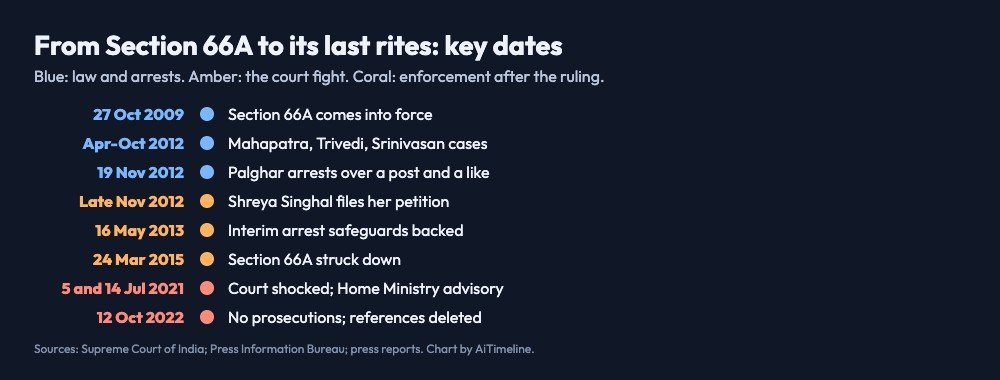
Each entry is colour-coded by phase. Dates follow court records, the Press Information Bureau and press reports.
Supreme Court orders 66A references deleted from pending cases Verdict and aftermath
What happened: On an application by the People’s Union for Civil Liberties (PUCL), a bench led by Chief Justice U. U. Lalit held that no citizen can be prosecuted for an alleged offence under Section 66A. It directed that references to the section be deleted from pending criminal cases where people were still being charged under it.
Instructions to police: State Directors General of Police, Home Secretaries and the competent authorities of Union Territories were told to instruct police not to register complaints under Section 66A. Where other offences are also alleged, those proceedings continue in accordance with law.
Publications: Any government, semi-government or private publication of the IT Act that quotes Section 66A must tell readers that the Supreme Court has held it unconstitutional. On 6 September 2022 the Court had first asked the Union to press the states to take remedial steps.
Home Ministry tells states not to register 66A cases Verdict and aftermath
What happened: The Ministry of Home Affairs asked states and Union Territories to instruct police stations not to register cases under Section 66A and to withdraw cases already booked under it. It reminded them that the section became null and void from 24 March 2015.
Why: The advisory followed the Supreme Court’s shock, days earlier, that the struck-down section was still being used.
Supreme Court calls continued use of 66A “shocking” Verdict and aftermath
What happened: Hearing a PUCL application, the Court expressed astonishment that people were still being prosecuted under a provision it had struck down six years earlier, and issued notice to the Centre. Justice Nariman called it “terrible” that such cases continued.
What it showed: Section 66A still appeared in police records, charge sheets and pending cases. A constitutional ruling does not automatically delete a law from those places.
Supreme Court strikes down Section 66A Verdict and aftermath
The ruling: A two-judge bench, with the opinion written by Justice Nariman, held Section 66A unconstitutional in its entirety. It violated Article 19(1)(a) and was not saved by Article 19(2). The petitions of Shreya Singhal, the PUCL, Common Cause and Mouthshut.com were heard together.
The reasoning: The Court found the section vague, because words such as “annoying” and “inconvenient” gave no clear standard; overbroad, because it caught speech that Article 19(2) does not allow the state to restrict; and likely to chill lawful speech out of fear of arrest.
Discussion, advocacy, incitement: The judgment separated the three. Discussion and advocacy, even of unpopular views, are protected by Article 19(1)(a). Only incitement can be restricted, on the grounds in Article 19(2).
Other provisions: The Court upheld Section 69A (blocking of online content) and the 2009 Blocking Rules, citing their safeguards. It read down Section 79 and Rule 3(4) of the Intermediary Guidelines so that an intermediary must remove content only after a court order or a government notification. It did not strike down the IT Act as a whole.
Supreme Court backs the arrest safeguards as an interim measure Arrests and petition
What happened: On an interim application by Shreya Singhal in her pending petition, the Court directed all states to comply with the Centre’s advisory before making any arrest under Section 66A. Under it, an arrest needed prior approval from an Inspector General of police in metropolitan areas or a Deputy Commissioner or Superintendent of police elsewhere.
What it was not: It was a stopgap while the challenge was heard. It did not change the section or settle its constitutionality; the final remedy came only in March 2015.
Centre issues an advisory; charges against the Palghar women are dropped Arrests and petition
The advisory: The Centre’s advisory, dated 9 January 2013, said no arrest under Section 66A should be made without permission from an officer of Inspector General, Deputy Commissioner or Superintendent rank. A first set of guidelines had been announced in November 2012; reports differ on the exact wording and date.
Palghar: In late January 2013 a court in Palghar dropped the charges against Shaheen Dhada and Renu Srinivasan.
Shreya Singhal challenges Section 66A in the Supreme Court Arrests and petition
What happened: Shreya Singhal, a young Delhi law student, filed a public interest petition under Article 32 challenging the constitutional validity of Section 66A, arguing that its vague terms violated freedom of speech. Other petitions, including one by the PUCL, were heard along with hers.
The trigger: Her petition was prompted by the Palghar arrests. The cases of Ambikesh Mahapatra, Aseem Trivedi and Ravi Srinivasan earlier in 2012 were part of the wider pattern cited in the debate, but they were not the cause of her petition.
Two women arrested in Palghar over a Facebook post Arrests and petition
What happened: Mumbai shut down for Shiv Sena founder Bal Thackeray’s funeral. Shaheen Dhada posted on Facebook questioning the shutdown, saying in effect that it was out of fear, not respect. Her friend Renu Srinivasan “liked” the post. After a complaint by a local Shiv Sena leader, police arrested both under Section 66A. Reports also cite a section of the Indian Penal Code on promoting enmity between religious groups.
The aftermath: Both were granted bail. The arrests drew national criticism, and police officers involved were suspended. Only Shaheen Dhada wrote the post; Renu Srinivasan was arrested for liking it.
Businessman arrested over a tweet about a politician’s son Arrests and petition
What happened: Ravi Srinivasan, a Puducherry businessman, tweeted on 19 October 2012 about Karti Chidambaram, son of then Union Finance Minister P. Chidambaram. Puducherry police arrested him under Section 66A on 30 October. He was remanded in custody and later released on bail.
Cartoonist Aseem Trivedi arrested in Mumbai Arrests and petition
What happened: Political cartoonist Aseem Trivedi was arrested in Mumbai over cartoons attacking corruption that portrayed national symbols. The charges included sedition, the Prevention of Insults to National Honour Act and Section 66A.
Professor arrested for forwarding a cartoon of the Chief Minister Arrests and petition
What happened: Ambikesh Mahapatra, a chemistry professor, was arrested in April 2012 after he forwarded an email with a cartoon about West Bengal Chief Minister Mamata Banerjee and another political leader. He was later booked under Section 66A and Indian Penal Code provisions and became a party in the Supreme Court case. He was discharged by a court a decade later.
Why it matters: It showed that sharing a message, not only writing one, could bring someone within the section.
Section 66A comes into force Law and 66A
What happened: Parliament passed the Information Technology (Amendment) Act in December 2008, and it received assent in February 2009. Section 66A came into force on 27 October 2009. It punished sending, through a computer resource or communication device, messages that were grossly offensive or menacing, known to be false but sent to cause annoyance, inconvenience, insult or ill will, or sent to annoy or mislead about their origin. The penalty was up to three years’ imprisonment and a fine.
The problem: Terms such as “grossly offensive”, “annoyance” and “inconvenience” were not defined, so police officers and complainants decided what they meant.
The IT Act, 2000 takes effect Law and 66A
What happened: India’s first law on electronic commerce and cyber offences came into force. It originally had no provision like Section 66A; that was added in 2008.
The 2012 Cases That Fed the Debate
Four episodes in one year. Only the last prompted Shreya Singhal’s petition.
| Case | When | What triggered it | Role in the debate |
|---|---|---|---|
| Ambikesh Mahapatra | April 2012 | Forwarded an email with a cartoon of West Bengal Chief Minister Mamata Banerjee | Early example; later a party in the Supreme Court case |
| Aseem Trivedi | 9 September 2012 | Cartoons attacking corruption and portraying national symbols | Charges included sedition and Section 66A |
| Ravi Srinivasan | 30 October 2012 | Tweet of 19 October about Karti Chidambaram | Arrested in Puducherry under Section 66A |
| Shaheen Dhada and Renu Srinivasan | 19 November 2012 | A Facebook post questioning the Mumbai shutdown, and a like | The arrests that prompted Shreya Singhal’s petition |
What Section 66A Said, and Why It Was Controversial
Section 66A applied to messages sent through a computer resource or communication device. It punished information that was grossly offensive or had a menacing character; information the sender knew to be false but sent persistently to cause annoyance, inconvenience, danger, obstruction, insult, injury, criminal intimidation, enmity, hatred or ill will; and emails sent to cause annoyance or inconvenience or to deceive or mislead the recipient about the origin of the message. The maximum penalty was three years in prison and a fine.
The difficulty was the vocabulary. The Supreme Court found that “annoying”, “inconvenient” and “grossly offensive” set no clear standard, so what counted as a crime depended on how a complainant or police officer felt about a message. That is what the judgment called vague, and the reach over lawful speech is what it called overbroad.
Three IT Act Provisions: Struck Down, Upheld, Read Down
The judgment is often summed up as a ruling on 66A alone. It addressed three provisions.
The judgment did not declare the whole IT Act invalid, and it did not remove every restriction on online content. It struck down Section 66A, upheld Section 69A and read down Section 79.
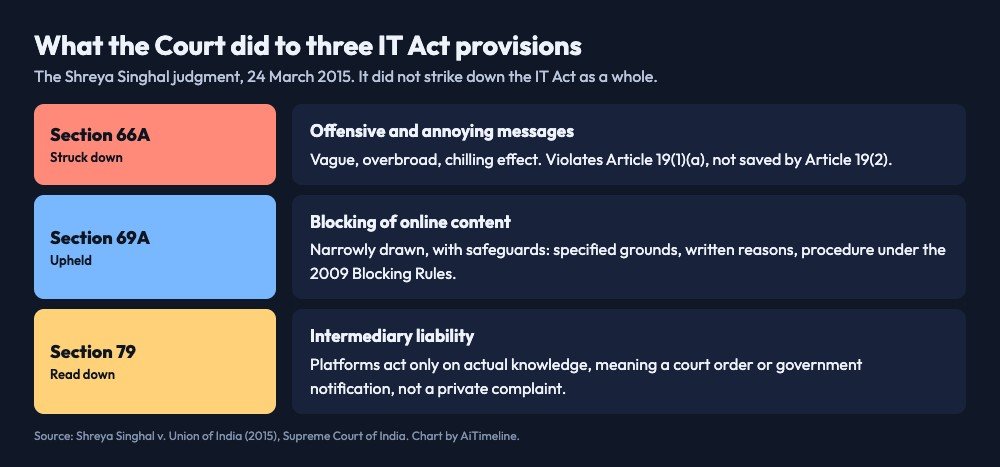
| Provision | What it covers | Outcome on 24 March 2015 | Reason |
|---|---|---|---|
| Section 66A | Offensive, annoying or menacing electronic messages | Struck down in full | Vague, overbroad, chilling effect; not within Article 19(2) |
| Section 69A | Government power to block online content | Upheld, with the 2009 Blocking Rules | Specified grounds, written reasons and procedural safeguards |
| Section 79 and Rule 3(4) | Conditional protection for intermediaries | Read down | Actual knowledge means a court order or government notification |
What the Supreme Court Protected: Discussion, Advocacy and Incitement
Article 19(1)(a) guarantees every citizen freedom of speech and expression, and the Court treated that as covering expression on the internet. Article 19(2) lets the State impose reasonable restrictions only on specified grounds. The Court held that Section 66A did not fit within any of them.
The judgment also drew a line between three kinds of expression, which is one of its most quoted passages.
| Type of expression | Constitutional position |
|---|---|
| Discussion | Protected, including on controversial subjects |
| Advocacy | Protected even when the view is unpopular |
| Incitement | Can be restricted, on the grounds in Article 19(2) |
The grounds in Article 19(2) are listed below. A restriction on speech has to fall within one of them, and has to be reasonable.
| Ground in Article 19(2) | Meaning in brief |
|---|---|
| Sovereignty and integrity of India | Speech threatening the unity of the country |
| Security of the State | Serious threats to the State, not mere criticism |
| Friendly relations with foreign States | Speech harming diplomatic ties |
| Public order | Speech with a proximate link to disorder |
| Decency or morality | Obscenity and similar limits |
| Contempt of court, defamation | Existing legal limits on speech |
| Incitement to an offence | Speech that provokes a crime, beyond mere advocacy |
Impact of the Judgment on India’s Digital Landscape
Online speech is constitutionally protected
The ruling confirmed that Article 19(1)(a) covers social media posts, comments and other online expression. Speech does not lose protection because it is on a screen.
Vague criminal laws face scrutiny
The judgment reinforced the principle that a criminal law must be clear enough for citizens to know what is forbidden. It sits alongside other rights cases we cover, such as the right to privacy judgment in Puttaswamy, and the Shayara Bano triple talaq case.
A reference point for internet regulation
Because the Court assessed each provision separately, the case is cited in later debates over blocking, intermediary liability and platform responsibility. For the data-protection side of that debate, see our Safer Internet Day and India’s data protection law timeline.
Implementation is a separate problem
The cases after 2015 show that a constitutional ruling has to be carried into police databases, charge sheets and pending cases. The 2021 advisory and the 2022 directions were attempts to close that gap. Speech-related prosecutions under other laws are a different matter: see, for instance, the Rahul Gandhi defamation case and the Bhima Koregaon case.
The Terms Behind the Judgment
Vagueness
A law is vague when people cannot tell what it forbids. The Court held that Section 66A’s terms left that to the discretion of whoever enforced it.
Vague criminal laws can be applied selectively, and the fear of that can silence speech.
Overbreadth
A law is overbroad when it covers speech that the Constitution allows the State to restrict and speech that it does not, without telling them apart.
Section 66A caught harmless and unpopular speech along with anything that could properly be punished.
Chilling effect
People may avoid lawful speech when they fear arrest or prosecution, even if they would never be convicted.
The Court counted that fear as a harm in itself.
Six things often told wrongly about the Shreya Singhal case
- “Two women wrote a Facebook post.” Shaheen Dhada wrote the post. Renu Srinivasan liked it, and was arrested for the like.
- “The Palghar arrests were the first 66A case.” They were not. Cases involving Ambikesh Mahapatra, Aseem Trivedi and Ravi Srinivasan came earlier in 2012, but Shreya Singhal’s petition was prompted by Palghar.
- “The Court struck down the IT Act.” It struck down Section 66A only, upheld Section 69A and read down Section 79.
- “The 2013 arrest rule ended the problem.” The senior-officer approval was an interim measure while the case was pending. The final remedy was the 2015 judgment.
- “After 2015 nobody could be charged under 66A.” Police kept registering such cases. It took the 2021 advisory and the October 2022 order to push the state to act.
- “All online speech is now legal.” Other laws on defamation, intimidation and incitement still apply. Only Section 66A was invalidated.
Explore More Timelines
People Also Ask
Shreya Singhal Case: Frequently Asked Questions
Conclusion: A Landmark Ruling and a Continuing Lesson
The Shreya Singhal case began with two arrests over a Facebook post and a like. It became a constitutional challenge that established that the internet is not outside the protection of fundamental rights, and that laws restricting expression must be precise and fall within Article 19(2).
The later story is as instructive as the verdict. Section 66A kept appearing in police cases for years after it was struck down, and it took an advisory in 2021 and directions in 2022 to push the system to follow the ruling. A right to free speech depends on clear laws, and also on whether the police and courts apply them.
Related AiTimeline Stories
⚠️ Editorial Note
Last updated 1 November 2026. Dates and holdings follow the Supreme Court judgment of 24 March 2015, the Supreme Court order of 12 October 2022, the Press Information Bureau advisory of 14 July 2021 and press reports. Reports differ on some details of the 2012 arrests and on the exact date and wording of the first arrest guidelines; we say so where relevant. This article is informational and is not legal advice.
Sources & further reading
Every dated entry above was checked against these references. Last reviewed 1 November 2026.
- Supreme Court of India: Shreya Singhal v. Union of India, judgment of 24 March 2015 (Indian Kanoon)
- Supreme Court of India: PUCL v. Union of India, order of 12 October 2022 (Indian Kanoon)
- Press Information Bureau: MHA asks states not to register cases under Section 66A, 14 July 2021
- Supreme Court Observer: Implementing Shreya Singhal
- Internet Freedom Foundation: SC direction to stop prosecuting people under Section 66A
- LiveLaw: No person should be prosecuted under Section 66A, 12 October 2022
- Bar and Bench: Arrest under Section 66A to follow Union guidelines, Supreme Court