NAFTA Timeline: How the US, Canada and Mexico Reshaped Trade, Jobs and the USMCA
NAFTA timeline from 1989 to the USMCA review: what changed for trade and jobs, the July 2026 non-renewal, US-Canada tariffs and the 2027 review.
Latest Story
On 1 January 1994 the United States, Canada and Mexico began trading under the North American Free Trade Agreement (NAFTA), removing tariffs and building cross-border supply chains, above all in cars. It became one of the most disputed trade policies in US politics, and USMCA replaced it on 1 July 2020. In 2026 the story turned again: at the first joint review on 1 July the US declined to renew USMCA in its current form, though it stays in force, and a public consultation for the 2027 review is open until 12 January 2027.
💡 Short Answer
NAFTA took effect on 1 January 1994 and was replaced by USMCA on 1 July 2020. USMCA raised car content rules from 62.5% to 75%, added wage-linked and steel rules, stronger labour enforcement and digital trade rules. On 1 July 2026 the US did not agree to renew USMCA in its current form, but the agreement remains in force and is now reviewed every year. NAFTA reshaped where goods were made, with gains and losses spread unevenly.
NAFTA and USMCA: Key Questions
NAFTA to USMCA in Nine Points
- Origins: the 1989 Canada-US deal was widened to include Mexico, with NAFTA signed on 17 December 1992.
- Approval: Congress passed it in November 1993 (House 234-200, Senate 61-38) and it took effect on 1 January 1994.
- Trade effect: US goods trade with Canada and Mexico rose sharply to 2023, though not only because of NAFTA.
- Jobs: gains and losses were uneven; no single figure can be pinned on NAFTA alone.
- Replacement: after the 2016 election, the US reopened talks in August 2017, and USMCA took effect on 1 July 2020.
- Car rules: regional content rose from 62.5% to 75%, with wage-linked and steel rules added.
- 2026 review: on 1 July the US did not agree to renew USMCA in its current form; it remains in force.
- Tariff fight: US-Canada talks collapsed on 21 August 2026 and 50% US tariffs followed; Mexico talks continue.
- Next: public comments close on 12 January 2027 ahead of the next annual review, around 1 July 2027.
NAFTA Timeline: From the 1989 Canada-US Deal to the 2027 Review, Latest First
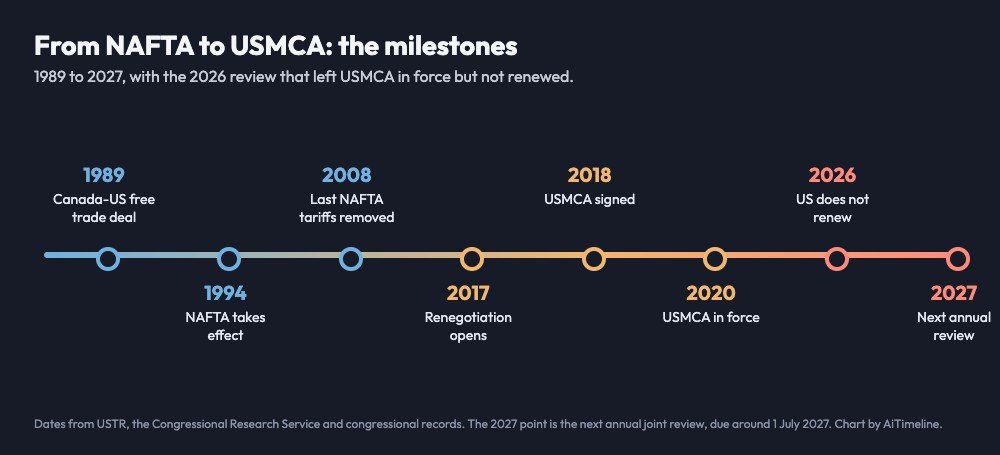
Each entry is colour-coded by period. Dates and figures follow official records and the sources listed below.
Public comments on the 2027 review close Review & tariffs
What is due: Written comments on the operation of USMCA, and requests to appear at the public hearing, are due by 11:59 p.m. Eastern time on 12 January 2027. USTR has said it will announce the hearing date and place later.
What happens after: The comments help set the US position for the next annual joint review, which falls around the agreement’s seventh anniversary on 1 July 2027. Nothing in the process ends USMCA.
Interim deals sought, none announced Review & tariffs
Mexico: Reports on 28 October said Mexico and the US were assessing whether a narrow interim deal was possible before the US midterm elections on 3 November. Mexico’s main requests were tariff relief on autos, steel and aluminium. Both governments said talks were advancing, and no agreement had been announced.
Canada: Talks stayed stalled after the August collapse, though Carney described a slight warming. He said Canada’s position had not changed.
The US aim: US Trade Representative Jamieson Greer has said he wants interim arrangements with both countries by the end of 2026, with harder issues such as rules of origin and labour likely to run into 2027.
USTR opens the public consultation for the 2027 review Review & tariffs
What happened: USTR announced a public consultation “in advance of the 2027 joint review” and, as Congress requires, asked for comments on how USMCA operates. It asked about implementation, compliance problems, specific actions the US should propose at the review, and North American investment and economic security.
Dates: The press release is dated 2 October 2026; the formal Federal Register notice followed on 5 October. Comments are due on 12 January 2027.
Canada’s retaliatory tariffs begin Review & tariffs
What happened: Canada began imposing counter-tariffs, which Prime Minister Mark Carney had announced as “dollar for dollar”. The announced targets included steel, dairy, agricultural equipment and pulp and paper.
Why it matters: The two largest members of USMCA were now taxing each other’s goods at a scale not seen since the agreement began.
US-Canada talks collapse; 50% US tariffs take effect Review & tariffs
What happened: Talks broke down on 21 August. On 22 August the US put 50% tariffs on about US$20 billion of Canadian goods, including wine, furniture, dairy, cement and clothing, under three July proclamations that used Section 338 of the Tariff Act of 1930, an authority the CNBC report says had not been used since 1949.
What each side said: Greer said “Canada declined to finalize the trade deal under the terms agreed earlier this week” and that no new talks were planned. Carney said the US “asked too much and offered too little”. One report said the US had added late demands on auto content, critical minerals and oversight of Canada’s future trade deals; Canada rejected them.
Third US-Mexico round in Mexico City Review & tariffs
What happened: The third round covered autos, steel and aluminium, economic security, labour, agriculture and electronic payment services. Mexico’s Economy Minister Marcelo Ebrard called the steel and aluminium talks “constructive”. No outcomes were announced, and a fourth round was planned for Washington in September.
Earlier rounds: Round one was in Mexico City on 28-29 May and round two in Washington on 16-17 June. Reports said Washington had floated raising the auto regional content requirement to 82% with 50% US content; those proposals were not published by the governments.
First joint review: the US does not renew Review & tariffs
What happened: The three countries held USMCA’s first six-year joint review. The US declined to agree to renew the agreement in its current form. Mexico and Canada both said they supported a new 16-year term.
What it means: USMCA was not cancelled and has not expired. It remains in force “pending resolution of these issues or until the Agreement’s termination”, in Greer’s words. Because not every party confirmed an extension, the three must now hold a joint review every year. If no extension is ever confirmed, the agreement ends on 1 July 2036.
What it was not: It was not a withdrawal notice. Any party can leave on six months’ written notice under the agreement, and none has given it.
Section 232 tariffs reach imported cars and parts Review & tariffs
What happened: The US imposed a 25% Section 232 tariff on imported passenger vehicles and certain parts. The Congressional Research Service says vehicles that meet USMCA rules of origin are taxed only on their non-US content, so qualifying goods are largely, but not entirely, protected.
The scale: CRS reported that about 84% of 2025 US auto imports from Canada and Mexico met USMCA content rules, yet still faced tariff actions of some kind. Earlier in March 2025 the US had also put 25% tariffs on many Canadian and Mexican goods and then exempted USMCA-qualifying goods within days.
USMCA replaces NAFTA Renegotiation
What happened: USMCA entered into force after all three countries finished their approvals. It kept NAFTA’s tariff-free core and changed the rules around it.
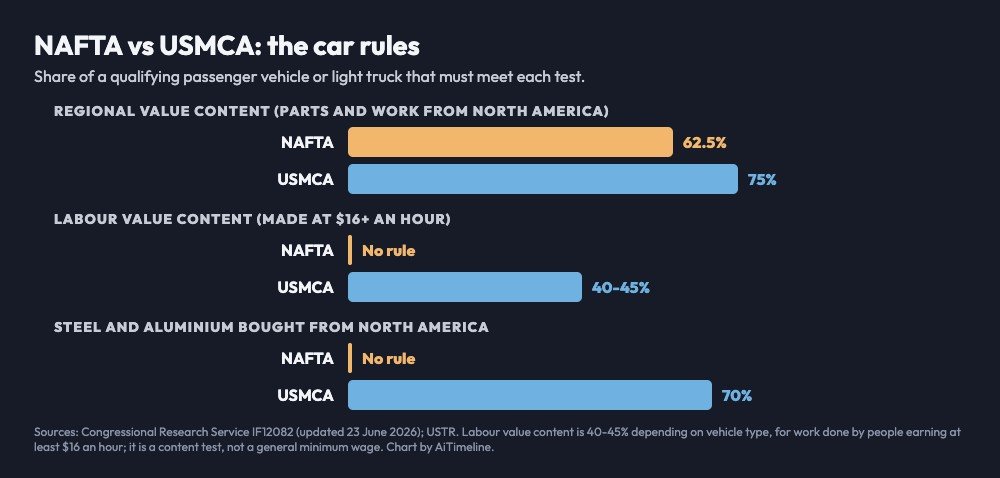
Main changes: Autos needed 75% regional value content instead of 62.5%, plus 40-45% labour value content made by workers earning at least US$16 an hour, and 70% North American steel and aluminium purchases. The deal added a Rapid Response Labour Mechanism for covered Mexican facilities, a digital trade chapter, tougher environmental rules, and the 16-year term with a six-year review.
Also changed: Investor-state arbitration ended between Canada and the US and between Canada and Mexico, and was narrowed between the US and Mexico. The binational panels for anti-dumping disputes (Chapter 19), which Canada called a red line, were kept.
Trump signs the USMCA Implementation Act Renegotiation
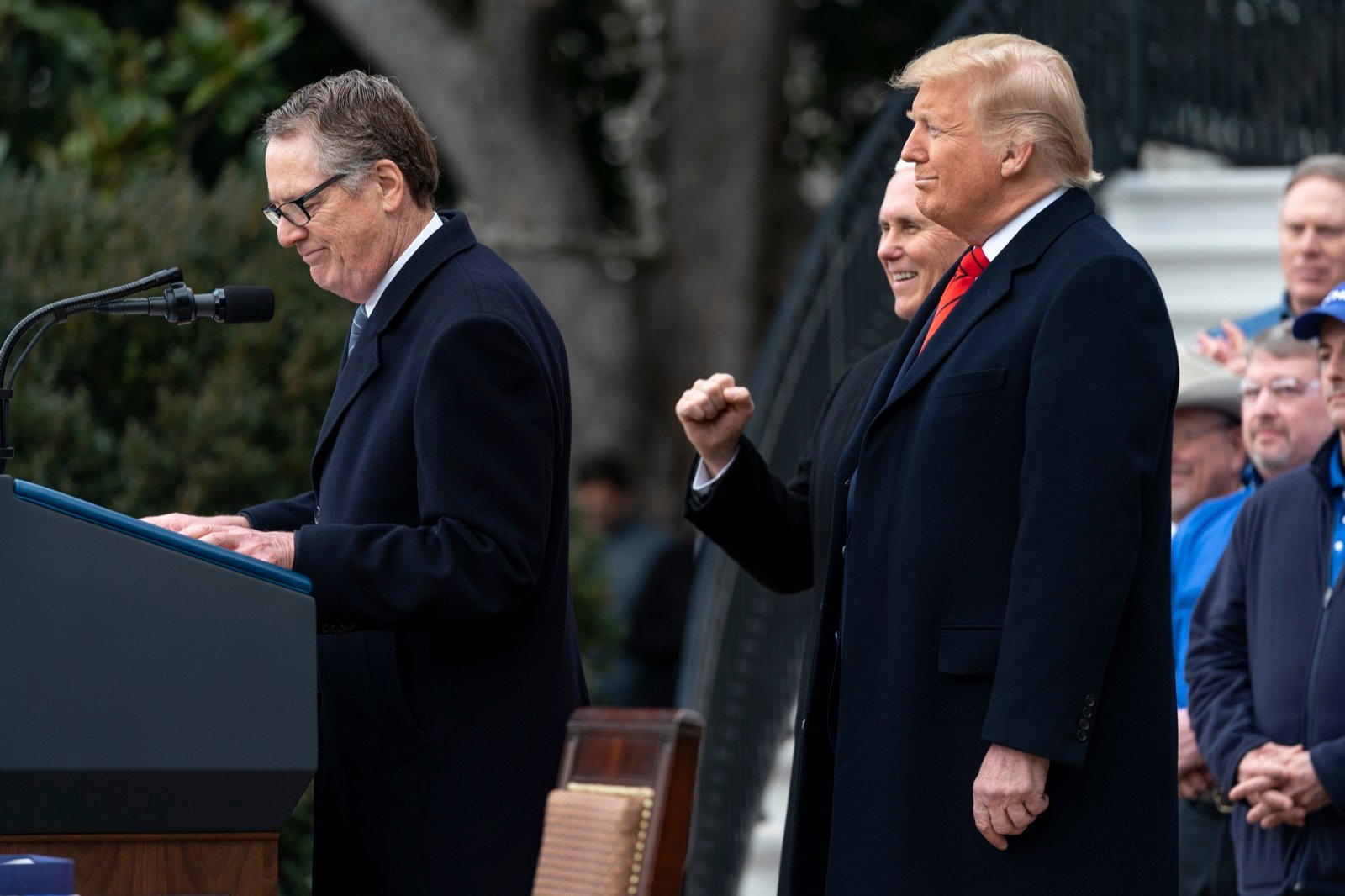
What happened: President Donald Trump signed the law at a White House ceremony after the House voted 385-41 on 19 December 2019 and the Senate 89-10 on 16 January 2020. Canada completed its own approval in March 2020.
Why it mattered: Congress had made its approval depend on stronger labour enforcement in Mexico, which the December protocol delivered.
Protocol of amendment signed Renegotiation
What happened: The three governments signed a protocol that changed the text agreed in 2018. It strengthened labour enforcement, including the Rapid Response Mechanism, tightened environmental commitments, and dropped a proposed 10-year data exclusivity period for new biologic medicines that US House Democrats had opposed.
USMCA is signed in Buenos Aires Renegotiation
What happened: The three leaders signed the agreement on the sidelines of the G20 summit. In the US it is USMCA; Canada calls it CUSMA, and Mexico calls it T-MEC (Tratado entre México, Estados Unidos y Canadá).
What came next: Signing did not bring the deal into force. Each country still had to ratify it, and it took until 2020.
The US reaches deals with Mexico, then Canada Renegotiation
What happened: The US and Mexico announced a preliminary agreement on 27 August 2018, covering autos, labour and rules of origin. Canada, which had been outside the talks for weeks, joined an agreement reached just before a US deadline on 30 September.
Sticking points: Dairy access, dispute settlement and autos were the hardest issues. Canada kept the Chapter 19 panels and opened part of its dairy market to US producers.
Renegotiation talks open in Washington Renegotiation
What happened: Formal talks began 90 days after the Trump administration notified Congress on 18 May 2017 that it intended to renegotiate. The US sought changes to auto rules, dispute settlement, agriculture and a sunset clause.
NAFTA becomes a campaign issue Renegotiation
What happened: Donald Trump campaigned against NAFTA, blaming it for factory closures and for a large trade deficit with Mexico. Supporters of the agreement pointed to export growth and to supply chains that depended on it.
The evidence: The Congressional Research Service has long described NAFTA’s net effect on the US economy as relatively small, because trade with Canada and Mexico was a modest share of US output when it began. Its effects on particular industries and towns were larger, and that is where the political argument took hold.
NAFTA’s last tariffs are removed NAFTA era
What happened: The transition period ended and the last tariffs and quotas, mainly on sensitive farm goods such as corn, beans, sugar and milk powder, were removed.
Who felt it: Mexican maize farmers faced cheaper US imports, one reason farm groups protested the final phase-out. Supporters noted that Mexican exports of fruit, vegetables and manufactured goods had grown.
Mexico’s peso crisis NAFTA era
What happened: Mexico devalued the peso on 20 December 1994, a year after NAFTA took effect, and the currency fell sharply. The US led an international rescue package in early 1995.
Why it matters here: The crisis made NAFTA’s first years look like a loss to critics. It also showed how closely the US and Mexican economies had become linked.
NAFTA takes effect NAFTA era
What happened: NAFTA entered into force and began phasing out tariffs over up to 15 years. Before it, average US duties on Mexican goods were about 2%, while Mexico’s averaged about 10%, and over half of US imports from Mexico already entered duty free.
The same day: The Zapatista National Liberation Army rose in Chiapas on 1 January 1994 and cited NAFTA as a reason, drawing attention to its effect on Mexico’s small farmers.
What it covered: Goods, services, investment, intellectual property, agriculture and dispute settlement, including investor-state arbitration in Chapter 11 and the Chapter 19 panels.
Congress approves NAFTA NAFTA era
What happened: The House passed the NAFTA Implementation Act on 17 November 1993 by 234-200, and the Senate on 20 November by 61-38. President Bill Clinton signed it on 8 December 1993.
The fight: Opposition was bipartisan. Ross Perot warned of a “giant sucking sound” of jobs going south, and the vote needed Republican support to pass.
Clinton adds labour and environment side deals NAFTA era
What happened: To win congressional support, President Clinton negotiated side agreements on labour and the environment. They created commissions but had weaker enforcement than the main text.
NAFTA is initialled, then signed NAFTA era
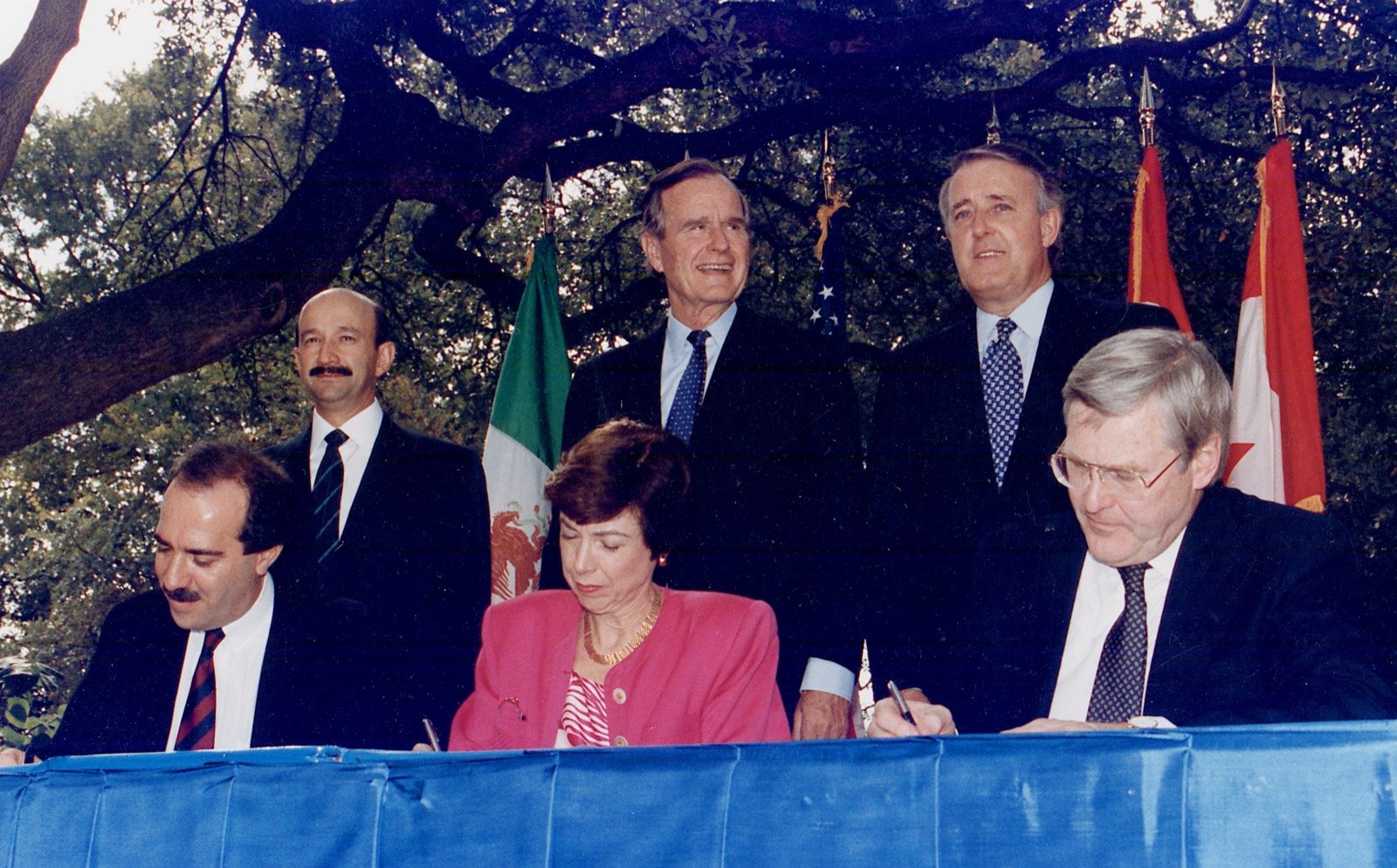
What happened: Trade ministers initialled the text in San Antonio on 7 October 1992 as President George H. W. Bush, Prime Minister Brian Mulroney and President Carlos Salinas de Gortari looked on. The leaders signed it on 17 December 1992, in ceremonies held in their separate capitals.
Politics: Bush signed weeks after losing the November 1992 election, leaving ratification to Bill Clinton.
Canada joins the US-Mexico talks NAFTA era
What happened: The US and Mexico had announced in 1990 that they would negotiate a free-trade agreement. Canada said in February 1991 that it would join, and formal three-country talks opened in Toronto on 12 June 1991.
Why Canada joined: Canada wanted to protect the access it had won in 1989 and avoid a hub-and-spoke system with the US at the centre.
The Canada-US Free Trade Agreement takes effect NAFTA era
What happened: The first modern North American free-trade agreement phased out tariffs between the US and Canada. NAFTA built on its structure and kept its dispute-settlement panels.
NAFTA vs USMCA: What Is the Difference?
The core free-trade structure stayed. The rules for cars, labour and enforcement changed. Car rules apply through detailed product-specific calculations.
| Feature | NAFTA (1994) | USMCA (2020) |
|---|---|---|
| Members | United States, Canada, Mexico | United States, Canada, Mexico |
| Main aim | Remove trade barriers | Update the rules and add enforcement |
| Car content | About 62.5% regional value for passenger vehicles and light trucks | 75% regional value content |
| Car wages | No wage-linked rule | 40-45% labour value content from work paid at least US$16 an hour |
| Steel and aluminium | No equivalent rule | 70% of a vehicle maker’s purchases must originate in North America |
| Digital trade | No digital chapter | Dedicated digital trade rules |
| Labour enforcement | Side agreement with weaker enforcement | Obligations inside the agreement, plus the Rapid Response Labour Mechanism |
| Investor-state arbitration | Chapter 11 among all three | Ended for Canada; narrowed between US and Mexico |
| Duration and review | No end date, no review | 16-year term, six-year joint review, annual reviews if not extended |
How Much Did Trade Grow Under NAFTA and USMCA?
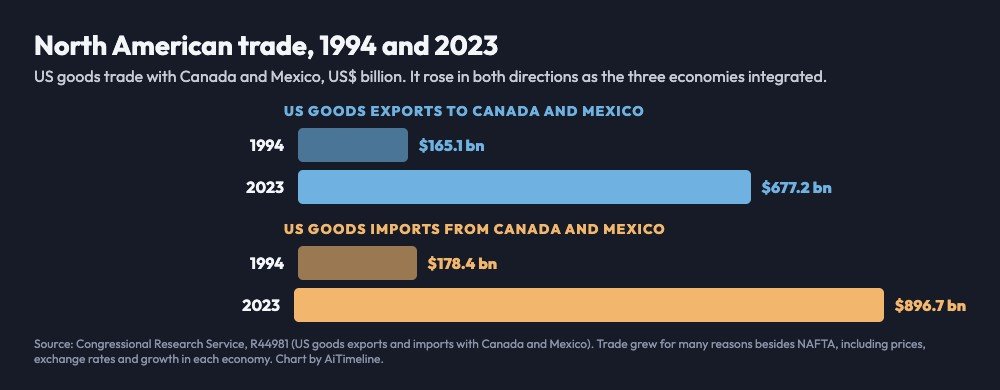
US goods exports to Canada and Mexico rose from US$165.1 billion in 1994 to US$677.2 billion in 2023, and imports from US$178.4 billion to US$896.7 billion, according to the Congressional Research Service. The US ran a goods trade deficit of US$219.5 billion with the two partners in 2023. Foreign direct investment also grew: US investment stock in Mexico rose from US$24.1 billion in 1997 to US$130.3 billion in 2022. Trade increases come from many causes, including prices and growth, so these numbers are not a measure of NAFTA’s effect alone.
How Did NAFTA Affect Jobs in the US, Canada and Mexico?
The effect depended on where firms produced, where consumers bought and how quickly workers could change jobs.
United States: broader markets, uneven local effects
US exporters, farmers and manufacturers gained easier access to Canada and Mexico. Some industries, including parts of textiles, apparel and furniture, faced stronger competition from Mexican production, and some companies reorganised supply chains to move labour-intensive work south. The Congressional Research Service has described NAFTA’s net effect on the US economy as relatively small, with larger effects on particular sectors and regions.
Mexico: a bigger export base, uneven gains
Mexico became a larger manufacturing and export platform. Its exports of goods and services rose from 13% of GDP in 1994 to 36% in 2023, according to the Congressional Research Service. Some workers entered export supply chains, while small farmers and local firms faced more imports, and higher output did not automatically bring high wages.
Canada: a deeper integrated market
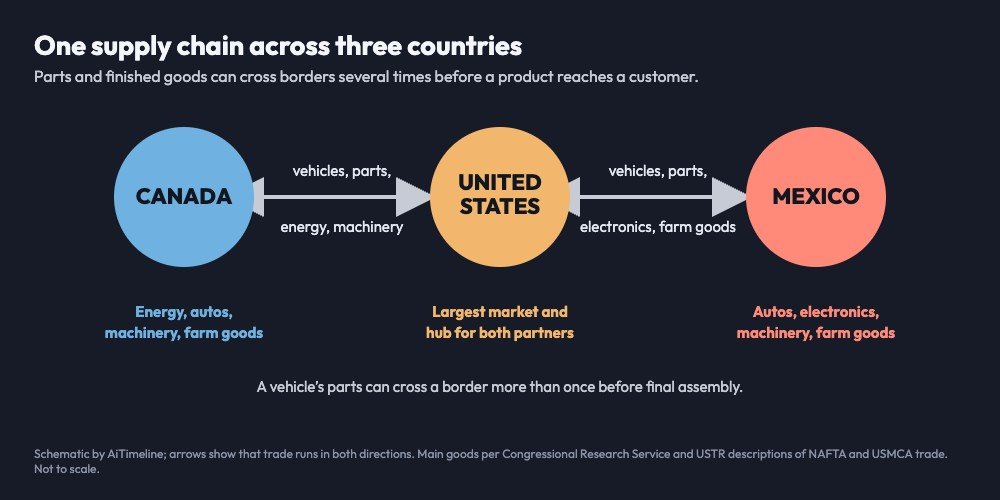
Canada was already closely tied to the US before NAFTA. The agreement widened cross-border manufacturing and farm trade, mainly in autos, and added competition for Canadian producers.
Did NAFTA create or destroy jobs?
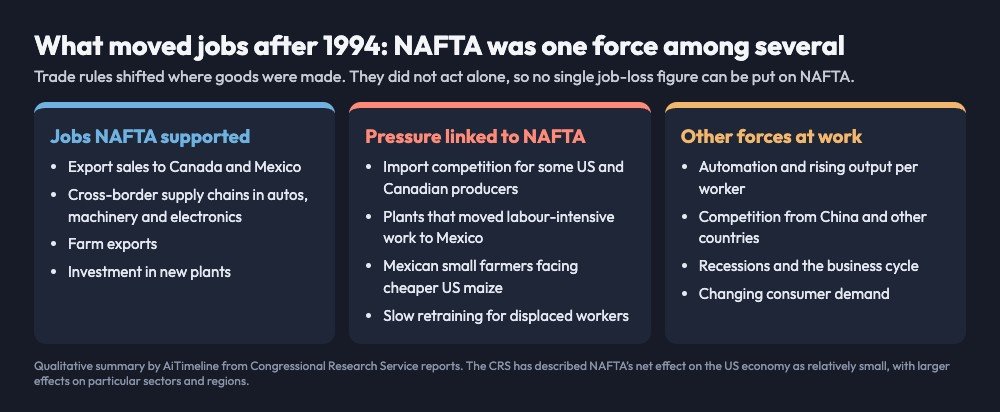
It did both, and no reliable single number captures the net result. A careful assessment separates four things: jobs linked to rising exports, jobs lost to import competition, jobs affected when firms reorganised production across borders, and changes caused by automation and other forces. A firm adding export jobs and a rival cutting staff because of imports can both be telling the truth.
It would also be wrong to put every US manufacturing job lost after 1994 down to NAFTA. China joined the World Trade Organization in 2001, productivity rose, and recessions hit factories hard. The most defensible reading is that NAFTA changed where goods were made and how firms organised production, and that its gains and costs were spread unevenly among workers, industries and regions. For a later case of the same pattern, see how the China export boom is affecting consumer spending.
| Question | Who benefited or was hurt | Evidence and caution |
|---|---|---|
| US exporters and farmers | Gained access to Canada and Mexico | US goods exports to both rose from US$165.1bn (1994) to US$677.2bn (2023), but rising trade has many causes |
| Communities reliant on labour-intensive plants | Faced import competition and relocation | Hard to isolate from automation, China’s rise and recessions |
| Mexican manufacturing workers | Gained export jobs | Wages and development stayed uneven across regions |
| Mexican small farmers | Faced cheaper US imports, notably maize | Protests peaked around the final 2008 phase-out |
| Canadian exporters and auto plants | Gained a larger market and a deeper supply chain | Also faced more competition inside it |
Why Did the United States Replace NAFTA?
NAFTA became a central issue in the 2016 US presidential campaign. Critics said it pushed factory jobs to Mexico, widened the trade deficit and did too little for workers. Supporters said it improved North American competitiveness, expanded exports and made supply chains more efficient.
The Trump administration’s renegotiation aimed to raise North American content in autos, address wage gaps and labour enforcement in Mexico, open Canada’s dairy market, add rules for digital trade and update dispute settlement. The result, USMCA, kept most of NAFTA’s tariff-free structure while adding obligations and enforcement tools. For earlier US-Canada tariff disputes, see our US-Canada tariffs timeline.
The Terms Behind the Headlines: Content Rules, the US$16 Wage Test and the Joint Review
Regional value content
A car qualifies for tariff-free trade only if enough of its value comes from North America. The 75% threshold is a share of the vehicle’s value, worked out under detailed product-specific formulas.
It does not mean every component must be made in the region, and it does not say a car is 75% American.
The US$16 an hour rule
USMCA requires 40-45% of a qualifying vehicle’s value to come from work paid at least US$16 an hour. The share depends on the vehicle type.
It is a calculation for car production, not a minimum wage for every worker in North America.
The joint review
Under Article 34.7, the agreement ends 16 years after it took effect unless every party confirms it wants a new 16-year term. The first review fell on 1 July 2026.
If any party does not confirm, the three hold a review every year. The agreement stays in force meanwhile and ends on 1 July 2036 if no extension is confirmed.
What Happens Next for USMCA?
Both processes now run on parallel tracks. The US is gathering public comments until 12 January 2027 for the next annual review, around 1 July 2027. It is also negotiating bilaterally, with Mexico on a narrow interim deal while talks with Canada have been stalled since the August collapse. Greer has said he wants interim arrangements by the end of 2026, while harder questions are expected to run into 2027.
The issues likely to dominate are:
- Auto rules of origin and regional supply chains, including the higher content levels the US reportedly floated.
- US tariffs on Canadian and Mexican goods, and the legal authorities used to impose them.
- Labour standards and enforcement, especially in Mexico.
- Agricultural access, including Canada’s dairy market.
- Critical minerals, energy and manufacturing, and competition from non-regional suppliers such as China.
The US political calendar matters too: the 3 November 2026 midterms, covered in our midterms explainer, shape how much room the administration has to compromise. The biggest practical effect is uncertainty. Firms planning plants and sourcing need stable rules on tariffs and market access, and the volatility in global container freight costs already makes those decisions harder.
Six things often told wrongly about NAFTA and USMCA
- “USMCA expired or was cancelled in 2026.” It did not. On 1 July 2026 the US declined to agree to renew it in its current form. The agreement remains in force and moves to annual reviews, ending on 1 July 2036 if no extension is confirmed.
- “NAFTA alone cost the US X million jobs.” No credible single figure exists. Automation, China’s rise and recessions also cut manufacturing jobs, and NAFTA also supported export jobs.
- “The US$16 rule is a minimum wage for North America.” It is a labour value content test for qualifying vehicles, not a wage law.
- “75% means every part is made in North America.” It is a regional value content requirement for the vehicle, not a per-part rule.
- “Mexico also calls it USMCA.” Mexico uses T-MEC; Canada uses CUSMA.
- “The 2027 review is a new six-year review.” Because the 2026 review did not confirm an extension, the next ones are annual. The next falls around 1 July 2027.
Explore More Timelines
People Also Ask
NAFTA and USMCA: Frequently Asked Questions
Conclusion: From Free Trade to a Fight Over the Rules
NAFTA made North America a deeply connected manufacturing and trading region. It expanded markets and let companies build supply chains across three countries, but the gains were uneven, and some workers and communities bore real costs. USMCA tried to answer those concerns without breaking up the integrated economy.
The 2026 review shows that argument is not over. The US did not renew USMCA in its current form, the agreement remains in force, and the next chapter will be settled through annual reviews, tariff talks and interim deals. The question is whether the three countries can keep the benefits of regional trade while answering demands for better jobs, fairer competition and economic security. NAFTA built the North American trade system; USMCA is the effort to rewrite its rules. For other trade fights see our history of US secondary sanctions and the India-UK free trade agreement.
Related AiTimeline Stories
⚠️ Editorial Note
Last updated 31 October 2026. Dates and figures follow the Office of the US Trade Representative, the Congressional Research Service, congressional records and contemporaneous reporting (CNBC, the Globe and Mail, US News, the Americas Society/Council of the Americas). Developments in the US-Mexico and US-Canada talks are moving; check the sources for later news. We do not attribute a specific number of job losses to NAFTA, because studies differ by period, industry and method. Where our brief or popular accounts differed from the record, we followed the record; see “Common mix-ups”. Articles here are informational and not investment or trade advice.
Sources & further reading
Every dated entry above was checked against these references. Last reviewed 31 October 2026.
- USTR: North American Free Trade Agreement (NAFTA)
- Congressional Research Service: The United States-Mexico-Canada Agreement (R44981)
- USTR: United States-Mexico-Canada Agreement
- Congressional Research Service: USMCA Automotive Rules of Origin (IF12082, updated 23 June 2026)
- USTR: Statement on the USMCA Joint Review (1 July 2026)
- USTR: Public comment sought for the 2027 USMCA Joint Review (2 October 2026)
- Americas Society/Council of the Americas: Tracking US-Mexico talks in the USMCA review
- CNBC: US-Canada trade talks collapse, ushering in new tariffs (22 August 2026)
- The Globe and Mail: US aiming for interim deals with Canada and Mexico by year end