Jessica Lall: The Murder Case That Changed India’s Justice Debate
Follow the Jessica Lall murder case from the 1999 Delhi shooting to the 2006 conviction, 2010 Supreme Court verdict and witness-protection debate.
Latest Story
At about 2 am on 30 April 1999, at a crowded party in a South Delhi restaurant, Jessica Lall refused to serve a man a drink because the bar had run dry. He fired one shot at the roof and another at her head. Dozens of people were there. Seven years later a trial court acquitted everyone accused. The Jessica Lall murder case became the case in which a country refused to accept that verdict: the Delhi High Court reversed it within ten months, the Supreme Court upheld the life sentence of Manu Sharma in 2010, and the witnesses who changed their stories were themselves taken to court.
💡 Short Answer
Jessica Lall, 34, was shot dead at a Delhi restaurant bar on 30 April 1999 after refusing Manu Sharma a drink. A trial court acquitted all nine accused on 21 February 2006 after key witnesses turned hostile. The Delhi High Court convicted Sharma of murder on 18 December 2006 and gave him life; the Supreme Court upheld that on 19 April 2010. He was released early on 1 June 2020; the conviction stands.
Jessica Lall Case: Key Questions
The Case in Ten Points
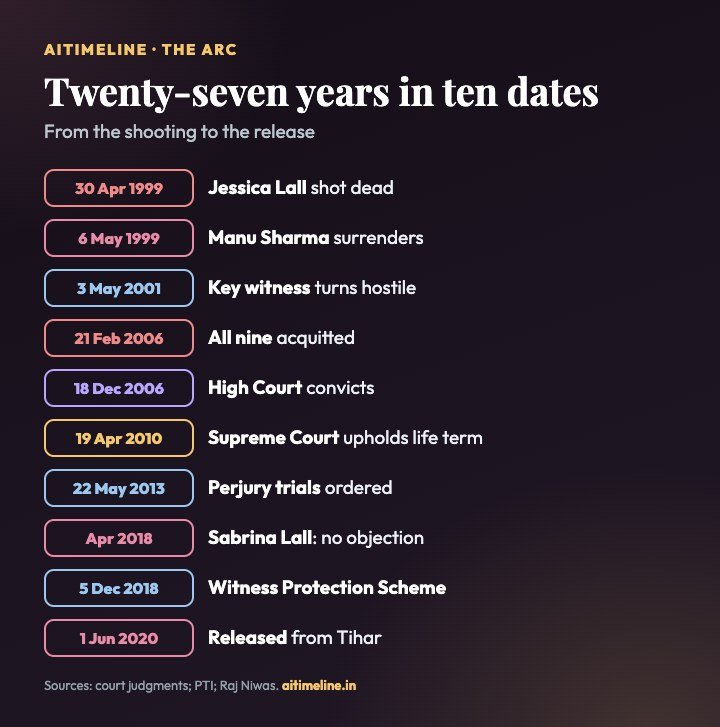
- The shooting: about 2 am on 30 April 1999, over a refused drink, at the Qutub Colonnade.
- The surrender: Manu Sharma gave himself up to police in Chandigarh on 6 May 1999.
- The witness: Shayan Munshi, whose statement was the FIR, turned hostile on 3 May 2001.
- The acquittal: all nine accused freed on 21 February 2006.
- The outrage: vigils, petitions and the headline “No One Killed Jessica”.
- The reversal: life for Manu Sharma from the Delhi High Court in December 2006.
- The final word: the Supreme Court dismissed all three appeals on 19 April 2010.
- Perjury: two witnesses sent for trial in 2013; the ballistic expert cleared in 2016.
- Forgiveness: Sabrina Lall told Tihar in 2018 she had no objection to his release.
- Release: 1 June 2020, after nearly 17 years in custody; the conviction stands.
Timeline: From a Refused Drink to the Supreme Court
Newest first. Colour shows which part of the case each event belongs to.
Where the case stands: the conviction is final Prison, parole and release
The murder case: Closed. The Supreme Court’s judgment of 19 April 2010 upholding Manu Sharma’s conviction for murder and his life sentence is the last word on guilt. The convictions of Vikas Yadav and Amardeep Singh Gill for destroying evidence were upheld in the same judgment.
The release: Manu Sharma has been out of prison since 1 June 2020 on a premature release approved by Delhi’s Lieutenant Governor. Premature release from a life term does not cancel or reduce a conviction.
Manu Sharma walks out of Tihar on premature release Prison, parole and release
The decision: The Sentence Review Board, chaired by Delhi Home Minister Satyendar Jain, recommended his release at a meeting on 11 May 2020. The Lieutenant Governor concurred on 21 May, and the order covered 19 prisoners in all. Sharma, already out on parole under Tihar’s Covid-19 decongestion measures, was formally released on Monday, 1 June.
Time served: According to the Lieutenant Governor’s office, he had served 16 years, 11 months and 24 days in actual custody, and 23 years, 4 months and 22 days counting remission.
Sharma goes to the High Court over his rejected release Prison, parole and release
The plea: His lawyer told the Delhi High Court that the Sentence Review Board had turned him down four times despite a record of good conduct in prison. The court listed the plea for hearing in February 2020.
Background: He had been moved to Tihar’s semi-open jail in 2017 and had been granted parole several times, including to sit law examinations.
Supreme Court approves a national witness protection scheme Hostile witnesses and perjury
The scheme: The Witness Protection Scheme, 2018 provides for threat assessment, concealing a witness’s identity, relocation, and police protection where needed. The court directed that it be enforced across India until Parliament enacts a law.
The link: The case arose from a different trial. But Jessica Lall’s case, in which the key eyewitness turned hostile, was a fixture of the public argument that led there.
Sabrina Lall says she has no objection to his release Prison, parole and release
The letter: Jessica’s sister, who had led the family’s fight for a conviction, wrote that she had no objection to Manu Sharma being released, citing the years he had spent in prison and his work with a welfare trust for prisoners’ children.
Why it mattered: The views of a victim’s family are among the factors a sentence review board considers. Sabrina Lall later said she had forgiven him.
Supreme Court quashes the ballistic expert’s perjury case Hostile witnesses and perjury
The finding: The court held that ballistic expert Prem Sagar Manocha had only answered a specific question put to him at trial, that he could not be said to have deliberately lied, and that the mere rejection of an expert’s opinion does not justify perjury proceedings.
The background: Manocha had been accused of supporting the defence’s “two-weapon” theory, that the two empty cartridges were fired from different guns.
Perjury complaints filed; Munshi granted bail Hostile witnesses and perjury
The complaints: Acting on the High Court’s order, its Registrar General filed perjury complaints against Shayan Munshi and Prem Sagar Manocha before the Chief Metropolitan Magistrate in 2013.
Munshi: A Delhi court later granted Munshi bail in the perjury proceedings. Being sent for trial on a perjury complaint is not a finding that he lied.
High Court orders perjury trials for Shayan Munshi and a ballistic expert Hostile witnesses and perjury
The order: The bench directed that Munshi, the man whose statement formed the FIR, and ballistic expert Prem Sagar Manocha be prosecuted for giving false evidence, an offence carrying up to seven years. It absolved 17 other witnesses.
Witness protection: The court asked the Delhi government to put a witness protection policy in place within ten weeks, and referred the wider question to the Chief Justice to be heard as a public interest litigation.
High Court reserves its order on the hostile witnesses Hostile witnesses and perjury
The hearing: The prosecutor sought the trial of 19 witnesses, including Munshi, after the court had discharged ten others whose testimony showed no major deviation. Of the witnesses who had turned hostile, three had died.
The question: Whether witnesses who change their account in court should face prosecution, or whether that would deter people from testifying at all.
Supreme Court upholds the life sentence Appeals: High Court and Supreme Court
The verdict: The court dismissed all three appeals: Manu Sharma’s against his murder conviction and life sentence, and those of Amardeep Singh Gill and Vikas Yadav against their convictions for destroying evidence.
The evidence: It held that eyewitness testimony, the evidence linking the vehicles and cartridges to Sharma, and his conduct after the shooting proved his guilt beyond reasonable doubt. It called the forensic laboratory reports vague and did not rely on them.
Media trials: The judgment warned that “trial by media should be avoided” and that the presumption of innocence must not be destroyed by coverage of a pending case.
Final hearing in the Supreme Court Appeals: High Court and Supreme Court
The hearing: Arguments on the appeal began on 19 January 2010, and the court reserved its judgment on 18 February.
The defence: Sharma’s lawyers argued that the prosecution had suppressed a ballistic report favourable to him, that witnesses had been pressured, and that media coverage had prejudiced the High Court.
Parole row: Sharma seen at a nightclub, returns to Tihar early Prison, parole and release
The parole: Sharma was released on parole on 22 September 2009, reportedly on the ground of his mother’s illness. He was then reported to have been seen at a Delhi hotel nightclub.
The return: After public criticism, he went back to Tihar on 10 November, about 12 days before his parole was due to end, and the Delhi government asked the police to look into the allegations.
Supreme Court admits the appeal and twice refuses bail Appeals: High Court and Supreme Court
The appeal: Sharma filed his appeal on 2 February 2007. The court admitted it on 8 March 2007.
Bail: His bail pleas were rejected on 27 November 2007 and again on 12 May 2008.
Life sentence for Manu Sharma Appeals: High Court and Supreme Court
Manu Sharma: Life imprisonment for murder, with a fine of Rs 50,000 to be paid to Jessica’s family, along with sentences for the evidence and Arms Act offences.
Gill and Yadav: Amardeep Singh Gill (Tony Gill) and Vikas Yadav were each given four years’ rigorous imprisonment and a fine of Rs 2,000 for destroying evidence under Sections 201 and 120B.
High Court reverses the acquittal Appeals: High Court and Supreme Court
The verdict: The court convicted Manu Sharma of murder under Section 302 and of offences under Sections 201 and 120B and the Arms Act, and convicted Gill and Yadav of destroying evidence. The other six accused were acquitted.
The reasoning: It found the trial court had misread the evidence of the witnesses who placed Sharma at the bar, and drew an adverse inference from his conduct after the shooting, including his flight and his refusal to join a test identification parade.
The witnesses: The court took suo motu notice of the prosecution witnesses who had turned hostile, beginning the perjury proceedings.
A sting operation puts the hostile witnesses on camera Hostile witnesses and perjury
The sting: Tehelka broadcast a months-long undercover investigation alleging that three key witnesses, Shayan Munshi, Karan Rajput and Shiv Das, had been induced to change their testimony.
The response: A police special investigation team collected the tapes in late September 2006 as the High Court appeal was being heard.
Delhi Police appeals to the High Court Appeals: High Court and Supreme Court
The appeal: Under public pressure and on the advice of its prosecutors, the Delhi Police challenged the acquittal of all nine accused in the Delhi High Court in March 2006.
The speed: The court agreed to hear the appeal on priority and later on a day-to-day basis.
“No One Killed Jessica”: the public reacts Trial and acquittal
The protests: Candlelight vigils at India Gate, SMS and email petitions run by news channels, and a newspaper headline, “No One Killed Jessica”, turned the verdict into a national story.
The argument: Protesters asked how a woman could be shot in front of a crowded bar and nobody be found responsible, and whether money and political influence had turned witnesses.
Trial court acquits all nine accused Trial and acquittal
The verdict: The court acquitted Manu Sharma and the eight other accused, holding that the prosecution had not proved its case beyond reasonable doubt.
The gaps: It pointed to the eyewitnesses who did not support the prosecution, the failure to recover the murder weapon, and ballistic evidence suggesting the two cartridges came from two different guns.
The trial: 101 prosecution witnesses Trial and acquittal
The evidence: The trial of nine accused opened in May 2001. In all, 101 prosecution witnesses and two court witnesses were examined. Several, including Munshi, did not support their earlier statements.
The identifications: Restaurant owner Bina Ramani, her daughter Malini Ramani and husband George Mailhot all testified and identified Manu Sharma as the man at the bar that night.
Shayan Munshi turns hostile Hostile witnesses and perjury
The testimony: Munshi, the bartender beside Jessica and the man whose statement was the FIR, did not support the prosecution. He said the statement had been recorded in Hindi, which he did not understand, and did not identify Manu Sharma as the gunman.
The lawyer: He arrived with an advocate, Ashok Bansal, who had appeared as proxy counsel for Manu Sharma in a bail hearing in March 2000. The Supreme Court later treated this as a sign the witness had been influenced.
Charges framed against nine accused Trial and acquittal
Manu Sharma: Murder under Section 302, destruction of evidence and conspiracy under Sections 201 and 120B, and Section 27 of the Arms Act.
The others: Vikas Yadav, Tony Gill and Alok Khanna were charged with destroying evidence. Four others, including Harvinder Chopra and Yograj Singh, were charged with harbouring an offender under Section 212.
Police file the chargesheet The killing and investigation, 1999
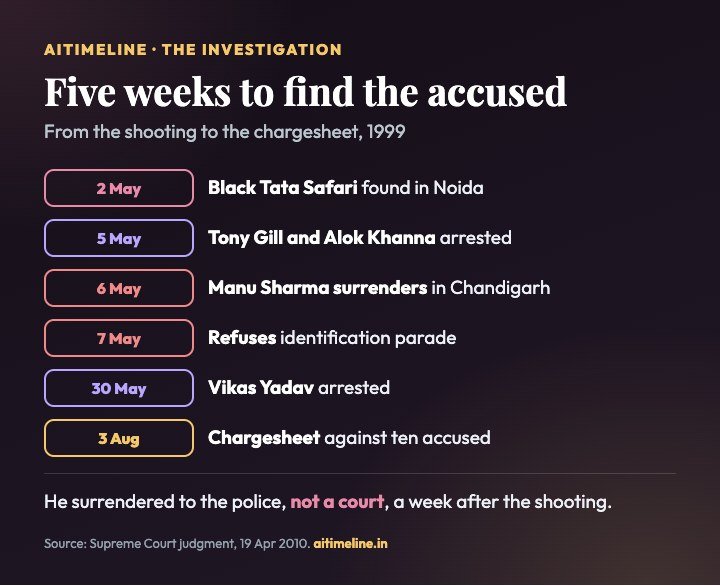
The chargesheet: The police chargesheeted ten people: Manu Sharma for the murder, his friends for helping him escape and destroy evidence, and others for harbouring him.
The weapon: The pistol used in the shooting was never recovered.
Manu Sharma surrenders in Chandigarh The killing and investigation, 1999
The surrender: After Tony Gill and Alok Khanna were arrested at about 2:30 am on 5 May, police in Chandigarh told Sharma’s lawyer he was wanted. He surrendered to the police team on 6 May and was arrested at about 2:20 pm.
The parade: He refused to take part in a test identification parade on 7 May. Vikas Yadav was arrested on 30 May.
The black Tata Safari is found in Noida The killing and investigation, 1999
The car: The black Tata Safari Sharma had arrived in, registered to a company of which he was a director, was found by the Uttar Pradesh police in Noida on 2 May and handed to the Delhi Police the next day.
The trail: Prosecution witnesses said Vikas Yadav and Tony Gill had driven the Safari away from the Qutub Colonnade in the early hours after the shooting.
Jessica Lall declared dead; FIR registered The killing and investigation, 1999
The death: Jessica, 34, was taken first to Ashlok Hospital and then to Apollo Hospital, where she was declared brought dead in the early hours. A post-mortem was carried out at AIIMS that morning.
The FIR: FIR No. 287/99 was registered at about 4 am at Mehrauli police station, based on the statement of Shayan Munshi. Two empty cartridges were recovered from the spot.
Shot for refusing a drink The killing and investigation, 1999
The party: On the night of 29-30 April a private “Thursday party” was being held at the restaurant, also called the Tamarind Cafe. Jessica Lall and Shayan Munshi were serving at the bar.
The shooting: At about 2 am Manu Sharma arrived with friends and asked for two drinks. Told the party was over and there was no liquor left, he took out a pistol, fired one shot at the roof and another at Jessica, hitting her near the left eye.
The escape: Bina Ramani confronted him and demanded the gun. He did not hand it over, and left.
Acquittal to Life Sentence: The Four Decisions
The outcome changed once. It has not changed since.
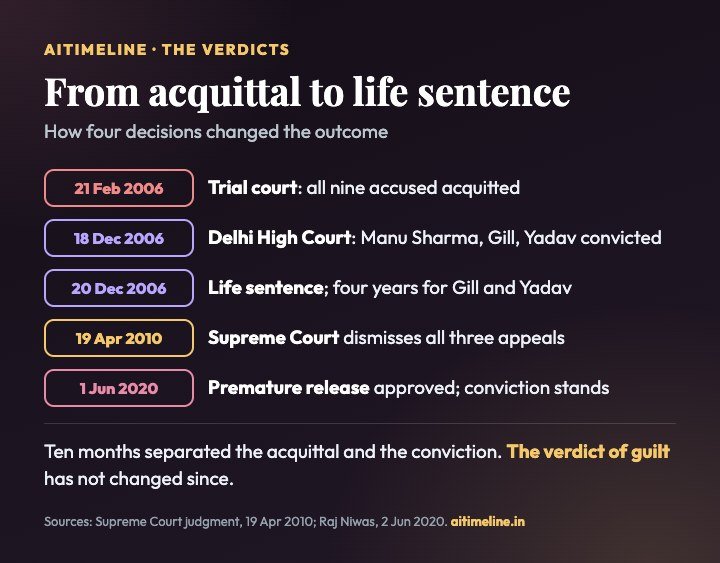
| Date | Court or authority | Outcome |
|---|---|---|
| 21 Feb 2006 | Sessions Court (ASJ S.L. Bhayana) | All nine accused acquitted |
| 18 Dec 2006 | Delhi High Court (Sodhi, Bhasin JJ) | Manu Sharma convicted of murder; Gill and Yadav of destroying evidence; six acquitted |
| 20 Dec 2006 | Delhi High Court | Life and Rs 50,000 fine for Sharma; four years each for Gill and Yadav |
| 19 Apr 2010 | Supreme Court (Sathasivam, Swatanter Kumar JJ) | All three appeals dismissed |
| 22 May 2013 | Delhi High Court (Bhat, Mittal JJ) | Perjury trials for two witnesses; 17 absolved; witness protection policy sought |
| 6 Jan 2016 | Supreme Court | Perjury case against ballistic expert quashed |
| 1 Jun 2020 | Sentence Review Board; Lieutenant Governor | Premature release; conviction unaffected |
What Happened at the Qutub Colonnade
As set out in the Supreme Court’s 2010 judgment.
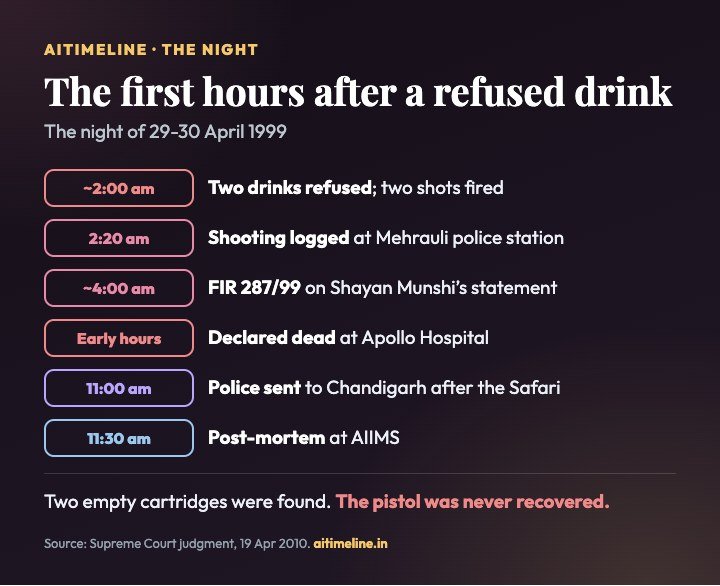
The party was a private “Thursday party” at the “Once Upon a Time” restaurant, also called the Tamarind Cafe, in the Qutub Colonnade at Mehrauli; the open courtyard was known as Tamarind Court. Jessica Lall and Shayan Munshi were tending the bar. At about 2 am Manu Sharma arrived with friends and asked for two drinks. The bar had stopped serving; Jessica and Malini Ramani told him there was no liquor left. He took out a pistol, fired one shot at the roof and a second at Jessica, which struck her near the left eye. Bina Ramani, who ran the restaurant, stopped him and demanded the gun. He kept it and left. Jessica was taken to Ashlok Hospital, then Apollo Hospital, where she was declared brought dead. By morning the black Tata Safari he had come in had been driven away; it turned up in Noida three days later.
Why the Trial Court Acquitted
And why the High Court disagreed.
Trial court, Feb 2006
- Key eyewitnesses did not support the prosecution.
- The murder weapon was never recovered.
- Ballistic opinion pointed to two different guns.
- Links in the chain of evidence were missing.
High Court and Supreme Court
- Seven witnesses placed Sharma at the scene.
- His flight and refusal of an ID parade told against him.
- The Safari and cartridges tied the escape to him.
- Laboratory reports were too vague to rely on either way.
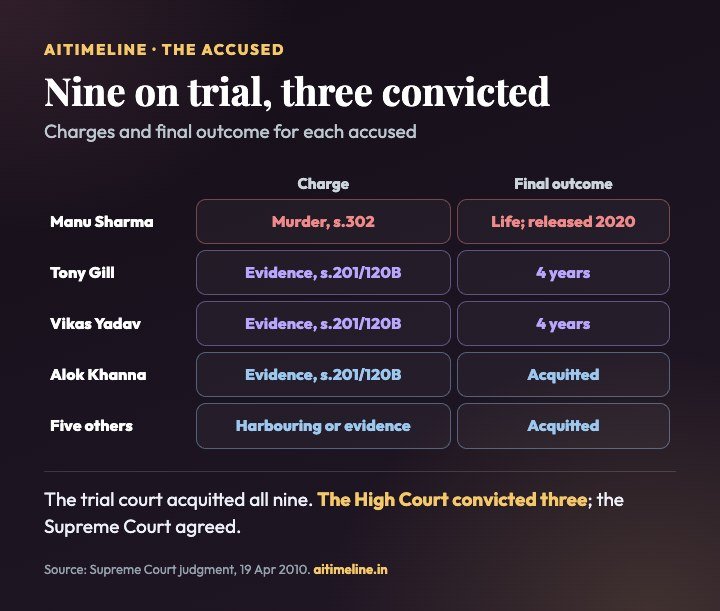
The acquittal was not a finding that Jessica Lall had not been shot by Manu Sharma; it was a finding that the prosecution had not proved it to the criminal standard. The appeal turned on how the evidence should be read. The High Court held that a witness who turns hostile on some points can still be believed on others, and that the testimony of Deepak Bhojwani, the Ramani family and others was enough to place Sharma at the bar with a gun. The Supreme Court added that the test for reversing an acquittal had been met: the High Court had given “cogent and adequate reasons”.
The Hostile Witnesses
From the witness box to perjury proceedings, 2001 to 2016.
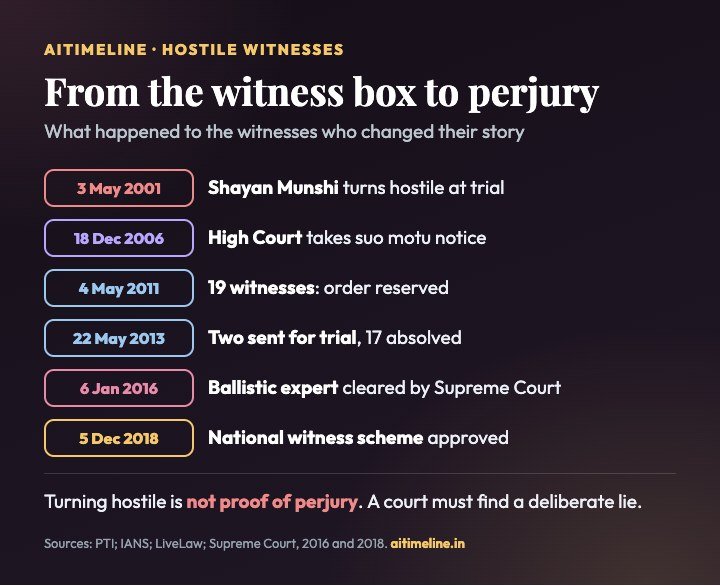
Shayan Munshi was the case’s first witness in every sense: he was beside Jessica at the bar, and his statement was the FIR. In court on 3 May 2001 he said that statement had been written in Hindi, a language he did not understand, and he did not support the prosecution. He arrived with a lawyer who had earlier appeared for Manu Sharma in a bail hearing, a fact the Supreme Court later treated as a sign he had been influenced. In 2013 the High Court sent him and ballistic expert Prem Sagar Manocha for perjury trial. The Supreme Court quashed Manocha’s case in 2016, holding that an expert who answers a question differently from his written report has not necessarily lied. For Munshi, we found no reported verdict.
Media, Protest and the Limits of Pressure
The case India cites both for and against public campaigns.
The campaign
- Vigils at India Gate.
- Media petitions.
- A sting on the witnesses.
The courts
- Day-to-day appeal hearing.
- Verdict on the trial record.
- Upheld on the evidence.
The warning
- Avoid trial by media.
- Protect presumption of innocence.
- Inform, don’t judge.
The public campaign after the acquittal is the most remembered part of the case, and its influence was real: it pushed the Delhi Police to appeal and the High Court to hear the appeal on a day-to-day basis. But the convictions rest on the trial record, not on the protests. The same Supreme Court judgment that upheld the life sentence spent pages warning against trial by media, holding that coverage which destroys the presumption of innocence before a verdict impinges on the accused’s rights under Article 21. The Jessica Lall case is therefore cited on both sides of the argument: as proof that scrutiny can expose a failing system, and as a caution about what happens when the press decides guilt first.
What Changed After Jessica Lall
What the case did, and what it is often wrongly credited with.
Witness Protection Scheme
Approved by the Supreme Court in Mahender Chawla v. Union of India, a different case. Jessica Lall was part of the debate, not the legal origin.
Delhi witness policy
The High Court asked the Delhi government to frame a witness protection policy within ten weeks and opened a public interest case on it.
Prosecuting hostile witnesses
Proceedings under the perjury provisions of the criminal procedure code, now carried into the 2023 Bharatiya Nagarik Suraksha Sanhita, against two witnesses.
Reversing acquittals
The 2010 judgment restated when an appeal court may overturn an acquittal: with compelling and substantial reasons.
Many accounts say the Jessica Lall case changed India’s laws. That overstates it. No statute was enacted because of it. What it did was make the hostile witness a national issue, give the courts a test case for prosecuting witnesses who change their stories, and supply the clearest modern example of an appeal court correcting an acquittal. The national witness protection scheme that followed in 2018 drew on many trials, including this one. The 2016 ruling on the ballistic expert also set a limit: an expert who changes an opinion has not, for that reason alone, committed perjury.
Parole, Forgiveness and Release
A life sentence, served for nearly 17 years.
Manu Sharma’s time in prison produced its own controversies. On parole in 2009, reportedly for his mother’s illness, he was reported to have been seen at a Delhi nightclub, and returned to Tihar early amid criticism. Later paroles carried conditions barring nightclubs. In 2017 he was moved to the semi-open jail. In April 2018 Sabrina Lall, who had campaigned for his conviction for more than a decade, told the prison she had no objection to his release. The Sentence Review Board rejected him several times before recommending release on 11 May 2020; he walked free on 1 June 2020, having served 16 years, 11 months and 24 days in actual custody. The release ended the sentence early. It did not touch the verdict.
Explore More Timelines
People Also Ask
Frequently Asked Questions
Dated facts from the court judgments and contemporary reports, 1999 to 2026.
⚠️ Editorial Note
This account draws on the Supreme Court’s judgment of 19 April 2010 in Sidhartha Vashisht @ Manu Sharma v. State (NCT of Delhi), the Delhi Lieutenant Governor’s statement of 2 June 2020, and reporting by PTI, IANS, LiveLaw, Scroll and others. Checking the brief this page began from against those records: the shooting took place at about 2 am on 30 April 1999, not on 29 April; Manu Sharma surrendered to a police team in Chandigarh, not before a court; he was released on 1 June 2020, not 2 June; the Supreme Court did not rely on the ballistic or laboratory reports, which it called vague; and the convictions of Tony Gill and Vikas Yadav were upheld alongside his. We found no record of a Delhi High Court order of 18 February 2011 reviving perjury proceedings (the court reserved its order on 4 May 2011), and we have not repeated trial-stage witness dates we could not confirm. Status reflects published reports to 7 November 2026, not court dockets.
Related Reading on AiTimeline
Sources & further reading
Every dated entry above was checked against these references. Last reviewed 7 November 2026.
- Sidhartha Vashisht @ Manu Sharma vs State (NCT of Delhi) (judgment, 19 April 2010)
- Premature release of Siddhartha Vashishta @ Manu Sharma (press release, 2 June 2020)
- Jessica Lal murder convict Manu Sharma released from Delhi's Tihar Jail
- Jessica Lal murder convict Manu Sharma released from jail
- Shayan Munshi, another witness to face perjury trial
- Jessica case: Shayan Munshi to be tried for perjury
- Jessica case: HC reserves order on trial of hostile witnesses
- Supreme Court quashes perjury proceedings against forensic expert who turned hostile in Jessica Lal case
- Jessica Lall Case: Murder, a Media Campaign, Justice & Forgiveness
- Manu Sharma returns to Tihar 12 days before parole expiry
- SIT team takes Tehelka tapes for probe
- Jessica Lal murder case: Delhi HC, convict Manu Sharma's plea for release to be heard on 6.02.2020