The Telgi Scam: How Fake Government Stamp Papers Spread Across India
Explore the Telgi stamp paper scam timeline: Abdul Karim Telgi's arrest, the nationwide counterfeit network, the CBI probe, convictions and aftermath.
Latest Story
Every property deed, rent agreement and affidavit in India once ran on paper the government printed and sold. The Telgi stamp paper scam counterfeited that paper on an industrial scale. Investigators said Abdul Karim Telgi, a former fruit seller and Gulf worker from Karnataka, ran a network of about 350 agents who sold fake stamp papers to banks, insurers and brokers, allegedly with help from inside the government’s own security press and from police officers. Telgi was arrested in 2001, convicted case after case, and died in custody in 2017. The officials accused of protecting him mostly walked free.
💡 Short Answer
The Telgi scam was a racket that printed and sold counterfeit stamp papers across India from the early 1990s. It unravelled after arrests in Bengaluru in August 2000; Abdul Karim Telgi was arrested in Ajmer in November 2001. The CBI took over in 2003-04. Telgi was convicted in several states, including a 13-year sentence in Pune on 28 June 2007, and died in Bengaluru on 26 October 2017.
Telgi Stamp Paper Scam: Key Questions
The Scam in Ten Points
- The product: fake stamp papers that looked like the government’s own.
- The start: a stamp-vending licence in 1994 and an office on Mint Road, Mumbai.
- The source: machinery and dies allegedly obtained from the India Security Press, Nashik.
- The market: about 350 agents selling to banks, insurers and brokers.
- The break: two men caught in Bengaluru on 19 August 2000.
- The arrest: Telgi held in Ajmer in November 2001.
- The cover-up claims: a former Mumbai police chief and two MLAs arrested in 2003.
- The handover: 48 cases to the CBI under a Supreme Court order in March 2004.
- The verdicts: Telgi convicted repeatedly; most officials acquitted.
- The end: Telgi died in custody on 26 October 2017, aged 56.
Timeline: From a Licence in 1994 to the Last Verdict in 2018
Newest first. Colour shows which phase each event belongs to.
A year after his death, acquittal in the Nashik railway-yard case Later cases 2009-2018
The verdict: The Nashik sessions court acquitted Telgi and seven others for want of “solid evidence”. The charges against Telgi himself had already abated after his death in October 2017.
The case: The CBI had chargesheeted the case in August 2004. It alleged that Railway Protection Force officers and constables opened sealed packets of genuine stamp papers being moved from the India Security Press to the Nashik railway yard, meant for state treasuries, and sold them to Telgi.
The accused: The seven acquitted with him were RPF officials Rambhau Pawar, Brijkishore Tiwari, Vilaschandra Joshi, Dyaneshwar Barke, Pramod Dahage, Mohammed Sarvar and Vilas More. Charges had been framed in February 2015 and 49 witnesses were examined.
Telgi dies in a Bengaluru hospital Later cases 2009-2018
The death: Police said Telgi died at about 3:55 pm of multi-organ failure. He had been admitted with meningitis a few days earlier and was on ventilator support. He had suffered from diabetes and hypertension for more than 20 years.
His sentence: He had been held in Bengaluru’s Parappana Agrahara Central Prison and was serving prison terms that PTI reported as totalling 30 years of rigorous imprisonment.
High Court clears the two hospital doctors Later cases 2009-2018
The ruling: The Division Bench allowed the appeals of the two former Victoria Hospital doctors convicted in 2007 of issuing a false medical certificate to help Telgi get bail, finding no evidence that they had taken a bribe from him.
Why it matters: It is a reminder that several convictions in the wider scandal did not survive appeal, and that each case has to be judged on its own record.
Convicted of running the racket from prison Later cases 2009-2018
The verdict: The special court convicted Telgi in a case alleging he kept the racket going from prison, acquitted 11 others and later gave him seven more years with a fine of Rs 1 lakh.
A milestone: Deccan Herald reported that with this case the special court had finished hearing all the Telgi cases registered in Karnataka.
Ten years in two Madhya Pradesh cases Later cases 2009-2018
The verdict: The court sentenced Telgi and two associates to 10 years’ rigorous imprisonment and fined each Rs 50 lakh for preparing and selling large quantities of fake stamp papers in Madhya Pradesh, under Sections 120B and 255 of the IPC among others.
How they appeared: Telgi and Sohail Khan joined by video link from a Bengaluru jail, Sheikh from a Pune prison. PTI reported that Telgi had by then been convicted in more than half a dozen cases in several states.
Delhi court: seven years in three cases Later cases 2009-2018
The sentence: Telgi, who had pleaded guilty in April and May 2009, was given seven years’ rigorous imprisonment and a total fine of Rs 1.3 crore in three cases registered by Delhi police stations.
The biggest seizure: One case, registered at Hauz Khas police station in January 2001, involved the recovery of fake stamp papers with a face value of about Rs 211 crore. Eight associates got five years each.
A former police officer convicted with Telgi Later cases 2009-2018
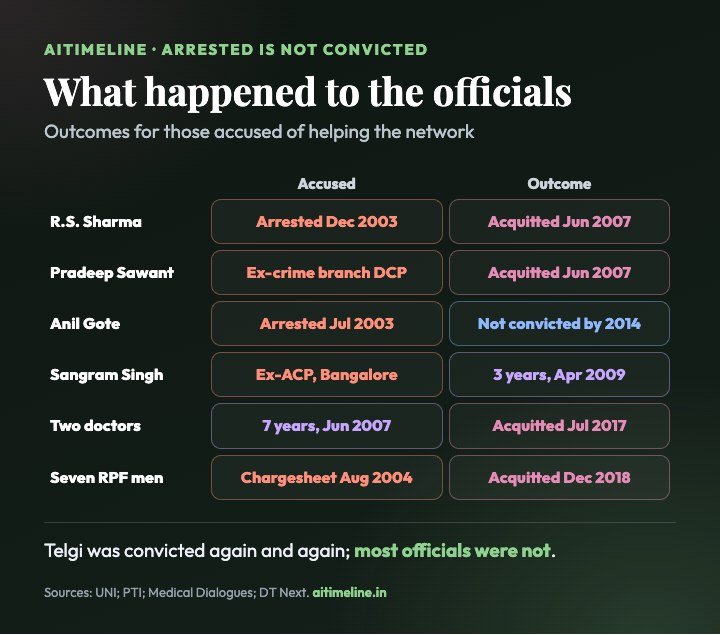
The verdict: Telgi, former Bangalore Assistant Commissioner of Police Sangram Singh and six others were convicted under several IPC sections. Telgi got seven years’ rigorous imprisonment and Singh three years for assisting him.
Why it mattered: It was one of the few cases in which the courts convicted a police officer for helping the network.
Guilty plea, 13 years and a record fine in Pune Convictions 2006-2007
The plea: Telgi broke down in court, pleaded guilty, apologised “to the country” and asked for leniency, citing his HIV-positive status. Forty-two co-accused also pleaded guilty and received terms of one to seven years.
The sentence: He got 13 years’ rigorous imprisonment under MCOCA and the IPC, with the terms running concurrently. Reports of the fine differ: PTI said over Rs 100 crore, UNI an aggregate of Rs 102 crore, and a UNI follow-up the next day put the total at Rs 252.28 crore. Later reports often say Rs 202 crore.
The case: It began with fake stamps and stamp papers seized from a car by Pune’s Bund Garden police in 2002, and was described as the main case of the scandal.
Former Mumbai police chief acquitted Convictions 2006-2007
The verdict: A day before Telgi’s sentence, the same court acquitted former Mumbai Police Commissioner R.S. Sharma for lack of sufficient evidence, and cleared former crime branch DCP Pradeep Sawant and police inspector Vashist Andhale of all charges.
Sharma’s response: Sharma alleged that SIT officers, including O.P. Bali and Subodh Jaiswal, had tried to frame him.
Seven years over a false medical certificate Convictions 2006-2007
The verdict: The court sentenced two former Victoria Hospital doctors to seven years each for issuing a false medical certificate to help Telgi get bail on health grounds, and fined each Rs 14 lakh. Telgi got seven years and a fine of Rs 25 lakh.
On appeal: The Karnataka High Court acquitted both doctors in July 2017.
Fake papers sold to a construction company Convictions 2006-2007
The verdict: Telgi and four others, Mohammed M. Sadiq, Badruddin, Hanif Khan and Ilias Ahmed, were convicted of selling fake stamp papers to a construction company, in a case a city police station had registered in 1999. DNA reported a sentence of 10 years’ rigorous imprisonment.
The pattern: Each buyer’s complaint became a separate trial, which is why Telgi was convicted again and again over the same years.
The Sami Labs case: 10 years in Bengaluru Convictions 2006-2007
The verdict: Convicted the previous day, Telgi and four associates, Badruddin, Irfan Ahmed, Wazir Ahmad Salik and Pradeep Kumar, were sentenced to 10 years and fined Rs 50,000 each.
The case: They were charged with forging documents such as Reserve Bank of India challan receipts and using a fake RBI embossing seal on a sale deed of Sami Labs, a company in the Peenya Industrial Estate. It was one of 28 Karnataka cases investigated by the CBI.
First conviction, in a 1995 Mumbai case Convictions 2006-2007
The verdict: The court sentenced the three men to 10 years in jail and fined them Rs 50,000 each for selling fake stamp papers worth about Rs 16 lakh to the Mumbai solicitors Poonam and Company in 1995.
A first: Telgi, held in Pune’s Yerwada prison, appeared by video link. It was reported as the first case in Mumbai tried entirely through video conferencing; 17 witnesses were examined.
A Rs 120 crore tax demand SITs and CBI 2002-2005
The demand: The tax department raised a demand of about Rs 120 crore against Telgi, described as one of the largest tax liabilities imposed on an individual.
The background: An earlier assessment for 1996-97 had put his annual income at Rs 4.54 crore, nearly half of it, Rs 2.29 crore, marked unaccounted. A claim that the money came from a kerosene transport business was rejected for lack of documents.
Supreme Court sends 48 cases to the CBI SITs and CBI 2002-2005
The order: The court directed 12 states to hand the CBI the complete records of 48 cases it had shortlisted, 23 of them from Maharashtra and 10 from Karnataka, and to give the agency infrastructure and resources. The CBI was asked for a status report within four months.
What followed: In June 2004 a Delhi court remanded Telgi to CBI custody over the recovery of fake stamp papers worth about Rs 220 crore in the capital. In August 2004 the CBI chargesheeted the Nashik railway-yard case.
Karnataka hands its probe to the CBI SITs and CBI 2002-2005
The decision: Karnataka, which had resisted the move for two years, agreed to transfer the investigation, after Finance Minister Jaswant Singh spoke on the scam in the Lok Sabha on 19 December. STAMPIT would continue until the formal handover.
The warning: Kharge said Karnataka had told the Finance Ministry in July 2002 how sensitive machinery from the India Security Press at Nashik had fallen into the wrong hands.
Mumbai’s former police commissioner arrested SITs and CBI 2002-2005
The arrest: The SIT arrested R.S. Sharma, who had retired as Mumbai police commissioner on 30 November, on allegations of helping to shield Telgi. He was reported as the first former police commissioner in Maharashtra arrested under MCOCA.
The allegation: In February 2004 the SIT told a Pune court that Telgi’s narco-analysis test pointed to payments of Rs 22 lakh to Sharma. Sharma denied wrongdoing.
A sitting MLA is arrested SITs and CBI 2002-2005
The arrest: Gote was arrested and held in Pune’s Yerwada Central Jail. He was released on bail in June 2007. The Bombay High Court rejected his plea for discharge in 2011, and by October 2014 he had not been convicted.
The wider net: The SIT, whose work was pushed by a public interest petition by the activist Anna Hazare, went on to arrest 54 people, including Gote and the Telugu Desam Party MLA Krishna Yadav.
Pune seizure, STAMPIT and the Jaiswal report SITs and CBI 2002-2005
In Pune: Bund Garden police seized fake government stamps and stamp papers from a car. That case became the main MCOCA prosecution, which ended with Telgi’s guilty plea in 2007.
In Karnataka: The state set up a dedicated team, STAMPIT, led by IPS officer R. Srikumar.
In Maharashtra: An inquiry report by Subodh Jaiswal, dated to November 2002, examined Telgi’s connections, but little followed until Anna Hazare’s litigation forced the issue in 2003.
Telgi arrested in Ajmer Exposure 2000-2001
The arrest: Police were tipped off that Telgi was travelling to Ajmer on a pilgrimage and arrested him there. He stayed in custody for the rest of his life.
What he said: He initially told police he was a small part of a scam involving high-ranking officials, including police officers and politicians.
Delhi police recover papers worth Rs 211 crore Exposure 2000-2001
The seizure: Delhi police registered a case after recovering fake stamp papers with a face value of about Rs 211 crore, one of the largest single recoveries in the scam.
The outcome: Telgi pleaded guilty in 2009 and was sentenced to seven years in this and two other Delhi cases.
Two men caught in Bengaluru’s Cottonpet Exposure 2000-2001
The arrests: Police arrested two men transporting counterfeit stamp papers. Their interrogation led to raids across Bengaluru that recovered fake stamp papers and other documents worth more than Rs 9 crore.
The suspect: Telgi was named among the suspects but had absconded.
The case that brought his first conviction Origins 1991-1999
The fraud: Fake stamp papers worth about Rs 16 lakh were sold to a firm of Mumbai solicitors. The case reached a verdict only in January 2006.
The warning signs: A Financial Times report cited by Business Standard said at least 12 cases relating to the stamps were registered against Telgi in Maharashtra between 1992 and 2002, plus 15 in other states, without serious action.
A stamp-vending licence and an office on Mint Road Origins 1991-1999
The licence: Telgi acquired a stamp-paper licence and opened an office on Mint Road in Mumbai. PTI reported that he befriended officials in the revenue department, the stamp office and the Nashik press, where stamp papers are printed.
The machinery: Investigators alleged he used political clout to have machinery at the Nashik press declared junk, bought it, installed it in Mumbai, and obtained original printing dies with the help of press security officials.
The shortage: They also alleged his network bribed India Security Press officials to create an artificial scarcity of genuine papers, so that his counterfeits could fill the gap.
From fake travel papers to a Mumbai jail Origins 1991-1999
The background: Born in Khanapur in Belagavi district on 29 July 1961, the son of a railway employee, Telgi sold fruit and vegetables on trains to pay for school, earned a commerce degree in Belagavi, and worked in Saudi Arabia for about seven years.
The first arrest: Back in Mumbai he ran a manpower export firm, Arabian Metro Travels, and was accused of forging passports and documents. Mumbai police arrested him for cheating in 1991; PTI reported he allegedly learnt the trade from an expert forger while in jail.
How the Telgi Scam Worked
The supply chain as investigators described it.
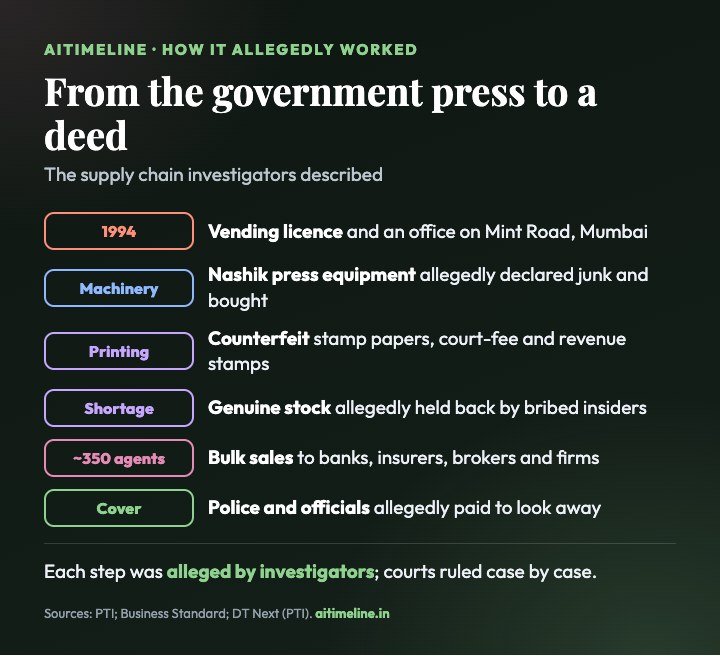
Stamp papers are proof that stamp duty has been paid. Because the government prints them, buyers rarely questioned whether a paper was genuine. That trust was the racket’s raw material. Investigators said Telgi did not simply forge paper: he acquired a vending licence, allegedly bought machinery from the India Security Press in Nashik after it was declared junk, obtained printing dies with insider help, and allegedly worked with press officials to create an artificial shortage of genuine stock so that his counterfeits filled the gap.
The fakes covered non-judicial stamp papers, court-fee stamps, revenue stamps, share transfer stamps, insurance and brokers’ documents. They reached buyers through roughly 350 agents who sold in bulk to banks, insurers, stockbrokers and companies. A separate Nashik case alleged that Railway Protection Force officers stole genuine papers from sealed packets in transit to state treasuries and sold them to Telgi; the court acquitted the officers in 2018.
How Big Was the Telgi Scam?
Four numbers that are often confused.
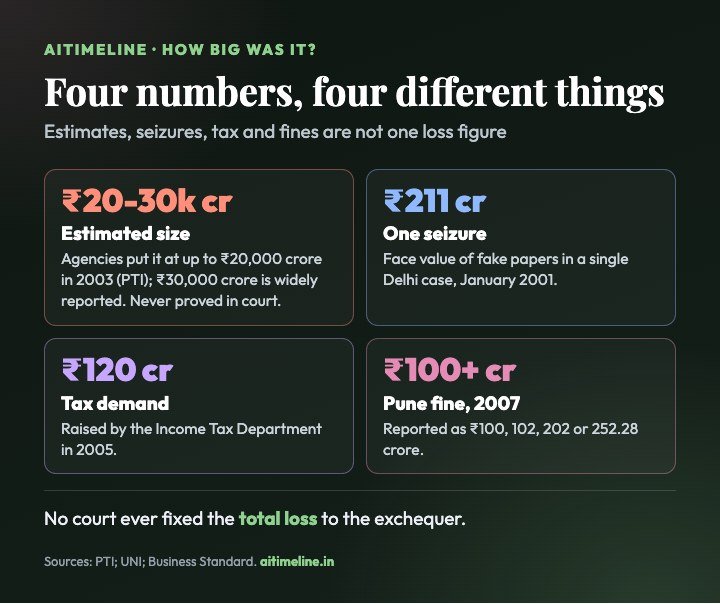
| Figure | What it measures | Source |
|---|---|---|
| Up to Rs 20,000 crore | Security and intelligence agencies’ estimate of the scam in 2003 | PTI, 2017 |
| Over Rs 30,000 crore | The estimate most widely reported; not a court finding | Business Standard, 2023 |
| About Rs 211 crore | Face value of fake papers recovered in one Delhi case, January 2001 | PTI, 2009 |
| More than Rs 9 crore | Fakes recovered in Bengaluru raids after the August 2000 arrests | Business Standard, 2023 |
| About Rs 120 crore | Income tax demand raised in 2005 | Business Standard, 2023 |
| Rs 100 to 252 crore | Fine in the 2007 Pune case, reported differently by different agencies | PTI; UNI |
How the Investigation Unfolded
Separate state teams, then one central agency.
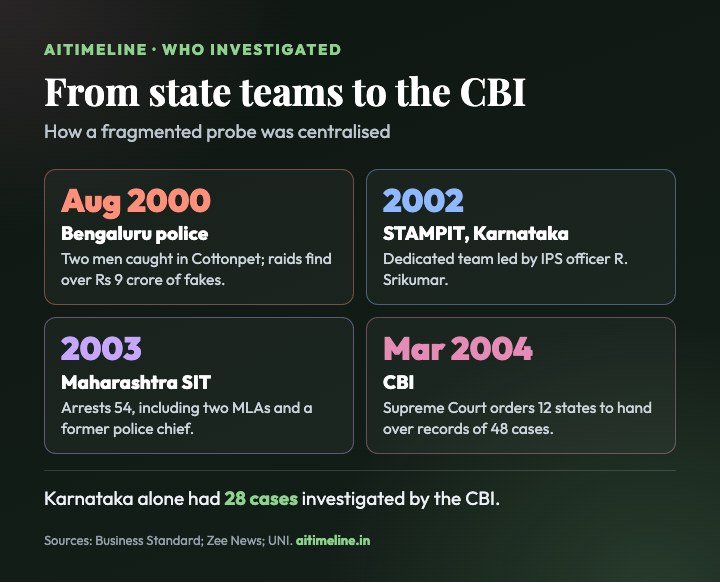
The racket was hard to see whole because it was policed in pieces. A case in Mumbai in 1995, a seizure in Delhi in 2001, a raid in Bengaluru in 2000 and a car stopped in Pune in 2002 were each handled locally. Business Standard, citing a Financial Times report, said at least 12 cases were registered against Telgi in Maharashtra between 1992 and 2002, and 15 elsewhere, without serious action. Karnataka formed STAMPIT under R. Srikumar; in Maharashtra, Anna Hazare’s public interest petition pushed a Special Investigation Team into the conduct of the police themselves. Karnataka agreed to hand its cases to the CBI on 26 December 2003, and in March 2004 the Supreme Court told 12 states to give the CBI the records of 48 cases.
The Officials: Arrested Is Not Convicted
Often claimed
- Senior police and politicians were convicted for protecting Telgi.
- Telgi was sentenced to 30 years in one go.
- The Rs 30,000 crore loss was proved.
- The 2018 acquittal wiped out his convictions.
What the record shows
- The former Mumbai police chief and a DCP were acquitted in 2007; an ex-ACP was convicted.
- Thirty years was PTI’s total across several cases; the largest single term was 13.
- It is an estimate; no court fixed the loss.
- It concerned one Nashik case; the earlier convictions stood.
The Verdicts, Case by Case
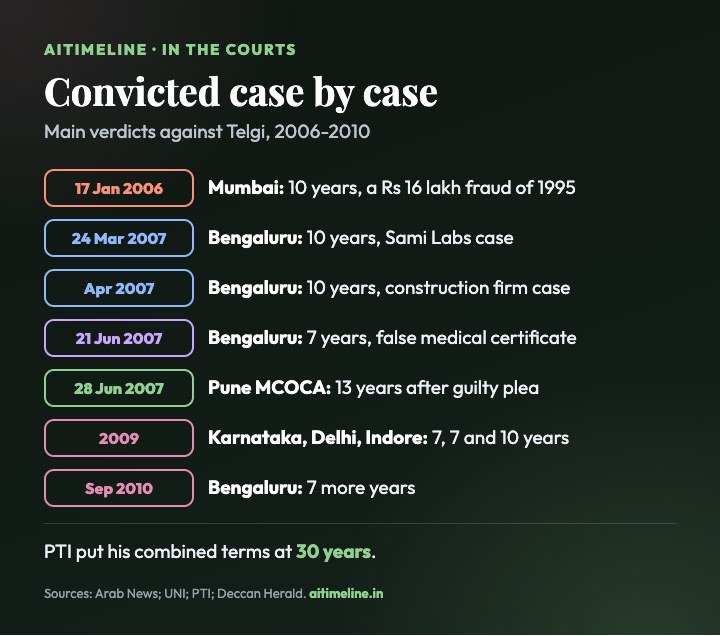
| Date | Court | Case | Sentence |
|---|---|---|---|
| 17 Jan 2006 | Special court, Mumbai | Rs 16 lakh fraud on solicitors, 1995 | 10 years |
| 24 Mar 2007 | Special court, Bengaluru | Sami Labs sale deed, forged RBI seal | 10 years |
| Apr 2007 | Special court, Bengaluru | Fakes sold to a construction company | 10 years (reported) |
| 21 Jun 2007 | Special CBI court, Bengaluru | False medical certificate for bail | 7 years, Rs 25 lakh |
| 28 Jun 2007 | Special MCOCA court, Pune | Bund Garden seizure of 2002, main case | 13 years, fine over Rs 100 crore |
| Apr 2009 | Special court, Karnataka | With ex-ACP Sangram Singh | 7 years |
| Jun 2009 | ACMM, Delhi | Three Delhi cases, Rs 213 crore face value | 7 years, Rs 1.3 crore |
| 26 Nov 2009 | CBI court, Indore | Fake papers in Madhya Pradesh | 10 years, Rs 50 lakh |
| Sep 2010 | Special court, Bengaluru | Running the racket from prison | 7 years |
The Legacy of the Telgi Scam
Guard the source
- Control machinery and dies.
- Track paper in transit.
- Audit press staff.
One view of the network
- State-by-state cases hid the scale.
- Central agency came late.
- Officials rarely convicted.
Less paper, more verification
- E-stamping in many states.
- Electronic duty payment.
- Checks on vendors.
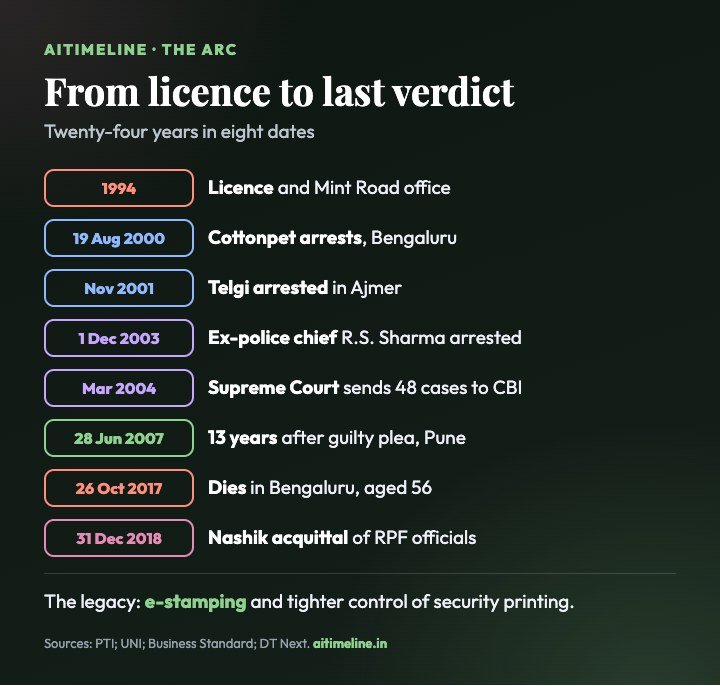
The lasting change was a move away from physical stamp paper. Several states adopted e-stamping and electronic payment of stamp duty, which reduce the stock of paper that can be stolen or faked and make it easier to check a certificate before relying on it. The pace has varied by state and by type of document. The case’s other lesson is about accountability: the man at the centre was convicted many times over, but most of the officials accused of making the racket possible were not, and its true size was never established.
Explore More Timelines
People Also Ask
Frequently Asked Questions
Dated facts from contemporary reports, 1991 to 2018.
⚠️ Editorial Note
This account draws on contemporary PTI, UNI and IANS reports carried by Business Standard, Oneindia, Gulf News and Eastern Mirror; Arab News on the 2006 Mumbai verdict; DT Next (PTI) on the 2018 Nashik acquittal; Deccan Herald on the 2010 Karnataka cases; Medical Dialogues on the 2017 High Court ruling; and Business Standard’s 2023 explainer. Court judgments themselves were not read. Checking the brief this page began from against those records: the 13-year sentence of 28 June 2007 came from a special MCOCA court in Pune, not Mumbai; the November 2009 10-year sentence was passed in Indore, not Bhopal; Telgi was 56 when he died, not 57; the April 2007 Bengaluru sentence was reported as 10 years, not 15, and we found no second 10-year sentence on 24 April; the seven men acquitted with Telgi in Nashik on 31 December 2018 were the RPF officials themselves, in a single case; the August 2004 CBI chargesheet we could confirm was the Nashik case, not a Delhi one; and the 1995 Mumbai fraud was reported as about Rs 16 lakh. We could not verify the brief’s October 1999 Mira Road seizure or the exact value of the Sami Labs papers, so we left them out. The brief also omitted that R.S. Sharma was acquitted in 2007 and that the two doctors were acquitted in 2017.
Related Reading on AiTimeline
Sources & further reading
Every dated entry above was checked against these references. Last reviewed 7 November 2026.
- Fake stamp paper case: Abdul Karim Telgi acquitted for lack of evidence
- Fake stamp paper scam convict Abdul Karim Telgi dies
- Telgi: From a vegetable vendor to scam mastermind
- Telgi confesses, gets 13-yr RI, fined Rs 100 cr
- Telgi gets 13 years RI with Rs 102 crore fine
- MCOCA court acquits Sharma, Sawant in fake stamp paper case
- Telgi and His Associates Get 10 Years
- Telgi sentenced to 10 year imprisonment
- Stamp paper scam: Telgi and two doctors sentenced
- Telgi, two others get 10 years in jail
- Karnataka hands over stamp scam probe to CBI
- Scam 2003: Who was Abdul Karim Telgi, and what was the Stamp Paper Scam?
- Fake Medical Certificate Case: 2 Doctors acquitted of 7 years imprisonment