NJAC vs Collegium: How India’s Judicial Appointment Battle Unfolded
Explore the NJAC timeline, from the 99th Constitutional Amendment in 2014 to the Supreme Court's 4:1 verdict in 2015 and the continuing collegium debate.
Latest Story
Who should choose India’s judges? For more than three decades the answer has been other judges. In 2014 Parliament tried to change that, almost unanimously, by creating a six-member commission on which the Law Minister and two eminent persons would sit beside the three senior-most judges. Before it recommended a single name, the Supreme Court struck it down. This NJAC timeline traces the fight from the supersession of judges in the 1970s and the three Judges Cases, through the 99th Constitutional Amendment and the 4:1 verdict of 16 October 2015, to the unfinished argument over how the collegium should work.
💡 Short Answer
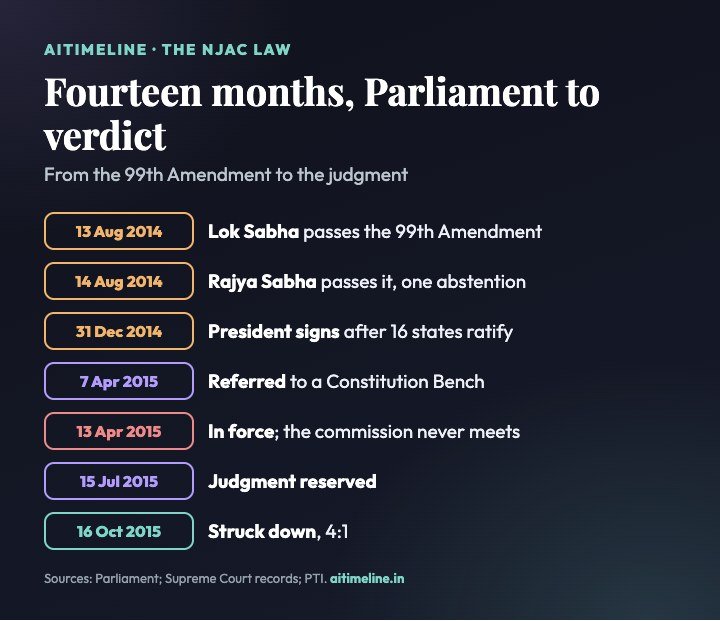
The NJAC was a six-member commission created by the 99th Constitutional Amendment and the NJAC Act, 2014, to appoint judges in place of the collegium. It came into force on 13 April 2015 but never functioned. On 16 October 2015 a five-judge Supreme Court bench struck both laws down 4:1 for undermining judicial independence, and restored the collegium, which still appoints judges in 2026.
NJAC: Key Questions
The Battle in Ten Points
- The backdrop: the government superseded senior judges for Chief Justice in 1973 and 1977.
- 1981: the First Judges Case gave the executive the upper hand in appointments.
- 1993: the Second Judges Case gave the Chief Justice and senior judges primacy.
- 1998: the Third Judges Case fixed the five-member Supreme Court collegium.
- August 2014: Parliament passed the 99th Amendment with near-unanimous support.
- The design: three judges, the Law Minister, two eminent persons, and a two-member veto.
- April 2015: in force on paper; the Chief Justice stayed away and it never met.
- 16 October 2015: struck down 4:1 on the basic structure doctrine.
- The unfinished part: a revised Memorandum of Procedure has never been agreed.
- Since then: review dismissed in 2018, revival refused in 2024, and the argument goes on.
Timeline: From Supersession to the Collegium Today
Newest first. Colour shows which phase of the dispute each event belongs to.
Where things stand: the collegium still decides The debate continues
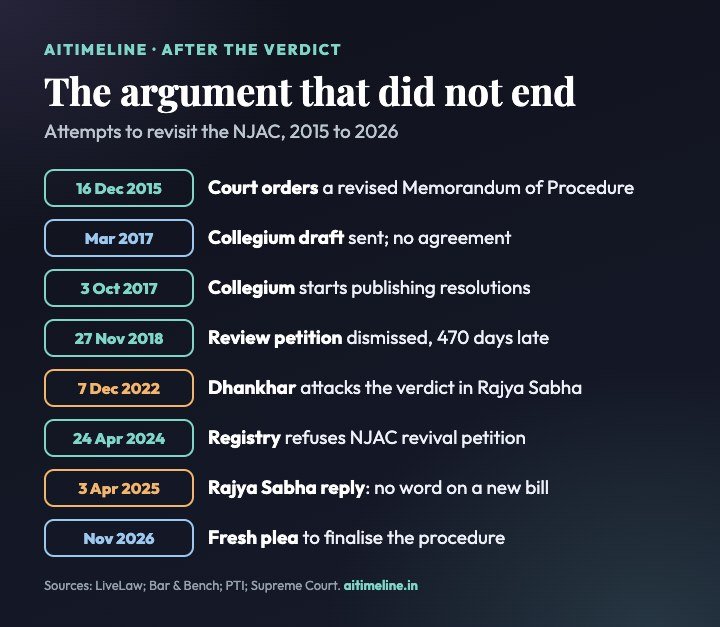
The law: The Supreme Court’s judgment of 16 October 2015 striking down the 99th Constitutional Amendment and the NJAC Act remains in force. A review petition was dismissed in 2018, and a 2022 writ petition seeking to revive the NJAC was refused by the Registry in 2024.
The practice: Judges of the Supreme Court and High Courts are still recommended by the collegium of senior judges, with the government processing the recommendations. The Memorandum of Procedure the court asked to be revised in 2015 has, on published accounts, still not been finalised.
A fresh plea to finalise the Memorandum of Procedure The debate continues
The plea: A petition asked the court to direct the Chief Justice of India and the Union government to finalise the Memorandum of Procedure for appointing High Court and Supreme Court judges, and to bring collegium decisions under the Right to Information Act.
The hearing: When it came up before Justices P.S. Narasimha and Alok Aradhe, Justice Narasimha recused himself from the case, Bar & Bench reported.
A sitting judge criticises collegium secrecy The debate continues
What he said: Justice Ujjal Bhuyan said that by not giving reasons for its choices, the collegium was doing a disservice to judges doing good work, according to LiveLaw’s report of his remarks.
Why it matters: Criticism of the collegium’s opacity usually comes from the government or the Bar. This came from a member of the court whose own judges sit on it.
The government restates its position in Parliament The debate continues
The answer: In a written reply, the Law Minister said the 99th Amendment and NJAC Act, in force from 13 April 2015, had been declared unconstitutional and void, and that the collegium system as it existed before them was declared operative. He described the aim of the laws as a more broad-based, transparent and accountable appointment mechanism.
What it left out: PTI reported that he was silent on whether the government would bring the NJAC bill back. He described continuing contact with the collegium on the Memorandum of Procedure.
The Justice Varma cash row revives the NJAC debate The debate continues
The trigger: Currency was reported found at the official residence of Delhi High Court judge Yashwant Varma after a fire in March 2025. The collegium transferred him to the Allahabad High Court and an in-house inquiry followed.
The debate: Rajya Sabha Chairman Jagdeep Dhankhar used the episode to argue again that Parliament’s NJAC law should not have been struck down. Opposition parties were wary of reviving it.
Vice-President attacks the verdict; the court replies The debate continues
The speech: In his first address as Rajya Sabha Chairman on 7 December 2022, Jagdeep Dhankhar called the 2015 judgment a severe compromise of parliamentary sovereignty and the mandate of the people.
The response: The next day a Supreme Court bench hearing a plea on delays in appointments said, without naming anyone, that the collegium system was the law of the land and had to be followed. Law Minister Kiren Rijiju had criticised the collegium as opaque in the preceding weeks.
Registry refuses a petition to bring back the NJAC The debate continues
The petition: Advocate Mathews J. Nedumpara and others asked the court to abolish the collegium and declare the 2015 verdict void.
The refusal: The Registrar declined to receive it under Order XV Rule 5 of the Supreme Court Rules, 2013, holding that it repeated questions the Constitution Bench had already decided and noting that a review had been dismissed in 2018.
Review petition dismissed in chambers Verdict and aftermath
The petition: The National Lawyers’ Campaign for Judicial Transparency and Reforms asked the court to review the 2015 judgment. It was considered in chambers, by circulation, without oral arguments.
The order: The bench held that the petition was 470 days late with no satisfactory explanation, which was enough to dismiss it, and that it also found no merit in it.
The collegium starts publishing its decisions Verdict and aftermath
The change: The collegium under Chief Justice Dipak Misra resolved to put its recommendations on the Supreme Court’s website, with brief reasons, to make the process more transparent.
The limits: Published resolutions give conclusions rather than the full material behind them, and the practice of stating reasons has varied over the years.
Government and judges deadlock over the procedure Verdict and aftermath
The dispute: Drafts of a revised Memorandum of Procedure went back and forth. Reported sticking points included the government’s wish to reject candidates on grounds of national security or public interest, and how a secretariat and complaints process would work.
The result: The collegium is reported to have sent its draft in March 2017. The two sides did not agree a final text.
The court asks for a new Memorandum of Procedure Verdict and aftermath
The order: After hearing suggestions on 3-5 November 2015, the bench said the government could finalise the existing Memorandum of Procedure by supplementing it in consultation with the Chief Justice of India.
The topics: It listed eligibility criteria, transparency in the appointment process, a secretariat, and a mechanism for complaints against candidates.
The court invites ideas to improve the collegium Verdict and aftermath
The hearing: Having restored the collegium, the same five judges heard the government, the Bar and others on how it could work better.
The ideas: Suggestions ranged from published eligibility criteria and a permanent secretariat to a way of handling complaints about candidates.
The Supreme Court strikes down the NJAC, 4:1 Verdict and aftermath
The ruling: The majority declared the Constitution (99th Amendment) Act, 2014 and the NJAC Act, 2014 unconstitutional and void, holding that they violated judicial independence, a part of the basic structure. The collegium system as it stood before the amendment was declared operative again.
The reasoning: Justice Khehar wrote the lead opinion. The majority objected chiefly to the judges being outnumbered or outvoted: the Law Minister’s membership, the two eminent persons, and the rule that any two members could block a recommendation.
The dissent: Justice J. Chelameswar would have upheld the amendment. He said primacy of the judiciary was not the only way to protect independence and criticised the collegium’s lack of transparency.
Judgment reserved after weeks of argument The NJAC law and challenge
The argument: The petitioners said the NJAC let the executive and non-judges control who became a judge. The Union argued Parliament could change the method by amendment and that the collegium was opaque. The government also asked for the 1993 and 1998 judgments to be reconsidered by a larger bench; the court did not refer them.
The order: The bench reserved its judgment on 15 July and extended the terms of High Court additional judges until it ruled.
A bench reshuffle and a recusal fight The NJAC law and challenge
The first change: On the first day, Fali S. Nariman objected that Justice Anil R. Dave had become an ex officio NJAC member. Justice Dave stepped aside and Justice J.S. Khehar was named to preside.
The second fight: The petitioners then asked Justice Khehar to recuse because he was in line for the collegium. The other four judges said there was no legal reason for him to step down, and he stayed.
The NJAC comes into force but never meets The NJAC law and challenge
The commission: Six members: the Chief Justice of India as chair, the next two senior-most Supreme Court judges, the Union Law Minister, and two eminent persons chosen by the Prime Minister, the Chief Justice and the Leader of the Opposition, or the leader of the largest opposition party in the Lok Sabha.
What happened: Chief Justice H.L. Dattu reportedly declined to take part in its meetings while the challenge was pending, and the two eminent persons were never chosen. The commission did not make a single recommendation.
Challenge sent to a Constitution Bench The NJAC law and challenge
The petitions: The Supreme Court Advocates-on-Record Association, Bar bodies and others challenged both the amendment and the NJAC Act after they received assent.
The order: The three-judge bench referred the case to a larger bench under Article 145(3), which requires at least five judges for substantial questions of constitutional interpretation, and refused to stay the law.
The President signs both laws The NJAC law and challenge
The assent: As a change to the federal judiciary, the amendment needed ratification by half the states. Sixteen of 29 legislatures ratified it, and the President signed both the amendment and the NJAC Act on 31 December 2014.
The design: The amendment inserted Articles 124A to 124C into the Constitution, creating the commission and letting Parliament regulate its procedure by law.
Parliament passes the 99th Amendment The NJAC law and challenge
The vote: The Lok Sabha passed the Constitution (121st Amendment) Bill, which became the 99th Amendment, on 13 August 2014. The Rajya Sabha passed it the next day with a single member abstaining. The NJAC Bill passed alongside it.
The pitch: The government presented it as a more broad-based, transparent and accountable way to choose judges, replacing a system no statute had created.
Criticism of the collegium grows The Judges Cases
The complaints: No published criteria for selection, no permanent secretariat, little disclosure of reasons, uneven assessment of candidates, and no clear process for complaints.
The defence: Supporters said the alternative was letting the government choose the judges who rule on its own cases, which the supersessions of the 1970s had shown was a real danger.
Third Judges Case fixes the collegium’s shape The Judges Cases
The reference: President K.R. Narayanan asked the court, under Article 143, to clarify how its 1993 ruling should work in practice.
The opinion: For the Supreme Court, the Chief Justice must consult the four senior-most judges, and their collective opinion governs. For High Courts, the Chief Justice of India and the two senior-most Supreme Court judges form the collegium.
Second Judges Case gives judges the last word The Judges Cases
The ruling: The court overruled S.P. Gupta and held that in appointments the opinion of the Chief Justice of India, formed after consulting senior colleagues, has primacy. “Consultation” in Articles 124 and 217 effectively meant concurrence.
The result: It laid the foundation of the collegium, and made seniority the normal rule for choosing the Chief Justice of India.
First Judges Case gives the executive primacy The Judges Cases
The ruling: The court held that “consultation” with the Chief Justice did not mean concurrence. The government could appoint against the Chief Justice’s advice for “cogent reasons”.
The effect: For the next 12 years the executive had the upper hand in choosing and transferring judges.
Justice Beg superseded Justice Khanna Supersessions, 1973-77
The appointment: M.H. Beg was sworn in as the 15th Chief Justice of India, passing over H.R. Khanna, the senior-most judge.
The reason given by history: Justice Khanna had been the lone dissenter in ADM Jabalpur in April 1976, holding that the right to life could not be suspended in the Emergency. He resigned after being superseded.
Three judges passed over for Chief Justice Supersessions, 1973-77
The appointment: A.N. Ray was named Chief Justice of India over three more senior judges, J.M. Shelat, K.S. Hegde and A.N. Grover, all of whom resigned.
The context: The three had been in the majority in Kesavananda Bharati, decided on 24 April 1973, which held that Parliament cannot amend the Constitution’s basic structure. Ray had been in the minority.
How the NJAC Was Supposed to Work
Six seats, three of them for judges.
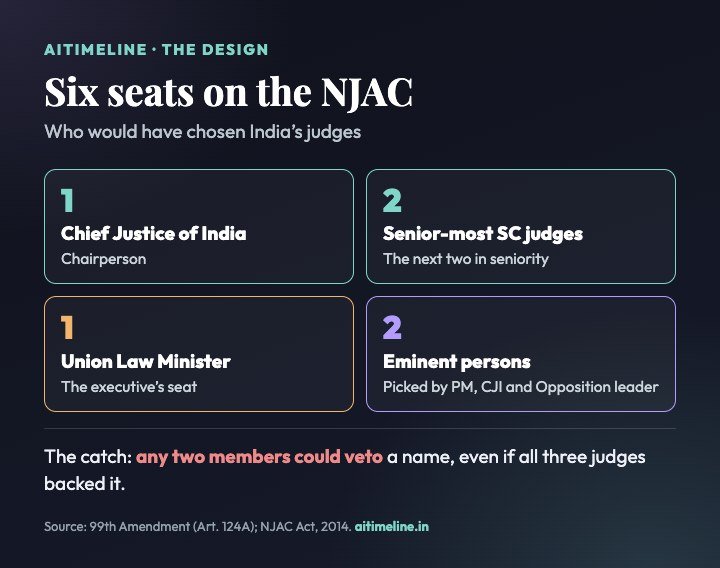
| Member | Role on the commission |
|---|---|
| Chief Justice of India | Chairperson |
| Two senior-most Supreme Court judges | Judicial members |
| Union Minister of Law and Justice | Executive member |
| Two eminent persons | Non-judicial members, three-year term; one to be from the SC, ST, OBC, minority communities or a woman |
| Selection committee for eminent persons | Prime Minister, Chief Justice of India, Leader of the Opposition or leader of the largest opposition party in the Lok Sabha |
The feature that decided the case was a single sentence in the NJAC Act: the commission could not recommend a person if any two members did not agree. In practice that meant the three judges could support a candidate and still lose to the Law Minister and one eminent person, or to the two eminent persons acting together. Supporters said that was the point, a check on judges choosing their own successors. The petitioners said it handed a veto over the judiciary’s composition to people outside it, one of them a member of the government that is the largest litigant before the courts.
Why the Supreme Court Struck Down the NJAC
Four judges against, one in favour.
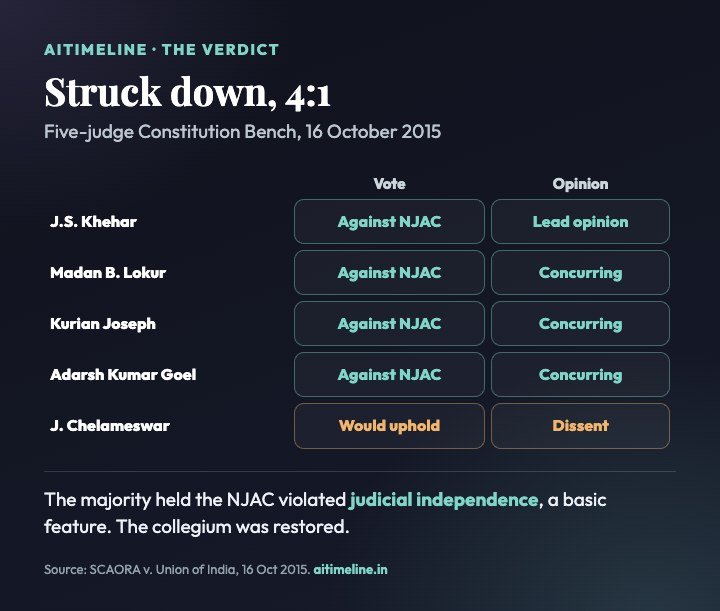
The majority, 4 judges
- Judicial independence is part of the basic structure.
- Judicial primacy in appointments is part of that independence.
- Judges on the NJAC could be outvoted by non-judges.
- The Law Minister’s seat and the two-member veto went too far.
The dissent, Justice Chelameswar
- Primacy of judges is not the only way to protect independence.
- Parliament may redesign the appointments process.
- The collegium’s working is opaque and unaccountable.
- The amendment should have been upheld.
The judgment ran to more than a thousand pages, with each majority judge writing separately. Their common ground was narrow but decisive: an appointments body on which the judiciary does not have the final say is incompatible with judicial independence, and the 99th Amendment, by its design, took that final say away. The court did not hold that judges must work in secret or that the collegium was beyond criticism. Several of the majority opinions accepted that it needed reform, which is why the same bench sat again in November 2015 to hear proposals for improving it. The binding result, though, is the majority’s: the NJAC is void, and the collegium, as it existed before the amendment, is the law.
The Three Judges Cases
How the balance moved from the government to the judges.
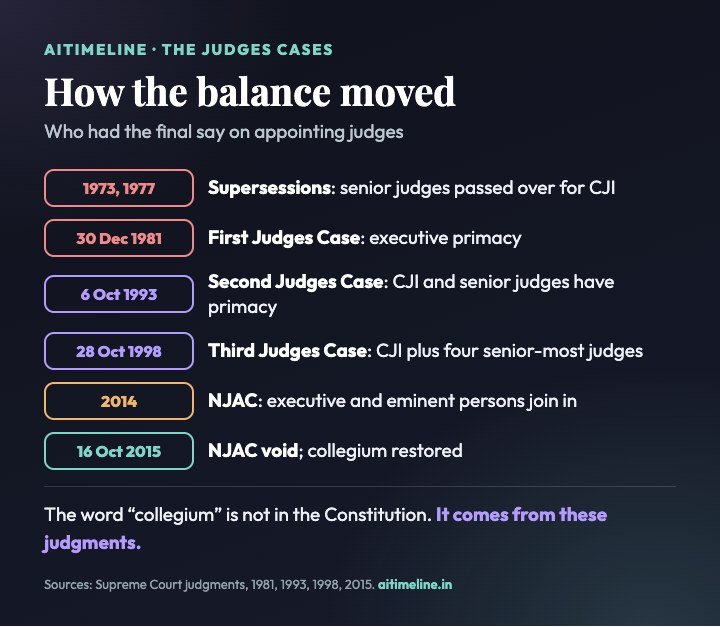
Article 124 says Supreme Court judges are appointed by the President “after consultation” with the Chief Justice and such other judges as the President thinks necessary. Everything in this story is an argument about what “consultation” means. In 1981 the court said it meant just that, consultation, leaving the government free to disagree. In 1993 it read it as giving the Chief Justice’s collective opinion primacy, and in 1998 it spelled out who must be consulted. The supersessions of 1973 and 1977, when the government passed over senior judges who had ruled against it, are the history that persuaded the court to read the text that way.
NJAC vs Collegium: What Was the Difference?
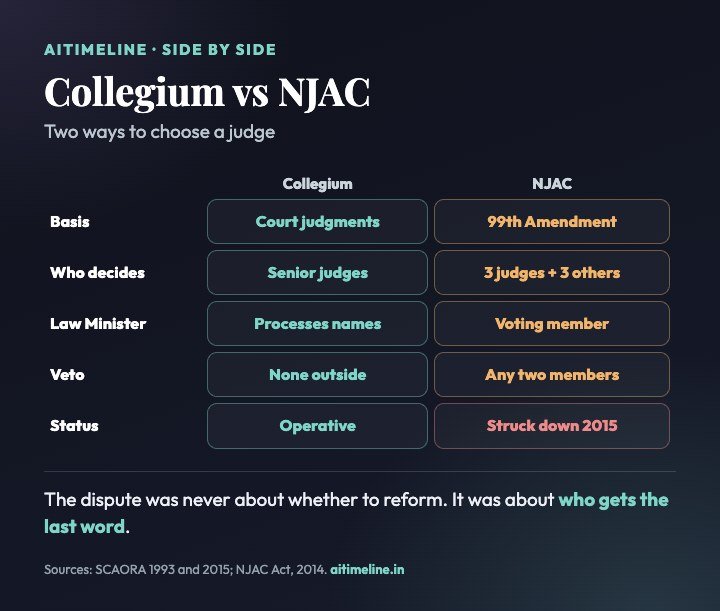
| Feature | Collegium system | NJAC proposal |
|---|---|---|
| Legal basis | Supreme Court judgments of 1993 and 1998 | 99th Constitutional Amendment and NJAC Act, 2014 |
| Who decides | Chief Justice and four senior-most judges (Supreme Court) | Three judges, the Law Minister and two eminent persons |
| Executive role | Processes names; can return a name once | Law Minister is a voting member |
| Veto | No veto outside the collegium | Any two members can block a name |
| Transparency | Resolutions published since October 2017 | Procedure to be set by regulations, never framed |
| Status | Operative | Struck down, 16 October 2015 |
After the Verdict: The Argument That Did Not End
2015 to 2026.
Closed
- Review dismissed, 2018.
- Revival petition refused, 2024.
- Verdict still binding.
Open
- MoP revision ordered, 2015.
- No agreed text since.
- Fresh plea, 2026.
Simmering
- Dhankhar, 2022 and 2025.
- Varma cash row, 2025.
- No new bill.
The legal challenge to the verdict is effectively over: the review was dismissed for delay and on merits, and the Registry has treated later petitions as attempts to reopen a settled question. What remains open is the part the court left to the government and the Chief Justice to finish, the revised Memorandum of Procedure, and the political argument. That argument flares whenever a controversy touches the judiciary, as it did when Vice-President Jagdeep Dhankhar attacked the verdict in December 2022 and again after cash was reported found at Justice Yashwant Varma’s residence in 2025. Each time the government has stopped short of a new law.
Why the NJAC Controversy Matters
Who controls the courts
The ruling keeps the government, India’s biggest litigant, from deciding who sits on the bench that hears its cases.
Who checks the judges
It also left a self-selecting body without published criteria, which judges, lawyers and governments have all criticised.
Limits on amendment
A near-unanimous constitutional amendment was struck down under the basic structure doctrine, one of its most significant uses.
Trust in the courts
How judges are chosen shapes public confidence in the courts that protect fundamental rights.
The central question has not moved since 2015: how can India make judicial appointments more transparent and accountable without giving the executive control over the judiciary? The NJAC answered it one way and the court rejected that answer. No alternative has been agreed since.
Explore More Timelines
People Also Ask
Frequently Asked Questions
Dated facts from the judgments, parliamentary records and contemporary reports, 1973 to 2026.
⚠️ Editorial Note
This account draws on the Supreme Court’s judgment of 16 October 2015 in Supreme Court Advocates-on-Record Association v. Union of India, the court’s order of 16 December 2015, the text of the 99th Amendment and NJAC Act, the Law Minister’s Rajya Sabha reply of 3 April 2025, and reporting by LiveLaw, Bar & Bench, PTI and others. Checking the brief this page began from against those records: the review petition was dismissed by an order of 27 November 2018 (reported on 1 December), not simply in December; the Constitution Bench heard the case from 15 April 2015 and reserved judgment on 15 July 2015, rather than hearing it from July to September; the case had been referred to five judges by a three-judge bench on 7 April 2015; and the NJAC came into force on 13 April 2015 but never functioned, because the Chief Justice reportedly stayed away and the eminent persons were never chosen. The NJAC was struck down before it could be tested, so the debate concerns its design, not its performance. Status reflects published reports to 7 November 2026.
Related Reading on AiTimeline
Sources & further reading
Every dated entry above was checked against these references. Last reviewed 7 November 2026.
- Supreme Court Advocates-on-Record Association v. Union of India (NJAC judgment), 16 October 2015
- The Constitution (Ninety-Ninth Amendment) Act, 2014
- Govt silent on whether it will consider bringing again law on judges' appointment (Rajya Sabha reply, 3 April 2025)
- Supreme Court collegium resolutions
- SC dismisses review petition against NJAC judgment
- Supreme Court Registry refuses to receive petition to abolish collegium system and revive NJAC
- Supreme Court reserves judgment in challenge to the NJAC
- Plea in Supreme Court to finalise MoP on appointment of judges, bring collegium decisions under RTI
- SC refers pleas challenging NJAC Act to larger bench
- Power of the people was undone: Jagdeep Dhankhar criticises SC for striking down NJAC Act