Why the Supreme Court Struck Down India’s 1969 Bank Nationalisation Law
R.C. Cooper case timeline: how 14 banks were nationalised in 1969, why the Supreme Court struck the law down 10-1 in 1970, and what it meant for rights.
Latest Story
On 19 July 1969 the government of Indira Gandhi nationalised India’s 14 largest private banks by ordinance. A shareholder, depositor and director named Rustom Cavasjee Cooper challenged the takeover, and on 10 February 1970 the Supreme Court, by ten votes to one, struck the law down. Yet the banks never went back to their owners. The R.C. Cooper case, known as the Bank Nationalisation Case, is remembered less for what it did to the banks than for what it did to constitutional law: it decided that a fundamental right is measured by what a law actually does to a person, not by what the law says it is for. This timeline separates what the Court struck down from what it left standing.
💡 Short Answer
In R.C. Cooper v. Union of India (10 February 1970), an 11-judge bench struck down the 1969 law nationalising 14 banks, 10 to 1. It upheld Parliament’s power to nationalise but found the compensation formula and a ban on the old banks unconstitutional. Within weeks a new ordinance and the 1970 Act re-nationalised the same banks with fixed compensation of Rs 87.40 crore.
R.C. Cooper Case: Key Questions
The Case in Ten Points
- 19 July 1969: an ordinance nationalised the 14 commercial banks holding at least Rs 50 crore in deposits.
- 21 July 1969: petitions reached the Supreme Court. Cooper was a shareholder in four of the banks, a depositor and a director of Central Bank of India.
- 9 August 1969: Parliament replaced the ordinance with Act 22 of 1969.
- 10 February 1970: an 11-judge bench declared the Act invalid by 10 to 1.
- The grounds: compensation fixed on irrelevant principles (Article 31(2)) and a discriminatory ban on the 14 banks (Article 14).
- Not the grounds: the Court upheld Parliament’s power to nationalise and did not rule on whether choosing those 14 banks was discriminatory.
- 14 February 1970: a new ordinance took the banks over again; the 1970 Act followed on 31 March with fixed compensation of Rs 87.40 crore.
- 20 April 1972: the 25th Amendment replaced “compensation” with “amount” in Article 31(2).
- The lasting doctrine: rights are judged by a law’s direct effect on the individual, not its object or form.
- 20 June 1979: property ceased to be a fundamental right, so R.C. Cooper’s compensation reasoning is history, while its rights reasoning lives on.
Timeline: From the State Bank to the Last Mergers
Newest first. Colour shows which stage of the story each event belongs to.
Ten public-sector banks merged into four Banks after
The mergers: Oriental Bank of Commerce and United Bank of India merged into Punjab National Bank, Syndicate Bank into Canara Bank, Andhra Bank and Corporation Bank into Union Bank of India, and Allahabad Bank into Indian Bank.
The result: The number of public-sector banks fell to 12. Several of the names nationalised in 1969 and 1980 disappeared as separate banks, though their businesses stayed in public ownership.
Vijaya Bank and Dena Bank merge into Bank of Baroda Banks after
The merger: Dena Bank, one of the 14 banks of 1969, and Vijaya Bank, one of the six of 1980, were amalgamated into Bank of Baroda.
Why it mattered: It was the first three-way merger of public-sector banks and set the pattern for the larger round a year later.
SBI absorbs its associate banks Banks after
The merger: The State Bank of India absorbed five associate banks and Bharatiya Mahila Bank, ending the separate SBI subsidiaries that dated back to 1959.
The link: This was a restructuring of the SBI group, which was never part of the 1969 nationalisation or the R.C. Cooper case.
Reform, not reversal Banks after
The policy turn: After the 1991 balance-of-payments crisis, the Narasimham Committee recommended capital-adequacy rules, income recognition, asset classification and provisioning norms, which were introduced from 1992 to 1993. New private banks were licensed.
The first merger: New Bank of India, one of the six banks nationalised in 1980, was merged into Punjab National Bank in 1993, the first merger of two nationalised banks.
Six more banks nationalised Banks after
The banks: Andhra Bank, Corporation Bank, New Bank of India, Oriental Bank of Commerce, Punjab and Sind Bank and Vijaya Bank were taken over.
The difference: By 1980 the 25th and 44th Amendments had changed the constitutional rules on acquisition, so the challenge that sank the 1969 law was far harder to mount.
Property stops being a fundamental right Constitution
The change: The amendment repealed Article 19(1)(f) and Article 31, the provisions R.C. Cooper had turned on, and added Article 300A: no one shall be deprived of property save by authority of law.
The effect: Property became a constitutional right rather than a fundamental right, so an acquisition can no longer be challenged directly in the Supreme Court under Article 32 on compensation grounds.
Maneka Gandhi builds on the effect test Constitution
The ruling: The Court held that a law depriving a person of personal liberty must also meet Articles 14 and 19, and that the procedure must be fair, just and reasonable.
The link: Its reading of Articles 14, 19 and 21 as connected guarantees drew on R.C. Cooper’s rejection of the idea that each right sits in a sealed compartment.
Kesavananda Bharati upholds the “amount” change Constitution
The ruling: The Court upheld the 25th Amendment’s replacement of “compensation” with “amount”, but struck down the part of Article 31C that barred courts from asking whether a law actually gave effect to the directive principles.
The bigger change: It laid down the basic-structure doctrine, which limits Parliament’s power to amend the Constitution.
Parliament replaces “compensation” with “amount” Constitution
The change: The amendment rewrote Article 31(2) so that the law fixing an acquisition need only provide an “amount”, which no court could question as inadequate, and which could be paid other than in cash.
The target: It was aimed directly at R.C. Cooper’s holding that “compensation” meant a just equivalent fixed on relevant principles. It also added Article 31C.
The Banking Companies Act, 1970 becomes law In court
The fix: The new Act acquired the same 14 banks but replaced the old valuation formula with fixed sums listed in its Second Schedule, totalling Rs 87.40 crore, from Rs 17.50 crore for Central Bank of India to Rs 2.30 crore each for Indian Bank and Bank of Maharashtra.
Payment: Each bank could take cash in three annual instalments at 4% interest, or Government securities maturing in 10 years at 4.5% or 30 years at 5.5%, or a mix.
A new ordinance four days after the judgment In court
The response: Four days after the Supreme Court ruling, the President promulgated a fresh ordinance taking over the 14 banks again.
Why so fast: The judgment declared action under the 1969 Act unauthorised. Without a new law, the government’s control of the banks had no legal basis.
Supreme Court strikes down the 1969 Act, 10 to 1 In court
The order: In accordance with the majority, two of Cooper’s petitions were allowed, the 1969 Act was declared invalid, and action taken under it was declared unauthorised. A third petition was dismissed.
The grounds: The compensation scheme ignored goodwill and unexpired leases and valued the banks by irrelevant principles, breaching Article 31(2). Barring only the 14 banks from banking was hostile discrimination under Article 14, and leaving them free in theory to do other business was an unreasonable restriction. Parliament’s competence to nationalise was upheld.
The 1969 Act replaces the ordinance In court
The law: Before the petitions could be heard, Parliament enacted the Banking Companies (Acquisition and Transfer of Undertakings) Act, 1969, which took effect on 9 August and repealed the ordinance.
The compensation: Compensation was to be worked out head by head under a Second Schedule, fixed by agreement or a tribunal, and paid in securities maturing in not less than ten years.
Cooper goes to the Supreme Court In court
The petitioner: Rustom Cavasjee Cooper held shares in Central Bank of India, Bank of Baroda, Union Bank of India and Bank of India, had current and fixed-deposit accounts with them, and was a director of Central Bank of India.
The claim: He argued that the takeover violated his own rights under Articles 14, 19 and 31. The government, through Attorney-General Niren De, objected that only the banks, not a shareholder, could complain.
Fourteen banks nationalised by ordinance Nationalisation
The order: Vice-President V.V. Giri, acting as President, promulgated an ordinance vesting the undertakings of the 14 commercial banks with deposits of at least Rs 50 crore in new banks owned by the Centre. The chairman of each bank became the custodian of its new successor, and its directors vacated office.
The scale: The judgment records that the State Bank group and the 14 banks together held about 80% of the branch offices of India’s commercial banks.
Indira Gandhi takes the finance portfolio Nationalisation
The move: Prime Minister Indira Gandhi relieved Deputy Prime Minister Morarji Desai of the finance portfolio, and he resigned. Desai had backed “social control” of banks rather than ownership.
The politics: Bank nationalisation became central to her contest with the Congress party’s old guard, which led to the party’s split later in 1969.
“Social control” over banks Before 1969
The policy: The government chose regulation over ownership: bank boards were to be reconstituted with a majority of directors with special knowledge of areas such as agriculture and small industry, and the National Credit Council would set credit priorities.
The verdict on it: Within months the government concluded that social control had not moved enough credit to farmers and small borrowers, and moved to ownership.
State-associated banks join the SBI group Before 1969
The law: Banks linked to former princely states were made subsidiaries of the State Bank of India. By 1969 there were seven.
Why it mattered: Together with SBI, they gave the government a large banking group of its own a decade before the 1969 takeover.
The State Bank of India is created Before 1969
The change: The Imperial Bank of India was taken over and reconstituted as the State Bank of India, majority-owned by the Reserve Bank, following the recommendation of the All-India Rural Credit Survey.
The purpose: The new bank was meant to expand branches into rural and semi-urban India.
The 14 Banks and What They Were Paid
Compensation fixed by the Second Schedule of the 1970 Act, after the 1969 formula was struck down.
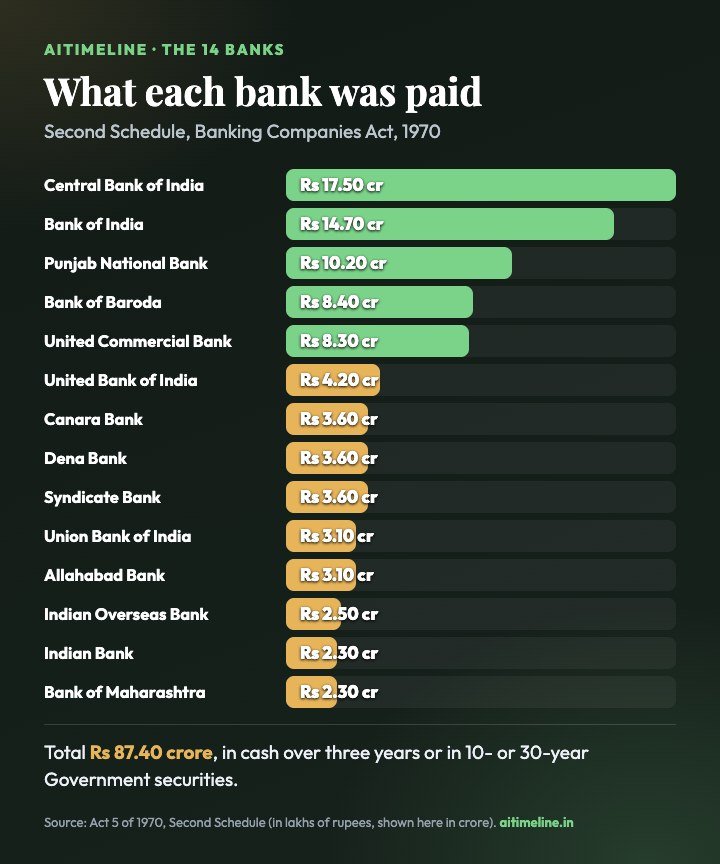
The 14 banks were chosen by size: each held deposits of at least Rs 50 crore. The judgment records that together with the State Bank of India and its seven subsidiaries they accounted for about 80% of the branch offices of the country’s commercial banks. The ordinance did not abolish the old companies. It transferred their undertakings, meaning the whole going concern with its assets, liabilities, staff and name, to new banks owned by the Centre, and left the shell companies to receive compensation.
| Bank (1969) | 1970 compensation | Position after the 2019–20 mergers |
|---|---|---|
| Central Bank of India | Rs 17.50 crore | Still separate |
| Bank of India | Rs 14.70 crore | Still separate |
| Punjab National Bank | Rs 10.20 crore | Absorbed OBC and United Bank, 2020 |
| Bank of Baroda | Rs 8.40 crore | Absorbed Dena and Vijaya, 2019 |
| United Commercial Bank | Rs 8.30 crore | Now UCO Bank |
| United Bank of India | Rs 4.20 crore | Merged into PNB, 2020 |
| Canara Bank | Rs 3.60 crore | Absorbed Syndicate, 2020 |
| Dena Bank | Rs 3.60 crore | Merged into Bank of Baroda, 2019 |
| Syndicate Bank | Rs 3.60 crore | Merged into Canara Bank, 2020 |
| Union Bank of India | Rs 3.10 crore | Absorbed Andhra and Corporation, 2020 |
| Allahabad Bank | Rs 3.10 crore | Merged into Indian Bank, 2020 |
| Indian Overseas Bank | Rs 2.50 crore | Still separate |
| Indian Bank | Rs 2.30 crore | Absorbed Allahabad Bank, 2020 |
| Bank of Maharashtra | Rs 2.30 crore | Still separate |
| Total | Rs 87.40 crore | Ten of the 14 survive as separate banks |
From Ordinance to Re-enactment in 255 Days
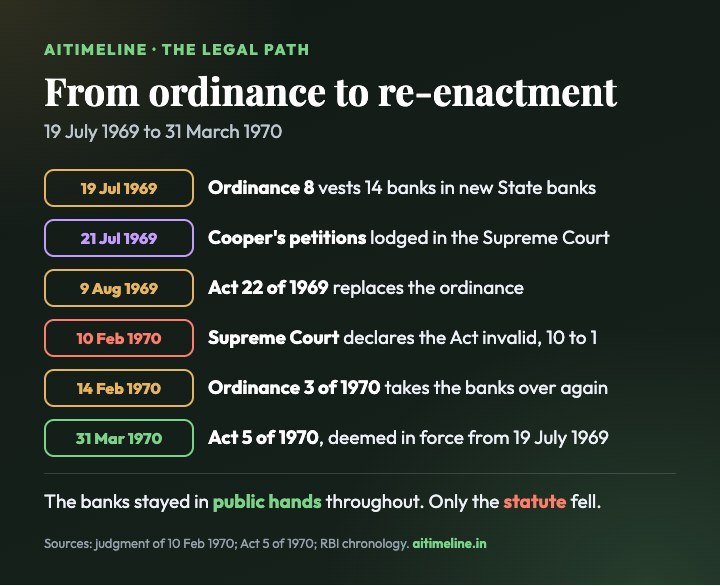
The government moved fast at every step. It issued the ordinance on a Saturday afternoon, two days before Parliament was due to meet, a timing Cooper’s lawyers called hasty. The Act that replaced it was passed before the petitions could be heard. When the Court ruled, a new ordinance followed in four days, and a new Act in seven weeks. Both Acts were made to apply from 19 July 1969, so that, on paper, the banks had been public from the start.
What the Supreme Court Actually Decided
The central distinction: the Court struck down a statute, not the policy.
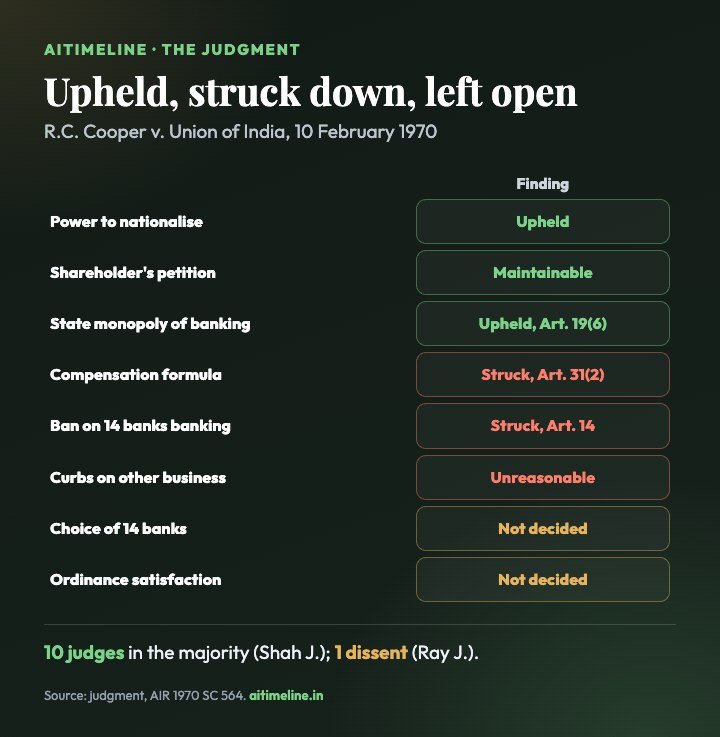
What the Court held
- Parliament had the power to acquire the banks’ undertakings.
- A shareholder whose own rights are affected may petition.
- The compensation formula did not give compensation at all.
- Barring only the 14 banks from banking was hostile discrimination.
- The core provisions could not be severed, so the whole Act fell.
What it did not decide
- Whether picking these 14 banks was itself discriminatory.
- How far courts can review the President’s satisfaction for an ordinance.
- Whether the Act’s retrospective operation was valid.
- Whether nationalisation was good economic policy.
The compensation finding was the heart of the case. The Act valued each bank by adding up some of its assets and subtracting liabilities, rather than valuing the business as a going concern. It left out goodwill and the value of unexpired long-term leases, valued occupied buildings at twelve times a reduced annual rent even though the new banks took vacant possession, and in effect deducted some debts twice. The majority held that a formula built on irrelevant principles did not produce “compensation” in the constitutional sense, and that bonds maturing years later might not either if their market value fell short of their face value.
The equality finding was narrower than it is often described. The Court did not hold that nationalising 14 banks while sparing others was discriminatory; it said it had no reliable data to decide that. What it struck down was the rule that, having lost their undertakings, the 14 old companies could never do banking again, while every other Indian and foreign bank could.
The Dissent: Justice A.N. Ray
Justice A.N. Ray would have dismissed the petitions. He held that the President is the sole judge of the satisfaction needed to issue an ordinance, acting on ministerial advice that courts cannot inquire into; that the challenge to the timing of the ordinance showed no mala fides; and that the Act, including its compensation provisions and its retrospective operation, was valid. He did not rule on whether Cooper could sue, since the case had been argued on its merits. In April 1973, after the Kesavananda Bharati judgment, Ray was appointed Chief Justice of India over three senior judges, a supersession widely seen as linked to the government’s disputes with the Court over property and its economic programme.
Effect, Not Object: The Doctrine That Outlived the Case
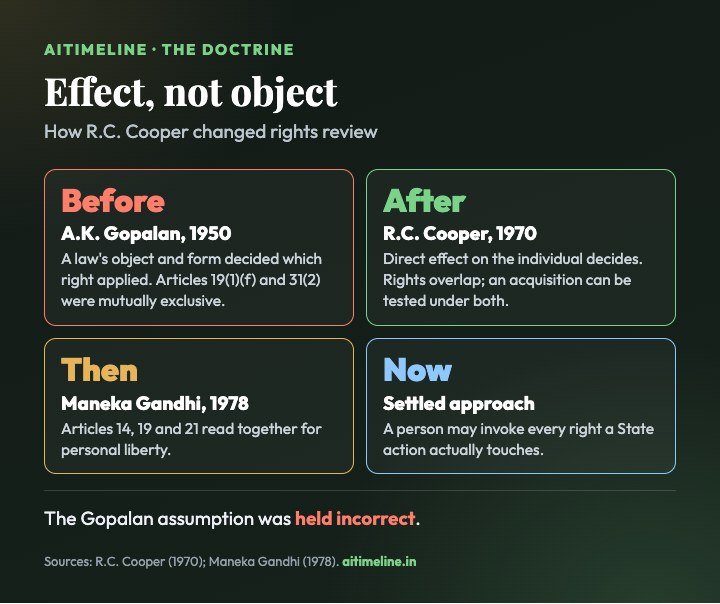
Since A.K. Gopalan v. State of Madras in 1950, the Court had tended to read each fundamental right as a self-contained code. If a law was aimed at acquiring property, only Article 31 applied, and the owner could not also argue that it was an unreasonable restriction on property under Article 19(1)(f). R.C. Cooper rejected that. In the majority’s words, the extent of protection against impairment of a fundamental right is determined not by the object of the legislature nor by the form of the action, but by its direct operation upon the individual’s rights.
That sentence travelled far beyond banking. In Maneka Gandhi v. Union of India in 1978, the Court held that a law depriving a person of liberty under Article 21 must also satisfy Articles 14 and 19. The idea that a person may invoke every right a State action actually touches is now a basic feature of Indian constitutional litigation.
What Happened to the Right to Property
R.C. Cooper’s compensation reasoning lasted barely two years.
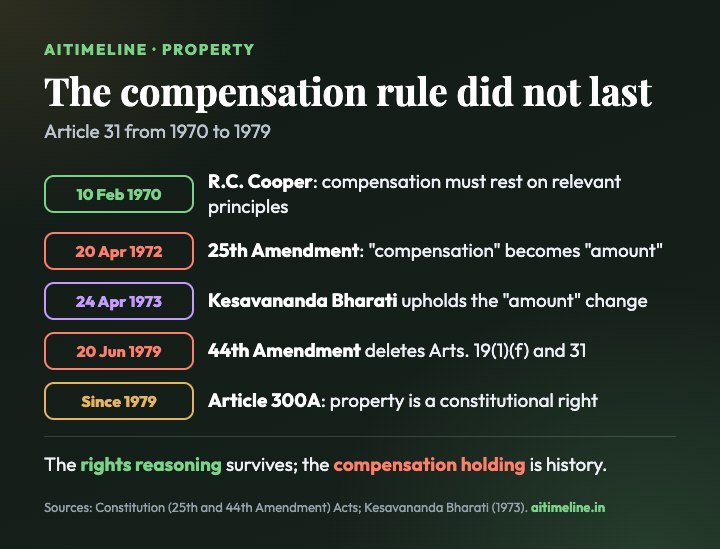
Parliament’s answer to the compensation holding was to change the Constitution. The 25th Amendment, in force from 20 April 1972, replaced “compensation” with “amount” in Article 31(2), said the amount could not be questioned as inadequate and could be paid other than in cash, and added Article 31C to protect laws giving effect to certain directive principles. The Supreme Court upheld the “amount” change in Kesavananda Bharati in 1973.
The 44th Amendment then removed property from the list of fundamental rights altogether, with effect from 20 June 1979, and placed it in Article 300A. Anyone reading R.C. Cooper today for its views on compensation is reading about a constitutional provision that no longer exists. Its reasoning on how rights interact is what remains.
What Became of Nationalised Banking
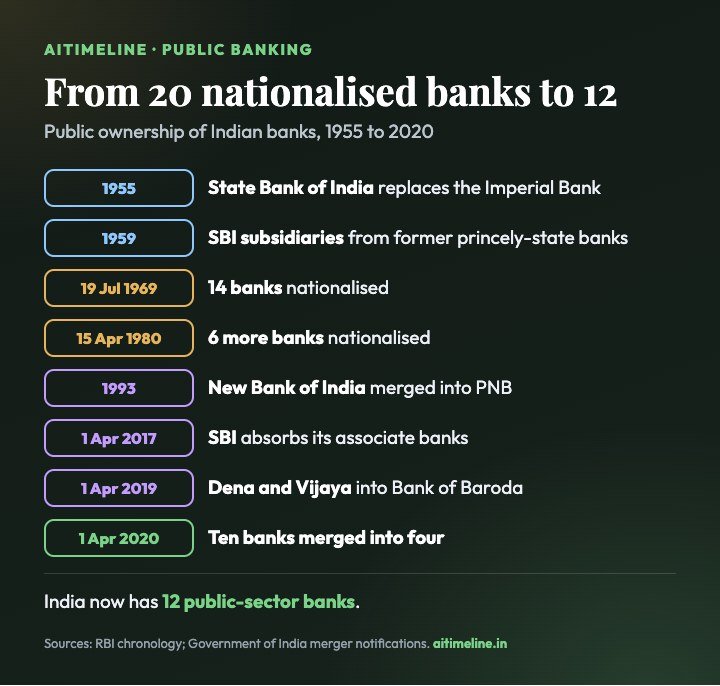
The judgment did not slow the policy. Within a decade the government nationalised six more banks, and by then the constitutional route Cooper had used was closed. Liberalisation after 1991 brought new private banks and prudential rules, but no return of the nationalised banks to private owners. Instead, successive governments merged them. After the mergers of 1 April 2020, India had 12 public-sector banks.
Key People
Rustom Cavasjee Cooper
Shareholder in four of the banks, depositor, and a director of Central Bank of India. His petitions gave the case its name.
Indira Gandhi
Took the finance portfolio from Morarji Desai on 16 July 1969, three days before the takeover.
V.V. Giri
As Vice-President acting as President, promulgated the 19 July ordinance, then resigned the next day to run for President.
Justice J.C. Shah
Delivered the judgment of ten judges striking down the 1969 Act.
Justice A.N. Ray
Would have upheld the Act. Became Chief Justice in 1973.
N.A. Palkhivala and Niren De
Palkhivala argued for Cooper; Attorney-General Niren De defended the law for the Union.
Key Facts at a Glance
| Detail | Information |
|---|---|
| Case | Rustom Cavasjee Cooper v. Union of India, AIR 1970 SC 564, (1970) 1 SCC 248 |
| Popular name | Bank Nationalisation Case |
| Law challenged | Banking Companies (Acquisition and Transfer of Undertakings) Act, 1969 (Act 22 of 1969) and Ordinance 8 of 1969 |
| Bench | 11 judges; Chief Justice M. Hidayatullah did not sit |
| Decision | 10 February 1970; 10 to 1; Act declared invalid |
| Articles | 14, 19(1)(f), 19(1)(g), 31(2), 32 and 123 |
| Replacement law | Act 5 of 1970, assent 31 March 1970, deemed from 19 July 1969 |
| Constitutional response | 25th Amendment, in force 20 April 1972 |
| Second nationalisation | Six banks, 15 April 1980 |
Explore More Timelines
People Also Ask
Frequently Asked Questions
Checked against the judgment, the 1970 Act and the RBI’s chronology.
⚠️ Editorial Note
This account is based on the text of the Supreme Court judgment of 10 February 1970, the Banking Companies (Acquisition and Transfer of Undertakings) Act, 1970 as published by the Department of Financial Services, and the Reserve Bank of India’s historical chronology. The Court invalidated the 1969 statute; it did not prohibit nationalisation. Checking the brief this page began from: social control dates from December 1967, when the National Credit Council was set up, and its law took effect on 1 February 1969, not February 1968; the discrimination the Court found was the ban on the 14 old banks carrying on banking, and it expressly left open whether selecting those banks was discriminatory; and V.V. Giri promulgated the ordinance as acting President and resigned the next day, so he was not President while the case was argued. This is not legal advice.
Related Reading on AiTimeline
Sources & further reading
Every dated entry above was checked against these references. Last reviewed 7 November 2026.
- Rustom Cavasjee Cooper v. Union of India, Supreme Court judgment of 10 February 1970
- Banking Companies (Acquisition and Transfer of Undertakings) Act, 1970 (Act 5 of 1970), full text
- Chronology of events: social controls, the nationalisation of banks and bank expansion, 1968 to 1985
- Desk Brief: The 25th Amendment
- Kesavananda Bharati v. State of Kerala, judgment of 24 April 1973
- Maneka Gandhi v. Union of India, judgment of 25 January 1978
- The Bank Nationalization Ordinance: A Remembrance On Its 51st Anniversary
- R. C. Cooper