Sonia Gandhi’s Memoir: The Personal Story Behind a Political Life
Sonia Gandhi's memoir Belonging: A Journey of Love, out 10 Nov 2026: key themes, life milestones and the publishing controversy behind its Indian release.
Latest Story
Sonia Gandhi’s memoir, Belonging: A Journey of Love, was released on 10 November 2026 by HarperCollins India, Alfred A. Knopf in the US and William Collins in the UK. She calls it “a personal one”, not a political book: the story of a 19-year-old from small-town Italy who met Rajiv Gandhi in Cambridge, married into the Nehru-Gandhi family, lost her mother-in-law and her husband to assassins, and was drawn into leading the Congress. This guide sets out what the book covers, the dated milestones of her life, and the dispute that moved the Indian edition from Penguin Random House India to HarperCollins.
📰 Latest Update — November 2026
Belonging went on sale on 10 November 2026, as scheduled. Release-day reports, including The Federal’s summary of the book, say it describes Rahul and Priyanka opposing her becoming prime minister in 2004 out of fear for her safety, Indira Gandhi in tears on seeing photographs of the damage to the Golden Temple after Operation Blue Star, and “practically no real contact” with Narendra Modi beyond formal events. Per Outlook and ThePrint (10 November), she also recounts telling her children “Absolutely not!” months before the 2004 result, a pressured “Theek hai” to alliance leaders before she declined, and Pranab Mukherjee remarking in 2010 that it was “perhaps time for a change at the top”, which she read as his prime-ministerial ambition; his daughter Sharmistha Mukherjee replied on X that there was nothing to be shocked about. BJP leaders have attacked the book, with spokesperson Pradeep Bhandari accusing her of “justifying” the Emergency; these are her recollections and their political reactions, not independently verified findings.
💡 Short Answer
Sonia Gandhi’s memoir is Belonging: A Journey of Love, a 544-page book released on 10 November 2026. It covers her childhood in Italy, meeting Rajiv Gandhi in Cambridge in 1965, life with Indira Gandhi, the assassinations of 1984 and 1991, her Congress leadership and her refusal of the prime minister’s post in 2004. HarperCollins publishes it in India after talks with Penguin Random House India ended in a disputed impasse.
Sonia Gandhi Memoir: Key Questions
The Memoir in Ten Points
- Confirmed title: Belonging: A Journey of Love, not An Ordinary Life.
- Release: 10 November 2026, simultaneously in India, the US and the UK.
- Publishers: HarperCollins India, Alfred A. Knopf and William Collins.
- Scale: 544 pages in the US hardcover; Knopf announced a 100,000-copy first printing.
- Starting point: Cambridge, 1965, when Sonia Maino met Rajiv Gandhi at a Greek restaurant.
- Core story: marriage in 1968, life in Indira Gandhi’s household, and the losses of 1980, 1984 and 1991.
- Political chapters: joining the Congress, leading it for more than 22 years, and declining the PM’s post in 2004.
- New detail: she says the family split over the 1975 Emergency, with Rajiv opposed and Sanjay in favour.
- Publisher row: Penguin Random House India’s deal ended in August 2026; the reasons are disputed.
- Read with care: a memoir is one person’s account and should be checked against the record.
Book Details: Belonging: A Journey of Love
From the publishers’ listings and announcements.
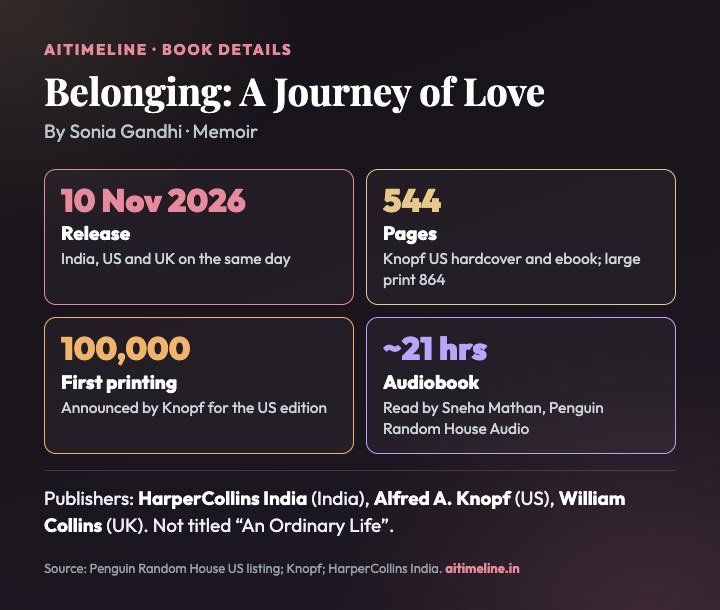
| Detail | Information |
|---|---|
| Title | Belonging: A Journey of Love |
| Author | Sonia Gandhi |
| Genre | Memoir |
| Indian publisher | HarperCollins India (announced 4 September 2026) |
| US publisher | Alfred A. Knopf (announced 18 August 2026) |
| UK publisher | William Collins, a HarperCollins UK imprint |
| Release date | 10 November 2026 (US large print: 24 November) |
| Length | 544 pages, US hardcover and ebook (ISBN 9780593803608) |
| Audiobook | About 20 hours 57 minutes, read by Sneha Mathan |
| Literary agent | David Godwin (per The Indian Express) |
Formats and page counts for the Indian and UK editions may differ from the US listing.
“This is not a political book. It is a personal one. Much has been written about my family, but rarely with real insight into who they were.”
Sonia Gandhi, essay in The Hindu, 9 November 2026
What Does Belonging Cover?
Based on the publishers’ descriptions, released excerpts, her essay, her Guardian interview and release-day reports on the published book.
Childhood in post-war Italy near Turin, language school in Cambridge and, at 18 or 19, meeting Rajiv. Then learning Hindi, the sari and Indian food: her first tandoori chicken “set her mouth on fire”.
A 1968 wedding in a sari spun from Nehru’s yarn, life in Indira Gandhi’s home, Rahul and Priyanka, and a mother-in-law who was formidable in public but “just like any other mother” at home.
Her account that Rajiv opposed the 1975 Emergency while Sanjay pushed for it, and her view that Indira was “a democrat at heart” who came to regret it.
Sanjay’s death in 1980, Indira’s assassination in 1984, and Rajiv’s in 1991. She told The Guardian that after 1984 her thought was always that Rajiv “will be killed next”.
Refusing the party presidency in 1991, then leading the Congress from 1998, the 2004 victory, declining the PM’s post, and the UPA years. She calls politics driven by “ambition, greed and hypocrisy”.
The question of home. “India was my home, my children’s home,” she said of refusing to return to Italy after 1991. Her foreign birth was used against her in 1999.
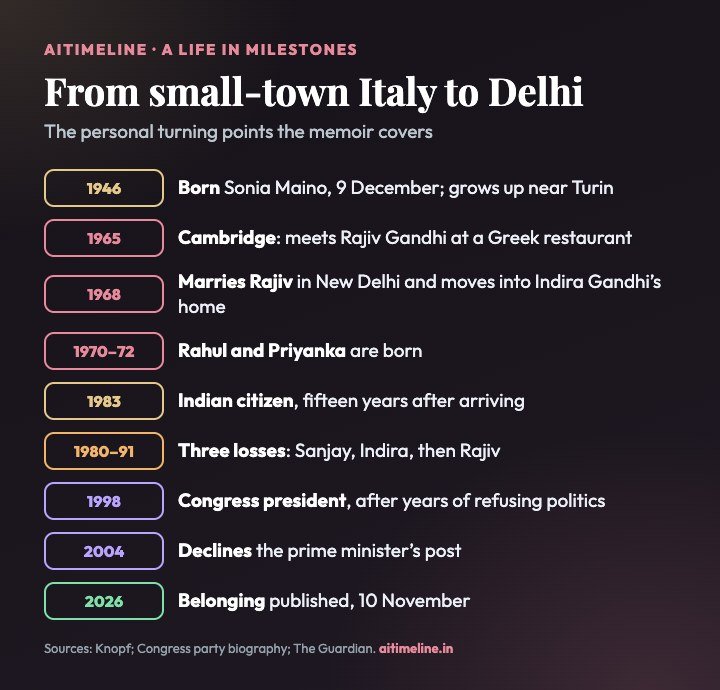
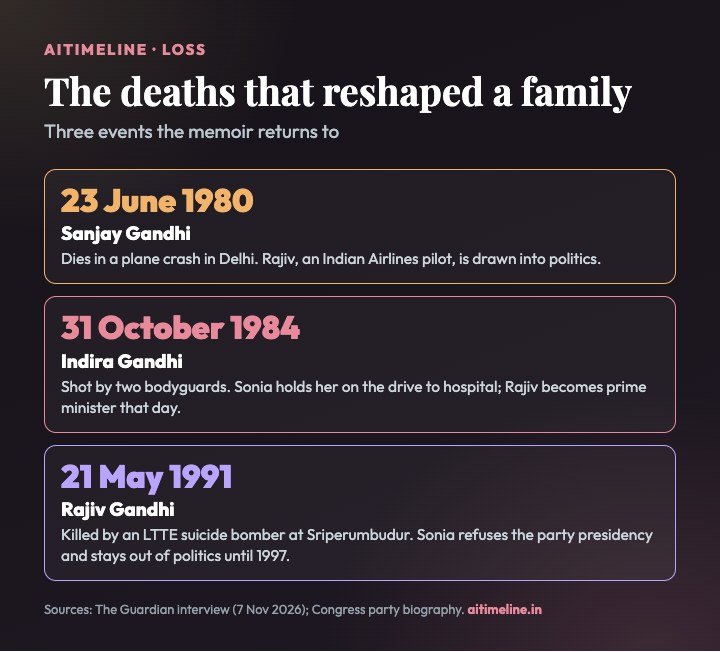
The Publishing Controversy: Why the Indian Edition Moved
What is reported, what is denied, and what is established.
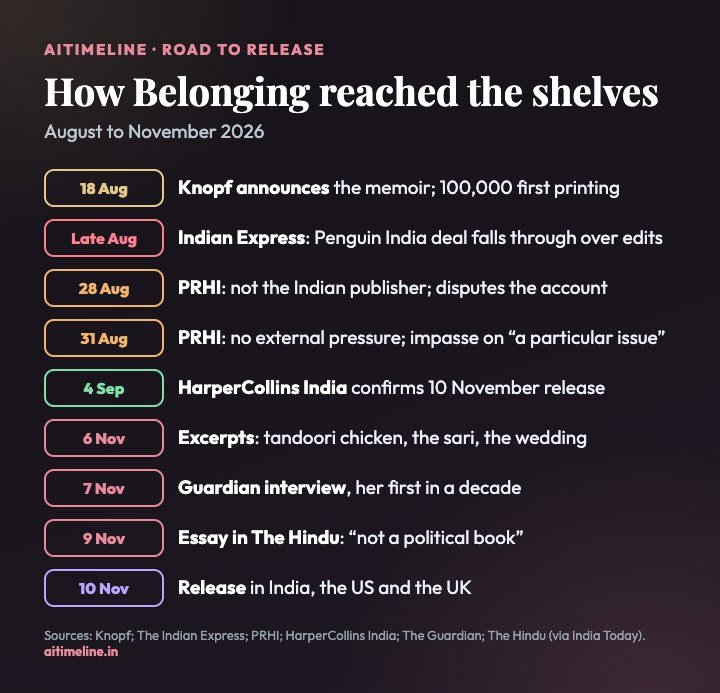
Knopf, part of Penguin Random House, announced the memoir on 18 August 2026. India was expected to follow through Penguin Random House India (PRHI). In late August The Indian Express reported that the Indian deal had fallen through after a back-and-forth of at least two months. Its sources said PRHI’s editors and lawyers suggested changes and deletions to passages on Prime Minister Narendra Modi and his 12 years in power, the RSS, communal riots, the position of minorities and the Galwan stand-off with China, and that the author’s side refused, arguing that Indian readers would otherwise get a different book from the rest of the world.
PRHI responded on 28 August that it was “not the publisher of Belonging in India” and that any suggestion it had dropped the book because the author declined editorial changes “does not accurately reflect the circumstances”. It said fact-checking and editorial recommendations are a normal part of publishing, that it had remained “willing and keen” to publish, and that it would not discuss confidential talks. On 31 August it added that there had been “no external pressure whatsoever” and that talks reached an impasse over “a particular issue”. HarperCollins India confirmed on 4 September that it would publish.
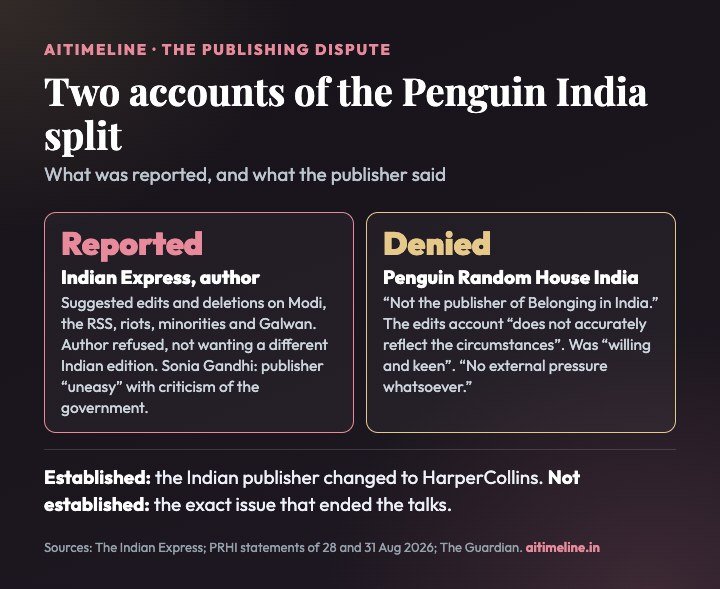
✅ Established
- Knopf announced the book on 18 August 2026.
- PRHI is not the Indian publisher.
- HarperCollins India published it on 10 November 2026.
- PRHI says it was willing to publish and faced no external pressure.
❓ Disputed or undisclosed
- The exact issue that ended the PRHI talks.
- Which specific edits were proposed, and why.
- Whether any edit amounted to censorship.
- Claims of political pressure, which PRHI denies.
Sonia Gandhi’s Political Roles at a Glance
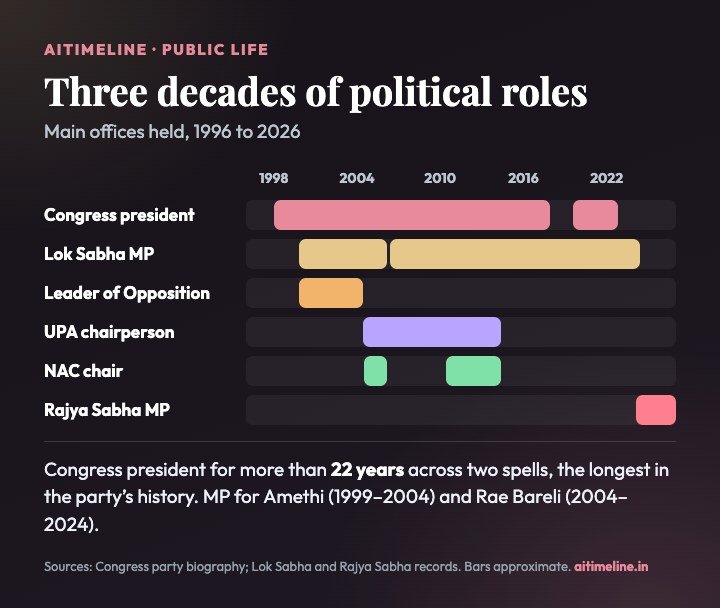
| Role | Period | Note |
|---|---|---|
| Congress primary member | 1997 | After six years outside politics |
| Congress president | 1998–2017 | Succeeded by Rahul Gandhi |
| MP, Amethi | 1999–2004 | Also won Bellary in 1999 |
| Leader of the Opposition | 1999–2004 | 13th Lok Sabha |
| MP, Rae Bareli | 2004–2024 | Re-elected in 2006 by-election |
| UPA chairperson | 2004–2014 | Declined PM post in 2004 |
| Interim Congress president | 2019–2022 | Until Mallikarjun Kharge |
| Rajya Sabha MP, Rajasthan | 2024– | Elected unopposed |
Timeline: Sonia Gandhi’s Life and the Making of the Memoir
Newest first. Colour shows the strand each event belongs to.
Belonging is released in India and abroad The memoir
What happened: Belonging: A Journey of Love went on sale on 10 November 2026. HarperCollins India publishes the Indian edition, Alfred A. Knopf the US edition and William Collins, a HarperCollins UK imprint, the UK edition. Knopf lists the US hardcover and ebook at 544 pages, a large-print edition on 24 November and an audiobook of almost 21 hours.
Why it matters: It is the first full first-person account of Sonia Gandhi’s life. Her earlier books, Rajiv and Rajiv’s World, were about her husband, and two volumes she edited collected letters between Jawaharlal Nehru and Indira Gandhi.
What release-day reports highlight: According to The Federal’s summary of the book, she writes that Rahul and Priyanka opposed her becoming prime minister in 2004, fearing for her safety, and that she told Rahul the morning after the result that she would stick to her decision; that tears rolled down Indira Gandhi’s face when she was shown photographs of the damage to the Golden Temple after Operation Blue Star; and that she has had “practically no real contact” with Narendra Modi beyond formal events. She also denies interfering in Manmohan Singh’s government, and recalls Pranab Mukherjee suggesting in 2010 that it was “perhaps time for a change at the top”.
Reaction: BJP leaders have criticised the book; spokesperson Pradeep Bhandari accused her of “justifying” the Emergency. Sharmistha Mukherjee defended her father’s ambition as earned on merit. Early opinion pieces split: ThePrint argued it matters for what she refuses rather than what it reveals, while The Pamphlet called it reputation management. Full-length reviews in major outlets had not yet appeared as of 11 November.
“This is not a political book. It is a personal one” The memoir
What she wrote: In an essay published in The Hindu the day before release, Sonia Gandhi said she wanted to show her family as she knew them, including their motivations, struggles and flaws. “Much has been written about my family, but rarely with real insight into who they were,” she wrote.
The thread of the book: She described love, and the loyalty it brought, as what connected the stages of her life: meeting Rajiv in England at 19, joining a new family, raising her children, and losing first her mother-in-law and then her husband to violence.
On privacy: “For most of my life, I kept my inner world to myself. Even after grief pulled me into politics, I held on to whatever privacy I could,” she wrote. She said she had watched India transform “at first from the margins and later from its very centre”.
First interview in a decade, with The Guardian The memoir
What she said: In her first interview in about ten years, given to The Guardian with her daughter Priyanka present, she described meeting Rajiv as “a coup de foudre”, recalled holding Indira Gandhi’s body on the drive to hospital in 1984, and said that after Indira’s death her constant thought was that Rajiv “will be killed next”.
On the Emergency: She said the family was split over the 1975 Emergency, with Rajiv opposed and Sanjay pushing for it, and that she believes Indira was “a democrat at heart” who came to feel uneasy about it. The book says that keeping Sanjay in check “could have prevented much of the damage that followed”.
On the publisher dispute: She told the paper Penguin Random House India had been “uneasy in general with the criticism of the government”. In the same report the publisher repeated that it had not decided against the book because she declined editorial changes.
HarperCollins shares early excerpts The memoir
What the excerpts show: Her first Indian dish was tandoori chicken, “bright red, slightly charred”, which “set her mouth on fire”. She gradually took to family thalis of rice, phulkas, vegetables, meat or fish and arhar dal.
The sari: She found the sari one of the most elegant garments in the world but hard to wear. For her engagement she chose a jade-green and pale-yellow sari held with several safety pins; for her wedding she wore a sari woven from yarn spun by Jawaharlal Nehru in prison.
The publisher’s line: “The unfamiliar becomes familiar. The familiar becomes loved. Love grows into responsibility. And that is belonging.”
Promotional videos: “bound to be some tamasha” The memoir
What she said: In short promotional videos she said there was “bound to be some tamasha” when the book came out, because others had spent decades telling her story and it was now her turn. Captions said she was “totally against” Rajiv becoming prime minister in 1984.
Why it matters: It set expectations that the book would contest “invented or exaggerated” accounts of her life, a reference reporters linked to earlier books about her, including Javier Moro’s novelised biography The Red Sari, which drew a Congress legal notice in 2010.
HarperCollins India confirms the Indian edition The memoir
What happened: HarperCollins India announced it would publish Belonging in India on 10 November 2026, calling it “one of the most anticipated political memoirs of our time”.
Background: The Indian Express reported that several Indian publishers had approached the author’s agent, David Godwin, but were told the deal had already been finalised with HarperCollins. The Indian release date matches the US one.
The Penguin Random House India dispute The memoir
The report: The Indian Express reported that Penguin Random House India (PRHI) would not publish the memoir after Sonia Gandhi declined some suggested “editorial changes and deletions”. Its sources said passages questioned included references to Prime Minister Narendra Modi, the RSS, communal riots, the position of minorities and the Galwan stand-off with China, and that the author’s side did not want an Indian edition that differed from the global one.
The publisher’s response: On Friday 28 August PRHI said it was “not the publisher of Belonging in India” and that any suggestion it decided not to publish because the author declined editorial changes “does not accurately reflect the circumstances”. It said it had remained “willing and keen” to publish, that fact-checking and editorial suggestions are normal, and that it would not discuss confidential talks. On 31 August it said there had been “no external pressure whatsoever” and that the talks reached an impasse over “a particular issue”.
Reaction: Congress leaders called the episode an attack on free expression; Gaurav Gogoi called the publisher’s statement “weak”.
Knopf announces the memoir The memoir
What was announced: Knopf announced Belonging: A Journey of Love for 10 November 2026, in hardcover and ebook, with an audio edition from Penguin Random House and a first printing of 100,000 copies. It said the book begins in Cambridge in 1965, when 19-year-old Sonia Maino falls in love with Rajiv Gandhi.
In her words: “It was heartbreak and loss that threw me into the public world of politics. Up till then I had guarded my privacy fiercely,” she said. “Writing about my life did not come easily to me.”
Moves to the Rajya Sabha from Rajasthan Politics
What happened: Sonia Gandhi was elected unopposed to the Rajya Sabha from Rajasthan in February 2024 and did not contest Rae Bareli in the 2024 general election. The seat stayed with the family: Rahul Gandhi won Rae Bareli in 2024.
Her role now: She chairs the Congress Parliamentary Party and, by her own account, has stepped back from the party’s day-to-day running.
Mallikarjun Kharge succeeds her as Congress president Politics
What happened: Mallikarjun Kharge won the Congress presidential election in October 2022, ending Sonia Gandhi’s second spell, as interim president, which began in August 2019.
Why it matters: It made Kharge the first non-Gandhi party president since Sitaram Kesri, whom she replaced in 1998.
Returns as interim Congress president Politics
What happened: After Rahul Gandhi resigned following the 2019 Lok Sabha defeat, the Congress Working Committee asked Sonia Gandhi to return as interim president in August 2019.
Why it matters: She steered the party through a period of electoral losses and internal dissent until the 2022 election.
Steps down; Rahul Gandhi becomes president Politics
What happened: Rahul Gandhi took over as Congress president in December 2017, ending her first, nearly two-decade term.
Context: The party had lost power at the Centre in 2014, when the BJP-led National Democratic Alliance won a majority.
Office-of-profit row: resigns, then wins back Rae Bareli Politics
What happened: Amid a controversy over whether chairing the National Advisory Council (NAC) was an “office of profit” incompatible with being an MP, she resigned her Lok Sabha seat in March 2006 and gave up the NAC chair, then won the Rae Bareli by-election with a larger margin.
The NAC: The NAC made recommendations that fed into the rural jobs guarantee (MGNREGA), the Right to Information Act and other programmes. It was reconstituted under her chairmanship on 29 May 2010.
Declines the prime minister’s post Politics
What happened: The Congress emerged as the largest party in the 2004 Lok Sabha election and formed the United Progressive Alliance government. Its MPs elected Sonia Gandhi as their leader, but she declined to become prime minister and backed Manmohan Singh, who led the government for ten years.
In her words: “It was clear in my mind I would never do it,” she told The Guardian in 2026. “It was just not me.”
Why it matters: It is one of the most debated decisions in modern Indian politics. In the memoir, per release-day reports, she says Rahul and Priyanka opposed her taking the post out of fear for her safety, and that she told Rahul the next morning she would not change her mind despite pressure from party leaders.
Enters Parliament amid a row over her foreign origin Politics
The split: In May 1999 Sharad Pawar, P.A. Sangma and Tariq Anwar challenged her leadership on the ground of her foreign birth. They were expelled and formed the Nationalist Congress Party. She offered to resign as party president and withdrew after the party rallied behind her.
The election: In the 1999 Lok Sabha election she won both Amethi in Uttar Pradesh and Bellary in Karnataka, kept Amethi, and became Leader of the Opposition.
Joins the Congress, then leads it Politics
What happened: She took primary membership of the Congress in 1997, campaigned for the party before the 1998 general election and became its president in 1998, replacing Sitaram Kesri. The party biography dates her presidency to April 1998.
In her words: She told The Guardian she took the post out of a sense of duty to her husband, campaigning in Hindi, her third language, and describes politics in the memoir as driven by “ambition, greed and hypocrisy”.
Rajiv Gandhi is assassinated at Sriperumbudur Loss
What happened: Rajiv Gandhi was killed by an LTTE suicide bomber at an election rally in Sriperumbudur, Tamil Nadu. Sonia Gandhi heard the news at the Delhi bungalow where she still lives.
Her response: She declined the Congress presidency offered to her after his death, set up the Rajiv Gandhi Foundation and stayed out of party politics for six years. Her sister urged her to return to Italy; “India was my home, my children’s home,” she said in 2026.
Still unresolved, in her view: She told The Guardian she believes the full truth of a wider conspiracy has not come out. That is her view; the courts convicted LTTE members and associates in the assassination case.
Indira Gandhi is assassinated Loss
What happened: Prime Minister Indira Gandhi was shot by two of her bodyguards months after Operation Blue Star at the Golden Temple. Sonia Gandhi, hearing what sounded like fireworks, ran to the spot and held her mother-in-law in the car to the hospital.
What followed: Rajiv Gandhi was sworn in as prime minister the same day. Sonia had begged him to stay out of politics and described the moment as a “knife going into my heart”. Anti-Sikh violence followed in Delhi and elsewhere.
Her account: She told The Guardian that Indira had prepared the family for her death and told Rahul to be brave.
Sanjay Gandhi dies in a plane crash Loss
What happened: Rajiv’s younger brother Sanjay Gandhi died when the aircraft he was flying crashed in Delhi.
What followed: Rajiv, then an Indian Airlines pilot, was persuaded to enter politics and won Sanjay’s Amethi seat in 1981, against Sonia’s wishes.
Becomes an Indian citizen Private life
What happened: Sonia Gandhi took Indian citizenship in 1983, fifteen years after moving to India.
Why it matters: The timing was later used by opponents, including the 1999 rebels, to question her eligibility to lead, a theme the memoir’s title, Belonging, addresses directly.
The Emergency splits the family Private life
Her account: Sonia Gandhi says Rajiv urged his mother to wait for the next election, while Sanjay pushed for the Emergency, telling her at a family dinner that the opposition “must be stopped”. She calls the Emergency a mistake.
Why it matters: It is one of the few places where the memoir is known to criticise a family decision, and it gives a private view of the period behind the Shah Commission findings.
Rahul and Priyanka are born Private life
What happened: Rahul was born in 1970 and Priyanka in 1972, after what she has described as a traumatic miscarriage. The family lived with Indira Gandhi, then prime minister.
Her life then: She redecorated the austere bungalow, learned Kashmiri cooking and, by her account, lived a “carefree” private life. She later took a diploma in conservation of oil paintings from the National Museum in New Delhi.
Marries Rajiv Gandhi and moves to India Private life
What happened: Sonia Maino moved to India and married Rajiv Gandhi in New Delhi in 1968. She lived with him in the home of his mother, Indira Gandhi, then two years into her first term as prime minister.
Her account: She was intimidated at first by Indira’s public image but found her “just like any other mother” at home. “For this man, I was ready to do everything, to lose even my Italian identity,” she said.
Meets Rajiv Gandhi in Cambridge Private life
What happened: While studying English at a language school in Cambridge, Sonia Maino met Rajiv Gandhi, then a student in England, at a Greek restaurant. Knopf dates the meeting to 1965.
In her words: “It was a coup de foudre,” she said. She did not know at first that he was Nehru’s grandson and Indira Gandhi’s son.
Born in post-war Italy Private life
Early life: Sonia Maino was born on 9 December 1946 into a working-class family. Her publisher’s author note says she grew up in the Piedmontese village of Sangano and the town of Orbassano near Turin and studied foreign languages in Turin before going to Cambridge.
Why it matters: The memoir starts from that “small-town Italy” and asks how a place far away became home.
Why the Memoir Matters
- A first-person record: the Nehru-Gandhi family has been written about mostly by biographers, rivals and novelists; this is the account of someone inside the household for six decades.
- Private views of public events: the Emergency, Operation Blue Star’s aftermath, Rajiv’s security and the 2004 decision, seen from the family table.
- The foreign-origin question: the book’s title takes on the issue opponents used against her in 1999 and after.
- Publishing and free expression: the dispute over the Indian edition became part of a wider debate about books on politically sensitive subjects in India.
- Limits: recollections of private conversations cannot be independently checked and should be read alongside court findings, official records and other memoirs.
Explore More Timelines
People Also Ask
Frequently Asked Questions
Checked against the publishers’ listings, The Guardian interview, The Indian Express, PRHI’s statements and the Congress party biography.
⚠️ Editorial Note
This article was prepared on 9 November 2026, before the book’s release, so descriptions of its contents rely on the publishers’ announcements, excerpts released by HarperCollins, Sonia Gandhi’s essay in The Hindu and her interview with The Guardian. It was updated on 11 November 2026, after the 10 November release, with contents reported by The Federal, Outlook, ThePrint and other outlets; full-length reviews in major outlets had not yet appeared. Her recollections and political opinions are attributed to her and are not independently verified findings. The publishing dispute is presented with both the reported account and Penguin Random House India’s response; claims of censorship or political pressure are not established. Corrections to the brief this page began from: in 1999 she kept Amethi, not Rae Bareli, which she first won in 2004; her 9 November essay appeared in The Hindu rather than as a HarperCollins release; she met Rajiv in 1965, not the early 1960s; and the confirmed title is Belonging: A Journey of Love, not An Ordinary Life.
Related Reading on AiTimeline
Sources & further reading
Every dated entry above was checked against these references. Last reviewed 11 November 2026.
- Penguin Random House: Belonging: A Journey of Love by Sonia Gandhi (Knopf US edition listing)
- Business Standard (PTI): Writing about my life did not come easily to me, Sonia on upcoming memoir (Knopf announcement, 19 August 2026)
- Onmanorama: Penguin Random House India clarifies it is not publishing Sonia Gandhi's memoir (28 August 2026)
- The Indian Express: It's official, HarperCollins to publish Sonia Gandhi memoir, release on Nov 10 (4 September 2026)
- The New Indian Express: Sonia Gandhi recalls first taste of tandoori chicken, struggles with sari in memoir (6 November 2026)
- The Guardian: Sonia Gandhi on marrying into an Indian political dynasty and her husband's assassination (interview, 7 November 2026)
- The Indian Express: 'India was my home, my children's home', Sonia Gandhi on why she never left after Rajiv's assassination (8 November 2026)
- India Today: Not a political book, a personal one, Sonia Gandhi on her upcoming memoir (9 November 2026)
- Indian National Congress: Smt. Sonia Gandhi, past party presidents (official biography)