Ford Mustang History: How America’s Pony Car Survived 60 Years of Change
Ford Mustang history from 1964 to 2026: every generation, Shelby, Boss, Fox Body, Dark Horse and GTD, plus Mach-E, fact-checked against Ford sources.
Latest Story
Most cars have a lifecycle. The Ford Mustang built a family tree. Since Ford unveiled it at the New York World’s Fair on April 17, 1964, the Mustang has lived through an oil embargo, three rounds of tightening emissions rules, a downsizing decade, the rise of front-wheel-drive family cars, the SUV takeover of the American driveway, Japanese and German performance competition, and now the shift toward electrification. Its two direct rivals from the muscle-car era — the Chevrolet Camaro and the Dodge Challenger — are both out of production as of 2026. The Mustang is not. This Ford Mustang history traces all seven generations, year by year, and asks the question that actually matters: not when the Mustang launched, but how it kept surviving.
The short version is that Ford rarely left the Mustang alone. It got smaller in 1974, bigger in 1971, cheaper in 1979, faster in 2011, independent rear suspension in 2015, and an electric SUV wearing its name in 2021. Enthusiasts hated some of those decisions in the moment. Nearly every one of them is why there is still a Ford Mustang to argue about in 2026.
Latest Update — April 2026
On April 17, 2026 — the Mustang’s 62nd anniversary — a hardware- and aero-upgraded Mustang GTD Competition, driven by Ford Racing/Multimatic factory driver Dirk Müller, lapped the Nürburgring Nordschleife in 6:40.835, more than 11 seconds quicker than the standard Mustang GTD’s 6:52.072 mark set in 2025. The time beat the Chevrolet Corvette ZR1X’s 6:49.275, per Ford’s own results release, reclaiming the title of fastest street-legal American car at the Nordschleife. It remains slower than the Ford GT Mk IV’s 6:15.977 set two weeks earlier, but that car is a non-street-legal race car in a different category.
🧠 Ford Mustang History in Brief
Ford launched the Mustang on April 17, 1964, creating the “pony car” segment with a long-hood, short-deck coupe starting at $2,368. It has run through seven generations — 1964–73, Mustang II (1974–78), Fox Body (1979–93), SN95 (1994–2004), S197 (2005–14), S550 (2015–23) and S650 (2024–present) — adding Shelby, Boss, Mach 1, Dark Horse and, in 2025, the 815-hp Mustang GTD. In 2021 Ford put the name on an electric SUV, the Mach-E. By 2024, both the Camaro and Challenger had ended production; the Mustang had not.
Ford Mustang: Key Questions
What to Know About Ford Mustang History
- Launch: Debuted April 17, 1964 at the New York World’s Fair; ~22,000 orders taken on day one, more than 400,000 sold in the first year.
- “1964½”: An enthusiast and dealer nickname, not an official Ford model-year designation — every 1964-built car is titled as a 1965 model.
- Creation: A team effort under Ford general manager Lee Iacocca, with chief engineer Donald Frey, planner Hal Sperlich and designer Joe Oros — not a single inventor.
- Survival move #1: The 1974 Mustang II, built on the subcompact Pinto platform, kept the nameplate alive through the OPEC oil embargo.
- Survival move #2: The 1979 Fox Body restored performance credibility with the “5.0” V8 after a decade of emissions-strangled engines.
- Survival move #3: The 2005 retro-styled S197 turned 1960s nostalgia into the car that revived the entire pony-car segment.
- Survival move #4: The 2015 S550 gave the Mustang independent rear suspension for the first time and made it a genuine global, right-hand-drive export car.
- 2021 pivot: Ford put the Mustang name on an all-electric SUV, the Mach-E — a separate model line, not a replacement for the coupe.
- 2023–24 turning point: The Dodge Challenger and Chevrolet Camaro both ended production; the Mustang is now the only nameplate of the original muscle-car trio still built.
- 2025: The 815-hp Mustang GTD, a motorsport-derived halo car starting near $328,000, lapped the Nürburgring Nordschleife in 6:52.072 — a record for an American production car at the time.
Ford Mustang: Three Numbers That Define It
Verified totals, not marketing rounding.
Production
Longevity
Performance
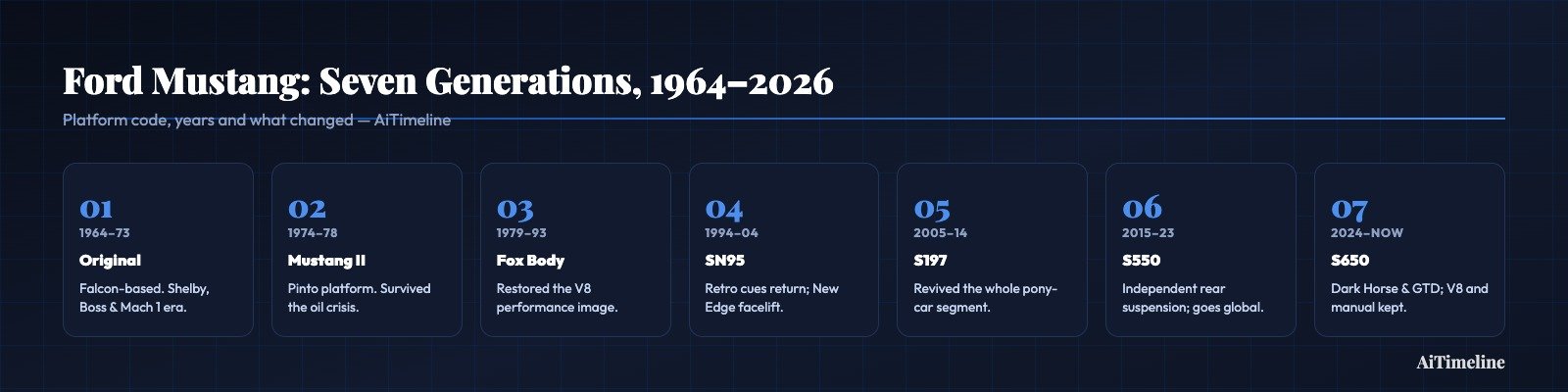
Ford Mustang’s seven generations, 1964 to present. © AiTimeline
Ford Mustang Timeline: Every Major Milestone
Newest first. Full year-by-year detail for each generation follows below.
Mustang GTD sets, then re-sets, its Nürburgring lap
The 815-hp Mustang GTD officially lapped the Nürburgring in 6:52.072 in 2025. On April 17, 2026, a hardware- and aero-upgraded GTD Competition variant, driven by Ford Racing/Multimatic factory driver Dirk Müller, cut that to 6:40.835 — over 11 seconds quicker — beating the Chevrolet Corvette ZR1X’s 6:49.275 to reclaim the title of fastest street-legal American car at the Nordschleife.
Mustang GT3 wins GTD Pro class at the Rolex 24 at Daytona
Ford’s factory Multimatic-run Mustang GT3 program topped its class at the season-opening Rolex 24, validating the car’s return to top-level factory GT racing after 2024’s Le Mans debut.
Camaro and Challenger both end production
Dodge built its last third-generation Challenger in December 2023; Chevrolet ended sixth-generation Camaro production in January 2024. Neither had a confirmed direct gasoline successor.
Seventh-generation S650 goes on sale; 60th anniversary marked
The S650 arrived on schedule for the Mustang’s April 17, 2024 60th-anniversary date, keeping EcoBoost and V8 engines plus a manual option, and introducing the Dark Horse trim.
S650 unveiled in Detroit
Ford revealed the seventh-generation Mustang on September 14, 2022, confirming it would keep a V8 and manual transmission at a time when several rivals were exiting combustion performance cars.
Mustang Mach-E launches
Ford’s first purpose-built EV, styled with Mustang cues, went on sale as a 2021 model — the first product carrying the Mustang name that isn’t a two-door coupe or convertible.
760-hp Shelby GT500 debuts
The supercharged 5.2L Shelby GT500 became the most powerful factory-built Ford ever produced to that point, until the GTD surpassed it in 2025.
Mustang officially launches in India; Shelby GT350 debuts
Ford began selling the CBU-imported Mustang in India at roughly ₹65 lakh ex-showroom, and Ford Performance launched the naturally aspirated, flat-plane-crank Shelby GT350/GT350R in the U.S.
Sixth-generation S550 launches with independent rear suspension
Every Mustang got IRS for the first time, plus a new turbo EcoBoost four-cylinder and factory right-hand-drive production, turning it into a genuinely global sports car.
5.0-liter Coyote V8 returns to the GT
The naturally aspirated Coyote V8, at 412 hp, replaced the 4.6L Modular engine and has powered every GT-and-above Mustang since, now in its fourth generation.
Fifth-generation S197 launches with retro-futuristic design
A bold, 1967-68-referencing redesign is widely credited with reviving the entire pony-car segment, prompting Chevrolet’s 2010 Camaro and Chrysler’s 2008 Challenger revivals.
“New Edge” facelift sharpens SN95 styling
A creased, angular restyling carried the fourth-generation Mustang through its final five years, closing out in 2003-04 with the supercharged SVT Cobra “Terminator.”
Fourth-generation SN95 launches
The first ground-up Mustang redesign since 1979 kept Fox-derived underpinnings but rounded the styling to reference the 1960s original, previewing the retro turn to come.
Turbocharged SVO Mustang debuts
Ford’s new Special Vehicle Operations division built a sophisticated turbo four-cylinder Mustang, sold alongside the simpler, cheaper 5.0 GT until its 1986 discontinuation.
Third-generation Fox Body Mustang launches
A lighter, boxier, more aerodynamic Mustang on Ford’s new Fox platform began the longest production run of any generation, and became the foundation of the modern tuning aftermarket.
Mustang II debuts amid the oil crisis
Built on the subcompact Pinto platform and launched with no V8 available in its first year, the Mustang II traded performance for fuel economy right as the 1973 OPEC embargo hit.
Mach 1, Boss 302 and Boss 429 launch
Ford’s performance lineup hit its widest point: Mach 1 as a factory GT package, Boss 302 for SCCA Trans-Am homologation, Boss 429 to legalize its “semi-hemi” engine for NASCAR.
Steve McQueen’s Bullitt Mustang hits theaters
McQueen’s Highland Green Mustang GT 390 fastback starred in one of film history’s most influential car chases, cementing the Mustang’s “freedom and speed” identity for decades of moviegoers.
First Mustang redesign widens the engine bay
A larger body made room for Ford’s FE-series big-block V8s, including a new 390-cubic-inch option, setting up the muscle-car horsepower race that peaked in 1969.
One-millionth Mustang built
Ford hit its first production milestone in under two years, cementing the Mustang’s launch as one of the fastest-selling new nameplates in American automotive history.
Shelby GT350 launches
Carroll Shelby’s 306-hp, track-tuned Mustang fastback gave the new car genuine racing credibility, winning its SCCA class outright in its debut season.
Ford Mustang debuts at the New York World’s Fair
Unveiled April 17, 1964 and on sale at dealers the same day, the $2,368 Mustang took roughly 22,000 orders on day one and created the pony-car segment outright.
How the Mustang Changed the Car Industry in 1964
The launch, the price, and the “1964½” question, verified.
Ford unveiled the Mustang on April 17, 1964, with two simultaneous events: a press preview at the Ford Pavilion (the “Wonder Rotunda”) at the New York World’s Fair in Flushing Meadows, and a same-day on-sale date at Ford dealers nationwide. Henry Ford II did the unveiling honors at the fair. The car went on sale as a hardtop starting at $2,368, with a convertible following soon after and a fastback “2+2” arriving that August. Ford dealers reportedly took orders for close to 22,000 cars on the first day alone, and the company sold more than 400,000 Mustangs within the first 12 months — a launch pace that still ranks among the fastest in automotive history.
The formula was not about horsepower. It was long hood, short deck proportions borrowed from European sports coupes, a compact size built on the humble Ford Falcon’s platform and mechanicals to keep costs down, a wide options sheet, and a starting price that undercut every genuine sports car on the market. A buyer could order a Mustang with a thrifty 170-cubic-inch inline-six or step up through 260 and 289-cubic-inch V8s, then personalize it with dozens of factory options — a “car you build yourself” pitch that Ford’s marketing leaned on hard. That combination of style, affordability and choice, not raw power, is what created the entirely new “pony car” segment and what every rival — Chevrolet’s Camaro, Plymouth’s Barracuda, AMC’s Javelin — spent the rest of the decade chasing.
What the “1964½ Mustang” actually means
This is one of the most repeated inaccuracies in Mustang history, so it is worth stating precisely. Ford never sold a separate “1964½” model year. Every Mustang built between the April 1964 launch and the end of that summer was titled, VIN-coded and sold by Ford as an early-production 1965 model. “1964½” is a nickname that Mustang owners, dealers and later collectors adopted to describe those early cars, which do carry small mechanical differences from later 1965-built cars (including the generator-vs-alternator charging system and a smaller-bore six-cylinder engine on the earliest units). Collectors and marque historians use the “1964½” term as shorthand for “early-build 1965 Mustang” — it is a useful distinction, but it is not, and never was, Ford’s own official model-year designation.
Lee Iacocca Didn’t Build the Mustang Alone
The team behind the car, and why the “one genius” story oversimplifies it.
Lee Iacocca, Ford Division’s general manager at the time, is the name most associated with the Mustang, and rightly so — he championed the project internally, pushed for an aggressive 18-month development schedule, and fronted the launch publicity, including a Time and Newsweek double cover the same week. But Iacocca did not design or engineer the car. Donald N. Frey, Ford’s chief engineer at the time, is credited by his own New York Times obituary and by Ford historians as the executive who supervised the Mustang’s actual engineering development and is sometimes called “the father of the Mustang” for that reason. Hal Sperlich, a Ford product-planning executive, is credited with the cost-saving insight to base the new car on the existing Falcon platform, which is what made the aggressive timeline and low launch price possible at all. On the design side, Joe Oros led the Ford styling studio team (working with designer Dave Ash) whose clay-model proposal won Ford’s internal 1962 design competition and became the production Mustang’s shape. Treating any one of these people as the Mustang’s sole inventor understates how the car actually got made: a compressed, cross-functional product-development sprint, not a single executive’s idea sketched on a napkin.
First Generation: 1964–1973
From lightweight pony car to the biggest, heaviest Mustang Ford ever built.
The first generation ran nine model years and changed shape twice. The 1967 redesign widened the engine bay specifically to accept Ford’s FE-series big-block V8s, allowing a 390-cubic-inch option and setting up the muscle-car arms race that followed. 1968 brought the 428 Cobra Jet V8 mid-year and, in pop culture, the Bullitt Mustang GT 390 fastback. The 1969 model year was the performance peak of the whole generation: Ford added the Mach 1 as a factory-optioned performance package, the Boss 302 as a homologation special for SCCA Trans-Am racing, and the Boss 429 to legalize its 429 “semi-hemi” engine for NASCAR. By 1971–73, tightening emissions and safety-bumper rules had pushed the Mustang into a heavier, longer “big Mustang” era — nearly 20 inches longer and 600+ pounds heavier than the 1965 original — that set the stage for the drastic downsizing that followed.
How Carroll Shelby Changed the Mustang
Shelby American’s factory-blessed performance cars, and where Shelby’s own hands actually were.
Carroll Shelby, already known for the AC Cobra, was brought in by Iacocca in 1964 to give the Mustang genuine racing and performance credibility beyond the base car’s sporty-but-mild handling. The 1965 Shelby GT350, built at Shelby American’s Los Angeles facility from Ford-supplied Mustang fastbacks, used a modified 289-cubic-inch V8 rated at 306 hp along with reworked suspension, brakes and a limited factory color scheme (Wimbledon White with Guardsman Blue stripes). A track-only GT350R variant won its SCCA racing class outright in its debut season. The 1967 GT500 added a 428-cubic-inch big-block V8 for more straight-line performance. It is important to separate the brands correctly: these were Ford/Shelby collaborations, built on Ford Mustang bodies-in-white and sold through Ford dealers, not cars Carroll Shelby personally hand-built one at a time. By the early 1970s, production had moved in-house to Ford, and the Shelby name went dormant on Mustangs until Ford revived it as the Shelby GT500 (2007) and later Shelby GT350 (2015) trims — both factory Ford Performance products carrying Shelby’s name and input under a renewed licensing partnership, not products of Shelby American’s original shop.
Mach 1 and the Boss Mustangs
Three different performance philosophies, one model year: 1969.
The Mach 1, introduced for 1969, was Ford’s factory-optioned grand-touring performance package — not a homologation special, but an image car aimed at buyers who wanted a fast, well-equipped Mustang without ordering a race-bred variant. It stayed in the lineup, on and off, longer than any single Boss model, including a modern revival on the 2021–23 S550. Boss 302, also 1969, existed for one reason: SCCA Trans-Am racing rules required Ford to sell at least 1,000 street versions of the small-block engine it wanted to race, so the Boss 302 combined a high-revving 302-cubic-inch V8 with track-tuned suspension. Boss 429 served the same homologation purpose for NASCAR, shoehorning Ford’s massive 429 “semi-hemi” engine — designed for stock-car racing, not street driving — into narrow-body Mustangs modified by outside contractor Kar Kraft, at a reported loss on every car sold. A milder Boss 351 followed in 1971 as the big-block Boss cars were discontinued. None of these were mass-production trims; each existed to satisfy a specific racing rulebook, which is exactly why they carry outsized collector value today.
Mustang II: The Controversial Reset
Why enthusiasts still argue about the car that kept the Mustang alive.
The October 1973 OPEC oil embargo hit the American car market just as Ford was finalizing its next Mustang, and the timing could not have worked out better for Ford’s bet: the 1974 Mustang II, built on the subcompact Ford Pinto platform and roughly 500 pounds lighter and 19 inches shorter than the car it replaced, launched with a four-cylinder as the standard engine and a V6 as the performance option — no V8 was available at all in its first model year (a 302 V8 returned as an option for 1975). Motor Trend named it Car of the Year. It sold well — nearly 386,000 units in its debut year, well above the outgoing 1973 Mustang’s total.
Enthusiast opinion on the Mustang II has never fully recovered, and it is worth explaining why rather than just repeating the “worst Mustang ever” verdict. The criticism is really a complaint about timing and platform, not execution: buyers who wanted a 1969 Boss 302 successor got a Pinto-based economy coupe instead, because that is what emissions rules, insurance surcharges on muscle cars, and $12-a-barrel oil made commercially sane to build. Cobra II (1976) and King Cobra (1978) trims added performance-look graphics packages to a car whose engines were emissions-strangled by period standards. The more useful way to read the Mustang II is as proof the nameplate could survive a total platform and mission change when the market demanded one — the same trick Ford would need again in 1979, and arguably again in 2021 with the Mach-E.
Fox Body: The Mustang That Saved the Performance Car
1979–1993 — the longest-running Mustang platform, and the one the aftermarket built an industry on.
The third-generation Mustang moved to Ford’s new, lighter “Fox” platform for 1979 — shared with the Fairmont sedan — trading the Mustang II’s stubby proportions for a longer wheelbase, boxier aerodynamic styling and reduced weight. Performance returned gradually: a turbocharged 2.3-liter SVO Mustang (1984–86) showcased Ford’s new Special Vehicle Operations division with sophisticated four-cylinder technology, while the simpler, cheaper 5.0 GT (actually a 4.9-liter/302-cubic-inch V8) became the car enthusiasts actually bought, especially after Ford’s 1987 facelift and the switch to sequential fuel injection pushed horsepower up while keeping the price down. The stripped-down LX 5.0 notchback and hatchback, lighter than the GT, became a favorite of street and drag racers chasing horsepower-per-dollar rather than showroom trim.
Fox Body’s 15-year run (1979–93, the longest of any Mustang generation) is why it became a cultural icon independent of the Mustang nameplate itself: it was cheap, mechanically simple, structurally strong enough to handle serious power, and produced in huge numbers, all of which made it the foundation of the modern Mustang aftermarket-tuning industry. The platform closed out with the 1993 SVT Cobra and track-only Cobra R, Ford’s first “SVT” (Special Vehicle Team) Mustangs.
Fourth Generation: SN95 (1994–2004)
A full redesign that modernized the Mustang without losing its face.
The 1994 SN95 Mustang was the first ground-up redesign since 1979, still riding on a heavily revised Fox platform underneath but wearing rounder, more organic sheet metal that deliberately echoed the original 1960s car’s proportions — a preview of the full retro turn Ford would make a decade later. The 5.0 V8 carried over initially; from 1996, Ford switched the GT and new SVT Cobra to its overhead-cam “Modular” 4.6-liter V8. The 1999 “New Edge” facelift sharpened the SN95’s soft curves into creased, angular surfacing for the platform’s final five years, closing out with the supercharged, 390-hp SVT Cobra “Terminator” in 2003–04. SN95 mattered because it proved a Mustang could look forward and backward at once — modern engineering, a heritage-referencing silhouette — without alienating buyers who just wanted a contemporary coupe.
Fifth Generation: S197 (2005–2014)
The retro Mustang that revived the entire pony-car segment.
Where SN95 referenced the 1960s Mustang, the 2005 S197 committed to it outright: a bold, “retro-futurist” fastback silhouette drawing directly on 1967–68 styling cues, on an all-new rear-wheel-drive platform. The gamble paid off immediately in sales and in influence — the S197’s success is widely credited with prompting Chevrolet to revive the Camaro for 2010 and Chrysler to bring back the Challenger for 2008, both of which had been out of production for decades. Ford brought the Shelby GT500 back in 2007 after a 34-year absence, and the platform’s mid-cycle highlights include the 5.0-liter “Coyote” V8’s 2011 return to the GT (412 hp) and a revived Boss 302 for 2012–13. S197 is the clearest single data point for the article’s core argument: turning nostalgia into a modern product, rather than simply updating the current one, is what actually rescued the pony-car segment industry-wide.
Sixth Generation: S550 (2015–2023)
The Mustang stopped being an America-only car.
The 2015 S550 was the most significant engineering change to the Mustang since 1964: for the first time, every Mustang — not just a rare Cobra R race option — got independent rear suspension in place of the solid rear axle the car had used since day one. That single change transformed ride quality and handling enough to make the Mustang credible in markets that had never taken the live-axle car seriously, and Ford paired it with a new turbocharged 2.3-liter EcoBoost four-cylinder base engine and, crucially, factory right-hand-drive production. The result: the Mustang became a genuinely global model, officially sold new in more than 100 countries across Europe, Australia, the Middle East and Asia, and repeatedly cited by Ford (using IHS Markit registration data) as the world’s best-selling sports coupe through the second half of the decade. The Shelby GT350/GT350R (2016, naturally aspirated 5.2L flat-plane-crank V8) and the 760-hp supercharged Shelby GT500 (2020) capped the generation as the most powerful factory Mustangs built to that point.
S650: The Modern Mustang
2024–present — continuity, not reinvention.
Ford revealed the seventh-generation S650 Mustang in Detroit on September 14, 2022, and put it on sale as a 2024 model — deliberately timed to the Mustang’s 60th anniversary on April 17, 2024. Where several rivals were retreating from combustion performance cars entirely, Ford kept the S650 conventional on purpose: EcoBoost and GT (5.0 Coyote V8) trims, a six-speed manual still available on GT and Dark Horse, and a new twin-screen “digital cockpit” as the main visible interior change. As of the 2026 model year the lineup spans EcoBoost, EcoBoost Premium, GT, GT Premium, Dark Horse and Dark Horse Premium trims, with the EcoBoost four making 315 hp/350 lb-ft and the GT’s naturally aspirated 5.0 Coyote V8 making 480 hp (486 hp with the active exhaust option). Do not assume every 2024-launch specification still applies unchanged — Ford has already added two new exterior colors (Adriatic Blue Metallic, Orange Fury Metallic Tri-Coat) for 2026 and continues to revise trim content year to year.
Why Dark Horse Matters
The S650’s new top-tier performance trim, positioned below Shelby-level halo cars.
Introduced with the S650 launch, Dark Horse replaced the Bullitt/Mach 1/GT350 naming rotation Ford had cycled through on previous generations as its second-tier performance trim, sitting above the GT and below any Shelby or GTD halo model. It uses a reworked, higher-output version of the fourth-generation 5.0-liter Coyote V8 — rated at 500 hp and 418 lb-ft for 2026 — paired with either a standard 10-speed automatic or an available Tremec 6-speed manual with rev-matching, plus track-oriented chassis tuning (wider tires, unique dampers, added chassis bracing) not fitted to the standard GT. A Dark Horse R track/racing variant has also been developed for club and factory-adjacent racing series; specifications for track-only variants should be treated as separate from the street-legal Dark Horse’s EPA-rated figures above.
Mustang GTD: How Far Can a Mustang Go?
A motorsport-derived halo car, not an ordinary Mustang with a bigger engine.
The Mustang GTD, developed alongside Ford’s Mustang GT3 factory racing program and revealed for the 2025 model year, is best understood as a Le Mans-style race car made barely street-legal rather than a quicker version of the regular GT. It pairs an 815-hp supercharged 5.2-liter V8 with a carbon-fiber driveshaft feeding a rear-mounted 8-speed transaxle for near-50/50 weight distribution, extensive carbon-fiber bodywork, and active aerodynamics. Ford officially recorded a 6:52.072 lap of the Nürburgring Nordschleife with the GTD in 2025, at the time the fastest lap ever recorded there by an American production car. In testing reported during 2026, an upgraded GTD Competition variant ran even faster (around 6:40) — treat this later figure as a recent, still-developing data point rather than a long-settled record. Pricing starts at roughly $328,000, and Ford has stated production is limited to the 2025 and 2026 model years at up to around 700 units annually, with no confirmed extension beyond that as of this writing.
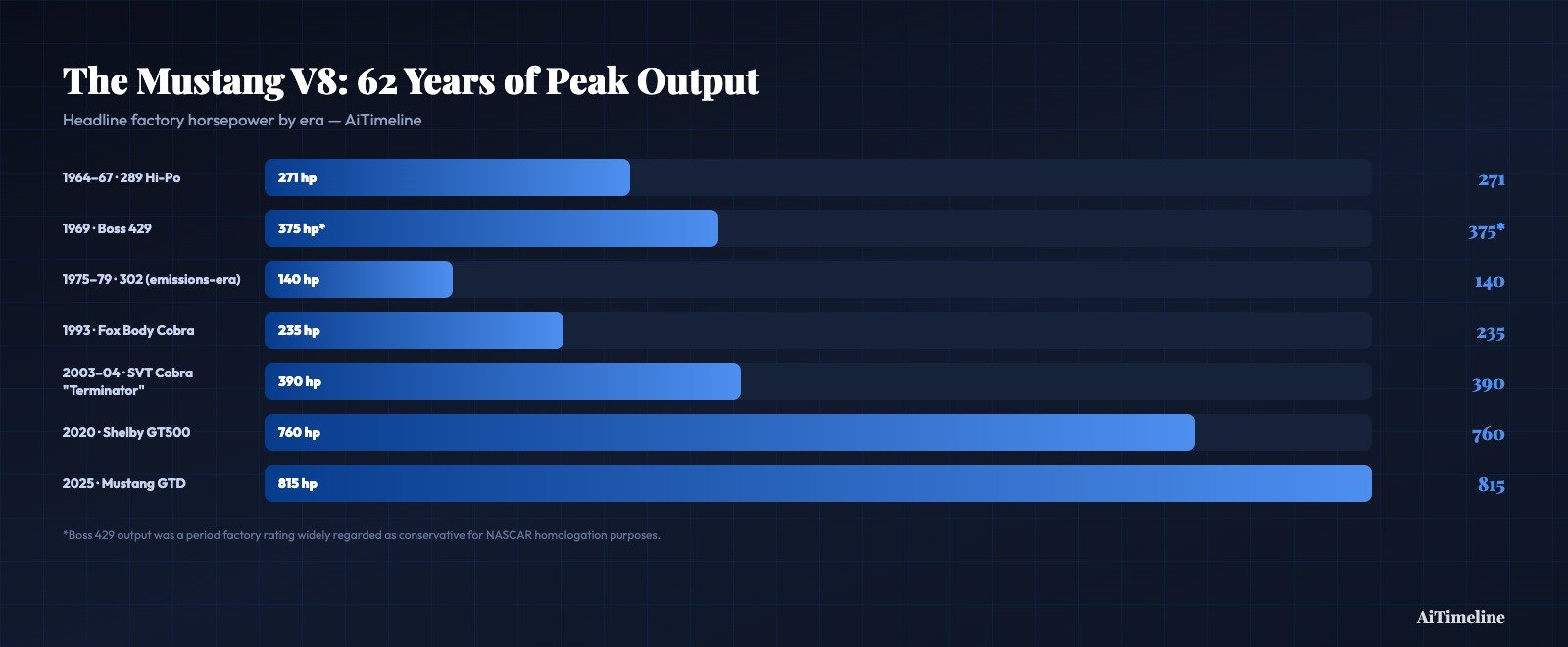
The Mustang V8, 1964 to 2026: bigger, then smaller, then smarter. © AiTimeline
Why the V8 Became Part of the Mustang’s Identity
The engine changed constantly. The idea of a Mustang V8 never went away for long.
The Mustang’s V8 story is really a 60-year negotiation between power, emissions law and fuel economy, not a straight line of bigger numbers. Early small-block 289 and 302-cubic-inch V8s (1964–67) gave way to big-block 390, 428 and the 429 “Boss” engines (1967–71) as Ford chased raw output during the muscle-car peak. The 1973 oil crisis and tightening emissions rules eliminated the V8 option entirely for the Mustang II’s first year (1974), and the V8s that did return through the late 1970s and early 1980s were deliberately smaller and lower-output than their late-1960s ancestors, a direct result of catalytic-converter-era emissions calibration rather than any loss of engineering ambition. The 5.0 (4.9L/302) V8 of the Fox Body era rebuilt performance credibility gradually, through fuel injection rather than displacement. Ford’s overhead-cam “Modular” V8 family — 4.6L, then 5.4L, then supercharged variants — carried the SN95 and S197 generations through the 1990s and 2000s. Since 2011, the naturally aspirated 5.0-liter “Coyote” V8, now in its fourth generation and making up to 500 hp in Dark Horse trim, has been the GT-and-above Mustang’s defining engine, while the supercharged 5.2-liter V8 pushes to 760 hp in the Shelby GT500 and 815 hp in the Mustang GTD. Through all of it, the throughline is that a V8 Mustang has been available in almost every model year since 1964 (1974 is the one clear gap) — which is why, for most buyers, “Mustang” and “V8” remain close to synonymous even as EcoBoost four-cylinder Mustangs now outsell the V8 in several markets.
Mustang and Emissions: Adapting Instead of Disappearing
Three separate regulatory waves, three separate Mustang responses.
The Mustang has been reshaped by U.S. regulation at least three times. The 1970s combination of the oil embargo, new EPA tailpipe standards and rising insurance surcharges on high-output engines produced the smaller, lower-powered Mustang II and Fox Body’s early, emissions-choked years. The 1980s saw Ford recover lost performance largely through fuel-injection technology rather than bigger engines — the 5.0 GT’s horsepower climbed years before its displacement did. Since the 2000s, rising Corporate Average Fuel Economy (CAFE) targets pushed Ford to add the turbocharged EcoBoost four-cylinder as a genuine mainstream Mustang option in 2015, not just a base-model afterthought, so the lineup could post a competitive fleet-average fuel economy number without eliminating the V8. In each era, Ford’s response was to adapt the Mustang’s engineering rather than discontinue the model — the same pattern that shows up again in its approach to electrification.
The Mustang Name Goes Electric
Mach-E is a separate SUV, not an electric version of the coupe. This distinction matters for search and for fact.
Ford unveiled the Mustang Mach-E in November 2019 and put it on sale as a 2021 model — its first purpose-built electric vehicle, and the first product ever to carry the Mustang name that was not a two-door coupe or convertible. The Mach-E is a five-door electric crossover roughly the size of a Ford Escape, offered with 66- or 88-kWh battery packs (up to roughly 300 miles of EPA range on the extended-range rear-wheel-drive version) and performance GT variants, styled with Mustang-referencing details like tri-bar taillights and a galloping-horse badge but sharing no platform, body or mechanical lineage with the actual Mustang coupe.
Ford’s stated reasoning was to borrow the Mustang name’s performance and emotional equity to help an unproven electric SUV stand out in a crowded new-EV market, rather than launch it under a brand-new nameplate. The move drew real, vocal backlash from Mustang enthusiasts and some automotive press at its 2019 reveal, on the grounds that “Mustang” had meant a rear-wheel-drive two-door sports car for 55 years and an SUV badge dilutes that meaning. Whether the Mach-E strengthened or diluted the Mustang brand is a genuinely contested opinion, not a settled fact — supporters point to Mach-E sales volume and its halo effect for Ford’s EV strategy; critics point to enthusiast sentiment and the risk of brand confusion. This article does not resolve that argument; it only insists on keeping the two products factually separate, since conflating them is one of the most common inaccuracies in Mustang coverage.
Mustang’s Global Expansion
From an America-only nameplate to a right-hand-drive export car.
For most of its history the Mustang was sold new almost exclusively in North America; earlier generations reached other markets mainly through private “grey import” channels, not official Ford distribution. That changed decisively with the 2015 S550, which Ford engineered from the outset for factory right-hand-drive production and global type-approval, then launched officially across Europe, Australia, the Middle East and parts of Asia. Ford has repeatedly cited IHS Markit / S&P Global Mobility registration data to claim the Mustang as the world’s best-selling sports coupe in multiple years since. India got the Mustang in 2016, imported as a completely built unit (CBU) and sold through Ford India’s dealer network at roughly ₹65 lakh ex-showroom for the 5.0 GT automatic — a low-volume halo product rather than a mainstream launch. Ford ended domestic car manufacturing in India in 2021–22 and does not currently operate an official Indian sales channel for new Mustangs; scattered 2026-dated reports of a renewed CBU import push (at an expected price near ₹85 lakh) describe an expected, unconfirmed plan, not a confirmed relaunch, as of this article’s fact-check date.
How Hollywood Turned the Mustang Into a Cultural Icon
Film reinforced an identity the car already had — freedom, rebellion, speed — more than it created one.
No single film appearance made the Mustang famous, but a handful of verifiable ones repeatedly reinforced the same set of associations. Bullitt (1968) is the reference point: Steve McQueen’s Highland Green 1968 Mustang GT 390 fastback, filmed racing a Dodge Charger through San Francisco’s hills in a chase sequence largely performed without modern stunt-driving effects, is widely credited by film historians as one of the most influential car-chase sequences ever shot, and Ford has released several “Bullitt” special-edition Mustangs referencing it since (most recently on the S550). Other verifiable, widely documented appearances include the Gone in 60 Seconds franchise (the original 1974 film and the 2000 remake, both centered on a Mustang character nicknamed “Eleanor”), a modified Shelby GT500-based Mustang in John Wick, and Mustang cameos in productions including I Am Legend and the Need for Speed film and game franchise. The throughline across all of them is not the specific film but the association Hollywood kept reaching for: a Mustang on screen reads as freedom, rebellion and American speed, which is the same identity Ford’s own 1964 marketing sold in the first place.
Mustang’s Racing Legacy
From 1960s Trans-Am homologation specials to a 2025 GTD Pro class win at Daytona.
Ford’s “Total Performance” motorsport push of the mid-1960s put the Mustang into competition almost immediately after launch, and the car has never been fully absent from factory racing since. The Shelby GT350R won its SCCA B-Production class in 1965–66. The Boss 302 was purpose-built for SCCA Trans-Am racing in 1969–70. The Boss 429 existed purely to legalize its engine for NASCAR. Mustangs have also had a long, separate history in drag racing, particularly Fox Body cars in the 1980s–90s grassroots scene, and in various Cobra Jet factory drag-racing special editions built specifically for the strip rather than the street. After a long gap from top-level factory GT racing, Ford returned with the Mustang GT3 for the 2024 IMSA WeatherTech Championship and FIA WEC (including a class podium at the 2024 24 Hours of Le Mans for a Proton Competition-run car), and the factory Multimatic-run GT3 program won its class outright at the 2025 Rolex 24 at Daytona. A related Mustang GT4 customer-racing car serves lower amateur and pro-am racing series. Each of these programs, old and new, exists to prove the same point in a different era: that a Mustang can win, not just look fast.
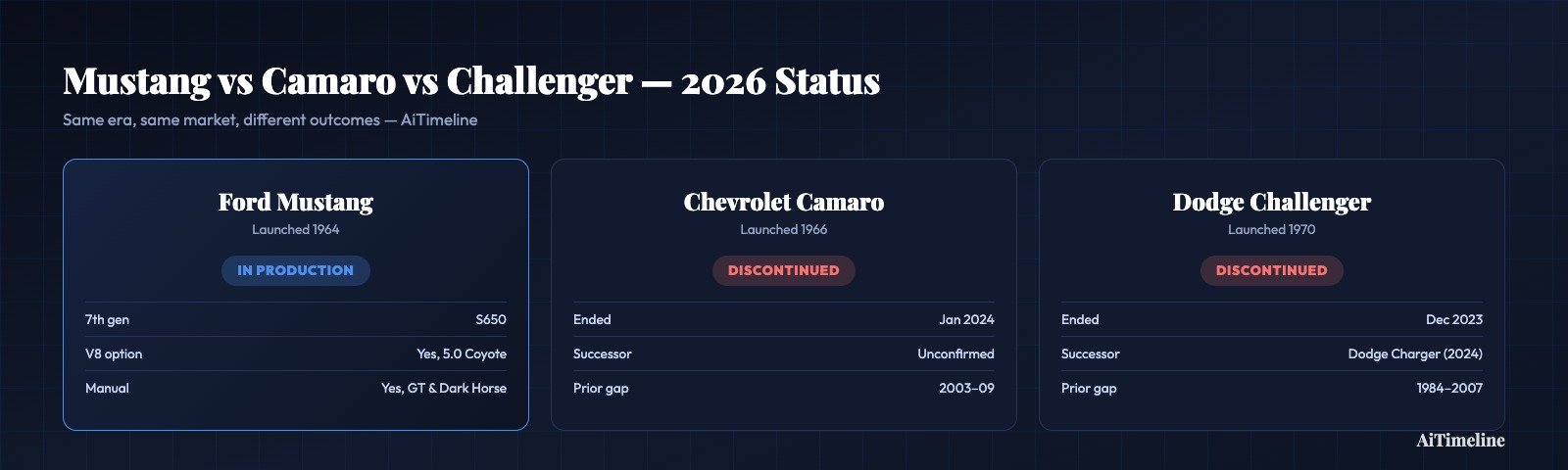
The pony-car trio in 2026: only one is still in production. © AiTimeline
Mustang vs Camaro vs Challenger
Same era, same market, very different 2026 outcomes.
All three of America’s classic pony/muscle cars launched within a few years of each other — the Mustang in 1964, the Camaro and Plymouth Barracuda in 1966–67, the Dodge Challenger in 1970 — and all three spent the late 1960s and 2000s revival era as direct rivals selling nearly identical promises: an affordable, stylish, V8-optional two-door. Their paths diverge sharply after that. The Camaro was discontinued once already, from 2003–09, before its S197-era revival; Chevrolet ended sixth-generation Camaro production in January 2024 with no direct gasoline successor confirmed, citing factory capacity needs and only vaguely signaling a possible future electric replacement. The Challenger’s third generation ended production in December 2023 as Stellantis pursued its “Dare Forward 2030” electrification strategy; its replacement, the Dodge Charger, launched first as the all-electric Charger Daytona (2024) and then added a twin-turbo inline-six “Sixpack” gasoline option (2025) after reported weak EV Daytona demand — a different nameplate on a different platform, not a continuation of the Challenger name. The Mustang, meanwhile, has been built continuously since 1964 with no production gap and remained, per Ford’s own sales reporting, the best-selling two-door sports car in the U.S. through 2025 — a title it now holds partly by default, since its two historic rivals are no longer in the race.
Mustang vs Camaro vs Challenger — 2026 Status
The Mustang Family Tree
Ford Motor Company
Dearborn, Michigan-based automaker; has built the Mustang continuously since April 1964.
Carroll Shelby / Shelby American
Independent racer and constructor whose 1965–70 GT350/GT500 collaboration with Ford defined the Mustang’s early performance image.
Mach 1
Ford’s recurring grand-touring performance package, revived most recently on the 2021–23 S550.
Boss 302 / 429 / 351
1969–71 race-rule-driven variants built to legalize specific Ford racing engines for Trans-Am and NASCAR.
Dark Horse
S650’s top street performance trim, 500-hp Coyote V8, positioned below Shelby/GTD-level halo cars.
Mustang GTD
815-hp, motorsport-derived supercar variant built alongside Ford’s Mustang GT3 racing program; from roughly $328,000.
Mustang Mach-E
All-electric SUV carrying the Mustang name; shares no platform or body with the coupe.
Ford Performance
Ford’s factory performance and racing division; runs the current Mustang GT3/GT4 programs and engineered the GTD.
Which Mustangs Matter Most to Collectors?
Categories, not price predictions — this is not investment advice.
Collector-relevant categories
- Early first-generation (1964–66): Originality and documented “1964½”-era build details drive interest among marque purists.
- Shelby GT350/GT500 (1965–70): Low original production numbers and Carroll Shelby’s direct involvement make these among the most sought-after Mustangs at auction.
- Boss 302/429/351 (1969–71): Homologation-special rarity and motorsport pedigree, particularly numbers-matching Boss 429s.
- Fox Body special editions: Low-mileage, documented late-1980s/early-1990s 5.0 GTs and SVT Cobra R track specials have a strong enthusiast following distinct from mainstream classic-car collecting.
- SVT Cobra (1993–2004): Particularly the 2003–04 supercharged “Terminator,” valued for factory forced induction and limited production.
- Modern limited editions: Shelby GT350R, GT500 and early production-run Mustang GTDs are the most actively speculated-on modern collector category, given the GTD’s short confirmed production window.
No category here is a guarantee of future value. Collector-car markets move on originality, documentation, condition and broader economic conditions as much as on model history — treat this as a starting map for research, not a prediction.
10 Ford Mustang Myths, Checked
1. “The Mustang invented the pony car.”
Close, but imprecise: the Mustang created the commercial category that came to be named “pony car” after it, but it did not invent the long-hood/short-deck sporty-coupe concept outright — it packaged an existing style trend into an unusually affordable, widely optioned production car at exactly the right moment.
2. “1964½ was an official Ford model year.”
False. See the 1964 launch section above — Ford titled every 1964-built car as a 1965 model. “1964½” is enthusiast shorthand, not a factory designation.
3. “Every Mustang is a muscle car.”
False. The Mustang is more accurately described as a “pony car” — a broader affordable-sporty-coupe category. Many Mustangs, including the base inline-six original and every four-cylinder EcoBoost model since 2015, were never marketed or specified as muscle cars.
4. “Every Mustang is a V8.”
False. Six-cylinder and, later, turbocharged four-cylinder Mustangs have outsold V8 versions in some model years, including much of the current S650 EcoBoost run.
5. “Carroll Shelby built every GT350 personally.”
False. Shelby American assembled early GT350s from Ford-supplied cars under Shelby’s direction, but production scaled well beyond anything one person hand-built, and later Shelby-badged Mustangs (2007-present) are built by Ford itself under a licensing and consulting arrangement.
6. “The Mach-E is the same type of vehicle as the Mustang coupe.”
False. The Mach-E is a battery-electric SUV/crossover on its own platform; the coupe/convertible Mustang is unchanged, gasoline-only. They share a name and some styling cues, nothing structural.
7. “Fox Body means every 1979–93 Mustang is identical.”
False. The 15-year Fox Body run included a 1987 facelift, multiple engine and fuel-delivery changes, the turbo-four SVO sub-model, and dramatically different trim strategies across its life — treating it as one static car flattens a huge amount of change.
8. “The Mustang has always been a two-door coupe.”
Mostly true for the coupe/fastback/convertible lineage, but incomplete: the name now also covers the four-door, five-seat Mach-E SUV, which is why this article insists on separating the two products by name.
9. “The Mustang was always sold globally.”
False. Official factory global distribution, including right-hand-drive production, only began with the 2015 S550; earlier generations reached most non-U.S. markets, if at all, through private grey-market imports.
10. “The Mustang has never faced an existential threat.”
False. The 1973 oil crisis genuinely threatened to kill V8 performance cars industry-wide, and the Mustang’s 2024 sales figure (44,003 units) was its worst in 60 years of production — the current threat is a consumer shift toward SUVs, not a repeat of the 1970s, but it is a real one.
Why the Mustang Survived: 10 Reasons
AITIMELINE ANALYSIS — editorial interpretation, not a claim of documented Ford strategy.
Everything in this section is AiTimeline’s own analytical synthesis of the history above, not a quoted Ford strategy document. It should be read as informed interpretation.
- An affordable entry point, kept intact. Every generation, including the current S650, has offered a genuinely sub-luxury starting price relative to its performance segment.
- A recognizable design language. Long hood, short deck, galloping-horse badge — present in some form on every generation since 1964, including the Mach-E’s styling cues.
- Multiple performance tiers under one roof. A buyer can choose a four-cylinder commuter Mustang or an 815-hp GTD from the same showroom, spreading market risk across very different customers.
- A V8 identity that outlasted most direct rivals’ V8s. The Coyote V8 remaining available in 2026, after Camaro’s and Challenger’s V8s both ended, is itself a competitive advantage now, not just a heritage detail.
- Deep factory and aftermarket customization. From factory options in 1964 to the Fox Body tuning industry to today’s Ford Performance parts catalog, Mustang ownership has always included a build-it-yourself dimension few rivals matched as consistently.
- Continuous motorsport credibility. Trans-Am and NASCAR homologation in the 1960s, GT3/GT4 factory racing since 2024 — the Mustang has rarely gone long without a genuine competition program validating it.
- Hollywood exposure that reinforced, rather than created, its identity. Bullitt and its successors kept associating the Mustang with freedom and speed across multiple generations of moviegoers.
- Generational renewal instead of a single unchanging design. Mustang II, Fox Body, S197 and the Mach-E each represent Ford choosing to change the formula rather than defend an unchanging one.
- Genuine global expansion since 2015. The S550’s right-hand-drive, independent-rear-suspension global launch turned an America-only nameplate into a worldwide sales story.
- A willingness to let the name mean two different things. Splitting the brand into the traditional coupe and the electric Mach-E, rather than forcing one car to serve both audiences, is the clearest sign Ford is still actively managing what “Mustang” means — not simply preserving it.
What the Mustang’s 60-Year History Really Tells Us
AITIMELINE ANALYSIS
The following are AiTimeline’s editorial conclusions drawn from the verified timeline above, not additional historical facts.
- Ford repeatedly changed the Mustang’s size, platform and even powertrain type without ever letting the name lose its visual identity.
- Mustang II demonstrates that survival sometimes requires a company to compromise with the market rather than defend an enthusiast ideal.
- Fox Body’s real achievement was restoring performance credibility gradually, through engineering, after a decade in which that credibility had been lost to emissions rules.
- The 2005 S197’s retro design proved nostalgia could be engineered into a genuinely modern sales strategy, not just a styling exercise.
- The 2015 S550 made the Mustang a real global sports car rather than an American export curiosity.
- The V8 became an emotional product feature as much as a mechanical one — which is why its continued availability now functions as a competitive differentiator against discontinued rivals.
- The Mustang’s most serious competitor in 2026 may be the SUV market’s pull on consumer preference, not any remaining muscle-car rival.
- The Mach-E shows Ford is willing to stretch the Mustang brand into an entirely new vehicle category when it judges the payoff worth the backlash.
- The S650 is best read as a statement of continuity — keeping V8 and manual options alive on purpose — rather than a radical reinvention.
- The Mustang GTD shows how far Ford is willing to stretch the name into genuine motorsport-derived, six-figure territory.
- The Mustang’s biggest asset by 2026 is not outright horsepower — it is brand identity that survived every rival’s identity crisis.
- Its next real test is holding that identity through tightening emissions rules and the industry’s broader electrification push, without repeating the Mach-E naming debate on the coupe itself.
Explore More Timelines
People Also Ask
Frequently Asked Questions
Ford Mustang Generations Table
Platform codes, years, major models and why each generation matters.
| Gen | Years | Platform / Code | Major Models | Engine Highlights | Significance |
|---|---|---|---|---|---|
| 1st | 1964–1973 | Falcon-based | Shelby GT350/GT500, Mach 1, Boss 302/429/351 | 170 I6 to 429 big-block V8 | Created the pony-car segment |
| 2nd | 1974–1978 | Pinto-based (“Mustang II”) | Cobra II, King Cobra | 2.3L I4, 2.8L V6, 302 V8 from 1975 | Survived the 1973 oil crisis |
| 3rd | 1979–1993 | Fox platform | SVO, 5.0 GT, LX 5.0, SVT Cobra/Cobra R | 4.9L/302 “5.0” V8 | Restored performance credibility |
| 4th | 1994–2004 | SN95 (Fox-4 platform) | SVT Cobra, New Edge facelift (1999) | 5.0L V8, then 4.6L Modular V8 | Modernized without losing identity |
| 5th | 2005–2014 | S197 / D2C platform | Shelby GT500, Boss 302 revival | 4.6L V8, 5.0L Coyote from 2011 | Retro design revived the segment |
| 6th | 2015–2023 | S550 | Shelby GT350/GT350R, GT500 | 2.3L EcoBoost I4, 5.0L Coyote, 5.2L supercharged | First IRS; first global RHD Mustang |
| 7th | 2024–present | S650 | Dark Horse, Mustang GTD | 2.3L EcoBoost, 5.0L Coyote V8, 5.2L supercharged (GTD) | Continuity amid industry EV shift |
Mustang V8 Evolution
| Era | Engine Family | Displacement | Peak Output (era) |
|---|---|---|---|
| 1964–67 | Small-block | 260 / 289 cu in | ~271 hp (289 Hi-Po) |
| 1967–71 | FE big-block, 385-series | 390 / 428 / 429 cu in | ~335–375 hp (period gross rating) |
| 1975–79 | Windsor small-block (return) | 302 cu in | ~140 hp (emissions-limited) |
| 1982–93 | “5.0” Windsor | 4.9L / 302 cu in | ~225 hp by 1993 Cobra |
| 1996–2004 | Modular SOHC/DOHC | 4.6L, 5.4L (Cobra R) | ~390 hp (2003–04 supercharged Cobra) |
| 2011–present | Coyote (naturally aspirated) | 5.0L | 500 hp (2026 Dark Horse) |
| 2020–present | Supercharged 5.2L / 5.8L | 5.2L / 5.8L | 760 hp (GT500), 815 hp (GTD) |
Mustang Motorsport Timeline
| Year | Series / Event | Result |
|---|---|---|
| 1965–66 | SCCA B-Production | Shelby GT350R wins class |
| 1969–70 | SCCA Trans-Am | Boss 302 built for homologation |
| 1969–70 | NASCAR | Boss 429 built for engine homologation |
| 2024 | 24 Hours of Le Mans (FIA WEC) | Mustang GT3 class podium (Proton Competition) |
| 2025 | Rolex 24 at Daytona (IMSA) | Mustang GT3 wins GTD Pro class |
| 2025 | Nürburgring Nordschleife | Mustang GTD: 6:52.072 official lap |
💡 Discover: Ford Mustang Fast Facts
- The Mustang’s name references the P-51 Mustang fighter plane, not the horse breed directly — though Ford’s marketing leaned heavily into the horse imagery regardless.
- Ford sold its 10-millionth Mustang in August 2018 — a Wimbledon White convertible deliberately echoing the original 1965 launch car.
- The 2024 model year was the Mustang’s worst U.S. sales year in its 60-year history, at 44,003 units — even as it remained the best-selling two-door sports car in America.
- The Boss 429’s engine bay modifications were so extensive that Ford outsourced the conversion entirely to contractor Kar Kraft rather than build it on the regular assembly line.
- Ford’s 1999–2001 SVT Cobra faced a rare public horsepower-rating controversy: independent dyno testing suggested the factory-claimed 320 hp was optimistic, and Ford ran a goodwill customer program in response.
Explore More on AiTimeline
⚠️ Editorial Note
This article separates verified historical fact (launch dates, production figures, engine specifications) from AiTimeline’s own editorial analysis, which is explicitly labeled “AITIMELINE ANALYSIS” throughout. Pricing, unreleased-model and India-market details are hedged as “expected” where Ford has not issued a confirmed announcement. No investment, collector-value or purchase advice is intended; collector-car and new-vehicle markets change independently of this article’s fact-check date.
Sources & further reading
Every dated entry above was checked against these references. Last reviewed 20 September 2026.