Aadhaar vs Privacy: How the Supreme Court Changed India’s Digital ID Rules
Aadhaar judgment timeline: from the 2017 right-to-privacy ruling to the 2018 verdict that upheld Aadhaar 4:1 but ended compulsory bank and SIM linking.
Latest Story
For seven years Aadhaar ran on an executive notification, collecting the fingerprints and iris scans of most of India with no law behind it. Then, in the space of thirteen months, the Supreme Court decided two cases that set its limits. In August 2017 nine judges held that privacy is a fundamental right. In September 2018 five judges applied that right to Aadhaar, upheld it for welfare and tax, and stopped banks, phone companies and schools from demanding it. This Aadhaar judgment timeline follows the whole litigation, from the first petition in 2012 through the interim orders, the Money Bill fight and the two landmark rulings, to the 2019 amendment, the 2021 review and where things stand now.
💡 Short Answer
On 26 September 2018 the Supreme Court upheld the Aadhaar Act by 4:1 but limited its use. The government can require Aadhaar for welfare paid from the Consolidated Fund and for PAN and tax returns. Private companies cannot demand it, bank and SIM linking were struck down, and schools cannot insist on it. The ruling applied the 2017 judgment that privacy is a fundamental right.
Aadhaar Judgment: Key Questions
The Aadhaar Litigation in Ten Points
- 2009: UIDAI was set up by executive order; Aadhaar had no law until 2016.
- 2012: retired judge K.S. Puttaswamy, then 86, filed the lead challenge.
- 2013 to 2015: interim orders kept Aadhaar voluntary and limited where it could be used.
- March 2016: the Aadhaar Act was passed as a Money Bill, bypassing the Rajya Sabha.
- 24 August 2017: nine judges unanimously declared privacy a fundamental right.
- 17 January to 10 May 2018: 38 days of hearings before five judges.
- 26 September 2018: Aadhaar upheld 4:1, but compulsory private use struck down.
- The dissent: Justice Chandrachud said the Money Bill route made the Act unconstitutional.
- July 2019: Parliament allowed voluntary Aadhaar use by banks and telecom companies.
- 20 January 2021: review petitions dismissed 4:1; the 2018 judgment is final.
Timeline: From UIDAI to the Supreme Court Verdict and After
Newest first. Colour shows which stage of the story each event belongs to.
Where things stand: the 2018 ruling still governs After the verdict
The law: The Aadhaar Act, 2016, as amended in 2019, operates within the limits the Supreme Court set on 26 September 2018. The review petitions were dismissed on 20 January 2021, so the 2018 judgment is final.
The open question: Whether the Aadhaar Act was validly passed as a Money Bill has been referred to a seven-judge bench in a separate case, Rojer Mathew. We found no report of that bench deciding the question by November 2026. Its answer could affect how the Aadhaar Act’s passage is viewed, but it would not by itself reopen the 2018 judgment.
Digital Personal Data Protection Act becomes law After the verdict
What it does: The Act sets general rules for how organisations collect and process digital personal data, built on consent, purpose limits and duties for those who handle data, with a Data Protection Board to enforce it.
The link to Aadhaar: The 2017 privacy judgment had urged the government to bring in a data protection law. The 2023 Act answers that call for the digital economy as a whole. It does not change what the Court decided about Aadhaar.
Review petitions dismissed, 4:1 After the verdict
The majority: Justices A.M. Khanwilkar, Ashok Bhushan, S. Abdul Nazeer and B.R. Gavai held that no ground had been shown to review the 2018 judgment. A later reference of the Money Bill question to a larger bench, they said, was not a reason to reopen it.
The dissent: Justice D.Y. Chandrachud said the review should have been kept pending until the seven-judge bench answered the Money Bill question, because the two cases asked the same constitutional question and could produce conflicting answers.
Money Bill question sent to a larger bench After the verdict
The case: In a challenge to tribunal provisions passed through the Finance Act, 2017, a five-judge bench led by Chief Justice Ranjan Gogoi doubted how the Aadhaar majority had read Article 110, which defines a Money Bill.
The referral: Because a bench of five cannot overrule another bench of five, it sent the question of what counts as a Money Bill to a larger bench of seven judges.
Parliament amends the Aadhaar framework After the verdict
What changed: The amendment allowed banks and telecom companies to use Aadhaar authentication for customer verification only if the customer chose it, and only under specific laws. It added offline verification, let children opt out of Aadhaar on turning 18, and removed Section 57, the provision the Court had struck down.
What did not change: The law did not let private companies insist on Aadhaar. No one can be refused a bank account or a SIM card for not providing it.
The dissent: Justice Chandrachud would strike down the Act The Aadhaar case
The Money Bill point: He held that the Aadhaar Act could not be a Money Bill, because it dealt with much more than spending from the Consolidated Fund. Passing it that way to avoid the Rajya Sabha, he wrote, was a fraud on the Constitution.
The rest of his view: He also found that the Act did not adequately protect privacy, allowed surveillance by profiling and excluded people when biometrics failed. He would have declared the whole Act unconstitutional.
Aadhaar Act upheld, with major limits The Aadhaar case
The majority: Justice A.K. Sikri wrote for himself, Chief Justice Dipak Misra and Justice A.M. Khanwilkar; Justice Ashok Bhushan agreed in a separate opinion. They held that Aadhaar meets the privacy test set in 2017 when used for welfare paid from the Consolidated Fund of India, and that the Act was validly passed as a Money Bill.
The limits: The Court struck down the part of Section 57 that let private companies demand Aadhaar under a contract, the rule making bank accounts depend on Aadhaar, and the order to verify mobile SIMs with it. Schools and exams such as CBSE and NEET could not insist on it. Authentication records could be kept for six months, not five years.
Judgment reserved after 38 days of hearings The Aadhaar case
The length: The hearings ran over 38 working days, which was then reported as the second-longest hearing in the Court’s history after the Kesavananda Bharati case of 1972-73.
The arguments: Petitioners, through Shyam Divan, Kapil Sibal, Gopal Subramanium and others, argued about surveillance, exclusion and the Money Bill route. Attorney General K.K. Venugopal defended Aadhaar as the best way to cut leakage in welfare.
UIDAI chief explains Aadhaar in court The Aadhaar case
The presentation: The head of the Unique Identification Authority of India walked the bench through enrolment, encryption and authentication, arguing that the core biometric data was secure and never shared.
The questions: Judges asked about authentication failures, fingerprints that wear with manual work, the role of private enrolment agencies, and whether anyone was denied welfare when the system failed.
Linking deadlines extended until the verdict The Aadhaar case
The order: With the hearing running beyond 31 March, the Court extended the deadline to link Aadhaar with bank accounts, mobile numbers, passports and other services until it delivered judgment.
The exception: Welfare schemes under Section 7 of the Aadhaar Act, paid for from the Consolidated Fund, were not covered by the extension.
Final hearings begin The Aadhaar case
The bench: A five-judge Constitution Bench began hearing more than two dozen petitions challenging the Aadhaar scheme and the 2016 Act together.
The questions: Was Aadhaar a proportionate intrusion into privacy? Could the state compel it for welfare, tax, banking and phones? Was the Act validly passed as a Money Bill? Was the data safe?
Deadline extended to 31 March 2018 Privacy ruling
The order: The Court extended the deadline for linking Aadhaar with bank accounts, mobile numbers and welfare schemes to 31 March 2018, and said it would begin the final hearing in January.
Why it mattered: Millions had been receiving SMS and bank messages warning that accounts and SIMs would be cut off. The order postponed that while the main case was decided.
Privacy declared a fundamental right, 9:0 Privacy ruling
The ruling: The Court held unanimously that privacy is protected as part of the right to life and personal liberty under Article 21 and the freedoms in Part III. It overruled M.P. Sharma (1954) and Kharak Singh (1962) to the extent they had said otherwise.
The test: Any restriction must be backed by law, pursue a legitimate aim and be proportionate to it. That test is what the Aadhaar bench applied a year later.
Nine judges hear the privacy question Privacy ruling
The referral: On 18 July a five-judge bench sent the question of whether privacy is a fundamental right to nine judges, because earlier larger benches had cast doubt on it.
The government’s position: The Union had argued in 2015 that there was no fundamental right to privacy. Before the nine judges it accepted that privacy could be a right, but argued it was not absolute and that informational privacy could yield to welfare.
Aadhaar-PAN linking upheld, with a partial stay Interim orders
The ruling: A two-judge bench upheld Section 139AA of the Income Tax Act, which made Aadhaar mandatory for PAN and tax returns, against challenges based on equality and the freedom of trade.
The limits: It left the privacy challenge to the Constitution Bench, and stayed the provision in part: people without Aadhaar would not have their PAN cancelled until that bench decided.
Linking spreads to SIM cards and bank accounts Interim orders
Phones: A circular of 23 March 2017 told telecom companies to re-verify every mobile subscriber through Aadhaar e-KYC. It relied on a Supreme Court order in the Lokniti Foundation case that had asked for verification, not specifically for Aadhaar.
Banks: Amended money-laundering rules of 1 June 2017 required an Aadhaar number to open, and keep, a bank account. Both measures were struck down in September 2018.
Voluntary use allowed for four more schemes Interim orders
The schemes: The Court let the government use Aadhaar, on a voluntary basis, for the rural job guarantee (MGNREGA), social assistance pensions, Jan Dhan bank accounts and the Employees’ Provident Fund.
The condition: It repeated that Aadhaar was voluntary until the case was decided and that the new order did not dilute its earlier ones.
Aadhaar limited to rations and LPG; privacy question referred Interim orders
The order: The three-judge bench restricted the use of Aadhaar to the public distribution system and LPG subsidy, repeated that it was not mandatory, and told the government to publicise that.
The referral: Attorney General Mukul Rohatgi had argued that the Constitution gave no fundamental right to privacy. Because earlier larger benches had been read that way, the question was referred to a larger bench.
Biometric data not to be shared without consent Interim orders
The case: A Goa court had asked UIDAI to share biometric data to help the CBI in a criminal case. UIDAI resisted and the matter reached the Supreme Court.
The order: The Court directed that information about an Aadhaar holder must not be shared with any other authority without that person’s written consent.
No one to suffer for not having Aadhaar Interim orders
The order: The Court said no person should suffer for not having an Aadhaar card, even though some government circulars had made it mandatory, and that Aadhaar should not be issued to people living in India illegally.
The effect: The order became the reference point for later complaints that states and departments were insisting on Aadhaar despite it.
Aadhaar Act comes into force Building Aadhaar
In force: Most provisions took effect on 12 July 2016, when UIDAI became a statutory authority. The remaining provisions followed on 12 September 2016.
What it set up: The Act provided for enrolment, authentication, protection of core biometric data, offences and penalties, and the use of Aadhaar for subsidies and benefits under Section 7.
President Pranab Mukherjee signs the Aadhaar Act Building Aadhaar
The law: The Act gave Aadhaar a statutory basis and tied its main use to subsidies, benefits and services paid for from the Consolidated Fund of India.
The certification: The Lok Sabha Speaker had certified the bill as a Money Bill, which is what allowed it to become law without the Rajya Sabha’s agreement.
Passed as a Money Bill Building Aadhaar
The route: Under Article 109, the Rajya Sabha can only recommend changes to a Money Bill, and the Lok Sabha can ignore them. The Rajya Sabha returned the bill with five amendments on 16 March, and the Lok Sabha rejected them the same day.
Why it was contested: The government did not have a majority in the Rajya Sabha. Critics argued that a law on identity and data was far wider than the money matters Article 110 allows.
Aadhaar Bill introduced Building Aadhaar
The bill: The Aadhaar (Targeted Delivery of Financial and Other Subsidies, Benefits and Services) Bill, 2016 was introduced in the Lok Sabha.
The context: By then Aadhaar numbers had been issued to most adults, and the government wanted a law that could survive the Court’s orders keeping it voluntary.
Justice Puttaswamy files the challenge Building Aadhaar
The petitioner: Justice K.S. Puttaswamy, a retired judge of the Karnataka High Court then aged 86, challenged the Aadhaar scheme as an executive programme that collected biometric data with no law behind it.
What followed: His petition became the lead case. Others were added over the next five years, including challenges to the 2016 Act.
Parliamentary committee rejects the first bill Building Aadhaar
The bill: The National Identification Authority of India Bill, 2010 had been introduced in the Rajya Sabha on 3 December 2010 and sent to the committee.
The verdict: The committee asked the government to reconsider and bring a fresh bill. It flagged the lack of a data protection law, security risks, enrolment of non-citizens and the cost and reliability of biometrics.
First Aadhaar numbers issued Building Aadhaar
The launch: Prime Minister Manmohan Singh and Sonia Gandhi handed out the first Aadhaar numbers to residents of a tribal village in northern Maharashtra.
The system: Each number linked a person’s name, date of birth, gender and address to a photograph, ten fingerprints and both iris scans.
UIDAI set up by executive notification Building Aadhaar
The authority: The Unique Identification Authority of India was created as an attached office of the Planning Commission to issue a unique identity number to every resident.
The purpose: The stated aim was to remove duplicate and fake identities from welfare rolls and to give people who had no documents a way to prove who they were.
What Exactly Did the Supreme Court Decide in 2018?
Not a blanket approval, and not a rejection.
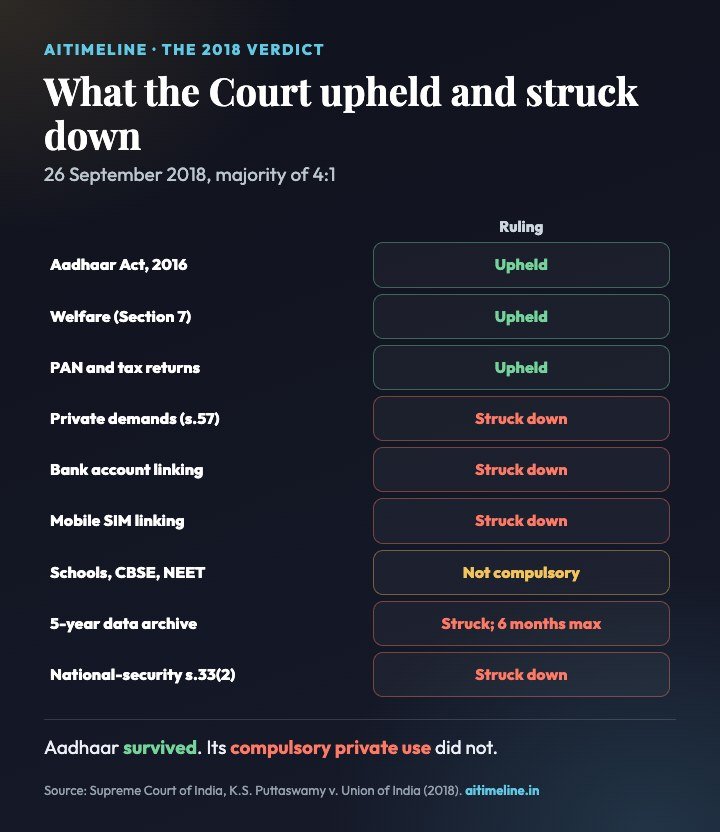
| Issue | The Court’s position in 2018 |
|---|---|
| Aadhaar Act, 2016 | Upheld by 4:1 |
| Welfare under Section 7 | Upheld for subsidies and benefits from the Consolidated Fund, with no denial for authentication failure |
| Aadhaar-PAN linking (Section 139AA) | Upheld |
| Private demands under Section 57 | Struck down as far as it let companies demand Aadhaar by contract |
| Compulsory bank-account linking | Struck down (2017 money-laundering rule) |
| Compulsory mobile SIM linking | Struck down (23 March 2017 DoT circular) |
| Schools, CBSE, NEET, UGC | Cannot make Aadhaar compulsory |
| Authentication records | Five-year archive struck down; not to be kept beyond six months |
| National-security disclosure, Section 33(2) | Struck down |
| Court-ordered disclosure, Section 33(1) | Read down: the person must be heard first |
| Children | Parental consent to enrol; no denial of benefits; can exit at 18 |
| Passage as a Money Bill | Upheld by the majority; rejected in the dissent |
What the judgment allowed
- Aadhaar for subsidies and benefits paid from the Consolidated Fund.
- Aadhaar for PAN and income-tax returns.
- The Act itself, and UIDAI’s role.
- The Money Bill certification, by majority.
What it did not allow
- Private companies demanding Aadhaar by contract.
- Banks or telecom firms making it compulsory.
- Schools and exam bodies insisting on it.
- Denying anyone a benefit because the machine failed.
Who Decided the Aadhaar Case?
Four in the majority, one dissent.
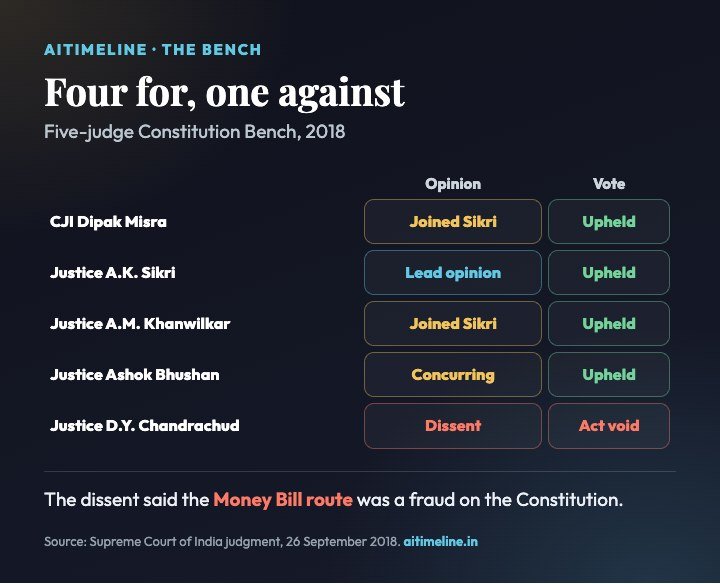
Justice A.K. Sikri
Wrote for himself, Chief Justice Misra and Justice Khanwilkar: Aadhaar empowers the poor, and its intrusion is proportionate for welfare.
Justice Ashok Bhushan
Reached the same result in his own opinion, upholding the Act and the Money Bill certification.
Justice D.Y. Chandrachud
Held the Money Bill route a fraud on the Constitution and found the Act failed the privacy test as a whole.
Chief Justice Dipak Misra
Headed the bench in his final weeks in office; he retired on 2 October 2018, six days after the verdict.
The Two Landmark Judgments: 2017 vs 2018
Same name, different questions.
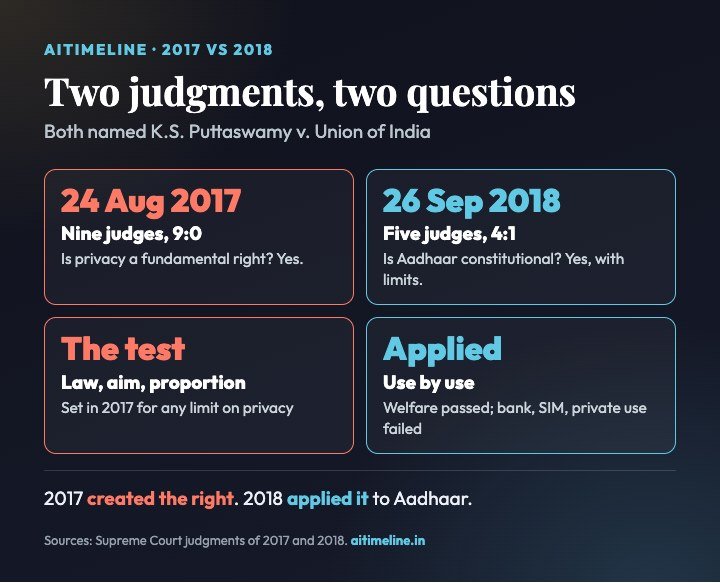
| Feature | 2017 privacy judgment | 2018 Aadhaar judgment |
|---|---|---|
| Date | 24 August 2017 | 26 September 2018 |
| Bench | Nine judges, led by CJI J.S. Khehar | Five judges, led by CJI Dipak Misra |
| Question | Is privacy a fundamental right? | Is the Aadhaar framework constitutional? |
| Result | Yes, unanimously | Largely upheld, 4:1, with provisions struck down |
| Overruled | M.P. Sharma (1954), Kharak Singh (1962) | Nothing; applied the 2017 test |
| Lasting effect | Basis for later rulings on sexuality, adultery, surveillance | Sets what Aadhaar can and cannot be used for |
The 2017 case began as a preliminary question inside the Aadhaar challenge. When the government argued in 2015 that Indians had no fundamental right to privacy, the Court could not decide Aadhaar without first deciding that. The nine judges were told not to rule on Aadhaar itself. Their judgment, which also influenced the Section 377 and adultery rulings of September 2018, gave the five-judge bench the test it needed: a limit on privacy must be lawful, serve a legitimate aim and be proportionate. Read together, the two judgments say that the state can build a biometric identity system, but must justify each compulsory use.
The Money Bill Question
The part of the case that is still argued about.

Valid Money Bill
- Core is Section 7.
- Spending from the Consolidated Fund.
- Other parts incidental.
Fraud on the Constitution
- Act goes far beyond money.
- Rajya Sabha bypassed.
- Whole Act void.
Before seven judges
- Rojer Mathew referral.
- Review refused in 2021.
- No ruling found by Nov 2026.
Article 110 says a bill is a Money Bill only if it deals with matters such as taxes and spending from the Consolidated Fund. The Speaker’s certificate decides the label, and the Rajya Sabha then has no power to block the bill. In 2016 the government did not have a Rajya Sabha majority. The majority judges accepted that the Aadhaar Act’s heart was Section 7, the delivery of subsidies, and that everything else was incidental. Justice Chandrachud thought that reasoning would let any law be passed as a Money Bill. A year later, in Rojer Mathew, another five-judge bench doubted the majority’s reading and sent the question to seven judges. The review petitions were dismissed anyway, so whatever that bench eventually decides, the 2018 Aadhaar ruling stands unless the Court chooses to revisit it.
How the Court Kept Aadhaar in Check Before the Verdict
Five years of interim orders.
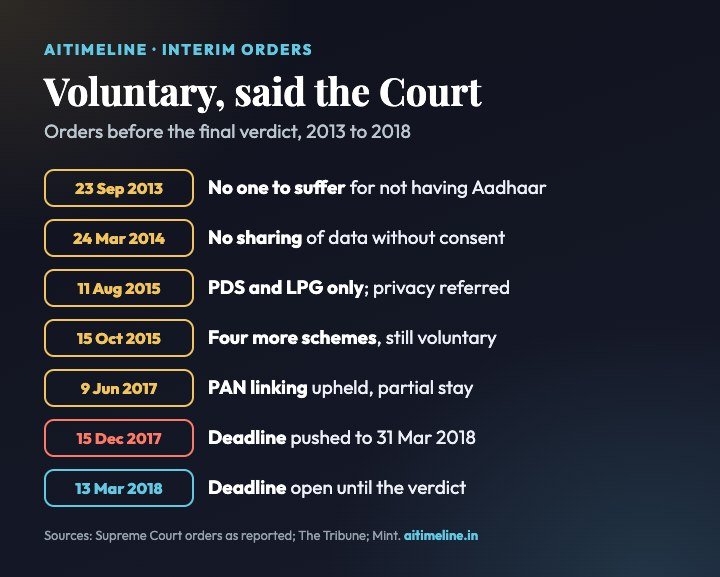
The interim orders show a gap that the final judgment tried to close. The Court said again and again that Aadhaar was voluntary, but ministries kept adding it as a condition, for scholarships, midday meals, pensions, bank accounts and phone numbers. By 2017 many people were getting messages saying their SIM or account would be cut off. The final judgment drew the line where the interim orders had pointed: compulsory for welfare paid from public funds, where the state can justify it, and voluntary elsewhere.
After the Verdict: 2019 to 2026
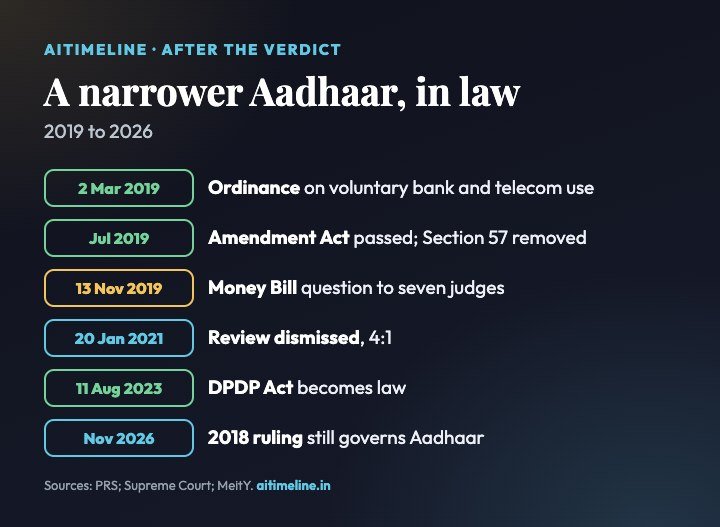
Parliament’s response in 2019 did not try to restore the old compulsory system. It created a legal route for banks and telecom companies to use Aadhaar when customers agree, deleted Section 57, and added civil penalties and the right for children to leave Aadhaar at 18. Aadhaar remains central to welfare, tax and digital payments, but it reached that position inside the boundaries set in 2018.
Why the Aadhaar Judgment Matters
Limits on compulsion
The state may require Aadhaar only where a law and a legitimate aim, such as targeted welfare, justify it.
No universal ID demand
Companies cannot make Aadhaar a condition of service simply by writing it into a contract.
Exclusion as a harm
No one may be denied a benefit because authentication fails; alternatives must exist.
Groundwork for a data law
The privacy test and data-retention limits fed into the debate that produced the DPDP Act, 2023.
Aadhaar survived the constitutional challenge, but compulsory use did not. The lasting lesson of the two Puttaswamy judgments is that a digital identity system can serve public administration only within limits that the state must justify each time it insists on it. Describing the 2018 ruling as either a blanket approval or a rejection of Aadhaar gets it wrong.
Explore More Timelines
People Also Ask
Frequently Asked Questions
Dated facts from the Supreme Court’s judgments and orders, Parliament and UIDAI, 2009 to 2026.
⚠️ Editorial Note
This account draws on the Supreme Court’s judgments of 24 August 2017, 26 September 2018 and 20 January 2021, its interim orders as reported, the text of the Aadhaar Act, 2016 published by UIDAI, PRS Legislative Research’s bill records, and contemporary reporting. Checking the brief this page began from: the order allowing Aadhaar for MGNREGA, pensions, Jan Dhan and EPF was pronounced on 15 October 2015 by a five-judge bench, not on 13 October; Binoy Viswam (9 June 2017) was a final ruling on equality and trade grounds with a partial stay, not an interim upholding; the order keeping linking deadlines open until the verdict was made on 13 March 2018, after the 15 December 2017 extension to 31 March 2018; and the Court struck down, rather than read down, the part of Section 57 allowing private demands. The status of the seven-judge Money Bill reference reflects published reports to 7 November 2026. This is not legal advice.
Related Reading on AiTimeline
Sources & further reading
Every dated entry above was checked against these references. Last reviewed 7 November 2026.
- Justice K.S. Puttaswamy (Retd.) v. Union of India, Aadhaar judgment (26 September 2018)
- Justice K.S. Puttaswamy (Retd.) v. Union of India, right to privacy judgment (24 August 2017)
- The Aadhaar (Targeted Delivery of Financial and Other Subsidies, Benefits and Services) Act, 2016
- The Aadhaar Bill, 2016: bill track
- The Aadhaar and Other Laws (Amendment) Bill, 2019: bill track
- Constitutionality of Aadhaar: judgment in plain English
- Aadhaar review: judgment in plain English (20 January 2021)
- Aadhaar's 'voluntary' use for 4 more schemes permitted (15 October 2015)
- Supreme Court extends Aadhaar linking deadline till it passes verdict (13 March 2018)
- Data protection framework: Digital Personal Data Protection Act, 2023