The Fastest 50 in ODI Cricket: Every Record-Holder, Explained
AB de Villiers and Matthew Forde share cricket's fastest ODI fifty at 16 balls. See the full verified list, country records and how the mark evolved.
Latest Story
Most one-day fifties are a negotiation. A batter takes guard, plays out the new ball, picks off ones and twos against a set field, and somewhere around the fortieth delivery the milestone arrives – useful, unremarkable, exactly on schedule. Then, every few years, the negotiation simply doesn’t happen. A batter walks to the crease with the bowling attack still setting its field, and inside three or four overs the scoreboard is struggling to keep pace: a slog-swept six, a length ball crunched through the covers, another six, and suddenly there are two numbers on the board that have no business sitting next to each other. That collapse of the normal rhythm of an innings is what this article is about – the fastest 50 in ODI cricket, a record that has moved only twice since anyone started keeping close count of it, and is currently shared, not owned outright, by two players a decade and two continents apart.
🧠 AI Overview Summary
The fastest fifty in men’s ODI cricket is 16 balls, jointly held by South Africa’s AB de Villiers (149 off 44 vs West Indies, Johannesburg, January 18, 2015) and West Indies’ Matthew Forde (58 off 19 vs Ireland, Dublin, May 23, 2025). De Villiers broke Sanath Jayasuriya’s 17-ball record, set in 1996, by a single delivery; Forde matched it 19 years later without going faster. No confirmed men’s ODI fifty has ever come in fewer than 16 balls.
The Fastest 50 in ODI Cricket: Key Questions
What the Record Actually Shows
- The record is shared, not solely owned. AB de Villiers (2015) and Matthew Forde (2025) have both reached fifty in 16 balls in a men’s ODI; Forde equalled the mark rather than breaking it.
- The record has moved only twice since 1996. Sanath Jayasuriya’s 17-ball fifty stood for almost 19 years before de Villiers beat it by one delivery in January 2015.
- Forde’s innings set a separate record outright. His 58 produced the highest percentage of runs scored in boundaries – 96.55% – in any ODI innings of 50 or more, alongside tying the fastest-fifty mark.
- De Villiers’ innings is still a double record. The same knock produced both the fastest ODI fifty (16 balls) and the fastest ODI century (31 balls), a combination nobody else has matched.
- Ten of the seventeen fastest independently verified fifties belong to just four teams – South Africa, Sri Lanka, Australia and Pakistan – in the dataset built for this article.
- Shahid Afridi reached fifty in 18 balls three separate times – in 1996, 2002 and 2014 – against three different opponents, across three different decades of his career.
- Associate nations are now part of the conversation. Scotland’s Michael Leask (2022, 18 balls) and Nepal’s Anil Sah (2024, 19 balls) both did it in fully recognized ODIs, not exhibition matches.
- Brendon McCullum’s 18-ball fifty against England at the 2015 World Cup is recognized by Guinness World Records as the fastest fifty specifically at a men’s Cricket World Cup – a separate record from the overall ODI mark.
- India’s national record is a relatively modest 21 balls (Ajit Agarkar, December 2000) – a reminder that fastest-fifty leaderboards reward a specific match situation, not a nation’s overall batting depth.
- Batting position varies from one end of the order to the other. Forde walked in at number eight with the game as good as settled; de Villiers batted at four in a genuinely live contest.
Top 10 Fastest ODI Fifties, at a Glance
Several of these are exact ties on balls faced – the cards below are grouped, not strictly individually ranked, where two or more players share a mark. Full top-17 table with sources further down.
South Africa
West Indies
Sri Lanka
Sri Lanka
New Zealand
England
Australia
Pakistan
Australia
New Zealand
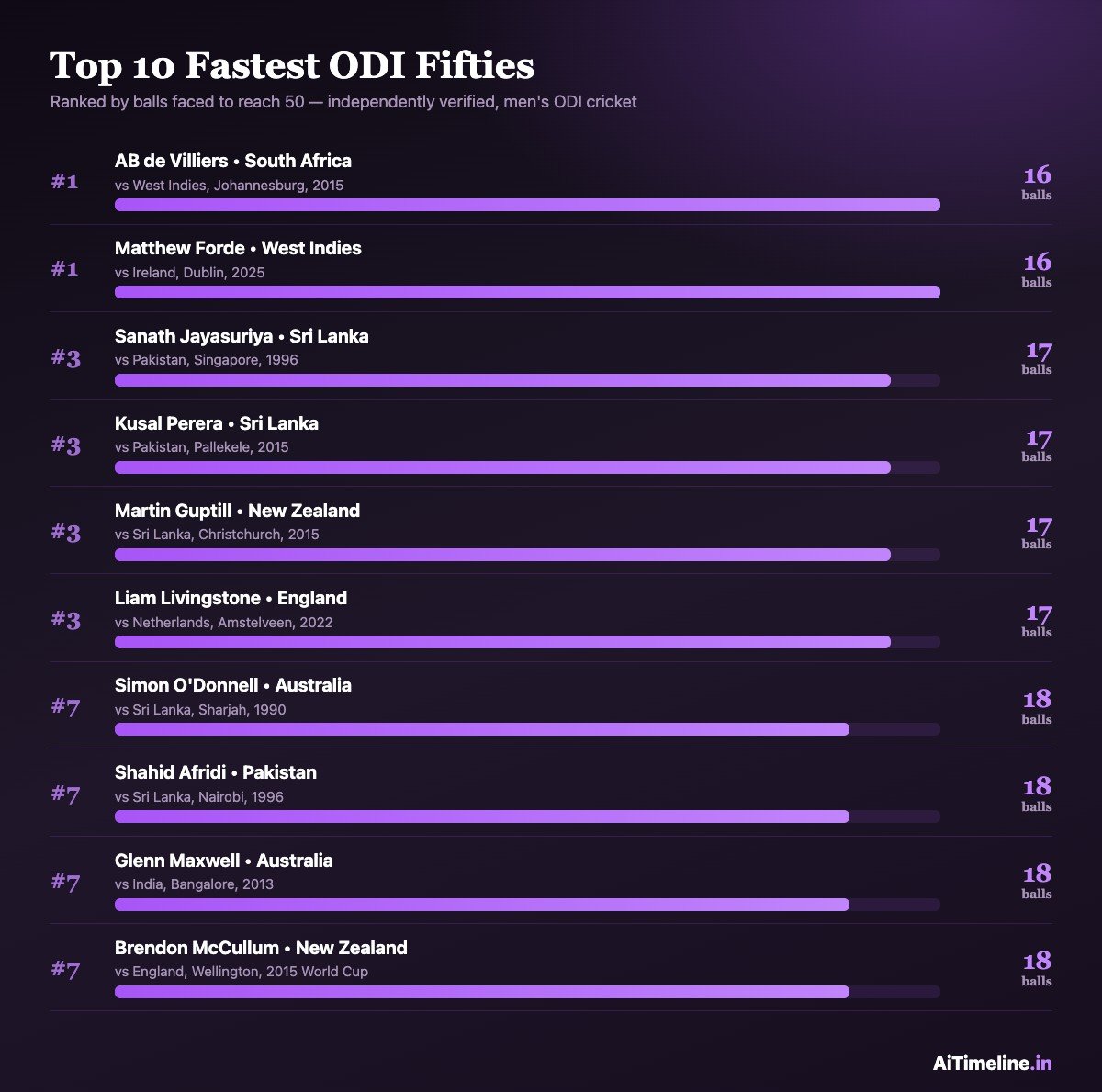
The 16-ball tier stands alone – the next fastest group is a four-way tie at 17.
Inside the Record Innings: AB de Villiers, January 18, 2015
South Africa had already won the toss and batted first at the Wanderers against West Indies in the second ODI of a five-match series. Hashim Amla anchored the innings with 153, and by the time AB de Villiers came to the crease South Africa were well placed but not yet in record territory. What happened next reset the sport’s understanding of how much damage a batter could do in a short space of time. De Villiers reached fifty in 16 balls, breaking Sanath Jayasuriya’s 17-ball mark that had stood since 1996. He did not stop there: his hundred came up in 31 balls – still the fastest century in ODI history a decade later – meaning his second fifty took just 15 deliveries, faster than his first. He finished unbeaten on 149 off 44 balls, striking 9 fours and 16 sixes, as South Africa posted 439 for 2 and won by 148 runs.
The scale of the acceleration is easier to see in stages than in one final number. His first 16 balls produced 50 runs. The next 15 balls produced another 50, taking him to 100 off 31. From there to his eventual dismissal or end of innings at 149 off 44 balls, he added a further 49 runs in just 13 deliveries – if anything, the fastest phase of an innings that was already historic. West Indies’ bowling attack that day included Jerome Taylor and Kemar Roach among others; no bowling change appeared to slow him down. De Villiers was South Africa’s captain in that match, and multiple cricket outlets have described the 16-ball fifty as the fastest by a captain in ODI history – a detail tied to his leadership role rather than a separately tracked official record category.
Inside the Record-Equalling Innings: Matthew Forde, May 23, 2025
Matthew Forde is a fast bowler, not a specialist batter, and he came to the crease at number eight in Dublin with West Indies already well set – 246 for 5 in the 44th over of their innings against Ireland, with Keacy Carty compiling what would become a 102-run century and Shai Hope and Justin Greaves also having contributed. There was no rescue act required and no required run rate to chase; Forde simply played the situation as an invitation to attack from his very first ball. He reached fifty in 16 balls, matching AB de Villiers’ decade-old world record, and was eventually dismissed for 58 off 19 balls, striking 8 sixes and 2 fours. West Indies closed on 352 for 8.
What makes Forde’s innings statistically distinct from de Villiers’ – beyond arriving a decade later, against a very different standard of attack, and from a lower position in the order – is its boundary composition. Of his 58 runs, 56 came from boundaries: 48 from his 8 sixes and 8 from his 2 fours. That works out to 96.55% of his runs scored in boundaries, reported as the highest boundary percentage recorded for any ODI innings of 50 or more. Rain then intervened before Ireland’s reply could begin, and the match was ultimately not completed – Forde’s innings stands as a record-equalling one regardless of the eventual match outcome, since fastest-fifty records are tracked at the individual-innings level, not the match-result level.
Milestone Pace: How the Two Record Innings Actually Broke Down
Derived from each player’s published milestone splits (fifty, hundred, final score) – not reconstructed ball-by-ball commentary.
| Phase | AB de Villiers (Jan 2015) | Matthew Forde (May 2025) |
|---|---|---|
| 0 to 50 runs | 16 balls (SR 312.5) | 16 balls (SR 312.5) |
| 50 to 100 runs | 15 balls (SR 333.3) | Not applicable – dismissed at 58 |
| Final stretch | 100 to 149: 13 balls (SR 376.9) | 50 to 58: 3 balls (SR 266.7) |
| Final figures | 149* off 44 (9×4, 16×6) | 58 off 19 (2×4, 8×6) |
| Overall strike rate | 338.6 | 305.3 |
Read one way, de Villiers actually accelerated as his innings went on – each successive phase was faster than the last. Forde’s innings, by contrast, was a single sustained burst from ball one to his dismissal, which is consistent with a lower-order batter facing no need to pace himself for a long innings.
How the Record Evolved
Newest first. Labels mark whether an entry is the outright world record, a national record, a tournament record, or general historical context.
Matthew Forde equals the 16-ball world record
What happened: Batting at number eight, Forde reached fifty in 16 balls and was out for 58 off 19, matching AB de Villiers’ 2015 mark rather than breaking it.
Why it matters: It is the first time in over a decade that any player has even matched the outright record, let alone broken it – and it also set a separate record for boundary percentage in a 50-plus score (96.55%).
Kusal Mendis reaches fifty in 19 balls against West Indies
What happened: Mendis finished unbeaten on 56 off 22 balls, with his fifty coming up in 19, in a match Sri Lanka ultimately lost in a run-chase shootout.
Why it matters: It placed Mendis inside the fastest-fifty top tier and underlined how frequently Sri Lankan batters have appeared on this list since Jayasuriya’s era.
Anil Sah sets Nepal’s national fastest-fifty record
What happened: Opener Anil Sah reached fifty in 19 balls, his first ODI half-century, and was dismissed lbw one ball later for 50 – striking 7 fours and 3 sixes.
Why it matters: It broke Nepal’s previous national mark (Aasif Sheikh, 21 balls, 2023) and showed the same speed-record culture spreading through associate-nation cricket that had already reached Scotland two years earlier.
Mohammad Nabi sets Afghanistan’s national record at the Asia Cup
What happened: Nabi reached fifty in 24 balls on his way to 65 off 32, hitting six fours and five sixes, breaking Mujeeb ur Rahman’s earlier 26-ball national mark.
Why it matters: Afghanistan chased 292 and fell just short, losing by two runs – a reminder that a record-fast fifty does not guarantee a winning result.
Liam Livingstone sets England’s national record
What happened: Livingstone reached fifty in 17 balls, finishing unbeaten on 66, as England posted a huge total against the Dutch.
Why it matters: It made Livingstone England’s fastest ODI fifty-scorer and placed an English batter, for the first time, inside the outright top tier of the all-time list.
Michael Leask sets Scotland’s national record
What happened: Leask reached fifty in 18 balls, finishing on 55, in an ICC Cricket World Cup League 2 fixture.
Why it matters: It tied Scotland’s mark with the historic Australia/Pakistan 18-ball tier and demonstrated that associate nations with full ODI status could now produce genuinely world-class fast innings, not just occasional outliers.
Chris Gayle sets West Indies’ fastest fifty at the time
What happened: Gayle reached fifty in 19 balls and finished unbeaten on 77 off 29, as West Indies chased down a modest target with 227 balls to spare.
Why it matters: At the time it was the fastest fifty ever by a West Indian batter, surpassing Daren Sammy’s previous mark by one delivery – a record that stood until Matthew Forde broke it outright, and then matched the world record, six years later.
Aaron Finch ties Australia’s national record
What happened: Finch reached fifty in 18 balls, finishing on 55, matching the mark Simon O’Donnell had set in 1990 and Glenn Maxwell had matched in 2013.
Why it matters: It made Australia the only nation on this list where three different batters, across three different decades, have independently matched the exact same national fastest-fifty mark without any of them going faster.
Martin Guptill sets New Zealand’s national record
What happened: Guptill reached fifty in 17 balls on his way to 93, joining the four-way tie for the outright number-three spot on the all-time list.
Why it matters: It came in the same calendar year New Zealand co-hosted the 2015 World Cup and reached the final – part of a broader surge in New Zealand’s white-ball aggression that decade.
Kusal Perera ties Sri Lanka’s national record
What happened: Perera reached fifty in 17 balls on his way to 68, matching the pace of Jayasuriya’s historic 1996 innings without beating it.
Why it matters: Al Jazeera’s coverage at the time described the innings as flattening Pakistan’s bowling attack in a low-scoring, rain-affected contest.
Brendon McCullum sets the Cricket World Cup fastest-fifty record
What happened: New Zealand’s captain reached fifty in 18 balls and finished on 77 off 25, striking 7 fours and 4 sixes as New Zealand won by 8 wickets in 12.2 overs.
Why it matters: Guinness World Records recognizes this specifically as the fastest fifty ever recorded at a men’s ICC Cricket World Cup – a tournament-specific record, separate from the overall ODI mark, that still stands.
AB de Villiers breaks the outright world record
What happened: De Villiers reached fifty in 16 balls, beating Sanath Jayasuriya’s 19-year-old mark by a single delivery, then went on to 149 off 44 with the fastest ODI century (31 balls) along the way.
Why it matters: It is still, as of this article, the fastest fifty ever recorded in a men’s ODI – a record now shared, not surpassed, by Matthew Forde a decade later.
Shahid Afridi’s third 18-ball fifty, at the Asia Cup
What happened: Afridi reached fifty in 18 balls for the third time in his career, finishing run out for 59 off 25, as Pakistan chased down 326 to reach the Asia Cup final.
Why it matters: It made Afridi the first player to record three separate 18-ball ODI fifties, and remains Pakistan’s national fastest-fifty benchmark, matched but not broken since.
Glenn Maxwell ties Australia’s national record
What happened: Maxwell reached fifty in 18 balls on his way to 60, matching Simon O’Donnell’s 1990 mark for Australia.
Why it matters: It was an early signal of the power-hitting reputation Maxwell would build over the following decade, and it kept Australia’s national record exactly where it had sat since 1990.
Ajit Agarkar sets India’s national record
What happened: A fast bowler batting down the order, Agarkar reached fifty in 21 balls and finished unbeaten on 67 off 25, striking 7 fours and 4 sixes, and was named Man of the Match after also taking three wickets.
Why it matters: It broke a long-standing record previously held by Kapil Dev, and remains India’s national fastest-fifty mark, unmatched by any of India’s specialist batters since.
Shahid Afridi’s second 18-ball fifty, at the Champions Trophy
What happened: Afridi reached fifty in 18 balls and finished unbeaten on 55, the fastest fifty recorded at any ICC Champions Trophy tournament.
Why it matters: It is the second of Afridi’s three 18-ball fifties and stands as the Champions Trophy’s own fastest-fifty record – see the Record Disputes section below for a note on a conflicting ball-count claim found in some secondary sources.
Shahid Afridi’s first 18-ball fifty announces his arrival
What happened: Months after his famous 37-ball century on ODI debut, a 16-year-old Afridi reached fifty in 18 balls and went on to 102 off 40, striking a mix of boundaries and sixes.
Why it matters: It confirmed his debut century was not a one-off, establishing the template – fast, fearless, unconcerned with his own batting average – that defined his entire career.
Sanath Jayasuriya sets the fastest fifty then on record
What happened: Jayasuriya reached fifty in 17 balls and was dismissed for 76 off 28, though Sri Lanka lost the final by 43 runs.
Why it matters: This is the earliest sub-20-ball ODI fifty independently confirmed by multiple outlets for this article, and it stood as the standalone fastest fifty in the format for almost 19 years – the longest reign of any mark on this list.
Simon O’Donnell sets what becomes Australia’s national record
What happened: O’Donnell reached fifty in 18 balls on his way to 74, in an era when sub-20-ball fifties were a genuine rarity.
Why it matters: It is the earliest 18-ball (or faster) fifty independently documented for this article, and set a mark that two more Australians – Maxwell in 2013, Finch in 2016 – would later match but never beat.
The format itself begins
What happened: The first officially recognized One Day International was played almost by accident, after rain washed out a Test match and the two boards agreed to a shortened 40-over-a-side game instead.
Why it matters: Every record in this article exists inside a format that began as an improvisation – a detail worth remembering whenever a “timeless” cricket record is discussed.
Top 17 Fastest ODI Fifties – Independently Verified
Every entry below was cross-checked against at least two independent sources before inclusion. Below the 19-ball mark, the list becomes heavily tied across dozens of names – see the note underneath the table.
| Rank | Player | Country | Balls | Final score | Opponent | Venue | Date |
|---|---|---|---|---|---|---|---|
| 1 | AB de Villiers | South Africa | 16 | 149 (44) | West Indies | Johannesburg | Jan 18, 2015 |
| 1 | Matthew Forde | West Indies | 16 | 58 (19) | Ireland | Dublin | May 23, 2025 |
| 3 | Sanath Jayasuriya | Sri Lanka | 17 | 76 (28) | Pakistan | Singapore | Apr 7, 1996 |
| 3 | Kusal Perera | Sri Lanka | 17 | 68 | Pakistan | Pallekele | Jul 15, 2015 |
| 3 | Martin Guptill | New Zealand | 17 | 93 | Sri Lanka | Christchurch | Dec 28, 2015 |
| 3 | Liam Livingstone | England | 17 | 66* | Netherlands | Amstelveen | Jun 17, 2022 |
| 7 | Simon O’Donnell | Australia | 18 | 74 | Sri Lanka | Sharjah | May 2, 1990 |
| 7 | Shahid Afridi | Pakistan | 18 | 102 (40) | Sri Lanka | Nairobi | Oct 4, 1996 |
| 7 | Shahid Afridi | Pakistan | 18 | 55* | Netherlands | Colombo | Sep 21, 2002 |
| 7 | Glenn Maxwell | Australia | 18 | 60 | India | Bangalore | Nov 2, 2013 |
| 7 | Shahid Afridi | Pakistan | 18 | 59 (25) | Bangladesh | Mirpur | Mar 4, 2014 |
| 7 | Brendon McCullum | New Zealand | 18 | 77 (25) | England | Wellington | Feb 20, 2015 |
| 7 | Aaron Finch | Australia | 18 | 55 | Sri Lanka | Dambulla | Aug 31, 2016 |
| 7 | Michael Leask | Scotland | 18 | 55 | Papua New Guinea | Dubai | Apr 13, 2022 |
| 15 | Chris Gayle | West Indies | 19 | 77* (29) | England | Gros Islet, St Lucia | Mar 2, 2019 |
| 15 | Anil Sah | Nepal | 19 | 50 (20) | Canada | Kirtipur | Feb 10, 2024 |
| 15 | Kusal Mendis | Sri Lanka | 19 | 56* (22) | West Indies | Pallekele | Oct 26, 2024 |
Below 19 balls, the field widens sharply and gets heavily tied – names credibly reported elsewhere with a 19-ball ODI fifty include Brendon McCullum (a second instance), Mark Boucher, Ross Taylor and David Hussey, among others. This article did not include those specific rows because their exact opponent, venue and final-score details could not be independently cross-checked to the same standard as the 17 entries above at the time of writing – a deliberate choice, in line with this article’s sourcing methodology, over publishing an unverified figure.
Fastest ODI Fifties by Country
Each nation’s own fastest-recognized ODI fifty, independent of where it ranks on the overall world list.
| Country | Player | Balls | Opponent | Year | Score |
|---|---|---|---|---|---|
| South Africa | AB de Villiers | 16 | West Indies | 2015 | 149 (world record) |
| West Indies | Matthew Forde | 16 | Ireland | 2025 | 58 (world record) |
| Sri Lanka | Sanath Jayasuriya / Kusal Perera | 17 | Pakistan (both) | 1996 / 2015 | 76 / 68 (tied) |
| New Zealand | Martin Guptill | 17 | Sri Lanka | 2015 | 93 |
| England | Liam Livingstone | 17 | Netherlands | 2022 | 66* |
| Australia | O’Donnell / Maxwell / Finch | 18 | Sri Lanka, India, Sri Lanka | 1990 / 2013 / 2016 | Tied three ways |
| Pakistan | Shahid Afridi | 18 | Sri Lanka, Netherlands, Bangladesh | 1996 / 2002 / 2014 | Achieved three times |
| Scotland | Michael Leask | 18 | Papua New Guinea | 2022 | 55 |
| Nepal | Anil Sah | 19 | Canada | 2024 | 50 |
| India | Ajit Agarkar | 21 | Zimbabwe | 2000 | 67* |
| Afghanistan | Mohammad Nabi | 24 | Sri Lanka | 2023 | 65 |
| Zimbabwe | Sean Williams | ~33 (source-dependent) | United States | 2023 | Best documented, not triple-sourced |
Bangladesh and Ireland are deliberately omitted from this table: this article’s research could not independently cross-verify a specific national record claim for either team’s ODI fastest fifty to the sourcing standard used elsewhere in this piece, as distinct from domestic List A or T20I records that sometimes get conflated with it in casual reporting.
Fastest Fifties at the Cricket World Cup
A separate leaderboard from the overall ODI record. Compiled from statistical databases and cross-checked against Guinness World Records for the top entry.
| Rank | Player | Team | Balls | Opponent | Edition | Venue |
|---|---|---|---|---|---|---|
| 1 | Brendon McCullum | New Zealand | 18 | England | 2015 | Wellington |
| 2 | Brendon McCullum | New Zealand | 20 | Canada | 2007 | Gros Islet |
| 3 | Angelo Mathews | Sri Lanka | 20 | Scotland | 2015 | Hobart |
| 4 | Glenn Maxwell | Australia | 21 | Afghanistan | 2015 | Perth |
| 5 | Mark Boucher | South Africa | 21 | Netherlands | 2007 | Basseterre |
| 6 | Brendon McCullum | New Zealand | 21 | Australia | 2015 | Auckland |
| 7 | Mark Boucher | South Africa | 22 | West Indies | 2007 | St George’s |
| 8 | Dinesh Chandimal | Sri Lanka | 22 | Australia | 2015 | Sydney |
| 9 | Brendon McCullum | New Zealand | 22 | South Africa | 2015 | Auckland |
| 10 | Kusal Perera | Sri Lanka | 22 | New Zealand | 2023 | Bengaluru |
Brendon McCullum occupies four of the top nine World Cup entries across two different tournaments (2007 and 2015) – the single most dominant individual presence on any sub-list in this article.
Fastest Fifties at the ICC Champions Trophy
| Rank | Player | Team | Balls | Opponent | Year | Venue |
|---|---|---|---|---|---|---|
| 1 | Shahid Afridi | Pakistan | 18 | Netherlands | 2002 | Colombo |
| 2 | Craig McMillan | New Zealand | 21 | United States | 2004 | The Oval |
| 3 | Eoin Morgan | England | 26 | South Africa | 2009 | Centurion |
| 4 | Jesse Ryder | New Zealand | 28 | Sri Lanka | 2009 | Johannesburg |
| 5 | Yuvraj Singh | India | 29 | Pakistan | 2017 | Birmingham |
Fastest Fifties at the Asia Cup (ODI Format Only)
The Asia Cup alternates between ODI and T20I format by edition. Only ODI-format matches are included here – T20I Asia Cup fifties are a separate record category entirely.
| Rank | Player | Team | Balls | Opponent | Year | Venue |
|---|---|---|---|---|---|---|
| 1 | Shahid Afridi | Pakistan | 18 | Bangladesh | 2014 | Mirpur |
| 2 | Mohammad Nabi | Afghanistan | 24 | Sri Lanka | 2023 | Lahore |
Record Disputes: Where Sources Disagree
Shahid Afridi’s Champions Trophy fifty (17 vs 18 balls): Three independently cross-checked overall fastest-fifty compilations (used throughout this article) list Afridi’s fifty against Netherlands at the 2002 Champions Trophy as 18 balls, consistent with his other two documented 18-ball fifties. One tournament-specific listicle, sourced separately for this article’s Champions Trophy table, lists the same innings as 17 balls. Because the overall-record sources independently agree with each other and with Afridi’s broader career pattern of exactly-18-ball fifties, this article treats 18 balls as the more reliable figure and flags the single dissenting 17-ball claim here rather than silently picking one number.
Zimbabwe’s national record: Available reporting points to Sean Williams reaching a fifty in roughly 33 balls against the United States at a 2023 World Cup Qualifier as Zimbabwe’s fastest documented ODI fifty, but this article could not independently triple-source the exact ball count to the same confidence level as the entries in the main top-17 table. It is presented as the best currently available reference, not a fully verified record claim.
Bangladesh’s national record: Multiple searches conducted for this article surfaced a domestic List A fifty (Dhaka Premier League, 2026) that does not qualify as an ODI record, and no clearly sourced, independently confirmed ODI-specific national record for Bangladesh. Rather than guess, this article leaves that entry blank in the country table above.
The Fastest 50 vs the Fastest 100 in ODI Cricket
Fastest ODI Fifty vs Fastest ODI Century
A batter can be devastatingly fast to fifty without ever converting into the fastest century – Matthew Forde’s 58 off 19 never got the chance to become a hundred, and most of the players on the top-17 fifty list never went on to challenge the century record at all. The two categories reward different things: fifty-pace rewards a short, explosive burst; hundred-pace rewards sustaining that burst for twice as long against a bowling attack that has had time to adjust.
Fastest 50 vs Highest Strike Rate vs Most Sixes: Three Different Records
It is easy to conflate “fastest fifty,” “highest strike rate in an innings,” and “most sixes in an innings” as though they describe the same thing. They don’t. Fastest fifty measures only the balls needed to reach exactly 50 runs, regardless of what happens afterward. Highest strike rate (for a qualifying innings) measures the runs-per-ball ratio across an entire innings, which can be skewed by a short cameo that never reaches fifty at all, or dragged down by a slow start before an innings like de Villiers’ accelerates even further. Most sixes in an innings is a raw counting record, unrelated to how many balls were needed to get there – a batter can hit 15 sixes in a slow 80-ball century and still not come close to a fastest-fifty mark.
Matthew Forde’s 58 off 19 illustrates the distinction well: it ties the fastest-fifty record (16 balls to fifty) and separately holds the record for highest boundary percentage in a 50-plus score (96.55%), but his overall innings strike rate (305.3) is actually lower than AB de Villiers’ final figure (338.6) – because de Villiers kept accelerating for 44 balls, while Forde’s innings ended at 19.
How Is an ODI Fifty Calculated?
- Only the batter’s own runs count. A fifty is reached the moment a specific batter’s individual run tally hits 50 – extras (wides, no-balls, byes, leg-byes) go toward the team total but never toward any individual batter’s score.
- Balls faced, not overs, is the unit of speed. “Fastest fifty” always ranks by legal deliveries faced by that batter to reach 50, not by the over count of the innings, which includes deliveries faced by their partner.
- A wide or no-ball does not count as a ball faced by the batter on strike for record-keeping purposes, even though runs scored off it can count toward the batter’s total in the case of no-balls hit for runs.
- The record is set the instant 50 is reached, not when the batter is eventually dismissed – a player can reach a fastest-fifty-class mark and then get out cheaply, as several entries on this list show.
- Boundaries (fours and sixes) are counted separately from the ball-count record, which is why “fastest fifty” and “most sixes in a fifty” are tracked as two different statistics, even though they’re obviously related in practice.
Boundary Composition: How Much of a Fast Fifty Comes in Fours and Sixes
Every fifty inside the 16-to-18-ball tier in this article’s dataset was built overwhelmingly from boundaries, which is mathematically close to unavoidable – reaching 50 in 18 balls or fewer requires an average of more than 2.7 runs per ball, a rate that ones and twos alone essentially cannot sustain. Forde’s 58 off 19 is the extreme case: 56 of his 58 runs, or 96.55%, came from boundaries (8 sixes worth 48 runs, 2 fours worth 8 runs), leaving just 2 runs scored any other way. De Villiers’ fifty was reached with a mix of running and boundaries, but by the time he reached 149 off 44 balls, boundaries (9 fours plus 16 sixes, worth 132 of his 149 runs) still accounted for roughly 89% of his total.
Sixes specifically carry more weight than fours in reaching a fast fifty, simply on arithmetic grounds: three consecutive sixes is already 18 runs in three balls, a pace no combination of running between the wickets can realistically match over a full innings. That is why almost every entry on the top-17 table skews toward sixes rather than fours in its final boundary count, even accounting for the fact that fours are, in absolute terms, the more common boundary in ODI cricket generally.
Boundary Math, Based on the Verified Dataset in This Article
- Forde’s 58 (May 2025): 96.55% of runs from boundaries – the highest recorded for any 50-plus ODI innings.
- De Villiers’ 149 (Jan 2015): roughly 89% of runs from boundaries (9 fours, 16 sixes).
- Reaching 50 in exactly 16 balls requires an average scoring rate of 3.125 runs per legal delivery faced.
- Every entry in the top-17 table struck at least one six on the way to their fifty; none reached the milestone through running alone.
- Across the top-17 table, sixes outnumber fours in aggregate boundary count – unusual compared to ODI cricket’s overall long-run boundary mix, which typically favors fours.
Why Fast Fifties Matter in Modern ODI Cricket
A fast fifty is not just a personal milestone; it changes the shape of a match in ways a slower fifty of identical final value does not. In the powerplay overs, when fielding restrictions limit the number of players outside the inner circle, a batter who reaches fifty in 16-18 balls has effectively used the overs when boundaries are easiest to find far more efficiently than a batter who needs 40-plus balls for the same score, freeing up the rest of the innings for partners to rebuild or consolidate. In a chase, a fast fifty can single-handedly collapse a required run rate that looked competitive into one that looks trivial within a handful of overs – exactly what Chris Gayle’s 19-ball fifty did to West Indies’ modest 2019 chase, finished with 227 balls still unused.
Batting depth is the other half of the story. A team confident in its middle and lower order – the situation Matthew Forde was in, batting at eight with West Indies already past 250 – can afford to let a lower-order player simply attack from ball one with no responsibility to build an innings, because there is no scoreboard pressure requiring caution. That calculation did not exist in the same way in earlier decades of ODI cricket, when batting line-ups were generally shorter and lower-order batters were expected to survive rather than accelerate.
Powerplays and Fast Fifties
Fielding restrictions during the first block of overs in an ODI innings – commonly known as the powerplay – limit how many fielders a captain can station outside the inner 30-yard circle, which mechanically increases the number of gaps available to a batter willing to take risks. Several entries on this article’s top-17 list were struck inside that powerplay window, including both world-record innings: de Villiers came to the crease well after South Africa’s own powerplay had passed but still exploited an aggressively set field late in the innings, while Forde’s fifty came deep into West Indies’ innings, in the overs when field restrictions have already eased and bowlers are permitted more fielders on the boundary – a reminder that fast fifties are not exclusively a powerplay phenomenon, even though the powerplay’s extra boundary riders theoretically make it the easier window to accelerate in.
It would be an overstatement to credit powerplay rules alone for this list, since several of the fastest fifties in this dataset – Forde’s included – came from the middle and death overs, when fields are fuller rather than more open. What powerplay rules reliably do is create one recurring opportunity per innings; what separates the players on this list is the willingness and skill to take that opportunity (or a comparable one later in the innings) to its logical extreme, rather than the rules themselves guaranteeing the outcome.
Bat Technology and Fast Scoring
Modern bat manufacturing – thicker edges, larger and better-positioned sweet spots, and lighter willow that lets batters generate more bat speed without sacrificing control – has widened the margin for error on mistimed shots that might once have resulted in a catch rather than a six. That shift plausibly helps explain why more of the fastest-fifty list is concentrated in the 2013-2025 period than in the 1990s, when only Jayasuriya’s and O’Donnell’s innings from this article’s dataset originate. But it is not the whole explanation: Jayasuriya’s 17-ball fifty in 1996, with 1990s-era bats, still stood as the outright world record for almost two decades, output that plenty of technologically superior bats in the years between failed to beat. Equipment appears to be a contributing factor among several, not a standalone cause.
Bowling and Fast Fifties: The Other Half of the Equation
Every innings on this list happened to a specific bowling attack on a specific day, and it would be unfair to read these records purely as batting triumphs without acknowledging that execution failures – a length ball that sits up, a slower ball that doesn’t deceive, width outside off stump against a batter shaping to cut – are what actually gets hit for the boundaries that make up these totals. Small grounds (Sharjah in 1990, Singapore in 1996, Colombo’s compact dimensions in several entries) also feature disproportionately often in this dataset, suggesting venue geometry is a real contributing variable alongside bowling execution and batting skill, rather than any single factor explaining the whole list.
Evolution of ODI Batting, Decade by Decade
1970s-1980s: The format was young, and batting approaches largely mirrored Test cricket’s caution with only a modest gear change for the shorter format. Fast fifties existed but were rare outliers rather than a recognizable pattern.
Early 1990s: Fielding-restriction rules introduced during this period, combined with grounds like Sharjah that rewarded clean hitting, began producing the first cluster of genuinely rapid innings – Simon O’Donnell’s 1990 fifty sits at the start of this shift in this article’s dataset.
Mid-to-late 1990s: Sanath Jayasuriya and Sri Lanka’s pinch-hitting opening approach, refined around the 1996 World Cup, formalized the idea that an opener’s job could be pure aggression rather than occupation of the crease – a philosophy that directly produced his 17-ball fifty and 48-ball century in the same tournament window, and influenced how Shahid Afridi’s career-long approach developed just afterward.
2000s: Afridi’s repeated 18-ball fifties and the format’s growing acceptance of high-risk, high-reward batting through the middle overs, not just the powerplay, expanded where in an innings a fast fifty could plausibly happen.
2010s: AB de Villiers’ 2015 innings represented a ceiling few thought reachable, arriving during a decade when bat technology, fitness standards and analytics-driven aggression were all improving simultaneously – and the same decade produced five of this article’s top-17 entries.
2020s: The record has proven far harder to break than to approach – only Matthew Forde has matched it, in 2025 – even as associate nations (Scotland, Nepal) and part-time or lower-order batters (Forde himself, a fast bowler) have shown that fast-fifty-class hitting is no longer confined to specialist top-order stars from the sport’s wealthiest boards.
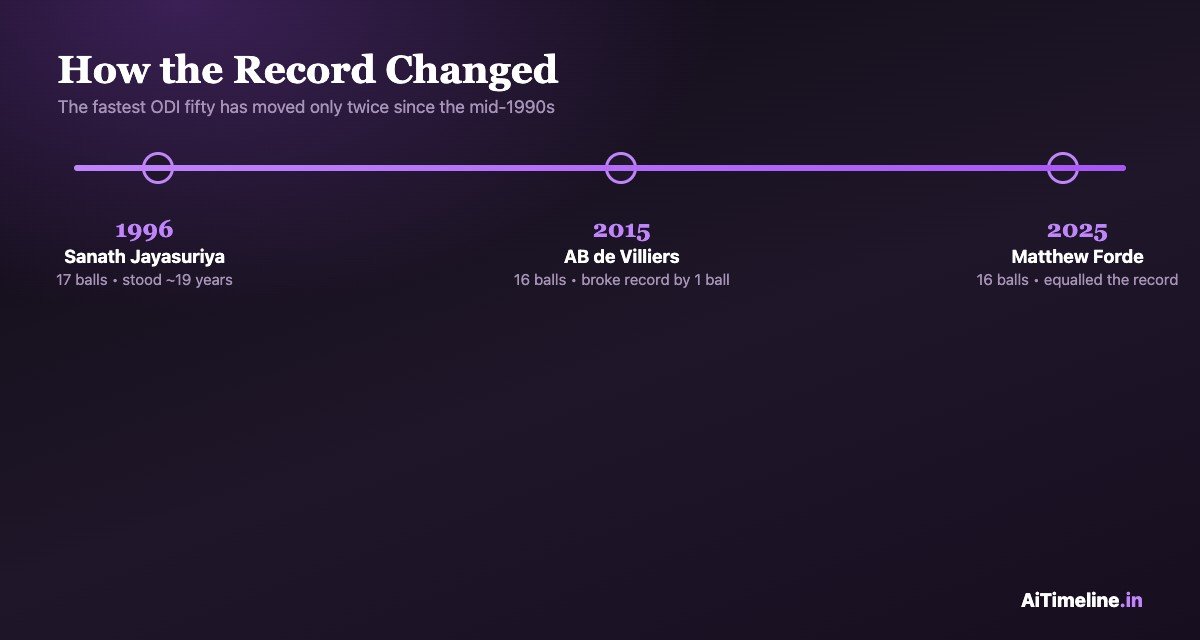
Two record changes in three decades – the mark has proven far easier to approach than to beat.
Player Profiles: The Names Behind the Record
AB de Villiers
South African wicketkeeper-batter and former captain, widely regarded as one of the most versatile ODI batters ever to play. His January 2015 innings against West Indies – 149 off 44 balls – produced the fastest fifty (16 balls) and fastest century (31 balls) in the same knock, a combination no other player has matched. Retired from international cricket in 2018.
Matthew Forde
West Indies fast bowler, primarily selected for his bowling, who produced one of the most improbable record-equalling innings in the sport’s history batting at number eight. His 58 off 19 balls against Ireland in May 2025 matched AB de Villiers’ decade-old mark and set a separate record for boundary percentage in a 50-plus score.
Sanath Jayasuriya
Sri Lankan opener whose pinch-hitting approach, built around the 1996 World Cup, reshaped how ODI innings were structured from ball one. His 17-ball fifty against Pakistan in April 1996 stood as the outright world record for almost 19 years, longer than any other mark on this list.
Shahid Afridi
Pakistan all-rounder who reached fifty in exactly 18 balls on three separate occasions across three different decades of his career – 1996, 2002 and 2014 – a consistency of extreme pace unmatched by any other player in this article’s dataset.
Brendon McCullum
New Zealand’s captain during their run to the 2015 World Cup final, and the most-represented player in this article’s dedicated World Cup fastest-fifty table, with four entries across the 2007 and 2015 tournaments. His 18-ball fifty against England in 2015 remains, per Guinness World Records, the fastest ever recorded at a men’s Cricket World Cup.
Martin Guptill
New Zealand opener whose 17-ball fifty against Sri Lanka in December 2015 remains his country’s national fastest-ODI-fifty record. Also holds New Zealand’s record for the highest individual ODI score, 237 not out, from the same broader era of his career.
The Human Side of a Record-Fast Fifty
The psychological gap between a fast fifty and a genuinely record-threatening one is larger than the ball-count difference suggests. A batter reaching fifty off 30 balls has time to recalibrate mid-innings, to ease off after a good over or push harder after a quiet one. A batter on course for a sub-20-ball fifty has almost no such margin – miss-time one attacking shot into a fielder’s hands, and the entire innings ends before the record conversation even starts. That is part of why so many entries on this list belong to batters with little to lose in the moment: Forde walking in with the match effectively decided, Afridi playing with the same fearless method regardless of situation throughout his career, Agarkar and Nabi batting down the order with no responsibility to occupy the crease.
None of the players covered in this article have gone on record, in sourcing available for this piece, describing their specific thought process during the record-pace overs themselves – which is why this article does not speculate about what any of them were thinking in the moment. What is documented, repeatedly, in post-match reporting is a common thread of surprise: several of these innings were described by commentators and reporters as catching even the batter’s own teammates off guard, precisely because so few players ever get near this pace at all.
Fastest ODI Fifty: Myth vs Fact
❌ Common Myths
- The fastest fifty in all of cricket is the same as the fastest ODI fifty.
- A 50 off 20 balls is automatically a “better” innings than a 50 off 40 balls.
- T20 or List A fastest-fifty records can be folded into the ODI record list.
- Extras (wides, no-balls, byes) count toward the batter’s individual fifty.
- Fastest fifty and highest strike rate in an innings are the same statistic.
- AB de Villiers’ record has been broken since 2015.
✅ What’s Actually True
- Test cricket, T20Is and List A cricket each track entirely separate fastest-fifty records – this article covers men’s ODI cricket only.
- Match context (target, required rate, wickets in hand, opposition quality) shapes how much a fast fifty is actually worth to the result, independent of ball count.
- T20I and domestic List A fifties are excluded from every table in this article; mixing them with ODI figures is a common but avoidable error.
- Extras go to the team total only. A batter’s individual fifty counts only runs they personally scored off the bat (or leg byes/byes are never credited to the batter, only to the team).
- Strike rate is a whole-innings average; fastest fifty measures only the balls needed for the first 50 runs specifically.
- De Villiers’ 16-ball mark has been equalled, by Matthew Forde in May 2025, but not beaten by anyone as of this article’s publication.
Statistical Insight: What the Verified Dataset Actually Shows
Based on the 17 independently verified innings included in this article’s master table.
Of the 17 verified innings, 6 came while the batting side batted first and 11 came while chasing or in the second innings – suggesting fast fifties are somewhat more common in run-chases or second-innings situations than when setting a target, though the sample is too small to treat as a firm statistical rule. Only 2 of the 17 innings were played by an opener facing the new ball from the very start of the match (Jayasuriya, Guptill); the rest came from batters entering after the innings was already under way, at positions ranging from number three through number eight. Just 1 of the 17 verified fast fifties – de Villiers’ – converted into a century in the same innings; the other 16 ended below three figures, whether through dismissal, the innings closing, or (in Forde’s case) a match that never reached its second innings at all.
Explore More Timelines
Sources and Statistical Methodology
Every entry in this article’s main top-17 table, country table and tournament tables was checked against a minimum of two independently published sources – drawn from ESPNcricinfo match reports and scorecards, ICC and Guinness World Records where an entry carries an official record designation, and established cricket wire and news services including the BBC, Al Jazeera and dedicated cricket-statistics outlets. Where sources disagreed on a specific figure (see the Record Disputes section above), this article states the disagreement explicitly rather than silently picking one number, and favors the figure supported by the broader pattern of independently agreeing sources.
Domestic List A and T20I innings were excluded from every table in this article, even when a specific ball count sounded competitive with the ODI list – one such instance (a June 2026 Dhaka Premier League innings) was identified and deliberately excluded during research for this piece. Two national-record claims (Bangladesh, Ireland) that could not be independently verified to this article’s sourcing standard were left blank rather than filled with an unverified figure. This article will be updated on this same page, rather than republished at a new URL, if the outright ODI fastest-fifty record changes.
🕑 Freshness & Record Status
Current as of: August 9, 2026. Last verified: August 9, 2026, against ESPNcricinfo scorecards, ICC records and Guinness World Records. Record status: Current – the 16-ball mark is jointly held by AB de Villiers (2015) and Matthew Forde (2025); no faster men’s ODI fifty has been recorded since.
⚠️ Editorial Note
This article is compiled from publicly available match reports, official scorecards, ICC and Guinness World Records data, and established cricket journalism, cross-checked as described in the Sources and Statistical Methodology section above. Sports records can change with the next relevant match – this page will be updated in place, on this same URL, if the outright ODI fastest-fifty record is broken again. It is provided for informational purposes and should not be treated as a betting, fantasy-sport or wagering resource.
Sources & further reading
Every dated entry above was checked against these references. Last reviewed 15 September 2026.
- ESPNcricinfo - South Africa vs West Indies, 2nd ODI 2015 - Match Report (de Villiers' 16-ball fifty)
- ESPNcricinfo - Ireland vs West Indies, 2nd ODI 2025 - Full Scorecard (Forde's 16-ball fifty)
- ICC Cricket - Forde equals AB de Villiers' feat in Dublin
- Guinness World Records - Fastest fifty in an ICC World Cup match (male)
- ESPNcricinfo - India vs Zimbabwe, 5th ODI 2000 - Full Scorecard (Agarkar's 21-ball fifty)
- ESPNcricinfo - ODI Batting Records: Fastest Fifties
- Cricket Country - Martin Guptill slams joint 2nd-fastest fifty in ODI history
- Wikipedia: List of One Day International cricket records