Tata Nano History: The ₹1 Lakh Car Story & Legacy
Tata Nano history: the ₹1 lakh promise, the Singur exit, 2.03 lakh bookings, fires, a zero-star crash test, GenX AMT and why output fell to one car.
Latest Story
On 10 January 2008, at the Auto Expo in New Delhi, Ratan Tata drove a small, egg-shaped car on to the stage and kept a promise he had been making for years: a four-seat family car priced at ₹1 lakh. The world called the Tata Nano the cheapest car ever built. Two lakh people booked one in April 2009. Yet the car that was meant to move India’s scooter families into cars never came close to the volumes its factory was built for. By June 2018 Tata was making one Nano a month, and in 2019 it made none at all. This is the full history: the engineering that got the price down, the Singur land fight that cost the project its factory, the fires and crash test that hurt trust, the updates that came too late, and why a low price turned out not to be enough.
💡 Short Answer
The Tata Nano was a 624cc, rear-engined four-seat car unveiled on 10 January 2008 at a promised price of ₹1 lakh ex-factory. It went on sale in March 2009 and drew about 2.03 lakh bookings, but sales peaked at 74,527 in 2011-12 and then fell. A forced factory move from Singur, fire incidents, a zero-star crash test and the “cheapest car” label all hurt it. Tata made just one Nano in June 2018 and none in 2019.
Tata Nano: Key Questions
The Tata Nano in Ten Lines
- Ratan Tata said the idea came from watching families of four ride on one scooter in the rain.
- Girish Wagh led an engineering team of about 500; Tata filed 31 design and 37 technology patents.
- The Nano was unveiled on 10 January 2008. “A promise is a promise,” Ratan Tata said of the ₹1 lakh price.
- Tata left Singur, West Bengal, on 3 October 2008 after protests over the 997 acres acquired for the plant.
- Four days later it chose Sanand, Gujarat. That plant opened on 2 June 2010.
- Sales opened on 23 March 2009. About 2.03 lakh bookings came in; the first 1 lakh buyers were picked by draw.
- Fire incidents in 2010 and a zero-star Global NCAP crash test in 2014 damaged trust.
- Sales peaked at 74,527 in 2011-12 and fell to 7,591 by 2016-17.
- Tata added power steering (Twist, 2014) and an automatic gearbox (GenX, 2015), but too late.
- Tata built one Nano in June 2018 and none in 2019. The idea still shapes debates about frugal engineering.
2003–2005: The Scooter Family and the ₹1 Lakh Promise
The Nano began as a safety idea, not a price idea.
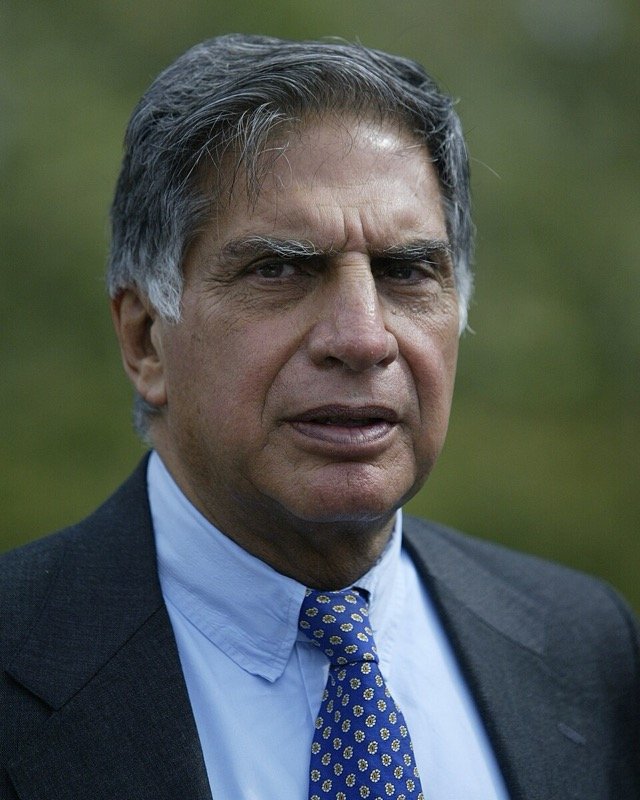
In the early 2000s, most Indian families who owned a vehicle owned a two-wheeler. Ratan Tata, then chairman of the Tata Group and Tata Motors, later described what he kept seeing on Indian roads: “the father driving the scooter, his young kid standing in front of him, his wife seated behind him holding a little baby.” It led him, he said at the 2008 unveiling, to wonder whether “one could conceive of a safe, affordable, all-weather form of transport for such a family.”
He began speaking publicly about a car for about ₹1 lakh in the early 2000s. Once the number was out, it became a public target that Tata could not quietly raise. Motoring experts doubted it could be done without leaving out things a car needs.
In mid-2005, a young Tata Motors engineer named Girish Wagh was put in charge of the project. He led a team of about 500 engineers. The brief was not to strip down an existing car. It was to design a new one around the price, while still meeting Indian safety and emission rules. The project went on to file 31 design and 37 technology patents.
How Tata Engineered a ₹1 Lakh Car
No single trick. Hundreds of small decisions.
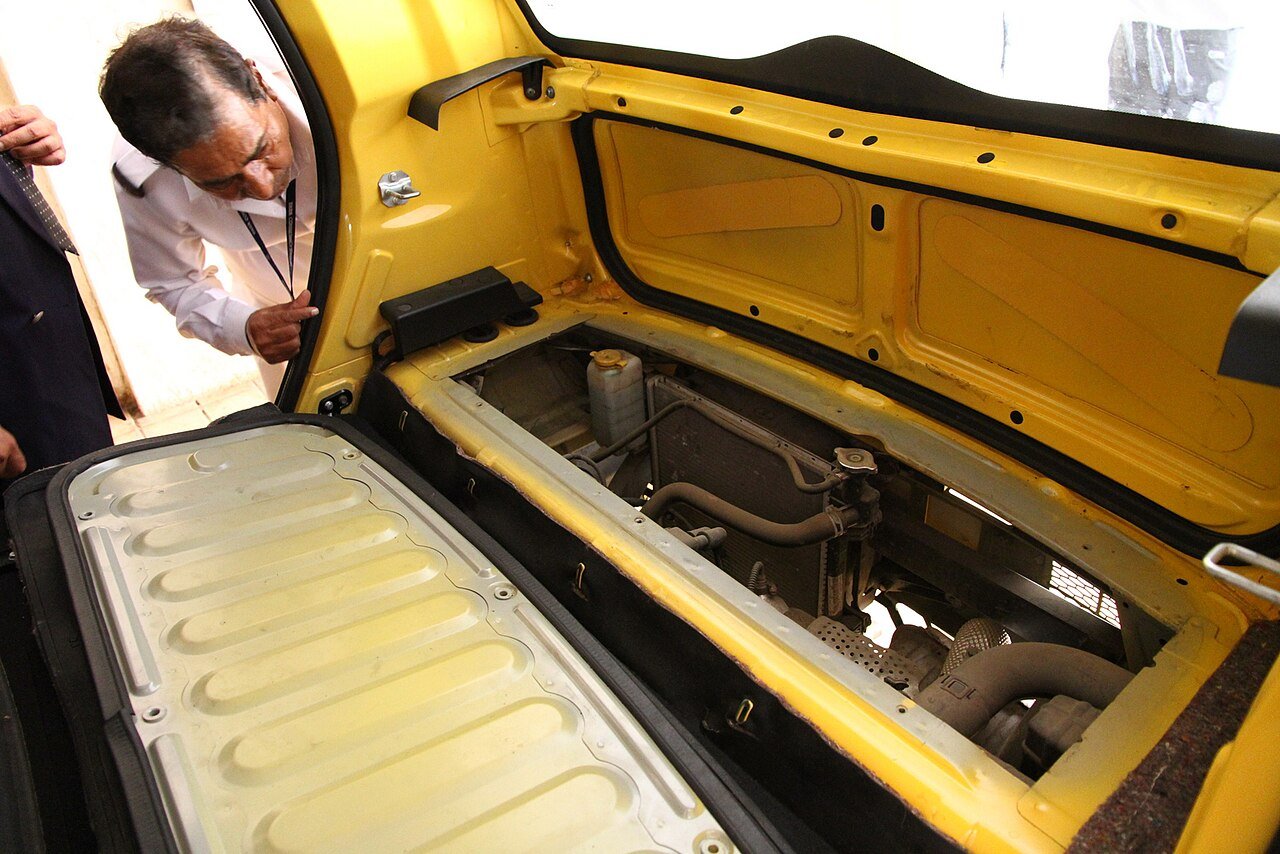
The Nano’s most important decision was where to put the engine. A small 624cc two-cylinder petrol engine sat at the rear, under the back floor, driving the rear wheels. That kept the front short and pushed the wheels to the corners, so a car only about 3.1 metres long (3,099 mm) could seat four adults in a tall, upright cabin.
The first engine made about 35 PS. It was small because the car was light: roughly 600 kg. A lighter car needs a smaller engine, smaller brakes and smaller wheels, and each of those saves money again.
Many savings were visible to owners. The base car had one windscreen wiper, no power steering, no air conditioning and a single central instrument pod. The wheels were held on by three nuts, not four. The small fuel tank (15 litres) and the spare wheel sat in the front. And until 2015 the rear hatch did not open: luggage went in by folding the back seat from inside the car.
Where the cost came out
- Layout: rear engine, short nose, wheels at the corners, tall roof.
- Engine: 624cc, two cylinders instead of the usual three or four.
- Weight: about 600 kg, so smaller brakes, wheels and tyres.
- Parts: one wiper, three wheel nuts, a simple dashboard, fewer parts overall.
- Suppliers: Tata worked with suppliers on cost from the design stage.
- Features left out: no AC, power steering or openable hatch on the base car.
10 January 2008: “A Promise Is a Promise”
The day the Nano became the world’s most talked-about car.
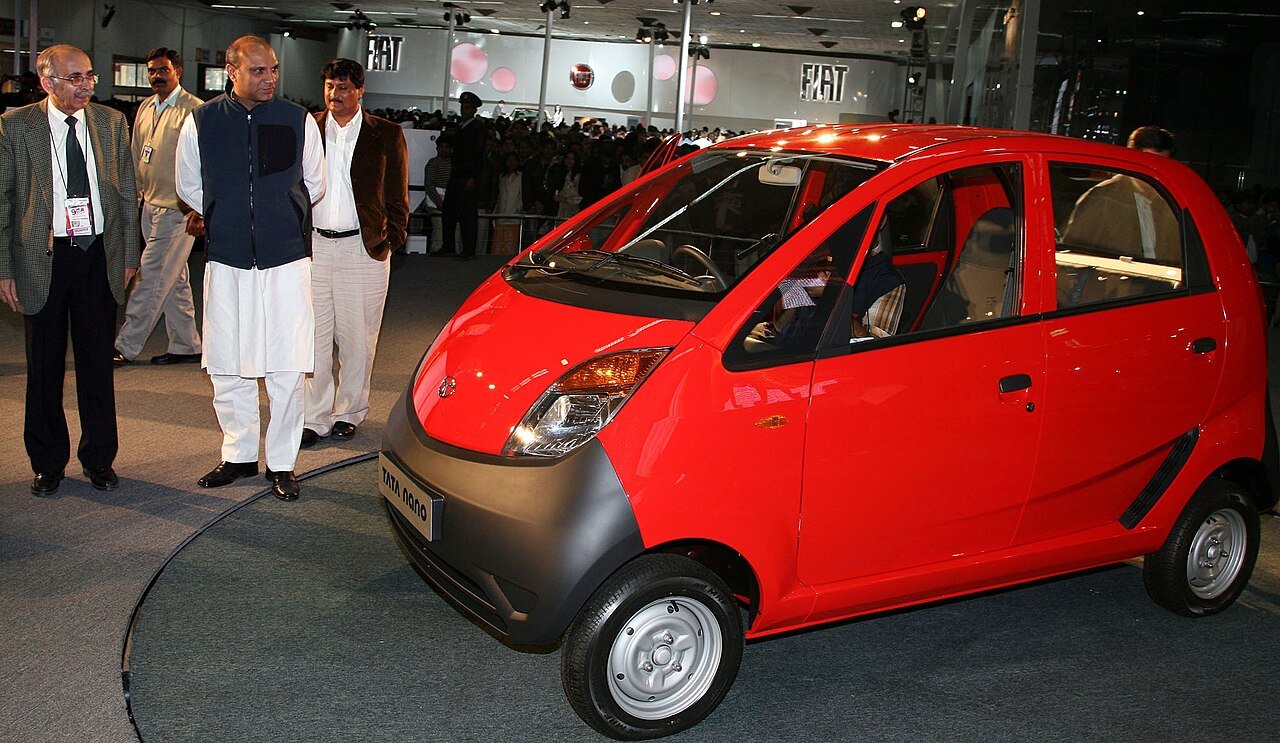
The Nano was shown to the public at the 9th Auto Expo in New Delhi on 10 January 2008. Wagh shared the stage with Ratan Tata and Tata Motors’ managing director Ravi Kant.
Material costs had risen sharply since the project began. Ratan Tata addressed that head on: “Since we started the project four years back, there has been a steep increase in input cost, but a promise is a promise.” The price would stay at ₹1 lakh.
International newspapers and TV channels called it the world’s cheapest car. That phrase gave the Nano huge free publicity. It would later become a problem.
2006–2008: Singur, the Factory That Never Built a Car
A land fight turned an engineering story into a political one.
The Nano’s main plant was to be at Singur, in West Bengal’s Hooghly district. In 2006 the Left Front state government acquired about 997 acres of farmland for it. Many farmers had not agreed to sell. The protests were led by Mamata Banerjee and her Trinamool Congress.
By 2008 the plant was largely built, but protests and blockades made it hard to work. On 3 October 2008, Ratan Tata announced that Tata Motors was leaving Singur, blaming the agitation. Tata said it had spent about ₹1,000 crore on the site.
Several states offered land. Gujarat’s chief minister Narendra Modi famously sent a one-word SMS: “Welcome”. On 7 October 2008, Tata announced the Nano would be built at Sanand, near Ahmedabad.
The dispute did not end there. On 31 August 2016, the Supreme Court ruled that the Singur acquisition was illegal and ordered the land returned to its 9,117 landowners. On 30 October 2023, an arbitral tribunal awarded Tata Motors ₹765.78 crore plus 11% interest from the West Bengal Industrial Development Corporation for its lost investment.
2009: Launch, a Lottery and 2 Lakh Bookings
The price was real, but only for one version.
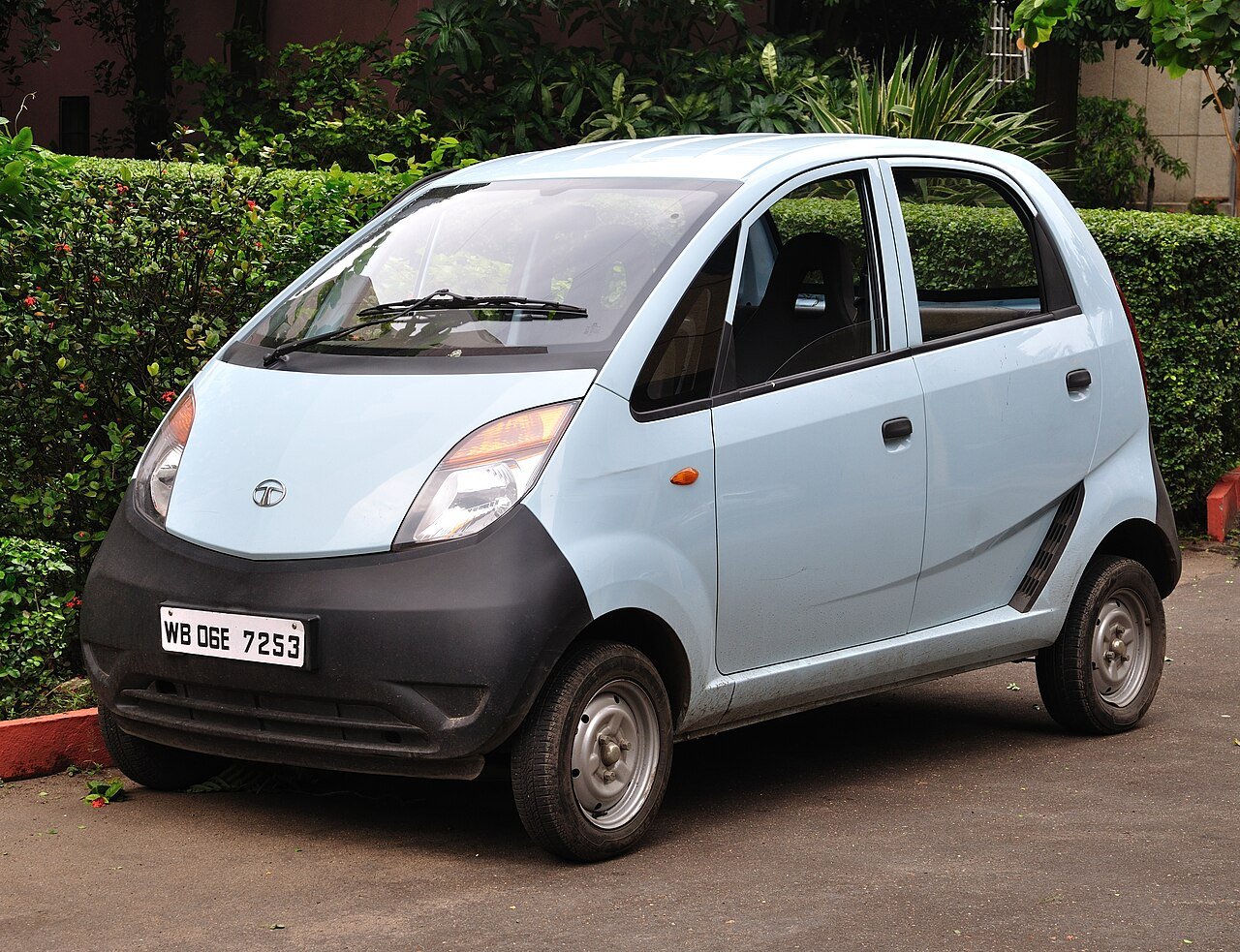
Tata launched the Nano in Mumbai on 23 March 2009. The promised ₹1 lakh applied to the Standard (BS2) model, ex-factory at Pantnagar, before transport charges and VAT. Every other version cost more.
Booking forms were sold from 9 to 25 April 2009 at more than 30,000 outlets in about 1,000 cities. About 2.03 lakh people booked, around 70% with a loan. Because Tata could not build that many cars quickly without Sanand, the first 1 lakh buyers were chosen by a computerised draw.
The first car was delivered on 17 July 2009 in Mumbai. Ratan Tata handed the keys of a silver Nano LX to Ashok Raghunath Vichare.
Tata Nano Launch Prices, March 2009
Ex-showroom Pantnagar, from Tata Motors’ launch announcement.
| Version | Emission level | Price |
|---|---|---|
| Standard | BS2 | ₹1,12,735 (₹1 lakh ex-factory) |
| Standard | BS3 | ₹1,20,960 |
| CX, solid paint | BS2 | ₹1,39,780 |
| CX, metallic paint | BS3 | ₹1,48,725 |
| LX, metallic paint | BS3 | ₹1,70,335 |
2 June 2010: Sanand Opens, Built for 2.5 Lakh Cars a Year
The factory was ready. The buyers were not.
Narendra Modi inaugurated the Sanand plant on 2 June 2010, with Ratan Tata present. It was designed for 2.5 lakh cars a year in phases, and could be expanded to 3.5 lakh.
That capacity was the core of the plan. A car with very thin margins makes money only at very high volume. When demand came in far below plan, the Nano was a loss-maker built in a mostly idle factory.
Sanand did find a future. From 2016 it built the Tiago and Tigor, and Tata Motors later said the plant had reached full capacity. In January 2023, Tata’s electric vehicle arm also completed its purchase of Ford India’s neighbouring Sanand plant.
2010: Fires, the “Cheapest Car” Label and a Trust Problem
A family car has to feel safe before it feels cheap.
In 2010 several Nanos caught fire, and photographs spread fast. Tata Motors said there was no design defect and blamed extra electrical equipment fitted near the exhaust in some cases. It refused a recall, but in December 2010 it extended the warranty from 18 months to four years and added protective changes.
The deeper problem was image. In India a car is often a family’s biggest purchase and a sign of having moved up. The Nano was marketed and reported as the cheapest car in the world. For a scooter owner, that could feel like buying the car that tells neighbours you could not afford a real one.
Ratan Tata said so himself in 2013: “It became termed as the cheapest car by the public and, I am sorry to say, by ourselves, not by me, but the company when it was marketing. I think it was unfortunate.”
Planned vs Real: The Nano in Numbers
From a factory built for 2.5 lakh a year to one car in a month.
2011–2015: The Fixes That Came Late
From “cheapest car” to “smart city car”.
Tata spent the next five years adding what buyers had asked for and changing how it sold the Nano.
The 2012 Nano (late 2011) had a stronger engine, up from 35 bhp to 37 bhp, and better official fuel economy of 25.4 km/l, up from 23.6. Prices ran from about ₹1.40 lakh to ₹1.96 lakh.
The Nano CNG emax (8 October 2013) ran on petrol or compressed natural gas and was rated at 36 km per kg of CNG, which Tata called the most fuel-efficient car in India.
The Nano Twist (January 2014) added electric power steering, at ₹2.36 lakh ex-showroom Delhi. By then the car cost more than twice the famous launch number.
The GenX Nano (19 May 2015) was the biggest change. It had a new front, an openable hatch at last, a 24-litre fuel tank and an “Easy Shift” five-speed automated manual gearbox (AMT). Prices started at ₹1.99 lakh. Tata now sold it as a practical city car for traffic, not as the cheapest car.
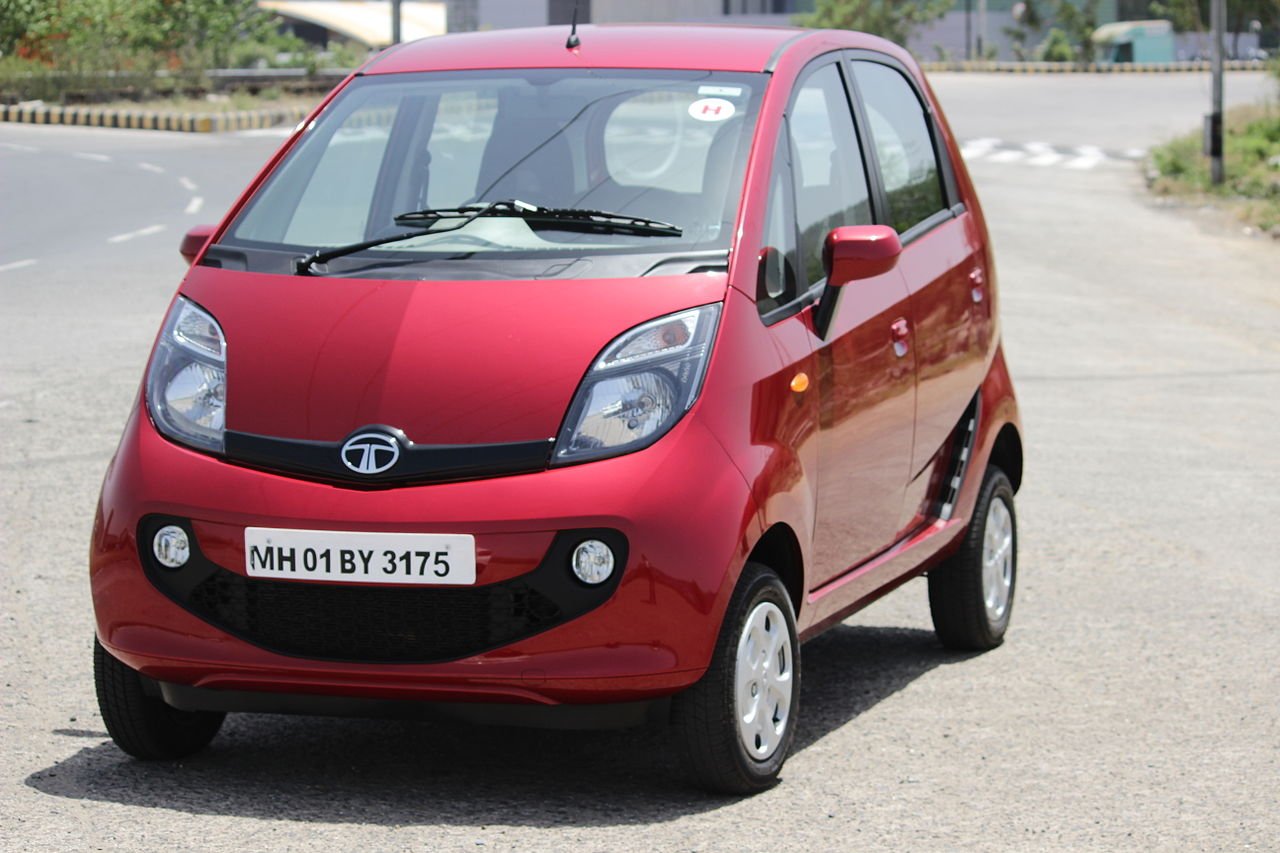
Nano 2009 vs GenX Nano 2015
January 2014: Zero Stars in Global NCAP
The crash test that changed the small-car debate.
In January 2014, Global NCAP published the first independent crash tests of popular Indian small cars. The Nano, tested without airbags at 64 km/h, scored zero stars for adult protection. Global NCAP’s chairman Max Mosley said: “Poor structural integrity and the absence of airbags are putting the lives of Indian consumers at risk.”
The Nano met the Indian rules of its time, and other popular small cars in the same round also scored zero. But the result stuck to the Nano more than to the others, because its whole pitch had been to make families safer than on a scooter. The test also showed the limit of the cost-first idea: as buyers began to expect airbags and stronger body shells, a car designed around the lowest price had the least room to add them.
2016: “Emotional Reasons”
A boardroom fight put the Nano’s losses on the record.
Cyrus Mistry was removed as chairman of Tata Sons in October 2016. In a letter to the board soon after, he wrote that the Nano “has consistently lost money, peaking at Rs. 1,000 crores” and that there was “no line of sight to profitability”. He added: “Emotional reasons alone have kept us away from this crucial decision” to shut it down.
It was the first time a Tata insider had said plainly that the Nano was kept alive by its founder’s attachment to the idea, not by its numbers.
2018–2020: One Car in June
The Nano was never formally retired. It faded out.
In June 2018, Tata Motors made one Nano and sold three in India. The figure made headlines. Tata said the car was now built only against orders. It sold 518 Nanos in calendar 2018, about 43 a month.
In 2019 Tata made no Nanos at all and sold one, in February. Company officials said the car would not be upgraded for the BS-VI emission rules that took effect on 1 April 2020. Tata never held a farewell event. The Nano simply stopped.
Ratan Tata died on 9 October 2024. Many tributes led with the Nano: a car that failed as a business, but that people remembered as an attempt to do something for families who could not afford a car.
Why Did the Tata Nano Fail? Seven Reasons
No single cause. Each one made the others worse.
1. The “cheapest car” label
- The phrase that brought global attention put off buyers who saw a car as a step up. Ratan Tata later called the marketing “unfortunate”.
2. Singur cost it time and scale
- Leaving a nearly finished plant in October 2008 delayed volume production until mid-2010, the year buyer interest was highest.
3. Fires and a zero-star crash test
- The 2010 fires and the 2014 Global NCAP result hurt trust in a car that was sold as safer than a scooter.
4. ₹1 lakh did not last
- Only one version was ever ₹1 lakh ex-factory. With rising costs and new features, the Nano Twist cost ₹2.36 lakh by 2014, close to bigger used and entry-level cars.
5. Too basic for changing tastes
- No AC, power steering or opening boot on the first car. By the time GenX fixed this in 2015, buyers had moved on.
6. Stronger rivals
- Maruti Suzuki’s Alto and other small cars from larger dealer networks offered a more conventional car and better resale value.
7. Finance and resale
- Many scooter buyers needed loans, and the Nano’s weak resale value made both buyers and lenders more cautious.
Legacy: What the Nano Proved
A business failure and an engineering landmark are not the same thing.
The Nano is taught in business schools as a case of frugal engineering and design-to-cost: set the price first, then design every part to meet it. It showed that a working four-seat car could be built for far less than the industry thought possible, and it pushed Indian suppliers to rethink parts.
It also taught a sharper lesson: affordability is not the same as aspiration. People did not only buy a price. They bought safety, status, comfort and resale value. Later small cars in India, such as Tata’s own Tiago built in the same Sanand plant, were sold on features and safety ratings rather than on being the cheapest.
The engineer who led the project, Girish Wagh, rose to become executive director of Tata Motors. And the plant built for the Nano became one of Gujarat’s main car-making sites.
The People Behind the Tata Nano
Ratan Tata
Tata Group chairman who set the ₹1 lakh target and unveiled the car in 2008. Died on 9 October 2024.
Girish Wagh
Led the Nano project from mid-2005 with a team of about 500 engineers. Later executive director of Tata Motors.
Ravi Kant
Tata Motors’ managing director at the 2008 unveiling, on stage with Ratan Tata and Wagh.
Mamata Banerjee
Led the Singur protests. Became West Bengal’s chief minister in 2011.
Narendra Modi
Brought the Nano to Sanand in October 2008 and opened the plant on 2 June 2010.
Cyrus Mistry
Tata Sons chairman 2012–2016. His 2016 letter put the Nano’s peak losses at ₹1,000 crore.
Tata Nano Full Timeline, 2003–2024
Newest first.
Ratan Tata dies
Ratan Tata dies aged 86. Tributes recall the Nano as his most personal project.
Tata wins Singur arbitration
A three-member tribunal awards Tata Motors ₹765.78 crore plus 11% interest from West Bengal’s industrial development corporation for its lost Singur investment.
BS-VI rules take effect
The Nano is not upgraded for the new emission rules, ending any chance of a return.
Zero built, one sold
Tata makes no Nanos all year and sells one, in February.
One Nano in June
Tata makes a single Nano and sells three in India. Calendar-year sales total 518.
Mistry letter and Singur verdict
On 31 August the Supreme Court quashes the Singur acquisition and orders 997 acres returned. In October, ousted chairman Cyrus Mistry writes that the Nano lost up to ₹1,000 crore and was kept for “emotional reasons”.
GenX Nano with AMT
New front, openable hatch, 24-litre tank and an “Easy Shift” AMT. The Nano is repositioned as a city car.
Twist and a zero-star crash test
The Nano Twist adds electric power steering. The same month, Global NCAP rates the Nano zero stars for adult protection.
Nano CNG emax
A petrol-CNG version, which Tata calls India’s most fuel-efficient car.
Peak year
The best year the Nano ever had, helped by the “2012 Nano” update with a stronger engine and better economy.
Sanand opens; fires hit trust
Narendra Modi opens the 2.5-lakh-a-year plant. Fire incidents follow; in December Tata extends the warranty to four years.
First delivery
Ratan Tata hands a silver Nano LX to Ashok Raghunath Vichare.
Launch and bookings
Launched in Mumbai. About 2.03 lakh bookings; the first 1 lakh buyers are picked by computerised draw.
Out of Singur, into Sanand
Tata quits Singur after months of protests, then picks Sanand four days later.
Unveiled at Auto Expo
“A promise is a promise.” Ratan Tata confirms the ₹1 lakh price despite rising costs.
Singur land acquired
West Bengal acquires about 997 acres for the Nano plant. Protests begin.
Girish Wagh takes charge
Wagh is put in charge of the car’s development, with a team that grows to about 500 engineers.
The ₹1 lakh idea
Ratan Tata begins talking about a car for families that ride on two-wheelers, at about ₹1 lakh.
Quiz: How Well Do You Know the Tata Nano?
Tap a question to reveal the answer.
1. When was the Nano unveiled?
2. Where were the first Nanos built?
3. Where was the engine?
4. How many cylinders did the engine have?
5. How were the first 1 lakh buyers chosen?
6. What did the GenX Nano add in 2015?
7. How many Nanos did Tata make in June 2018?
Explore More Timelines
People Also Ask
Frequently Asked Questions
Related AiTimeline Stories
⚠️ Editorial Note
Dates and figures are cross-checked against Tata Motors’ own launch release (23 March 2009), contemporary reports by PTI, Business Standard, Autocar India, Business Today and Rushlane, Global NCAP’s January 2014 results, the Supreme Court’s 2016 Singur judgment as reported, the 2023 arbitral award as reported, and Wikipedia’s articles on the Tata Nano and the Singur controversy. Some widely shared accounts say Singur was the Nano’s first production site, that the Twist launched in 2013, or that production was 2,240 in 2017-18 and 1 in 2018-19. The record shows Pantnagar built the first cars, the Twist launched in January 2014, and one Nano was made in June 2018 with none in 2019, so those claims are not used. This is editorial, AI-assisted content.
Sources & further reading
Every dated entry above was checked against these references. Last reviewed 27 September 2026.
- Tata Motors: Tata Motors keeps its Nano price promise (23 March 2009)
- Tata Motors: The Tata Nano arrives
- Business Standard (PTI): No Tata Nano production since January, only 1 unit sold
- The Tribune: Tata Nano ends 2019 with zero output, sale of 1 unit
- Business Today: Singur case, Tata Motors wins arbitral award of Rs 766 crore plus interest
- SCC Online: Singur land acquired for Tata Motors to be restored to landowners (2016)
- Autocar India: Tata inaugurates Nano mother plant at Sanand
- Global NCAP: India crash test results
- Business Today: When Ratan Tata opened up about the Nano's marketing misfire
- Wikipedia: Tata Nano