Space Elevator History: Could We Really Reach Space?
From Tsiolkovsky's 1895 tower to Obayashi's 2050 plan: how a space elevator would stay up, why the cable is still missing, and every key study.
Latest Story
Imagine stepping into an electric car on the equator and riding a cable straight up, with no launch, no engines and no stage separation, for about a week, until you reach geostationary orbit 35,786 km above Earth. That is the space elevator. The idea began with Konstantin Tsiolkovsky in 1895, took its modern form with Yuri Artsutanov in 1960, was studied by NASA from 1999 and drawn in detail by Japan’s Obayashi in 2012, with a 2050 target. As of 2026 it has still not been built, and the reason is not the physics. It is the cable. This page traces the full space elevator history, explains how it would stay up, and shows exactly how far today’s materials fall short.
💡 Short Answer
A space elevator is a cable anchored on the equator, stretching past geostationary orbit at 35,786 km to a counterweight, held taut by Earth’s rotation. Tsiolkovsky imagined a space tower in 1895 and Artsutanov designed the modern cable in 1960. The physics works, but no material yet exists at the needed scale: an Earth elevator needs a breaking length of about 3,100-8,200 km, and the best bulk fibres manage about 400 km. None has been built.
Space Elevator: Key Questions
The Space Elevator in Ten Lines
- 1895: Tsiolkovsky, inspired by the Eiffel Tower, imagines a tower reaching geostationary height.
- 1960: Artsutanov turns it upside down: hang a cable from geostationary orbit with a counterweight beyond.
- 1966-1975: Isaacs’ Sky-Hook paper and Pearson’s Orbital Tower bring the idea to Western engineering.
- 1979: Clarke’s The Fountains of Paradise makes it famous.
- 1991: Carbon nanotubes arrive, the first material that looks strong enough on paper.
- 1999-2003: NASA studies it; Bradley Edwards designs a self-thickening nanotube ribbon.
- 2009: A laser-powered climber wins $900,000; the tether prize is never won.
- 2012: Obayashi publishes a 96,000 km concept with a 2050 target.
- The gap: An Earth elevator needs ~3,100-8,200 km of breaking length; bulk fibres give about 400 km.
- 2026: None built. A Moon elevator, by contrast, could use materials that exist today.
How Would a Space Elevator Stay Up?
It is not a tower. It is a cable held taut by a spinning planet.
A skyscraper stands on its foundations: every floor pushes down on the one below, and the material has to resist compression. Build high enough and the structure crushes itself. That is why Tsiolkovsky’s 1895 tower could never be built.
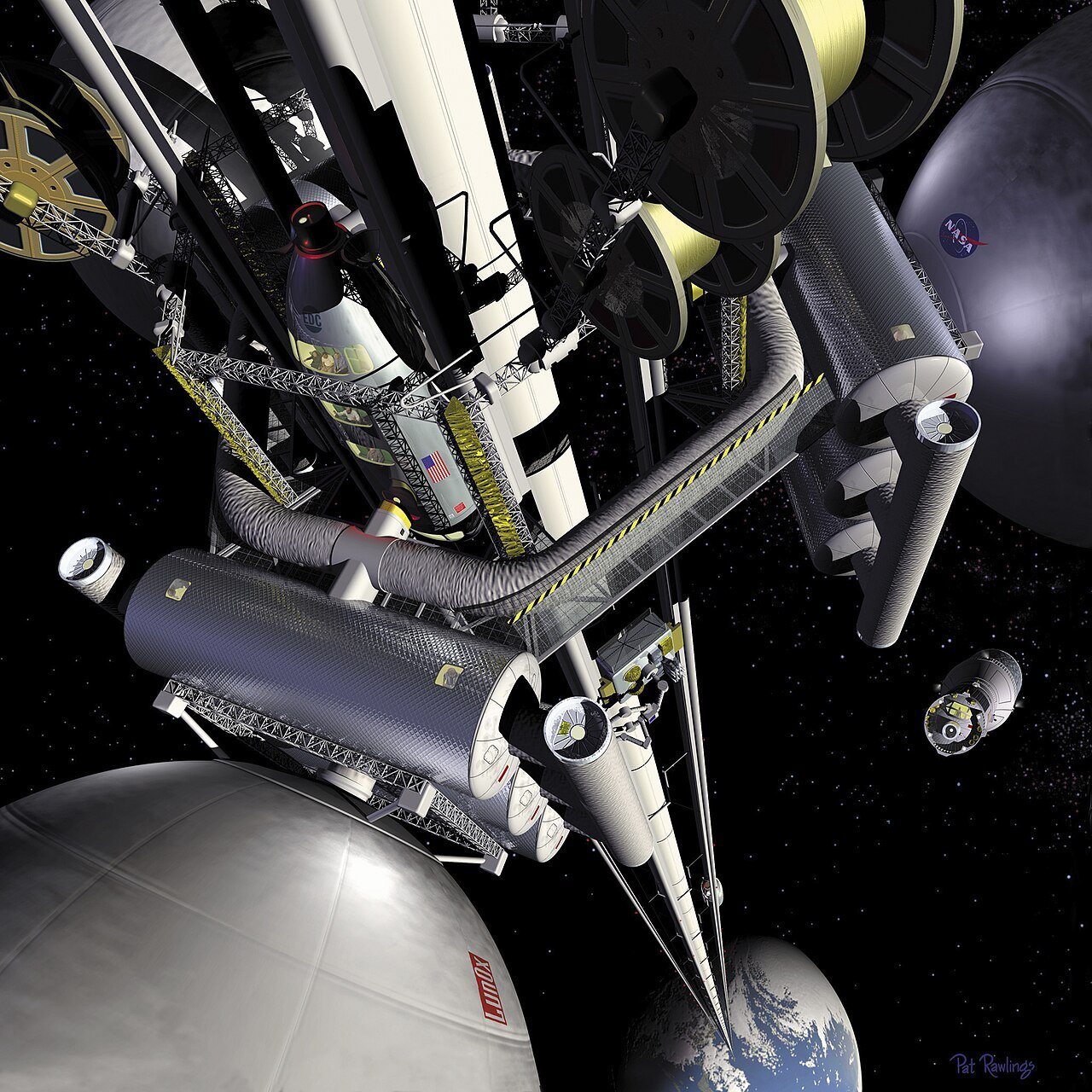
A space elevator works the other way round. It is centred on geostationary orbit (GEO), 35,786 km above the equator, where an object circles Earth once a day and so appears fixed over one spot. A cable runs from an Earth Port on the equator up through GEO and on to a counterweight far beyond.
Below GEO, each piece of cable is moving slower than orbital speed for its height, so gravity pulls it down. Above GEO, each piece is moving faster than orbital speed, so it pulls outward, like a stone on a string being swung. Balance the two and the cable hangs in tension: it is pulled tight from both ends instead of squashed from above. Tension is greatest at GEO, which is why Pearson showed in 1975 that the cable should be thickest there and taper toward both ends.
Why Is the Space Elevator Still on Paper?
Five problems stand between the concept and a construction site. Open each one to see how solved it is.
1. The physics: solved
2. The cable: unsolved, and it decides everything
3. Power for the climbers: partly demonstrated
4. Debris, weather and lightning: manageable on paper
5. Money and law: not started
Physics says maybe → materials say not yet → the cable is the whole question
The Cable Problem, in One Chart
Every other obstacle is engineering. This one is materials science.
A normal cable gets heavier as it gets longer. At some length its own weight snaps it. Engineers call that length the breaking length, and it is the single number that decides whether a space elevator can exist.
For an Earth elevator, the answer is roughly 3,100 to 8,200 km (the higher the figure, the less the cable has to taper). Bradley Edwards’ NASA-funded design assumed a material strength of about 100 gigapascals with very low density. High-strength steel manages about 30 km. Kevlar, Zylon and the best carbon fibre sit around 250-400 km.
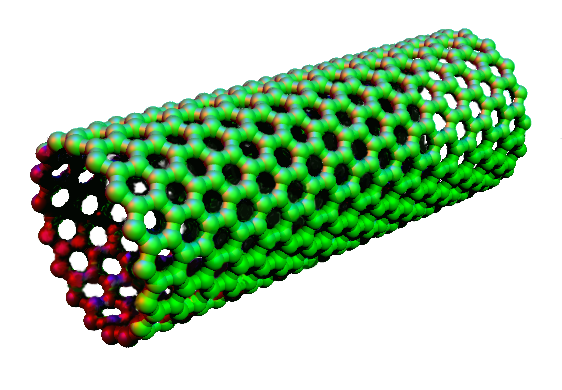
Only two materials reach the zone, and only at microscopic scale: carbon nanotubes and graphene. A single nanotube a few nanometres wide can be astonishingly strong; a rope made from billions of them is limited by the weakest joins and defects, and today’s nanotube yarns fall far short of the target. In 2014 Google X reportedly shelved its own look at the idea after finding no one could make a perfect nanotube strand longer than about a metre.
That is the real state of the problem. The challenge is not “can carbon nanotubes be strong?” It is “can anyone manufacture a metre, then a kilometre, then tens of thousands of kilometres of them, with no flaw anywhere?” As of 2026 the answer is no.
Build your own space elevator
Make five engineering choices and see how your elevator scores on physics, materials, safety and construction. The scoring is a simplified teaching model based on the NASA and Obayashi studies, not an engineering calculation.
Pick your options above.
Space Elevator History: The Full Timeline, 1895 to 2026
Newest first. Proposals, studies and experiments, not construction.
Still on paper, still debated
No space elevator exists or is under construction. The International Space Elevator Consortium holds its 2026 conference online on 12-13 September. In late August its president, Peter Swan, tells reporters that polycrystalline graphene may be the long-sought tether material. That is the consortium’s view; no tether-scale graphene has been independently shown to meet the requirement.
A Moon elevator with today’s materials
Cambridge and Columbia astronomers Zephyr Penoyre and Emily Sandford publish The Spaceline, arguing that a cable hanging from the Moon toward Earth could be made from Zylon, a fibre that is already mass-produced. The Moon’s weak gravity and slow rotation remove the materials problem that blocks an Earth elevator.
The IAA’s second verdict
The Academy’s study Road to the Space Elevator Era says the concept remains feasible and flags single-crystal graphene as a possible material stronger for its weight than carbon nanotubes.
A mini elevator in orbit
Japan’s STARS-Me reaches the ISS on the HTV-7 cargo ship and is released in October: two 10 cm cubesats joined by a 10 m tether, with a small motorised “car” designed to move along it. It was billed as the first test of movement along a cable in space.
Carbon nanotubes go to the ISS
Obayashi and partners mount carbon nanotube samples on the ISS’s ExHAM exposure platform outside Japan’s Kibo module, to see how the material survives radiation, atomic oxygen and temperature swings.
Google X walks away
Google’s research lab reportedly puts a space elevator study into “deep freeze” after finding that no one could make a perfect carbon nanotube strand longer than about a metre.
IAA: the cable decides
An international feasibility assessment concludes the space elevator is plausible but the tether material is the critical technology, and projects about 20 years of work to reach the needed strength.
Obayashi draws a 2050 elevator
Japanese construction firm Obayashi publishes a concept: a 96,000 km carbon nanotube cable, a station at 36,000 km, and climbers carrying 30 people at 200 km/h, reaching it in about 7.5 days. Target: 2050. Its current version specifies 100-tonne climbers, a 12,500-tonne counterweight and a 400 m floating Earth Port.
A laser-powered climb wins $900,000
LaserMotive drives a 4.8 kg climber up a 900 m cable hung from a helicopter using only a ground-based laser, averaging about 13 km/h. It is the only team to reach the top and wins $900,000, the competition’s first cash prize.
The Space Elevator Games
The Elevator:2010 competitions offer prizes for power-beamed climbers and ever-stronger tethers, with $500,000 per category by 2007. The climbers make progress; the tether prize is never won.
Bradley Edwards: the ribbon that builds itself
Physicist Bradley Edwards, funded by NIAC, designs a paper-thin carbon nanotube ribbon instead of a round cable. A spacecraft would lower a light seed ribbon from orbit; once anchored, 207 robotic climbers would each add material, thickening it into a cable that can lift 20-tonne loads. He assumes a material strength of about 100 GPa. His book with Eric Westling follows in 2003.
NASA’s report: at least 50 years
NASA Marshall’s 1999 workshop in Huntsville leads to David Smitherman‘s report Space Elevators: An Advanced Earth-Space Infrastructure for the New Millennium. It treats the elevator as serious infrastructure but concludes it could not be built for at least another 50 years.
Carbon nanotubes arrive
Sumio Iijima‘s paper in Nature sets off research into carbon nanotubes, rolled sheets of carbon atoms with extraordinary strength for their weight. For the first time, a real material looks strong enough, at least on paper and at the nanometre scale.
The Fountains of Paradise
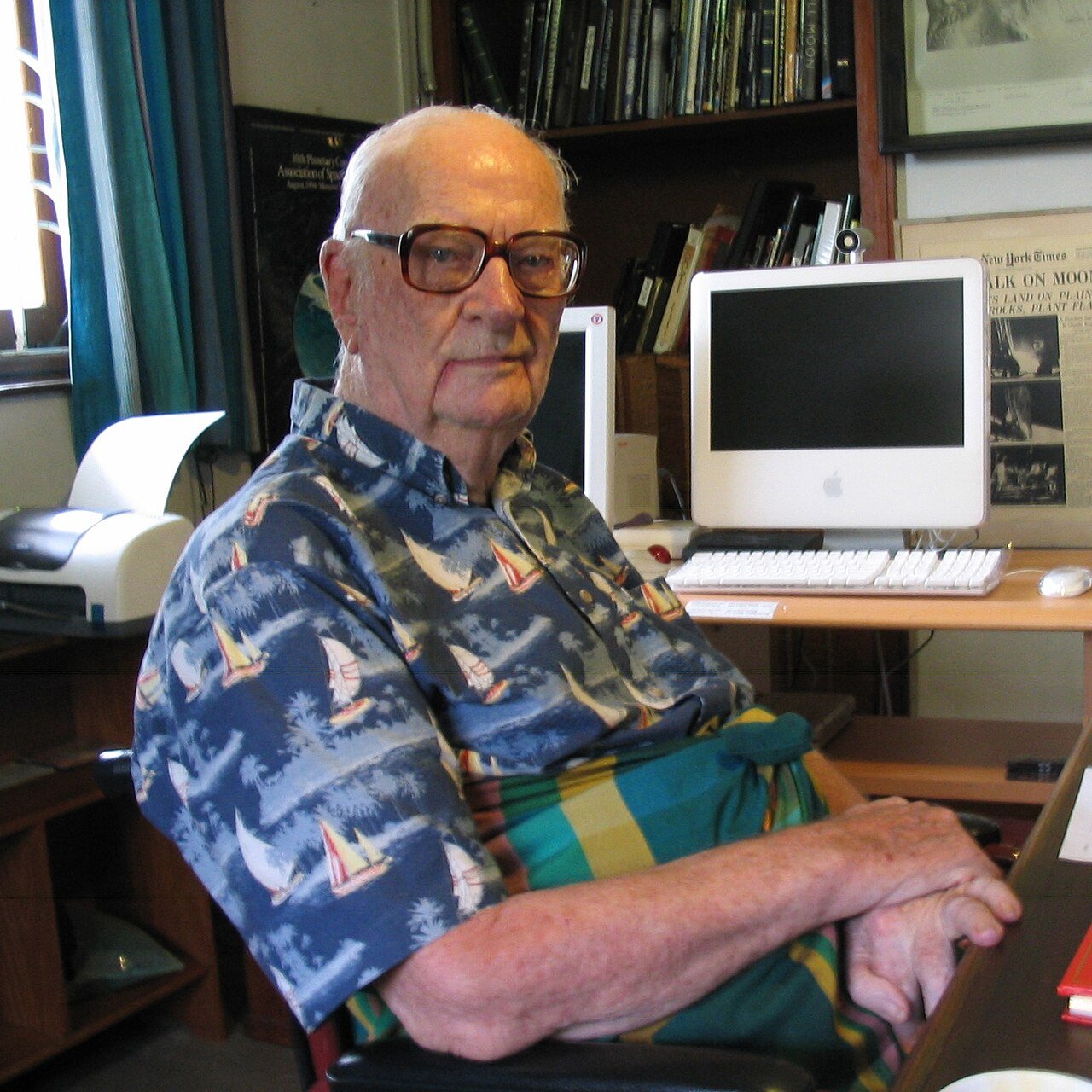
Arthur C. Clarke‘s novel puts a space elevator on a mountain in a fictional Sri Lanka. The same year Charles Sheffield’s The Web Between the Worlds uses the same idea. The concept reaches a mass audience, still waiting on a material that does not exist.
The skyhook variant
Roboticist Hans Moravec describes a non-synchronous rotating skyhook, a spinning tether in orbit that is not anchored to the ground. Tether concepts start to branch.
The Orbital Tower
US Air Force engineer Jerome Pearson, working independently of Artsutanov, publishes the first detailed Western engineering analysis. He shows the cable must taper, thickest at geostationary altitude, and extends it to about 144,000 km so the outer cable acts as the counterweight.
The Sky-Hook
Oceanographer John Isaacs and colleagues publish Satellite Elongation into a True “Sky-Hook” in Science, independently arriving at a cable hanging from a geostationary satellite.
To space by electric train
Leningrad engineer Yuri Artsutanov proposes building from the top down: lower a cable from a satellite in geostationary orbit to the ground while extending a counterweight outward. This is the modern space elevator, and it pulls, rather than pushes.
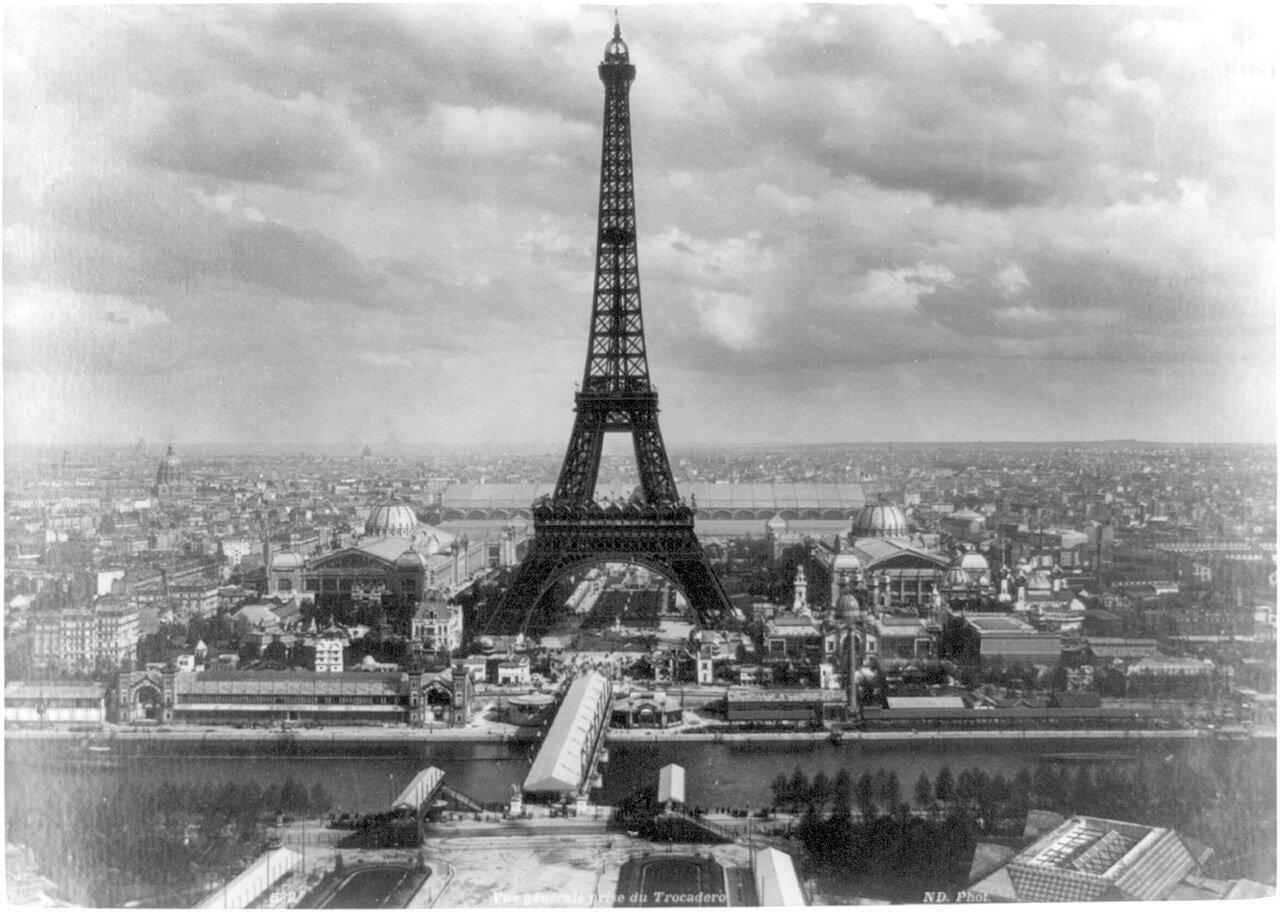
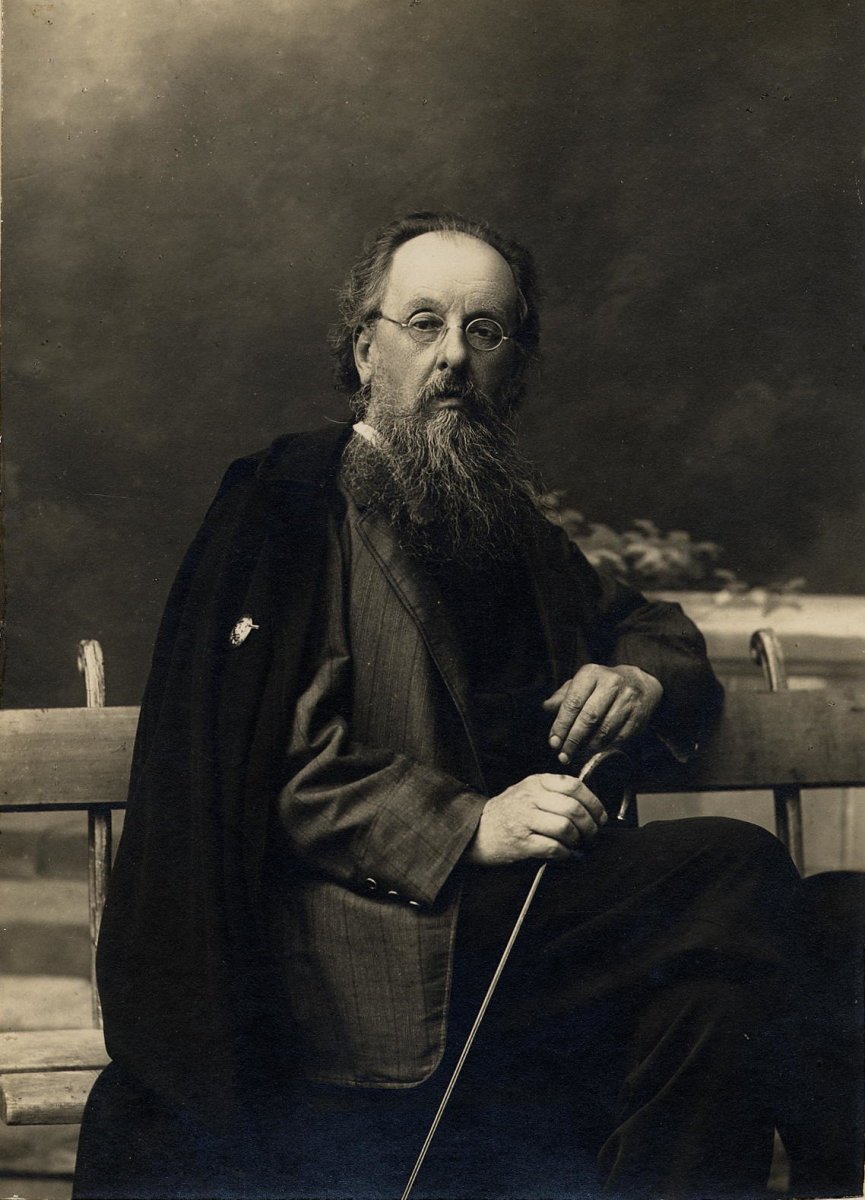
Tsiolkovsky’s tower
Inspired by the new Eiffel Tower in Paris, Konstantin Tsiolkovsky imagines a tower so tall that at its top, at geostationary height, objects would float. As a free-standing tower it is impossible, but the idea of a fixed structure into space is born.
The Space Elevator Timeline at a Glance
| Year | Milestone | Why it matters |
|---|---|---|
| 1895 | Tsiolkovsky’s space tower | First fixed structure into space |
| 1960 | Artsutanov’s cable from GEO | Tension replaces compression |
| 1966 | Isaacs et al., Sky-Hook, Science | Idea reaches Western science |
| 1975 | Pearson, The Orbital Tower | Tapered cable, 144,000 km length |
| 1979 | The Fountains of Paradise | Clarke makes it famous |
| 1991 | Iijima’s carbon nanotube paper | First plausible cable material |
| 1999-2000 | NASA Marshall workshop and report | “At least 50 years” away |
| 2000-2003 | Edwards’ NIAC ribbon design | Self-building elevator concept |
| 2005-2009 | Space Elevator Games | Climber prize won; tether prize not |
| 2012 | Obayashi concept | 96,000 km cable, 2050 target |
| 2015 | Nanotubes exposed on the ISS | Tests survival in space |
| 2018 | STARS-Me tether test | First climber-on-tether test in orbit |
| 2019 | Spaceline paper | Moon elevator possible with Zylon |
| 2026 | No elevator built | Cable material still missing |
| 2050 | Obayashi target | A goal, not a confirmed date |
Obayashi’s 2050 Space Elevator, in Numbers
The most detailed corporate plan, and its own caveat.
| Element | Obayashi concept |
|---|---|
| Cable | 96,000 km, carbon nanotube |
| Geostationary station | 36,000 km |
| Counterweight | 12,500 tonnes |
| Climbers | 100 tonnes (2012 version: 30 people at 200 km/h) |
| Trip to the GEO station | About 7.5 days (2012 version) |
| Earth Port | Floating, 400 m across, on the equator |
| Construction | About 20 years; cable thickened by climbers ~510 times |
| Target | 2050 |
| Cost estimate | None published |
Obayashi Corporation, Space Elevator Construction Concept
What Could Go Wrong?
Even with a perfect cable, five hard problems remain.
Space debris. A rocket crosses the crowded low orbits in minutes. An elevator would sit through every altitude, permanently, in the path of thousands of satellites and fragments. It cannot dodge, so designs rely on tracking and on moving the ocean platform to swing the cable clear. NASA’s studies list collision avoidance as a critical technology.
Weather and lightning. The lowest 20 km face wind, storms and lightning. That is one reason concepts favour an equatorial ocean site away from hurricane tracks, on a platform that can move.
Coriolis forces. A climber going up must gain sideways speed to keep pace with the rotating cable. It borrows that speed from the tether, pulling it slightly westward and setting it swaying. Climb too fast and the swing grows; control systems would have to manage it.
A broken cable. Where it snaps matters. A break low down lets the upper cable, no longer held, swing outward into a higher path. A break high up drops the lower section back toward Earth, where much of it would burn up or wrap around the planet. Designs call for redundancy, monitoring and repair climbers.
Radiation and atomic oxygen. The cable crosses the Van Allen radiation belts, and in low orbit atomic oxygen erodes many materials. That is what the nanotube samples Obayashi put on the ISS from 2015 were testing.
Space Elevator vs Rocket
| Rocket | Space elevator | |
|---|---|---|
| How it works | Burns propellant | Electric climber on a cable |
| Time to reach GEO | Hours | About a week at 200 km/h |
| Ride | Violent acceleration | Gentle climb, falling weight |
| Infrastructure | Vehicle and launch pad | Permanent cable and stations |
| Orbits served | Any, including polar | Only the equatorial plane |
| Main challenge | Cost and reuse | A cable material that does not exist |
| Status in 2026 | Operational | Concept and small experiments |
An elevator would not replace rockets. Polar orbits, fast launches and missions away from the equatorial plane would still need them. Its promise is cost: once built, sending cargo up would be a matter of electricity, not a new launch for every payload. A payload released high enough up the rotating cable, above about 47,000 km, would even be flung free of Earth, which is why Obayashi describes its design as a gateway toward the Moon and Mars.
The Twist: A Moon Elevator Could Be Built Now
The Moon’s gravity is one-sixth of Earth’s, and it turns once a month instead of once a day. Those two facts shrink the materials problem dramatically. In 2019 Zephyr Penoyre and Emily Sandford proposed the Spaceline, a cable anchored on the Moon and hanging toward Earth, ending deep in Earth’s gravity well near geostationary altitude. Their conclusion: Zylon, a polymer fibre already in mass production, would be strong enough. Earlier lunar tether studies for NASA’s advanced-concepts institute reached similar conclusions. It would still be a colossal project, but it would not need a material that has not been invented.
🤔 Did You Know?
- Artsutanov‘s 1960 article was titled, roughly, “Into space by electric locomotive”.
- Pearson worked without knowing of Artsutanov’s article, which was little known outside the USSR; both are credited as independent inventors.
- Clarke set his fictional elevator on a sacred mountain modelled on Sri Pada in Sri Lanka, where he lived for decades.
- The winning 2009 climb covered 900 m. Geostationary orbit is about 40,000 times farther.
- At the GEO station, riders would feel weightless, even though they would be standing still relative to Earth.
Quiz: How Much Do You Know About Space Elevators?
Tap a question to reveal the answer.
1. Where would the Earth Port ideally be?
2. How high is geostationary orbit?
3. What keeps the cable taut?
4. Who first proposed hanging the cable from geostationary orbit?
5. What has a real space elevator competition actually paid out for?
Explore More Timelines
People Also Ask
Frequently Asked Questions
Related AiTimeline Stories
⚠️ Editorial Note
Checked against Obayashi’s Space Elevator Construction Concept, NASA’s technical reports, Wikipedia’s space elevator and specific-strength entries, Space.com, NBC News and the Spaceline paper on arXiv. Several points in circulating summaries were corrected: Tsiolkovsky’s space tower dates to 1895, not 1896; a claimed 1963 Clarke milestone could not be verified and is left out; Obayashi’s 2050 date is a concept target that the company says current technology cannot yet meet. The 1966 Sky-Hook paper, Moravec’s skyhook, the 2000 NASA report, the Space Elevator Games and LaserMotive’s 2009 prize, Google X’s 2014 retreat, STARS-Me and the lunar Spaceline were added. Breaking lengths are for ideal materials under 1 g and are for comparison only. Claims about new materials in 2026 are attributed to the organisations making them. This is editorial, AI-assisted content.
Sources & further reading
Every dated entry above was checked against these references. Last reviewed 28 September 2026.
- Obayashi Corporation: The Space Elevator Construction Concept
- NASA Technical Reports Server: Critical Technologies for the Development of Future Space Elevator Systems
- NASA Goddard Engineering Colloquium: Bradley Edwards, The Space Elevator (2003)
- Wikipedia: Space elevator
- Wikipedia: Specific strength
- Space.com: Seattle Team Wins $900,000 in Space Elevator Contest
- Space.com: Going Up? Waiting for the Space Elevator (STARS-Me)
- arXiv: Penoyre and Sandford, The Spaceline (2019)
- Scientific American: Space Elevators Are Less Sci-Fi Than You Think
- International Space Elevator Consortium