US–Iran Tensions & Strait of Hormuz Timeline (1953–2026): Conflict, Oil and the World’s Most Critical Chokepoint
US-Iran Strait of Hormuz crisis, Sept 2026: Larak Island strike, Iran's missile reply in Jordan, restricted tanker traffic and Brent oil above $90.
Latest Story
Every day, tankers carrying a fifth of the world’s oil thread through a channel narrower than the distance many people drive to work. For most of us, the Strait of Hormuz is just a name on a map between Iran and Oman. Yet decisions made in its waters ripple outward into fuel prices, inflation, shipping costs, airfares and stock markets from Mumbai to Munich. This US–Iran and Strait of Hormuz timeline traces more than seventy years of history in reverse chronological order — from the renewed strikes and the return of $90 oil in September 2026 back to the 1953 coup that set two nations on a collision course. It draws on the United Nations, the U.S. Energy Information Administration, the International Energy Agency, the International Maritime Organization and established reporting, and it carefully separates verified events, official positions and clearly labelled editorial analysis. Where events are still unfolding or disputed, they are marked as such.
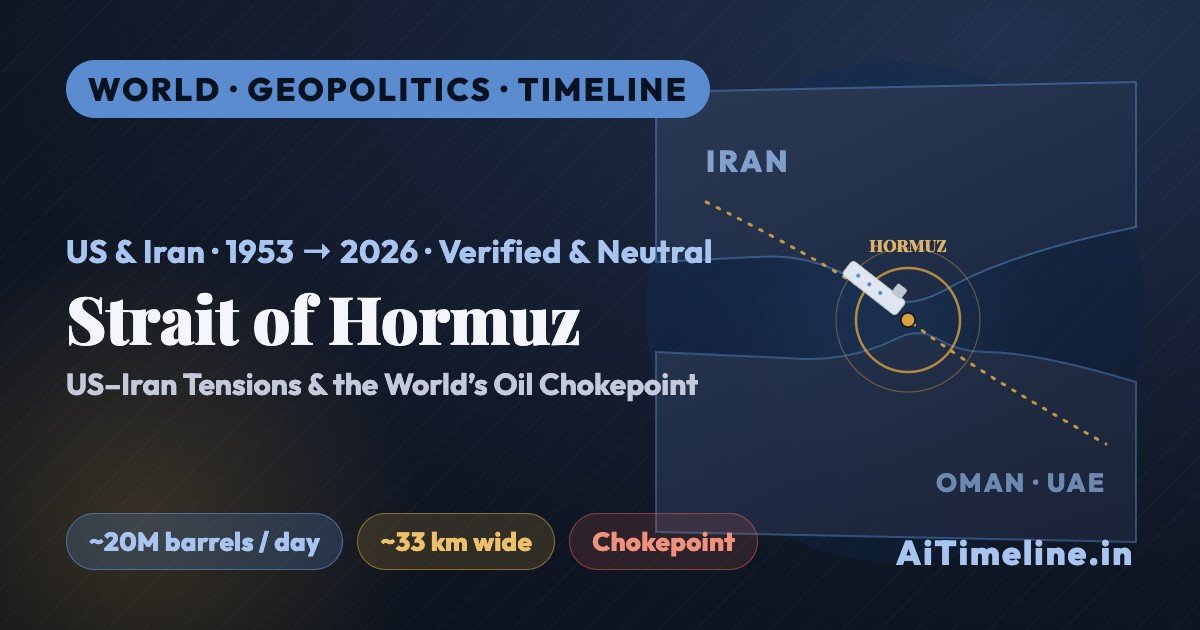
After more than a month without direct US–Iran strikes, fighting has resumed around the Strait of Hormuz. US forces struck two Iranian launchers on Larak Island on 30 August, saying they threatened navigation. Iran then said it retaliated with ballistic missiles against US bases in Jordan. Brent crude settled above $90 a barrel on 31 August and rose further on 1 September as shipping through Hormuz stayed severely disrupted — preliminary Kpler tracking data reported by Reuters recorded only five commodity-vessel transits on Monday, with no liquid tankers among them, and two Saudi crude supertankers were hit by unidentified projectiles.
Why it matters: The escalation came only days after Iran and Oman discussed a temporary shipping corridor and a joint mine-clearing framework, raising hopes that one of the world’s most important energy chokepoints might gradually reopen. Those hopes have now suffered a major setback. This is a fast-moving story reported by news agencies; battlefield, casualty and interception claims by any party are treated here as claims until independently confirmed.
🕑 The False Dawn — how five days turned from diplomacy back to war
For a few days in late August the Strait of Hormuz appeared to be moving toward reopening. Then the missiles started flying again.
- 24 AugUS Treasury launches “Economic D-Day” — Operation Economic Outcast — sanctioning more than 60 entities, individuals and vessels tied to Iran.
- 25 AugPresident Trump says US forces have cleared mines from the international shipping lane through Hormuz.
- 25 AugIran and Oman discuss a phased framework for a temporary navigational corridor and joint mine clearance. Oil prices fall as reopening hopes grow.
- 30 AugUS strikes two Iranian launchers on Larak Island, inside the strait — the first known US strike on Iranian territory since July.
- 31 AugIran says it fired ballistic missiles at the King Hussein and Al Azraq bases in Jordan. Brent settles at $90.49 after touching $91.52.
- 1 SepOnly five commodity-vessel transits recorded through the strait on Monday; two Saudi supertankers hit by unidentified projectiles; oil climbs further.
🌍 The Strait of Hormuz in 60 Seconds — AI Overview
The Strait of Hormuz is a narrow sea passage linking the Persian Gulf to the Gulf of Oman and the open ocean. At its narrowest it is only about 33 km (21 miles) wide, with shipping lanes just a few kilometres across. It is the single most important oil chokepoint on Earth: in 2024 roughly 20 million barrels of oil a day — about a fifth of world consumption and a quarter of seaborne oil trade — passed through it, along with about a fifth of global liquefied natural gas (LNG), mostly from Qatar.
Because Iran sits along the strait’s northern shore, tension between the United States and Iran repeatedly raises fears the waterway could be disrupted. Doing so would lift energy prices worldwide and hit big importers in Asia — especially China, India, Japan and South Korea — hardest. That is why a channel most people never see can move the price of petrol everywhere.
Strait of Hormuz: Key Questions
Key Takeaways
- The Strait of Hormuz is the world’s most critical oil chokepoint: about a fifth of global oil and LNG normally pass through a channel only ~33 km wide.
- US–Iran hostility traces back to the 1953 coup and the 1979 revolution and hostage crisis, hardening over nuclear disputes, sanctions and regional conflicts.
- The strait has been a flashpoint before — the 1980s Tanker War, the 1988 clashes, repeated closure threats, and tanker attacks in 2019 — but was never fully closed.
- In 2025 the confrontation escalated sharply with a brief Israel–Iran war and US strikes on Iranian nuclear sites; in 2026 it escalated again into a sustained shipping crisis.
- After a month-long pause, direct US–Iran strikes resumed in late August 2026: a US strike on launchers on Larak Island on 30 August, an Iranian missile response against US bases in Jordan on 31 August, and Brent crude back above $90.
- The escalation followed days of diplomacy — a US mine-clearance claim and Iran–Oman corridor talks — showing how fast the chokepoint can swing from negotiation back to military risk.
- Most legal scholars hold that fully closing the strait would breach international law; big Asian economies — China, India, Japan and South Korea — would feel any disruption most.
- The editorial thesis of this page: Hormuz does not have to be completely closed to shock the global oil market; it only has to become too dangerous for normal shipping.
- This page separates verified events from contested wartime claims and does not predict how the current crisis will end.
The Strait of Hormuz, Explained
Why a channel most people never see can move the price of energy everywhere — and what international law actually says.
Picture a funnel. On one side sits the Persian Gulf, ringed by some of the largest oil and gas producers on Earth — Saudi Arabia, Iran, Iraq, Kuwait, the United Arab Emirates and Qatar. On the other side lies the open ocean and the world’s buyers. Between them is the Strait of Hormuz, a dog-legged passage roughly 160 km long that pinches to about 33 km at its narrowest, with inbound and outbound shipping lanes each only a couple of kilometres wide. Nearly everything the Gulf sells to the world has to pass through it.
Why it is called a chokepoint
A chokepoint is a narrow passage that a large share of trade must use, with few practical alternatives. Some pipelines can bypass Hormuz — Saudi Arabia’s East–West line and a UAE pipeline to Fujairah — but together they can carry only a fraction of normal flows. That is why the U.S. Energy Information Administration calls Hormuz “the world’s most important oil transit chokepoint.” When traffic there is threatened, buyers cannot simply reroute; they compete for scarcer supply, and prices rise.
Can Iran legally close it?
The short answer most legal scholars give is no. The strait is an international waterway, and under the 1982 UN Convention on the Law of the Sea (UNCLOS) ships and aircraft enjoy the right of transit passage that a coastal state may not suspend. Iran has signed but not ratified UNCLOS and argues the rules apply differently to non-parties, and it controls the strait’s northern shore and key islands. In practice, then, the debate is less about a lawful “closure” and more about whether Iran can physically deter or endanger shipping — through mines, fast boats, missiles or seizures — and at what cost to itself, since roughly half the oil that transits Hormuz also underpins Iran’s own neighbours and customers.
Who would a disruption hurt most?
Not, mainly, the United States, which imports little Gulf oil today. The biggest exposure is in Asia. China is the largest single buyer of crude that crosses Hormuz; India, Japan and South Korea depend heavily on it too, and Japan and South Korea are especially reliant on Qatari LNG. Europe feels it through global prices more than direct barrels. Because oil is priced on a world market, though, a shock at Hormuz raises pump prices and freight costs almost everywhere — which is why a distant strait shows up in household bills, airfares and inflation figures far from the Gulf.
Defining Moments
Six turning points that shaped the US–Iran relationship and the strait’s strategic weight. Ordering reflects editorial judgement of long-term significance, not a ranking of importance.
Turning point
Root cause
Naval flashpoint
Diplomacy
Escalation
Ongoing
Key Events at a Glance
A compact reference of pivotal moments, from the 1953 coup to the 2026 crisis. Full detail follows in the timeline below.
| Year | Event | Why it mattered |
|---|---|---|
| 1953 | Coup topples PM Mossadegh | Seeded lasting Iranian distrust of the US and UK |
| 1979 | Islamic Revolution; embassy hostage crisis | Broke US–Iran ties; began enduring hostility |
| 1980–88 | Iran–Iraq War & Tanker War | First direct US–Iran naval clashes in the Gulf |
| 1988 | Operation Praying Mantis; Iran Air 655 | Largest US surface battle since WWII; tragedy |
| 2002–03 | “Axis of Evil”; nuclear sites revealed | Nuclear file becomes central dispute |
| 2015 | JCPOA nuclear deal signed | Sanctions eased in exchange for limits |
| 2018 | US exits JCPOA; “maximum pressure” | Sanctions return; tensions climb again |
| 2019 | Gulf tanker attacks; US drone downed | Hormuz becomes a live flashpoint |
| 2020 | US kills Gen. Soleimani; Iran retaliates | Nearest to open war at the time |
| 2025 | Israel–Iran war; US strikes nuclear sites | Direct US attack on Iranian facilities |
| Feb–Jul 2026 | Renewed war; Hormuz shipping crisis | Largest strait disruption in modern oil-market history |
| 24–25 Aug 2026 | “Economic D-Day” sanctions; US demining claim; Iran–Oman corridor talks | Brief window when reopening looked possible; oil fell |
| 30–31 Aug 2026 | US strikes Larak Island; Iran says it hit US bases in Jordan | Direct US–Iran strikes resume; Brent back above $90 |
| 1 Sep 2026 | ~5 recorded commodity transits; two Saudi tankers hit | Shipping a fraction of normal; oil climbs further |
US–Iran & Strait of Hormuz Timeline (2026 → 1953)
Reverse chronological — the most recent developments first. Each entry notes what happened, why, and its impact. Tags mark whether an entry is verified history, editorial analysis, or a developing, still-contested situation.
1 September 2026: Hormuz traffic falls to five recorded transits; Saudi tankers hit
Preliminary Kpler tracking data reported by Reuters showed only five commodity vessels transited the strait on Monday — four entering, one exiting — against a recent 10-day average of about 14. No liquid tankers were among the recorded transits. Separately, Reuters reported that two supertankers carrying Saudi crude, the Sidr and the Senegal Prosperity, each loaded with roughly two million barrels, were struck by unidentified projectiles while leaving Hormuz; crews were reported safe. Brent crude rose further on the day amid the renewed fighting and Trump’s threats of additional strikes.
31 August 2026: Iran says it struck US bases in Jordan
Iran’s Islamic Revolutionary Guard Corps said it had launched ballistic missiles at the King Hussein and Al Azraq US bases and facilities in Jordan, in response to the Larak Island strike. The Iranian claim of hits and damage is attributed to Iran; independent Jordanian and US accounts of what was struck, and any interception or casualty figures, should be treated separately and are not established here. President Trump threatened a further response. Brent crude settled at $90.49 a barrel, up about 2.7%, after an intraday high of $91.52; WTI settled at $85.76, up about 2.8%.
30 August 2026: US strikes Iranian launchers on Larak Island
US forces struck two Iranian launchers on Larak Island, inside the Strait of Hormuz near Qeshm and Bandar Abbas. Reuters reported it was the first known US strike on Iranian territory since July. US officials described the action as limited and precise and linked it to an imminent threat to navigation; the assertion that Iranian forces intended to lay mines is a US military and government justification, not an independently established fact. The strike ended a month-long pause in direct US–Iran exchanges.
28–30 August 2026: Trump turns to Venezuelan oil for the SPR
President Trump announced a major US–Venezuela oil arrangement and later said Venezuelan crude would be used to replenish the US Strategic Petroleum Reserve. Reporting describes a complex plan involving around 17 Venezuelan oilfields, large reserves and private-operator and potential US participation — not a simple transfer of oil. Reuters noted its near-term ability to add supply is uncertain: the arrangement needs investment, infrastructure and higher production, and faces legal and commercial questions. Late-August DOE data put the SPR near 286.6 million barrels, its lowest level since about 1982.
25 August 2026: Iran and Oman discuss a temporary Hormuz corridor; US claims demining
Oman’s Foreign Minister, Sayyid Badr Albusaidi, met Iranian Foreign Minister Abbas Araghchi in Tehran. Their joint statement discussed a phased framework for safer navigation — a joint temporary navigational corridor, a joint mine-clearance project, and technical talks toward a permanent route, traffic management, information sharing and navigational and security services. It was a proposal under negotiation, not a completed agreement, and by 1 September it had not restored normal shipping. Separately, President Trump said US forces had cleared mines from the international-water route through Hormuz; Reuters reported oil flows still ran far below pre-conflict levels. Oil prices fell as reopening hopes grew.
24 August 2026: Washington launches “Economic D-Day”
The US Treasury formally launched Operation Economic Outcast, described by Treasury Secretary Scott Bessent as an economic offensive against Iran. Treasury sanctioned more than 60 entities, individuals and vessels linked to Iranian oil revenue, military and missile or nuclear-related procurement, cyber operations and other networks. Reuters reported that Washington also threatened much broader secondary sanctions while initially giving countries an opportunity to change their dealings with Iran — a threat of future measures, not an immediate blanket penalty on every buyer of Iranian oil. Iranian officials, among them Mohsen Rezaei, warned against cooperating with the pressure and threatened retaliation affecting regional oil flows; a threat is not an implemented policy.
July 2026: Threat level “severe” as US resumes strikes
Through early July, projectiles and missiles struck several tankers near the strait, including a Qatari LNG carrier and Saudi and UAE-owned vessels, killing crew and prompting the Joint Maritime Information Center to raise the threat level to “severe.” After a fragile truce collapsed, the United States notified Congress it had resumed “limited” military action and said it would reinstate a naval blockade of Iranian ports; Iran said it had struck two tankers. Oil prices jumped about 9%. Casualty counts and competing claims from each side remain unverified and are reported here as claims.
June 2026: Ceasefire signed, then unravels
In mid-June, US President Donald Trump and Iranian President Masoud Pezeshkian were reported to have signed a memorandum of understanding aimed at ending the war and reopening the strait, opening a negotiating window. Within days the arrangement frayed: Iran again announced restrictions on passage, fresh vessel attacks were reported, and CENTCOM said it carried out retaliatory strikes on Iranian military targets. The episode showed how quickly diplomacy and escalation were alternating.
May 2026: Iran sets up a “Strait Authority”; seizures continue
Iran announced a new Persian Gulf Strait Authority to regulate maritime transit — effectively asserting control over who may pass and by which route — and continued seizing vessels. Several ships were reported hit or boarded, and Iran insisted traffic use a northern lane closer to its coast rather than the traditional central channel. The United States and Gulf states rejected any Iranian right to license shipping through an international strait.
April 2026: US naval blockade; talks in Islamabad fail
A brief early-April ceasefire meant to reopen the strait gave way to renewed confrontation. US Navy destroyers entered the strait for the first time since the war began to help clear mines, but talks between US and Iranian officials in Islamabad broke down. Washington then declared a naval blockade of Iranian ports; Iran responded by again declaring the strait closed and targeting some vessels despite prior clearances. Both sides blamed the other for the collapse.
March 2026: Mines, tanker fires and a price spike
In the war’s first weeks the IRGC issued radio warnings forbidding passage, and a series of tankers were reported struck by drones, missiles and mines in and around the strait, with crew killed and vessels set ablaze. Reports emerged of Iran laying naval mines; the US military said it destroyed several minelayers. Brent crude was reported to climb above $100 a barrel for the first time in years, with later peaks reported near $126 — among the sharpest moves in any recent conflict.
28 February 2026: A new US–Israel air war begins
The United States and Israel launched a broad air campaign against Iranian military and nuclear targets, sharply escalating the confrontation that had simmered since 2025. In the strikes’ aftermath, Iranian state media and international outlets reported that Supreme Leader Ayatollah Ali Khamenei had been killed — later confirmed by a state funeral in July — and Iran moved to block shipping through Hormuz. Iran’s succession then became uncertain: an interim leadership council was announced, and Mojtaba Khamenei was named successor but did not appear publicly, leaving real authority unclear.
Late 2025: An uneasy pause after the Twelve-Day War
After the June 2025 ceasefire, the region settled into a tense, unstable quiet. Diplomacy over Iran’s nuclear programme stalled, Iran restricted cooperation with international inspectors, and sanctions pressure continued. Analysts warned the underlying disputes — nuclear capability, sanctions, and regional armed groups — remained unresolved, leaving the door open to renewed conflict. That warning proved prescient when fighting resumed in early 2026.
24 June 2025: Ceasefire ends the Twelve-Day War
A ceasefire brought the twelve-day Israel–Iran war to a halt. Despite fears that Iran would move to shut the Strait of Hormuz, the waterway stayed open throughout the 2025 conflict. Oil prices, which had spiked on the strikes, fell back as it became clear the strait was still functioning. The war nonetheless marked the first direct US attack on Iranian nuclear facilities and reset expectations about how far the confrontation could go.
23 June 2025: Iran strikes the Al Udeid base in Qatar
Iran retaliated for the US strikes by launching missiles at Al Udeid Air Base in Qatar, the largest US installation in the Middle East. Iran gave advance warning and the attack caused no reported US deaths, which analysts read as a calibrated response designed to save face without triggering all-out war. Iran’s parliament had also voted to advise closing Hormuz, but the decision rested with Iran’s security council, which did not act.
22 June 2025: US strikes Iran’s nuclear sites (Operation Midnight Hammer)
In its only direct action of the 2025 war, the United States struck three Iranian nuclear facilities — Fordow, Natanz and Isfahan — using B-2 stealth bombers dropping massive “bunker-buster” bombs, plus submarine-launched cruise missiles. US commanders said the sites suffered severe damage; independent assessments of how far Iran’s programme was set back varied. Iran’s parliament responded by backing a motion to consider closing the Strait of Hormuz.
13 June 2025: Israel launches strikes on Iran
Israel opened a surprise air campaign against Iranian nuclear and military targets, beginning what became known as the Twelve-Day War. Iran retaliated with waves of missiles and drones against Israel. Global markets reacted immediately, with oil prices jumping on fears the fighting could spread to the strait. The war drew in the United States nine days later.
Spring 2025: A last attempt at diplomacy
Before the June war, the United States and Iran held several rounds of indirect nuclear talks mediated by Oman, the most serious diplomatic contact in years. The two sides remained far apart on enrichment and sanctions relief, and the negotiations stalled without agreement. The failure of this track helped clear the way for the military escalation that followed weeks later.
December 2024: The fall of Assad weakens Iran’s network
The sudden collapse of Bashar al-Assad’s government in Syria stripped Iran of a decades-old ally and a vital land bridge to Hezbollah in Lebanon. Coming after heavy blows to Iran-aligned groups during 2024, it left Tehran’s regional network — often called the “Axis of Resistance” — markedly weaker. Analysts judged Iran more exposed, a shift that helped shape the calculations behind the confrontations of 2025 and 2026.
October 2024: Iran and Israel trade direct strikes
Iran fired around 180 ballistic missiles at Israel on 1 October 2024, its largest-ever direct attack, in response to Israeli operations against Iran-aligned groups and commanders. Israel struck Iranian military and air-defence sites in return later that month. The open, state-to-state exchanges — rather than shadow warfare through proxies — marked a dangerous new phase that set the stage for 2025.
April 2024: First direct Iranian attack on Israel; tanker seized near Hormuz
After a strike on its consulate in Damascus, Iran launched its first-ever direct attack on Israeli soil on 13 April 2024, firing more than 300 drones and missiles, most intercepted. The same weekend, the IRGC seized the container ship MSC Aries near the Strait of Hormuz, a reminder that the waterway remained a pressure point even amid the wider confrontation.
January 2024: Houthis choke the Red Sea
Yemen’s Iran-aligned Houthis escalated attacks on merchant ships in the Red Sea and Bab-el-Mandeb strait, in solidarity with Gaza. Major carriers diverted around Africa, lengthening voyages and raising costs, and the US and UK launched retaliatory strikes on Houthi targets. The episode showed how a second maritime chokepoint could be disrupted — and how closely Gulf tensions and global shipping are intertwined.
October 2023: Gaza war reignites the region
The Hamas-led attack on Israel and the ensuing war in Gaza set off the most intense regional escalation in years. Iran-aligned groups — Hezbollah, Iraqi militias and Yemen’s Houthis — entered the fray. Houthi attacks on Red Sea shipping soon disrupted a second major trade artery, underscoring how Middle East conflict and global commerce are tightly linked.
2023: Tanker seizures and a prisoner swap
Iran seized several tankers in and near the Gulf during 2023, prompting the US to boost its naval presence in the strait. In a rare diplomatic step, Washington and Tehran completed a prisoner exchange in September 2023, tied to the release of about $6 billion in previously frozen Iranian funds for humanitarian use. The mix of confrontation and quiet dealing typified the era.
2022: Nuclear talks collapse; enrichment advances
Indirect talks in Vienna to revive the 2015 nuclear deal ultimately failed. Iran expanded uranium enrichment to 60% purity — far above the deal’s 3.67% cap and a short technical step from weapons-grade — while restricting inspector access. Iran also began supplying drones used by Russia in Ukraine, deepening its rift with the West and complicating any diplomatic reset.
September 2022: Protests sweep Iran
The death in custody of Mahsa Amini triggered the largest wave of protests Iran had seen in years. The state responded with a harsh crackdown and Western governments imposed new human-rights sanctions. While a domestic story, the unrest deepened Iran’s isolation and hardened the mutual hostility with Washington just as nuclear diplomacy was collapsing — feeding the tensions that surfaced around the Gulf.
2021: Raisi elected; a tanker attack off Oman
Hardliner Ebrahim Raisi won Iran’s presidency, and revival talks resumed in Vienna without breakthrough. In July 2021 the tanker Mercer Street was attacked by a drone off Oman, killing two crew; the US, UK and Israel blamed Iran, which denied involvement. The incident kept maritime security in the Gulf on edge even as diplomacy limped along.
November 2020: Nuclear scientist assassinated
Mohsen Fakhrizadeh, widely described as the leading figure in Iran’s nuclear programme, was assassinated near Tehran. Iran blamed Israel and vowed revenge. Coming amid “maximum pressure” sanctions, the killing hardened Iranian resolve on its nuclear work and further poisoned prospects for renewed diplomacy in the following year.
8 January 2020: Iran retaliates; airliner shot down by mistake
Days after Soleimani’s killing, Iran fired ballistic missiles at Iraqi bases housing US troops; no one was killed, though many soldiers later reported traumatic brain injuries. Hours later, on high alert, Iranian air defences mistakenly shot down Ukraine International Airlines Flight 752, killing all 176 aboard. The tragedy triggered protests inside Iran and underscored how quickly miscalculation can turn deadly.
3 January 2020: US kills General Qassem Soleimani
A US drone strike at Baghdad airport killed Qassem Soleimani, commander of the IRGC’s Quds Force and one of Iran’s most powerful figures. The US called him a threat behind attacks on Americans; Iran called it an act of war and an assassination. Markets and militaries braced for a major conflict — the closest the two had come to open war up to that point.
September 2019: Attack on Saudi oil facilities
Drone and missile strikes hit the Abqaiq and Khurais oil facilities in Saudi Arabia, briefly knocking out about half of Saudi output — roughly 5% of global supply. The Houthis claimed the attack; the US and Saudi Arabia blamed Iran, which denied it. Oil prices spiked in the largest single-day jump on record at the time before Saudi output recovered.
July 2019: The tanker tit-for-tat
After Britain detained an Iranian tanker (the Grace 1) off Gibraltar for suspected sanctions-busting, Iran’s Revolutionary Guard seized the British-flagged Stena Impero in the Strait of Hormuz. Both vessels were eventually released, but the episode — playing out in the world’s most important oil passage — showed how quickly the strait itself could become the arena for retaliation.
June 2019: Iran downs a US drone; strike aborted
Iran shot down a US RQ-4 Global Hawk surveillance drone near the strait, each side disputing whether it was over international or Iranian airspace. President Trump ordered retaliatory strikes, then called them off minutes before impact, citing likely Iranian casualties. The near-miss highlighted how a single incident over Hormuz could tip into war.
May–June 2019: Tanker mine attacks near Hormuz
A series of tankers were damaged by limpet mines in the Gulf of Oman, just outside the Strait of Hormuz; the US released video it said showed an Iranian boat removing an unexploded mine, and blamed Tehran, which denied responsibility. Coming as US “maximum pressure” squeezed Iran’s oil sales toward zero, the attacks made 2019 the year Hormuz returned to the very top of the global-risk agenda.
April 2019: US labels the Revolutionary Guard a terrorist group
Washington designated Iran’s Islamic Revolutionary Guard Corps (IRGC) a foreign terrorist organisation — the first time the US so labelled part of another government’s armed forces. Iran responded by naming US Central Command a terrorist entity. The tit-for-tat, alongside the end of waivers that had let some countries keep buying Iranian oil, set the confrontational tone that produced the tanker attacks of mid-2019.
May 2018: US withdraws from the nuclear deal
President Trump announced the United States would leave the JCPOA and reimpose sweeping sanctions under a “maximum pressure” policy aimed at forcing a tougher deal. European partners tried to preserve the accord, but sanctions choked Iran’s oil exports and economy. Over the next year, Iran began breaching the deal’s limits, and the Gulf slid back toward confrontation.
2017: Washington sours on the deal
A new US administration under President Trump sharply criticised the 2015 nuclear accord as too weak, declining to certify it to Congress and signalling a tougher line on Iran’s missile programme and regional activity. Iran, for its part, said it was abiding by the deal, a view the IAEA repeatedly confirmed. The year set the stage for America’s formal withdrawal the following spring.
January 2016: Sanctions lifted; sailors briefly detained
On “Implementation Day,” international inspectors confirmed Iran had met its commitments and major nuclear-related sanctions were lifted. Days earlier, Iran had briefly detained ten US Navy sailors whose boats strayed into its waters, releasing them within a day — a moment of friction that diplomacy quickly contained, illustrating the fragile goodwill of the deal era.
14 July 2015: The JCPOA nuclear deal is signed
After years of negotiation, Iran and six world powers (the US, UK, France, Russia, China and Germany) agreed the Joint Comprehensive Plan of Action. Iran accepted strict limits on enrichment and intrusive inspections in exchange for relief from nuclear-related sanctions. It was the high point of US–Iran diplomacy — proof the rivalry could, at least briefly, be managed at the negotiating table.
2015–2016: Rival wars deepen the regional contest
Even as the nuclear deal was signed, a Saudi-led coalition went to war in Yemen against the Houthis, while Iran-aligned forces fought in Syria and Iraq. These overlapping conflicts sharpened the wider Saudi–Iran rivalry and Iran’s network of regional partners — the same web of proxies that would later shape crises around Hormuz and the Red Sea. Diplomacy on the nuclear file coexisted, uneasily, with hot wars nearby.
2013: Rouhani elected; an interim nuclear agreement
The election of the relatively moderate Hassan Rouhani opened space for diplomacy. A brief phone call between Presidents Obama and Rouhani was the highest-level US–Iran contact since 1979. In November, Iran and world powers reached an interim deal that froze parts of Iran’s programme in exchange for limited sanctions relief, paving the way to the 2015 accord.
–12
2011–2012: Oil sanctions and a Hormuz closure threat
As the US and EU imposed tough new sanctions on Iran’s central bank and oil exports, Iranian officials threatened to close the Strait of Hormuz if their oil sales were blocked. The US Fifth Fleet warned it would not tolerate any closure, and a tense naval standoff followed. Iran never acted on the threat, but the episode became the template for every Hormuz scare since.
2010: Stuxnet and tougher sanctions
The Stuxnet computer worm — widely attributed to the US and Israel, though never officially confirmed — sabotaged centrifuges at Iran’s Natanz enrichment plant, a landmark act of cyber warfare. The same year, the US enacted sweeping new sanctions (CISADA) and the UN adopted further measures, tightening the economic pressure over Iran’s nuclear work.
2009: A secret plant and a disputed election
Western leaders revealed a previously secret uranium-enrichment facility being built deep inside a mountain at Fordow, near Qom — a site that would later become a prime target. The same year, Iran’s disputed presidential election triggered the mass Green Movement protests, met with a harsh crackdown. Both events widened the gulf with Washington just as a new US administration had offered engagement.
–08
2007–2008: Sailors seized and a Hormuz scare
Iran seized 15 British naval personnel in the Gulf in 2007, holding them for nearly two weeks before release. In January 2008, a tense encounter between IRGC fast boats and US warships in the Strait of Hormuz raised alarm about how a small incident could escalate. The episodes previewed the pattern of seizures and close calls that would define Hormuz for years.
–06
2005–2006: Ahmadinejad and the first UN sanctions
The election of hardliner Mahmoud Ahmadinejad in 2005 ended a diplomatic pause, and Iran resumed enrichment. In response, the UN Security Council imposed its first sanctions on Iran in 2006 (Resolution 1737) and tightened them repeatedly. Iran insisted its programme was peaceful and its right under the Non-Proliferation Treaty; Western governments feared a covert weapons path. The standoff hardened into the defining dispute of the next decade.
2003–2004: Europe brokers a nuclear pause
Britain, France and Germany — the “EU-3” — opened negotiations with Iran, and under the 2004 Paris Agreement Iran temporarily suspended uranium enrichment while talks continued. The International Atomic Energy Agency stepped up inspections. The diplomatic opening ultimately collapsed after 2005, but it foreshadowed the multilateral bargaining that would eventually produce the 2015 deal.
2003: The Iraq War reshapes the region
The US-led invasion of Iraq toppled Saddam Hussein — Iran’s old enemy — and unintentionally strengthened Iran’s regional hand. Amid the uncertainty, Iran briefly suspended uranium enrichment and offered talks, an opening that ultimately went nowhere. US troops now sat on Iran’s doorstep in both Iraq and Afghanistan, feeding Tehran’s sense of encirclement.
2002: “Axis of Evil” and hidden nuclear sites
President George W. Bush named Iran, alongside Iraq and North Korea, as part of an “Axis of Evil,” chilling a brief post-9/11 cooperation on Afghanistan. Months later, an exiled opposition group revealed previously undisclosed nuclear facilities at Natanz and Arak. The disclosures thrust Iran’s nuclear programme onto the world stage, where it has remained ever since.
1995–1996: Trade embargo and new sanctions laws
President Bill Clinton imposed a comprehensive US trade and investment embargo on Iran in 1995, and Congress followed in 1996 with the Iran–Libya Sanctions Act targeting foreign investment in Iran’s energy sector. The measures reflected US concerns over Iran’s weapons ambitions and support for militant groups, and set the legal architecture for decades of sanctions to come.
August 1988: The Iran–Iraq War ends
A UN-brokered ceasefire (Resolution 598) finally halted the eight-year Iran–Iraq War, one of the deadliest conflicts of the late 20th century, with an estimated one million casualties. Iran accepted the truce, which Ayatollah Khomeini likened to drinking “a chalice of poison.” The war’s Gulf dimension had dragged the US Navy into direct combat with Iran.
3 July 1988: USS Vincennes shoots down Iran Air 655
Amid Gulf tensions, the US cruiser USS Vincennes mistakenly shot down Iran Air Flight 655, a civilian airliner, killing all 290 people aboard. The US said the crew misidentified the plane as a hostile fighter; Iran called it a deliberate atrocity. Washington later expressed regret and paid compensation, but the tragedy remains a deep and lasting grievance in Iran.
18 April 1988: Operation Praying Mantis
After the frigate USS Samuel B. Roberts struck an Iranian mine in the Gulf, the US Navy launched Operation Praying Mantis, sinking or crippling several Iranian vessels and destroying oil platforms used for military purposes. It was the largest US surface naval battle since World War II and the first major direct combat between US and Iranian forces — a milestone in the strait’s military history.
14 April 1988: USS Samuel B. Roberts hits a mine
The US frigate USS Samuel B. Roberts struck an Iranian naval mine while escorting tankers in the central Gulf, nearly sinking and injuring ten sailors. Investigators traced the mine to Iran, and Washington chose to respond in force four days later. The near-loss of a warship to a cheap mine underscored a lesson that still shapes Hormuz strategy: small, low-cost weapons can threaten the mightiest navies.
1987: Operation Earnest Will — reflagging the tankers
As the Tanker War threatened Gulf shipping, the US agreed to reflag Kuwaiti oil tankers under the American flag and escort them through the strait — Operation Earnest Will, the largest naval convoy operation since 1945. It committed the US Navy to keeping Hormuz open by force, a principle that has shaped US Gulf policy ever since.
October 1987: Operation Nimble Archer
After an Iranian missile hit a reflagged, US-escorted tanker in Kuwaiti waters, US warships shelled and destroyed two Iranian oil platforms being used as military bases in the Gulf. Operation Nimble Archer was a limited but pointed reprisal — a warning that the US would answer attacks on the tankers it was protecting, and a prelude to the larger clash of April 1988.
17 May 1987: USS Stark hit in the Gulf
An Iraqi warplane fired Exocet missiles at the frigate USS Stark, killing 37 American sailors. Though the attacker was Iraq — then tacitly backed by Washington against Iran — the incident dramatised the danger to all shipping in the war-torn Gulf and accelerated the US decision to escort tankers through the strait.
1984–1988: The Tanker War
During the Iran–Iraq War, both sides attacked oil tankers and shipping in the Persian Gulf to strangle each other’s exports — the Tanker War. Hundreds of vessels were hit, insurance costs soared, and neutral shipping was drawn into the crossfire. It was the first time the modern world saw energy flows through Hormuz become a direct weapon of war.
January 1981: The hostages are freed
After 444 days, the 52 American hostages were released under the Algiers Accords, minutes after Ronald Reagan’s inauguration. The crisis had humiliated Washington, helped end Jimmy Carter’s presidency, and left a legacy of mistrust. Diplomatic ties, severed in 1980, have never been restored — a rupture that still shapes the relationship today.
September 1980: Iraq invades — the Iran–Iraq War begins
Iraq’s Saddam Hussein invaded a revolutionary Iran he judged weakened and isolated, launching an eight-year war. The US and Gulf Arab states largely backed Iraq to contain Iran’s revolution. The conflict would eventually spill into the Gulf’s waters as the Tanker War, drawing the US Navy toward direct confrontation with Iran near Hormuz.
April 1980: Ties severed; a failed rescue
The US broke diplomatic relations with Iran over the hostage crisis. A daring rescue attempt, Operation Eagle Claw, ended in disaster when aircraft collided in the Iranian desert, killing eight servicemen. The debacle deepened the sense of American impotence and became a symbol of the crisis, spurring later reforms of US special forces.
January 1980: The Carter Doctrine
With the hostage crisis unresolved and Soviet troops in Afghanistan, President Jimmy Carter declared that any attempt by an outside power to control the Persian Gulf region would be repelled “by any means necessary, including military force.” The Carter Doctrine formalised the Gulf — and by extension the Strait of Hormuz — as a vital US interest, a commitment that underpins the American naval presence there to this day.
4 November 1979: The US embassy hostage crisis
Iranian students stormed the US embassy in Tehran and took 52 Americans hostage for 444 days, demanding the return of the exiled Shah. The crisis transfixed the world, dominated American politics, and turned mutual suspicion into open enmity. More than four decades on, it remains the emotional bedrock of US–Iran hostility.
February 1979: The Islamic Revolution
Mass protests toppled the US-backed Shah, and Ayatollah Ruhollah Khomeini returned from exile to lead a new Islamic Republic founded on opposition to foreign domination. Iran shifted overnight from a close US ally into its foremost regional adversary. The revolution redrew Middle East politics and set the stage for everything that followed.
–78
1957–1978: The Shah’s era and the “twin pillars”
For two decades the restored Shah, Mohammad Reza Pahlavi, was a close US ally — a “pillar” of Washington’s Gulf strategy, armed with advanced US weapons and guarding oil routes against Soviet influence. But rapid modernisation, inequality and the feared SAVAK secret police bred resentment. Beneath the alliance, opposition grew, setting up the revolution that would sweep the Shah away and turn Iran from partner into adversary.
19 August 1953: The coup that shaped everything
A coup organised by the US CIA and Britain’s MI6 overthrew the elected Prime Minister Mohammad Mossadegh and restored the Shah to full power. Washington saw it as Cold War containment; many Iranians saw it as the theft of their democracy for Western oil interests. Declassified decades later, the coup became a foundational grievance — the root from which later distrust and revolution grew.
1951: Iran nationalises its oil
Prime Minister Mohammad Mossadegh nationalised the British-controlled Anglo-Iranian Oil Company, asserting Iranian ownership of its own oil. Britain responded with a boycott and blockade of Iranian oil exports. The dispute over who controlled Iran’s most valuable resource set the stage for the covert intervention that would follow two years later.
1908: The Gulf strikes oil
The first major oil field in the Middle East was discovered at Masjed Soleyman in south-west Persia (Iran), launching the Anglo-Persian Oil Company — forerunner of BP. That single strike began the transformation of the Persian Gulf into the beating heart of the world’s energy supply, and made the narrow exit at Hormuz strategically priceless. Every later dispute over oil, sovereignty and the strait traces back to this moment.
The August–September 2026 Escalation, Explained
Why a strike on a small island moved oil thousands of kilometres away — and why an “open” strait is not the same as a working one.
⚖️ The crisis is running on three fronts — plus diplomacy
Military: the Larak Island strike, Iran’s missile response against bases in Jordan, tanker attacks and the threat of more. Economic: Operation Economic Outcast, secondary-sanctions threats, and a US Strategic Petroleum Reserve near a four-decade low. Maritime: mines, restricted lanes, war-risk insurance and the willingness of crews and owners to sail. All three feed into the oil price at once.
Diplomacy continues in parallel: Oman hosted the 25 August corridor talks, and Qatar and others have mediated before. Negotiation and escalation have been alternating week to week through 2026.
Open is not the same as normal
A shipping lane does not need to be physically blocked to stop functioning. A tanker captain has to be willing to enter it; the owner has to accept the risk; the insurer has to provide war-risk cover; the crew has to be protected; the cargo owner has to believe the oil will arrive. Remove confidence from enough of those people and an open waterway behaves like a closed one. That is why, even after the US said the international lane had been demined on 25 August, Reuters reported flows still running far below pre-conflict levels. Three different states are worth separating: physically passable, militarily secured, and commercially normal — with tankers willing to transit and insurance available. As of 1 September the strait is somewhere between the first two.
Why $90 oil matters — and to whom
Crude is priced on a world market, so a shock at Hormuz lifts prices even where few Gulf barrels land. Higher crude can feed through to petrol and diesel, jet fuel, freight and the cost of moving food and goods — and from there into inflation. How much of that reaches households differs sharply by country, depending on fuel taxes, subsidies, currency and how much oil is imported. The most exposed economies are in Asia: China is the largest single buyer of crude crossing Hormuz, followed by India, Japan and South Korea; Japan and South Korea also lean heavily on Qatari LNG that transits the strait. Europe feels it mainly through global prices, LNG and refined-product costs rather than direct barrels.
What $90–$100 oil could mean for India
India imports a large share of its crude and LNG, much of it through Hormuz, so a sustained rise toward or above $90–$100 tends to enlarge the import bill, add pressure on the rupee, raise fuel and airline costs and widen the current-account gap, with some pass-through to inflation. The precise size of that effect is not fixed — it depends on the duration of the shock, the government’s tax and subsidy choices and hedging — and figures for the impact of each $10 move should come from the RBI, the government or credible bank research rather than a rule of thumb.
Can Venezuela replace disrupted Gulf oil? Not quickly.
Hormuz moves enormous volumes of existing Gulf production every day. Venezuela has huge reserves but far lower current output; lifting it needs investment, repaired infrastructure, drilling and time, and the announced US–Venezuela arrangement also faces legal and commercial questions. It may strengthen US supply and refill the SPR over months and years, but it cannot substitute for interrupted Gulf barrels in the near term.
⚠️ How to read the data in this section
Oil: daily settlement prices and intraday highs are different numbers and are not used interchangeably; Brent and WTI are stated separately. Shipping: transit counts are AIS-based estimates that can miss vessels with transponders off. Military: government statements are labelled as such and are not converted into established fact. Sanctions: announced measures are distinguished from threatened future ones. Diplomacy: a proposal or framework is distinguished from a signed agreement.
The Strait of Hormuz, By the Numbers
Verified figures from the U.S. Energy Information Administration, the International Energy Agency and maritime data. Values are approximate and rounded; wartime and recent figures may be provisional.
| Metric | Figure | Notes |
|---|---|---|
| Oil flow (2024) | ~20 million barrels/day | About a fifth of world petroleum use (EIA) |
| Share of seaborne oil trade | ~25–30% | More than a quarter of oil shipped by sea |
| LNG flow | ~1/5 of global LNG | Mostly Qatari exports |
| Narrowest width | ~33 km (21 miles) | Shipping lanes only a few km wide |
| Depth | Deep enough for the largest tankers | Handles fully laden VLCCs |
| Share of Hormuz crude going to Asia | ~80%+ | China, India, Japan, South Korea lead |
| Pre-crisis daily transits | ~100+ ships | Including dozens of tankers |
| Bypass pipeline capacity | A few million b/d | Saudi East–West line; UAE–Fujairah line |
| Reported flow (June 2026) | Far below normal | Only a fraction of the ~20 mb/d baseline |
📊 Why the numbers matter
Because bypass pipelines can carry only a fraction of normal volumes, there is no easy substitute for Hormuz. That is what makes it a true chokepoint: a disruption cannot simply be routed around, so buyers compete for scarcer supply and prices rise worldwide. The strait’s importance is also shifting east — the overwhelming majority of the oil that crosses it now flows to Asia, not the West.
Leadership, Operations and Sanctions
Who has led the two nations, the major military operations in the Gulf, and the sanctions that have shaped the relationship.
| US President | Years | Key Iran developments |
|---|---|---|
| Jimmy Carter | 1977–81 | Revolution, hostage crisis, ties severed, Carter Doctrine |
| Ronald Reagan | 1981–89 | Tanker War, Earnest Will, Praying Mantis, Iran Air 655 |
| Bill Clinton | 1993–2001 | Trade embargo (1995), Iran–Libya Sanctions Act (1996) |
| George W. Bush | 2001–09 | “Axis of Evil,” nuclear file opens, first UN sanctions |
| Barack Obama | 2009–17 | Sanctions escalate, then the 2015 JCPOA nuclear deal |
| Donald Trump | 2017–21 | JCPOA exit, “maximum pressure,” Soleimani killing |
| Joe Biden | 2021–25 | Revival talks fail, tanker tensions, prisoner swap |
| Donald Trump | 2025– | 2025 strikes on nuclear sites; 2026 war and blockade |
| Iranian leadership | Role | Era |
|---|---|---|
| Mohammad Reza Pahlavi | Shah (monarch) | Until 1979 |
| Ayatollah Ruhollah Khomeini | Supreme Leader (founder) | 1979–1989 |
| Ayatollah Ali Khamenei | Supreme Leader | 1989–2026 (reported killed Feb 2026) |
| Interim Leadership Council / Mojtaba Khamenei | Contested succession | 2026 (authority unclear) |
| Presidents (elected) | Rafsanjani, Khatami, Ahmadinejad, Rouhani, Raisi | 1989–2024 |
| Masoud Pezeshkian | President | 2024– (after Raisi died in a 2024 crash) |
| Naval / military operation | Year | What it was |
|---|---|---|
| Operation Eagle Claw | 1980 | Failed US attempt to rescue the embassy hostages |
| Operation Earnest Will | 1987–88 | US reflagging and escort of Kuwaiti tankers |
| Operation Nimble Archer | 1987 | US strikes on Iranian oil platforms |
| Operation Praying Mantis | 1988 | Largest US surface naval battle since WWII |
| Operation Midnight Hammer | 2025 | US air strikes on Fordow, Natanz and Isfahan |
| US naval blockade | 2026 | Declared blockade of Iranian ports (developing) |
| Sanctions milestone | Year | Effect |
|---|---|---|
| US trade embargo | 1995 | Broad ban on US trade and investment with Iran |
| Iran–Libya Sanctions Act | 1996 | Targeted foreign investment in Iran’s energy sector |
| UN Security Council sanctions | 2006–10 | Multilateral measures over the nuclear programme |
| CISADA (US) | 2010 | Tightened financial and energy restrictions |
| EU oil embargo | 2012 | Europe halts Iranian oil imports; banking cutoff |
| JCPOA relief | 2016 | Nuclear-related sanctions lifted under the deal |
| “Maximum pressure” | 2018– | US reimposes sweeping sanctions after JCPOA exit |
US vs Iran: Two Positions, Side by Side
A neutral summary of how each side, and international bodies, frame the core disputes. These are stated positions, not endorsements.
| Issue | US and allies say | Iran says |
|---|---|---|
| Freedom of navigation | The strait is an international waterway that must stay open to all | It can regulate passage, especially by hostile states, in its waters |
| Legality of closure | Blocking transit would violate international law (UNCLOS) | It is not fully bound by UNCLOS and cites sovereignty and self-defence |
| Nuclear programme | Iran must be prevented from acquiring nuclear weapons | Its programme is peaceful and a right under the NPT |
| Sanctions | Legitimate pressure to change Iran’s behaviour | Illegal economic warfare against ordinary Iranians |
| Regional role | Iran destabilises the region through armed proxies | It supports partners resisting foreign domination |
| Military presence | US forces protect global shipping and deter aggression | US forces are a hostile presence in Iran’s own region |
| Country / bloc | Dependence on Hormuz | Main exposure |
|---|---|---|
| China | Very high — largest buyer of Hormuz crude | Energy supply and economic growth |
| India | High — big share of crude and LNG imports | Fuel prices, inflation, trade balance |
| Japan | High — crude plus Qatari LNG | Energy security, power generation |
| South Korea | High — crude and LNG | Energy-intensive industry |
| Europe | Moderate — more via global prices | Prices, inflation, shipping costs |
| United States | Low direct imports today | Global prices; naval and security role |
| Gulf exporters | Existential — their main export route | Oil and gas revenue, budgets |
| Period | Trigger | Oil-price reaction |
|---|---|---|
| 2011–12 | Iran threatens to close Hormuz | Prices held elevated above $100 |
| June 2019 | Tanker attacks and US drone downed | Short, sharp spikes |
| Sept 2019 | Attack on Saudi oil facilities | Largest single-day jump on record at the time |
| June 2025 | Israel–Iran war and US strikes | Spiked, then fell back as strait stayed open |
| March 2026 | Hormuz shipping crisis begins | Brent reported above $100, peaks near $126 |
| July 2026 | Strikes resume; blockade declared | Reported jump of about 9% in a day |
| 25 Aug 2026 | US demining claim; Iran–Oman corridor talks | Prices fell as reopening hopes grew |
| 31 Aug 2026 | Larak strike; Iran says it hit bases in Jordan | Brent settled $90.49 (intraday high $91.52); WTI $85.76 |
| 1 Sep 2026 | ~5 recorded transits; two Saudi tankers hit | Brent rose further amid renewed fighting |
Price figures are drawn from contemporary reporting and are approximate; oil markets move on many factors, and this table does not forecast future prices.
Key Players and Institutions
The countries, forces and organizations at the centre of the story — and the bodies that set the rules of the sea.
United States
Longtime security guarantor of Gulf shipping, chief architect of sanctions on Iran, and, since 2025, a direct combatant striking Iranian targets.
Iran
The Islamic Republic controls the strait’s northern shore and key islands, giving it powerful leverage over one of the world’s vital energy arteries.
Strait of Hormuz
The ~33 km-wide passage linking the Persian Gulf to the open ocean — the single most important oil transit chokepoint on Earth.
Persian Gulf
The near-enclosed sea ringed by the world’s greatest concentration of oil and gas producers, with Hormuz as its only sea exit.
Gulf of Oman
The waters on the ocean side of the strait, where several of the 2019 tanker attacks took place before ships even reached Hormuz.
US Navy Fifth Fleet
Based in Bahrain, it patrols the Gulf and has, since the 1980s, been the main force keeping the strait open to international shipping.
IRGC Navy
The naval arm of Iran’s Revolutionary Guard, known for fast attack boats, mines and missiles — asymmetric tools suited to threatening the strait.
United Nations
Its Convention on the Law of the Sea sets the rules on transit passage, and its Security Council has repeatedly sanctioned Iran over the nuclear file.
OPEC
The oil producers’ group includes several Gulf states whose exports depend on Hormuz; its spare capacity is a key buffer against supply shocks.
International Energy Agency (IEA)
The Paris-based watchdog for oil-importing nations coordinates strategic petroleum reserves that can be released to calm supply disruptions.
International Maritime Organization (IMO)
The UN agency for shipping safety and security, central to protecting seafarers and vessels during crises like the current one.
JCPOA
The 2015 nuclear deal between Iran and six world powers — the high point of diplomacy, abandoned by the US in 2018.
IAEA
The UN nuclear watchdog that inspects Iran’s facilities and verifies its commitments; its access has been a recurring flashpoint.
Case Studies
Five episodes that reveal how the strait, oil and US–Iran rivalry interact — and what each taught the world.
1. The Tanker War and Operation Earnest Will (1984–1988)
During the Iran–Iraq War, both sides attacked shipping to choke each other’s oil revenue. When neutral tankers came under fire, the United States agreed to reflag Kuwaiti vessels and escort them through the Gulf. It was the first time the modern world watched energy flows through Hormuz become a weapon — and the moment the US Navy took on its enduring role as guarantor of the strait, a commitment that still anchors its Gulf presence.
2. The 2019 tanker attacks and drone shootdown
A summer of limpet-mine attacks, a downed US drone and duelling tanker seizures showed how a single incident over Hormuz could bring two nations to the edge of war. A US retaliatory strike was reportedly called off with minutes to spare. The lesson: in so narrow and crowded a waterway, miscalculation is a constant danger, and deterrence is fragile.
3. The killing of Qassem Soleimani (2020)
The US drone strike that killed Iran’s most powerful military commander brought the rivals as close to open war as they had ever been. Iran’s response — missile strikes with advance warning and no US deaths — illustrated a recurring pattern: dramatic retaliation calibrated to save face while stopping short of all-out war. The tragic accidental downing of a passenger jet hours later showed how easily that calculus can go wrong.
4. Operation Midnight Hammer (2025)
The first direct US military strike on Iran’s nuclear facilities marked a historic escalation. Yet even at the peak of the twelve-day war, and despite an Iranian parliamentary vote urging closure, the Strait of Hormuz stayed open. It was a powerful demonstration that the threat to close the strait can move markets long before — or without — any actual closure.
5. The 2026 Hormuz shipping crisis (developing)
What earlier crises only threatened, 2026 delivered: sustained disruption of traffic through the strait, with mines, attacks and competing US and Iranian claims over navigation. Analysts have described it as the largest disruption to the strait in the history of the modern oil market. Because it is unfolding in real time, its course and consequences remain uncertain, and the figures cited by each side should be treated with caution.
Myths vs Facts
Common misconceptions about the strait and the rivalry, corrected with evidence.
| Myth | Fact |
|---|---|
| Iran can legally close the strait whenever it wants. | Most legal scholars say a closure would breach the right of transit passage under international law. |
| A Hormuz crisis mainly hurts American drivers. | Asia is far more exposed; the US imports little Gulf oil, though global prices affect everyone. |
| Iran has closed the strait before. | Despite decades of threats, it has never fully closed it; even in the 2025 war it stayed open. |
| Pipelines can easily replace the strait. | Bypass pipelines can carry only a fraction of the roughly 20 million barrels a day that transit Hormuz. |
| The US and Iran have always been enemies. | Iran was one of America’s closest Middle East allies until the 1979 revolution. |
| Closing the strait would only hurt the West. | It would also choke Iran’s neighbours and its own biggest customer, China. |
Glossary
Key terms for understanding the strait, the rivalry and the energy stakes.
Terms to know
- Chokepoint — a narrow passage that a large share of trade must use, with few alternatives.
- UNCLOS — the 1982 UN Convention on the Law of the Sea, the main body of maritime law.
- Transit passage — the right of ships and aircraft to pass through international straits, which a coastal state may not suspend.
- Freedom of navigation — the principle that ships may travel international waters without unlawful interference.
- JCPOA — the 2015 Joint Comprehensive Plan of Action, the Iran nuclear deal.
- IAEA — the International Atomic Energy Agency, the UN nuclear watchdog.
- IRGC — Iran’s Islamic Revolutionary Guard Corps, a powerful branch of its armed forces.
- VLCC — Very Large Crude Carrier, a supertanker able to carry about two million barrels of oil.
- LNG — liquefied natural gas, shipped in chilled liquid form; much of it transits Hormuz from Qatar.
- Snapback — a mechanism to rapidly reimpose UN sanctions on Iran if it breaches commitments.
- Bunker-buster — a heavy bomb designed to penetrate deep underground, used against fortified nuclear sites.
- Proxy — an armed group a state supports to advance its interests without direct involvement.
Explore Related Timelines
Continue through connected histories of conflict, energy and the world economy on AiTimeline.
Explore More Timelines
People Also Ask
Short answers to the questions most people search after the August–September 2026 escalation.
Frequently Asked Questions
51 clear, neutral answers on the Strait of Hormuz, US–Iran relations, oil and the August–September 2026 escalation.
Sources & further reading
Every dated entry above was checked against these references. Last reviewed 6 September 2026.