Atari Crash of 1983: Causes, Impact, and Legacy for Gaming
Discover the Atari crash of 1983, from the E.T. game controversy and market oversupply to the landfill story, Atari's decline and Nintendo's comeback.
Latest Story
In 1982 home video games were one of the fastest-growing businesses in America. By 1985 the market had shrunk by almost 97%. The Atari crash of 1983, also called the video game crash of 1983, wiped out much of the North American home-console industry: retailers were stuck with unsold cartridges, Atari lost more than half a billion dollars, and thousands of cartridges ended up in a New Mexico landfill. This timeline follows the rise of the Atari 2600, the rushed E.T. game that became the crash’s symbol, the real causes behind the collapse, and how Nintendo’s NES revived consoles from 1985. For a later story of a market leader undone by a changing business, see AiTimeline’s BlackBerry rise and fall.
💡 Short Answer
The Atari crash of 1983 was a collapse of the North American home video game console market. Too many consoles and cartridges, many of them poor or rushed, overstocked retailers and cheap home computers combined to cut US home video game revenue from about $3.2 billion at its peak to about $100 million by 1985. Atari lost about $536 million in 1983 and was sold in 1984. The market recovered after Nintendo launched the NES in 1985.
Atari Crash of 1983: Key Questions
The Atari Crash in Nine Points
- A regional collapse: the crash hit the North American home-console market; Japan, European computers and arcades carried on.
- The scale: US home video game revenue fell from about $3.2 billion to about $100 million by 1985, by widely cited estimates.
- Oversupply: by 1982 at least six consoles competed, and anyone could publish Atari 2600 games.
- Quality: big releases such as Pac-Man disappointed, and weak games eroded trust.
- The symbol: E.T. was made in just over five weeks; about 4 million were produced.
- The warning: Warner’s 8 December 1982 profit warning sent its shares down by about a third.
- The burial: about 728,000 cartridges went into a New Mexico landfill in September 1983, confirmed by a 2014 dig.
- The fallout: Atari lost about $536 million in 1983 and was split and sold in July 1984.
- The comeback: Nintendo’s NES, launched in 1985, rebuilt trust through strict quality control.
Atari Crash of 1983 Timeline, Latest First
Each entry is tagged by phase and ends with why it matters. Use the filter to isolate one phase.
Show only Atari’s rise, the 1982 boom, the 1983 crash, the corporate fallout, Nintendo’s recovery or the landfill legacy.
–
2014
The Alamogordo landfill is dug up Legacy
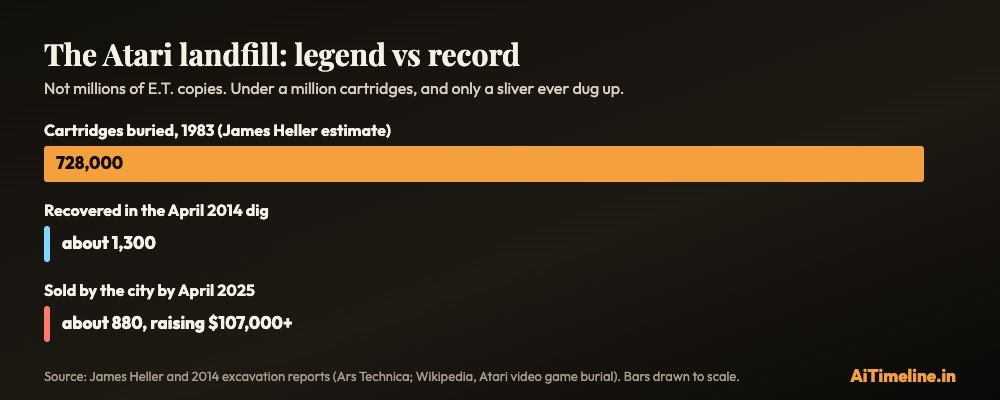
A dig organised for the documentary Atari: Game Over reached the buried Atari waste in a landfill south of Alamogordo. About 1,300 cartridges were recovered, including copies of E.T. the Extra-Terrestrial but also many other titles. Former Atari manager James Heller, who oversaw the 1983 dumping, said about 728,000 cartridges had gone into the ground, not the millions of E.T. copies of legend (Ars Technica; Wikipedia).
Some finds went to museums: the Smithsonian’s National Museum of American History accepted an excavated E.T. cartridge for its collection (Smithsonian). The city sold others; by April 2025 about 880 cartridges had raised more than $107,000.
1986
The NES goes on sale nationwide in the US Recovery
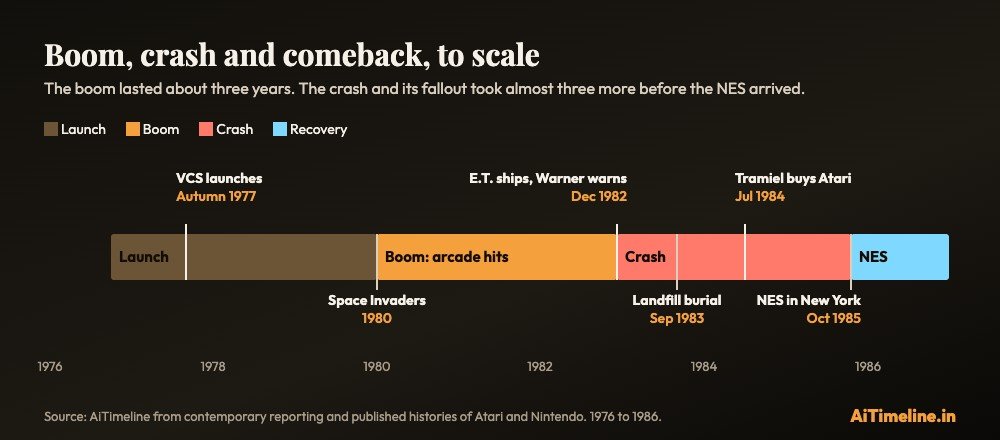
After test markets, Nintendo took the NES national. A basic set with Super Mario Bros. was priced at $99.99. The NES went on to sell 61.91 million consoles worldwide (Wikipedia).
1985
Nintendo tests the NES in New York Recovery
Nintendo launched the Nintendo Entertainment System in New York with a deluxe set at $179.99 that included a light gun and R.O.B., a toy robot. The accessories helped present the machine as something new rather than another console from the era that had just collapsed. Licensed games carried Nintendo’s Seal of Quality, a lockout chip (10NES) blocked unlicensed cartridges, and most third-party publishers were limited to five games a year (Wikipedia).
Warner sells Atari’s consumer business to Jack Tramiel Fallout
Warner Communications sold Atari’s consumer electronics and home computer business to Jack Tramiel, the founder of Commodore, who renamed it Atari Corporation. Warner kept the coin-operated arcade business, which became Atari Games (Wikipedia; Wikipedia: Atari Corporation).
1984
Rivals retreat: Mattel sells its video game division Fallout
Mattel sold its entire video game division, including Intellivision, to a group led by its former senior vice-president of marketing, and many shops cut or dropped console stock to free shelf space for other products. Specialist video game retailers folded (Wikipedia).
1983
Atari’s losses pass half a billion dollars Crash
By mid-1983 Atari had lost $356 million and laid off about 30% of its 10,000 employees; for the full year it reported a loss of about $536 million (Wikipedia; Wikipedia). In December 1983 the retailer JCPenney announced it would stop selling home computers.
Atari dumps unsold stock in a New Mexico landfill Crash
Trucks carried crushed cartridges, consoles and boxes from Atari’s El Paso plant to a landfill south of Alamogordo; reports gave 10 to 20 truckloads. A layer of concrete was poured over the material from 29 September 1983 (Wikipedia). Atari told reporters at the time that the stock came from a plant that was being closed.
Atari’s chief executive resigns Crash
Ray Kassar, who had run Atari since 1978, was forced out. He had sold 5,000 Warner shares shortly before the December 1982 earnings warning, a sale that drew scrutiny; he was later cleared of wrongdoing (Wikipedia).
1983
Nintendo launches the Famicom in Japan Recovery
Nintendo released the Family Computer, or Famicom, in Japan. The crash did not directly hit Japan, where console sales stayed strong, and the Famicom became the basis of the NES (Wikipedia).
A home-computer price war hits consoles Crash
Commodore cut the VIC-20 to $199 and the Commodore 64 to $499 in 1982, then cut the C64 to $300 in June 1983; some shops sold it for as little as $199 (Wikipedia). A computer that could play games and also run software for school and work was suddenly priced near a console.
1982
Warner warns that Atari has missed its targets Crash
Warner Communications told investors its fourth-quarter earnings would fall well short because Atari’s cartridge sales had disappointed. Its stock fell by about a third in the following trading session, and video game shares fell with it (Christian Science Monitor, 10 Dec 1982; Wikipedia).
E.T. the Extra-Terrestrial reaches the Atari 2600 Boom
Atari reportedly paid $20 to $25 million for the film licence, then gave designer Howard Scott Warshaw just over five weeks to build the game so it could ship for Christmas (Game Developer; Wikipedia). About 4 million cartridges were manufactured. Sales estimates vary from about 1.5 million to over 2 million, but hundreds of thousands came back as returns and unsold stock, and players criticised its confusing pits (KQED).
The game was a commercial disaster for Atari, but the wider market was already slowing before it shipped; E.T. became the symbol because of its timing.
Atari launches the 5200; the VCS becomes the 2600 Boom
Atari introduced the 5200 SuperSystem and renamed the Video Computer System the Atari 2600 (Wikipedia). The 5200 joined a crowded field with Intellivision, ColecoVision, Odyssey² and Vectrex. In 1982 the VCS held about 58% of the hardware market and ColecoVision about 17% (Wikipedia).
Pac-Man on the 2600: a hit that disappointed Boom
Atari’s home version of the arcade sensation became the best-selling Atari 2600 game, with about 8 million copies sold, but critics and players complained it looked and played little like the arcade original (Wikipedia; Wikipedia). Unsold Pac-Man stock later filled Atari’s warehouses alongside E.T. (Wikipedia).
Space Invaders proves arcade hits sell consoles Rise
Atari’s licensed port of Space Invaders was the first VCS game to sell a million copies. Atari sold about 1.25 million cartridges and more than a million consoles that year, nearly doubling the installed base to over 2 million (Wikipedia).
Activision becomes the first third-party publisher Rise
Four Atari programmers left to found Activision, making games for Atari’s console without Atari’s permission. Atari sued in 1980 and the case was settled, with Activision paying a licensing fee (Wikipedia). Dozens of other firms followed, and with no gatekeeper, anyone could publish 2600 cartridges.
Atari launches the Video Computer System Rise
The VCS, later called the Atari 2600, went on sale with two joysticks and the Combat cartridge. Interchangeable cartridges meant one console could play a growing library of games (Wikipedia; Smithsonian). It sold an estimated 30 million units over its life.
Warner Communications buys Atari Rise
Warner agreed to buy Atari for $28 million, giving the young arcade company the money to finish and launch its home console (Wikipedia).
What Caused the Atari Crash of 1983?
No single game or company. Six pressures hit at once.
| Cause | What happened | Effect on the market |
|---|---|---|
| Too many consoles | Atari 2600 and 5200, Intellivision, ColecoVision, Odyssey² and Vectrex all competed by 1982 | Buyers and shops split across incompatible systems |
| Too many cartridges | After Activision (1979), dozens of firms could publish 2600 games without Atari’s approval | Supply outran demand; shelves filled with unsold stock |
| Uneven quality | Big releases such as Pac-Man (1982) disappointed; many cheap games were worse | Consumers could not tell good games from bad and stopped buying |
| Rushed licences | E.T. was built in just over five weeks after a reported $20–25 million licence | Huge production runs of games that did not sell through |
| Retail overstock | Retailers ordered for continued growth, then discounted and returned stock | Prices collapsed and orders for new games dried up |
| Home computer price war | Commodore 64 cut to $300 in June 1983, near console prices | Families chose machines that did more than play games |
Supply outran demand. The success of the Atari 2600 and of arcade ports such as Space Invaders pulled in rival consoles and dozens of new publishers. Because Atari could not stop others making cartridges for its machine, the number of games grew far faster than the number of buyers (Wikipedia; University of Houston, Engines of Our Ingenuity).
Buyers lost confidence. With no reviews in most shops and little to tell games apart, a few expensive disappointments taught families to stop buying. Retailers then cut prices to clear stock, which lowered the value of every new game.
Computers changed the comparison. As Commodore slashed prices, a home computer that played games and ran school and office software cost little more than a console (Wikipedia). For a later example of price wars reshaping a hardware market, see AiTimeline’s AMD comeback story.
How Bad Was the 1983 Video Game Crash?
A fall of almost 97% in North American home console revenue, by the most cited estimates.
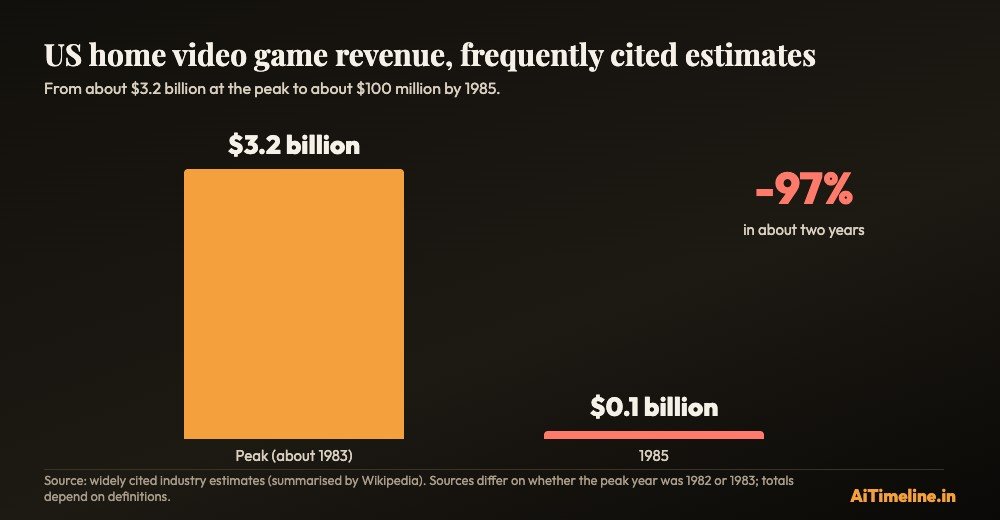
The most frequently cited figures put US home video game revenue at about $3.2 billion at its peak and about $100 million by 1985. Treat them as estimates: sources disagree on whether the peak year was 1982 or 1983, and totals depend on what is counted (Wikipedia).
| Company | What happened | When |
|---|---|---|
| Atari (Warner) | Loss of about $536 million; around 30% of staff laid off by mid-year; consumer arm sold to Jack Tramiel for about $240 million | 1983–84 |
| Mattel Electronics | Video game division, including Intellivision, sold off | Early 1984 |
| Coleco | ColecoVision held about 17% of hardware in 1982; Coleco later shifted away from consoles | 1983–85 |
| Retailers | Many cut console stock; specialist game shops closed; JCPenney stopped selling home computers | 1983–84 |
| Nintendo | Unaffected at home: the Famicom launched in Japan and became the NES | 1983–86 |
The E.T. Game: Symbol, Not Sole Cause
Atari’s chief executive Ray Kassar commissioned E.T. the Extra-Terrestrial on 27 July 1982 with a 1 September deadline, leaving Howard Scott Warshaw just over five weeks to design and program it (Game Developer; Wikipedia). Atari reportedly paid $20–25 million for the licence and manufactured about 4 million cartridges.
The game sold in large numbers, with estimates from about 1.5 million to over 2 million, but far below what was made, and hundreds of thousands were returned. Players disliked its repeated falls into pits (KQED). Its December 1982 release, days before Warner’s profit warning, fixed it in memory as the cause of the crash. The record shows a broader collapse that was already under way.
The Atari Landfill Story: What Really Happened?
In September 1983 trucks carried crushed cartridges, consoles and boxes from Atari’s El Paso plant to a landfill south of Alamogordo, New Mexico, and concrete was poured over them (Wikipedia). For three decades the story grew into a legend of millions of buried E.T. cartridges.
The April 2014 dig settled it: the burial was real, but the total was about 728,000 cartridges of many titles, according to James Heller, the Atari manager who oversaw it (Ars Technica). An excavated E.T. cartridge is now in the Smithsonian’s collection (Smithsonian collection record).
How Nintendo Revived the Console Market
Nintendo fixed the problems that had broken the Atari era.
| Atari era (to 1983) | Nintendo NES (from 1985) | |
|---|---|---|
| Who could publish | Anyone could make 2600 cartridges | Licensed publishers only, enforced by the 10NES lockout chip |
| Quality signal | None; good and bad games looked alike on the shelf | Nintendo Seal of Quality on licensed games |
| Volume | Unlimited releases | Most third parties limited to five games a year |
| Positioning | Video game console | Entertainment system with a robot and light gun |
| Launch | National, crowded market | Test market in New York (1985), then national (1986) |
Nintendo did not rebuild gaming alone: arcades and home computers had kept it alive. But the NES rebuilt the North American console business, and its model of a platform owner controlling who publishes became standard for the consoles that followed (Wikipedia). Read how that model later fed the graphics-chip industry in AiTimeline’s NVIDIA history.
The Lasting Legacy of the Atari Crash
Quality control became the platform owner’s job. Licensing, approval and lockout systems descend directly from the lesson of 1983.
Retailers demanded proof of demand. Shops that had been burned by unsold stock made console makers carry more of the risk.
Licences stopped being a shortcut. E.T. remains the standard example of a famous brand that could not rescue a rushed game.
Fast growth is not guaranteed. A market can collapse when production and expectations lose touch with real demand, a pattern AiTimeline also traces in the Blockbuster downfall.
Who Is in the Story
Atari, Inc.
Market leader with the 2600; owned by Warner Communications from 1976 to 1984.
Warner Communications
Bought Atari for $28 million in 1976; its December 1982 warning signalled the bust.
Howard Scott Warshaw
Programmed E.T. in just over five weeks in 1982.
Ray Kassar
Atari chief executive from 1978 until he was forced out in July 1983.
Jack Tramiel
Commodore founder who bought Atari’s consumer business in July 1984.
James Heller
Former Atari manager who oversaw the 1983 burial and estimated 728,000 cartridges.
Activision, Mattel, Coleco
The first third-party publisher and the two main rival console makers.
Nintendo
Launched the Famicom in 1983 and the NES in North America in 1985–86.
Common Assumptions vs the Record
| Common assumption | What the record shows |
|---|---|
| E.T. caused the crash | The market was already slowing; E.T. shipped in December 1982 and became the symbol because of its timing |
| Millions of E.T. cartridges were buried | James Heller put the total at about 728,000 cartridges of many titles |
| The landfill was only E.T. | The 2014 dig found many games, including Pac-Man, Space Invaders, Centipede and Yars’ Revenge as well as E.T. |
| E.T. sold almost nothing | Estimates range from about 1.5 million to over 2 million copies; the problem was the 4 million made |
| Video games died worldwide | Japan’s console market stayed strong, Europe was dominated by home computers, and arcades continued |
| Nintendo saved gaming alone | The NES rebuilt the North American console market; computers and arcades had kept gaming alive |
Explore More Timelines
People Also Ask
Frequently Asked Questions
Related AiTimeline Stories
⚠️ Editorial Note
Last updated 23 October 2026. The crash is described here as a crisis in the North American home-console market, not the end of video games worldwide. Revenue totals are widely cited historical estimates; sources disagree on whether the peak year was 1982 or 1983. E.T. sales figures vary between sources, and the landfill total of about 728,000 cartridges is James Heller’s estimate. Added to the brief: Warner’s 1976 purchase, Activision (1979), Pac-Man (1982), the Atari 5200, Warner’s 8 December 1982 warning, the Famicom, the Commodore price war, Ray Kassar’s exit, Atari’s 1983 loss, Mattel’s exit, the NES test and national launch dates, and the 2014 dig figures.
Sources & further reading
Every dated entry above was checked against these references. Last reviewed 24 October 2026.
- Smithsonian National Museum of American History: From landfill to Smithsonian collections, E.T. the Extra-Terrestrial Atari 2600 game
- Smithsonian Institution: E.T. the Extra-Terrestrial Atari 2600 cartridge, collection record
- Smithsonian Institution: Video game history
- University of Houston, The Engines of Our Ingenuity: The video game crash of 1983
- KQED: Total failure? The world's worst video game
- Game Developer: The free-wheeling development of the disastrous E.T. for Atari 2600
- Ars Technica: Landfill excavation unearths years of crushed Atari treasure (Apr 2014)
- Christian Science Monitor: Stock of Atari gamemaker plunges on earnings news (10 Dec 1982)
- Wikipedia: Video game crash of 1983
- Wikipedia: Atari video game burial
- Wikipedia: E.T. the Extra-Terrestrial (video game)
- Wikipedia: Atari 2600
- Wikipedia: Nintendo Entertainment System