Twitter Acquisition Timeline: Elon Musk’s $44 Billion Takeover
Twitter acquisition timeline: Musk's $54.20 offer in April 2022, the Delaware lawsuit, the October closing and the platform's transformation into X.
Latest Story
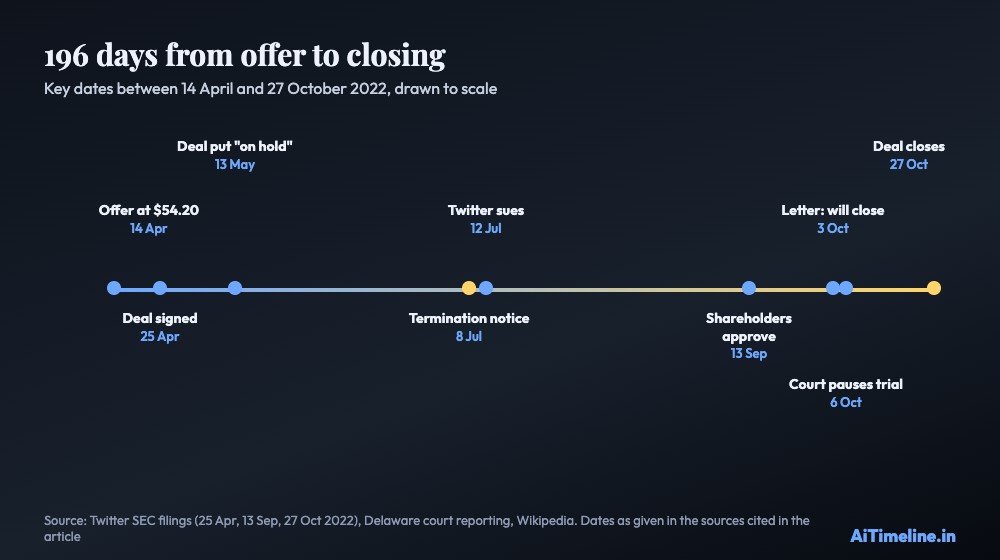
On 27 October 2022, Elon Musk completed his purchase of Twitter for about $44 billion, ending months of uncertainty over one of the world’s most influential social media platforms. The Twitter acquisition timeline began with a $54.20-per-share offer on 14 April and a signed agreement on 25 April. Disagreements over spam and fake accounts, access to company data and contractual duties then threatened to derail it. On 8 July Musk tried to terminate the agreement; Twitter sued in Delaware, and a trial was set for October. Musk ultimately agreed to complete the original deal before the trial could proceed, Twitter was delisted and Musk took control. That made Twitter’s end as an independent listed company a legally pressured closing rather than a court-ordered one, and no judge ruled on the underlying allegations. The takeover began a transformation that saw the platform renamed X in July 2023, and it still has consequences: a jury found in March 2026 that Musk misled investors with two May 2022 tweets, and an SEC case over his stake disclosure ended in a $1.5 million settlement. This page separates allegations, court rulings and filings. For related reading, see AiTimeline’s timelines of the TikTok ban saga, the OpenAI board crisis, Facebook’s early decisions and the downfall of MySpace.
Tap a stage. The key point: no court ever ruled on the merits — the deal closed before the trial.
Choose a stage above.
💡 Short Answer
Elon Musk offered $54.20 a share for Twitter on 14 April 2022 and signed a roughly $44 billion agreement on 25 April. Disputes over spam accounts led him to try to terminate it on 8 July, and Twitter sued to enforce it on 12 July. After a conditional letter on 3–4 October and a court stay on 6 October, the deal closed on 27 October 2022 without a trial. Twitter became private, Musk became sole director, and the service was renamed X in July 2023.
What Is Settled and What Is Disputed, as of 25 October 2026
Last updated: 25 October 2026. Kept separate from the timeline because each question has its own level of evidence.
| Question | Position of the sources | Status |
|---|---|---|
| When did the deal close? | Twitter’s 8-K says the merger was consummated on 27 Oct 2022, at $54.20 in cash per share; trading was suspended before the NYSE opened on 28 Oct | Settled |
| Did a court order Musk to buy Twitter? | No. The Delaware court stayed the case on 6 Oct after Musk agreed to close; there was no judgment on the merits | Settled |
| Did shareholders approve? | Yes: 453,106,848 shares for, 4,149,957 against, 2,387,234 abstaining (8-K); holders of about 59.2% of all shares voted to adopt | Settled |
| Did Twitter understate spam and fake accounts? | Musk alleged so; Twitter said its under-5% estimate was heavily qualified. No court ruled before the closing | Unresolved |
| Was Musk entitled to terminate? | Musk gave notice on 8 Jul citing material breach; Twitter rejected it. The trial that would have decided it never took place | Unresolved |
| Did Musk mislead investors? | A San Francisco jury found on 20 Mar 2026 that two May 2022 tweets were misleading; damages are not fixed and Musk said he would appeal | Found by a jury; open on damages and appeal |
| Did he disclose his stake late? | The SEC alleged an 11-day delay; settled in 2026 for $1.5 million without admission | Settled, no admission |
The Twitter Acquisition: Key Questions
The Twitter Takeover in Ten Points
- The stake: Musk disclosed a 9.2% stake on 4 April 2022 and then declined a board seat.
- The offer: a non-binding $54.20-a-share bid on 14 April, answered by a poison pill on 15 April.
- The agreement: a roughly $44 billion deal signed on 25 April, with no financing conditions.
- The doubt: on 13 May Musk put the deal “on hold” over spam-account estimates.
- The termination notice: Musk’s side gave notice on 8 July; Twitter rejected it.
- The lawsuit: Twitter sued on 12 July, won an expedited trial and faced counterclaims on 29 July.
- The vote: about 98.6% of votes cast approved the deal on 13 September.
- The reversal: a conditional letter dated 3 October said Musk would close at $54.20.
- The closing: the court paused the trial on 6 October and the deal closed on 27 October.
- The aftermath: layoffs, the X rebrand, a 2026 jury finding and an SEC settlement.
Twitter Acquisition Timeline, Latest First
Each entry is tagged by type and ends with why it matters. Allegations are labelled as allegations.
Show only the stake and bid, the agreement, the dispute, the closing, or the aftermath.
–
The SEC case over Musk’s late stake disclosure ends in a $1.5 million settlement Aftermath and legacy
The SEC sued Musk in January 2025, arguing that an 11-day delay in disclosing his first 5% stake in Twitter let him buy more than $500 million of shares at artificially low prices (CPA Practice Advisor). The case was settled in May 2026: the Elon Musk Revocable Trust agreed to a final judgment with a $1.5 million civil penalty and an injunction against future beneficial-ownership violations, without admitting or denying the allegations. A federal judge approved the consent judgment in July 2026 “despite its significant misgivings” (CPA Practice Advisor).
These are secondary reports. AiTimeline did not find the court order itself, so the exact approval date is not given here. The settlement resolves the disclosure-timing allegation only; it says nothing about the spam-account dispute or the merger agreement.
2026
A San Francisco jury finds Musk misled Twitter investors in 2022 Aftermath and legacy
After a three-week trial, a federal jury in San Francisco found that two tweets Musk posted in May 2022 contained false or misleading statements that depressed Twitter’s share price. It rejected the claim that he ran a scheme to defraud investors and treated his podcast comments as opinion (Al Jazeera). The suit was brought for investors who sold Twitter shares between mid-May and early October 2022.
Plaintiffs’ lawyers estimated damages at about $2.5–2.6 billion, but that is an estimate, not an award; the amount depends on claims later filed by investors, and Musk’s lawyers said they would appeal. One case summary reports post-trial rulings that narrowed liability; AiTimeline could not confirm them against the court record, so treat the final outcome as open.
2025
xAI acquires X in an all-stock deal valuing it at $33 billion Aftermath and legacy
Musk announced that his AI company xAI had acquired X in an all-stock transaction. He described the price as $45 billion less $12 billion of debt, which values X at $33 billion on an equity basis (SiliconANGLE). Both companies were controlled by Musk, so the deal was effectively an internal swap.
For comparison, the 2022 purchase price was about $44 billion. The two figures describe different things (a $44 billion purchase from public shareholders versus a related-party equity valuation) and should not be read as a simple gain or loss.
2023
Twitter’s bird is replaced by an X Aftermath and legacy
Musk and CEO Linda Yaccarino announced the rebrand on 23 July 2023, and the blue bird was dropped for a white X on 24 July. Crews began removing the letters of the Market Street headquarters sign that day; work was paused after police were called, and a lighted X sign that went up drew permit complaints (NBC News).
Musk had called the purchase the cornerstone of an “everything app” he named X ({L(WIKI, ‘Wikipedia’)}). A court filing reported in April 2023 had already said that Twitter, Inc. had merged into X Corp. and no longer existed as a separate company ({L(BT0411, ‘Business Today’)}).
2022
About half of Twitter’s staff are laid off Aftermath and legacy
A week after closing, Musk laid off roughly half of Twitter’s workforce. Two weeks later he issued an ultimatum to commit to “extremely hardcore” work or leave, and hundreds resigned. One account puts headcount falling from close to 7,500 to about 1,500 (Wikipedia).
Verification, moderation and advertising policies changed in the same months. This timeline stops at the acquisition and its legal aftermath; those product and policy changes are covered by the sources listed below, not assessed here.
2022
Musk completes the $44 billion purchase and takes control Revival and closing
Twitter told the SEC the merger was consummated on 27 October 2022. Each share was converted into the right to receive $54.20 in cash, Twitter became a wholly owned subsidiary of Musk’s acquisition company, and Musk became its sole director; Bret Taylor, Parag Agrawal and the other directors left the board (Twitter 8-K). The company asked the NYSE to delist its stock, and trading was suspended before the open on 28 October.
News reports said Musk fired CEO Parag Agrawal, CFO Ned Segal, legal chief Vijaya Gadde and general counsel Sean Edgett the same day (Wikipedia). The deal closed before the Delaware trial could decide whether Musk had a valid reason to walk away, so no court ruled on his spam-account allegations.
2022
Musk walks into headquarters carrying a sink Revival and closing
The day before closing, Musk visited Twitter’s San Francisco headquarters, tweeted a video of himself carrying a kitchen sink into the lobby and changed his profile to “Chief Twit” (Wikipedia). The stunt played on the phrase “let that sink in”.
It was a public signal, not a legal step: the closing still depended on the financing and the paperwork finished the next day.
2022
The Delaware court pauses the trial so the deal can close Revival and closing
Chancellor Kathaleen McCormick agreed to stay the litigation after Musk and his acquisition entities committed to close the merger. The parties had until 5 p.m. on 28 October to complete the transaction; if it did not close by then, they were to contact the court to arrange a trial in November (Court of Chancery order; Wikipedia).
There was no judgment on the merits. The stay replaced the 17 October trial with a deadline, which is why this was a legally pressured closing rather than a court-ordered one.
2022
Musk tells Twitter he will close at $54.20 — on conditions Revival and closing
A letter dated 3 October from Musk’s lawyers said he intended to “proceed to closing of the transaction” on the terms of the 25 April agreement. The offer was conditional: it depended on his receiving debt financing and on the Delaware court immediately staying the case and adjourning the trial. Twitter disclosed the letter in an SEC filing on 4 October and said its intention was to close at $54.20 per share (Axios).
Twitter did not drop its lawsuit. Earlier, Musk had reportedly floated lower prices of about $31 billion and $39.6 billion, which Twitter rejected ({L(HBLR, ‘Harvard Business Law Review’)}). Twitter’s shares jumped about 22% to close near $52 after trading resumed. The brief this article was based on dated the proposal 4 October; the letter itself is dated 3 October and became public on the 4th.
2022
Shareholders approve the deal; the Twitter whistleblower testifies Revival and closing
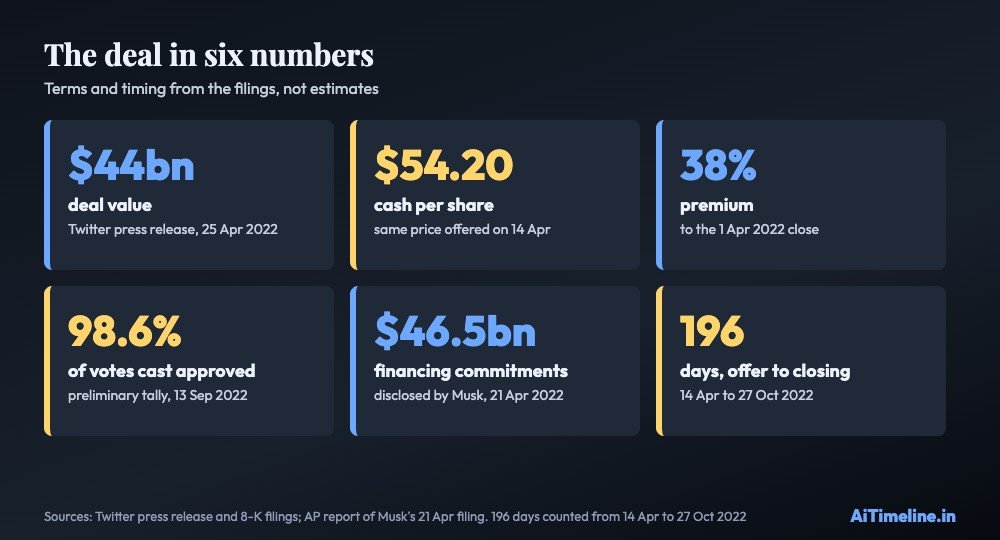
At a special meeting, Twitter stockholders adopted the merger agreement. Twitter’s preliminary tally said about 98.6% of the votes cast approved it (Twitter press release). The final count in the 8-K was 453,106,848 shares for, 4,149,957 against and 2,387,234 abstaining; holders of about 59.2% of all outstanding shares voted to adopt (Twitter 8-K).
The same day, former security chief Peiter Zatko testified before the Senate Judiciary Committee ({L(WIKI, ‘Wikipedia’)}). Shareholder approval did not end the dispute; it removed one closing condition and left Musk’s termination notice contested.
2022
The judge refuses to delay the trial but lets Musk add whistleblower claims Dispute and lawsuit
Judge McCormick denied Musk’s request to delay the trial but allowed him to amend his counterclaims with allegations from Zatko, saying the request cleared the “low bar” of the court’s rules. She limited the new discovery to “incremental” material (CNBC). The trial remained set for 17 October.
A later ruling on 22 September let Musk add claims about a severance payment to Zatko. Neither ruling decided whether the claims were true.
2022
A whistleblower goes public and Musk sends a new termination letter Dispute and lawsuit
On 23 August the Washington Post reported a whistleblower complaint by former Twitter security chief Peiter Zatko, who accused the company of misleading regulators and the public about security and spam. The complaint, filed with the SEC, DOJ and FTC on 6 July, also called Agrawal’s 16 May thread on spam accounts deceptive (Wikipedia). On 29 August Musk filed a further termination letter with the SEC citing Zatko’s claims.
Twitter disputed Zatko’s account. These were allegations: no court or regulator had found the claims proven by the time the deal closed.
2022
Musk files counterclaims, sealed at first Dispute and lawsuit
Hours after McCormick set the five-day trial to start on 17 October, Musk filed his answer and counterclaims. The filing accused Twitter of lying about the number of spam and bot accounts and withholding information; it was initially under seal, and the court ordered a public version by the afternoon of 5 August (CNBC).
Counterclaims are allegations. Twitter denied them, and the trial that would have tested them never took place.
2022
The court grants Twitter an expedited five-day trial in October Dispute and lawsuit
Judge McCormick granted Twitter’s request for a fast schedule and ruled that the trial would last five days in October. Twitter had sought a September date; Musk’s lawyers asked for February 2023 (Wikipedia). On 29 July she set the start for 17 October.
The speed mattered because the merger agreement carried an outside date, and delay favoured the side that wanted out.
2022
Twitter sues to force Musk to complete the purchase Dispute and lawsuit
Twitter filed suit in the Delaware Court of Chancery four days after the termination notice, arguing that the notice was invalid and seeking an order that Musk and his acquisition entities perform the agreement (Wikipedia). Musk tweeted in reply: “Oh the irony lol”.
The company did not simply accept the withdrawal; it sought judicial enforcement, which is what made a trial and a closing possible.
2022
Musk gives notice that he is terminating the agreement Dispute and lawsuit
Musk’s lawyers sent Twitter a notice purporting to terminate the merger, claiming Twitter was in “material breach” by refusing to provide spam-account data and by dismissing senior employees. Twitter said it would pursue legal action to complete the deal (Wikipedia). Its shares fell about 7% on the news.
Twitter rejected the notice. No court ruled the termination valid or invalid before the closing.
2022
Antitrust clearance, a termination threat and a data “firehose” Dispute and lawsuit
US antitrust review cleared the deal on 3 June. On 6 June Musk’s attorney wrote that Twitter was refusing to hand over user data and threatened to terminate; Twitter said it would keep cooperating. On 8 June Twitter agreed to give him access to a “firehose” of tweets (Wikipedia).
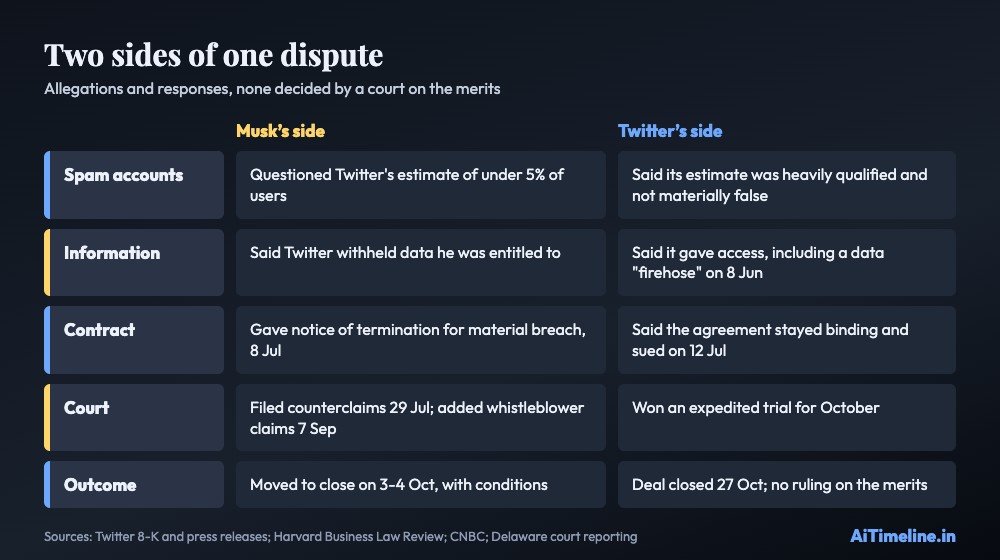
Twitter’s SEC filings had estimated that false and spam accounts were less than 5% of monetisable daily active users, and Twitter argued those estimates were heavily qualified. Musk questioned them (Harvard Business Law Review). An estimate of spam is not a verified count of all fake accounts.
2022
Musk puts the deal “on hold”, then says it cannot move forward Dispute and lawsuit
On 13 May Musk said the deal was “on hold” pending details on the share of spam accounts; Twitter stock fell more than 10%. On 17 May he said it “cannot move forward” until Twitter showed that spam was under 5% of users, and Twitter said it would enforce the merger agreement. On 25 May he dropped plans for margin loans against Tesla stock and pledged about $6.25 billion more in equity (Wikipedia).
A merger agreement has no “on hold” button. The agreement limited when it could be terminated and said courts could order specific performance (Section 9.9), which is why Twitter could later ask a court to compel closing (Harvard Business Law Review).
2022
Twitter accepts Musk’s $44 billion offer Agreement
Twitter announced a definitive agreement to be acquired by an entity wholly owned by Musk for $54.20 per share in cash, a transaction valued at about $44 billion. The price was a 38% premium to Twitter’s close on 1 April, the last trading day before Musk disclosed his stake. The board approved the deal unanimously; closing was expected in 2022, subject to a stockholder vote and regulatory approvals (Twitter press release).
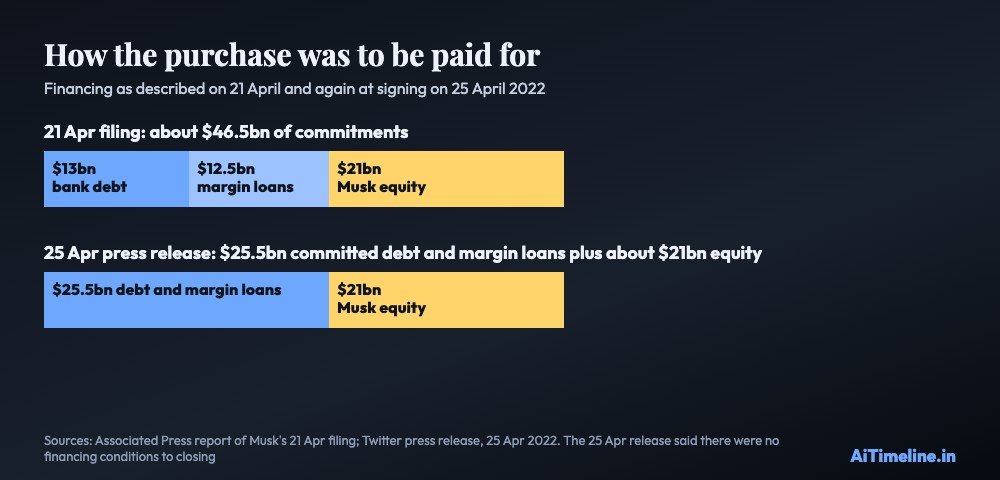
Musk said he had secured $25.5 billion of fully committed debt and margin-loan financing and was providing about $21 billion of equity. The press release said there were no financing conditions to the closing. That wording became important when Musk later sought to leave.
2022
Musk discloses $46.5 billion of financing commitments Agreement
Musk disclosed that entities related to him had received commitment letters for about $46.5 billion: $13 billion of debt, up to $12.5 billion of loans secured by Tesla shares and $21 billion of equity from him. He said he was exploring a tender offer at $54.20 per share direct to shareholders (Associated Press).
The disclosure answered the board’s main doubt, whether he could pay, and made a direct appeal to shareholders credible.
2022
Twitter adopts a “poison pill” Stake and bid
One day after Musk’s offer, Twitter’s board adopted a shareholder-rights plan, commonly called a poison pill. It lets other shareholders buy extra stock if a holder crosses a threshold without board approval, making an unwelcome takeover costlier (Wikipedia).
The plan bought the board time to negotiate. It was not used to block the sale permanently, and the board agreed to a deal ten days later.
2022
Musk makes an unsolicited $54.20-a-share offer Stake and bid
Musk offered to buy Twitter for $54.20 a share in cash, valuing it at about $43 billion on the shares he proposed to buy. He said Twitter needed to be taken private to realise its potential as a platform for free speech (Wikipedia). The offer was non-binding: a definitive agreement, financing and approvals were still required.
The $54.20 figure is widely thought to nod to the number 420; AiTimeline treats that as commentary, not a stated reason.
2022
Musk decides not to join the board Stake and bid
Twitter had offered Musk a board seat, with an appointment due to take effect on 9 April. CEO Parag Agrawal announced on 11 April that Musk would not join, citing the fiduciary duties a director owes all shareholders (Al Jazeera).
The board seat would have capped his stake at 14.9% and limited what he could say about the company ({L(WIKI, ‘Wikipedia’)}). Declining it removed those limits and opened the way to a bid.
2022
Musk becomes Twitter’s largest shareholder Stake and bid
Musk disclosed on 4 April that he owned 9.2% of Twitter, worth about $2.64 billion. He had begun buying on 31 January. Twitter’s stock surged as much as 27% in its biggest intraday jump since its IPO, and on 5 April Twitter invited him to join its board (Wikipedia).
Twitter’s later press release dated the premium to 1 April, the last close before the stake became public (Twitter press release). The timing of that disclosure is the subject of the SEC case that ended in 2026.
Five Common Claims, Checked
Each claim rests on something real. Each stops short of what it is often taken to show.
| Claim | What it rests on | What it does not show |
|---|---|---|
| A court forced Musk to buy Twitter | Twitter sued to enforce the agreement and won an expedited trial | A judgment. The case was stayed on 6 Oct after Musk agreed to close, and no ruling on the merits followed |
| Twitter lied about its number of bots | Musk’s counterclaims and the Zatko whistleblower complaint | A finding. No court or regulator decided it before the deal closed, and an estimate of spam is not a count of all fake accounts |
| Musk was always going to walk away | The 8 Jul termination notice and the 29 Aug letter | His intent. He moved to close on 3–4 Oct; reports of lower-price offers to Twitter in Sept are secondary |
| The 98.6% vote meant nearly everyone backed the deal | Twitter’s preliminary tally of votes cast | Support among all shares: holders of about 59.2% of outstanding shares voted to adopt, per the 8-K |
| Twitter was renamed X when Musk bought it | Musk’s later “everything app” plan | The date. The rebrand began 23–24 Jul 2023, nine months after closing |
Why Did the Twitter Deal Become a Legal Battle?
Three issues defined the dispute.
1. Spam and fake accounts. Musk questioned Twitter’s estimate that false and spam accounts were less than 5% of monetisable daily active users. Twitter defended its disclosures and argued that the disagreement did not justify termination (Harvard Business Law Review).
2. Contractual obligations. Twitter argued that the signed merger agreement remained binding and that Musk had no valid basis to withdraw. Musk alleged breaches by Twitter and tried to terminate the deal on 8 July. The agreement allowed courts to order specific performance.
3. The risk of litigation. The lawsuit created the possibility of a court order requiring the acquisition to proceed. The accelerated trial put pressure on both sides to resolve the dispute before a ruling. The deal ultimately closed without a final trial judgment, so it is more accurate to call it a legally pressured closing after a threatened trial than a court-ordered sale. For another case where a board and a founder collided, see AiTimeline’s OpenAI board crisis timeline.
What Changed After Musk Bought Twitter?
The legal record ends at closing; these are the first consequences.
The acquisition brought an immediate change in ownership and leadership. Twitter became private and Musk took control of its board and executive direction; reports say senior executives were fired the day of closing. About half the staff were laid off on 4 November. Verification, moderation and subscription policies were revised in the months that followed, outside the scope of the legal record.
In April 2023 a court filing said Twitter, Inc. had merged into X Corp. On 23–24 July 2023 the service was rebranded as X, replacing the bird logo. In March 2025 Musk announced that xAI had acquired X in an all-stock deal valuing it at $33 billion. For how a social platform can lose ground to rivals, see AiTimeline’s MySpace downfall and TikTok ban saga timelines.
What Remains Uncertain?
As of 25 October 2026, on the sources AiTimeline reviewed.
Whether Twitter understated spam accounts. It was alleged, denied and never decided in court.
Whether Musk could lawfully terminate. The trial that would have decided it was cancelled by the closing.
The 2026 verdict’s final cost. Damages are not fixed, plaintiffs’ estimates are about $2.5–2.6 billion, Musk said he would appeal, and AiTimeline could not confirm reported post-trial rulings against the court record.
Exact dates in the 2026 SEC settlement. The sources reviewed give May for the agreement and July for approval.
Numbers reported by secondary sources. Layoff and headcount figures come from news summaries, not company filings.
Figure, Filing or Report?
The same story, sorted by who said it and how strong it is.
| Figure or statement | Source | Type | Caution |
|---|---|---|---|
| $54.20 per share in cash; about $44 billion; 38% premium to 1 Apr close | Twitter press release, 25 Apr 2022 (SEC exhibit) | Primary filing | Value is the company’s own description of the deal |
| Consummation 27 Oct 2022; Musk sole director | Twitter 8-K, 27 Oct 2022 | Primary filing | Officer firings are not in the 8-K; they come from news reports |
| 98.6% of votes cast; 453,106,848 for, 4,149,957 against | Twitter press release and 8-K, 13 Sep 2022 | Primary filing | The 98.6% was a preliminary tally; about 59.2% of all shares voted to adopt |
| $46.5 billion of commitments | Musk filing, 21 Apr 2022, via AP | News report of a filing | Reallocated by 25 Apr to $25.5 billion debt and margin loans plus about $21 billion equity |
| Stay until 5 p.m. on 28 Oct | Delaware Court of Chancery order, 6 Oct 2022 | Court order | Justia copy returned a bot-protection error to AiTimeline; date also reported by Wikipedia |
| Letter dated 3 Oct, disclosed 4 Oct | Axios, citing the filing | News report | Brief for this article dated it 4 Oct; the letter is dated 3 Oct |
| Jury verdict, 20 Mar 2026; damages $2.5–2.6 billion | Al Jazeera; plaintiffs’ lawyers | News report; estimate | Damages are an estimate; post-trial rulings not confirmed |
| SEC settlement $1.5 million, July 2026 | CPA Practice Advisor | Secondary report | Exact approval date not confirmed |
The Story at a Glance
Oldest first, with the type of each entry.
| Date | Event | Type |
|---|---|---|
| 4–5 Apr 2022 | Musk becomes Twitter’s largest shareholder | Stake and bid |
| 11 Apr 2022 | Musk decides not to join the board | Stake and bid |
| 14 Apr 2022 | Musk makes an unsolicited $54.20-a-share offer | Stake and bid |
| 15 Apr 2022 | Twitter adopts a “poison pill” | Stake and bid |
| 21 Apr 2022 | Musk discloses $46.5 billion of financing commitments | Agreement |
| 25 Apr 2022 | Twitter accepts Musk’s $44 billion offer | Agreement |
| 13–25 May 2022 | Musk puts the deal “on hold”, then says it cannot move forward | Dispute and lawsuit |
| 3–8 Jun 2022 | Antitrust clearance, a termination threat and a data “firehose” | Dispute and lawsuit |
| 8 Jul 2022 | Musk gives notice that he is terminating the agreement | Dispute and lawsuit |
| 12 Jul 2022 | Twitter sues to force Musk to complete the purchase | Dispute and lawsuit |
| 19 Jul 2022 | The court grants Twitter an expedited five-day trial in October | Dispute and lawsuit |
| 29 Jul 2022 | Musk files counterclaims, sealed at first | Dispute and lawsuit |
| 23–29 Aug 2022 | A whistleblower goes public and Musk sends a new termination letter | Dispute and lawsuit |
| 7 Sep 2022 | The judge refuses to delay the trial but lets Musk add whistleblower claims | Dispute and lawsuit |
| 13 Sep 2022 | Shareholders approve the deal; the Twitter whistleblower testifies | Revival and closing |
| 3–4 Oct 2022 | Musk tells Twitter he will close at $54.20 — on conditions | Revival and closing |
| 6 Oct 2022 | The Delaware court pauses the trial so the deal can close | Revival and closing |
| 26 Oct 2022 | Musk walks into headquarters carrying a sink | Revival and closing |
| 27 Oct 2022 | Musk completes the $44 billion purchase and takes control | Revival and closing |
| 4 Nov 2022 | About half of Twitter’s staff are laid off | Aftermath and legacy |
| 23–24 Jul 2023 | Twitter’s bird is replaced by an X | Aftermath and legacy |
| 28 Mar 2025 | xAI acquires X in an all-stock deal valuing it at $33 billion | Aftermath and legacy |
| 20 Mar 2026 | A San Francisco jury finds Musk misled Twitter investors in 2022 | Aftermath and legacy |
| Jul 2026 | The SEC case over Musk’s late stake disclosure ends in a $1.5 million settlement | Aftermath and legacy |
| Term | Meaning | Why it matters here |
|---|---|---|
| Poison pill | A shareholder-rights plan that makes an unwelcome takeover more expensive | Twitter adopted one on 15 Apr 2022 |
| Specific performance | A court order requiring a party to carry out a contract | Twitter sought it in its 12 Jul lawsuit; the agreement allowed it (Section 9.9) |
| Material adverse effect | A contract term allowing a party to exit if the business suffers a major, lasting hit | Musk’s side struggled to show one, according to one account |
| Chancery Court | Delaware’s court for corporate disputes, with judges rather than juries | Heard Twitter, Inc. v. Elon R. Musk |
| mDAU | Monetisable daily active users, Twitter’s headline usage metric | The base for the under-5% spam estimate |
| Margin loan | A loan secured by shares the borrower owns | Musk planned up to $12.5 billion against Tesla stock, then dropped it on 25 May |
| Going private | Buying out all public shareholders so a company stops being listed | Twitter’s stock left the NYSE on 28 Oct 2022 |
Who Is Who
Elon Musk
Offered $54.20 a share on 14 Apr 2022, tried to terminate on 8 Jul, moved to close on 3–4 Oct and became sole director on 27 Oct.
Bret Taylor
Independent board chair who announced the agreement and pledged legal action when Musk tried to leave. Left the board at closing.
Parag Agrawal
CEO during the bid. His 16 May thread on spam accounts was criticised in the Zatko complaint. Reported fired on 27 Oct 2022.
Kathaleen McCormick
Chancellor of the Delaware Court of Chancery. Set the October trial, allowed whistleblower claims and paused the case on 6 Oct.
Peiter Zatko
Former Twitter security chief. His complaint, public on 23 Aug, and his Senate testimony on 13 Sep fed Musk’s arguments.
Jack Dorsey
Twitter co-founder. Left the board on 25 May 2022; reports say he kept a stake worth about $1 billion.
Linda Yaccarino
Named CEO in 2023 and announced the X rebrand with Musk on 23 Jul 2023.
SEC
Sued Musk in Jan 2025 over late disclosure of his stake; settled for $1.5 million in 2026.
The Popular Story vs the Record
| Popular version | What the record shows |
|---|---|
| Musk was forced by a judge to complete the deal | He agreed to close and the court paused the trial on 6 Oct. The outcome was a legally pressured closing, not a court order |
| Musk lost the lawsuit | There was no verdict in Delaware. The suit became moot when the deal closed |
| Twitter was proven to have far more bots than it said | Nobody tested that in court. Twitter said its under-5% figure was a qualified estimate and never conceded otherwise |
| Musk paid far more than Twitter was worth | $54.20 was a 38% premium to the 1 Apr 2022 close, accepted by a unanimous board and 98.6% of votes cast. Whether it was an overpayment is a judgment; reports say Musk later called it one, which AiTimeline could not trace to a primary source |
| Twitter became X the day the deal closed | The deal closed 27 Oct 2022. The merger into X Corp. was reported in April 2023 and the rebrand came 23–24 Jul 2023 |
| The SEC punished Musk for the whole takeover | The SEC case concerned only the timing of his stake disclosure and ended in a $1.5 million settlement without admission |
Explore More Timelines
People Also Ask
Frequently Asked Questions
From Takeover Bid to Corporate Transformation
The Twitter acquisition shows how a high-profile takeover can move from a public offer to a binding contract, then into a legal confrontation over data, disclosures and contractual duties. Musk’s April 2022 offer became a $44 billion agreement. His July attempt to withdraw triggered a lawsuit, and the prospect of an October trial helped bring the parties back to the original deal, which closed on 27 October before the court could decide the merits. The transaction ended Twitter’s life as a publicly traded company and gave Musk control of the platform. Its rebranding as X, and later its absorption into xAI, showed that the acquisition was not merely a change in ownership but the start of a far-reaching transformation.
Related AiTimeline Stories
⚠️ Editorial Note
Last updated 25 October 2026. This story distinguishes Musk’s allegations from Twitter’s responses and from court rulings. Because the parties moved to close the deal before the scheduled trial, no final court judgment resolved the underlying allegations about spam accounts. Deal terms and dates come from Twitter’s SEC filings and press releases; court events come from reporting and a copy of the 6 October order that AiTimeline could not open directly; 2025–2026 outcomes come from news reports and are labelled as such. Photographs of Musk or Twitter’s former headquarters are not used because AiTimeline could not verify their licences. This is a business history, not legal or investment advice.
Sources & further reading
Every dated entry above was checked against these references. Last reviewed 25 October 2026.
- Twitter press release: Elon Musk to Acquire Twitter (25 April 2022, SEC Exhibit 99.1)
- Twitter Form 8-K: completion of the merger, delisting and change of directors (27 October 2022)
- Twitter Form 8-K: results of the 13 September 2022 special meeting
- Twitter press release: Stockholders approve acquisition by Elon Musk (13 September 2022)
- Delaware Court of Chancery: order pausing Twitter v. Musk (6 October 2022), via Justia
- Harvard Business Law Review: From Public to Private: A Mogul's Acquisition of Twitter
- Axios: Timeline of the Musk-Twitter deal
- Axios: Musk offers to proceed with Twitter deal (4 October 2022)
- CNBC: Elon Musk countersues Twitter over merger (29 July 2022)
- CNBC: Delaware court denies Musk request to delay Twitter trial (7 September 2022)
- Al Jazeera: US jury finds Elon Musk misled investors during Twitter purchase (21 March 2026)
- CPA Practice Advisor: Musk agrees to pay $1.5 million over SEC Twitter stake case (5 May 2026)
- Wikipedia: Acquisition of Twitter by Elon Musk (dated events, secondary)