How IL&FS Collapsed: The ₹99,000 Crore Debt Crisis That Shook India’s Markets
Explore the IL&FS default crisis of 2018, government takeover, financial-market impact, investigations and debt recovery through November 2026.
Latest Story
How does a group built to finance India’s roads, power and water projects end up unable to repay its lenders? The IL&FS crisis began with a delayed ₹450-crore repayment in June 2018 and, within weeks, had frozen parts of India’s debt market. On 1 October 2018 the government replaced the board. Eight years on, IL&FS reports ₹50,387 crore of debt discharged against a ₹61,000-crore target, with total external debt outstanding of about ₹99,377 crore and litigation still open. This timeline follows the borrowing, the defaults, the takeover, the investigations and the long recovery, and keeps the different debt figures apart.
💡 Short Answer
IL&FS borrowed heavily to fund long-gestation infrastructure and depended on refinancing. When projects stalled and market access closed in mid-2018, it defaulted, and on 1 October 2018 the NCLT replaced its board at the government’s request. By 30 June 2026 it had discharged ₹50,387 crore, about 83% of its ₹61,000-crore target, with 205 of 302 entities resolved.
IL&FS Crisis: Key Questions
The Crisis in Ten Points
- 1987: IL&FS is set up to finance long-term infrastructure.
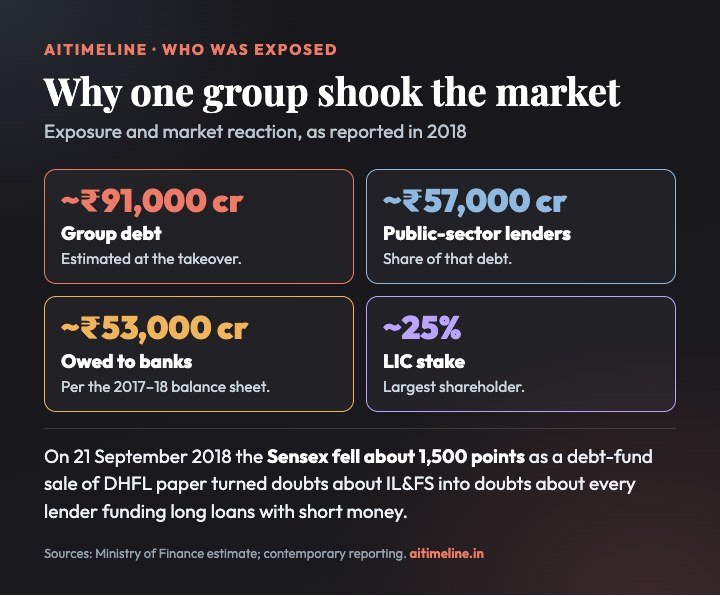
- March 2018: group debt is estimated at about ₹91,000 crore, around ₹57,000 crore of it owed to public-sector lenders.
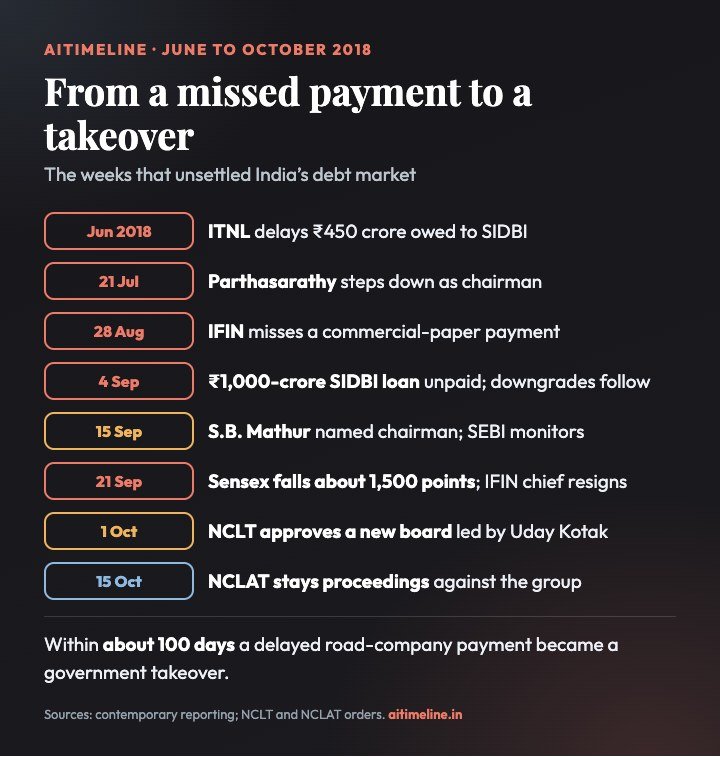
- June 2018: ITNL delays a ₹450-crore repayment, the first domino.
- 4 September 2018: a ₹1,000-crore SIDBI loan goes unpaid and downgrades follow.
- 21 September 2018: a mutual fund’s paper sale sets off a market rout; the Sensex falls about 1,500 points.
- 1 October 2018: the NCLT suspends the board and approves a Kotak-led replacement.
- 15 October 2018: the NCLAT stays proceedings against the group, preventing a creditor stampede.
- 2019–2022: accounts are reopened, entities are sorted by health, and interim distributions are approved.
- 30 June 2026: ₹50,387 crore discharged against a ₹61,000-crore target; 205 of 302 entities resolved.
- September 2026: the Supreme Court stays the NCLAT order on the ₹1,080-crore SREI-linked dispute.
Debt, Target, Discharged: Which Number Is Which?
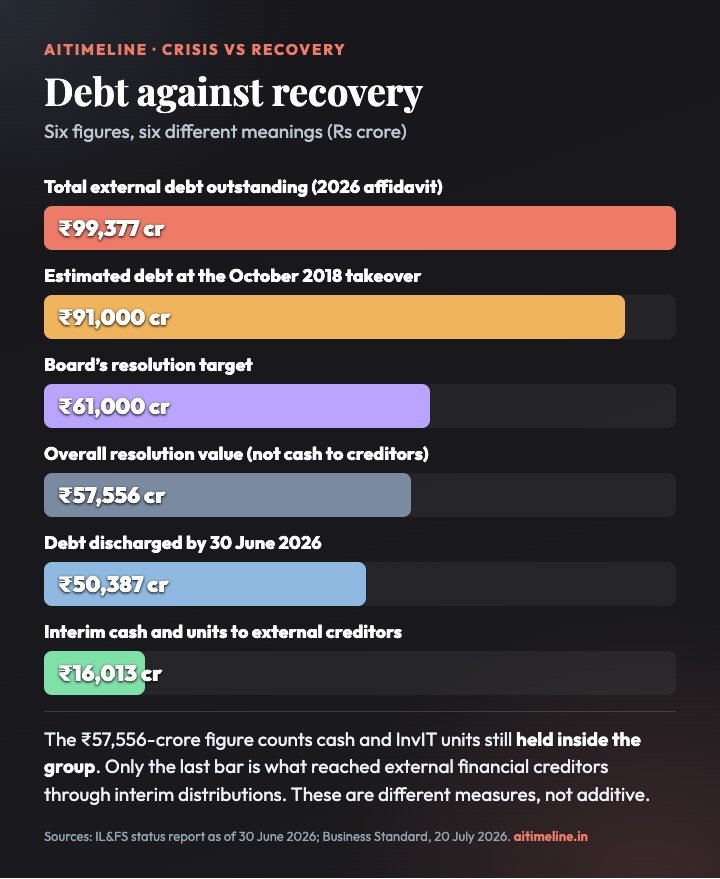
Six figures, six different meanings.
| Figure | What it measures |
|---|---|
| ~₹91,000 crore | Group debt estimated at the October 2018 takeover; about ₹57,000 crore owed to public-sector lenders |
| ~₹99,377 crore | Total external debt outstanding cited in IL&FS’s June 2026 affidavit |
| ₹61,000 crore | The board’s aggregate debt-resolution target |
| ₹50,387 crore | Debt discharged by 30 June 2026 (about 83% of the target) |
| ₹57,556 crore | Overall resolution value, counting cash and InvIT units held inside the group |
| ₹16,013 crore | Interim distributions to external financial creditors (₹18,398 crore in all) |
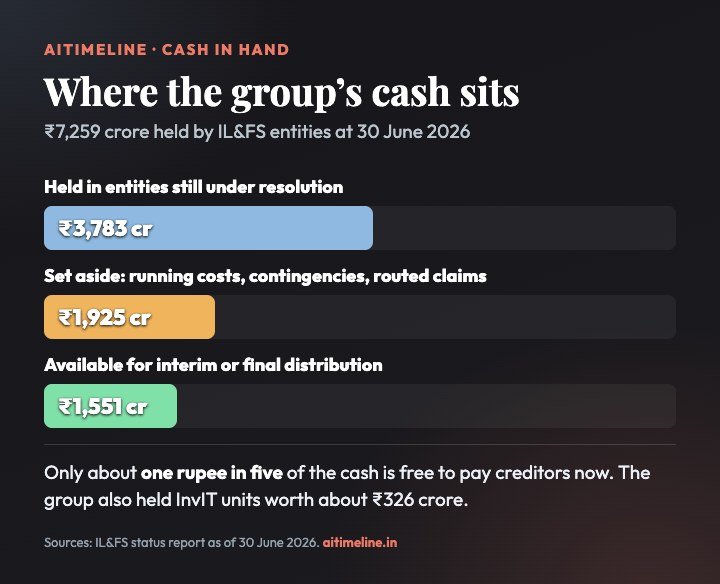
| ₹7,259 crore | Cash held by the group; ₹1,551 crore available for distribution |
The Discover headline’s ₹99,000 crore is the total external debt outstanding as IL&FS now reports it. It is not the 2018 estimate (about ₹91,000 crore), and it is not what has been recovered. The ₹61,000-crore target was always lower than the debt, so even full success against it would leave much of the debt unresolved. These figures should not be added together as separate repayments.
How the Group’s Model Created the Risk
Long projects, short funding, many entities.
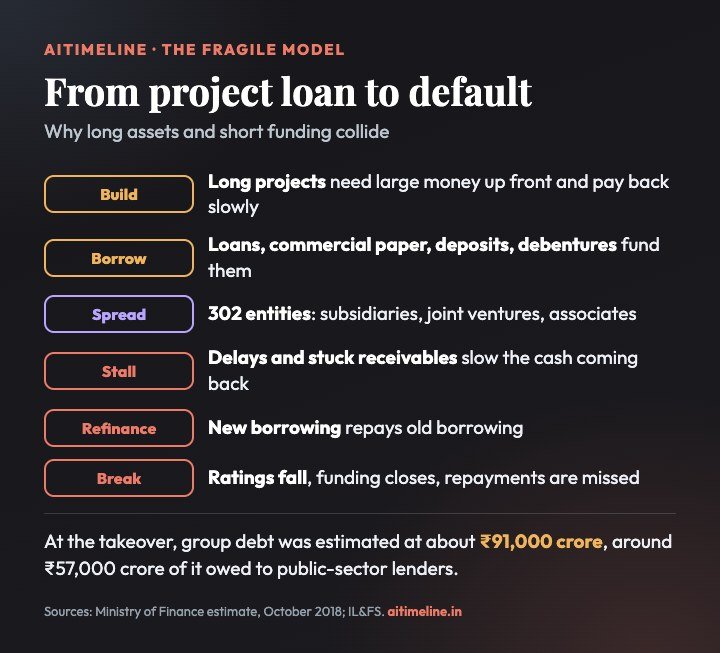
Infrastructure projects need large sums up front and pay back slowly. IL&FS and its subsidiaries met the gap with loans, commercial paper, inter-corporate deposits and debentures, so the model worked only while lenders kept rolling over. At the takeover, the group had 302 entities, 169 domestic and 133 offshore, so it was hard for a lender to see where the risk really sat.
Timeline: From the First Project Loans to the Supreme Court
Newest first. Colour shows which strand each event belongs to.
M. Nagaraju Maddirala becomes chairman and managing director Government and board
The change: The Mumbai bench of the NCLT appointed Nagaraju Maddirala, a retired 1993-batch IAS officer and former Secretary in the Department of Financial Services, to the IL&FS board on 1 October 2026. The Ministry of Corporate Affairs then designated him chairman and managing director for two years from the day he takes charge.
Whom he follows: Nand Kishore, a member of the first Kotak-led board of October 2018 and later its chairman and managing director, completed his tenure in that post on 30 September 2026.
Supreme Court stays the NCLAT order on the ₹1,080-crore transactions Tribunals and courts
What happened: The Supreme Court stayed the operation of the NCLAT’s 30 June order, which had revived IL&FS’s plea to unwind six lending transactions worth ₹1,080 crore. Senior Advocate Shyam Divan, for SREI, argued that IL&FS had treated the transactions as valid for years. Gopal Sankaranarayanan, for IL&FS, said the NCLT should have examined them on the merits.
What it does not mean: The stay is interim. It does not decide whether the transactions were circuitous or fraudulent, only that the NCLAT’s revival of the plea is paused while the Supreme Court considers the challenge.
NCLAT upholds the SFIO’s right to seek disgorgement from auditors Investigation and audit
The ruling: The NCLAT dismissed appeals by the audit firm BSR & Associates and a former partner, N. Sampath Ganesh, who had challenged the Serious Fraud Investigation Office’s authority to file disgorgement proceedings for the Union government. The tribunal said the SFIO’s report goes to the Central Government, which decides whether to file.
What it does not decide: Disgorgement proceedings are about recovering gains. The ruling settles who may bring the case, not whether any auditor is liable.
Status report: ₹50,387 crore discharged against a ₹61,000-crore target Recovery and payouts
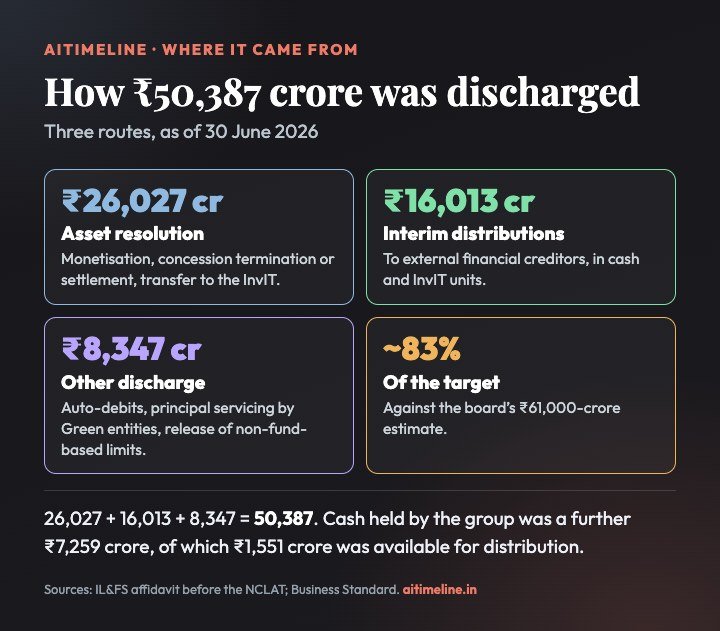
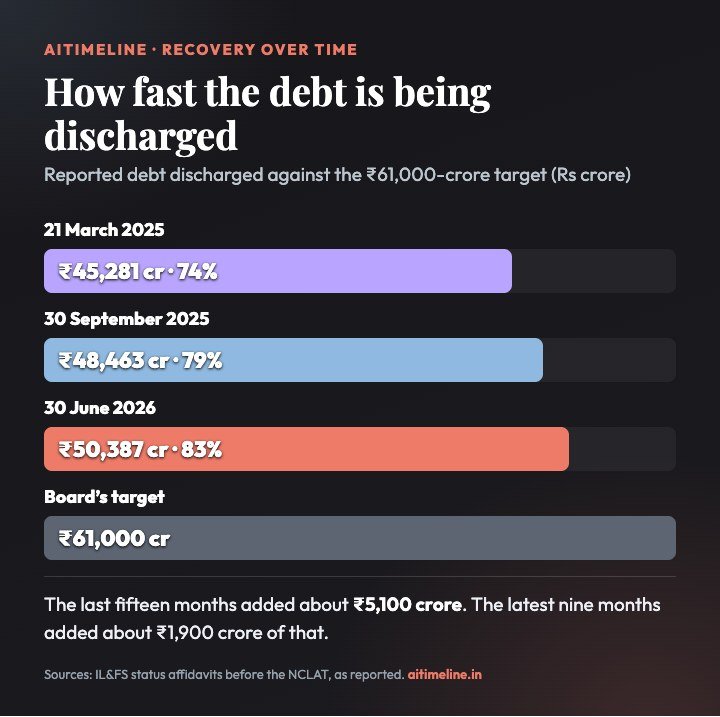
The figures: As of 30 June 2026 IL&FS reported ₹50,387 crore of debt discharged, about 83% of the ₹61,000-crore target: ₹26,027 crore through asset monetisation, concession termination or settlement, and transfer to the InvIT; ₹16,013 crore through interim distributions to external financial creditors; and about ₹8,347 crore through auto-debits, principal servicing by Green entities and release of non-fund-based limits.
The wider measure: Counting cash and InvIT units still held inside the group, the overall resolution value was ₹57,556 crore, more than 94% of the target. That is not money paid to creditors. Cash held by the group was ₹7,259 crore, of which ₹1,551 crore was available for distribution.
The entities: Resolution was complete for 205 of the original 302 entities. About 240 had reached an advanced or concluded stage, 128 had been released from the moratorium and 41 still needed its protection.
NCLAT sets aside the NCLT order and revives IL&FS’s applications Tribunals and courts
The order: The NCLAT held that the NCLT had misread its own order of 16 January 2025 by treating transactions as capable of being collapsed only if all parties consented. It said the consent provision could not be used to bar scrutiny of allegedly sham or fraudulent transactions. It set aside the 13 April order and revived IL&FS’s application and SREI’s two applications for fresh decision.
The money: Amounts payable to SREI out of the resolution of IL&FS group entities are to stay in an escrow account until the NCLT decides the applications afresh.
NCLT Mumbai refuses to unwind six transactions Tribunals and courts
What it held: The NCLT Mumbai bench rejected IL&FS’s application to declare six transactions between IL&FS Financial Services and SREI group entities sham, circuitous and fraudulent, and allowed SREI Infrastructure Finance’s applications. It held that IL&FS, having treated the loans as independent, valid and enforceable since 2019, could not now take a contradictory stand.
The amount: The transactions were lending arrangements between March 2017 and March 2018 aggregating ₹1,080 crore. IL&FS appealed to the NCLAT.
Debt discharged reaches ₹48,463 crore Recovery and payouts
What was reported: IL&FS reported ₹48,463 crore of debt discharged as of 30 September 2025, up from ₹45,281 crore at 21 March 2025, when 197 of 302 entities had been resolved. The figure included asset monetisation, principal servicing by operating group entities, release of non-fund-based limits and interim distributions. The group then held ₹8,575 crore in cash, of which ₹406 crore was available for distribution.
NCLAT allows only consensual unwinding of circuitous transactions Tribunals and courts
The order: On applications to unwind circuitous transactions involving IL&FS, its lending arm and SREI group entities, the NCLAT allowed those that all sides had agreed to unwind. For the rest it indicated that a closer examination was needed in the proper proceedings.
Why it mattered: The NCLT read this order in April 2026 as barring unwinding without consent. The NCLAT said that reading was wrong.
NCLAT approves interim distribution to creditors Recovery and payouts
The order: The NCLAT approved an interim distribution of about ₹16,361 crore to financial creditors, around ₹11,296 crore in cash and ₹5,065 crore in InvIT units. Payments were to be pro rata, only after the new board approved them, and creditors had to undertake to refund any excess when the final resolution was settled.
Cash and units: Because part of each payout was in InvIT units, “debt discharged” and “cash received” are different things, a distinction the later status reports keep.
SEBI raises the penalty on three rating agencies to ₹1 crore each Group and markets
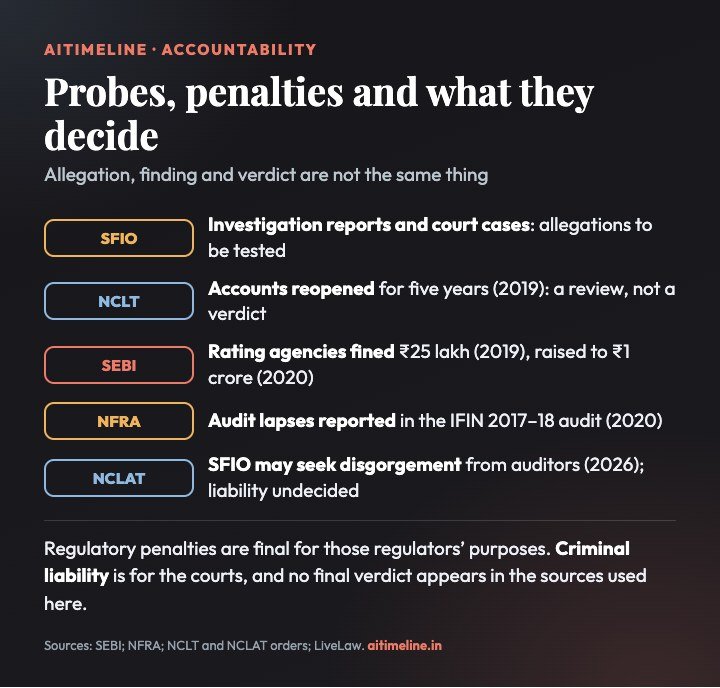
What changed: SEBI raised its penalty on ICRA, CARE and India Ratings to ₹1 crore each, over lapses in rating IL&FS debentures. Its earlier order of December 2019 had fined each ₹25 lakh.
The finding: SEBI said the agencies relied too heavily on management’s assurances and failed to exercise due diligence, and that ratings stayed high even after IL&FS Transportation Networks had defaulted.
The audit regulator reports on the IFIN audit Investigation and audit
What it found: The NFRA, set up on 1 October 2018, reported serious lapses in the 2017–18 statutory audit of IL&FS Financial Services, which was done jointly by Deloitte Haskins & Sells and BSR & Associates. It was among its first quality reviews.
Caution: These are regulatory findings about audit quality. Later orders and appeals decide what follows for the firms, so they are not a conviction of any person.
NCLAT accepts a pro-rata framework for creditors Tribunals and courts
What was approved: The NCLAT accepted a pro-rata distribution framework for creditors, as the government had proposed, and a separate framework suggested by SBI for Red and Amber entities. It also confirmed its stay of October 2018, which has itself been challenged before the Supreme Court.
Not the classification: The Green, Amber and Red classification dates from the new board’s work in late 2018 and early 2019. The March 2020 order dealt with how creditors would share recoveries.
SEBI fines three rating agencies ₹25 lakh each Group and markets
The order: SEBI’s adjudicating officer fined each agency ₹25 lakh for failing to exercise due diligence in rating IL&FS debentures. As reported, the order criticised “lethargic indifference”, “needless procrastination” and laxity, and said high ratings had rested largely on the group’s parentage and management’s assurances.
NCLAT lets 22 group companies service their debt Tribunals and courts
The order: The NCLAT allowed 22 IL&FS group companies to pay their lenders, lifting the stay for them. The new board had sorted entities by a 12-month cash-flow test: Green entities could meet their obligations, Amber ones part of them, and Red ones none.
Why it mattered: It broke the blanket stay of October 2018. Healthy businesses could pay their own debts and the rest were held back for the resolution plan.
NCLT lets the government reopen three companies’ books Investigation and audit
The order: The NCLT allowed the government to reopen and recast the accounts of IL&FS, IL&FS Financial Services and IL&FS Transportation Networks for the five years from 2012–13 to 2017–18 under section 130 of the Companies Act. The NCLAT dismissed an appeal by a suspended director on 31 January 2019, and the Supreme Court later upheld both.
Why it mattered: It was the first time the government sought to reopen such accounts. The aim was to see whether earlier statements had been misstated.
SFIO submits its interim report Investigation and audit
What it is: The SFIO, which began investigating on the government’s order after the takeover, sent its interim report to the Ministry of Corporate Affairs on 30 November. It was placed before the NCLT on 3 December.
Caution: An investigation report, and later prosecutions, set out allegations to be tested in court. They are not findings of guilt against everyone named.
The new board says the group cannot be sold whole Government and board
The plan: The new board told the NCLT that a single solution for the whole group, with about ₹91,000 crore of debt, was not realistic. It proposed resolving the group business by business and asset by asset instead.
The Kotak board files its first report Government and board
The report: The new board sent its first progress report to the ministry on 30 October and filed it with the NCLT on 31 October. It set out the group’s key challenges and a range of resolution options, and said large parts of the group had in the past been run as a single enterprise with no boundaries between entities.
Group lending: The board told the tribunal that IL&FS Financial Services’ exposure to group companies appeared, prima facie, to be well above RBI norms in each of 2015–16 to 2017–18. That was the board’s preliminary assessment, not a finding by a court.
NCLAT stays proceedings against the group Tribunals and courts
What happened: The NCLT had declined the government’s request for a moratorium on 12 October. On appeal, the NCLAT on 15 October stayed proceedings by any party against IL&FS and its subsidiaries, including action to enforce security. Public-sector lenders were later told not to take coercive action.
Why it mattered: It stopped a race among creditors for the group’s assets and gave the new board time. The order was later challenged in the Supreme Court.
Government replaces the IL&FS board Government and board
What happened: On the Ministry of Corporate Affairs’ application, the NCLT Mumbai bench suspended the existing board and approved a new one: Uday Kotak as non-executive chairman, with Vineet Nayyar, G.N. Bajpai, G.C. Chaturvedi, Malini Shankar and Nand Kishore. The government said the company’s affairs were being run in a manner prejudicial to public interest.
The stakes: The government told the tribunal that the group’s collapse could cascade to mutual funds. The Ministry of Finance estimated group debt at about ₹91,000 crore, of which about ₹57,000 crore was owed to public-sector lenders.
AGM approves a rights issue and a higher borrowing limit Group and markets
What was approved: Shareholders backed raising ₹4,500 crore through a rights issue and lifting the borrowing limit from ₹25,000 crore to ₹35,000 crore. The company named Alvarez & Marsal to run its debt restructuring.
The RBI meets the major shareholders Group and markets
What happened: The RBI met IL&FS’s top shareholders and raised its concerns about the crisis. LIC was the largest, with about 25%. The day before, IL&FS Financial Services had told the stock exchange it had missed payments on a ₹52.4-crore short-term deposit and a ₹104-crore term deposit.
SIDBI threatens legal action; the group loses commercial-paper access Group and markets
What happened: According to reports at the time, SIDBI said it could go to the NCLT over non-payment, the group lost access to the commercial-paper market for up to six months after a missed repayment, and the board approached the NCLT to work out an arrangement with shareholders and creditors.
A mutual fund’s paper sale sets off a market panic Group and markets
The panic: A sale of Dewan Housing Finance commercial paper by DSP Mutual Fund at a high yield set off a rout. The Sensex fell about 1,500 points as investors questioned the model of financing long loans with short-term borrowing.
The resignation: Ramesh C. Bawa, managing director and chief executive of IL&FS Financial Services, resigned the same day.
S.B. Mathur is named chairman; SEBI says it is monitoring Government and board
What happened: Former LIC chairman S.B. Mathur was named chairman of the IL&FS group, replacing Hemant Bhargava, LIC’s managing director, who had held the post since July. SEBI said it was monitoring the situation, and contagion spread to mutual funds and the debt market.
The group says it is waiting for ₹16,000 crore from government bodies Group and markets
The claim: IL&FS told staff the defaults arose because it had not received about ₹16,000 crore from government agencies, and said it was trying to raise money by selling non-strategic assets, a rights issue and corporate debt.
A ₹1,000-crore loan from SIDBI goes unpaid Group and markets
What happened: IL&FS missed repayment of a ₹1,000-crore short-term loan from SIDBI, as reported at the time. Rating agencies downgraded almost all of the group’s debt instruments in the days after.
IL&FS Financial Services misses a commercial-paper payment Group and markets
What happened: The group’s financial services arm defaulted on commercial paper, then repaid within days. The incident raised fresh doubts about its ability to meet short-term obligations.
Founder Ravi Parthasarathy steps down Group and markets
What happened: Ravi Parthasarathy resigned as chairman, citing health. LIC’s managing director, Hemant Bhargava, who represented the group’s largest shareholder, was elected non-executive chairman at a board meeting shortly after.
IL&FS Transportation Networks delays a ₹450-crore repayment Group and markets
What happened: The group’s road arm delayed repayment of about ₹450 crore of inter-corporate deposits owed to SIDBI. ICRA and CARE downgraded its instruments.
The RBI’s inspection tells IFIN to cut group exposure Group and markets
What was reported: As cited in a later forensic report, the RBI’s inspection report on IL&FS Financial Services, issued in November 2017, advised it to reduce its exposure to group companies and not lend further to them. The same report says IFIN then bought shares from group firms, which the forensic report said gave them funds another way. The primary RBI document is not public, so this is given as reported.
Borrowing grows on long-gestation projects Group and markets
The model: IL&FS and its subsidiaries funded projects with loans, commercial paper, inter-corporate deposits and debentures, relying on refinancing and on recovering money from projects over many years. Delayed projects, cost overruns, disputes and stuck concession payments widened the gap between debt due and cash coming in.
The scale: By March 2018 the group’s debt was estimated at about ₹91,000 crore, around ₹57,000 crore of it owed to public-sector lenders. At the takeover it had 302 entities, 169 domestic and 133 offshore.
IL&FS is established Group and markets
The business: Infrastructure Leasing & Financial Services was set up in 1987 to mobilise long-term money for infrastructure. It grew into a group of subsidiaries, joint ventures and associates across transport, energy, urban services and finance.
Ninety Days in 2018
From a missed payment to a government takeover.
Why Did IL&FS Collapse?
Several linked weaknesses rather than one event.
Too much borrowing
About ₹91,000 crore of debt by March 2018, relying on lenders to keep rolling it over.
Long gestation
Delays in construction, approvals and concession payments stretched the gap between debt due and cash received.
302 entities
A web of subsidiaries and associates made group exposure hard to see.
Money stuck
The group said about ₹16,000 crore was awaited from government agencies; assets on paper were not cash.
Alleged lapses
Investigators examined misstatements, group lending and audit quality. These are allegations and regulatory findings.
Refinancing dependence
Once ratings fell, access to short-term money closed quickly.
How the Resolution Works
A government-appointed board under tribunal supervision.
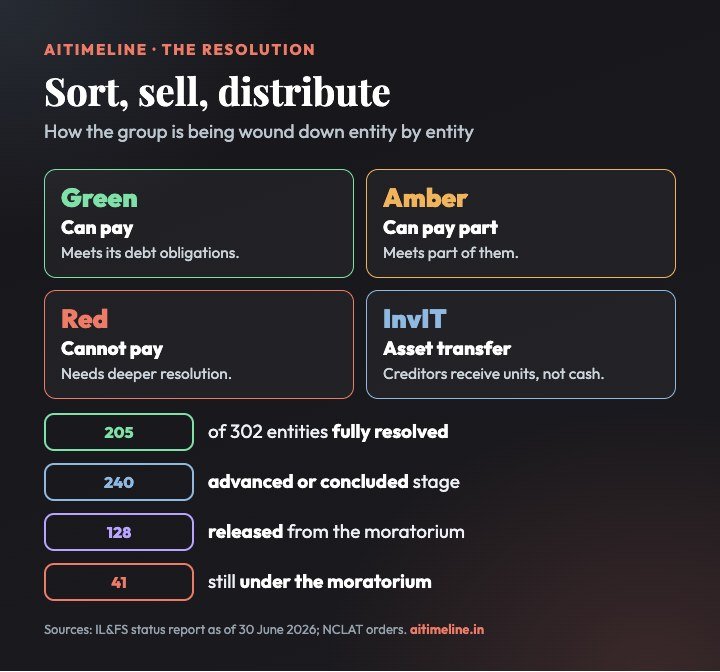
| Mechanism | Purpose |
|---|---|
| Government-appointed board | Replace the old board and stabilise the group |
| NCLT and NCLAT | Supervise and give directions on resolution |
| Green, Amber, Red sorting | Separate entities that can pay from those needing restrictions |
| Asset monetisation | Turn infrastructure holdings into recovery value |
| InvIT transfers | Move operating assets into an investment trust; creditors get units |
| Interim distributions | Return recoveries to creditors before the whole group is resolved |
| SFIO and regulators | Investigate alleged misconduct; address audit and rating lapses |
The ₹1,080-Crore SREI Dispute
Three decisions in six months, none final.
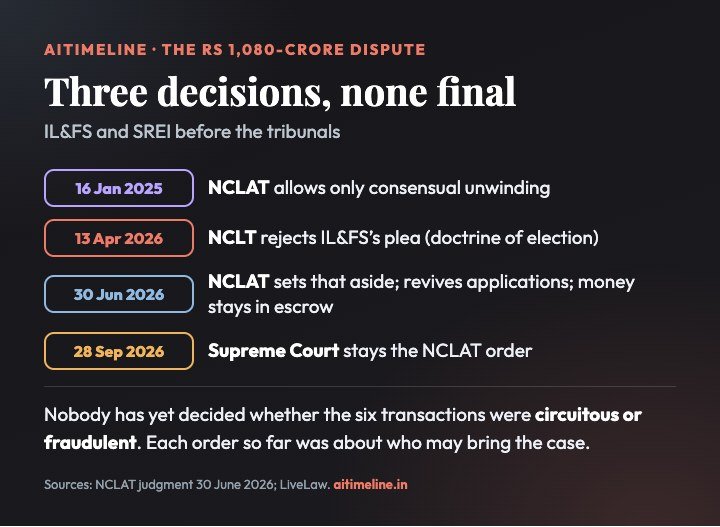
IL&FS says six lending transactions between March 2017 and March 2018 were routed through SREI entities to get around the RBI’s limits on lending to group companies. SREI says IL&FS treated them as valid for years. The merits have not been heard: the NCLT decided on a point of principle, the NCLAT reversed it, and the Supreme Court paused that reversal.
How the Crisis Affected India’s Financial System
Funding got harder
Lenders to non-bank finance and housing finance companies became more cautious after September 2018.
Redemption pressure
Debt funds holding IL&FS-linked paper faced valuation concerns and withdrawals.
Penalised by SEBI
ICRA, CARE and India Ratings were fined ₹25 lakh each in December 2019, raised to ₹1 crore in September 2020.
Under scrutiny
The NFRA reported lapses in the IFIN audit, and the SFIO is pursuing disgorgement.
Group lending
Related-party lending, disclosure and board oversight drew more attention.
Confidence shock
The failure of a major borrower raised questions about long-term funding for the sector.
What Is Established, and What Is Not?
| Matter | Status, November 2026 |
|---|---|
| Government takeover | Done on 1 October 2018 by NCLT order |
| Debt resolution | ₹50,387 crore discharged by 30 June 2026; unfinished |
| SFIO investigation and prosecutions | Allegations to be tested in court; no final verdict reported in sources used here |
| Auditor liability | NFRA lapses reported; SFIO disgorgement authority upheld; liability undecided |
| Rating agencies | SEBI penalties imposed in 2019 and 2020 |
| ₹1,080-crore dispute | NCLAT order stayed by the Supreme Court; merits undecided |
Lessons from IL&FS
- Match funding to assets: short-term borrowing against long projects is a refinancing bet.
- Look at cash, not value: receivables stuck in disputes do not service debt.
- Read the group: exposure across hundreds of entities needs consolidated disclosure.
- Test the early warnings: ratings, audits and inspections only help if they are acted on.
- Separate allegation from finding: investigations and tribunal orders are steps, not verdicts.
- Expect a long tail: eight years in, hundreds of entities and a Supreme Court stay show how slow clean-up can be.
Key People and Institutions
Uday Kotak
Led the board approved by the NCLT on 1 October 2018.
Vineet Nayyar
Senior member of the new board during the resolution.
Ravi Parthasarathy
Stepped down on 21 July 2018, citing health.
M. Nagaraju Maddirala
Designated for two years in October 2026.
SFIO and MCA
The ministry led the takeover; the SFIO investigated.
RBI, SEBI, NFRA
Inspection, rating-agency penalties and audit-quality review.
Explore More Timelines
People Also Ask
Frequently Asked Questions
Checked against tribunal orders, IL&FS filings and contemporary reporting.
⚠️ Editorial Note
Debt discharged, overall resolution value, cash distributed to external creditors and the value of assets monetised are different measures and should not be added together as separate repayments. Investigations, regulatory findings and tribunal orders are not criminal convictions, and this page makes no claim of guilt against any person. The latest published status figures are as of 30 June 2026. Checking the brief this page began from: the Green, Amber and Red classification dates from the new board’s work in 2018–19 and the NCLAT’s order of 11 February 2019, while the 12 March 2020 order approved a pro-rata distribution framework; SEBI’s first penalty on the three rating agencies was in December 2019 (₹25 lakh each), raised to ₹1 crore in September 2020; Hemant Bhargava was elected chairman a few days after 21 July and was replaced by S.B. Mathur on 15 September 2018; the asset-sale plan was announced on 12 September; the NFRA was constituted on 1 October 2018 and its audit-quality report on IFIN came in 2020; and the brief’s figure of 62 entities awaiting decisions was not found, so the 41 entities IL&FS reports as still under the moratorium are used.
Related Reading on AiTimeline
Sources & further reading
Every dated entry above was checked against these references. Last reviewed 9 November 2026.
- IL&FS: Group repays ₹50,387 crore debt by June 2026, status report summary (NCLAT affidavit as of 30 June 2026)
- IL&FS: Group resolves over ₹57,500 crore of debt, nearing end of clean-up (July 2026)
- Business Standard: IL&FS Group repays ₹50,387 cr debt by June 2026, achieves 82.6% of target
- NCLAT: Infrastructure Leasing & Financial Services Ltd v. Union of India, Comp. App. (AT) 143-145 of 2026, judgment of 30 June 2026
- LiveLaw: NCLT Mumbai refuses to unwind IL&FS-SREI transactions, applies doctrine of election (13 April 2026)
- LiveLaw: Supreme Court stays NCLAT order reviving IL&FS plea over ₹1,080 crore SREI-linked transactions (28 September 2026)
- LiveLaw: NCLAT upholds SFIO's authority to file disgorgement proceedings in the IL&FS Securities Services matter (25 August 2026)
- Business Today: Ex-IAS officer Nagaraju Maddirala appointed Chairman, MD of IL&FS (13 October 2026)
- Business Standard / PTI: NCLAT stays proceedings against IL&FS group companies (15 October 2018)
- Business Standard: RBI asks IL&FS Financial to reduce loans to group firms by March 2019 (21 August 2018)
- Free Press Journal: NCLAT directs distribution of ₹16,361 crore to IL&FS creditors on pro-rata basis (31 May 2022)
- The Week / PTI: IL&FS case, SEBI raises penalty to ₹1 crore each on three rating agencies (22 September 2020)
- The Week / PTI: IL&FS, NFRA finds lapses in 2017-18 statutory audit (17 August 2020)