Pentagon Papers: Timeline of Publication, the Leak and the Supreme Court Ruling
In June 1971, a classified US government study exposed years of decision-making behind America’s involvement in Vietnam. The Pentagon Papers triggered a
Latest Story
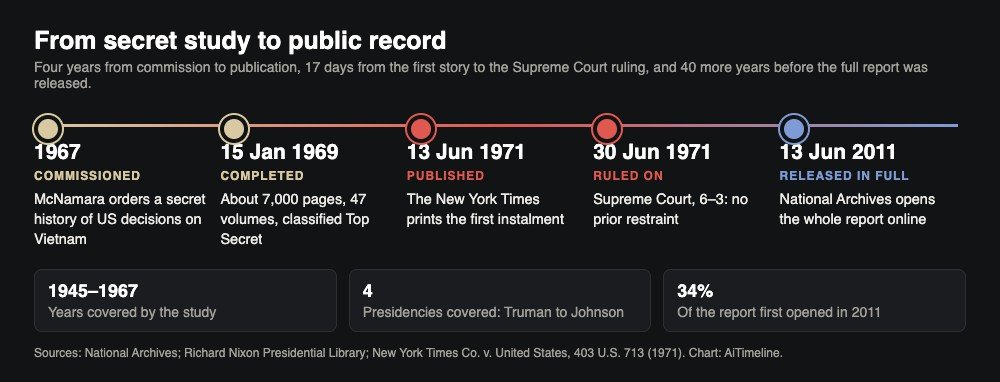
The Pentagon Papers were a classified US Defense Department history of American decision-making in Vietnam from 1945 to 1967. Commissioned by Defense Secretary Robert McNamara in 1967, the study became a national controversy in June 1971, when The New York Times began publishing excerpts supplied by former analyst Daniel Ellsberg. The Nixon administration went to court to stop publication. On 30 June 1971 the Supreme Court ruled 6–3 in New York Times Co. v. United States that the government had not justified this prior restraint. The ruling protected the right to publish; it did not decide whether obtaining or leaking the documents was lawful.
💡 Short Answer
The Pentagon Papers were a 7,000-page secret Defense Department study of US policy in Vietnam from 1945 to 1967. Daniel Ellsberg leaked it, and The New York Times began publishing it on 13 June 1971. When the government obtained court orders to stop the Times and the Washington Post, the Supreme Court ruled 6–3 on 30 June 1971 that it had not met the heavy burden needed to block publication in advance. The ruling did not make the leak lawful; Ellsberg was prosecuted, and his case was dismissed in 1973 for government misconduct.
Pentagon Papers: Key Questions
The Pentagon Papers in Nine Points
- The study: commissioned in June 1967, completed on 15 January 1969, classified Top Secret.
- Scope: US decisions on Vietnam under Truman, Eisenhower, Kennedy and Johnson, 1945–1967.
- The leak: Daniel Ellsberg began copying it in October 1969 and gave it to the Times in 1971.
- Publication: the Times on 13 June 1971, the Post on 18 June, the Boston Globe on 22 June.
- Restraint: a court halted the Times series on 15 June, after three instalments.
- Ruling: the Supreme Court lifted the restraints 6–3 on 30 June 1971.
- The distinction: the right to publish was protected; the legality of obtaining and leaking the documents was not decided.
- Prosecution: charges against Ellsberg and Russo were dismissed on 11 May 1973 over government misconduct.
- Full record: the National Archives released the complete report on 13 June 2011.
Pentagon Papers Timeline: Key Events, Latest First
From the full release and Ellsberg’s death back to the study’s origins. Each entry is tagged and ends with why it matters.
2023
Daniel Ellsberg dies at 92 Legacy
Ellsberg died of pancreatic cancer, three days after the 52nd anniversary of the Times’ first story. For the rest of his life he campaigned against nuclear weapons and spoke in defence of later leakers of classified material, arguing that the Espionage Act should allow a public-interest defence. It still does not.
Neil Sheehan, the Times reporter who obtained the papers from him, had died in January 2021. Anthony Russo died in 2008 and Robert McNamara in 2009.
2011
The complete Pentagon Papers are released Legacy
Forty years to the day after the first Times instalment, the National Archives released the whole report, titled United States–Vietnam Relations, 1945–1967: about 7,000 pages in 47 volumes, declassified and unredacted, in reading rooms and online (National Archives press release). About 2,384 pages, 34% of the report, were opened for the first time compared with the 1971 Senator Gravel edition (National Archives Pentagon Papers collection).
The 1971 newspaper stories had covered only a small part of the study, and the printed editions of that year were incomplete or partly redacted. Ellsberg and Russo had not copied Part VI on negotiations, which the State Department had declassified separately in 2002.
1973
Judge dismisses all charges against Ellsberg and Russo Prosecution
Judge Byrne threw out the case because of government misconduct. On 26 April prosecutors had told him that White House operatives had burgled the office of Ellsberg’s psychiatrist in 1971; records of an FBI wiretap that picked up Ellsberg were then found to be missing, and it emerged that a White House aide had discussed the FBI directorship with the judge during the trial (trial chronology).
The dismissal was not an acquittal, and no court ruled on whether copying and leaking the study had been lawful. Because of how the case ended, it cannot be retried.
1973
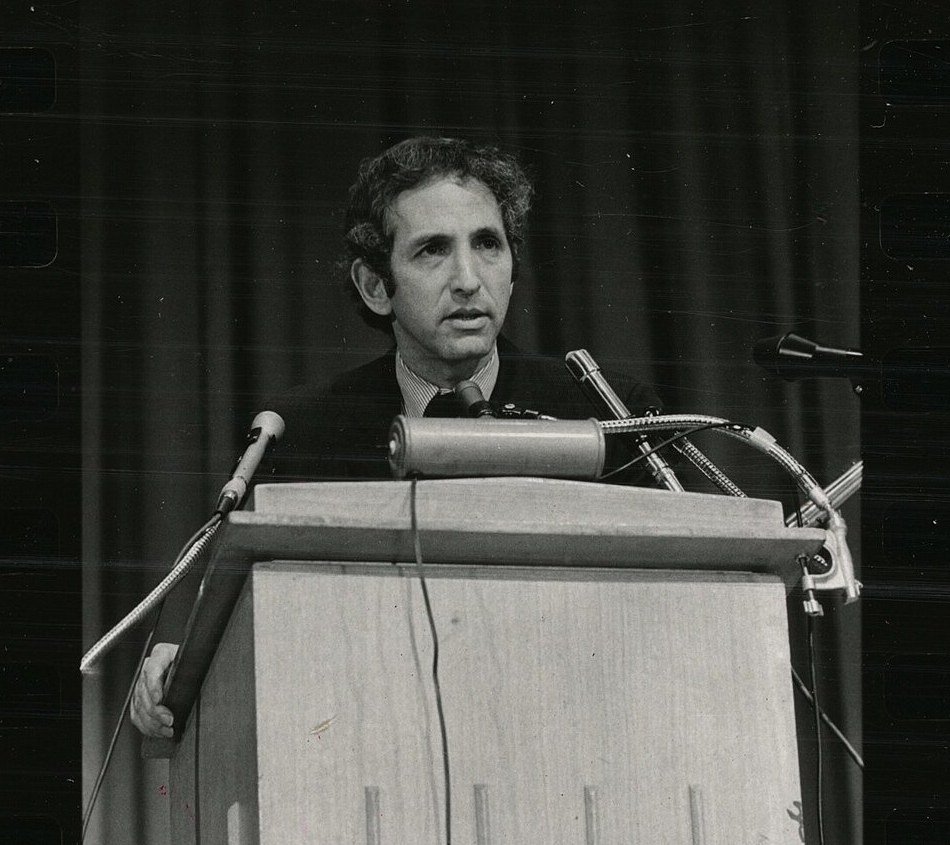
Second trial of Ellsberg and Russo begins Prosecution
The trial began in Los Angeles in January 1973, the Nixon Library records (Nixon Library), with opening statements on 17 January. It was the second attempt: a first jury had been seated in 1972, but proceedings were halted on 29 July 1972 after the defence learned the government had overheard a defendant on a wiretap, and Judge Byrne declared a mistrial on 12 December 1972.
Ellsberg faced 12 counts and Russo three, including conspiracy, theft of government property and Espionage Act charges, which together carried a theoretical maximum of more than 100 years in prison for Ellsberg.
1971
New 15-count indictment adds Anthony Russo Prosecution
A superseding indictment replaced the first one against Ellsberg and named Anthony Russo, his former RAND colleague, who had helped him photocopy the study in 1969. Russo had already spent six weeks in jail for refusing to testify to the grand jury (trial chronology).
1971
White House ‘Plumbers’ burgle Ellsberg’s psychiatrist Prosecution
A unit set up in the White House to stop leaks, later known as the Plumbers, broke into the office of Dr Lewis Fielding looking for material to discredit Ellsberg. The idea had appeared in a June 1971 memo by E. Howard Hunt headed “Neutralization of Ellsberg” (trial chronology). The Oval Office tapes record how angry Nixon and his aides were over the leak.
The burglars found nothing useful. Some of the same men were arrested at the Watergate building nine months later.
1971
Supreme Court rules 6–3 against prior restraint Supreme Court
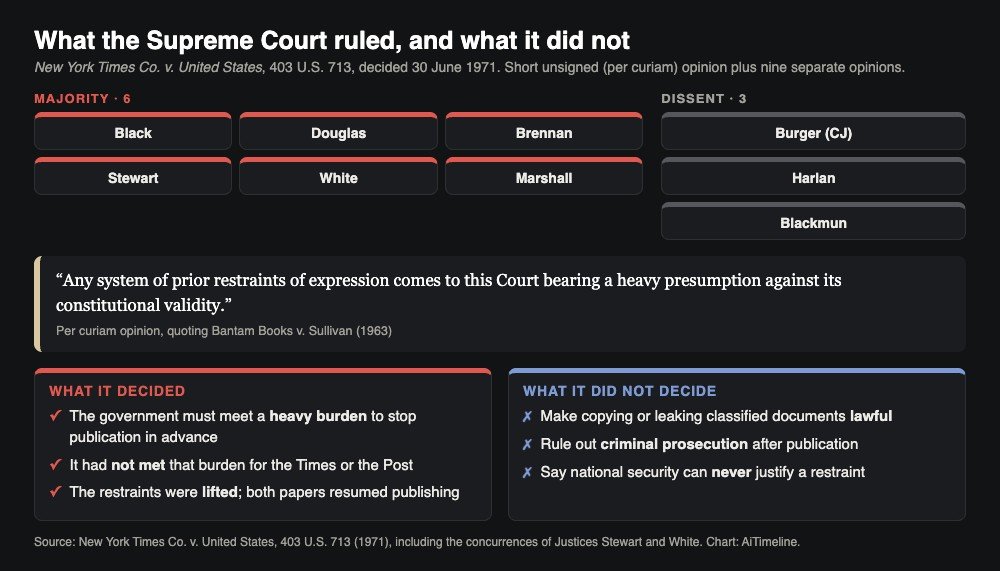
Four days after hearing argument, the Court held that the government had not met the “heavy burden” needed to justify stopping publication in advance. Its short unsigned opinion repeated that “any system of prior restraints of expression comes to this Court bearing a heavy presumption against its constitutional validity” and agreed with the lower courts that this burden had not been met (full opinion, Cornell LII). The Times and the Post resumed publication the next day.
Justices Black, Douglas, Brennan, Stewart, White and Marshall formed the majority; Chief Justice Burger and Justices Harlan and Blackmun dissented, saying the Court had acted too fast. Justices Stewart and White wrote that criminal prosecution after publication was a separate question the case did not decide.

1971
Ellsberg surrenders and is indicted The leak
After about two weeks in hiding, during which he passed copies to other newspapers, Ellsberg surrendered at the federal courthouse in Boston. The same day a Los Angeles grand jury indicted him on charges of theft and violating the Espionage Act (trial chronology). He told reporters he had acted to end the war.
On the night of 29 June, Senator Mike Gravel of Alaska read from the papers at a Senate subcommittee hearing he chaired; Beacon Press later published his copy as the four-volume Gravel edition.
1971
Supreme Court hears the newspapers’ cases Supreme Court
The Court agreed on 25 June to hear both cases together and heard argument the next day, a Saturday, about two weeks after the first story ran. Solicitor General Erwin Griswold argued that specific items in the study could harm military operations, diplomacy and the return of prisoners of war. Alexander Bickel argued for the Times and William Glendon for the Post.
Both newspapers stayed under restraint while the Court considered the case. The question was not whether the papers were classified, but whether the government could get a court to stop publication beforehand.
1971
Courts split; the Boston Globe and others publish Publication
On 23 June the full DC Circuit voted 7–2 to uphold Judge Gesell’s refusal to block the Post, while in New York the Second Circuit returned the Times case to Judge Gurfein for more secret hearings, leaving the restraint in place. The two newspapers were now under different rulings on the same documents.
The Boston Globe began printing its own excerpts on 22 June, and the government sought injunctions against it and the St. Louis Post-Dispatch (trial chronology). Ellsberg passed copies to more than a dozen outlets in all (National Archives).
1971
The Washington Post publishes; Judge Gesell refuses to stop it Publication
The Post began publishing on 18 June from its own copy, obtained by editor Ben Bagdikian from Ellsberg, after publisher Katharine Graham approved the decision. The government sued it the same day. On 19 June Judge Murray Gurfein refused a preliminary injunction against the Times, writing that the government had not shown a threat to national security, but the restraint stayed in force while the government appealed.
On 21 June Judge Gerhard Gesell in Washington likewise refused an injunction against the Post. An appeals panel had already ordered the Post to stop temporarily on 19 June.
1971
Court order halts the New York Times series Publication
After the Times refused to stop, the Justice Department asked the federal court in Manhattan for an injunction. Judge Gurfein, in his first days on the bench, issued a temporary restraining order after the third instalment had run (Nixon Library). It is widely described as the first time the federal government had obtained a court order stopping a newspaper from publishing on national-security grounds.
1971
Attorney General Mitchell demands the Times stop Publication
On the day the second instalment ran, Attorney General John Mitchell told the Times that further publication would cause irreparable injury to US defence interests, and asked it to stop and return the documents (Nixon Library). The newspaper said it would contest any legal action. Nixon had first been inclined to stay out of it; aides, including Henry Kissinger, pressed him to act.
1971
The New York Times publishes the first instalment Publication
The first story ran under the headline “Vietnam Archive: Pentagon Study Traces 3 Decades of Growing U.S. Involvement,” with pages of documents (Nixon Library). A team of reporters and editors had worked in secret for weeks; the paper’s own lawyers had advised against publishing.
The Times chose and summarised parts of a much larger study. Not every finding was new, but seeing the government’s own internal account side by side with its public statements was. The coverage won the 1972 Pulitzer Prize for Public Service.
Ellsberg is identified as the source The leak
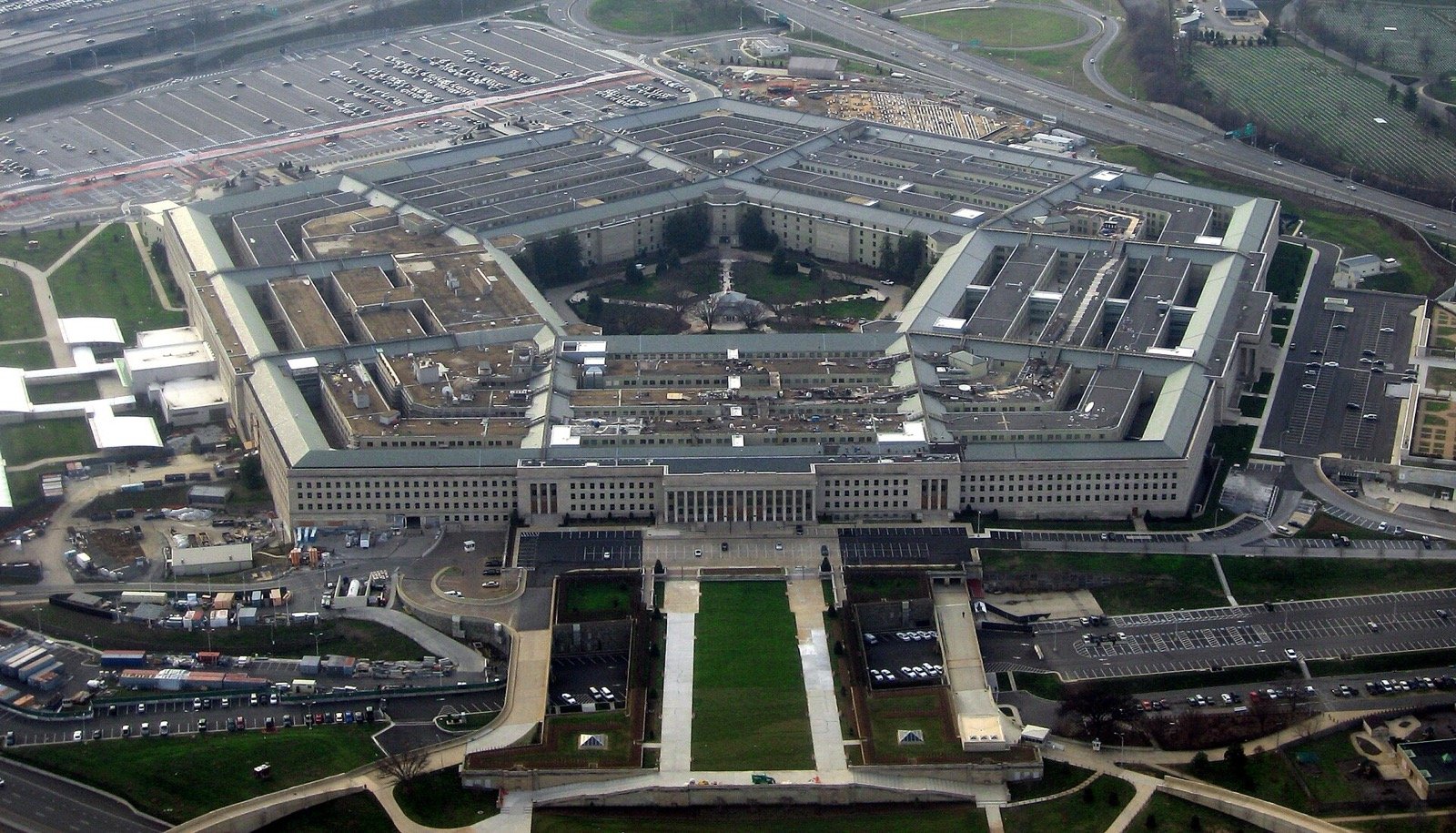
Within days of the first instalment, former Times reporter Sidney Zion named Ellsberg as the source on a New York radio programme. The FBI was already looking for him. Ellsberg went into hiding, moving between motels, and on 16 June gave copies to the Washington Post; on 23 June he spoke to Walter Cronkite of CBS from an undisclosed location (trial chronology).
His role did not become public in “early June”: the newspapers protected their source, and he was identified only after publication began.
Apr 1971
Ellsberg copies the study and gives it to the Times The leak
Ellsberg, by then at the RAND Corporation and holding one of the few copies, began taking volumes from his office safe on 1 October 1969 and photocopying them at night with Anthony Russo. He first tried to get members of Congress to release the study, giving copies to Senator J. William Fulbright, chair of the Foreign Relations Committee, without result (trial chronology).
In March 1971 he met Neil Sheehan of the New York Times and agreed to let the paper have the study (Nixon Library).
1969
The study is completed The study
Leslie Gelb presented the finished report to Clark Clifford, McNamara’s successor (National Archives). It ran to about 7,000 pages in 47 volumes, combining around 3,000 pages of narrative history with about 4,000 pages of government documents, and was classified Top Secret. At least 15 copies were made.
Robert McNamara commissions a secret history of the war The study
Defense Secretary Robert McNamara, increasingly doubtful about the war, ordered a study of how the United States had become involved in Vietnam. Morton Halperin supervised and Leslie Gelb ran the work day to day; some 36 analysts, Ellsberg among them, worked from Pentagon files (Nixon Library).
The period the Pentagon Papers cover The study
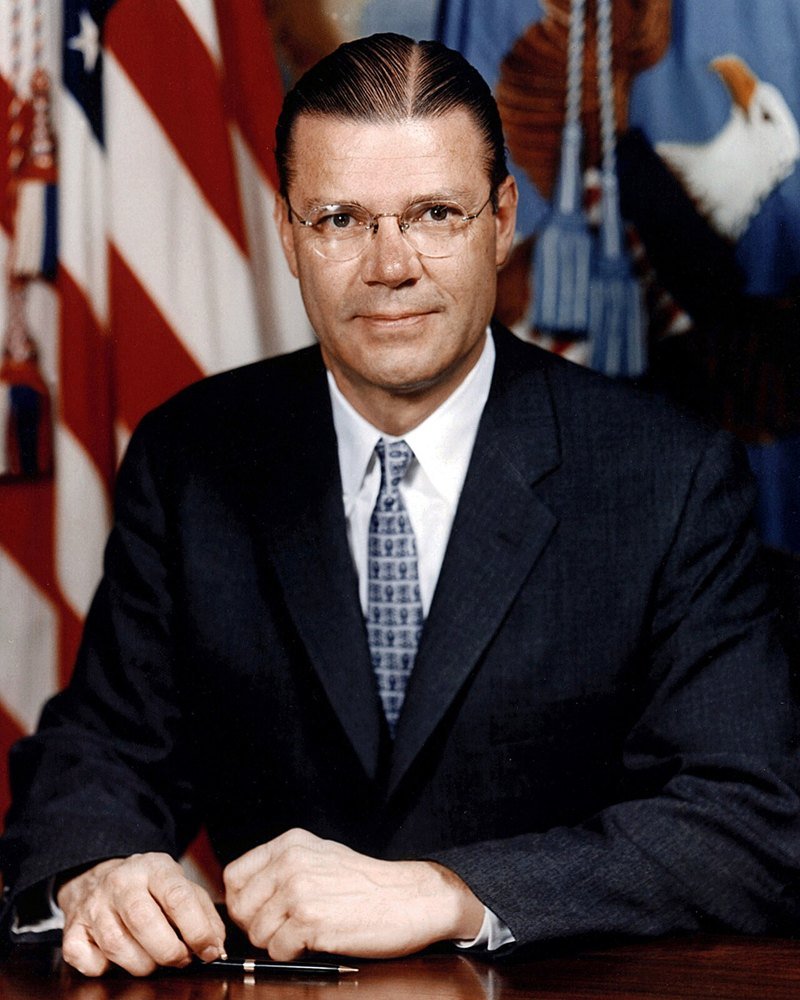
The report traces US policy in Vietnam and Indochina from the end of the Second World War to 1967: support for France’s war, the 1954 Geneva settlement, backing for South Vietnam, the 1963 coup against Ngo Dinh Diem, the 1964 Gulf of Tonkin events and the escalation of 1965.
It is a history of decision-making drawn from government records, not a complete history of the war, and it stops before the Nixon years.
Seventeen Days in June 1971: The Newspapers in Court
How the Pentagon Papers moved from the newsroom to the Supreme Court.
| Date (1971) | New York Times | Washington Post and others |
|---|---|---|
| 13 June | First instalment | — |
| 14 June | Second instalment; Attorney General asks it to stop | — |
| 15 June | Third instalment; temporary restraining order | — |
| 18 June | Under restraint | Post publishes; government sues |
| 19 June | Judge Gurfein refuses injunction; restraint kept pending appeal | Appeals panel temporarily bars the Post |
| 21 June | Under restraint | Judge Gesell refuses injunction |
| 22 June | Under restraint | Boston Globe publishes |
| 23 June | Second Circuit sends case back for more hearings | DC Circuit, 7–2, sides with the Post |
| 25–26 June | Supreme Court takes the case and hears argument | Cases heard together |
| 30 June | Supreme Court lifts restraint, 6–3 | Supreme Court lifts restraint, 6–3 |
Why Did the Supreme Court Rule in Favour of Publication?
The constitutional question was prior restraint: stopping publication before it happens.
The newspapers argued that the First Amendment protected their right to report on a matter of great public importance. The government argued that specific passages could harm military operations, diplomacy and the release of prisoners of war. The Court’s short per curiam opinion held that the government had not met its heavy burden, and each justice then wrote separately. There was no single majority rationale beyond that holding.
| Justice | Vote | Main point of his opinion |
|---|---|---|
| Hugo Black | Majority | The First Amendment bars prior restraint of the press; “only a free and unrestrained press can effectively expose deception in government” |
| William O. Douglas | Majority | No law permits this kind of restraint; secrecy in government is fundamentally anti-democratic |
| William Brennan | Majority | Only proof that publication would inevitably and immediately cause harm of the gravest kind could justify a restraint |
| Potter Stewart | Majority | Restraint would be justified only for direct, immediate and irreparable damage to the nation; prosecution is a separate matter |
| Byron White | Majority | Failing to justify a restraint does not mean the government could not convict a publisher under criminal law |
| Thurgood Marshall | Majority | Congress had not authorised the courts to issue such injunctions |
| Warren Burger (Chief Justice) | Dissent | The case was decided in too much haste; the Times should have given the government a chance to review the material first |
| John Harlan | Dissent | The courts should defer to the executive on foreign affairs; the schedule was too rushed |
| Harry Blackmun | Dissent | The case needed careful, orderly consideration of the possible harms |
The Right to Publish vs the Legality of the Leak
The most misunderstood part of the Pentagon Papers case.
✅ What the ruling protected: the right to publish
- The government could not get a court order stopping the Times and the Post from publishing in advance.
- Any prior restraint carries a heavy presumption against its validity; the government bears a heavy burden to justify it.
- Classification alone, or a general claim of national-security harm, was not enough.
❌ What it did not decide: obtaining or disclosing the documents
- It did not make it lawful to copy, take or leak classified documents. Ellsberg and Russo were still prosecuted.
- It did not rule out criminal prosecution of a publisher after publication; Justices White and Stewart said so explicitly.
- It did not say national security can never justify a restraint, only that it had not been shown here.
This distinction matters because the two questions are often merged. The Supreme Court answered only the first: whether a court could stop publication before it happened. Whether taking and passing on the documents was a crime was a question for the separate prosecution of Ellsberg and Russo, and that case ended in 1973 on the government’s misconduct without any ruling on the merits. Read the full text of the Supreme Court opinion for the nine justices’ own words.
What Did the Pentagon Papers Reveal?
The Pentagon Papers documented how US involvement in Vietnam deepened under four presidents, and how internal assessments often differed from what the public was told. Among the points that drew most attention in 1971:
- Continuity across administrations: commitments made under Truman and Eisenhower, from aid to France’s war to support for South Vietnam, shaped the choices of Kennedy and Johnson.
- The 1963 coup: the study detailed US knowledge of and encouragement for the generals who overthrew South Vietnam’s President Ngo Dinh Diem.
- Planning before the 1964 election: the second Times instalment reported that a consensus to bomb North Vietnam had formed inside the Johnson administration before the 1964 election, while Johnson campaigned on restraint.
- Doubts behind the escalation: officials expressed serious private doubts about the chances of success even as troop numbers rose.
The papers did not prove that every official statement was false, or that every decision had the same motive. Their importance was that journalists, historians and the public could compare the government’s own internal record with its public account. The whole report is now in the National Archives Pentagon Papers collection; the National Security Archive compares the printed editions.
How the Pentagon Papers Led Toward Watergate
The Pentagon Papers and Watergate are separate events, but they are connected. After the leak, the White House set up a unit to stop leaks, later called the Plumbers. On 3 September 1971 its operatives burgled the office of Ellsberg’s psychiatrist, hoping to find material to discredit him.
On 17 June 1972 burglars working for Nixon’s re-election committee were caught inside the Democratic National Committee offices at the Watergate building; E. Howard Hunt and G. Gordon Liddy, who had run the Fielding break-in, organised it. When the earlier burglary came out in April 1973, it ended Ellsberg’s trial. Investigations into the cover-up eventually led to Nixon’s resignation on 9 August 1974.
The leak did not cause Watergate on its own. It was part of the same pattern of secrecy, surveillance and efforts to punish opponents that the investigations exposed. For a wider view of US presidents and the press, see our timeline of White House battles with journalists.
The People Behind the Pentagon Papers
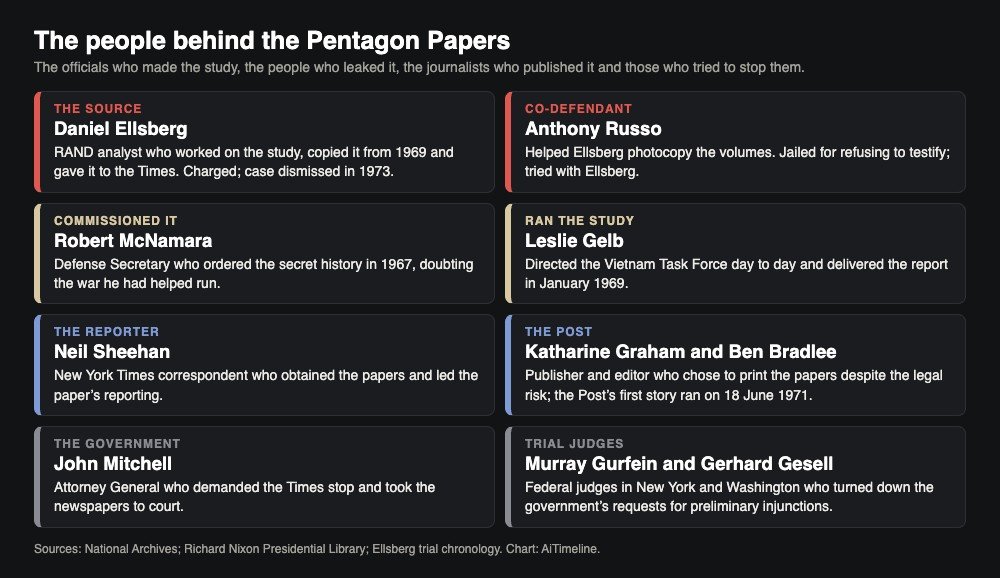
Daniel Ellsberg (1931–2023)
Former Marine and RAND analyst who worked on the study, copied it and gave it to the press. Charged under the Espionage Act; the case was dismissed in 1973.
Anthony Russo (1936–2008)
RAND colleague who helped Ellsberg photocopy the volumes in 1969, was jailed for refusing to testify and was tried alongside him.
Robert McNamara (1916–2009)
Defense Secretary under Kennedy and Johnson who ordered the history in 1967 as his own doubts about the war grew.
Leslie Gelb
Pentagon official who directed the Vietnam Task Force day to day and delivered the finished report in January 1969.
Neil Sheehan (1936–2021)
New York Times correspondent who obtained the papers and led the paper’s reporting team.
Katharine Graham and Ben Bradlee
Publisher and executive editor who chose to print the papers on 18 June 1971 despite warnings about the legal and financial risk.
John Mitchell and Erwin Griswold
The Attorney General who demanded the Times stop, and the Solicitor General who argued the government’s case at the Supreme Court.
Murray Gurfein, Gerhard Gesell, William Byrne
Trial judges who refused injunctions against the Times and the Post, and the judge who dismissed the case against Ellsberg and Russo.
The Pentagon Papers’ Lasting Legacy
- Freedom of the press: the case remains the leading US authority against prior restraint, cited whenever a government tries to stop publication of secret material.
- Government accountability: it showed how documents can test official accounts of policy, a role investigative reporting has played since, from the Pegasus spyware revelations to the Radia tapes.
- Whistleblowing: Ellsberg’s choice is still debated. The Espionage Act has been used against many later leakers, and it has no public-interest defence.
- Limits of secrecy: the case raised lasting questions about who decides what the public may know and how national-security claims should be tested.
Other countries faced the same question in different forms. In India, the press censorship of the Emergency in 1975 drew the Indian Express blank editorial in protest (see the Emergency timeline), and India’s Supreme Court has since grounded transparency and privacy in landmark rulings such as the Puttaswamy privacy case and the electoral bonds judgment.
Explore More Timelines
People Also Ask
Pentagon Papers: Frequently Asked Questions
A Landmark for the Press, With Limits
The Pentagon Papers turned a classified government study into a test of American press freedom. Ellsberg’s disclosure and the newspapers’ decision to publish forced the courts to answer how far a government can go to stop the public learning about its own actions.
The Supreme Court’s answer was that national-security claims alone do not justify censorship before publication. It did not make every leak lawful. More than five decades later, that balance, a strong right to publish alongside open questions about disclosure, still defines the case.
Related AiTimeline Stories
⚠️ Editorial Note
Last updated 29 October 2026. This article keeps the right to publish separate from the legality of obtaining or disclosing classified information: the Supreme Court decided only the first. Primary sources are the National Archives Pentagon Papers collection, its 2011 release notice, the Supreme Court opinion and the Nixon Presidential Library. We corrected the source brief in places: the Washington Post began publishing on 18 June 1971, not 22–23 June; the Boston Globe on 22 June, not 19 June; and Ellsberg was identified as the source only after publication began, not in “early June”. We added the 19 and 21 June trial-court rulings, the 1972 mistrial, the 15-count indictment, the date and details of the 1973 dismissal, Senator Gravel’s reading and Ellsberg’s death in 2023. AiTimeline does not yet have dedicated pages on the Vietnam War or Watergate; related coverage is linked above.
Sources & further reading
Every dated entry above was checked against these references. Last reviewed 29 October 2026.
- National Archives: Pentagon Papers, complete report
- National Archives: Pentagon Papers to be released on 40th anniversary of leak (2011 press release)
- Supreme Court: New York Times Co. v. United States, 403 U.S. 713 (1971), Cornell LII
- Richard Nixon Presidential Library: 50th anniversary of the release of the Pentagon Papers
- Miller Center, University of Virginia: The Pentagon Papers, a view from the Oval Office
- National Security Archive: The complete Pentagon Papers and a comparison of editions
- Douglas O. Linder: The Daniel Ellsberg (Pentagon Papers) Trial, a chronology (PDF)