Bulldozer Demolitions Judgment: Tracing Its Legal Evolution in India (1985–2026)
India’s debate over bulldozer demolitions has evolved from questions of municipal enforcement into a major constitutional issue. Trace the legal journey
Latest Story
The Bulldozer Demolitions Judgment is the Supreme Court of India’s ruling of 13 November 2024 in In Re: Directions in the Matter of Demolition of Structures. It held that the government cannot demolish a person’s home because they are accused of a crime, and set nationwide steps every demolition must follow: notice, a hearing, a reasoned order, time to appeal and a video record. It did not stop the removal of illegal buildings. This timeline traces how the law reached that point, from Olga Tellis in 1985 and the 2022 Jahangirpuri demolitions, and what has happened since, up to the Allahabad High Court’s split verdict of July 2026.
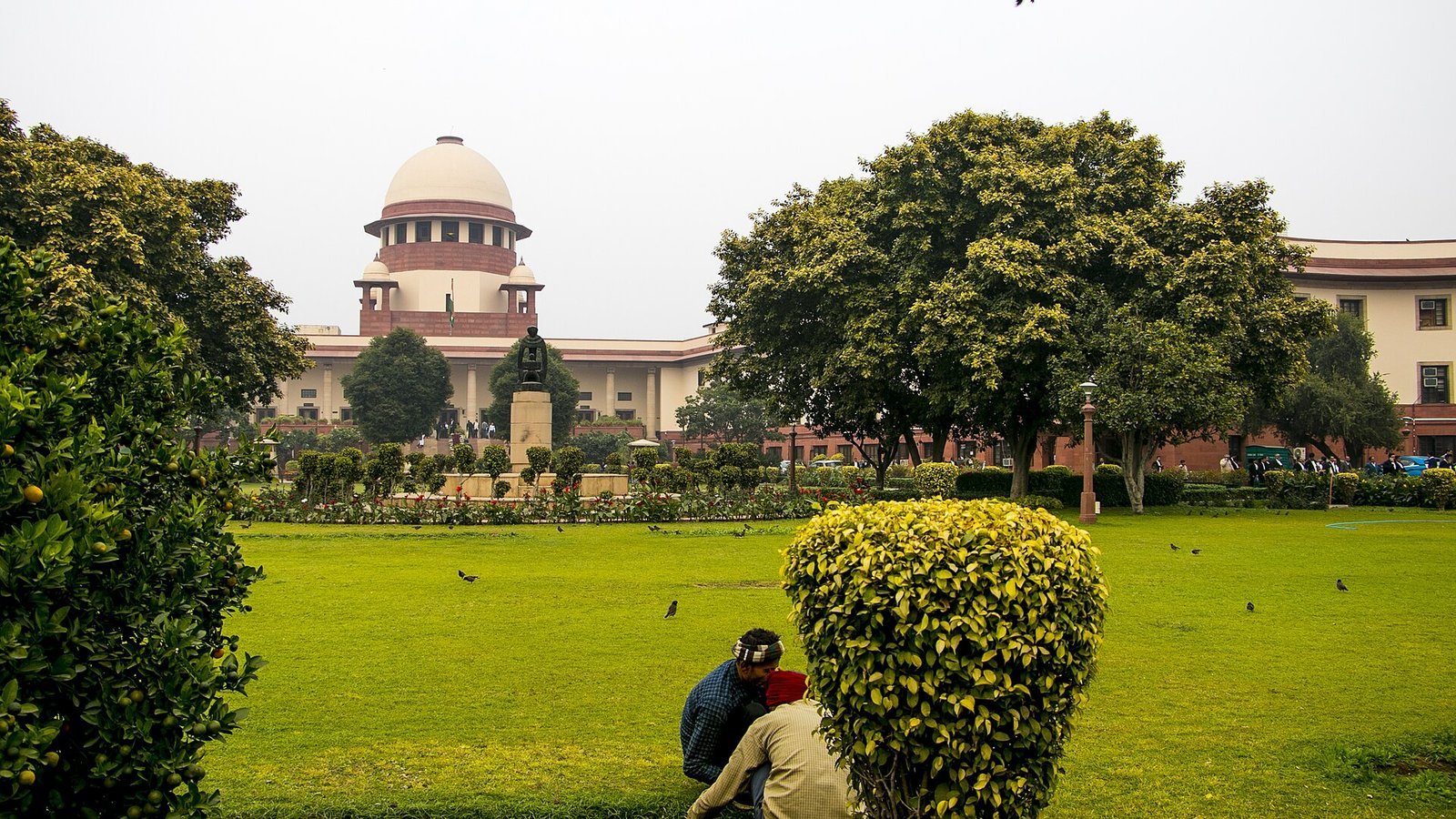
The 2024 Supreme Court judgment is the governing law. Two follow-up questions are open:
- Allahabad High Court split verdict (20–21 July 2026): referred for a third judge on whether courts can bar demolition for two years after an FIR. Not a final or nationwide rule. No third-judge decision reported.
- Transferred contempt cases (16 July 2026): High Courts asked to decide, preferably within four months, so by about mid-November 2026. Interim protection continues.
- Next update: when the third judge rules or the High Courts decide the transferred cases.
💡 Short Answer
On 13 November 2024 Justices B.R. Gavai and K.V. Viswanathan ruled that demolishing homes as punishment for alleged crimes is unconstitutional. Any demolition now needs a 15-day show-cause notice, intimation to the District Magistrate, a personal hearing, a reasoned order, 15 more days to appeal, and videography. Roads, railway land, water bodies and court-ordered demolitions are excluded. Officials who break the rules face contempt and personal liability. In July 2026 the Court sent alleged violations to High Courts.
Bulldozer Demolitions Judgment: Key Questions
The Bulldozer Demolitions Judgment in Nine Points
- Core holding: an accusation or FIR is never a ground to demolish a home.
- Lead case: Jamiat Ulama-i-Hind’s petition over the April 2022 Jahangirpuri demolitions, W.P.(C) 295/2022.
- Procedure: 15-day notice, DM intimation, hearing, reasoned order, 15 days to appeal, video.
- Proportionality: authorities must consider compounding or demolishing only the illegal part.
- Exceptions: roads, footpaths, railway land, water bodies and court-ordered demolitions.
- Liability: contempt, prosecution and restitution at officials’ own cost.
- Compensation in practice: Rs 25 lakh in Maharajganj (2024), Rs 10 lakh each in Prayagraj (2025).
- July 2026: contempt complaints sent to High Courts, with a four-month target.
- Split verdict: the Allahabad two-year shield after an FIR is one judge’s view, not law.
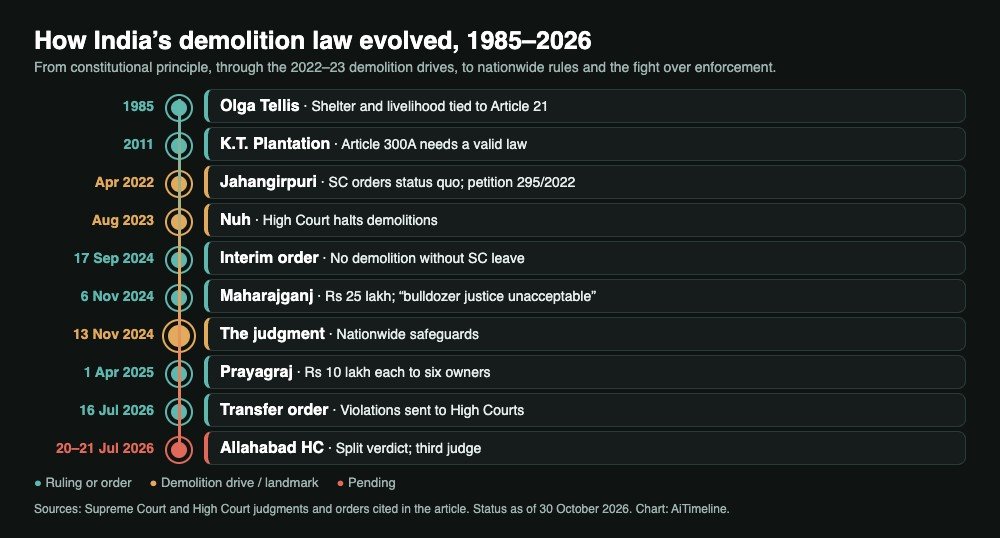
Bulldozer Demolitions: Legal Timeline, Latest First
From the 2026 split verdict back to the 1978 amendment that made property a constitutional right. Each entry is tagged and ends with why it matters.
2026
Allahabad High Court splits on a two-year shield after an FIR PendingHigh Court
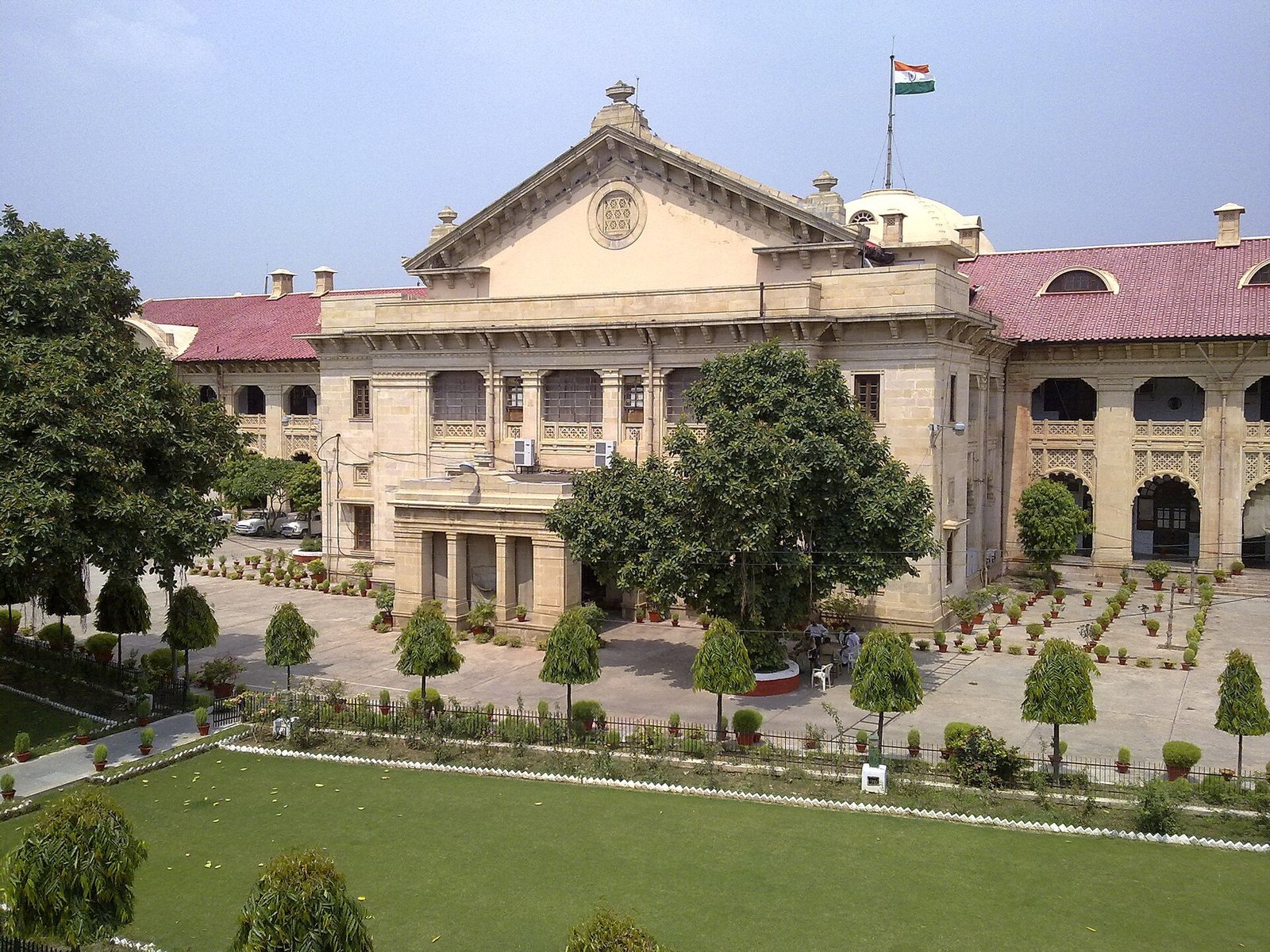
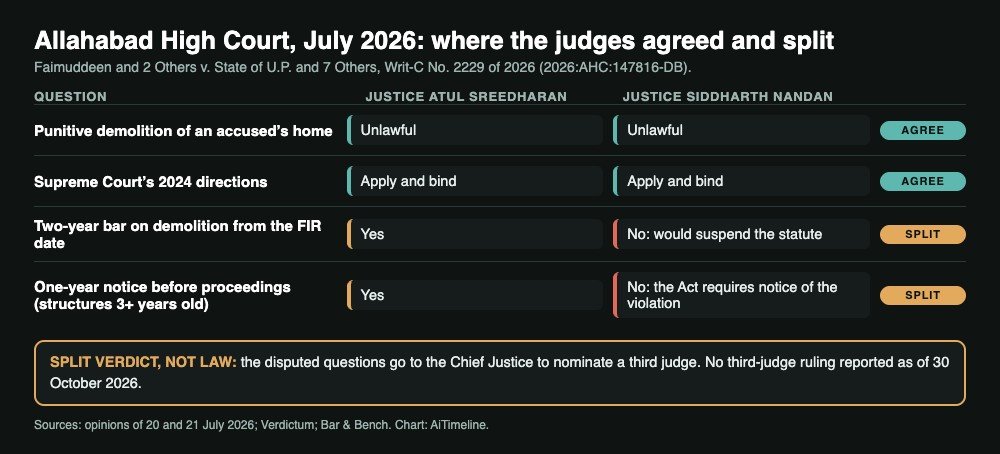
In Faimuddeen and 2 Others v. State of U.P. and 7 Others (Writ-C No. 2229 of 2026; 2026:AHC:147816-DB), a family from Sumerpur in Hamirpur district said they feared their house would be demolished after a relative was booked in a criminal case. Both judges accepted that a home cannot be demolished to punish a person or family for an alleged offence, and both applied the Supreme Court’s November 2024 directions.
They split on two further directions. Justice Sreedharan’s opinion would bar demolition of an accused person’s house for two years from the date of the FIR, and require a year’s notice before proceedings against structures occupied for three years or more (opinion text). Justice Nandan said he was “unable to concur”: a fixed bar would in effect suspend the statute (Verdictum; Bar & Bench).
Justice Nandan directed that the matter be placed before the Chief Justice to nominate a third judge. This is a split verdict, not a final or nationwide rule. As of 30 October 2026, no third-judge decision had been reported.
2026
Supreme Court sends alleged violations to the High Courts Supreme Court
Faced with a batch of contempt petitions alleging that authorities in several states had ignored the 2024 directions, the Court declined to decide them itself. It said the disputes turned on facts, such as whether land was public or private and whether a structure was authorised, and that High Courts were better placed to examine them (Bar & Bench).
The order transferred the matters, including the original 2022 writ petition, to the jurisdictional High Courts, asked them to decide “expeditiously and preferably within four months” and allowed evidence to be recorded through district courts. Interim protection already granted continues, though parties may ask the High Courts to modify it. One contempt matter from Madhya Pradesh was sent back to that High Court with a three-month target (order text). Petitions cited demolitions of mosques at Somnath in Gujarat, a case from Maharashtra and a roadside stall (Maktoob).
The Court expressed no view on whether any official had committed contempt.
Hamirpur family’s petition reaches the Allahabad High Court High Court
The Faimuddeen petition came up in early 2026. The bench said it would frame and answer questions of law on punitive demolitions in Uttar Pradesh, including whether the Supreme Court’s directions were being followed (Bar & Bench). The State said the petition was premature and gave an oral assurance that nothing would be demolished without due process.
2025
Prayagraj: Rs 10 lakh to each family whose home was razed Supreme Court
Hearing an appeal by advocate Zulfiquar Haider, professor Ali Ahmed and others whose houses in Prayagraj were demolished in 2021, the Court found that notices had been served only by affixing them, and that demolition followed within about a day. It called the demolitions “inhuman and illegal”, said they shocked its conscience, and ordered the Prayagraj Development Authority to pay Rs 10 lakh to each of the six appellants within six weeks (Verdictum).
2024
The other half of the law: illegal buildings must still go Supreme Court
In Rajendra Kumar Barjatya v. U.P. Avas Evam Vikas Parishad, a case about illegal commercial construction in Meerut, the Court said unauthorised buildings cannot be regularised merely because of delay, investment or official inaction. It directed that no trade licence be issued for unauthorised buildings and that banks verify completion certificates before lending (judgment).
2024
The bulldozer demolitions judgment: nationwide safeguards Supreme Court
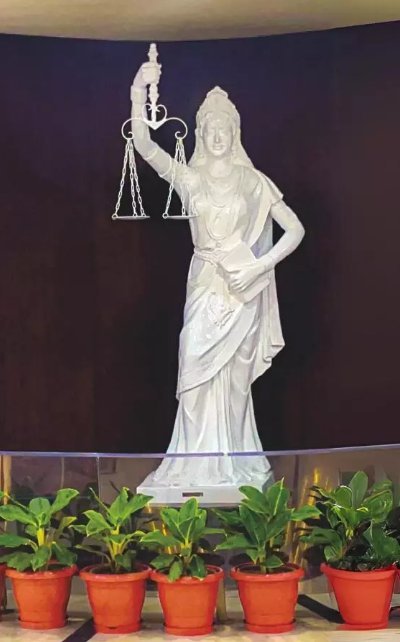
In In Re: Directions in the Matter of Demolition of Structures (W.P.(C) No. 295 of 2022 and connected cases), the Court held that the executive cannot act as a judge, declare an accused person guilty and demolish their home as punishment (judgment). It grounded the ruling in the rule of law, the separation of powers, the presumption of innocence and the right to shelter under Article 21, and said punishing a family for one member’s alleged crime would be collective punishment.
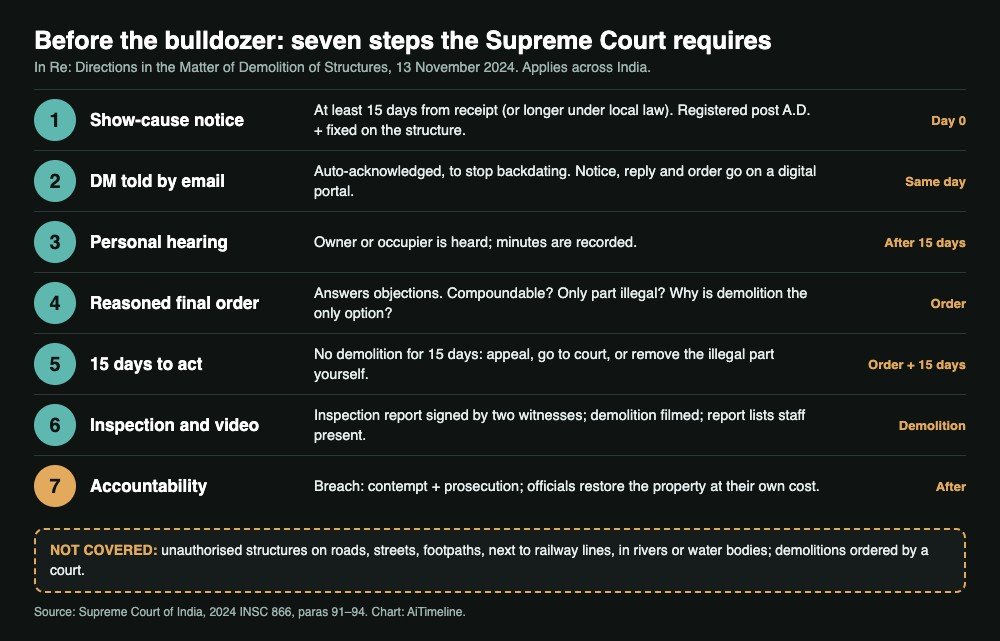
Using its power under Article 142, the Court then laid down a procedure for every demolition outside its stated exceptions: a 15-day show-cause notice, intimation to the District Magistrate, a personal hearing, a reasoned final order, 15 more days before the order is carried out, videography and a demolition report. Violations would invite contempt and prosecution, and officials could be made to restore the property at their own cost. The full list is below.
2024
“Bulldozer justice is simply unacceptable”: the Maharajganj case Supreme Court
Journalist Manoj Tibrewal Akash wrote to the Court on 4 October 2019 after his ancestral house and shop in Maharajganj, Uttar Pradesh, were demolished in September 2019 for widening National Highway 730. An NHRC inquiry found the alleged encroachment was about 3.7 metres, yet the house was razed without proper written notice (judgment).
The Court said “justice through bulldozers is unknown to any civilized system of jurisprudence” and that, if allowed, it would reduce the right to property under Article 300A to “a dead letter”. It ordered Rs 25 lakh as interim compensation, an inquiry into officials and contractors, and an FIR to be investigated by the CB-CID, and set six steps for road-widening drives, from checking official records to written notice and a speaking order on objections.
Police later registered a case against 26 people, including a former District Magistrate (Deccan Herald).
2024
No demolition anywhere without the Court’s leave Supreme Court
On the Solicitor General’s request the hearing was fixed for 1 October 2024. Until then, the Court directed “there shall be no demolition anywhere across the country without seeking leave of this Court” (order). The order did not cover unauthorised structures on roads, streets, footpaths, alongside railway lines or in rivers and water bodies, or demolitions ordered by a court.
The Court heard the matter at length on 1 October 2024 and reserved judgment, keeping the interim order in place.
2024
Court announces pan-India guidelines Supreme Court
Allowing fresh applications in the 2022 batch, the Court recorded the grievance that properties of people accused of crimes were being demolished. Uttar Pradesh disputed this, filing an affidavit that immovable property can be demolished only under the procedure prescribed by law; the Court said it appreciated that stand. It then announced it would lay down guidelines “on Pan-India basis” and asked all sides to send suggestions to Nachiketa Joshi, Additional Advocate General for Madhya Pradesh, to collate.
New demolitions bring the 2022 petitions back Demolition drive
In August 2024 several demolitions followed soon after criminal cases. On 22 August, a day after a protest at a police station in Chhatarpur, Madhya Pradesh, turned violent, authorities razed the house of local leader Haji Shahzad Ali, citing unauthorised construction (Deccan Herald). Applicants from several states asked the Court to revive the pending petitions and stop punitive demolitions.
2024
Seven procedural rights inside Article 300A Foundation
In Kolkata Municipal Corporation v. Bimal Kumar Shah, about land acquisition, the Court said “authority of law” in Article 300A is more than a statute on the books. It listed seven sub-rights, including the right to notice, to be heard, to a reasoned decision, and to a fair procedure before property is taken (judgment).
2023
Nuh: a High Court halts demolitions after communal clashes High Court
After communal violence in Nuh, Haryana, on 31 July 2023, authorities demolished hundreds of structures in Nuh and parts of Gurugram, describing them as illegal. On 7 August a bench of Justices G.S. Sandhawalia and Harpreet Kaur Jeewan took suo motu notice, stayed the demolitions and asked whether buildings of one community were being brought down under the guise of a law-and-order problem, and whether “an exercise of ethnic cleansing” was being conducted (SCC Online).
Haryana denied targeting any community and said due procedure was followed. On 11 August another bench directed that the case be placed before the Chief Justice (Verdictum).
2022
Prayagraj and Kanpur: demolitions after protest violence Demolition drive
After violence in several Uttar Pradesh towns over remarks about the Prophet by a suspended BJP spokesperson, the Prayagraj Development Authority demolished the house of Javed Mohammad on 12 June 2022, after police named him as an alleged conspirator. His family said the house was in his wife’s name and that taxes had been paid. Jamiat Ulama-i-Hind asked the Supreme Court to stop demolitions without notice (Scroll).
On 16 June the Court declined to stay demolitions but asked Uttar Pradesh to respond, saying they must follow the procedure in law. The State replied that the actions were under building rules and unconnected to the riots (Scroll).
2022
Jahangirpuri: demolition continues after a status quo order Demolition drive
Four days after clashes during a Hanuman Jayanti procession in Delhi’s Jahangirpuri on 16 April 2022, the North Delhi Municipal Corporation began an anti-encroachment drive with bulldozers. Jamiat Ulama-i-Hind mentioned the matter, and a bench led by CJI N.V. Ramana ordered status quo that morning. Demolition continued for some time after the order, until it was communicated on the ground (Khaleej Times).
On 21 April Justices L. Nageswara Rao and B.R. Gavai extended the status quo and said they would take a “serious view” of demolitions carried out after the Mayor was informed (Bar & Bench). Jamiat’s petition, W.P.(C) No. 295 of 2022, became the lead case decided in November 2024.
2011
K.T. Plantation: what “authority of law” requires Foundation
In K.T. Plantation Pvt. Ltd. v. State of Karnataka, a five-judge bench held that Article 300A is a constitutional right, though no longer a fundamental right, and that a law depriving a person of property must be valid, serve a public purpose and be open to judicial review (judgment).
1985
Olga Tellis: livelihood is part of the right to life Foundation
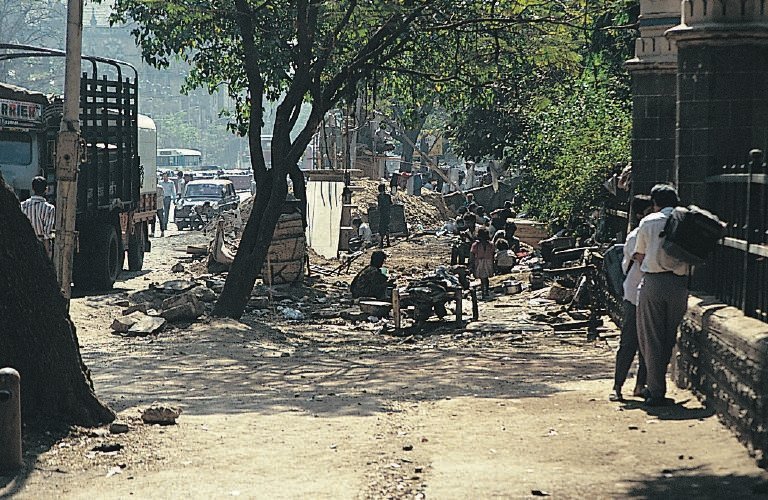
Pavement and slum dwellers in Bombay challenged their eviction. The Court held that the right to livelihood is part of the right to life under Article 21, and that procedure for eviction must be fair and reasonable. It did not give anyone a right to occupy public land, and upheld the municipal power to remove encroachments, but required notice and allowed time for removal (judgment).
–79
Property becomes a constitutional, not fundamental, right Foundation
The 44th Amendment removed the right to property from the list of fundamental rights and placed it in Article 300A: “No person shall be deprived of his property save by authority of law.” A person can no longer go directly to the Supreme Court under Article 32 for property alone, but the State still needs legal authority for every deprivation.
The Supreme Court’s Eight Demolition Safeguards
From Part IX of the judgment, paras 90–94. These apply in every state and union territory.
115-day show-cause notice
Returnable within 15 days of receipt, or the longer period in local law. Sent by registered post A.D. and fixed on the structure.
2What the notice must say
The nature of the construction, the specific violation and grounds, documents to be filed, and the date and authority for a personal hearing.
3District Magistrate told by email
An automatic acknowledgement guards against backdating. Each district names a nodal officer; each local body runs a digital portal for notices and orders.
4Personal hearing, minuted
The designated authority must hear the person and record minutes of the hearing.
5Reasoned final order
It must answer the objections, say whether the work can be compounded or only part is unauthorised, and why demolition is the only option.
615 days before action
The order is not carried out for 15 days, to allow an appeal or a court challenge, or for the owner to remove the unauthorised part.
7Inspection, video, report
An inspection report signed by two witnesses before demolition; the demolition is filmed; a report listing police and civil staff goes to the Municipal Commissioner.
8Contempt and restitution
Violation invites contempt and prosecution. Officials can be made to restore the property at their own cost and pay damages.
When do the Supreme Court’s demolition safeguards not apply?
Paragraph 91 of the judgment says the directions do not apply to:
- Unauthorised structures in public places such as a road, street or footpath.
- Structures abutting a railway line.
- Structures in a river body or water body.
- Cases where a court of law has already ordered demolition.
What the exceptions do not do: they do not remove the procedure in the applicable municipal or highway law, and they do not allow punitive demolition. The Maharajganj road-widening judgment of 6 November 2024 still requires a survey, written notice and a decision on objections before roadside encroachments are removed. Whether a site really falls in an exception, for instance whether land is public, is a factual question, and is one reason the Court sent the 2026 contempt cases to the High Courts.
The Constitutional Principles Behind the Judgment
Why the Court treated arbitrary demolition as a constitutional wrong, not a municipal dispute.
Article 14: equality before the law
Selective enforcement, acting against one owner while comparable violations nearby are ignored, raises arbitrariness under Article 14. The 2024 judgment said that when one structure is chosen “all of a sudden” for demolition while similar ones nearby are not touched, “mala fide may loom large”, especially if an occupant was recently named in a criminal case.
Article 21: life, shelter and livelihood
From Olga Tellis (1985) to the Puttaswamy privacy ruling, the Supreme Court has read dignity, livelihood and shelter into Article 21. The 2024 judgment opened with a Hindi verse on the dream of a home, called a house “an embodiment of the collective hopes of a family”, and said demolishing it because one resident is accused, or even convicted, would be collective punishment of the whole family.
Article 300A: the right to property
Article 300A says no one may be deprived of property save by authority of law. It has been a constitutional, not fundamental, right since 1979, which is why demolition challenges usually pair it with Articles 14 and 21. In the Maharajganj case the Court said bulldozer justice would make Article 300A “a dead letter”.
Separation of powers
Deciding guilt and punishment belongs to courts. The Court held that an executive that demolishes an accused person’s home because of an FIR acts as judge, and that this violates the separation of powers. For a period when executive power ran with few judicial checks, see the 1975–77 Emergency.
Natural justice and the presumption of innocence
Notice, a hearing and a reasoned decision are the core of natural justice. The judgment tied them to the presumption of innocence: an accused person is innocent until proved guilty, so an FIR cannot justify a penalty as severe as losing a home.
What the 2024 Judgment Does Not Mean
It is often described as a ban on demolitions. It is not.
✅ What the 2024 judgment does
- Bars demolition as punishment for an alleged crime.
- Requires notice, a hearing, a reasoned order and 15 more days before action.
- Requires authorities to consider removing only the unauthorised part.
- Makes officials personally answerable for unlawful demolitions.
❌ What it does not do
- It does not ban demolition of illegal construction.
- It does not give an accused person immunity from building law.
- It does not cover encroachments on roads, railway land or water bodies, or court-ordered demolitions.
- It does not create a waiting period after an FIR; that was one Allahabad judge’s proposal in 2026.
The July 2026 Allahabad Ruling: A Split Verdict
Split verdictNot a final ruling and not a nationwide rule.
Both judges agreed that punitive demolition is unlawful and that the Supreme Court’s directions bind authorities. They differed on whether a High Court can add a two-year bar on demolishing an accused person’s house from the FIR date, and a one-year notice before municipal proceedings. Justice Nandan referred those questions to the Chief Justice for a third judge. Even if adopted, a High Court ruling would bind only within Uttar Pradesh.
Where Each Question Stands
Settled or pending, as of 30 October 2026.
| Question | Forum | Status, 30 Oct 2026 |
|---|---|---|
| Can a home be demolished to punish an alleged crime? | Supreme Court, 13 Nov 2024 | Settled: no |
| What procedure applies to other demolitions? | Supreme Court, 13 Nov 2024 | Settled: notice, hearing, order, 15 days, video |
| Did officials in specific cases violate the 2024 directions? | Jurisdictional High Courts (transferred 16 Jul 2026) | Pending; four-month target |
| Can a High Court bar demolition for two years after an FIR? | Allahabad High Court, third judge | Pending; split verdict |
| Can a one-year notice be required before municipal action? | Allahabad High Court, third judge | Pending; split verdict |
How the Law Evolved: From Individual Rights to Nationwide Safeguards
| Period | Legal development | Significance |
|---|---|---|
| 1978–79 | 44th Amendment | Property moves from fundamental right to Article 300A |
| 10 Jul 1985 | Olga Tellis | Livelihood and shelter linked to Article 21; fair procedure before eviction |
| 9 Aug 2011 | K.T. Plantation | Deprivation of property needs a valid law open to review |
| Apr 2022 | Jahangirpuri status quo | Supreme Court steps in; lead petition W.P.(C) 295/2022 filed |
| Jun 2022 | Uttar Pradesh petitions | Challenge to alleged punitive demolitions after protests |
| Aug 2023 | Nuh, suo motu | High Court stays demolitions and asks if one community is targeted |
| 16 May 2024 | Kolkata MC v. Bimal Kumar Shah | Seven procedural sub-rights read into Article 300A |
| 17 Sep 2024 | Supreme Court interim order | No demolition without leave, with exceptions |
| 6 Nov 2024 | Manoj Tibrewal Akash | Rs 25 lakh; “bulldozer justice is simply unacceptable” |
| 13 Nov 2024 | Bulldozer demolitions judgment | Nationwide procedural safeguards; officials personally liable |
| 17 Dec 2024 | Rajendra Kumar Barjatya | Illegal construction cannot be regularised by delay |
| 1 Apr 2025 | Prayagraj compensation | Rs 10 lakh each to six home-owners |
| 16 Jul 2026 | Contempt pleas transferred | High Courts to examine alleged violations, preferably in four months |
| 20–21 Jul 2026 | Allahabad High Court split verdict | Two-year shield after FIR disputed; third judge to decide |
Explore More Timelines
People Also Ask
Bulldozer Demolitions Judgment: Frequently Asked Questions
The Bulldozer Cannot Replace the Rule of Law
India’s demolition debate began with municipal enforcement and became a constitutional question. The November 2024 judgment drew the line: governments may remove illegal construction, but they cannot use demolition as a shortcut to punish people accused of crimes. It rests on property rights, the right to shelter, natural justice and the separation of powers.
The 2026 developments show where the fight has moved: enforcement. Guidelines are a first step; whether High Courts hold officials to them will decide what they are worth. For other cases on how courts check executive power, see the India Political Cases hub.
A government can enforce building laws. It cannot replace the judicial process with a bulldozer.
Related AiTimeline Stories
⚠️ Editorial Note
Last updated 30 October 2026. The 2024 guidelines are taken from the Supreme Court’s judgment itself (2024 INSC 866), with the 17 September 2024 order and the 6 November 2024 Maharajganj judgment from the Court’s own records. The 2026 entries rely on the text of the 16 July 2026 order and the Allahabad High Court opinions, with law reports for what each judge decided. Oral remarks from the bench are reported as remarks, not rulings. This article is general information, not legal advice. We corrected or added to the source brief in several places: the Allahabad split also covered a proposed one-year notice, and the questions go to the Chief Justice to nominate a third judge; the 16 July order set a three-month target for one Madhya Pradesh matter and four months for the rest; the 2025 entry is now the Prayagraj compensation ruling; the brief’s two Jahangirpuri entries are merged; and the brief’s links for Olga Tellis and K.T. Plantation were search pages, so we cite the judgments. We added the 1978 amendment, Kolkata Municipal Corporation v. Bimal Kumar Shah (2024), Rajendra Kumar Barjatya (2024) and the Chhatarpur demolition. AiTimeline does not yet have dedicated pages on the Jahangirpuri demolitions, the Nuh violence, Article 21 or Article 300A; closely related coverage is linked below.
Sources & further reading
Every dated entry above was checked against these references. Last reviewed 30 October 2026.
- Supreme Court of India: In Re: Directions in the Matter of Demolition of Structures, 2024 INSC 866, judgment of 13 November 2024 (PDF)
- Supreme Court of India: In Re: Manoj Tibrewal Akash, 2024 INSC 863, judgment of 6 November 2024 (PDF)
- Supreme Court of India: Jamiat Ulama-i-Hind v. North Delhi Municipal Corporation, interim order of 17 September 2024 (PDF)
- Supreme Court of India: order of 16 July 2026 transferring demolition matters to the High Courts (Indian Kanoon)
- Allahabad High Court: Faimuddeen and 2 Others v. State of U.P. and 7 Others, 2026:AHC:147816-DB (Indian Kanoon)
- Verdictum: Allahabad High Court delivers split verdict on two-year demolition shield (22 July 2026)
- Bar & Bench: Supreme Court declines to hear bulldozer contempt pleas, asks High Courts to decide (16 July 2026)
- Verdictum: Zulfiquar Haider v. State of Uttar Pradesh, 2025 INSC 480 (Prayagraj compensation)
- Supreme Court Observer: SC hearings on bulldozer justice
- Supreme Court of India: Olga Tellis v. Bombay Municipal Corporation, 10 July 1985 (Indian Kanoon)
- Supreme Court of India: K.T. Plantation Pvt. Ltd. v. State of Karnataka, 9 August 2011 (Indian Kanoon)