Jimmy Stewart: The Hollywood Star Who Became a WWII Bomber Pilot
Jimmy Stewart WWII record: how the Oscar winner enlisted in 1941, flew B-24 bombers over Europe and retired a brigadier general in 1968. Facts checked.
Latest Story
Jimmy Stewart was one of Hollywood’s biggest stars when he was inducted into the US Army Air Corps on 22 March 1941, less than a month after winning the Best Actor Oscar. He became a B-24 bomber pilot, flew about 20 combat missions over Europe with the Eighth Air Force, rose from private to colonel in four years and retired from the Air Force Reserve as a brigadier general in 1968. This record separates what official and museum sources confirm from details that vary between accounts.
💡 Short Answer
Jimmy Stewart left Hollywood after winning an Oscar and joined the US Army Air Corps on 22 March 1941. He trained pilots, then flew B-24 Liberator bombers with the 445th Bomb Group in England from late 1943, and later served as operations officer of the 453rd. Most sources credit him with about 20 combat missions. He became a colonel on 29 March 1945, a reserve brigadier general on 23 July 1959, and retired on 31 May 1968.
Jimmy Stewart in World War II: Key Questions
Jimmy Stewart’s Service in Eight Points
- Before the war: Princeton architecture graduate, Broadway and MGM actor, and a licensed pilot.
- Oscar then uniform: won Best Actor on 27 February 1941 and was inducted on 22 March 1941.
- Not an automatic star posting: he was first rejected for low weight and then spent over a year training pilots at Kirtland.
- Overseas: arrived in England in November 1943 with the 703rd Bomb Squadron, 445th Bomb Group.
- Combat flying: the 445th flew its first mission on 13 December 1943; Stewart moved to the 453rd in spring 1944.
- Missions: about 20 is the standard figure, though sources differ.
- Rank: private to colonel in four years, then reserve brigadier general in 1959.
- After the war: It’s a Wonderful Life in 1946, retirement in 1968 and the Medal of Freedom in 1985.
Jimmy Stewart Timeline: From Indiana, Pennsylvania to the Medal of Freedom, Latest First
Entries are colour-coded by period. Dates follow museum, government and encyclopaedia records, and we say where they differ.
Stewart dies in Beverly Hills at 89 After the war
What happened: James Stewart died on 2 July 1997 at the age of 89. He had been married to Gloria Hatrick McLean from 1949 until her death in 1994.
What he left: He is remembered for roles in Mr. Smith Goes to Washington, The Philadelphia Story and It’s a Wonderful Life, and as a bomber pilot who retired from the Air Force Reserve as a brigadier general.
Honorary Oscar and the Presidential Medal of Freedom After the war
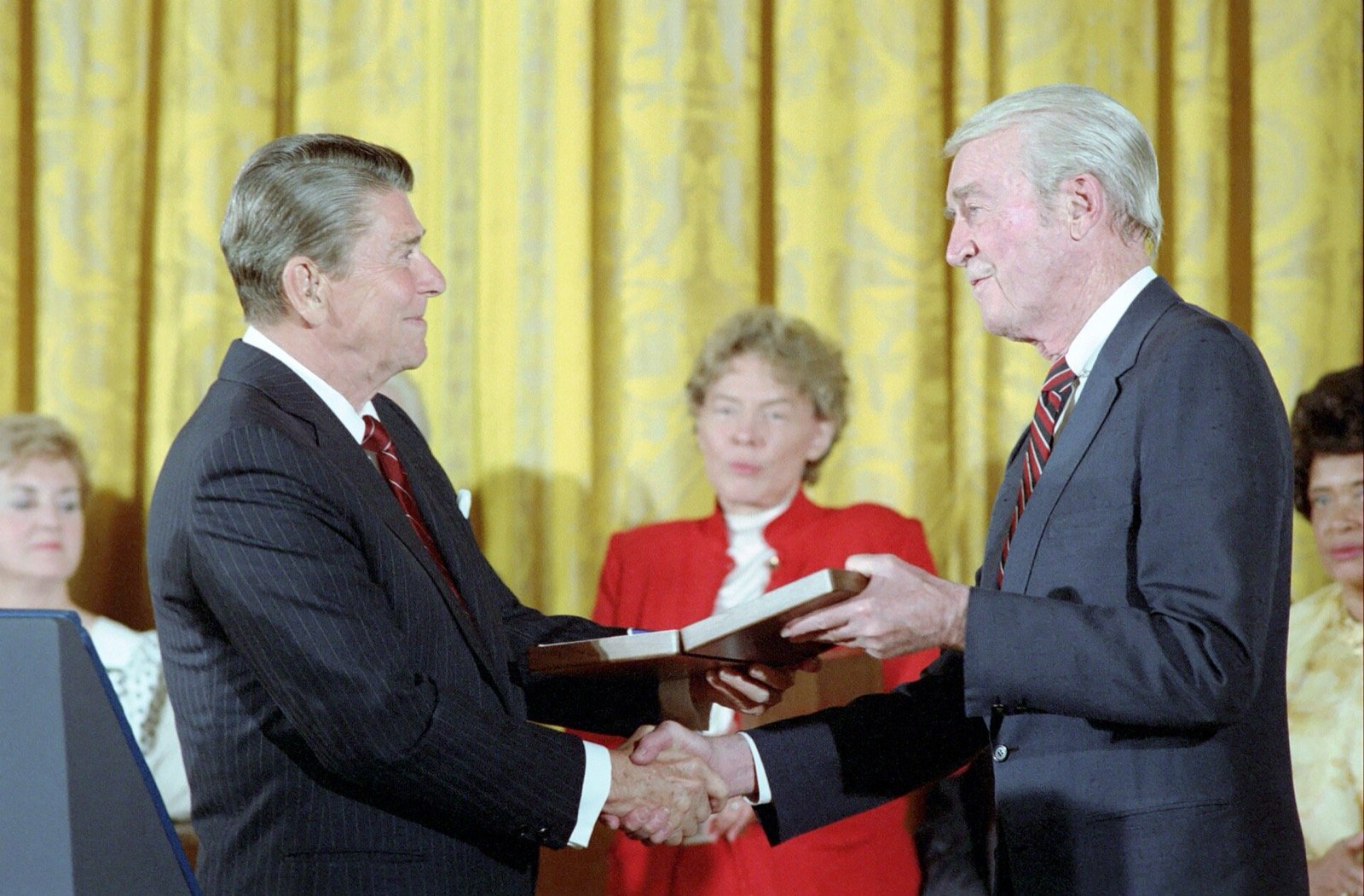
What happened: In 1985 Stewart received an Academy Honorary Award for his body of work. On 23 May 1985 President Ronald Reagan presented him with the Presidential Medal of Freedom in the East Room of the White House.
Why it matters: The two honours recognised the two halves of a long public life: a film career that ran from 1935 to 1991 and decades of service in uniform.
Retirement after 27 years in uniform After the war
What happened: Stewart retired from the Air Force Reserve on 31 May 1968, when he reached the mandatory retirement age of 60. He had served for 27 years. The Air Force awarded him its Distinguished Service Medal on retirement.
What our brief got wrong: A draft of this story gave 1966 as the retirement year. Official records give 31 May 1968.
A B-52 bombing flight over Vietnam as an observer After the war
What happened: In February 1966 Stewart flew as a non-duty observer in a B-52 on an Arc Light bombing mission during the Vietnam War, according to the biography on Wikipedia and the records it cites.
Context: By then he held the rank of brigadier general in the reserve and trained and served with Strategic Air Command, including on the B-47 and the B-52. The flight was an observer role, not a combat command.
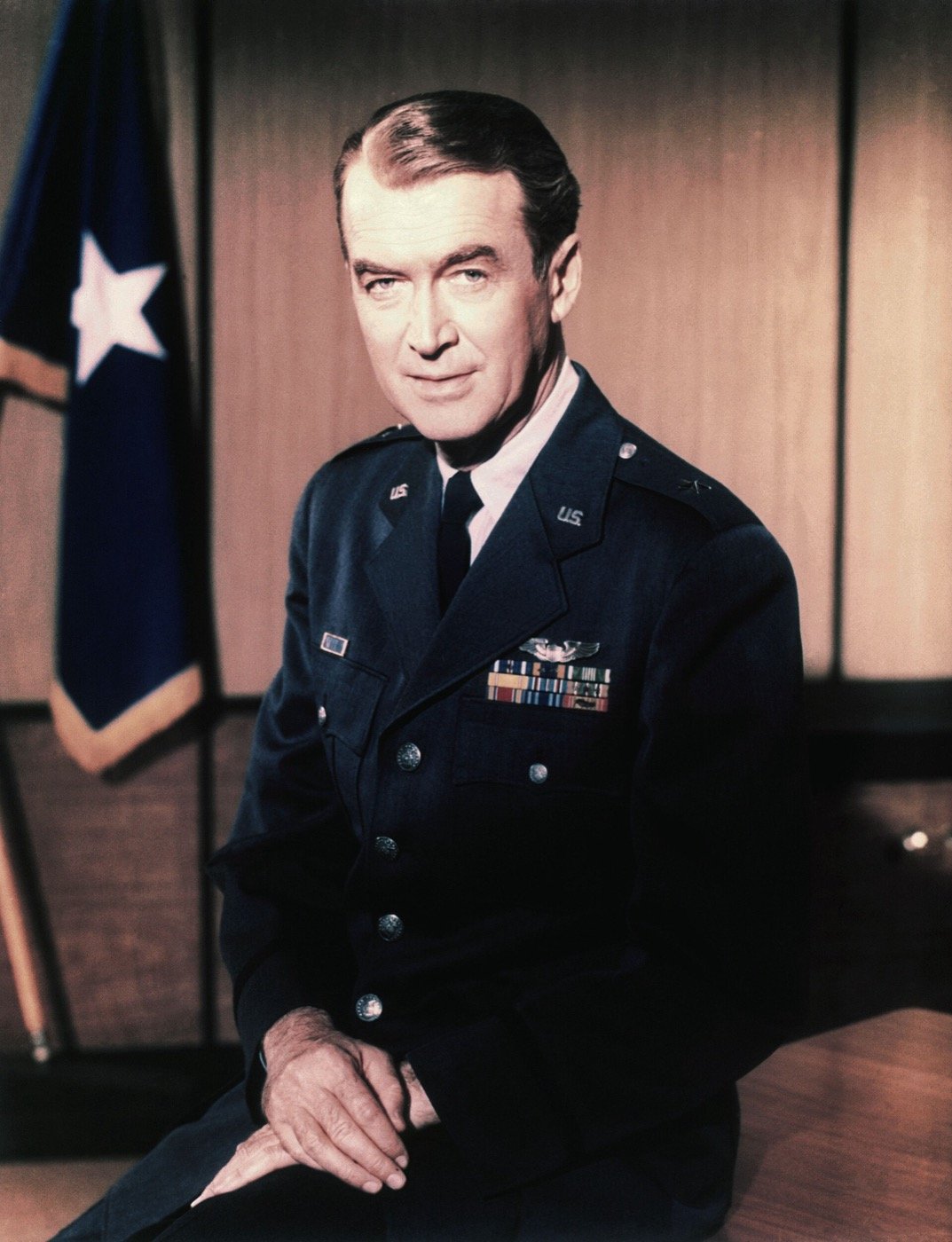
Promoted to brigadier general After the war
What happened: Stewart was promoted to brigadier general in the Air Force Reserve on 23 July 1959. He had been nominated in February 1957.
Why it is notable: Wikipedia describes him as the highest-ranking actor in American military history. We have not found an official count of every actor who served, so we treat that as a description, not a verified ranking.
Balancing two careers: He kept making films while serving in the reserve, including on active-duty tours with Strategic Air Command.
It’s a Wonderful Life After the war
What happened: Stewart’s first film after the war was It’s a Wonderful Life, in which he played George Bailey. The Jimmy Stewart Museum says it was a box-office disappointment at first, though it earned him a Best Actor nomination.
Legacy: In later decades the film became one of the most-watched Christmas films in American cinema.
Back home and a founder of the Air Force Association After the war
What happened: Stewart returned to the United States in early fall 1945. In October 1945 he was one of 12 founders of the Air Force Association, according to Wikipedia, and he later transferred to the Air Force Reserve.
What came next: He stayed in uniform part-time for another 23 years, which is why his service record runs from 1941 to 1968.
Full colonel, four years after enlisting as a private War service
What happened: Stewart was promoted to colonel on 29 March 1945. Wikipedia notes that only a few Americans rose from private to colonel in four years.
His staff role: Late in the war he served on the staff of the 2nd Combat Bombardment Wing. Sources differ on the title: some say chief of staff, while Wikipedia says deputy commander. We use the neutral wording ‘wing staff officer’.
Operations officer of the 453rd Bomb Group War service
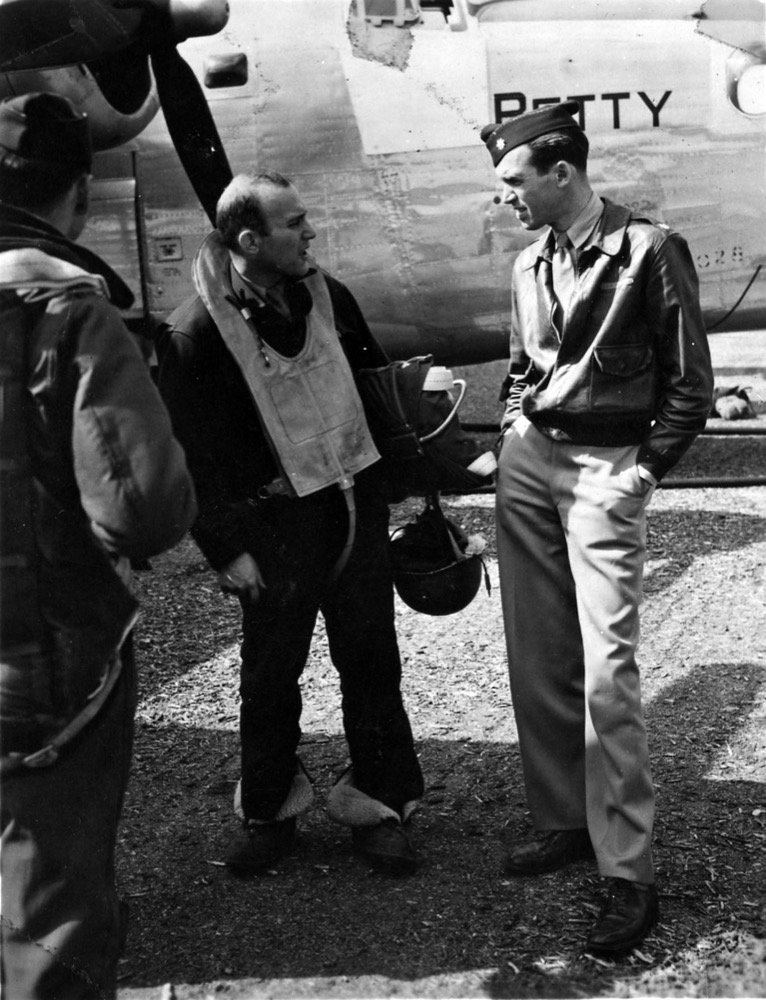
What happened: In spring 1944 Stewart moved from the 445th to the 453rd Bomb Group as group operations officer. The Air & Space Forces Magazine says he planned missions, worked nights and stayed in the control tower until the last crew had returned.
Dates differ: The USAF photograph description on Wikimedia Commons says he began flying combat missions on 31 March 1944 and was appointed operations officer of the 453rd. That is the date he began with the 453rd. The 445th Bomb Group had been flying missions since 13 December 1943, so the ‘March 1944 first mission’ in our brief is not right.
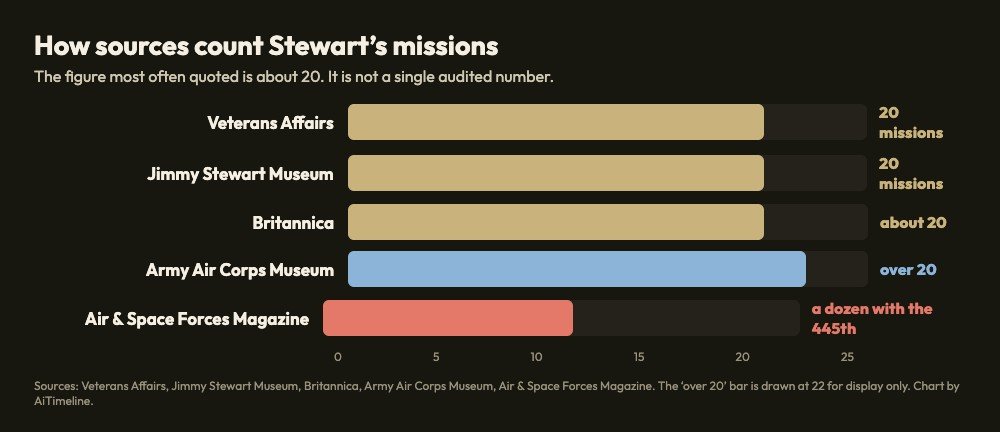
How many missions?: The Veterans Affairs biography, the Jimmy Stewart Museum and Britannica all give about 20 combat missions; the Army Air Corps Museum says ‘over 20’. The Air & Space Forces Magazine says he flew a dozen missions with the 445th and reports, without attribution, that he flew more than his commanders wanted. We therefore say ‘about 20’, not a precise count.
The 445th loses 13 of 25 aircraft over Gotha War service
What happened: On 24 February 1944, during Big Week, the 445th Bomb Group lost 13 of the 25 aircraft it sent to Gotha, with 122 aircrew lost, according to Wikipedia’s group history. The target was a Messerschmitt Bf 110 assembly plant.
Stewart’s place in it: He was then commanding the group’s 703rd Bomb Squadron. The sources we reviewed do not record whether he flew that mission, so we do not claim it.
Promoted to major after a raid on Ludwigshafen War service
What happened: Stewart was promoted to major after a mission to Ludwigshafen on 7 January 1944, according to Wikipedia. He had been named commander of the 703rd Bomb Squadron after first serving as its operations officer.
Why it matters: A squadron commander’s job was to lead a squadron of B-24s on its missions, which is why the rank came with the post.
The 445th flies its first mission, to Kiel War service
What happened: On 13 December 1943 the 445th Bomb Group attacked U-boat installations at Kiel, its first mission, according to Wikipedia’s group history. Only fifteen crews were judged fit for it.
Stewart’s role: Several accounts say Stewart led the high squadron on that raid, but we found that in only one source, so we flag it for editorial review and do not state it as fact.
Stewart arrives in England with the B-24 Liberator War service
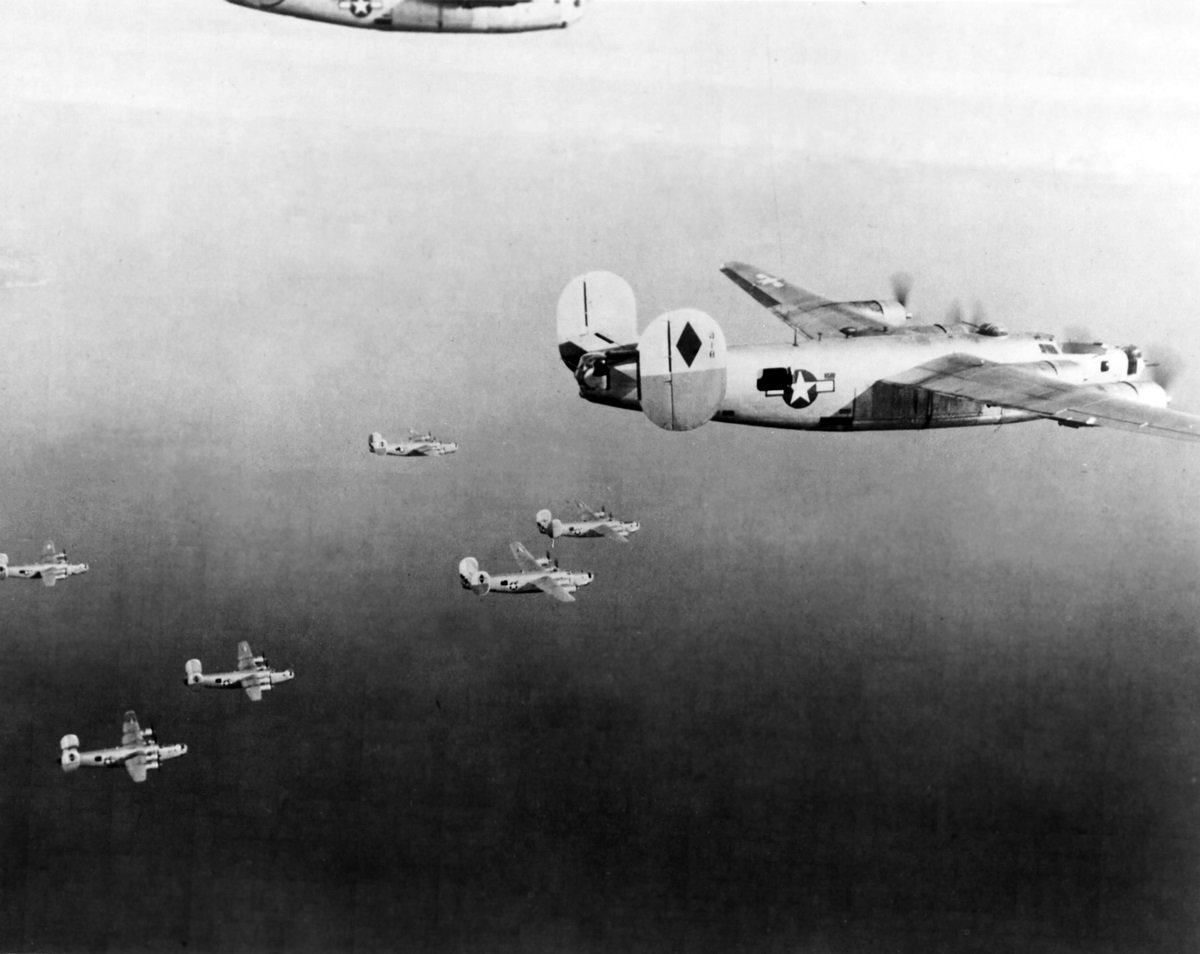
What happened: In November 1943 Stewart was sent to England with the 703rd Bomb Squadron of the 445th Bomb Group to fly B-24 Liberators, first from RAF Tibenham and later RAF Old Buckenham. The group had moved into Tibenham on 4 November 1943.
The aircraft: The B-24 Liberator was a four-engine heavy bomber used in the US daylight bombing campaign over Germany and occupied Europe.
Training other pilots at Kirtland War service
What happened: After being commissioned a second lieutenant on 1 January 1942, Stewart spent more than a year training other pilots at Kirtland Army Airfield. Air & Space Forces Magazine says he trained pilots on the B-17 and qualified on twin- and four-engine aircraft.
Note: Our brief gave 31 December 1941 for his commission. Wikipedia gives 1 January 1942, and we follow that.
A movie star is inducted as a private War service
What happened: Stewart was rejected for low weight in November 1940. He enlisted in February 1941 and reported for induction as a private in the Air Corps on 22 March 1941. Wikipedia calls him the first major American movie star to enlist in the Army for World War II.
Why he was a pilot, not a cadet: He was over the age limit for aviation cadet training, so he applied for a commission as a college graduate and licensed commercial pilot.
Best Actor for The Philadelphia Story Hollywood and flying
What happened: Stewart won the Academy Award for Best Actor for The Philadelphia Story at the 13th Academy Awards on 27 February 1941. The other nominees were Charlie Chaplin, Henry Fonda, Raymond Massey and Laurence Olivier. Stewart was the only one of the five nominees to attend.
Date note: The film is from 1940, but the ceremony was held in February 1941. Our brief’s 8 October 1940 date was wrong.
Why it matters: He enlisted less than a month later.
Mr. Smith Goes to Washington Hollywood and flying
What happened: Stewart played an idealistic junior senator in Frank Capra’s Mr. Smith Goes to Washington. It earned him his first Best Actor nomination, and fixed the ‘everyman’ image that carried into his later roles.
Princeton, Broadway and MGM Hollywood and flying
What happened: Stewart graduated from Princeton in 1932 with an architecture degree and made his Broadway debut that year in Carry Nation. After A Journey by Night closed in 1935 he signed a seven-year contract with MGM.
Pilot’s licence: Veterans Affairs notes that he earned a private pilot’s licence at about age 27, around 1935, and Wikipedia says he was a licensed commercial pilot by the time of his commission.
Born in Indiana, Pennsylvania Hollywood and flying
What happened: James Maitland Stewart was born on 20 May 1908 in Indiana, Pennsylvania, the son of Elizabeth and Alexander Stewart.
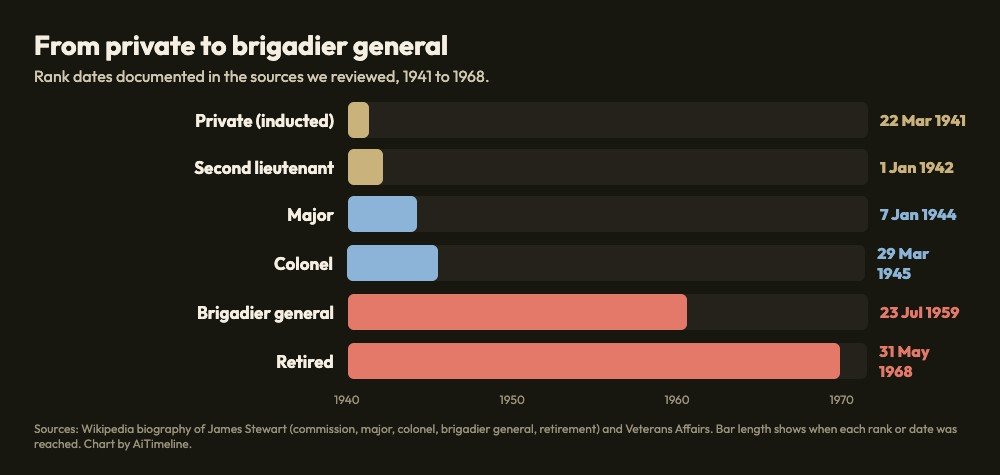
Jimmy Stewart’s Rank and Service Dates
From induction in 1941 to retirement in 1968.
| Rank or step | Date | Note |
|---|---|---|
| Private, Army Air Corps | 22 Mar 1941 | Rejected for low weight in Nov 1940; enlisted Feb 1941; inducted 22 March |
| Second lieutenant | 1 Jan 1942 | Wikipedia date; some summaries say late Dec 1941 |
| Major | 7 Jan 1944 | After a mission to Ludwigshafen |
| Colonel | 29 Mar 1945 | Private to colonel in four years |
| Brigadier general (Reserve) | 23 Jul 1959 | Nominated Feb 1957 |
| Retirement | 31 May 1968 | Mandatory retirement age of 60; 27 years of service |
How Many Missions Did Jimmy Stewart Fly?
About 20 is the usual answer. The record is less tidy.
Veterans Affairs, the Jimmy Stewart Museum and Britannica all give roughly 20 missions. The Army Air Corps Museum says ‘over 20’, including raids on Berlin. An excerpt in Air & Space Forces Magazine says he flew a dozen with the 445th, and reports without attribution that he flew more than his commanders wanted.
The differences come from how missions are counted and which unit’s records are used. We use ‘about 20’ and flag a precise count for editorial review.
Jimmy Stewart’s Decorations and Honours
| Honour | What the sources say | Caution |
|---|---|---|
| Distinguished Flying Cross | Awarded for his wartime flying | Veterans Affairs and the Jimmy Stewart Museum say two; Wikipedia mentions one |
| Air Medal | With three oak leaf clusters | Consistent across sources |
| Croix de Guerre with palm | French award for wartime service | Consistent across sources |
| Air Force Distinguished Service Medal | Awarded on retirement in 1968 | Wikipedia |
| Academy Award, Best Actor | The Philadelphia Story, 27 Feb 1941 | Ceremony date, not the 1940 film year |
| Academy Honorary Award | 1985 | For his body of work |
| Presidential Medal of Freedom | 23 May 1985 | Presented by President Reagan |
A Film Star and a Reserve General
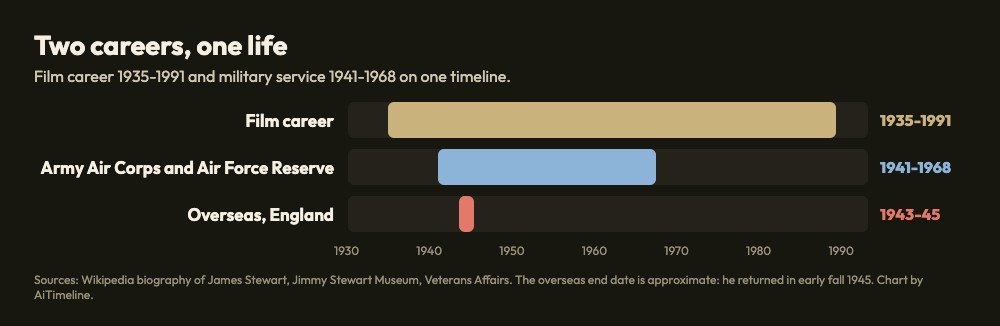
Stewart’s life ran on two tracks. His film career lasted from 1935 to 1991, and his military service from 1941 to 1968. The tracks overlapped for most of three decades: he made films while serving in the reserve, and he did active-duty tours with Strategic Air Command.
For other stories of aircraft and the people who flew them, see our Berlin Airlift history, the Falklands War timeline and the Concorde retirement story.
Record Check: Common Errors
Where common summaries of Stewart’s service go wrong
- “He began flying combat on 31 March 1944.” That is when he joined the 453rd Bomb Group. His unit, the 445th, flew its first mission on 13 December 1943.
- “He won the Oscar in 1940.” The film is from 1940, but the 13th Academy Awards were held on 27 February 1941.
- “He received his wings on 31 December 1941.” Wikipedia gives his commission as 1 January 1942.
- “He retired in 1966.” Official records give 31 May 1968.
- “He flew exactly 20 missions.” About 20 is the most common figure; sources differ, and none we could open gives a mission-by-mission audit.
- “He was the highest-ranking actor in history.” Wikipedia says so, but we have not seen a verified list of all actors who served.
Explore More Timelines
People Also Ask
Jimmy Stewart WWII: Frequently Asked Questions
Conclusion: Why the Record Matters
Jimmy Stewart stepped away from a film career at its height, trained as a pilot and flew bombers over Europe. After the war he stayed in uniform for another 23 years, retiring as a brigadier general in 1968.
The verified record is strong without exaggeration: the induction on 22 March 1941, the 445th Bomb Group’s missions from late 1943, the promotion to colonel on 29 March 1945 and the 1959 and 1968 dates. Where accounts differ, such as the exact mission count and the number of Distinguished Flying Crosses, we say so.
Related AiTimeline Stories
⚠️ Editorial Note
Last updated 1 November 2026. Dates and facts follow Wikipedia’s biography of James Stewart, Wikipedia’s history of the 445th Bomb Group, Veterans Affairs, the Jimmy Stewart Museum, Air & Space Forces Magazine, the Army Air Corps Museum and Britannica. The US Air Force Museum’s biography and the American Air Museum in Britain block automated access, so we could not read them directly. Items flagged for review: the exact mission count, the number of Distinguished Flying Crosses, the commission date, the title of his wing staff role and whether he flew the first Kiel mission. Photos marked as illustrative are not of Stewart’s own unit. Articles here are informational.
Sources & further reading
Every dated entry above was checked against these references. Last reviewed 1 November 2026.
- Wikipedia: James Stewart (biography, military service section)
- Wikipedia: 445th Bombardment Group (first mission, Gotha, Tibenham)
- Air & Space Forces Magazine: Heroes and Leaders, Jimmy Stewart
- US Department of Veterans Affairs: Veteran of the Day, James Stewart (via Aerotech News)
- The Jimmy Stewart Museum: Biography
- Army Air Corps Museum: General James Stewart
- Britannica: James Stewart
- National Museum of the US Air Force: Brig. Gen. James M. Stewart