Potti Sriramulu’s Fast: The Road to Andhra State, 1913–1956
Explore Potti Sriramulu's 58-day fast, the protests after his death and the events that led to Andhra State's formation in Kurnool on 1 October 1953.
Latest Story
Telugu-speaking people in the Madras Presidency had asked for a province of their own since 1913. Committees came and went, and the question of Madras city kept the demand stuck. On 19 October 1952 Potti Sriramulu, a Gandhian from Nellore, began a fast unto death in Madras. He died 58 days later, on the night of 15 December. Protests swept the Telugu districts, and on 19 December Jawaharlal Nehru announced that an Andhra State would be formed without Madras city. Andhra State came into existence on 1 October 1953 with Kurnool as its capital. This timeline follows the demand from 1913 to the fast, the new state, and the separate merger that created Andhra Pradesh on 1 November 1956.
💡 Short Answer
Potti Sriramulu fasted for 58 days, from 19 October 1952, for a separate state for Telugu speakers in Madras State. His death on 15 December 1952 set off protests across the Telugu districts. On 19 December Nehru announced an Andhra State without Madras city, and it was formed on 1 October 1953 with Kurnool as capital. Andhra Pradesh followed on 1 November 1956.
Potti Sriramulu and Andhra State: Key Questions
The Story in Ten Points
- The demand: organised at the Bapatla conference of May 1913.
- The compromise: the Sri Bagh Pact of 1937 balanced coastal Andhra and Rayalaseema.
- The delays: the Dar Commission (1948) and JVP report (1949) urged caution.
- The condition: Andhra could be formed only without Madras city.
- A first fast: Swami Sitaram fasted for 35 days in 1951.
- The fast: Sriramulu began on 19 October 1952 and died on day 58.
- The unrest: protests and police firing followed across the Telugu districts.
- The decision: Nehru announced Andhra State on 19 December 1952.
- The state: formed on 1 October 1953, capital Kurnool, Chief Minister Prakasam.
- The sequel: Andhra Pradesh, with Telangana, from 1 November 1956.
Timeline: From Bapatla to Andhra Pradesh
Newest first. Colour shows which phase each event belongs to.
Telangana separates; Andhra Pradesh returns to its 1953 shape Reorganisation 1953-2014
What changed: The ten Telangana districts left Andhra Pradesh and became the State of Telangana. The residuary Andhra Pradesh was made up of the coastal and Rayalaseema districts, broadly the territory of the Andhra State formed in 1953.
The echo: The same arguments heard in 1937 and 1956, over regional balance, capitals and safeguards, returned in the debate over division.
Andhra Pradesh is formed Reorganisation 1953-2014
The merger: Andhra State was joined with the nine Telugu-speaking districts of Hyderabad State, the Telangana region, and renamed Andhra Pradesh. Hyderabad replaced Kurnool as the capital.
Not the same date: This is a separate milestone from 1 October 1953. Andhra State existed for three years before the merger; Andhra Pradesh dates from 1956.
The Gentlemen’s Agreement on Telangana Reorganisation 1953-2014
What it covered: Leaders of the two regions agreed safeguards before the merger: a regional council for Telangana, protection for Telangana residents in public employment and education, and a share of ministerial posts.
Why it mattered: Complaints that these safeguards were not honoured fed the Telangana agitations of 1969 and the later statehood movement.
The States Reorganisation Commission reports Reorganisation 1953-2014
On Telugu areas: The commission recommended that Telangana be kept as a separate state for the time being, with the option of joining Andhra after the 1961 general elections if its legislature agreed.
What happened: The government chose immediate merger instead, subject to safeguards.
Andhra triggers a national commission Reorganisation 1953-2014
The decision: Less than three months after Andhra State was inaugurated, the Union government set up the States Reorganisation Commission to examine the reorganisation of all states.
The link: Andhra showed that a linguistic demand could not be settled one state at a time without others following.
The first government falls; President’s rule Andhra State 1953
What happened: Tanguturi Prakasam’s coalition lost a confidence vote in the Andhra Assembly and Andhra State was placed under President’s rule.
The outcome: A mid-term election followed in early 1955, and Bezawada Gopala Reddy became Chief Minister of a Congress-led government.
Andhra State comes into existence Andhra State 1953
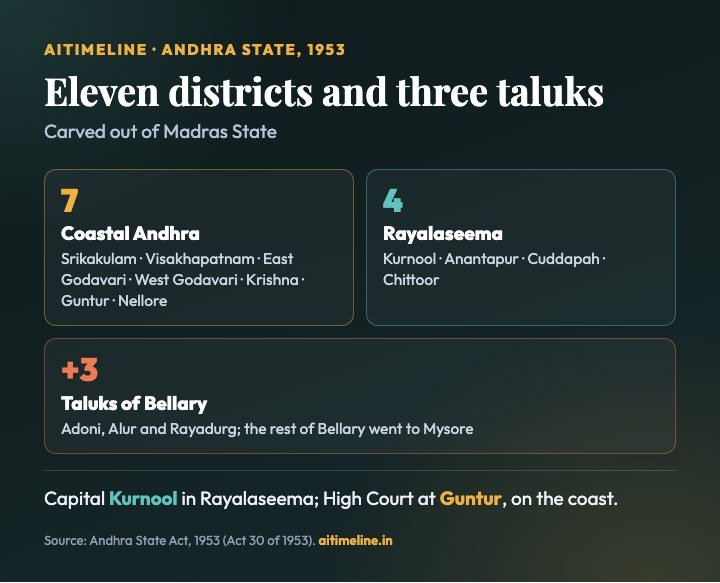
The new state: Eleven Telugu-speaking districts of Madras State, and three taluks of Bellary district, became Andhra State. Kurnool was the capital. Neelam Sanjiva Reddy was Deputy Chief Minister.
The precedent: It was the first state formed mainly on a linguistic basis after Independence. Orissa had been created for Odia speakers in 1936, under British rule.
The Andhra State Act, 1953 receives assent Andhra State 1953
What it did: The Act provided for “the formation of the State of Andhra, the increase of the area of the State of Mysore and the diminution of the area of the State of Madras”. Most of its provisions came into force on 1 October 1953, the appointed day.
Bellary: The Act divided Bellary district: three taluks went to Andhra and the rest to Mysore.
Parliament debates the Andhra State Bill Andhra State 1953
The debate: Members examined the boundaries, the division of assets and debts, the High Court and the services. Several speakers asked whether Andhra would be followed by similar states elsewhere.
The capital: Kurnool, chosen by the Andhra legislators, became the seat of the new government.
Kurnool is chosen as the capital Andhra State 1953
The choice: The Andhra legislators chose Kurnool, in Rayalaseema, over Vijayawada and other coastal towns. Rayalaseema leaders pointed to the 1937 Sri Bagh Pact, which promised the region a choice between the capital and the High Court.
The arrangement: Kurnool became the capital and the High Court went to Guntur, in the coastal region.
Justice Wanchoo reports on the new state Andhra State 1953
The task: Wanchoo was asked to examine the financial and administrative questions raised by forming Andhra: the division of assets and liabilities, the services and the location of offices.
Next: The government drew on his report in setting out its decisions on the new state in March 1953.
Nehru announces Andhra State The fast 1952
The announcement: Nehru said the government had decided to establish an Andhra State made up of the undisputed Telugu-speaking districts of Madras State. Madras city was not included.
The basis: He linked the decision to the approach in the 1949 JVP report: Andhra could be formed if disputed areas were left out.
Protests sweep the Telugu districts The fast 1952
What happened: Sriramulu’s funeral procession in Madras turned into a riot. Shutdowns, attacks on railway property and clashes followed in towns across the coastal districts for three to four days.
The toll: TIME reported on 29 December 1952 that police firing killed seven people and wounded forty; the deaths were at Anakapalle and Vijayawada. Counts in later accounts vary.
Potti Sriramulu dies after 58 days The fast 1952
The death: Sriramulu died on the night of 15 December 1952, close to midnight, on the 58th day of his fast. Some accounts date it 16 December for that reason.
The house: The house where he died, belonging to Bulusu Sambamurti, is preserved as a memorial.
The fast becomes a national issue The fast 1952
In Parliament: Members tried to raise the fast through adjournment motions. The Speaker held it was not a matter for the House to take up in that form.
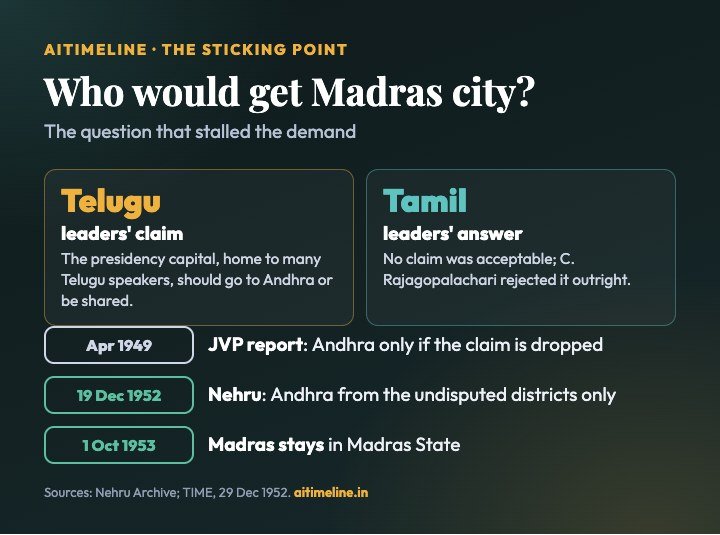
Behind the scenes: Nehru corresponded with Madras Chief Minister C. Rajagopalachari as the fast went on. The Madras city question remained the obstacle: Andhra leaders wanted the city, and Tamil leaders, including Rajagopalachari, rejected that.
Sriramulu begins his fast unto death The fast 1952
The demand: A separate Andhra State for the Telugu-speaking districts of Madras State. Sriramulu also wanted Madras city included, though many supporters thought that claim unwinnable.
The response: The Andhra Pradesh Congress Committee did not back the fast, but it drew growing public support across the Telugu districts.
Swami Sitaram fasts for 35 days The demand 1913-1951
The fast: Swami Sitaram began a fast unto death for a separate Andhra on 15 August 1951. He ended it on 20 September, after 35 days, when Vinoba Bhave intervened at the request of Madras Chief Minister P.S. Kumaraswami Raja.
Nehru’s position: Nehru wrote that the central government could not impose such a decision against the wishes of a considerable number of people.
The JVP report: Andhra, but not Madras The demand 1913-1951
The view: The committee advised against creating linguistic provinces for the time being, giving priority to security, unity and economic development.
The opening: It accepted that an Andhra province could be considered if public feeling was strong, provided the Telugu leaders gave up their claim to Madras city.
The Dar Commission rejects linguistic provinces The demand 1913-1951
The finding: The commission recommended against forming provinces mainly on linguistic grounds, preferring administrative convenience.
The reaction: The report was unpopular in the regions that had campaigned for linguistic provinces, and the Congress set up the JVP committee to look again.
The Sri Bagh Pact The demand 1913-1951
The bargain: Rayalaseema leaders feared domination by the richer coastal districts. The pact promised Rayalaseema a share of university institutions, priority in irrigation, equal representation, and a choice between the capital and the High Court.
Its later use: It was invoked in 1953 when Kurnool was chosen as capital and the High Court went to Guntur.
The first Andhra Conference at Bapatla The demand 1913-1951
The start: Telugu leaders meeting at Bapatla, in Guntur district, gave the demand for a separate Andhra province an organised platform.
The movement: Annual conferences kept the demand alive through the freedom struggle, and the Congress itself later organised its provincial committees by language, Andhra included.
Sriramulu’s fasts for Dalit temple entry Sriramulu’s life
The cause: Sriramulu fasted to open temples in Nellore, including the Venugopalaswamy temple at Moolapeta, to Dalits, and to press the Madras government for measures for Dalit welfare.
His method: A Gandhian since joining the Sabarmati Ashram in the early 1930s, he had been jailed for the Salt Satyagraha and the Quit India movement.
Potti Sriramulu is born Sriramulu’s life
Early life: Born to Guravayya and Mahalakshmamma, he grew up partly in Madras, studied at the Victoria Jubilee Technical Institute in Bombay and worked for the Great Indian Peninsula Railway.
The turn: After losing his wife and newborn child in 1929, he resigned and joined Gandhi’s Sabarmati Ashram.
The 58 Days, and the Four That Followed
Madras, October to December 1952.
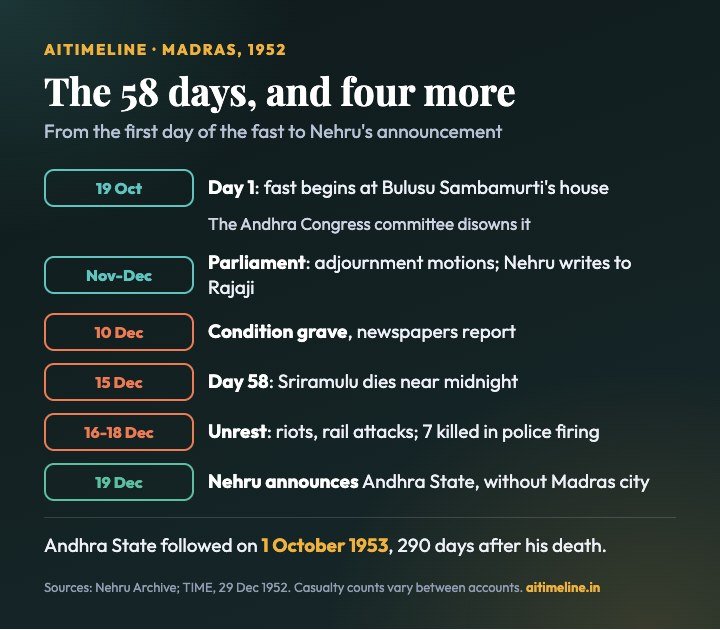
The fast did not begin as a mass event. The Andhra Congress committee kept its distance, and many of Sriramulu’s own supporters thought his insistence on Madras city was a lost cause. Attention grew as the weeks passed and his condition worsened. Members tried to raise it in the Lok Sabha; Nehru exchanged letters with Madras Chief Minister C. Rajagopalachari; neither side moved on Madras. When Sriramulu died near midnight on 15 December, the reaction was immediate. His funeral procession in Madras turned into a riot, and over the next three days crowds attacked railway stations, trains and government offices in towns from Visakhapatnam to Nellore. TIME reported that police firing killed seven people and wounded forty. On 19 December Nehru told Parliament that an Andhra State would be formed.
Andhra State 1953 vs Andhra Pradesh 1956
The distinction most accounts blur.
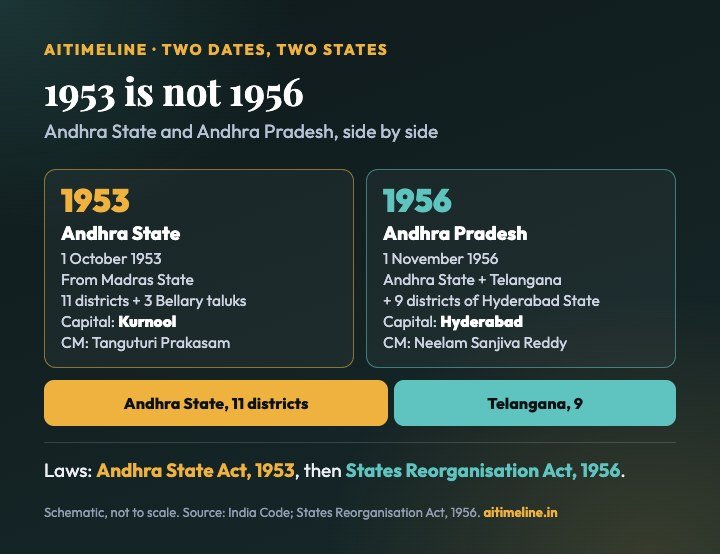
| Andhra State | Andhra Pradesh | |
|---|---|---|
| Formed | 1 October 1953 | 1 November 1956 |
| Law | Andhra State Act, 1953 (Act 30 of 1953) | States Reorganisation Act, 1956 |
| Carved from | Madras State | Andhra State plus Telangana districts of Hyderabad State |
| Territory | 11 districts and 3 Bellary taluks | Andhra State and 9 Telangana districts |
| Capital | Kurnool | Hyderabad |
| First Chief Minister | Tanguturi Prakasam | Neelam Sanjiva Reddy |
| Trigger | Sriramulu’s death and the December 1952 unrest | States Reorganisation Commission, 1953–55 |
The Long Road: 1913 to 1956
The fast came after four decades of conferences, pacts and committees.
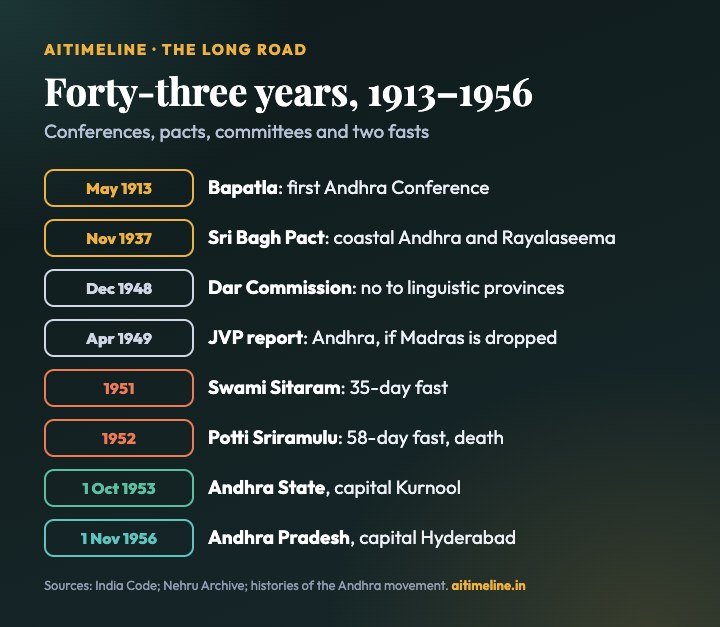
After Independence, national leaders were wary. Partition had just shown how identity politics could tear a country apart, and the Constituent Assembly’s Dar Commission recommended in December 1948 against provinces drawn by language. The Congress’s own JVP Committee, of Nehru, Patel and Pattabhi Sitaramayya, softened this in April 1949: Andhra might be considered, if its leaders gave up Madras city. They would not. Swami Sitaram’s 35-day fast in 1951 ended without a decision. By the time Sriramulu began his fast, the demand was 39 years old.
Why Madras City Was the Sticking Point
A capital both sides claimed.
Often claimed
- Andhra Pradesh was formed in 1953.
- Swami Sitaram fasted in May 1952.
- Andhra was India’s first linguistic state.
- Sriramulu’s fast won Madras city for Andhra.
What the record shows
- Andhra State was formed in 1953; Andhra Pradesh in 1956.
- His fast ran from 15 August to 20 September 1951.
- First after Independence; Orissa was formed in 1936.
- Madras city was excluded from the start.
Who Was Potti Sriramulu?
Potti Sriramulu was born on 16 March 1901 at Padamatipalli, then in Nellore district. He studied sanitary engineering at the Victoria Jubilee Technical Institute in Bombay and worked for the Great Indian Peninsula Railway. After his wife and newborn child died in 1929, he resigned and joined Gandhi’s Sabarmati Ashram. He was jailed for the 1930 Salt Satyagraha and again during the individual satyagraha and Quit India movement. Back in Nellore, he worked for khadi and Dalit rights, and between 1946 and 1948 he fasted three times for Dalit entry into temples, including the Venugopalaswamy temple at Moolapeta. Gandhi is reported to have said that with eleven more followers like Sriramulu he could win freedom in a year. He is remembered as Amarajeevi, the immortal one; Nellore district now carries his name.
| Detail | Information |
|---|---|
| Born | 16 March 1901, Padamatipalli |
| Died | 15 December 1952, Madras |
| Fast | 19 October to 15 December 1952, 58 days |
| Place of fast | Bulusu Sambamurti’s house, Mylapore, Madras |
| Demand | A separate state for Telugu-speaking people |
| Prime Minister | Jawaharlal Nehru |
| Madras Chief Minister | C. Rajagopalachari |
| Outcome | Andhra State, 1 October 1953 |
Why Was a Separate Andhra State Demanded?
Five strands of one demand
- Language: Telugu speakers wanted a government that worked in Telugu.
- Representation: campaigners said the Telugu districts were outweighed in the Madras administration.
- Identity: the movement drew on Telugu literature, history and culture.
- Resources: jobs, colleges, irrigation and public institutions were at stake.
- Madras city: the dispute over the presidency capital tied all of these together.
What Changed After Andhra State?
One state, then a national redraw.
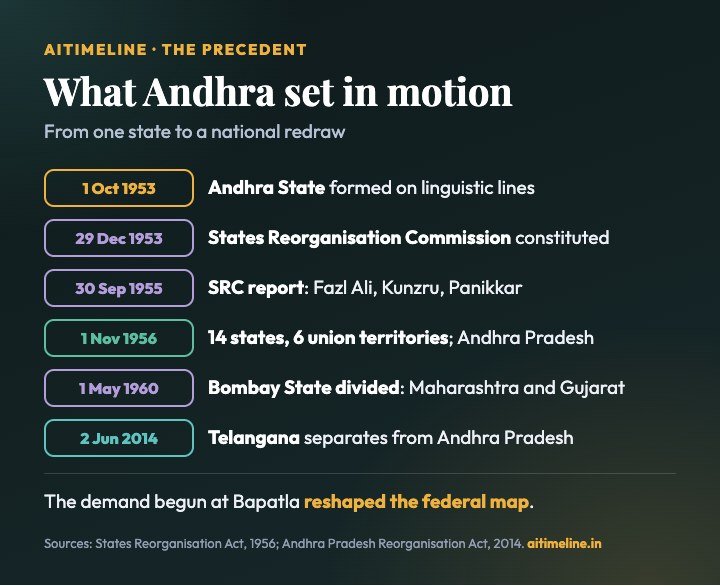
Language as a basis
- First linguistic state after 1947.
- Others followed within three years.
- Language became central to federal design.
Fast and agitation
- A death and unrest forced the decision.
- Later movements cited the example.
- Raised fears of politics by agitation.
Capitals and regions
- Kurnool, then Hyderabad.
- Telangana safeguards disputed.
- The state was divided again in 2014.
Explore More Timelines
People Also Ask
Frequently Asked Questions
Dates checked against the Andhra State Act, 1953 and contemporary records.
⚠️ Editorial Note
This account draws on the Andhra State Act, 1953 (India Code), Nehru Archive records of December 1952, TIME’s report of 29 December 1952, and published histories of the Andhra movement. Checking the brief this page started from: Swami Sitaram’s fast ran from 15 August to 20 September 1951, not May 1952 at Bhimavaram. We could not confirm a Madras Assembly walkout on 9 December 1952 or a figure of eight deaths from the Andhra Pradesh Police history, so we use the seven deaths reported by TIME at the time and note that counts vary. Sriramulu died close to midnight on 15 December 1952, which is why some sources say 16 December, and some count the fast as 56 days. The exact month of the Kurnool capital vote is not settled in the sources we read, so it is dated to 1953 only. The fast was a catalyst; the Andhra movement had been building since 1913.
Related Reading on AiTimeline
Sources & further reading
Every dated entry above was checked against these references. Last reviewed 6 November 2026.
- The Andhra State Act, 1953 (Act No. 30 of 1953)
- Death of Potti Sriramulu, 16 December 1952
- Jawaharlal Nehru, letter to Chief Ministers, 19 December 1952
- Swami Sitaram
- INDIA: Fast & Win (29 December 1952)
- Nehru couldn't ignore Potti Sriramulu, who gave India Andhra Pradesh by fasting till death
- From Kurnool to Amaravati: Andhra Pradesh's long struggle to find a suitable capital
- Strikes pave the way (Mapping the states of India)