India’s Same-Sex Marriage Journey: From Section 377 to the Supreme Court Verdict
India's LGBTQ+ rights journey, from Section 377 and the 2018 decriminalisation verdict to the 2023 marriage-equality ruling and 2025 review dismissal.
Latest Story
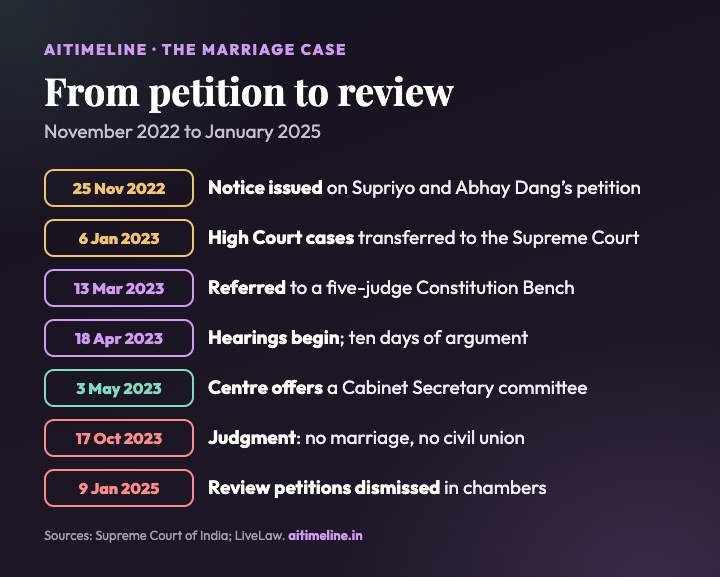
Can two men or two women marry in India? Not yet. The story of same-sex marriage in India is really two stories. The first, about Section 377, took 158 years and ended in 2018, when the Supreme Court held that consensual same-sex relations between adults are not a crime. The second, about marriage, reached the same court in 2022 and ended differently: in October 2023 a five-judge bench declined to read queer couples into the Special Marriage Act or to create civil unions, and in January 2025 it refused to review that decision. This timeline follows both, sets out what each judge actually held, and explains what queer couples can and cannot do under Indian law today.
💡 Short Answer
Same-sex marriage is not legal in India. The Supreme Court decriminalised consensual same-sex relations in 2018 (Navtej Singh Johar), but on 17 October 2023 it declined to recognise same-sex marriage or civil unions (Supriyo), leaving the question to Parliament. Review petitions were dismissed on 9 January 2025. Advisories since 2024 allow joint bank accounts, shared ration cards and prison visits.
Same-Sex Marriage in India: Key Questions
The Journey in Ten Points
- 1860: Section 377 entered the Indian Penal Code, which came into force in 1862.
- 1991 to 2001: ABVA’s report and petition, then Naz Foundation’s, began the legal challenge.
- 2 July 2009: the Delhi High Court read down Section 377 for consenting adults.
- 11 December 2013: the Supreme Court reversed it in Koushal.
- 2014 and 2017: NALSA recognised the third gender; Puttaswamy made privacy a fundamental right.
- 6 September 2018: Navtej Singh Johar decriminalised consensual same-sex relations, unanimously.
- 17 October 2023: Supriyo declined marriage equality; civil unions and joint adoption were refused 3 to 2.
- 2024: a Cabinet Secretary committee and advisories on bank accounts, ration cards and prison visits.
- 9 January 2025: review petitions dismissed; the 2023 position stands.
- November 2026: no bill on same-sex marriage or civil unions has been introduced.
Two Different Legal Questions
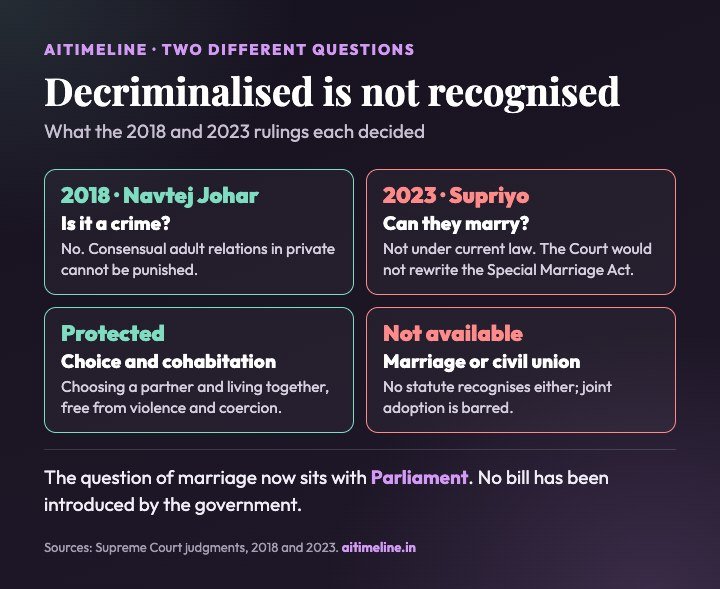
Being free from prosecution is not the same as being recognised.
Decriminalisation asks whether the state may punish a relationship. Recognition asks whether the state must register it and attach rights to it: inheritance, maintenance, next-of-kin status in hospitals, pensions, insurance, tax treatment and adoption. India answered the first question in 2018. It has not answered the second.
The difference explains why the 2018 and 2023 judgments came out so differently. Striking down a criminal provision is a classic judicial task. Recognising marriage means rewriting a web of statutes on succession, divorce, maintenance and adoption, which the Supreme Court’s majority held it could not do.
Timeline: From Section 377 to the Supreme Court Verdict
Newest first. Colour shows which strand each event belongs to.
Still no law on marriage or civil unions Government
Where it stands: As of 8 November 2026, no law recognises same-sex marriage or civil partnerships in India. The government has not introduced a bill, and the Special Marriage Act still speaks of a “husband” and a “wife”.
What has changed: Queer couples have practical protections from 2024 advisories on bank accounts, ration cards and prison visits, and from court rulings on choice of partner and protection from violence.
Couples narrow the fight to specific laws Activism
What is reported: With marriage ruled out by the courts, lawyers and couples have turned to narrower challenges: provisions that give benefits only to a spouse or relative, such as income-tax exemptions on gifts. Commentary in September 2026 described such cases as the next front of the movement.
Status: This page found no final High Court ruling on these challenges as of 8 November 2026.
Madras High Court: a queer couple can form a family High Court
The case: A woman filed a habeas corpus petition after her female partner was confined by her natal family. The court ordered her release, restrained the family from interfering and directed the police to protect the couple.
The principle: The bench said that while Supriyo did not legalise same-sex marriage, marriage is not the only way to found a family, and the idea of a “chosen family” is settled in LGBTQIA+ law.
Government lists its measures in Parliament Government
The reply: The Minister of State for Social Justice and Empowerment told the Lok Sabha that advisories had been issued so queer partners can be treated as one household for ration cards, open joint bank accounts and name each other as nominees, and receive equal prison visitation rights.
Health: The reply said the Health Ministry had asked states to ensure access to care and to prohibit conversion therapy.
Review petitions dismissed Setback
The order: The bench dismissed about 13 review petitions, saying it found no error apparent on the face of the record and that the majority view was in accordance with law. It declined an open-court hearing.
The bench: A fresh bench had to be formed after Justice Sanjiv Khanna recused himself from the review in July 2024. Of the original five judges, only Justice P.S. Narasimha was still on the court.
Joint bank accounts and partner nominees Government
The advisory: The Finance Ministry clarified that there is no restriction on persons of the queer community opening a joint bank account, or nominating a partner in a queer relationship to receive the balance if the account holder dies.
The limit: A nominee receives money as a trustee for the legal heirs in many situations; nomination does not by itself make the partner an heir. Reports soon after said some branches were still unsure how to apply it.
Prison visits: equal rights for queer partners Government
The advisory: The MHA told states and Union Territories that prison rules allowing visits from family, relatives, friends and legal advisers apply equally to LGBTQ+ prisoners, so a partner should be able to visit without discrimination.
A companion advisory: The MHA also asked states to act against violence, harassment and coercion directed at queer persons.
New criminal code has no Section 377 Government
What changed: The Indian Penal Code was replaced by the Bharatiya Nyaya Sanhita. The new code contains no equivalent of Section 377.
The concern: Lawyers pointed out that this also removed the only provision covering non-consensual sexual acts against men and transgender persons, a gap raised before the Delhi High Court in 2024.
Cabinet Secretary committee notified Government
The committee: The Centre notified a committee chaired by the Cabinet Secretary to examine the entitlements of the queer community, as promised to the Supreme Court in 2023.
Its agenda: At its first meeting on 21 May 2024 it discussed ration cards, joint bank accounts with a partner as nominee, and harassment based on gender identity and sexual orientation. A second meeting on 22 August 2024 directed ministries to issue advisories.
Curative petitions against Koushal closed Supreme Court
What happened: The Supreme Court closed the curative petitions filed against the 2013 Koushal judgment, holding they had been rendered infructuous by Navtej Singh Johar.
Supreme Court declines marriage equality Setback
The decision: A five-judge Constitution Bench unanimously held that it could not read the Special Marriage Act as gender-neutral or strike it down, and that there is no unqualified fundamental right to marry. By a 3 to 2 majority it held that queer couples have no legally enforceable right to a civil union in the absence of a law.
The split: Chief Justice D.Y. Chandrachud and Justice Sanjay Kishan Kaul would have held that the state must recognise queer unions and allow joint adoption. Justice S. Ravindra Bhat, writing for himself and Justice Hima Kohli, and Justice P.S. Narasimha disagreed. Their view is the law.
What it affirmed: The judges recognised that queer people can choose their partners and live together, and that the state must protect them from violence and coercion. Transgender persons in heterosexual relationships can marry under existing law.
Centre offers a committee instead of marriage Government
The offer: The Solicitor General told the court that the Centre would set up a committee headed by the Cabinet Secretary to examine administrative steps for same-sex couples, without legalising their marriage.
Why: On 27 April the bench had asked whether social-welfare benefits could be given to same-sex couples without marriage.
Ten days of hearings Supreme Court
The arguments: Petitioners argued that excluding queer couples from civil marriage denied them equality, dignity and a range of legal benefits. The Union argued that marriage is a social institution for Parliament to define, and called the petitions “urban elitist” views.
The questions: Whether marriage is a fundamental right, whether the Special Marriage Act could be read gender-neutrally, whether the state must recognise queer unions, and whether queer couples could adopt jointly.
Referred to a Constitution Bench Supreme Court
What happened: A bench led by Chief Justice Chandrachud referred the petitions to a five-judge Constitution Bench, saying they raised substantial questions of constitutional law.
High Court cases moved to the Supreme Court Activism
What happened: The Supreme Court transferred to itself the marriage-equality petitions pending in the Delhi, Kerala and other High Courts, so that one bench would decide the question.
Supreme Court issues notice on marriage equality Activism
The petitions: Two couples, including Hyderabad-based Supriyo Chakraborty and Abhay Dang, asked the Supreme Court to recognise same-sex marriages under the Special Marriage Act. The court issued notice to the Union and the Attorney General.
The argument: They said excluding queer couples from civil marriage violated equality, dignity and non-discrimination guaranteed by Navtej.
First marriage petitions in the High Courts Activism
The cases: From September 2020, couples and activists asked the Delhi and Kerala High Courts to recognise same-sex marriages under the Hindu Marriage Act, the Special Marriage Act and the Foreign Marriage Act.
The Centre’s answer: In February 2021 the Union told the Delhi High Court that same-sex relationships were not comparable to the “Indian family unit” of a husband, wife and children.
Transgender Persons Act becomes law Government
The law: The Transgender Persons (Protection of Rights) Act, 2019 prohibits discrimination against transgender persons in education, employment and services and provides a procedure for identity certificates.
The criticism: Trans groups objected that it required a district magistrate’s certificate, departing from the self-identification upheld in NALSA.
A larger bench takes up Section 377 Supreme Court
What happened: A three-judge bench referred dancer Navtej Singh Johar’s petition to a Constitution Bench, saying Koushal needed reconsideration. During the July hearings the Centre left the validity of Section 377, as applied to consensual adults, to the “wisdom of the court”.
Privacy becomes a fundamental right Supreme Court
The ruling: A nine-judge bench held that privacy is a fundamental right protected by Article 21.
On sexual orientation: The plurality opinion said sexual orientation is an essential attribute of privacy, and that the reasoning in Koushal was unsustainable, while leaving the challenge itself to be decided in a proper case.
Curative petitions sent to a larger bench Supreme Court
What happened: The Supreme Court agreed to have the curative petitions against Koushal heard by a five-judge bench, an unusual step for a curative plea.
NALSA recognises the third gender Supreme Court
The ruling: The Supreme Court recognised transgender persons as a third gender, upheld the right to self-identify one’s gender and directed governments to provide protections and reservations.
Review of Koushal dismissed Setback
What happened: The Supreme Court dismissed the review petitions against Koushal, including one filed by the Union government, leaving the curative route as the only remaining option.
Koushal restores Section 377 Setback
The ruling: The Supreme Court set aside the Delhi High Court judgment and held Section 377 constitutional, saying it was for Parliament to change the law.
The reasoning: It said LGBT persons were a “minuscule fraction” of the population, a phrase later rejected in Puttaswamy and Navtej.
Delhi High Court reads down Section 377 High Court
The ruling: The court held Section 377 unconstitutional in so far as it criminalised consensual sexual acts between adults in private, finding a violation of Articles 14, 15 and 21.
Its reach: For four years, consensual same-sex relations between adults were legal in India.
Supreme Court sends the case back Supreme Court
What happened: The Supreme Court set aside the High Court’s dismissal, saying the matter required consideration, and sent it back to be heard on merits.
Delhi High Court dismisses Naz’s petition Setback
What happened: The High Court dismissed the petition, holding that no cause of action had accrued to Naz Foundation and that purely academic issues could not be examined.
Naz Foundation files its challenge Activism
The petition: Naz Foundation (India) Trust, an HIV/AIDS organisation, asked the Delhi High Court to read down Section 377, arguing that it drove men who have sex with men away from health services and violated privacy, dignity and equality.
ABVA’s petition against Section 377 Activism
What happened: After authorities refused to allow condoms to be distributed in Tihar Jail on the ground that this would encourage sodomy, ABVA petitioned the Delhi High Court to strike down Section 377.
“Less Than Gay” Activism
What happened: ABVA published Less Than Gay, one of the first public reports in India documenting discrimination against gay men and calling for repeal of Section 377 and for recognition of same-sex marriages.
Section 377 enters the Indian Penal Code Setback
The law: The colonial Indian Penal Code, drafted under Thomas Babington Macaulay and enacted on 6 October 1860, made “carnal intercourse against the order of nature” punishable with transportation for life.
How it was used: Prosecutions were rare, but the section was used to harass, extort and stigmatise LGBT people for well over a century.
The Road to Decriminalisation
Section 377, 1860 to 2018.
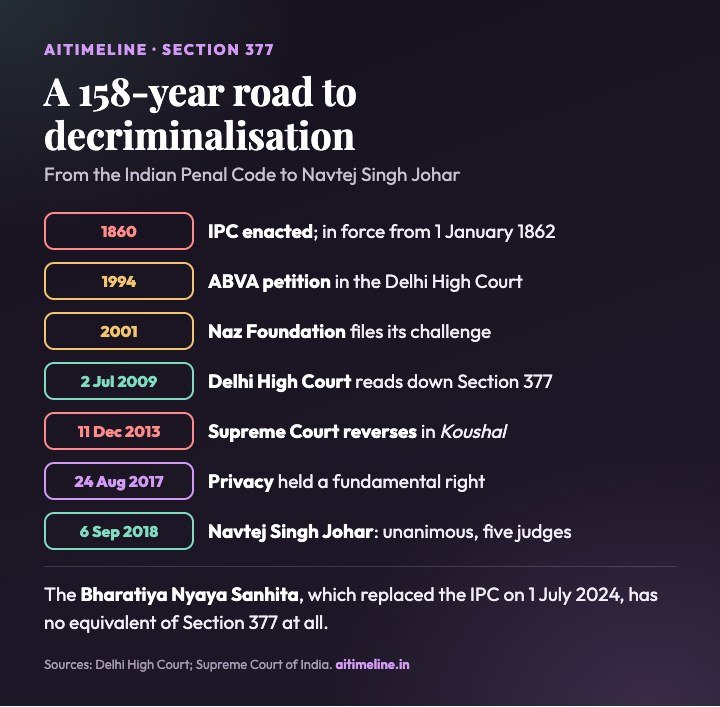
The path was not straight. A High Court victory in 2009 was reversed in 2013, and for nearly five years consensual same-sex relations were again a crime. What changed the outcome was the privacy judgment of 2017, which removed the foundations of Koushal, and a bench willing to call Section 377 a relic that punished people for who they are.
The 2023 Verdict: What Each Judge Held
Four opinions. Only the majority’s binds.
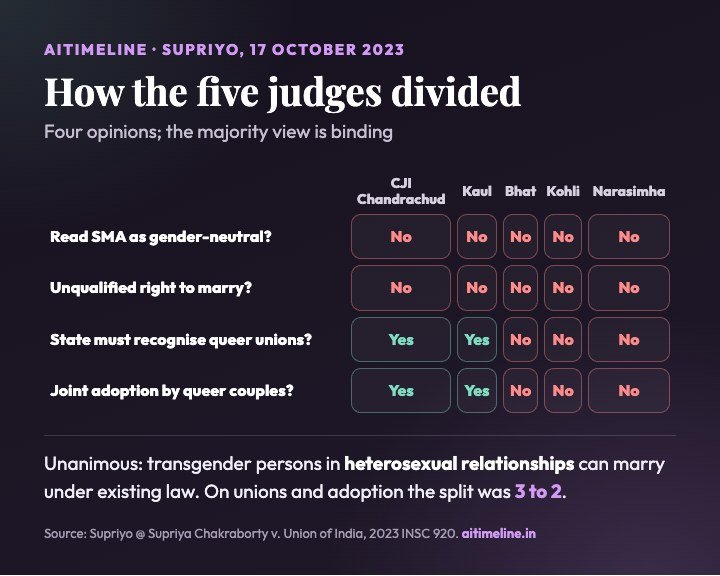
CJI D.Y. Chandrachud
Queer persons have a right to enter a union; the state must recognise it and its benefits. Would have allowed joint adoption. Issued directions against harassment and forced medical treatment.
Justice Sanjay Kishan Kaul
Agreed with the Chief Justice that queer unions deserve legal recognition, and called for an anti-discrimination law.
Justice S. Ravindra Bhat
No right to a civil union can be created by the court without a law; that is for the legislature. Upheld the adoption regulation. Wrote for himself and Justice Kohli.
Justice Hima Kohli
Joined Justice Bhat’s opinion in full.
Justice P.S. Narasimha
Wrote separately, agreeing that there is no unqualified right to marry or to a civil union without legislation, and that the adoption bar stands.
What all five agreed
The Special Marriage Act cannot be read gender-neutrally; queer people may choose partners and cohabit; trans persons in heterosexual relationships can marry.
It is a mistake to read Supriyo as a rejection of LGBTQ+ rights. Every judge accepted that queer relationships are protected from state and family interference. The disagreement was about who should build the legal framework for those relationships: the court or Parliament. The majority chose Parliament.
What About Adoption?
Regulation 5(3) of the Adoption Regulations, 2022, framed by the Central Adoption Resource Authority, says a couple must have been in a stable marital relationship for at least two years to adopt together. The Chief Justice and Justice Kaul would have read it down so that unmarried couples, including queer couples, could adopt jointly. The majority upheld it.
The result is that a queer person may adopt as a single parent if they meet the eligibility rules, but their partner has no legal relationship with the child. That affects guardianship, inheritance and decisions about the child’s care if the adoptive parent dies or the couple separates.
After the Verdict: What the Government Changed
Advisories, not legislation.
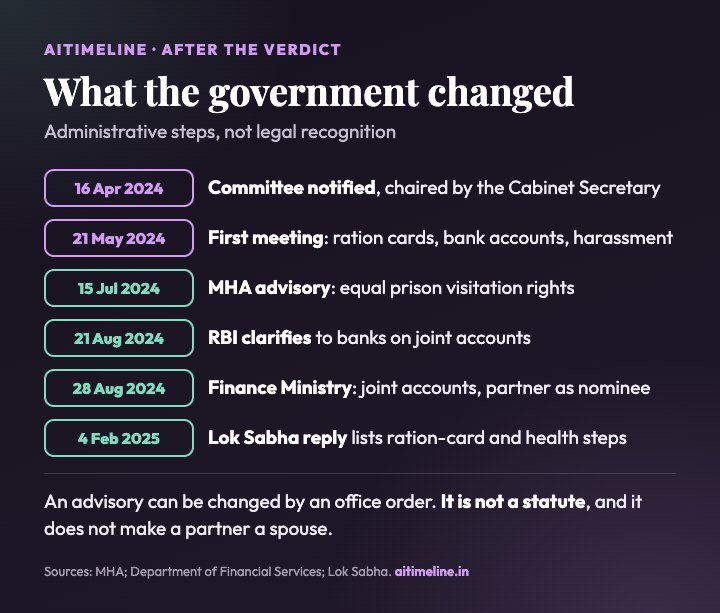
The committee the Centre promised in May 2023 was notified in April 2024. Within months, ministries issued advisories on the three practical problems that came up most often in court: banks refusing joint accounts, ration offices refusing to treat partners as one household, and prisons refusing visits from a partner. The government also said it had asked states to stop conversion therapy and improve access to health care.
These steps matter in daily life, but they are fragile. An advisory can be withdrawn by an office order, does not bind private parties such as insurers or hospitals, and gives no rights in succession, maintenance or divorce.
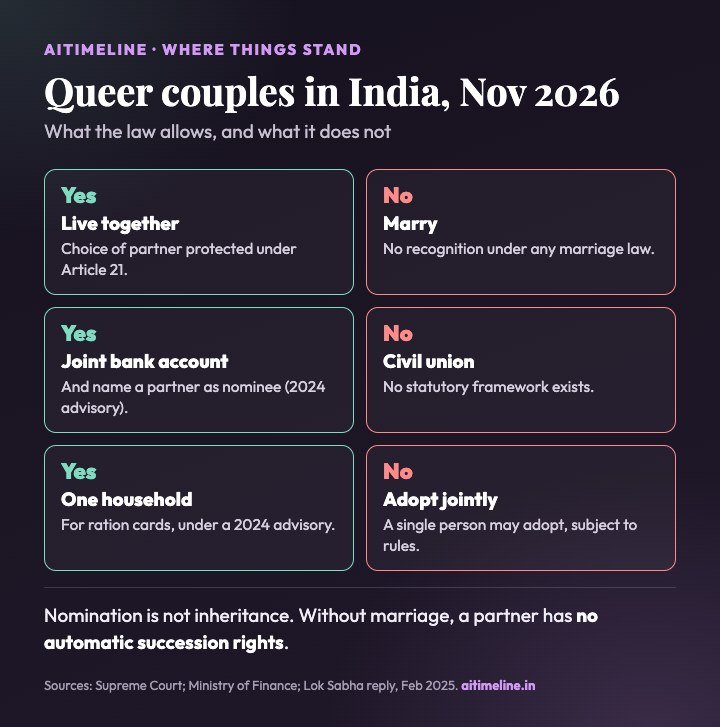
What Rights Do Queer Couples Have in India Today?
The position as of 8 November 2026.
| Area | Current legal position | Source |
|---|---|---|
| Consensual adult relations | Not a crime | Navtej Singh Johar (2018) |
| Choice of partner, living together | Protected; police must prevent coercion | Article 21; Supriyo; High Court rulings |
| Marriage | Not recognised | Supriyo (2023); review dismissed 2025 |
| Civil union or partnership | No statutory framework | Supriyo, 3 to 2 |
| Joint bank account, partner as nominee | Permitted | Finance Ministry advisory, 28 Aug 2024 |
| Ration card as one household | Permitted | Advisory, reported to Lok Sabha Feb 2025 |
| Prison visits by a partner | Equal access | MHA advisory, 15 Jul 2024 |
| Joint adoption as a couple | Not permitted | CARA Regulation 5(3), upheld 2023 |
| Adoption as a single person | Possible, subject to eligibility | Adoption Regulations, 2022 |
| Inheritance from a partner | Only by will; no intestate succession | Succession laws unchanged |
| Transgender persons in heterosexual relationships | Can marry under existing law | Supriyo, unanimous |
Landmark Judgments in India’s LGBTQ+ Rights Journey
| Case | Date | What it decided |
|---|---|---|
| Naz Foundation v. Govt of NCT of Delhi (Delhi HC) | 2 Jul 2009 | Read down Section 377 for consenting adults |
| Suresh Kumar Koushal v. Naz Foundation | 11 Dec 2013 | Reversed Naz; upheld Section 377 |
| NALSA v. Union of India | 15 Apr 2014 | Third gender; right to self-identify |
| K.S. Puttaswamy v. Union of India | 24 Aug 2017 | Privacy a fundamental right; sexual orientation part of it |
| Navtej Singh Johar v. Union of India | 6 Sep 2018 | Decriminalised consensual same-sex relations; overruled Koushal |
| Supriyo v. Union of India | 17 Oct 2023 | No marriage equality; civil unions and joint adoption refused 3 to 2 |
| Review in Supriyo | 9 Jan 2025 | Review petitions dismissed |
| M.A. v. SP, Vellore (Madras HC) | 22 May 2025 | Same-sex couples can form a family |
Impact on Indian Society and Governance
Choice and dignity
The 2018 and 2023 rulings settled that queer adults may choose partners and live together without state or family interference.
The security gap
Without marriage, couples lack default rights in inheritance, maintenance, pensions, insurance and hospital decisions.
One legal parent
A child adopted by one partner has no legal tie to the other, with consequences for guardianship and succession.
Conversion therapy
Government directions against conversion therapy and for access to care depend on state-level implementation.
Banking access
Joint accounts and nominee rights ease daily life, though branch-level practice has lagged.
Court and Parliament
The Supreme Court placed the next step with the legislature, which has not yet taken it up.
India’s position now sits between two models. It protects queer relationships from punishment and interference, as most democracies do, but gives them no legal form, unlike the countries that have adopted marriage equality or civil partnerships. Whether that gap closes will depend on Parliament, or on courts extending rights one statute at a time.
Explore More Timelines
People Also Ask
Frequently Asked Questions
Checked against the judgments, government advisories and contemporary court reporting.
⚠️ Editorial Note
This page is a factual account of court rulings and government measures, not legal advice. The 2023 Supriyo judgment is described by its binding majority view; the opinions of Chief Justice Chandrachud and Justice Kaul are identified as minority opinions. The ruling declined marriage and civil-union recognition but affirmed protections for choice of partner, cohabitation and freedom from coercion, so it should not be read as a complete rejection of LGBTQ+ rights. Checking the brief this page began from: Section 377 dates from the Indian Penal Code of 1860, in force from 1862, not 1861; the Delhi High Court dismissed Naz Foundation’s petition on 2 September 2004, not in 2003; review of Koushal was dismissed in January 2014, while 2016 was the curative stage; on 25 November 2022 the Supreme Court issued notice and the High Court petitions were transferred on 6 January 2023; and the Cabinet Secretary committee was offered on 3 May 2023, during the hearings, not in October 2023. An entry for the third anniversary of Navtej was dropped as not a legal event.
Related Reading on AiTimeline
Sources & further reading
Every dated entry above was checked against these references. Last reviewed 8 November 2026.
- Supreme Court: Supriyo @ Supriya Chakraborty v. Union of India, judgment of 17 October 2023 (Indian Kanoon)
- LiveLaw: No legal support for queer marriages, time for legislature to decide (17 October 2023)
- LiveLaw: Supreme Court dismisses petitions to review its same-sex marriage judgment (9 January 2025)
- Supreme Court: Navtej Singh Johar v. Union of India, judgment of 6 September 2018 (Indian Kanoon)
- Delhi High Court: Naz Foundation v. Government of NCT of Delhi, judgment of 2 July 2009 (Indian Kanoon)
- Supreme Court: Suresh Kumar Koushal v. Naz Foundation, judgment of 11 December 2013 (PDF)
- Supreme Court: National Legal Services Authority v. Union of India, judgment of 15 April 2014 (Indian Kanoon)
- Supreme Court: Justice K.S. Puttaswamy v. Union of India, judgment of 24 August 2017 (Indian Kanoon)
- The Week / PTI: Committee to be set up to address concerns of same-sex couples, Centre tells Supreme Court (3 May 2023)
- LiveLaw: Queer partners can open joint bank accounts and nominate their partners, Ministry of Finance (August 2024)
- The Mooknayak: Centre directs states to ensure equal rights for queer community in prisons (MHA advisory, July 2024)
- ThePrint / PTI: Govt seeks public input on LGBTQI+ policies as new measures are implemented (1 September 2024)
- ThePrint / PTI: Same household for ration cards, joint bank account, Centre lists measures for LGBTQ couples (4 February 2025)
- SCC Times: Madras High Court on same-sex couples' right to form a family (M.A. v. Superintendent of Police, May 2025)
- SCC Times: Supreme Court declares curative petitions against the 2013 Koushal judgment infructuous (February 2024)