Nitish Katara: The Murder That Became a Fight Against Honour Killing
Follow the Nitish Katara murder case from the 2002 killing to the convictions, Supreme Court sentences and Neelam Katara's long fight for justice.
Latest Story
On the night of 16-17 February 2002, 23-year-old Nitish Katara was led out of a wedding in Ghaziabad by the brother and cousin of the woman he loved. By morning he was dead, his body burnt beside a road near Khurja. The Nitish Katara murder case then became a 14-year contest between a politician’s family and a mother, Neelam Katara, who moved the trial out of Uttar Pradesh, sought the death penalty and fought every appeal. Three men were convicted. The Supreme Court fixed their terms in 2016, and the case is now about how those terms are served.
💡 Short Answer
Nitish Katara, 23, was abducted from a Ghaziabad wedding and murdered on 16-17 February 2002 by Vikas Yadav, his cousin Vishal Yadav and Sukhdev Yadav alias Pehalwan, over his relationship with Vikas’s sister Bharti. A Delhi court convicted them in 2008 and 2011, the Delhi High Court upheld the verdicts in 2014, and on 3 October 2016 the Supreme Court fixed 25 years without remission for Vikas and Vishal and 20 for Sukhdev, who was released in 2025.
Nitish Katara Case: Key Questions
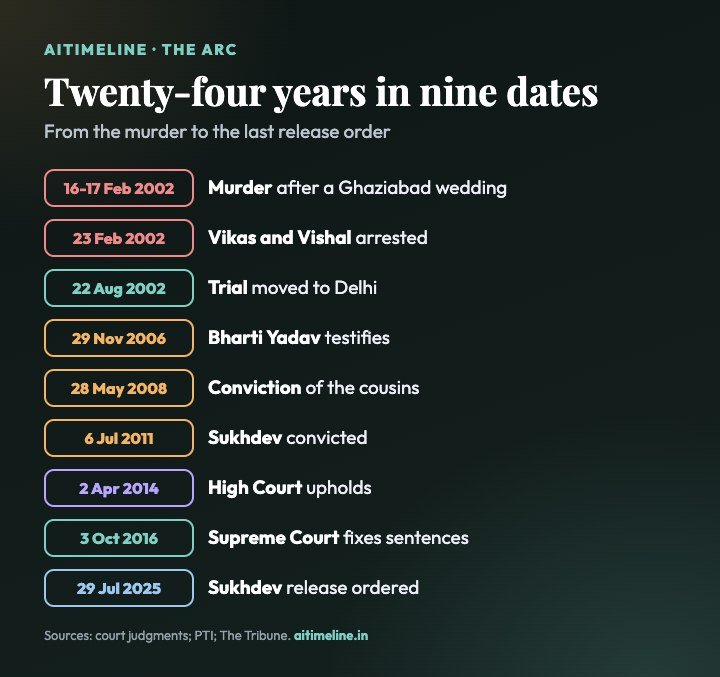
The Case in Ten Points
- The motive: a relationship between Nitish and Bharti Yadav that her family opposed.
- The murder: taken from a wedding on 16-17 February 2002, killed and burnt near Khurja.
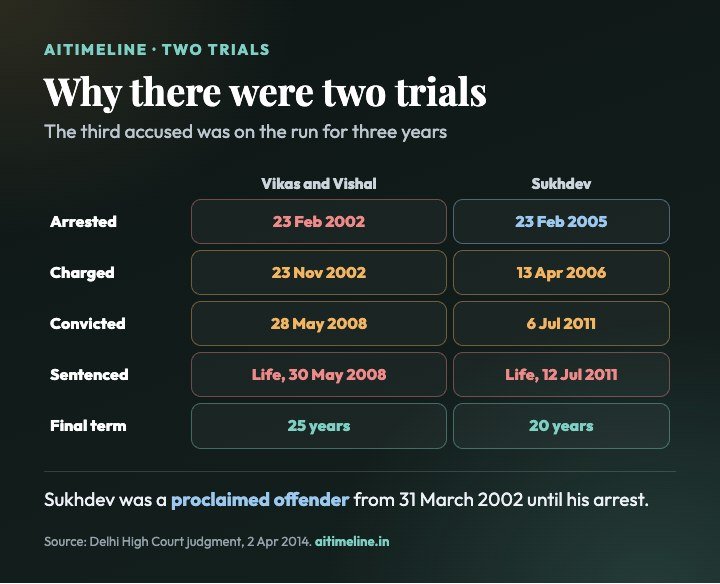
- The arrests: Vikas and Vishal held in Madhya Pradesh on 23 February 2002; Sukhdev only in 2005.
- The transfer: the Supreme Court moved the trial to Delhi on 22 August 2002.
- The reluctant witness: Bharti Yadav testified in camera in November 2006, after three and a half years.
- The convictions: Vikas and Vishal in May 2008; Sukhdev in July 2011; all given life.
- Honour killing: the Delhi High Court upheld the convictions on 2 April 2014 and used the term.
- Fixed terms: 30 and 25 years from the High Court in 2015, cut to 25 and 20 by the Supreme Court in 2016.
- The release: Sukhdev freed in 2025 after completing 20 years; not an acquittal.
- The mother: Neelam Katara has been a party to every round, from 2002 to 2026.
Timeline: From a Ghaziabad Wedding to the Supreme Court
Newest first. Colour shows which stage of the case each event belongs to.
Where the case stands: convictions intact, one convict released Sentences served 2019-2026
The convictions: All three convictions, upheld by the Delhi High Court in 2014 and the Supreme Court in 2015, stand. No court has reopened them.
The sentences: Sukhdev Yadav alias Pehalwan was freed in 2025 after completing his 20-year term. Vikas Yadav and Vishal Yadav are serving 25 years without remission. Vikas’s counsel told the Supreme Court in May 2026 that his term ends in May 2027.
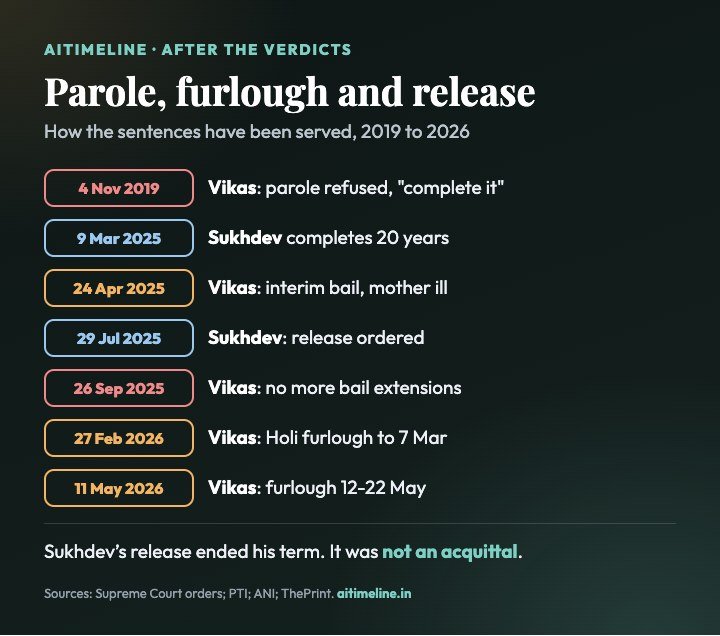
A second furlough for Vikas Yadav Sentences served 2019-2026
The order: The Supreme Court allowed Vikas Yadav out on furlough from 12 to 22 May 2026, noting that he had surrendered on time after his previous furlough.
The question: At the hearing the bench asked whether a sentence without remission also ruled out furlough. It kept that question open and listed the case for 21 July 2026.
Supreme Court grants a Holi furlough Sentences served 2019-2026
The order: The Supreme Court let Vikas Yadav out of prison until 7 March 2026 to spend Holi with his family, overruling the Delhi High Court’s refusal earlier that month.
Time served: The court noted that he had spent about 23 years in custody of his 25-year term.
Delhi High Court says no to furlough Sentences served 2019-2026
The decision: The High Court upheld the prison authorities’ rejection of Vikas Yadav’s request for 21 days of furlough, made on 29 October 2025.
The reason: It said that, given the grave offences he was convicted of, he was statutorily ineligible for furlough under the Delhi Prison Rules, 2018.
No more interim bail for Vikas Yadav Sentences served 2019-2026
Background: Vikas Yadav had been out on interim bail since 24 April 2025 to care for his mother, and later asked for more time saying his wedding was fixed for 5 September. Neelam Katara’s counsel said he had already married in July.
The refusal: “Now it’s marriage, then you will have children; it will go on and on,” the bench remarked, and declined to extend his release.
A ruling for every prisoner kept past their term Sentences served 2019-2026
The judgment: In its reasoned judgment, the Supreme Court held that a fixed-term sentence ends when the term ends: Sukhdev Yadav should have walked out on 10 March 2025, and no remission order was needed.
The wider order: It directed the home secretaries of every state and union territory to check for prisoners still held after completing their sentences and release them if they are not wanted in another case.
Supreme Court orders Sukhdev Yadav’s release Sentences served 2019-2026
The order: The court ordered that Sukhdev Yadav, then out on furlough, need not return to prison, as he had finished the 20 years of actual imprisonment the courts fixed.
What it is not: The order is not an acquittal. His conviction for murder, kidnapping and destroying evidence stands.
Three months’ furlough for Sukhdev Yadav Sentences served 2019-2026
The order: The Supreme Court granted Sukhdev Yadav three months of furlough, noting he had served 20 years without remission, and asked the trial court to set conditions before his release.
The safeguards: The trial court’s conditions were meant to protect the Katara family and witnesses.
Sukhdev Yadav completes his 20 years Sentences served 2019-2026
The term: Sukhdev Yadav completed the 20 years of actual imprisonment fixed for him. The Supreme Court later said he should have been released the next day.
The dispute: The Delhi government argued in February 2025 that “life imprisonment” meant prison for the rest of his life and that release after 20 years was not automatic.
Delhi High Court refuses Sukhdev furlough Sentences served 2019-2026
The decision: The High Court dismissed Sukhdev Yadav’s plea for three weeks of furlough after the prison authorities had refused it.
The concern: The refusal cited the gravity of the crime and the safety of the victim’s family and a key witness.
“Complete it”: parole refused Sentences served 2019-2026
The plea: Vikas Yadav, having served more than 17 years, sought four weeks’ parole and argued that parole was a fundamental right.
The answer: “How can you claim a fundamental right to parole after being found guilty and sentenced to 25 years,” the bench asked. It also dismissed his challenge to the no-remission term.
Supreme Court settles the sentences Supreme Court 2015-2016
The ruling: The court upheld the High Court’s power to impose a fixed term without remission, but ordered the five-year sentence for destroying evidence to run concurrently, not after the murder sentence.
The result: Vikas and Vishal Yadav: 25 years without remission instead of 30. Sukhdev Yadav: 20 years instead of 25. The Rs 50 lakh fines and compensation were left intact.
No death penalty, says the Supreme Court Supreme Court 2015-2016
The plea: The court dismissed the Delhi government’s appeal seeking death sentences. It had already declined Neelam Katara’s plea for the death penalty in October 2015.
The words: “What they did cannot be condoned, but [the offence] is not so heinous and abhorring that warrants death,” the bench said.
Convictions upheld by the Supreme Court Supreme Court 2015-2016
The order: After a long hearing, the court said the convictions of all three “call for no interference whatsoever” and upheld them.
What was left: It issued notice only on the quantum of sentence, the question it decided in October 2016.
High Court fixes 30 years without remission Delhi High Court 2008-2015
Vikas and Vishal: Life imprisonment meaning 25 years of actual imprisonment without remission for murder, plus five years for destroying evidence to run after it: 30 years in all. Fines of Rs 50 lakh each.
Sukhdev: Life meaning 20 years of actual imprisonment, plus the same consecutive five years: 25 years in all.
The death penalty: The court refused the death sentence sought by Neelam Katara and the state, but directed Rs 20 lakh from each Yadav’s fine to her for the costs of her legal battle.
High Court upholds all three convictions Delhi High Court 2008-2015
The verdict: The High Court dismissed the appeals of Vikas, Vishal and Sukhdev Yadav, after hearings reserved in April and November 2013.
Honour killing: It held that the murder fell “squarely” within the meaning of honour killing, a term it called “truly a misnomer”, driven by opposition to Nitish’s relationship with Bharti Yadav.
Neelam Katara asks for the death penalty Delhi High Court 2008-2015
The appeal: Nitish’s mother asked the High Court to raise the life sentences to death. Vikas and Vishal Yadav filed their own appeals against conviction.
Her role: She remained a party in every round that followed, up to the 2025-2026 furlough hearings.
Life sentence for Sukhdev Yadav Trials 2002-2011
The sentence: Sukhdev Yadav, known as Pehalwan, was sentenced to life imprisonment, with further terms for kidnapping and destroying evidence.
The death penalty: The court rejected the prosecution’s demand for death.
Sukhdev Yadav convicted Trials 2002-2011
The verdict: In his separate trial, Sukhdev Yadav was found guilty of murder, kidnapping and destroying evidence along with Vikas and Vishal Yadav.
Life imprisonment for Vikas and Vishal Yadav Trials 2002-2011
The sentence: Life imprisonment and a Rs 1 lakh fine each for murder, ten years for kidnapping and five years for destroying evidence, all to run concurrently.
The judge’s view: She found life imprisonment met the ends of justice rather than death.
Vikas and Vishal Yadav convicted Trials 2002-2011
The verdict: The trial court found Vikas Yadav and his cousin Vishal Yadav guilty of kidnapping and murdering Nitish Katara and destroying evidence.
The evidence: The case rested on circumstantial evidence: the last sighting at the wedding, recoveries made after arrest, and the motive the court found in the opposed relationship.
Bharti Yadav testifies, in camera Trials 2002-2011
The wait: She appeared almost three and a half years after her evidence was first required, having been in England. The court had threatened coercive process before she agreed to come from 25 to 28 November.
The testimony: Her statement was recorded in camera on 29 and 30 November 2006, and court staff were barred from speaking to the media.
Charges ordered against Sukhdev Yadav Trials 2002-2011
The charges: The court directed charges of kidnapping, murder and destroying evidence, with common intention, against Sukhdev Yadav, to be tried separately.
Sukhdev Pehalwan arrested after three years Trials 2002-2011
The capture: A proclaimed offender since 2002, he was caught after allegedly firing at a police party in Kushinagar district on the night of 11 February 2005, and was then arrested in the Katara case.
The timing: The High Court noted he surfaced only after 37 witnesses had been examined in his co-accused’s trial.
The trial court summons Bharti Yadav Trials 2002-2011
The summons: The summons came back with a report that she had gone to England and that her mother would not give her address.
Why it mattered: The prosecution’s motive centred on her relationship with Nitish.
Charges framed in Delhi Trials 2002-2011
The charge: Vikas and Vishal Yadav were charged with kidnapping and murdering Nitish Katara with Sukhdev Yadav, then still absconding, and with destroying evidence.
Supreme Court moves the trial to Delhi Trials 2002-2011
The order: Acting on Neelam Katara’s petition, the Supreme Court transferred the trial from the sessions court in Ghaziabad to Delhi, after staying the Ghaziabad proceedings on 22 May 2002.
Why: She feared the accused family’s political influence in Uttar Pradesh would prevent a fair trial.
Chargesheet filed Trials 2002-2011
The filing: Ghaziabad police filed a chargesheet against Vikas and Vishal Yadav, and the case was committed to the sessions court the same day.
Sukhdev Yadav declared a proclaimed offender Murder and investigation 2002
The search: Raids, arrest warrants and a reward failed to find the third accused, so the police had him declared a proclaimed offender and cancelled his gun licence.
Vikas and Vishal Yadav held in Madhya Pradesh Murder and investigation 2002
The arrest: The cousins, missing since the murder, were arrested in the early hours by Dabra police in an Arms Act case. Ghaziabad police then arrested them in the Katara case and produced them in court on 25 February.
The court’s view: The High Court later called the arrest “clearly stage managed”.
A mother identifies her son Murder and investigation 2002
The identification: Neelam Katara identified the body as Nitish’s from his unburnt left palm, comparing it with her own, as he had unusually small hands.
Confirmation: DNA profiling of the parents’ blood samples at AIIMS, New Delhi, later confirmed his identity.
A burnt body near Khurja, a complaint in Ghaziabad Murder and investigation 2002
The body: At about 9 am, Khurja police were told of a badly burnt body in a pit beside the Shikarpur road. It was not yet known to be Nitish.
The complaint: At about 1:15 pm Neelam Katara lodged a written complaint at Kavi Nagar police station saying Vikas and Vishal Yadav had taken her son from the wedding, and a kidnapping case was registered.
Taken from a wedding Murder and investigation 2002
The night: Nitish Katara, 23, attended the wedding of Bharti Yadav’s friend Shivani Gaur. Vikas and Vishal Yadav arrived around midnight and took him outside.
The murder: The courts found they drove him away in a Tata Safari with Sukhdev Yadav, killed him with a hammer blow to the head and set his body on fire.
Classmates, then a relationship Murder and investigation 2002
The friendship: Nitish Katara and Bharti Yadav, daughter of politician D.P. Yadav, met as MBA students at IMT Ghaziabad from 1998. After the course he joined Reliance General Insurance in Delhi.
The opposition: Around January 2001 their friendship became a relationship. The High Court found her brother Vikas and cousin Vishal opposed it, and that this was the motive for the murder.
How the Sentences Changed
Life at trial, 30 years in the High Court, 25 in the Supreme Court.
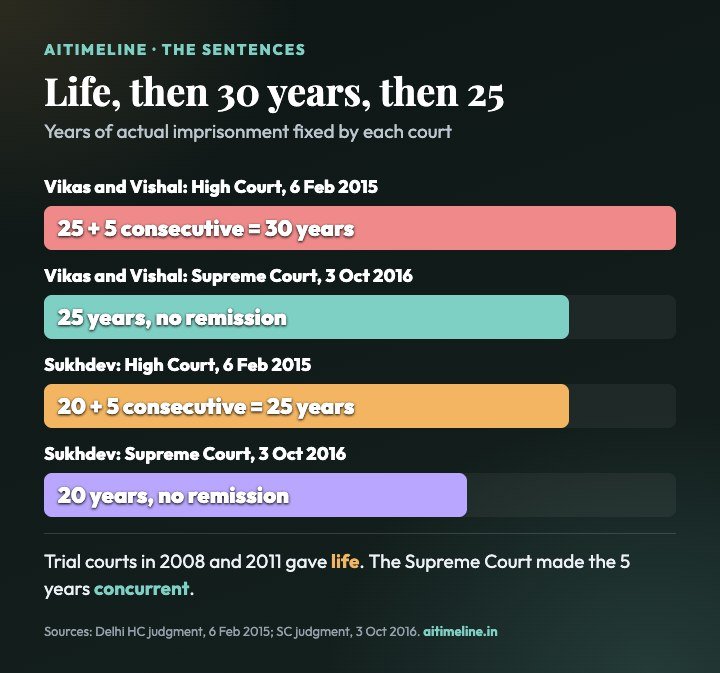
| Court | Vikas and Vishal Yadav | Sukhdev Yadav |
|---|---|---|
| Trial court, 2008 and 2011 | Life imprisonment; Rs 1.6 lakh fine each | Life imprisonment |
| Delhi High Court, 6 Feb 2015 | 25 years without remission + 5 years consecutive = 30; Rs 50 lakh fine each | 20 years without remission + 5 consecutive = 25 |
| Supreme Court, 3 Oct 2016 | 25 years without remission | 20 years without remission |
| Outcome | Serving; Vikas’s term reported to end May 2027 | Completed 9 Mar 2025; release ordered 29 Jul 2025 |
Under Indian law, a life sentence is in principle for the rest of a prisoner’s life, but governments can release convicts after 14 years through remission. The Delhi High Court closed that door: it fixed a minimum period of actual imprisonment that no remission could shorten. On appeal the Supreme Court upheld that power, relying on its Constitution Bench ruling in Union of India v. V. Sriharan (2015), but held that the High Court could not stack the five-year term for destroying evidence on top of the fixed murder term. That one change took the cousins from 30 years to 25 and Sukhdev from 25 to 20.
Court by Court: The Legal Journey
Every level of the judiciary, 2002 to 2026.
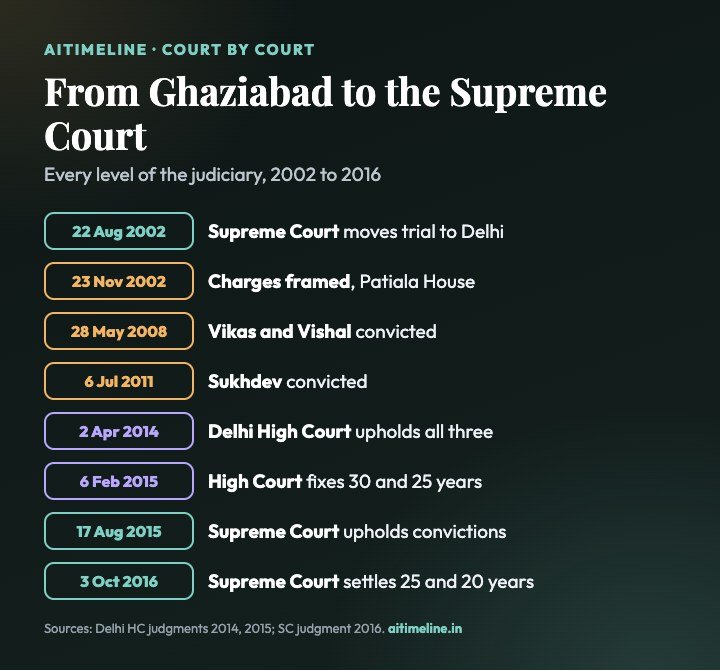
| Date | Court | Decision |
|---|---|---|
| 22 Aug 2002 | Supreme Court | Trial transferred from Ghaziabad to Delhi |
| 28-30 May 2008 | Sessions court, New Delhi | Vikas and Vishal convicted; life imprisonment |
| 6-12 Jul 2011 | Sessions court, New Delhi | Sukhdev convicted; life imprisonment |
| 2 Apr 2014 | Delhi High Court | Convictions upheld; honour killing |
| 6 Feb 2015 | Delhi High Court | Fixed terms without remission: 30 and 25 years |
| 17 Aug 2015 | Supreme Court | Convictions upheld; notice on sentence only |
| 3 Oct 2016 | Supreme Court | Sentences settled at 25, 25 and 20 years |
| 29 Jul 2025 | Supreme Court | Sukhdev’s release ordered on completion of term |
Key People in the Case
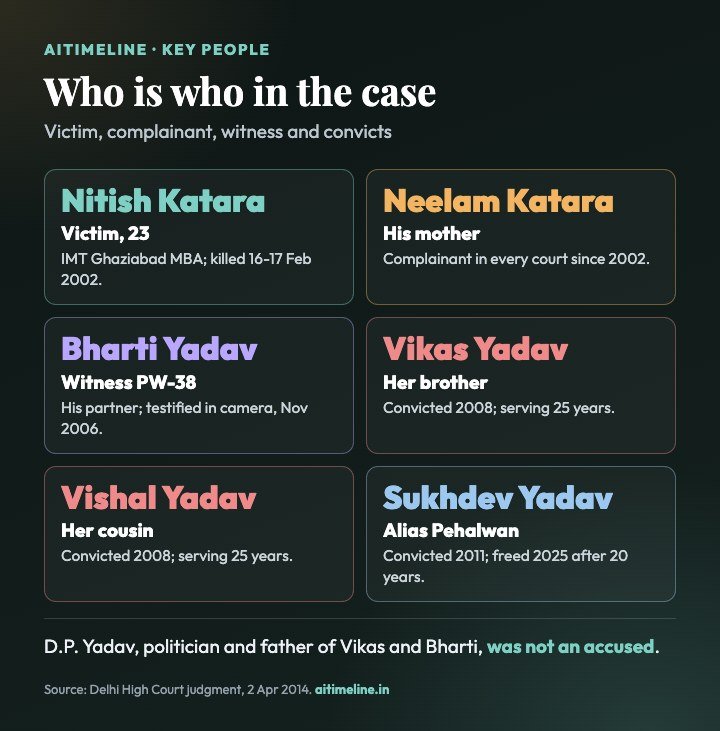
Nitish Katara
Born 20 April 1978. IMT Ghaziabad MBA graduate working for Reliance General Insurance in Delhi when he was killed at 23.
Neelam Katara
His mother. Filed the complaint on 17 February 2002 and has been a party in every court since.
Bharti Yadav
Nitish’s classmate and partner, daughter of D.P. Yadav. Testified in camera as prosecution witness PW-38 in November 2006.
Vikas Yadav
Bharti’s brother. Convicted in 2008; serving 25 years without remission.
Vishal Yadav
Vikas’s cousin. Convicted in 2008; serving 25 years without remission.
Sukhdev Yadav alias Pehalwan
Absconded until 2005; convicted in 2011. Released in 2025 after completing 20 years.
D.P. Yadav
Former MP from western Uttar Pradesh; father of Vikas and Bharti. Not an accused in the case.
Ajay Katara
Prosecution witness who said he saw Nitish with the accused that night; recorded in the High Court judgment as Ajay Kumar, PW-33.
Neelam Katara’s Fight for Justice
Twenty-four years as a party to the case.
A fair trial
- Complaint filed 17 Feb.
- Ghaziabad trial stayed 22 May.
- Moved to Delhi 22 Aug.
Harsher punishment
- Death penalty sought.
- Fixed terms won in 2015.
- Rs 20 lakh costs awarded.
Opposing release
- Parole refused 2019.
- Bail extensions opposed 2025.
- Witness safety raised.
The case is often told as Neelam Katara’s. It was her written complaint, lodged at Kavi Nagar police station hours before her son’s body was identified, that named Vikas and Vishal Yadav. It was her petition that persuaded the Supreme Court to take the trial out of Ghaziabad. When the trial court gave life sentences, she asked for death; she did not get it, but the High Court’s fixed terms without remission went further than any life sentence would have, and it ordered Rs 20 lakh from each Yadav’s fine to be paid to her for the cost of the fight. Her lawyers were still in court in September 2025 opposing Vikas Yadav’s request for more time out of prison.
After the Verdicts: Parole, Furlough and Release
Since 2019 the case has been about how the sentences are served.
Often claimed
- Sukhdev Pehalwan was acquitted in 2025.
- The High Court gave the cousins 25 years.
- Vikas Yadav’s furlough reduced his sentence.
- Bharti Yadav returned and testified on 25 November 2006.
What the record shows
- He completed his 20-year term; his conviction stands.
- It gave 30 years; the Supreme Court cut it to 25.
- Furlough is a short, temporary release; the 25-year term is unchanged.
- That date was fixed; she testified on 29-30 November.
Sukhdev Yadav’s release turned on a narrow question: when a court fixes a term of actual imprisonment, does the prisoner walk free when it ends, or must the government still grant remission? The Delhi government argued that “life” still meant life. The Supreme Court disagreed, held his detention after 9 March 2025 unlawful, and used his case to order every state to free prisoners held past their terms. Vikas Yadav’s position is different: his 25 years are not over, and his releases in 2025 and 2026 were temporary, granted for his mother’s illness and for family occasions, over objections from the Katara family.
Why the Nitish Katara Case Matters
No right to kill for honour
- Adults choose their partners.
- Family objection is no defence.
- “Honour” is a misnomer.
Fair trial first
- Transfer when influence is feared.
- Protect reluctant witnesses.
- Keep cases moving.
Fixed terms, fixed ends
- No remission means served in full.
- Served in full means release.
- Furlough is not reduction.
The case is cited for three reasons. It gave a High Court’s plain description of honour killing as murder born of caste and status, not a private family matter. It showed the courts acting on a mother’s fear that a politician’s family could bend a local trial. And it became a reference point for India’s fixed-term sentences: first for the power to impose terms that remission cannot touch, then, in 2025, for the rule that such terms end when they end.
Explore More Timelines
People Also Ask
Frequently Asked Questions
Dated facts from the court judgments and contemporary reports, 2002 to 2026.
⚠️ Editorial Note
This account draws on the trial court’s sentencing judgment of 30 May 2008, the Delhi High Court’s judgments of 2 April 2014 and 6 February 2015, the Supreme Court’s judgment of 3 October 2016, and reporting by PTI, ANI, The Tribune, ThePrint, Scroll and Deccan Herald on the 2015-2026 proceedings. “Honour killing” reflects the courts’ findings. Checking the brief this page began from against those records: the chargesheet was filed on 6 April 2002, not 31 March (the date Sukhdev Yadav was declared a proclaimed offender); the transfer order was 22 August 2002, not 23 August; Vikas and Vishal were arrested on 23 February 2002; Bharti Yadav was first summoned on 29 April 2003, not 7 April, and testified on 29-30 November 2006; the High Court’s 2015 terms were 30 and 25 years, not 25; the Supreme Court ordered Sukhdev’s release on 29 July 2025, with the reasoned judgment on 12 August; and Vikas Yadav’s Holi furlough was granted on 27 February 2026. We dropped the brief’s undated “December 2007” and “2023” entries, and added his 2025 interim bail, the February 2026 High Court refusal and the May 2026 furlough. Status reflects published reports to 7 November 2026, not the court docket.
Related Reading on AiTimeline
Sources & further reading
Every dated entry above was checked against these references. Last reviewed 7 November 2026.
- Vikas Yadav vs State of U.P. and Ors. (sentencing judgment, 3 October 2016)
- Vishal Yadav vs State of U.P. (convictions upheld, 2 April 2014)
- Vishal Yadav vs State Govt. of U.P. (sentence enhanced, 6 February 2015)
- State vs Vikas Yadav and Vishal Yadav (sentence, 30 May 2008)
- Nitish Katara murder case: Supreme Court orders release of convict Sukhdev Yadav
- Why Supreme Court ordered immediate release of Nitish Katara's killer
- Nitish Katara murder case: Supreme Court rejects death penalty for killers
- Nitish Katara murder case: 'How can you claim a fundamental right to parole,' SC asks Vikas Yadav
- Nitish Katara murder: SC refuses to extend interim bail of convict Vikas Yadav
- Nitish Katara murder case: SC grants furlough to convict Vikas Yadav till March 7 for Holi
- Nitish Katara murder case: SC grants furlough to Vikas Yadav till May 22
- Supreme Court grants 3-month furlough to Sukhdev Yadav in Nitish Katara murder case