Bihar Voter List Revision: The 2025 SIR and Supreme Court Verdict Explained
Explore the history of Bihar's electoral roll revisions, the 2025 Special Intensive Revision, voter-list changes and the Supreme Court's 2026 verdict.
Latest Story
In June 2025 the Election Commission ordered every elector in Bihar to be verified again, house to house, for the first time since 2003. The Bihar electoral roll revision, known as the Special Intensive Revision or SIR, took the roll from 7.89 crore names to about 7.42 crore before the November 2025 Assembly election, and became a test of how far the Commission can go in checking who is entitled to vote. On 27 May 2026 the Supreme Court upheld it, while ruling that the Commission’s inquiry into citizenship is limited and that the final word belongs to the authority under the Citizenship Act. This page sets out the history, the dates, the figures and what the judgment changed.
💡 Short Answer
Bihar’s Special Intensive Revision, ordered on 24 June 2025, re-verified every elector before the November 2025 election. About 65 lakh names were missing from the August draft; after claims, the final roll of 30 September 2025 had about 7.42 crore electors, roughly 47 lakh fewer than at the start. On 27 May 2026 the Supreme Court upheld the exercise but held that the Election Commission cannot finally decide anyone’s citizenship.
Bihar Electoral Roll Revision: Key Questions
The Revision in Ten Points
- 24 June 2025: the Election Commission ordered a Special Intensive Revision of Bihar’s whole roll, the first since 2003.
- Two routes: about 4.96 crore electors on the 2003 roll had only to verify; the remaining 2.93 crore or so also needed a listed document.
- 1 August 2025: the draft roll had 7.24 crore names; about 65 lakh were missing, mainly as dead, shifted, not found or duplicate.
- Not a verdict: leaving the draft was not a finding of ineligibility; claims and objections were open.
- 14 August: the Supreme Court ordered the 65 lakh names published with reasons.
- 8 September: Aadhaar was added as a 12th document, for identity only, not citizenship.
- 30 September: the final roll had about 7.42 crore electors, roughly 47 lakh fewer than at the start.
- November 2025: Bihar voted on the revised roll, with turnout of 67.13 per cent.
- 27 May 2026: the Supreme Court upheld the SIR as lawful and proportionate.
- The limit: the Commission’s citizenship inquiry is for the roll only; final decisions belong to the Citizenship Act authority.
The Numbers, Stage by Stage
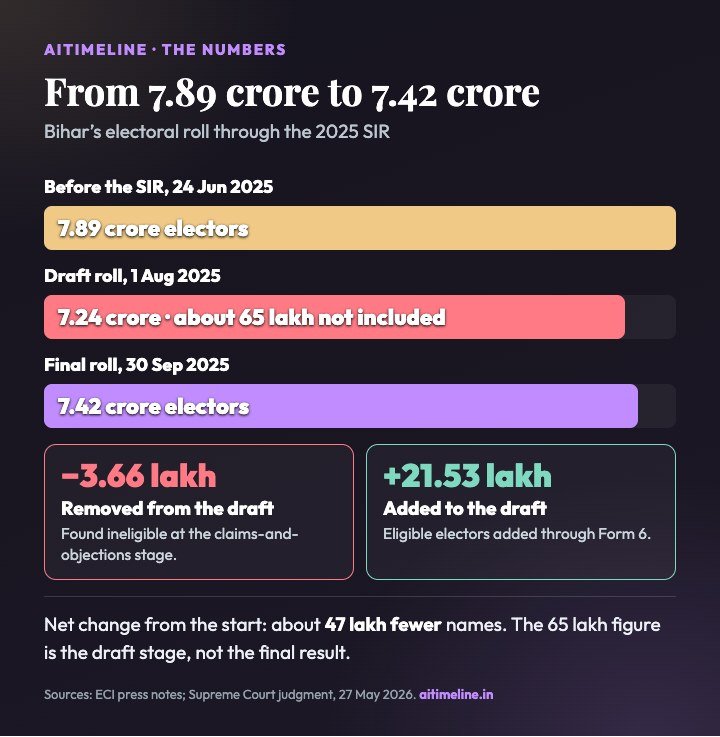
The most quoted figure, 65 lakh, describes only the draft.
| Stage | Electors | Change |
|---|---|---|
| Before the SIR, 24 Jun 2025 | About 7.89 crore | — |
| Draft roll, 1 Aug 2025 | About 7.24 crore | About 65 lakh not included |
| Claims and objections | — | +21.53 lakh added; −3.66 lakh deleted |
| Final roll, 30 Sep 2025 | About 7.42 crore | About 47 lakh fewer than at the start |
Timeline: From the First Rolls to the 2026 Verdict
Newest first. Colour shows which strand each event belongs to.
Supreme Court upholds the Bihar SIR Supreme Court
The ruling: Disposing of the petitions led by the Association for Democratic Reforms, the Court held that the revision was traceable to Section 21(3) of the Representation of the People Act, 1950 read with Article 324, that it met the proportionality test and that the safeguards of notice and hearing were preserved in substance.
The limit: The Election Commission may make a limited inquiry into citizenship to decide eligibility for the roll, but that is not a determination of citizenship. Where it is not satisfied, it must refer the person to the competent authority under the Citizenship Act, 1955, and any deletion on that ground stays subject to the result.
The direction: People removed from the 2003-based roll because the Commission thought they were not citizens are to be referred within four weeks, with a decision preferably before the next election. Bihar residents wrongly deleted as absent, dead, shifted or duplicate may seek judicial review.
Judgment reserved after 29 days of arguments Supreme Court
The hearing: The bench reserved its verdict after hearing the petitioners, including Kapil Sibal, Abhishek Manu Singhvi, Gopal Sankaranarayanan and Prashant Bhushan, and Yogendra Yadav in person, and the Commission.
Both sides: Most petitions challenged the SIR. At least one, filed in support, asked the Court to require such revisions at regular intervals.
Phase two of the SIR across 12 states and UTs Election Commission
The announcement: With Bihar complete, the Commission announced a second phase covering 12 states and union territories, among them Uttar Pradesh, West Bengal, Tamil Nadu, Kerala, Rajasthan, Madhya Pradesh and Gujarat. House-to-house enumeration began on 4 November 2025.
Assam: Assam was left out; the Commission said a separate provision of the Citizenship Act applies there.
Bihar votes on the revised roll Elections and law
Turnout: The Commission’s final figure was 67.13 per cent, the highest in a Bihar election since 1951. Women voted at a markedly higher rate than men: about 71.6 per cent against 62.8 per cent in the figures released at the close of polling.
Result: The NDA won 202 of the 243 seats.
Final roll: 7.42 crore electors Roll figures
The figures: From the 7.24 crore in the draft, a further 3.66 lakh names were deleted and 21.53 lakh eligible electors were added through Form 6, leaving about 7.42 crore on the final roll.
Against the start: That is about 47 lakh fewer than the 7.89 crore on the roll on 24 June. The 65 lakh figure belongs to the draft stage, not to the final result.
Aadhaar becomes the 12th document Supreme Court
The order: The Court directed the Commission to treat Aadhaar as a twelfth document for establishing identity when deciding inclusion or exclusion, noting that Section 23(4) of the Representation of the People Act already names it for that purpose.
The limit: It said Aadhaar is not proof of citizenship, and that officials could verify whether a card was genuine.
Claims allowed after the deadline Supreme Court
The Commission’s stand: The Commission told the Court that claims, objections and corrections could be filed even after 1 September and would be considered until the last date of nominations.
Help for voters: The Bihar State Legal Services Authority was told to deploy para-legal volunteers through district authorities to help people file online.
Political parties told to help voters Supreme Court
The order: The Court made six national and six state parties respondents and told them to instruct their Booth Level Agents to help voters file claims, with any of the 11 documents or Aadhaar.
Online claims: Excluded electors could submit claims online, not only in person.
Publish the 65 lakh names, with reasons Supreme Court
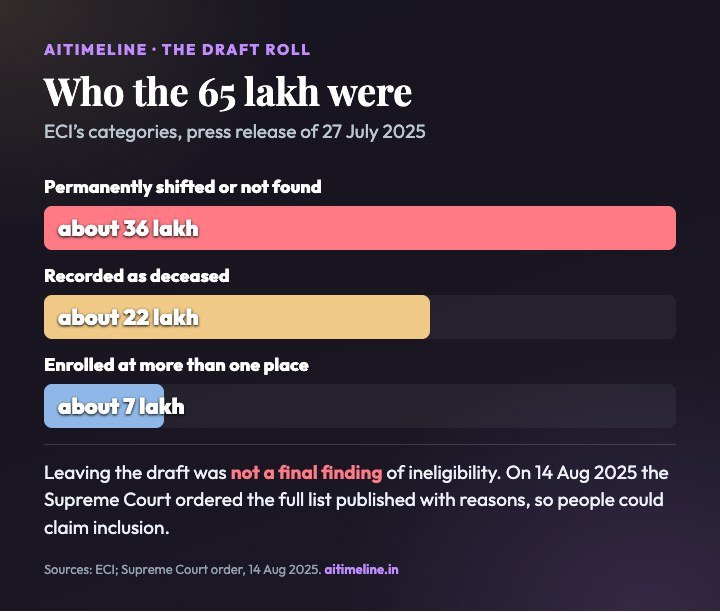
The order: The Court directed the Commission to publish a searchable list of the roughly 65 lakh people left out of the draft roll, with the reason for each, and to publicise it in newspapers, on radio and on television.
Why it mattered: People could not challenge an omission they did not know about. The lists were also put up at block offices, panchayat bhawans and polling booths.
Draft roll: about 65 lakh names not included Roll figures
The draft: The draft roll listed about 7.24 crore electors, against 7.89 crore before the revision.
What it meant: The draft included only those whose enumeration forms had been received. Leaving it was not a final ruling that someone was ineligible: claims and objections were open, and final deletions required an inquiry.
The Commission explains the gap Roll figures
The breakdown: About 22 lakh electors were recorded as deceased, about 36 lakh as permanently shifted or not found, and about 7 lakh as enrolled at more than one place.
Forms received: The Commission said forms had been received from about 7.24 crore electors.
Supreme Court declines to stop the exercise Supreme Court
No stay: The Court let the revision continue and framed three questions: the Commission’s power to order it, the procedure including how citizenship was checked, and its timing so close to the election.
Documents: It asked the Commission to consider accepting Aadhaar, the Elector Photo Identity Card and ration cards in addition to the 11 listed documents.
Booth Level Officers go door to door Election Commission
The process: BLOs distributed pre-filled enumeration forms to every elector and collected them, with an option to submit online.
Two routes: About 4.96 crore electors already on the 2003 roll had only to verify their entry. The remaining 2.93 crore or so also had to produce one of 11 listed documents.
The Election Commission orders a Special Intensive Revision Election Commission
The order: Acting under Article 324 and Section 21(3), the Commission directed a fresh, house-to-house revision of Bihar’s entire roll ahead of the Assembly election, citing rapid urbanisation, migration, unreported deaths and duplicate entries since 2003.
The baseline: The 2003 roll, with 1 January 2003 as its qualifying date, was to be treated as evidence of eligibility unless rebutted.
Four qualifying dates a year Elections and law
The change: Instead of a single qualifying date of 1 January, people turning 18 can now enrol against 1 January, 1 April, 1 July or 1 October.
Aadhaar: The same law allowed electoral registration officers to ask for Aadhaar to establish identity, the provision the Supreme Court relied on in 2025.
The last intensive revision cycle History
What happened: Intensive revisions were carried out state by state in 2002, 2003 and 2004.
Bihar: Bihar’s took place in 2003. For 22 years afterwards its roll was updated only through summary revisions, which is why the 2003 roll became the 2025 reference point.
Revisions and the first photo identity cards History
The revisions: Rolls were intensively revised three times in four years.
Photo identity: From 1993 the Commission began issuing Elector Photo Identity Cards, tying roll entries to a card with a photograph.
Revisions amid concern over migration History
Focus: Intensive revisions in the 1980s paid growing attention to duplicate entries, population movement and the eligibility of those enrolled.
Revisions after reorganisation History
Why: The reorganisation of states and the delimitation of constituencies meant rolls had to be redrawn.
Building the first rolls History
The framework: The Constitution provided for one general roll per constituency, open to every adult citizen without exclusion on grounds of religion, race, caste or sex. The 1950 Act set out how rolls were to be prepared and revised.
The first election: For the 1951–52 election many women were recorded only as someone’s wife or daughter, and such entries were struck off. Through 1952–56 the Commission revised rolls intensively in phases, covering parts of each state at a time.
A Short History of Intensive Revisions
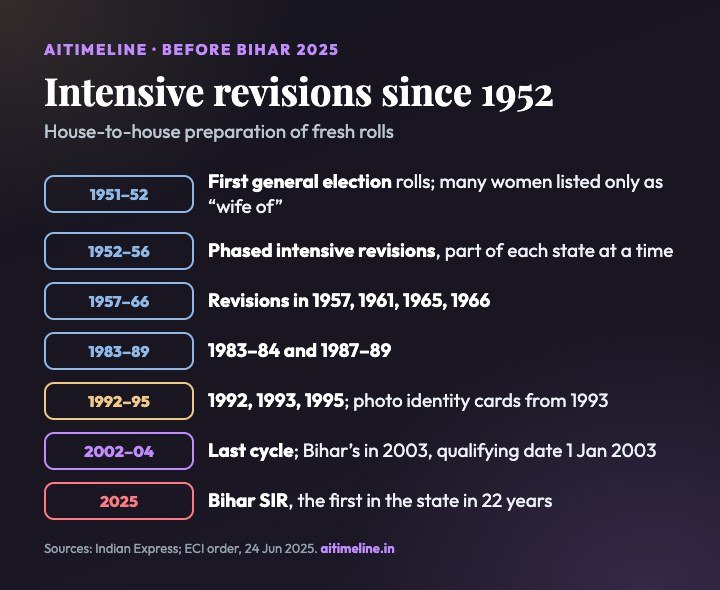
Most years, rolls are kept up to date through summary revisions: new voters apply, deaths and moves are reported, and objections are heard. An intensive revision is rarer and heavier, because it rebuilds the roll from house-to-house enumeration. India held them regularly until the early 2000s, then stopped. That 22-year gap is the Commission’s central justification for 2025, and the Supreme Court accepted that a state-wide problem could not be fixed by piecemeal, constituency-by-constituency corrections.
How the Verification Worked
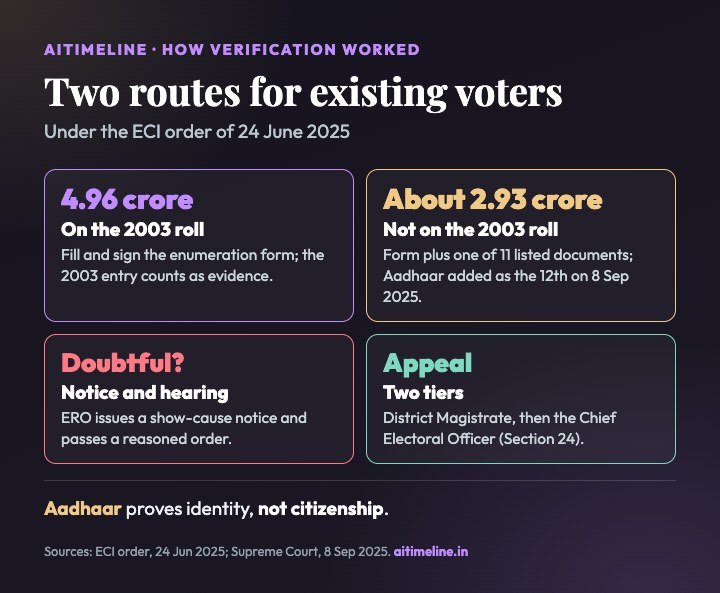
The design put most of the burden on people who joined the roll after 2003, roughly 37 per cent of electors. Critics said migrant workers, the poor, the elderly and women who had moved on marriage were the least likely to hold the listed documents or to be home when the BLO called. The Commission answered that the list was wider than in 2003, that forms could be filed online, and that nobody was removed from the final roll without notice and a chance to respond.
What Happened in Court
The Supreme Court never stopped the exercise, but it shaped it.

Each interim order dealt with a practical point: the documents, the right to know why a name was missing, help in filing claims and the deadline. None halted the revision, and the election went ahead on the final roll. The constitutional questions, whether the Commission could do this at all and how far it could inquire into citizenship, were left for the final judgment.
What the Supreme Court Clarified
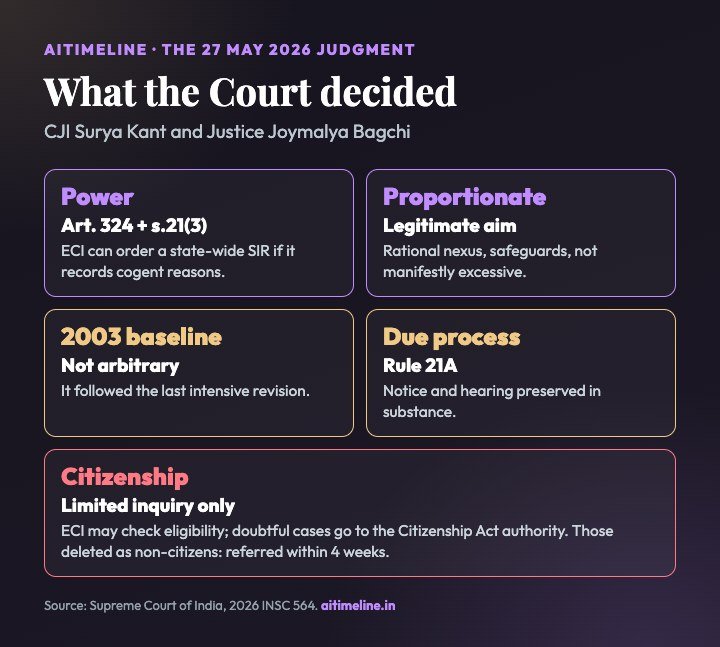
| Issue | Supreme Court’s position |
|---|---|
| Power to order the SIR | Traceable to Section 21(3) read with Article 324; a state-wide revision is allowed if cogent reasons are recorded |
| Proportionality | Legitimate aim, rational nexus, adequate safeguards, not manifestly excessive |
| Existing entries | Enrolment raises a presumption of validity, but it can be rebutted and does not bar re-verification |
| 2003 baseline | Neither arbitrary nor irrational, since 2003 was itself an intensive revision |
| Deletions | Consistent with Rule 21A; notice and hearing preserved in substance |
| Documents | Based on intelligible criteria; Aadhaar for identity, not citizenship |
| Citizenship | Limited inquiry for the roll only; doubtful cases referred to the competent authority under the Citizenship Act |
| Remedy | Suspected non-citizens referred within four weeks; wrong deletions as dead, shifted or duplicate open to judicial review |
The judgment did not say that an electoral-roll revision settles citizenship for any other purpose. Losing a place on the roll affects the right to vote; it does not strip a person of a claim to citizenship. Critics noted that the Court did not examine constituency-wise patterns in the deletions, and that its remedies depend on how quickly the referral and review processes actually work.
Impact on Governance and Democracy
Cleaner rolls
Dead, duplicate and long-moved entries weaken a roll. A full re-verification is the most direct way to find them.
The burden of proof
Migrants, the poor and the elderly found the documents and deadlines hardest, which is why notice, disclosure and appeals matter.
Field officials
The exercise rested on BLOs and registration officers handling millions of forms and claims in weeks.
Two separate questions
Eligibility for the roll and legal citizenship are now clearly distinct, with different authorities and consequences.
Transparency
Publishing omitted names with reasons, under court order, became part of the process rather than an afterthought.
A national template
Bihar was phase one. The rules tested there now apply to revisions covering most of India’s electorate.
Key Institutions and Their Roles
| Institution | Role |
|---|---|
| Election Commission of India | Ordered and supervised the SIR |
| Chief Electoral Officer, Bihar | Ran the revision statewide; hears second appeals |
| District Election Officers | District implementation and publication of lists; District Magistrates hear first appeals |
| Electoral Registration Officers | Decided claims, objections and doubtful cases by reasoned order |
| Booth Level Officers | Delivered and collected enumeration forms house to house |
| Political parties and Booth Level Agents | Told by the Court to help voters file claims |
| Supreme Court of India | Issued interim orders and decided the legality of the SIR |
Key Facts at a Glance
| Detail | Information |
|---|---|
| Exercise | Special Intensive Revision (SIR) of electoral rolls, Bihar |
| Ordered | 24 June 2025; qualifying date 1 July 2025 |
| Previous intensive revision | 2003 (qualifying date 1 January 2003) |
| Electors before | About 7.89 crore |
| Draft roll | 1 August 2025, about 7.24 crore |
| Final roll | 30 September 2025, about 7.42 crore |
| Assembly election | 6 and 11 November 2025; turnout 67.13% |
| Case | Association for Democratic Reforms v. Election Commission of India, W.P.(C) 640 of 2025 |
| Judgment | 27 May 2026, 2026 INSC 564; CJI Surya Kant and Justice Joymalya Bagchi |
Explore More Timelines
People Also Ask
Frequently Asked Questions
Checked against the Supreme Court judgment and Election Commission figures.
⚠️ Editorial Note
This account draws on the Supreme Court’s judgment of 27 May 2026, the Election Commission’s orders and press releases as recorded in that judgment, and contemporary reporting. The 65 lakh figure is the number of names missing from the draft roll, not a count of people found ineligible; the final roll was about 47 lakh smaller than the roll at the start. Checking the brief this page began from: the Supreme Court disposed of the petitions with directions rather than simply dismissing them; the Aadhaar order was made on 8 September 2025; and the women’s turnout figure of 71.78 per cent could not be matched to a Commission release, so the close-of-poll figures are used. This is not legal advice.
Related Reading on AiTimeline
Sources & further reading
Every dated entry above was checked against these references. Last reviewed 8 November 2026.
- Supreme Court of India: Association for Democratic Reforms v. Election Commission of India, W.P.(C) No. 640 of 2025, judgment of 27 May 2026 (2026 INSC 564)
- LiveLaw: 'SIR meets proportionality test', conclusions from the Supreme Court judgment (27 May 2026)
- Supreme Court Observer: Challenge to the ECI's revision of electoral rolls in Bihar (case page and hearing record)
- News On AIR: ECI to begin Special Intensive Revision of electoral rolls in Bihar (24 June 2025)
- Swarajya: Bihar voter list overhaul begins, 4.96 crore electors on the 2003 roll (29 June 2025)
- Moneylife: Supreme Court refuses to stay Bihar voter list revision, asks ECI to consider Aadhaar and ration card (10 July 2025)
- Business Standard: Bihar SIR wrap, 21.53 lakh electors added and 3.66 lakh removed in final roll (30 September 2025)
- ThePrint: EC hails record 67.13% turnout in Bihar polls, zero repolls (November 2025)
- News On AIR: Second phase of Special Intensive Revision to cover 12 states and UTs (27 October 2025)
- The Indian Express: Explained, the revision of electoral rolls and its history