Sabarimala: The Fight Over Women’s Right to Enter the Temple
Follow the Sabarimala women's entry movement, from the 1991 Kerala High Court ruling to the 2018 Supreme Court verdict and 2026 review hearings.
Latest Story
The Sabarimala women entry dispute began with a 1990 petition to the Kerala High Court and became one of India’s defining tests of how the Constitution balances equality against religious freedom. For decades, women aged roughly 10 to 50 were kept out of the Lord Ayyappa temple in Pathanamthitta district. In 2018 the Supreme Court struck down the restriction by 4:1, two women entered the shrine under police protection in January 2019, and a nine-judge bench reserved its opinion on the wider questions on 14 May 2026. This page sets out each chapter in order, and separates what has been decided from what is still pending.
💡 Short Answer
Women aged about 10 to 50 were traditionally barred from Sabarimala, a restriction the Kerala High Court upheld on 5 April 1991. On 28 September 2018 the Supreme Court ruled 4:1 that the exclusion was unconstitutional, with Justice Indu Malhotra dissenting. Bindu Ammini and Kanakadurga entered the shrine on 2 January 2019. Review petitions were referred to a larger bench in November 2019, and a nine-judge Constitution Bench reserved judgment on 14 May 2026. The 2018 verdict has not been stayed or overturned; no nine-judge ruling had been reported as of 10 November 2026.
Sabarimala Women Entry: Key Questions
The Dispute in Nine Points
- The custom: women of menstruating age, roughly 10 to 50, were kept out, linked to the belief that the deity is a celibate.
- 1991: the Kerala High Court upheld the restriction and told the Devaswom Board to enforce it.
- 2006: the Indian Young Lawyers Association took the issue to the Supreme Court.
- Shifting state: Kerala governments changed their stand in 2007, 2016 (twice) and 2026.
- 2018: a 4:1 Constitution Bench ruling opened the temple to women of all ages.
- Resistance: protests at Nilakkal and Pamba blocked most women who tried to go.
- January 2019: the Women’s Wall on 1 January, the two women’s entry on 2 January, a hartal on 3 January.
- 2019 reference: by 3:2, wider questions went to a larger bench; the 2018 verdict was not stayed.
- 2026: nine judges heard 16 days of arguments and reserved judgment on 14 May.
Three Distinct Chapters
The judgment, the public movement and the pending constitutional review are not the same thing.
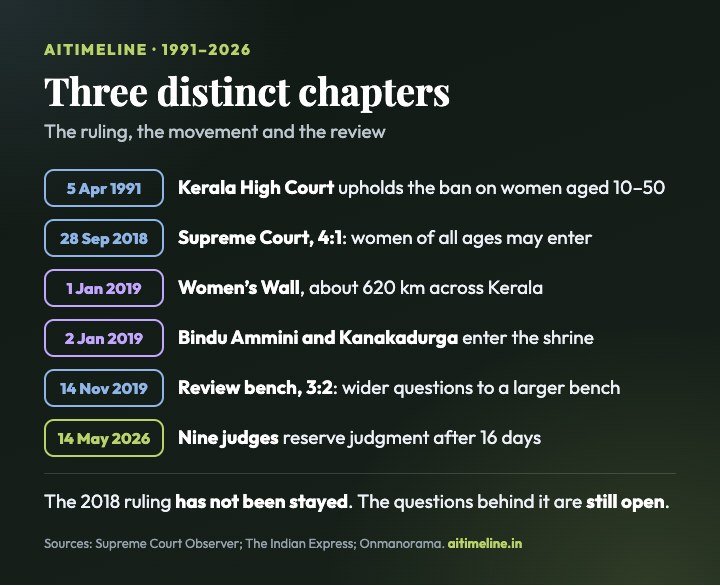
| Chapter | Key dates | Status |
|---|---|---|
| The ruling | 5 April 1991 (High Court); 28 September 2018 (Supreme Court) | 2018 judgment in force; not stayed |
| The movement | October 2018 to January 2019 | Women’s Wall, two women’s entry, protests and hartals |
| The review | 14 November 2019; 10 February 2020; 7 April to 14 May 2026 | Nine-judge opinion reserved; review petitions pending |
What Was the Restriction, and Why?
The Sabarimala Sree Dharma Sastha temple sits in the Western Ghats in Pathanamthitta district and draws millions of pilgrims each season. Lord Ayyappa is worshipped there as a naishtika brahmachari, an eternal celibate. Supporters of the restriction say keeping women of menstruating age away protects that character of the deity, and that the custom is part of a distinctive tradition, not a judgment on women.
Opponents argued that excluding women because of their age and presumed menstruation is discrimination, violating equality, dignity and the right to worship. Rule 3(b) of the 1965 Rules gave the custom legal backing by saying women who are not by custom allowed to enter a place of public worship are not entitled to enter it.
The dispute was never a simple split between believers and non-believers. Women devotees campaigned on both sides, the Travancore Devaswom Board changed its position, and so did successive Kerala governments.
Timeline: Sabarimala Women’s Entry, 1965–2026
Newest first. Colour shows the strand each event belongs to.
Where the case stands Courts
Decided: The 28 September 2018 judgment allowing women of all ages into Sabarimala has not been stayed or set aside. The 14 November 2019 review order kept the review petitions pending but did not suspend it.
Pending: The nine-judge Constitution Bench reserved its opinion on the seven reference questions on 14 May 2026. The Supreme Court Observer case page still lists the matter as pending, and we found no report of a judgment up to 10 November 2026.
What comes next: The nine-judge bench answers the legal questions. The review petitions against the 2018 verdict are then to be decided in the light of those answers.
CJI indicates verdict by early October Courts
What was said: While hearing pleas against the Bodh Gaya Temple Act, 1949, Chief Justice Surya Kant indicated that the nine-judge bench was likely to deliver its opinion by about 6 October 2026. The Bodh Gaya matter was deferred to 6 October so it could follow the Sabarimala ruling.
What happened: We could not find any report that the judgment was delivered in October or by 10 November 2026.
Nine-judge bench reserves judgment Courts
The bench: CJI Surya Kant with Justices B.V. Nagarathna, M.M. Sundresh, Ahsanuddin Amanullah, Aravind Kumar, Augustine George Masih, Prasanna B. Varale, R. Mahadevan and Joymalya Bagchi.
Last day: Arguments turned on how Articles 25 and 26 interact, and whether Article 26 stands alone because it lacks the words “subject to the other provisions of this Part”. Solicitor General Tushar Mehta argued that Article 25(1) does not itself provide for gender equality because Articles 15 and 16 already bar sex discrimination.
Outcome: After 16 days, the bench reserved its verdict.
Sixteen days of argument on faith and rights Courts
The Centre: The Union government told the court that the 2018 judgment was wrongly decided, and argued the restriction could not be reduced to gender discrimination.
Women’s side: Senior advocate Indira Jaising, appearing for Bindu Ammini and Kanakadurga, argued that exclusion based on menstruation is discrimination. Justice Nagarathna asked whether the claim came from devotees connected with the temple.
On PILs: Several judges questioned public interest litigation in religious matters. CJI Surya Kant remarked that the original PIL ought to have been “thrown outright in the dustbin”. Remarks in hearings are not findings.
Kerala calls for wider consultation Kerala govt
What it said: Any decision on changing the long-standing practice should come only after wide consultation with religious scholars and social reformers in the Hindu community, the state said.
What it did not say: The LDF government stopped short of a clear yes or no on women’s entry. Reports described this as a softening of its earlier support, and the UDF opposition called the timing political.
Earlier hint: On 16 February 2026, Law Minister P. Rajeev refused to say yes or no, and pointed to the 2007 affidavit, which had suggested a commission to study the tradition.
Nine-judge hearing fixed for 7 April Courts
Order: The bench listed the reference for arguments from 7 April 2026 and directed all parties to file written submissions by 14 March.
Help for the court: Senior advocate K. Parameshwar was appointed amicus curiae, assisted by advocate Shivam Singh.
Not reopened: The court said the February 2020 ruling, that a review bench can refer questions of law to a larger bench, was settled and would not be revisited.
Reasons for the reference published Courts
What it held: The detailed judgment explained why the Supreme Court may refer questions of law to a larger bench while hearing a review petition.
Effect: It confirmed that the wider questions on religious freedom could be decided by the nine-judge bench.
Nine-judge bench upholds the reference Courts
Ruling: The bench rejected objections that a review bench could not refer questions to a larger bench.
The questions: It framed seven questions on Articles 25 and 26, covering judicial review of religious practice, constitutional morality, denominational rights, the phrase “sections of Hindus”, and whether outsiders can file PILs against a community’s practice.
Nine-judge bench convenes Courts
What it did: The bench began by hearing whether the reference itself was valid.
Review bench refers wider questions, 3:2 Courts
Majority: The review petitions were kept pending and broad questions on religious freedom were referred to a larger bench, because they also affect the mosque, Parsi and Dawoodi Bohra cases.
Dissent: Justices Nariman and Chandrachud said this went beyond the narrow scope of a review and would have dismissed the review petitions.
Status of 2018 verdict: The 2018 judgment was not stayed.
Review petitions heard in open court Courts
Hearing: The court heard the review petitions and reserved its decision.
Board’s shift: The Travancore Devaswom Board, which runs the temple, told the court it now supported the 2018 judgment, reversing its earlier opposition.
Hartal and violence across Kerala Protests
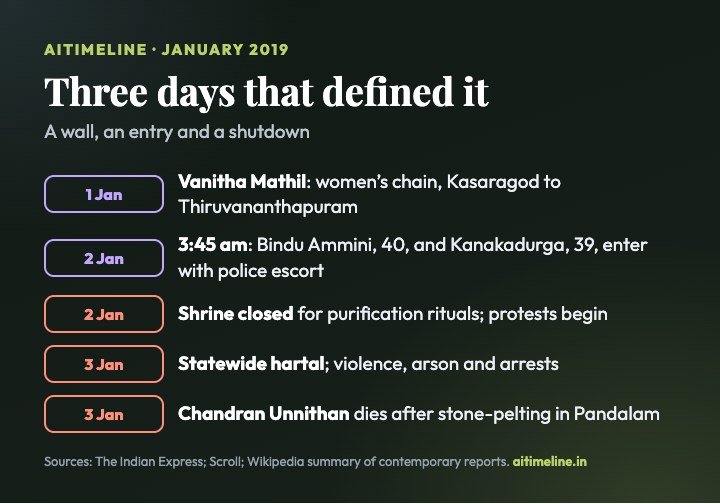
What happened: A statewide hartal followed the entry of the two women. Violence, arson and arrests were reported across the state.
A death: Chandran Unnithan, a Karma Samithi member, died of head injuries after stone-pelting during a protest in Pandalam.
Bindu Ammini and Kanakadurga enter the shrine Women’s entry
Who: Bindu Ammini, 40, a lecturer from Koyilandy in Kozhikode, and Kanakadurga, 39, from Angadipuram in Malappuram.
How: They entered under police protection, not by the 18 sacred steps but by a staff gate. CCTV images confirmed the visit.
Reaction: Priests closed the shrine for purification rituals. Protests broke out the same day.
Vanitha Mathil, the Women’s Wall Women’s entry
What it was: A human chain of women along Kerala’s length, promoted as a defence of the state’s social reform legacy and of gender equality.
Turnout: Reports put participation in the millions, with figures of three to five million cited. These are estimates, not counts.
Trupti Desai stopped at Kochi airport Women’s entry
What happened: Protesters blocked her from leaving Cochin International Airport on her way to Sabarimala. She returned home, saying she would come back.
Court agrees to hear reviews, refuses stay Courts
Order: The bench agreed to hear the review petitions in open court and declined to stay the 28 September judgment.
Petitions: Review petitions had been filed from early October 2018, after the verdict.
Protests as the temple reopens Protests
What happened: When the shrine opened for the first time after the verdict, protesters stopped women at Nilakkal and Pamba. Journalists covering the protests were attacked or harassed.
Turned back: On 19 October, a journalist and an activist reached near the sanctum under police escort but turned back after priests threatened to close it.
The state: The Kerala government said it was bound to implement the Supreme Court’s judgment.
Supreme Court allows women of all ages, 4:1 Courts
Majority: CJI Misra (for himself and Justice Khanwilkar), Justice Nariman and Justice Chandrachud held the exclusion unconstitutional. Rule 3(b) of the 1965 Rules was struck down.
Key findings: Ayyappa devotees are not a separate religious denomination, and the exclusion is not an essential religious practice. Justice Chandrachud also treated the exclusion as a form of untouchability under Article 17.
Dissent: Justice Indu Malhotra held that courts should not test deeply held religious beliefs against rationality, and that the petitioners were not devotees of the temple.
Constitution Bench hearings Courts
19 July: The bench said women have a fundamental right to enter and questioned the 10 to 50 age rationale.
25 July: The Nair Service Society argued that the celibate nature of the deity is protected by the Constitution.
1 August: Judgment reserved.
Referred to a Constitution Bench Courts
What it asked: Whether excluding women on a biological factor is discrimination, whether it is an essential religious practice, whether the temple has a denominational character, and whether Rule 3(b) is valid under the 1965 Act.
LDF government backs entry again Kerala govt
Stand: The new LDF government told the court it favoured the entry of women of all ages, returning to the 2007 position.
Supreme Court questions the restriction Courts
11 January: The bench asked on what basis women of a particular age could be kept out.
11 and 13 April: It said gender justice was endangered by the ban and that tradition alone could not justify it.
UDF government defends the custom Kerala govt
Stand: The state said it was duty-bound to protect the devotees’ right to practise their religion, and that the decision on such matters rests with the priests.
LDF government supports the PIL Kerala govt
Stand: The government supported the petition challenging the exclusion. Its affidavit also suggested a commission of eminent scholars to study the tradition.
Indian Young Lawyers Association files PIL Courts
Challenge: The PIL challenged the exclusion of women aged 10 to 50 and Rule 3(b) of the Kerala Hindu Places of Public Worship (Authorisation of Entry) Rules, 1965, under Articles 14, 15, 17 and 25.
Devaprasnam and the Jayamala claim Background
What happened: An astrological ritual at the temple claimed signs of a woman’s entry. Actor and politician Jayamala then said she had entered and touched the idol as a young woman in the 1980s. A police probe was later dropped.
Kerala High Court upholds the restriction Courts
Ruling: The two-judge bench held that the bar on women aged 10 to 50 was in accordance with usage and did not violate the Constitution or the 1965 law.
Direction: It directed the Travancore Devaswom Board to enforce the restriction and the government to use police help if needed.
S. Mahendran’s petition Background
What it alleged: That young women were visiting Sabarimala in breach of custom. Reports had appeared of a ceremony at the shrine for a former Devaswom Commissioner’s granddaughter attended by female relatives.
Kerala’s temple-entry law and Rule 3(b) Background
What it said: Rule 3(b) said women who are not by custom and usage allowed to enter a place of public worship shall not be entitled to enter it.
What the 2018 Judgment Said
Indian Young Lawyers Association v State of Kerala, 28 September 2018.
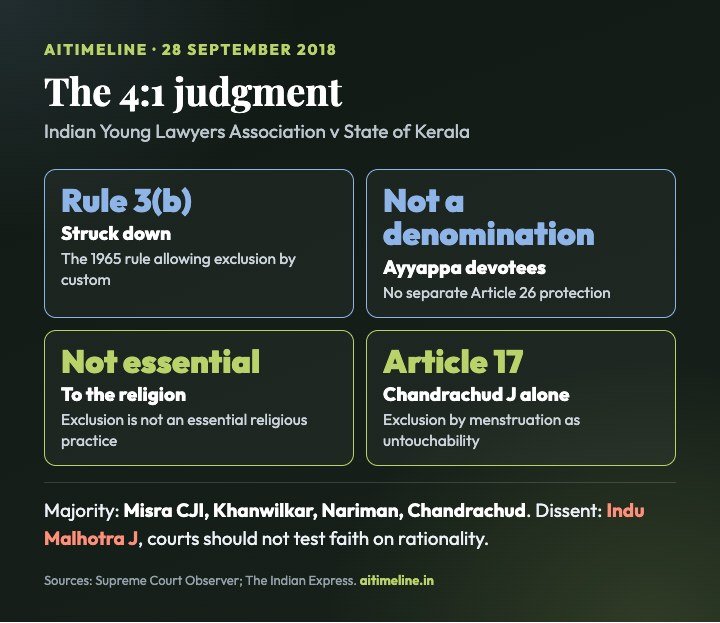
The rule allowing exclusion of women by custom was held unconstitutional and beyond the 1965 Act.
Devotees of Lord Ayyappa do not form a separate religious denomination, so Article 26 protection did not apply.
Excluding women was held not to be an essential religious practice of Hinduism.
Women devotees have an equal right under Article 25(1) to enter and worship.
Justice Chandrachud alone held that exclusion based on menstruation is a form of untouchability under Article 17.
Justice Indu Malhotra said what is essential to a faith is for the community, not the court, and that non-devotees should not be able to challenge it by PIL.
Why the dissent still matters. Justice Malhotra’s reasoning on locus standi and judicial restraint is close to several of the questions the nine-judge bench is now answering, including whether people outside a religious denomination can challenge its practices.
The Constitutional Provisions at Stake
| Article | Subject | Why it matters here |
|---|---|---|
| Article 14 | Equality before law | Whether exclusion by gender and age is arbitrary |
| Article 15 | No discrimination on grounds of sex | Whether a public temple can exclude women |
| Article 17 | Abolition of untouchability | Justice Chandrachud’s view of exclusion based on menstruation |
| Article 25 | Freedom of conscience and religion | Women devotees’ right to worship; the state’s power to open Hindu temples to all sections |
| Article 26 | Rights of religious denominations | Whether a temple’s community can manage its own affairs, including entry |
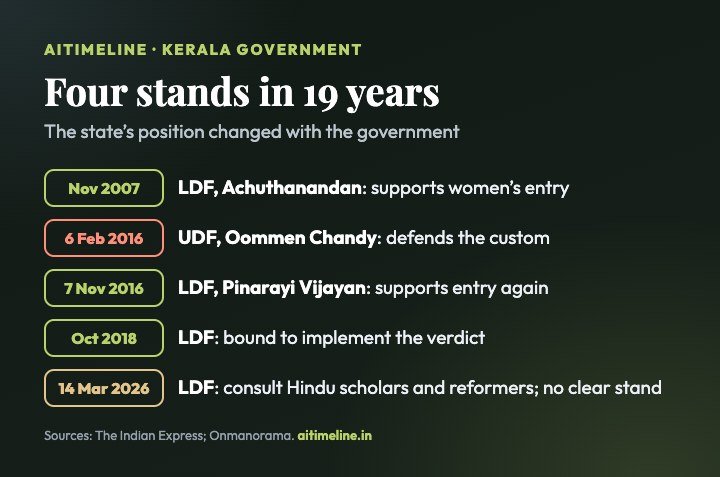
How the Kerala Government’s Stand Kept Changing
The Women at the Centre of the Movement
Individuals named here are public figures in this dispute.
| Person | Role | Key date |
|---|---|---|
| Bindu Ammini | Law lecturer from Koyilandy; entered the shrine; intervenor in the Supreme Court | 2 January 2019 |
| Kanakadurga | From Angadipuram, Malappuram; entered with Bindu Ammini; intervenor | 2 January 2019 |
| Trupti Desai | Bhumata Brigade founder; blocked at Kochi airport | 16 November 2018 |
| Indira Jaising | Senior advocate; argued untouchability in 2018 and for the two women in 2026 | 18 July 2018 |
| Justice Indu Malhotra | Only woman on the 2018 bench; sole dissent | 28 September 2018 |
| Justice B.V. Nagarathna | Only woman on the 2026 nine-judge bench | 7 April 2026 |
The movement was wider than a few names. Women devotees, lawyers and reform groups argued for entry, while other women devotees, including the “Ready to Wait” campaigners, said they would wait until they turned 50. Both groups described their stand as an act of faith.
Three Days in January 2019
Why the Nine-Judge Bench Matters
It is not re-hearing the temple case. It is setting the rules for every case like it.
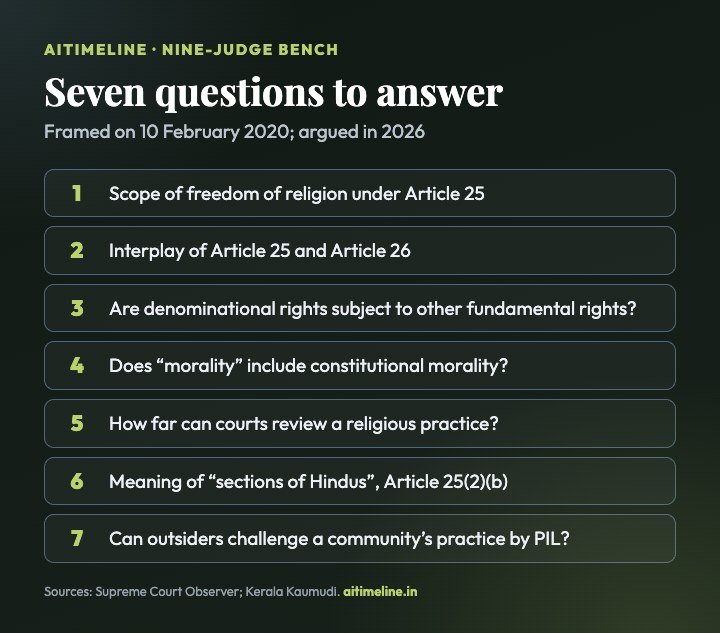
The 2019 review bench said the Sabarimala questions overlap with three other pending disputes: Muslim women’s entry into mosques, the right of a Parsi woman married outside the community to visit a fire temple, and female genital mutilation among Dawoodi Bohras. The nine-judge bench’s answers will apply to all of them. Only after that will a bench decide the review petitions against the 2018 judgment itself.
During the 2026 hearings, judges made pointed remarks, including on public interest litigation in religious matters. These were observations in argument, not findings, and should not be read as a preview of the judgment.
“Article 25(1) does not provide for gender equality for the simple reason that Articles 15 and 16 already prohibit discrimination on the grounds, inter alia, of sex.”
Solicitor General Tushar Mehta, for the Union government, 14 May 2026
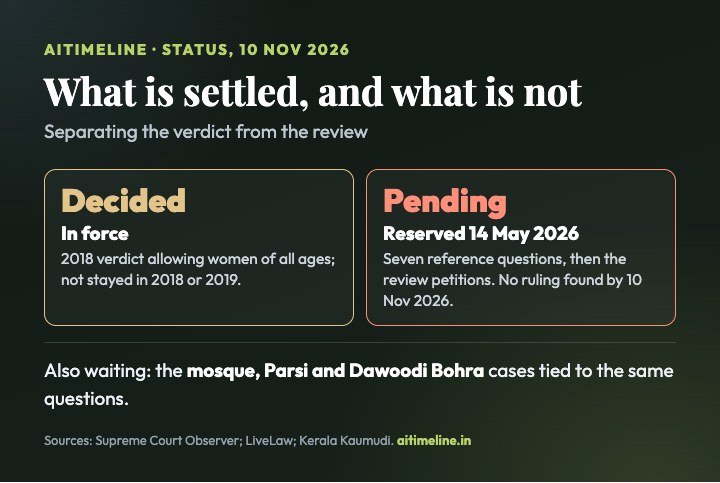
✅ Decided
- 2018 verdict allowing women of all ages, 4:1.
- No stay in November 2018 or November 2019.
- Review bench may refer questions to a larger bench (February 2020).
❓ Pending
- The nine-judge answers to seven questions.
- The review petitions against the 2018 verdict.
- The linked mosque, Parsi and Dawoodi Bohra cases.
Legal Terms Explained
- Essential religious practice: a practice so integral to a religion that it is protected under Articles 25 and 26. Courts decide what qualifies.
- Religious denomination: a group with a common faith, organisation and name, which gets the right to manage its own affairs under Article 26.
- Constitutional morality: the values of the Constitution, such as equality and dignity, as distinct from public or religious morality.
- Review petition: a request to the same court to reconsider its judgment on limited grounds.
- Reference: sending legal questions to a larger bench to settle them.
- Locus standi: the right of a person to bring a case to court.
- Hartal: a general strike and shutdown called as a protest.
Explore More Timelines
People Also Ask
Frequently Asked Questions
Checked against Supreme Court Observer, The Indian Express, Onmanorama, LiveLaw, The South First, Kerala Kaumudi and Scroll.
⚠️ Editorial Note and Legal Status
This page does not treat Ayyappa devotees as holding one position: devotees, religious bodies, women’s groups and parties disagreed among themselves. The 2018 ruling was a 4:1 majority, not unanimous. The pending nine-judge reference is not a decision overturning it, and remarks by judges during the 2026 hearings are not findings. Corrections to the brief this page began from: the review petitions were filed from October 2018, and 13 November 2018 was the date the court agreed to an open-court hearing without a stay; the 2019 review hearing took place on 6 February 2019; and the nine-judge bench has seven live questions, not six. Turnout figures for the Women’s Wall are estimates. As of 10 November 2026 we found no report of the nine-judge judgment, despite the Chief Justice’s August indication that it could come by early October.
Related Reading on AiTimeline
Sources & further reading
Every dated entry above was checked against these references. Last reviewed 10 November 2026.
- Supreme Court Observer: Sabarimala Review (Kantaru Rajeevaru v Indian Young Lawyers Association), case background and status
- The Indian Express (PTI): Sabarimala verdict, a chronology of events (28 September 2018)
- Onmanorama: Sabarimala women entry case, timeline and history (14 November 2019)
- The Indian Express: Sabarimala reference, nine-judge bench reserves verdict, key takeaways (May 2026)
- LiveLaw: Sabarimala Reference, Supreme Court 9-judge bench reserves verdict after 16 days hearing (14 May 2026)
- The South First: Nine-judge SC bench to hear petitions seeking review of women's entry to Sabarimala from 7 April (16 February 2026)
- Onmanorama: Kerala govt calls for wider consultation with Hindu scholars, social reformers (14 March 2026)
- Kerala Kaumudi: Sabarimala women's entry verdict likely by first week of October (12 August 2026)
- The Indian Express: Woman who entered Sabarimala, 'They may attack me, they may kill me, but I feel no fear' (January 2019)
- Scroll.in: Meet Bindu Ammini and Kanakadurga, Kerala women who made history by entering the shrine (January 2019)