Why India’s Citizenship Law Sparked One of Its Biggest Protest Movements
CAA-NRC protests timeline: from the Assam Movement and the 2019 citizenship law to Shaheen Bagh, the 2024 rules and the Supreme Court challenge.
Latest Story
In December 2019 Parliament passed the Citizenship (Amendment) Act, opening a faster route to Indian citizenship for six religious communities from three neighbouring countries, and leaving Muslims out of it. Within days Assam was under curfew, police had entered Jamia Millia Islamia, and women in Shaheen Bagh had begun a sit-in that lasted 101 days. The government said the law protected persecuted minorities and took nothing from any Indian. Its critics said it put a religious test into citizenship and, with a nationwide NRC, could leave Muslims without a fallback. This CAA–NRC protests timeline traces the story from the Assam Accord to the 2024 rules, the 2026 amendments and a Supreme Court challenge still undecided in November 2026.
The CAA, the NRC and the NPR are three different things, and much of the argument came from mixing them up. We explain each one first. Where the government and its critics disagree, we report both positions as positions, and we keep court findings separate from allegations.
💡 Short Answer
The CAA, passed on 11 December 2019, lets Hindu, Sikh, Buddhist, Jain, Parsi and Christian migrants from Afghanistan, Bangladesh and Pakistan who entered India by 31 December 2014 apply for citizenship after five years. It sparked protests from Assam to Shaheen Bagh. Its rules came on 11 March 2024 and certificates from 15 May 2024. More than 200 challenges remain pending in the Supreme Court, and Assam’s 2019 NRC has still not been formally notified.
CAA–NRC Protests: Key Questions
The CAA–NRC Debate in Ten Points
- Three terms: the CAA is a law; the NRC is a citizens’ register; the NPR is a residents’ register.
- The law: six religions, three countries, entry by 31 December 2014, five years’ residence.
- Assam’s date: the 1985 Accord’s cut-off is 24 March 1971, upheld by the Supreme Court in October 2024.
- The fear: critics linked the CAA to Amit Shah’s November 2019 statement on a nationwide NRC.
- The assurance: the government says the CAA removes no one’s citizenship.
- Protests: Assam, Jamia, AMU, Shaheen Bagh and dozens of cities, December 2019 to March 2020.
- Violence: deaths in Assam, Uttar Pradesh and Mangaluru; 53 killed in Delhi in February 2020.
- Implementation: rules on 11 March 2024, first certificates on 15 May 2024, Collectors empowered in August 2026.
- A different date: the 2025 immigration order uses 31 December 2024 for stay, not for citizenship.
- Still open: the constitutional challenge and Assam’s unfinished NRC.
CAA, NRC and NPR: What Each One Is
One law and two registers, often confused with each other.
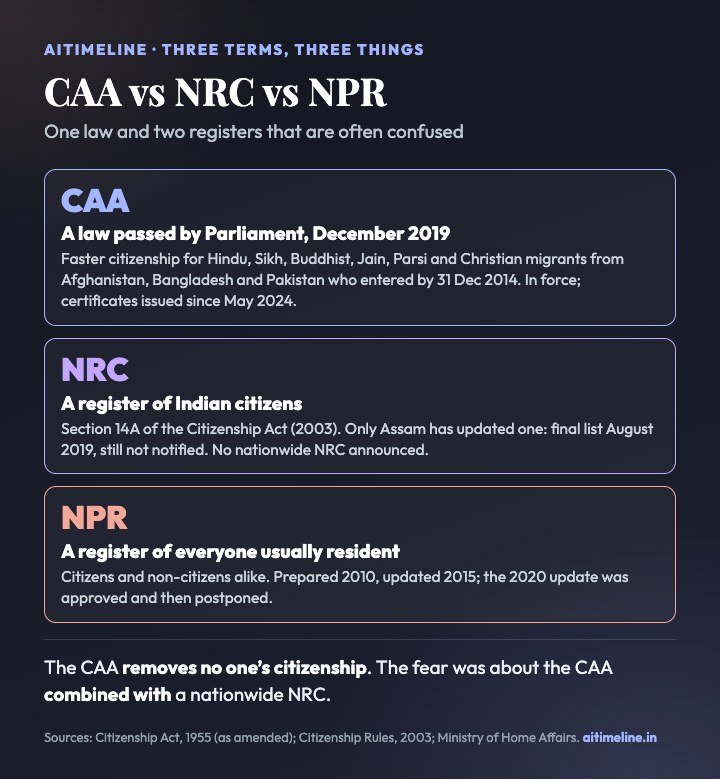
| CAA | NRC | NPR | |
|---|---|---|---|
| What it is | An Act of Parliament | A register of citizens | A register of usual residents |
| Who it covers | Migrants of six religions from three countries | Indian citizens | Everyone living in an area for six months or more |
| Legal basis | Citizenship (Amendment) Act, 2019; Section 6B | Section 14A (2003); 2003 Rules | 2003 Rules; census house-listing |
| Status in 2026 | In force; certificates being issued | Assam only; final list never notified | 2020 update postponed |
| Main dispute | Religious classification and Article 14 | Proof of citizenship and exclusion | Whether it is a first step to an NRC |
The CAA changed one thing in law. Before it, anyone who entered India without valid papers was an “illegal migrant” and could never be naturalised. The Act carved out an exception for members of six communities from Afghanistan, Bangladesh and Pakistan who arrived by 31 December 2014, and cut their residence requirement from eleven years to five. It did not touch anyone who is already a citizen.
The NRC and the NPR are registers. The 2003 rules let the government prepare a population register and then verify it to build a citizens’ register, and that sequence is why protesters treated the NPR as a first step. The government has said the two are not linked, and no nationwide NRC has been carried out. Assam’s NRC has its own history, rooted in the 1985 Assam Accord.
“CAA does not impinge upon any existing right that may have existed before the enactment of the amendment.”
— Union of India, affidavit to the Supreme Court, as quoted by The Tribune
Three Dates That Are Often Confused
1971 for Assam, 2014 for the CAA, 2024 for immigration.
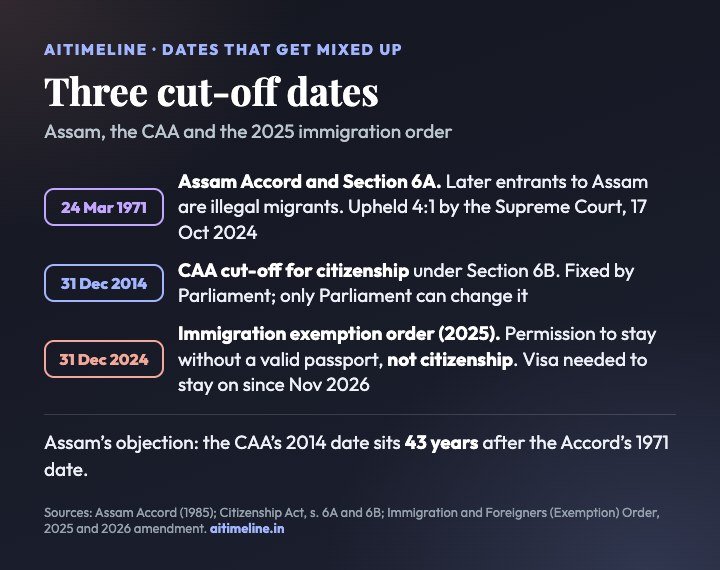
Much of the Assam opposition comes down to dates. The Accord says foreigners who came after 24 March 1971 should be detected and expelled. The CAA lets members of six communities who came as late as 31 December 2014 become citizens, which in Assam means more than four decades of later arrivals. That is why AASU and the Asom Gana Parishad, whose main objection is the date rather than the religious list, are among its petitioners.
A third date arrived in September 2025. The Immigration and Foreigners (Exemption) Order, 2025 lets members of the same six communities who entered by 31 December 2024 stay without a valid passport. Some headlines called this an extension of the CAA. It is not: it shields people from prosecution, and since November 2026 they need a visa to stay on. Only Parliament can change the 2014 date in the Act.
Timeline: India’s Citizenship Debate, 1950 to November 2026
Newest first. Colour shows the type of event.
Two questions still open: the CAA case and the Assam NRC Courts
The CAA challenge: The Supreme Court Observer’s case tracker, last updated on 22 September 2026, still lists Indian Union Muslim League v. Union of India as pending. Final arguments had been scheduled for 5–12 May 2026. We found no report of a judgment, or of the court reserving one, by 12 November 2026.
The Assam NRC: Separate petitions asking for identity cards for those included in Assam’s NRC, and rejection slips for those excluded, were listed for 6 November 2026. We found no report of what happened at that hearing.
What this means: The CAA is in force and citizenship is being granted under it. Its constitutional validity has not been decided.
Exemption order amended: a visa is now needed to stay on Government
What changed: The amendment, dated 4 November and published on 5 November, keeps the exemption that lets members of the six communities from Afghanistan, Bangladesh and Pakistan who entered India on or before 31 December 2024 come in without valid papers. Reports say staying on now requires an appropriate visa.
Other groups: The order also covers some long-term Pakistani residents, registered Sri Lankan Tamil refugees, Tibetans, and travel documents for Nepal and Bhutan.
Why it matters: This is immigration law, not citizenship law. It does not change who qualifies under the CAA.
Centre explains why 19 lakh NRC rejection slips are pending Assam & NRC
What the Centre said: In an affidavit, the Registrar General of India said the process of issuing rejection slips to about 19.07 lakh people left out of Assam’s NRC “has not been started yet”, because the final NRC has not been formally notified.
The reason given: The state NRC coordinator is still putting in place a “security regime” for the NRC data, and has not handed it to the Registrar General, who can notify the register only after receiving it.
Effect: Without a rejection slip stating reasons, an excluded person cannot begin an appeal before a Foreigners Tribunal. The court deferred the matter to 6 November.
District Collectors empowered to grant citizenship under Section 6B Government
What changed: Applicants ordinarily living in Gujarat, Rajasthan, Punjab, West Bengal, Assam and Tripura (excluding tribal areas), Jammu and Kashmir and Ladakh now file their Section 6B (CAA) applications online with the jurisdictional Collector, who verifies documents, administers the oath of allegiance and may grant citizenship.
Pending files: A separate order the same day moved pending Section 6B applications in these areas from the Empowered and District Level Committees to the Collectors.
What did not change: The religious categories and the 31 December 2014 entry cut-off in the Act stay the same.
Supreme Court asks why Assam’s NRC was never finished Assam & NRC
The petition: The Indian Express reported on 28 July 2026 that a bench of Chief Justice Surya Kant and Justices Joymalya Bagchi and Vipul Pancholi had issued notice on a petition by the Assam State Jamiat Ulama seeking the last statutory steps: identity cards for the 3.11 crore people included, and rejection slips for those excluded.
The hearing: On 10 August a bench sought replies from the Centre and Assam. Senior advocate Kapil Sibal, for the Jamiat, said earlier notices had gone unanswered.
The argument: The petition said the delay had turned a court-supervised exercise into “perpetual suspicion and denial of closure” for the people of Assam.
New rule: declare and surrender old passports Government
What changed: The rules now require applicants to declare whether they hold, or held, a valid or expired passport issued by Pakistan, Afghanistan or Bangladesh, with its number, place and dates of issue and expiry.
The undertaking: Applicants must undertake to surrender the passport to the postal authorities within 15 days of their citizenship application being approved.
Context: This is a procedural change to application forms. It does not alter eligibility under the Act.
Final hearing dates arrive Courts
The schedule: Under the February order, petitioners were to argue on 5 May and half of 6 May, the Union on the rest of 6 May and 7 May, with rejoinders on 12 May. Challenges about the whole country were to come first; Assam and Tripura later.
What we could not confirm: We found no published report describing the arguments made on these dates, or saying that the hearing was completed or the judgment reserved. We do not describe it as having taken place.
Assam’s position: Ahead of the dates, AASU adviser Samujjal Bhattacharjya said the separate Assam and Tripura hearing was a gain for the region.
Citizenship Rules amended for OCI and online filing Government
What changed: The Citizenship (Amendment) Rules, 2026 moved Overseas Citizen of India registration fully online, introduced an electronic OCI, set rules on minors holding two passports, and let an applicant appeal to an authority one rank above the one that decided the case.
What it was not: These are rules for running citizenship administration. They are not a court ruling on the CAA.
Supreme Court sets the CAA case for final hearing Courts
What happened: After nearly two years without a hearing, the bench put the batch on track for final arguments in the week of 5 May 2026. Reports put the number of petitions between about 200 and 243.
Two groups: Solicitor General Tushar Mehta recalled a 22 January 2020 order splitting the cases into Assam and Tripura, and the rest of India. The CJI said the “pan India” matters would be heard first. Nodal counsel were to sort the petitions within two weeks.
A point raised: Counsel for an Assam lawyers’ body pointed out that the immigration framework now used a December 2024 date. That refers to the 2025 exemption order, not the CAA itself.
New exemption order uses a 2024 date, but the CAA does not Government
What it did: Under the new Immigration and Foreigners Act, 2025, the MHA said members of the six communities from the three countries who entered India on or before 31 December 2024 because of religious persecution may stay without a valid passport or travel documents.
A common confusion: Some reports called this an extension of the CAA cut-off. It is not. It protects people from prosecution for entry and stay; citizenship under the Act still requires entry on or before 31 December 2014.
Critics’ view: Rights groups noted that the same religious categories, and the same exclusion of Muslims, carried over into immigration law.
Supreme Court upholds Section 6A, Assam’s own citizenship rule Assam & NRC
The ruling: By 4 to 1, the court upheld Section 6A, inserted after the Assam Accord. It gives citizenship to people who came to Assam from Bangladesh before 1966, and a registration route to those who came between 1 January 1966 and 24 March 1971. Later entrants are treated as illegal migrants.
The bench: Justice Surya Kant wrote the lead majority opinion, with Justices M.M. Sundresh and Manoj Misra; CJI D.Y. Chandrachud concurred separately. Justice J.B. Pardiwala dissented, holding the provision invalid with prospective effect.
Why it matters here: The judgment confirmed 24 March 1971 as Assam’s legal cut-off. The CAA’s 2014 date sits on top of it, which is the heart of the Assam challenge.
First citizenship certificates under the CAA Government
What happened: The Home Secretary handed certificates to 14 applicants in Delhi, the first granted under the new Section 6B.
Context: Certificates were also sent digitally to other applicants. The Lok Sabha election was then under way.
Process: Applications were scrutinised by a District Level Committee and decided by an Empowered Committee in each state.
Supreme Court refuses to stay the CAA Rules Courts
What happened: The bench declined to stay the 2024 Rules and gave the Centre three weeks to respond to more than 20 stay applications. The next date was set for 9 April 2024.
The petitioners’ worry: Kapil Sibal, for IUML, argued that once citizenship was granted it could not easily be undone if the law were later struck down.
Significance: The refusal let the application process go ahead. It was not a finding that the law is valid.
Stay pleas filed; protests return in Assam Protests
In court: The Indian Union Muslim League moved the Supreme Court to stay the rules within a day of notification; others, including the DYFI and Asaduddin Owaisi, followed.
On the streets: In Assam, student and opposition groups burned copies of the rules and called a shutdown. Protests were smaller than in 2019.
Politics: Opposition parties called the timing electoral. Chief ministers of Kerala, West Bengal and Tamil Nadu said they opposed the law.
Government notifies the Citizenship (Amendment) Rules, 2024 Law & Parliament
What happened: The MHA notified the rules that make the CAA operational. Applications are made online, verified by a District Level Committee and decided by an Empowered Committee headed by a Census official in each state.
Documents: The rules list documents that can show the applicant is from Afghanistan, Bangladesh or Pakistan and entered by 31 December 2014. A certificate from a local community institution confirming the applicant’s religion is also needed.
Reactions: The government said it was keeping its promise to persecuted minorities. Opposition parties questioned the timing, weeks before the general election.
Amit Shah: “No one can stop the CAA” Government
What he said: The Home Minister said the CAA was the law of the land and would be implemented.
Context: West Bengal has a large refugee population from Bangladesh, including the Matua community, and the CAA has been a campaign issue there.
Court revives the case; Centre files its reply Courts
What happened: On 12 September 2022 the court took up about 220 petitions and asked for issues to be compartmentalised, with Assam and Tripura handled separately. On 31 October it listed the hearing for 6 December 2022.
The Centre’s case: In an affidavit of about 150 pages, the Union said the CAA is a narrowly tailored law, that citizenship and immigration are for Parliament, and that the Act does not affect any Indian citizen.
What followed: The December 2022 hearing did not lead to final arguments.
Collectors in 13 districts may grant citizenship under the old law Government
What happened: With the CAA rules still unframed, the MHA delegated power to Collectors in 13 districts of Gujarat, Chhattisgarh, Rajasthan, Haryana and Punjab to accept citizenship applications from the six communities from the three countries.
The difference: This used the existing naturalisation and registration rules, not the CAA. On 1 June 2021 the IUML asked the Supreme Court to stay the order.
Amit Sahni: public roads cannot be occupied indefinitely Courts
The ruling: Deciding a petition over the Shaheen Bagh road blockade, the court said the right to protest is protected, but public ways and spaces cannot be occupied indefinitely, and authorities must act to clear them.
Balance: The judgment said dissent and democracy go hand in hand, but protests must be held in designated places.
Shaheen Bagh cleared as the lockdown begins Protests
What happened: Police cleared the site on the morning of the Delhi lockdown, as COVID-19 restrictions came into force. A small number of protesters had remained.
The protest: The sit-in on a stretch of road in south-east Delhi had run for about 101 days, led mainly by local women.
Union’s first defence in the Supreme Court Courts
What it said: The Centre told the court the CAA “does not impinge upon any existing right” and in no way seeks to affect the legal, democratic or secular rights of Indian citizens.
Its argument: It said the classification addressed a specific problem of persecution in three theocratic neighbours and that the existing routes to citizenship for foreigners remained the same.
Communal violence in north-east Delhi Protests
What happened: Violence broke out amid confrontations between people opposed to and supporting the CAA. 53 people were killed, most of them Muslims, and homes, shops and places of worship were burned.
A separate episode: This was not a protest but communal violence. Responsibility for specific crimes is being decided case by case in the courts; our Delhi riots 2020 timeline tracks those cases.
Court appoints mediators for Shaheen Bagh Courts
What happened: The court asked senior advocates Sanjay Hegde and Sadhana Ramachandran to talk to the protesters about moving to another site.
Outcome: The talks did not end the sit-in; the court later decided the issue in the Amit Sahni judgment.
Shots fired at protesters at Jamia and Shaheen Bagh Protests
Jamia: On 30 January, the anniversary of Mahatma Gandhi’s assassination, a gunman opened fire near a march outside Jamia Millia Islamia. A student was wounded. The shooter was later found to be a minor.
Shaheen Bagh: On 1 February a man fired shots in the air near the Shaheen Bagh site and was arrested.
Context: Both incidents came during the Delhi Assembly election campaign, when speeches about the protests had turned bitter.
Supreme Court refuses to stay the CAA or NPR Courts
What happened: With 140-plus petitions listed, the court refused to stay the Act or the NPR without hearing the Centre, and gave it four weeks to respond. It barred High Courts from hearing CAA cases.
Assam separate: It directed that petitions from Assam and Tripura be heard as a separate group, a split still followed in 2026.
Bigger bench: The court said a five-judge bench might eventually have to decide the issues.
States push back Government
Resolutions: Kerala’s Assembly passed a resolution against the CAA on 31 December 2019; Punjab followed on 17 January 2020, Rajasthan on 25 January and West Bengal on 27 January.
A lawsuit: On 14 January 2020 Kerala filed an original suit in the Supreme Court under Article 131, the first state to challenge the law in court.
The limit: Citizenship is a Union subject. Resolutions are political statements; they cannot stop a central law from applying.
The CAA comes into force Law & Parliament
What happened: The MHA notified 10 January 2020 as the date the Act took effect.
But: Without rules, no one could yet apply under it. That took another four years.
Cabinet approves NPR update; Shah says no link to NRC Government
What happened: The Cabinet approved ₹3,941.35 crore to update the National Population Register alongside house-listing for Census 2021, from April to September 2020.
The assurance: The same day Amit Shah told ANI there had been no discussion of a nationwide NRC and that the NPR had no link to it.
The fear: Protesters pointed out that the 2003 rules describe the NPR as the base from which a citizens’ register is prepared, and that new questions on parents’ birthplace had been proposed.
Modi: no discussion of a nationwide NRC since 2014 Government
What he said: The Prime Minister said there had been no discussion of a nationwide NRC since his government came to power in 2014, and that the CAA was not about Indian Muslims.
Why it drew attention: A month earlier, on 20 November 2019, Amit Shah had told the Rajya Sabha that the NRC process would be carried out across the country.
Nationwide protests, internet shutdowns and deaths Protests
What happened: Large demonstrations were held in many cities. Prohibitory orders were imposed in parts of Delhi, Bengaluru and Uttar Pradesh; the internet was cut in several areas.
Deaths: Two men were killed in police firing in Mangaluru on 19 December. Uttar Pradesh recorded the highest toll, with more than 20 deaths reported over the following days.
Two accounts: The UP government said it acted against rioters and later sought damages from those it named. Rights groups alleged excessive force and challenged the recovery notices, which the Supreme Court later had withdrawn.
Supreme Court issues notice; no stay Courts
What happened: The court issued notice to the Centre on 59 petitions, led by the IUML’s, but refused to stay the law. It listed the case for 22 January 2020.
The core argument: Petitioners said a religious test for citizenship fails the reasonable-classification test of Article 14, which guarantees equality to all persons, not just citizens.
Protests spread to campuses across India Protests
What happened: After the Jamia events, students marched at universities across India. At Aligarh Muslim University, police entered the campus on the night of 15 December, and the university was closed.
Who joined: Students were joined by civil-society groups, opposition parties and residents. Many protests used the Preamble to the Constitution and the national flag.
Police enter Jamia Millia Islamia Protests
What happened: After buses were set alight near the campus during a protest, Delhi Police entered Jamia Millia Islamia. Students said they were beaten, including inside the library, and video of the library circulated widely.
Police account: Delhi Police said they entered to pursue people who had committed violence outside.
Impact: The images set off protests at universities nationwide within hours.
The Shaheen Bagh sit-in begins Protests
What happened: A group of women, many of them older residents, began an indefinite sit-in on a road through Shaheen Bagh, against the CAA, the NRC and the police action at Jamia.
How it grew: It became a round-the-clock protest with libraries, art, readings of the Constitution and speeches, and was copied in other cities.
The cost: The blockade of a main road to Noida also caused long diversions for commuters, and became the subject of the Amit Sahni case.
Assam erupts Assam & NRC
What happened: Assam saw some of the largest protests. Guwahati was put under curfew, the army was deployed and mobile internet was suspended.
Deaths: At least five people died in the state, several of them in police firing.
Why Assam: Protesters said the 2014 date undercut the 1971 cut-off of the Assam Accord, whatever the migrants’ religion, and threatened language, land and political rights.
President gives assent Law & Parliament
What happened: President Ram Nath Kovind signed the Bill, and the Citizenship (Amendment) Act, 2019 was published in the Gazette the same day.
Rajya Sabha passes the Bill, 125–105 Law & Parliament
What happened: The Rajya Sabha passed the Bill by 125 votes to 105, after rejecting a motion to send it to a select committee.
The debate: Shah said Muslims were not persecuted as minorities in the three Islamic countries. The opposition asked why Ahmadiyyas, Hazaras, Rohingyas and Sri Lankan Tamils were left out.
Lok Sabha passes the Bill, 311–80 Law & Parliament
What happened: Amit Shah introduced the Citizenship (Amendment) Bill, 2019 on 9 December. After a debate that ran past midnight, the Lok Sabha passed it by 311 votes to 80.
What it contained: It kept the 2016 Bill’s core idea but added exemptions for Sixth Schedule tribal areas and Inner Line Permit states in the Northeast.
Shah tells Parliament the NRC will be nationwide Government
What he said: Answering a question, Shah said the NRC process would be carried out across the country and that no one of any religion should worry.
Why it matters: This statement, more than any other, linked the CAA and a nationwide NRC in the minds of protesters weeks later.
Assam’s final NRC: 19.06 lakh left out Assam & NRC
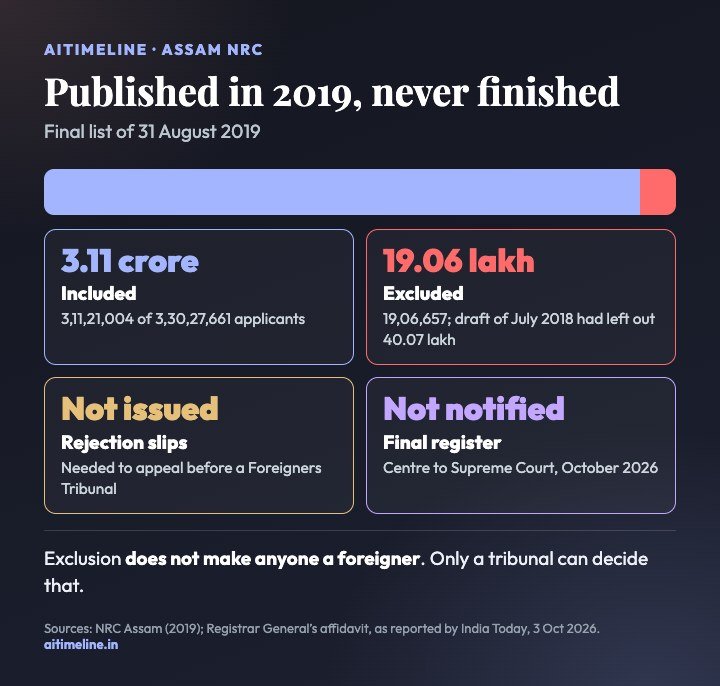
The numbers: Of 3,30,27,661 applicants, 3,11,21,004 were included and 19,06,657 excluded.
Not a declaration: Exclusion did not make anyone a foreigner. Those left out were to get 120 days to appeal before Foreigners Tribunals once they received reasons.
Reaction: Groups on all sides were unhappy: some said too many genuine citizens had been left out, others that too few migrants had been identified. Reports said a large number of those excluded were Bengali Hindus.
Lok Sabha passes the 2016 Bill; it lapses Law & Parliament
What happened: The Joint Parliamentary Committee tabled its report on 7 January 2019, with dissent notes from opposition members. The Lok Sabha passed the Bill the next day.
Northeast protest: The Asom Gana Parishad quit Assam’s BJP-led government over the Bill, and protests spread across the Northeast.
Lapsed: The Bill was never taken up by the Rajya Sabha and lapsed when the 16th Lok Sabha was dissolved in May 2019.
Draft NRC leaves out 40 lakh Assam & NRC
What happened: The complete draft of the updated NRC left out 40,07,707 applicants, setting off a claims-and-objections process.
Why it matters: The scale of exclusion in Assam shaped fears about what a nationwide register might do.
Citizenship (Amendment) Bill, 2016 introduced Law & Parliament
What it proposed: The Bill proposed treating Hindu, Sikh, Buddhist, Jain, Parsi and Christian migrants from Afghanistan, Bangladesh and Pakistan as not being illegal migrants, and cutting the naturalisation residence requirement from 11 years to six.
Scrutiny: It went to a Joint Parliamentary Committee chaired by BJP MP Rajendra Agrawal, which held hearings, including in Assam.
Exemptions for minority migrants Government
What happened: Notifications of 7 September 2015 exempted members of the six communities from Bangladesh and Pakistan who entered by 31 December 2014 from the Passport (Entry into India) Act, 1920 and the Foreigners Act, 1946. On 18 July 2016 Afghanistan was added.
Effect: These migrants could not be detained or deported for lacking papers. Many CAA petitions challenge these notifications too.
Supreme Court orders Assam’s NRC updated Assam & NRC
What happened: A bench of Justices Ranjan Gogoi and R.F. Nariman ordered the NRC in Assam updated on a fixed timetable, and referred the validity of Section 6A to a Constitution Bench.
Context: The BJP’s 2014 manifesto had described India as a natural home for persecuted Hindus. Both strands would meet in 2019.
“Illegal migrant”, the NRIC and the NPR Law & Parliament
The 2003 law: The amendment defined an “illegal migrant”, barred such migrants from citizenship by registration or naturalisation, and added Section 14A on compulsory registration of citizens and a National Register of Indian Citizens.
The rules: The Citizenship (Registration of Citizens and Issue of National Identity Cards) Rules, 2003 provide for a population register, which may be verified to prepare the citizens’ register.
The NPR: The first NPR was prepared in 2010 with the house-listing phase of the census, and updated in 2015.
Section 6A and the end of automatic birthright citizenship Law & Parliament
1985: Parliament inserted Section 6A to give effect to the Assam Accord’s citizenship terms.
1986: A further amendment provided that a person born in India on or after 1 July 1987 is a citizen by birth only if at least one parent is an Indian citizen.
The Assam Accord Assam & NRC
What it said: The Accord ended the six-year agitation. It set 24 March 1971 as the date after which foreigners in Assam were to be detected and expelled, and promised safeguards for the Assamese people’s identity.
Legacy: The 1971 date is why many in Assam opposed the CAA regardless of religion.
The Nellie massacre Assam & NRC
What happened: Thousands of people, mostly Bengali-speaking Muslims, were killed in a few hours in villages around Nellie. The official toll was about 1,800; unofficial estimates are higher.
Aftermath: No one was convicted. The Tewary Commission report was not made public for decades.
The Assam Movement begins Assam & NRC
What happened: The discovery of a large rise in the voters’ list for the Mangaldoi Lok Sabha by-election set off a movement demanding the detection, deletion and deportation of foreigners.
Six years: The agitation included mass protests, strikes and long boycotts of elections, and serious violence.
War, refugees and migration into Assam Assam & NRC
What happened: The Pakistani army’s crackdown in East Pakistan from 25 March 1971 drove millions of refugees into India. Bangladesh became independent in December.
Why the date matters: The night of 24 March 1971, before the crackdown, became Assam’s legal cut-off for citizenship.
Constitution, the first NRC and the Citizenship Act Law & Parliament
1950: Articles 5 to 11 of the Constitution settled who was a citizen on 26 January 1950, including Partition migrants, and left the rest to Parliament.
1951: An NRC was prepared along with the 1951 Census. It later became a base document in Assam.
1955: The Citizenship Act, 1955 set out citizenship by birth, descent, registration, naturalisation and incorporation of territory.
How the Bill Became Law
Two failed attempts’ worth of debate, compressed into one week.
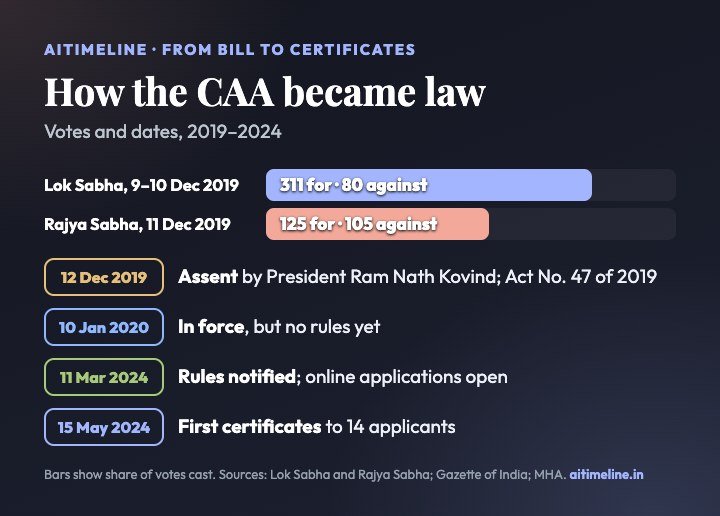
The idea was not new in 2019. A Bill with the same core had been introduced in July 2016, examined by a Joint Parliamentary Committee for more than two years, and passed by the Lok Sabha in January 2019, before lapsing for want of a Rajya Sabha vote. After the BJP returned with a larger majority, the 2019 Bill added exemptions for the Northeast’s tribal and Inner Line Permit areas and went through both Houses in three days.
What the CAA Protests Demanded
Not one movement but several, with different fears.
| Region or group | Main concern |
|---|---|
| Assam | Assamese identity, language, land and the Accord’s 1971 cut-off, regardless of religion |
| Other northeastern states | Migration and indigenous rights; partly met by the Sixth Schedule and ILP exemptions |
| Jamia, AMU and other campuses | The law, and police action against students |
| Shaheen Bagh and city sit-ins | Equality, secularism and the CAA–NRC combination |
| Opposition parties and states | Article 14 and the religious classification |
| Civil-rights groups | Documentation, due process and the scale of Assam’s exclusions |
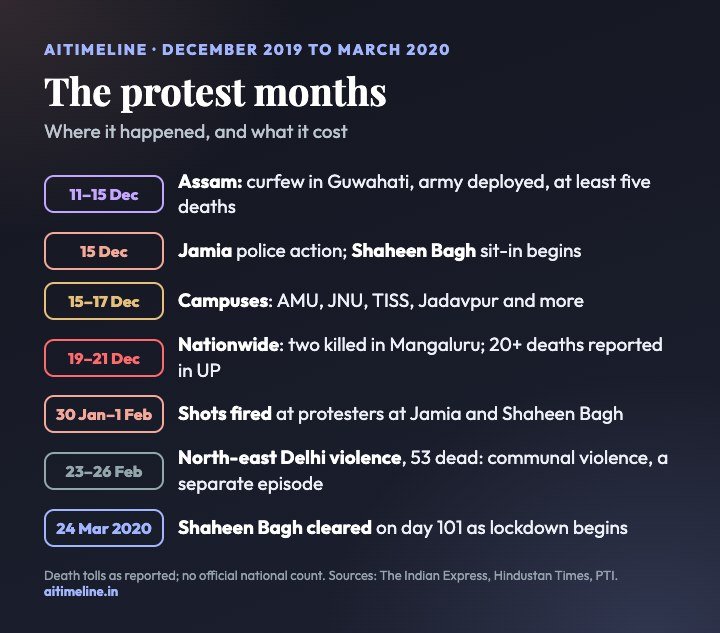
The protests had no single leader. Students, Muslim women in residential neighbourhoods, Assamese nationalist groups and opposition parties were each pushing a different argument. What they shared was the language of the Constitution: readings of the Preamble, the national flag and portraits of B.R. Ambedkar became the standard images of the movement.
The state’s response varied as well. Delhi saw police action at Jamia; Uttar Pradesh recorded the most deaths and later tried to recover damages from protesters it named, notices the Supreme Court made it withdraw in 2022. The UP government said it acted against rioters, and rights groups alleged excessive force. The February 2020 violence in north-east Delhi was a separate episode of communal violence, not a protest, and is covered in our Delhi riots timeline.
Assam’s NRC: Published, but Never Finished
Seven years after the final list.
| Assam NRC | Figure or date |
|---|---|
| Applicants | 3,30,27,661 |
| Included in final list | 3,11,21,004 |
| Excluded | 19,06,657 (about 19.07 lakh in later reports) |
| Final list published | 31 August 2019 |
| Historical cut-off | 24 March 1971 |
| Formally notified | Not as of October 2026 |
Publishing the list was meant to be halfway, not the end. Under the rules, everyone included should get a national identity card, and everyone excluded a rejection slip giving reasons, which starts the 120-day window to appeal before a Foreigners Tribunal. Neither has happened. In October 2026 the Registrar General of India told the Supreme Court that the state coordinator was still building a “security regime” for the data, and that the list could be notified only after it was handed over.
The result, as the Assam State Jamiat Ulama’s petition puts it, is that 19 lakh people are in limbo: not declared foreigners, but unable to clear their names. Exclusion from the NRC does not by itself make anyone a foreigner; only a tribunal can decide that.
The Legal Challenge, Step by Step
From notice in 2019 to a final hearing listed in 2026.
| Date | Development | Significance |
|---|---|---|
| 18 Dec 2019 | Notice issued on IUML-led petitions | Challenge formally begins; no stay |
| 22 Jan 2020 | Stay refused; four weeks to Centre | Assam and Tripura split off; High Courts barred |
| 7 Oct 2020 | Amit Sahni v. Commissioner of Police | Indefinite occupation of public roads not allowed |
| Sep–Oct 2022 | Issues compartmentalised; Union’s reply | Case revived but not argued |
| 19 Mar 2024 | Stay on CAA Rules refused | Applications can be processed |
| 17 Oct 2024 | Section 6A upheld, 4:1 | Assam’s 1971 cut-off confirmed |
| 19 Feb 2026 | Final hearing listed for May | Pan-India petitions first, then Assam and Tripura |
| Nov 2026 | Pending | No judgment reported |
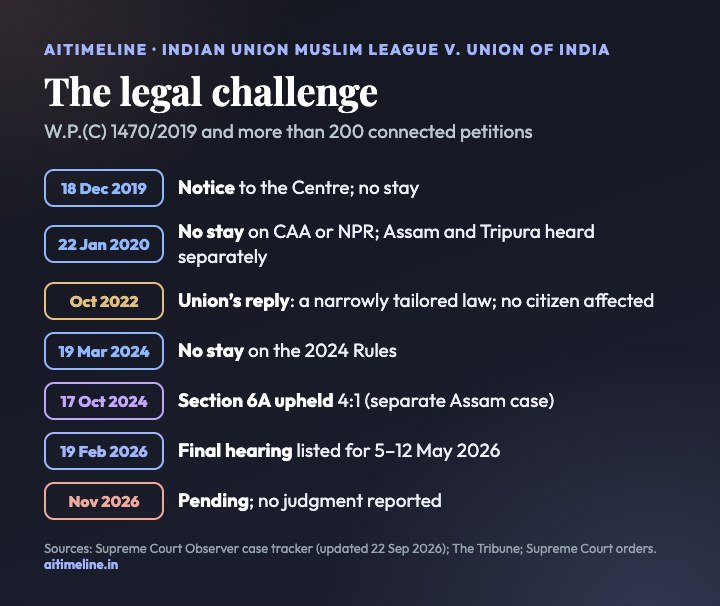
The legal question is narrow to state and hard to answer. Article 14 protects every person, citizen or not, from arbitrary classification. A law can treat groups differently if the difference is intelligible and has a rational link to the law’s purpose. The government says the purpose is relief from religious persecution in three theocratic neighbours. The petitioners say that purpose cannot justify leaving out persecuted Ahmadiyyas, Hazaras, Rohingyas or Sri Lankan Tamils, or picking religion as the test at all.
The Government’s Case and the Critics’ Case
Each side in its own terms.
| Issue | Government’s position | Critics’ position |
|---|---|---|
| Purpose | Relief for persecuted minorities of three neighbours | Religion-based eligibility for citizenship |
| Exclusion of Muslims | Muslims are the majority in those three countries | Persecuted Muslim sects and other countries left out |
| Indian Muslims | The Act removes no Indian’s citizenship | A future NRC could hit those without papers unequally |
| NRC | A separate exercise; none planned nationwide | Officials’ statements linked the two |
| Article 14 | Reasonable classification for a specific problem | Arbitrary and discriminatory classification |
| Assam | Tribal and ILP areas exempted | Undermines the Accord’s 1971 cut-off |
| Implementation | A humanitarian pathway, now running | Granting citizenship before the court rules is premature |
Key People and Organisations
| Person or organisation | Role |
|---|---|
| Narendra Modi | Prime Minister during the passage and implementation of the CAA |
| Amit Shah | Home Minister; piloted the Bill and its main defender |
| Ram Nath Kovind | President who gave assent on 12 December 2019 |
| Indian Union Muslim League | Lead petitioner in the Supreme Court |
| All Assam Students’ Union | Led the 1979–85 movement; petitioner against the CAA |
| Asom Gana Parishad | Born from the Assam Movement; quit Assam’s government over the 2016 Bill; petitioner |
| Bilkis Bano (Shaheen Bagh) | The protest’s best-known “dadi”; in TIME’s 100 for 2020; not the Bilkis Bano of the Gujarat case |
| Mahua Moitra, Jairam Ramesh, Asaduddin Owaisi, Harsh Mander | Among the petitioners challenging the law |
| Government of Kerala | First state to sue the Centre over the CAA, under Article 131 |
Where Things Stand in November 2026
The law runs; the questions about it remain.
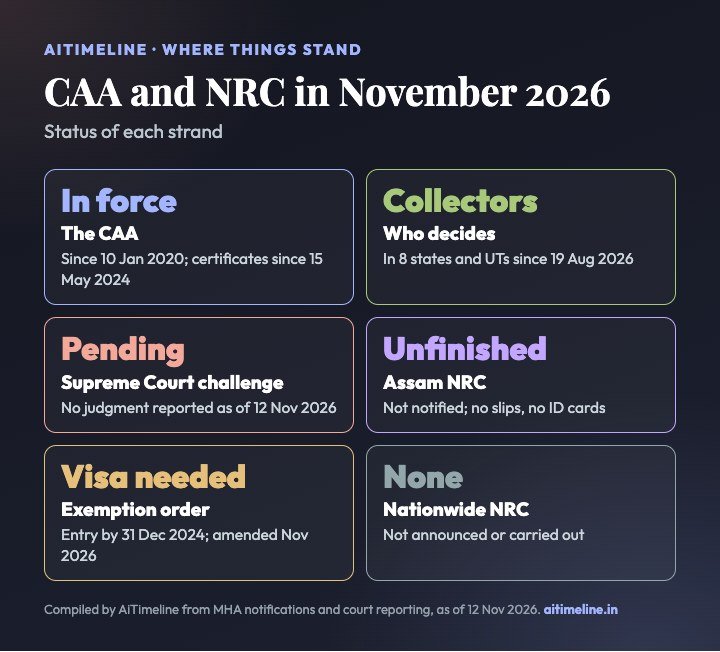
More than six years after it passed, the CAA is working law. People are applying, Collectors in border states now decide their cases, and rules have been amended three times in 2026 alone. The government has not published a running total of certificates granted.
What remains open is whether the law is constitutional. If the Supreme Court were to strike down Section 6B, it would also have to decide what happens to citizenship already granted, which is the risk petitioners raised in 2024. In Assam, the separate question of an NRC that was published but never finished is back before the court.
Why the CAA–NRC Debate Matters
- Religion and citizenship: the first time Indian citizenship law used religion as an eligibility test.
- Article 14: the court will decide how far equality protects non-citizens against classification.
- Proof of citizenship: Assam showed how hard documents can be for the poor and displaced.
- Federalism: states objected loudly but citizenship stayed a Union subject.
- Protest and public space: Amit Sahni set limits on indefinite road occupations.
- Regional identity: Assam’s opposition was about 1971, not religion, a distinction often lost.
- Implementation before judgment: citizenship is being granted under a law still under challenge.
Explore More Timelines
People Also Ask
Frequently Asked Questions
Based on the Act, MHA notifications, Supreme Court orders and contemporary reporting.
⚠️ Editorial Note
We checked dates against the Gazette, MHA notifications, Supreme Court reporting and contemporary news. Some summaries say the CAA cut-off was extended to 2024; it was not, and we explain the 2025 immigration order separately. We added the Act’s commencement on 10 January 2020, the Section 6A judgment of October 2024 and the November 2026 exemption-order amendment. A further stay refusal on 20 May 2020 is recorded by the Supreme Court Observer, which we cite as such. We could not find reports describing the scheduled May 2026 hearings, or the outcome of the 6 November 2026 NRC hearing, and do not describe either. Death tolls are as reported, not official national counts. This page is information, not legal advice.
Related Reading on AiTimeline
Sources & further reading
Every dated entry above was checked against these references. Last reviewed 12 November 2026.
- The Citizenship (Amendment) Act, 2019 (Act No. 47 of 2019), Gazette of India, 12 December 2019
- Constitutionality of the Citizenship Amendment Act: case tracker (IUML v. Union of India)
- Citizenship Amendment Act: Supreme Court schedules final hearings in May 2026
- Supreme Court refuses to stay the CAA Rules, 19 March 2024
- Section 6A of Citizenship Act: five-judge bench upholds constitutionality in a 4:1 majority
- The Citizenship (Amendment) Bill, 2019: bill track
- The Citizenship (Amendment) Bill, 2016: bill track
- 6 years on, SC to commence hearing on petitions challenging CAA on May 5
- CAA rules notified: a timeline of events
- Shaheen Bagh protests cleared: a timeline
- Seven years on, how Assam's NRC process remains incomplete (28 July 2026)
- Centre tells SC why Assam NRC rejection slips for 19.07 lakh are pending (3 October 2026)
- Persecuted minorities who entered India up to 2024 to be allowed to stay: MHA (Immigration and Foreigners (Exemption) Order, 2025)
- Citizenship (Amendment) Rules, 2026: OCI registration, cancellation and review provisions explained
- MHA mandates surrender of Pakistani, Afghan and Bangladeshi passports after citizenship approval (18 May 2026)
- Citizenship (Third Amendment) Rules, 2026 notified; Collectors empowered to decide Section 6B applications
- Centre amends passport rules for Pakistani nationals, minority refugees and Tibetans (November 2026)
- Indian Citizenship Online: CAA application portal