How a 1993 Supreme Court Judgment Created India’s Collegium System
Explore the Second Judges Case of 1993, the origin of India's collegium system, the 1998 ruling, NJAC controversy and judicial appointment process.
Latest Story
Who should appoint India’s judges: the elected government or the judiciary itself? For the first four decades after independence the answer, in practice, was the government. On 6 October 1993 a nine-judge bench of the Supreme Court reversed that. The Second Judges Case, formally Supreme Court Advocates-on-Record Association v. Union of India, held that the Chief Justice’s opinion, formed together with senior judges, has primacy in appointing and transferring judges. That ruling is the foundation of the collegium system, which was expanded in 1998, survived Parliament’s attempt to replace it in 2015, and still decides who sits on India’s higher courts.
Readers often run together two different judgments. The 1993 Second Judges Case decided who has the final say. The 1998 Third Judges Case decided how many judges take part, producing today’s five-member collegium. We keep them apart, and keep judgments, Parliament’s laws and the government’s procedure on separate tracks. Where the brief we worked from was wrong, we say so in the entry.
💡 Short Answer
The Second Judges Case is the Supreme Court’s 6 October 1993 judgment holding, by 7:2, that the Chief Justice of India’s opinion, formed after consulting senior judges, has primacy in appointing and transferring judges. It overruled the 1981 First Judges Case, which had given the executive the last word, and created the basis of the collegium system that the 1998 Third Judges Case expanded to five judges.
Second Judges Case: Key Questions
The Collegium Story in Ten Points
- The text: the Constitution requires only “consultation” with the Chief Justice and other judges.
- Supersessions: the government passed over senior judges for Chief Justice in 1973 and 1977.
- 1981: the First Judges Case gave the executive primacy, by 4:3.
- 1990: a three-judge bench doubted that ruling and sought a nine-judge bench.
- 1993: the Second Judges Case gave the judiciary primacy, by 7:2.
- Collective view: the Chief Justice cannot act alone; senior judges must be consulted.
- 1998: the Third Judges Case set the collegium at the CJI plus four senior-most judges.
- 2015: the NJAC was struck down 4:1 and the collegium restored.
- Unfinished reform: the revised Memorandum of Procedure ordered in 2015 is still not public.
- Today: the collegium led by CJI Surya Kant made three Supreme Court appointments in October 2026.
The Four Judges Cases
Executive primacy, judicial primacy, a five-judge collegium and a failed replacement.
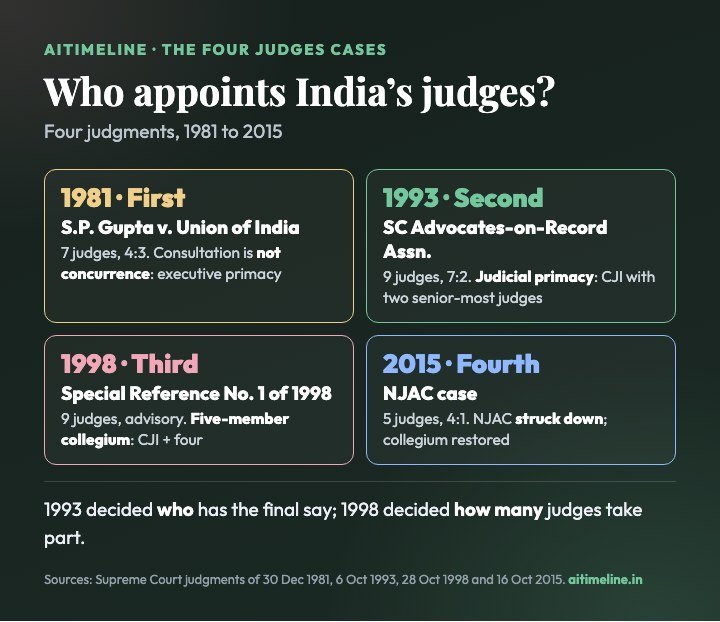
| Case | Date and bench | Main ruling | Effect |
|---|---|---|---|
| First Judges Case — S.P. Gupta v. Union of India | 30 Dec 1981; seven judges, 4:3 | Consultation does not mean concurrence | Executive primacy |
| Second Judges Case — SC Advocates-on-Record Association v. Union of India | 6 Oct 1993; nine judges, 7:2 | CJI’s opinion, formed with the two senior-most judges, has primacy | Judicial primacy; collegium’s foundation |
| Third Judges Case — Special Reference No. 1 of 1998 | 28 Oct 1998; nine judges, advisory | CJI plus four senior-most judges for SC appointments and HC transfers | Today’s five-member collegium |
| Fourth Judges Case — SC Advocates-on-Record Association v. Union of India | 16 Oct 2015; five judges, 4:1 | 99th Amendment and NJAC Act unconstitutional | Collegium restored |
Before 1993: Supersessions and Executive Primacy
Why judges came to distrust government control of appointments.
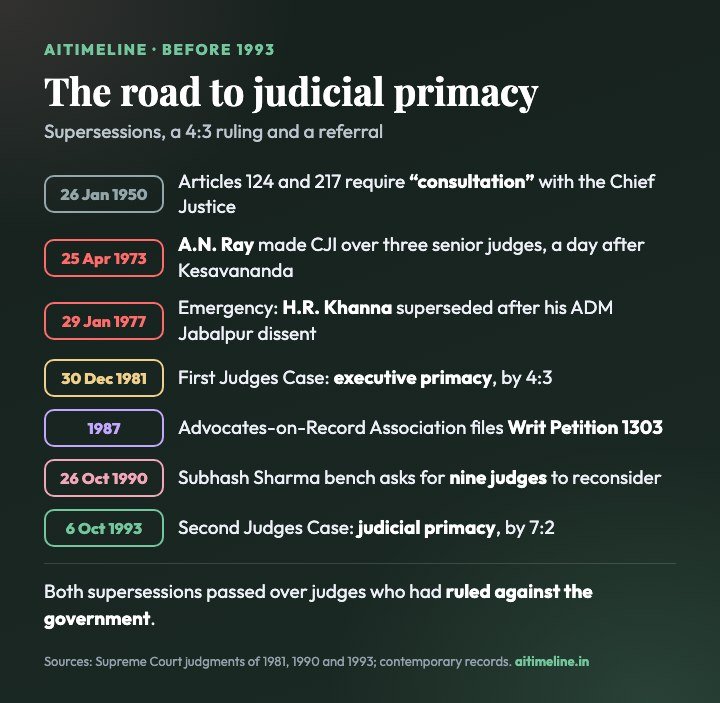
The Constitution left the key word, “consultation”, undefined. For two decades the senior-most judge simply became Chief Justice, until the government broke the convention twice: in April 1973, the day after Kesavananda Bharati, and again in January 1977, during the Emergency. In 1981 the First Judges Case confirmed that the executive could overrule the Chief Justice in appointments. Through the 1980s vacancies piled up, and in 1990 a bench led by Chief Justice Ranganath Misra said the 1981 ruling had to be looked at again by nine judges.
What the 1993 Judgment Held
Five principles from the majority, and the dissent.
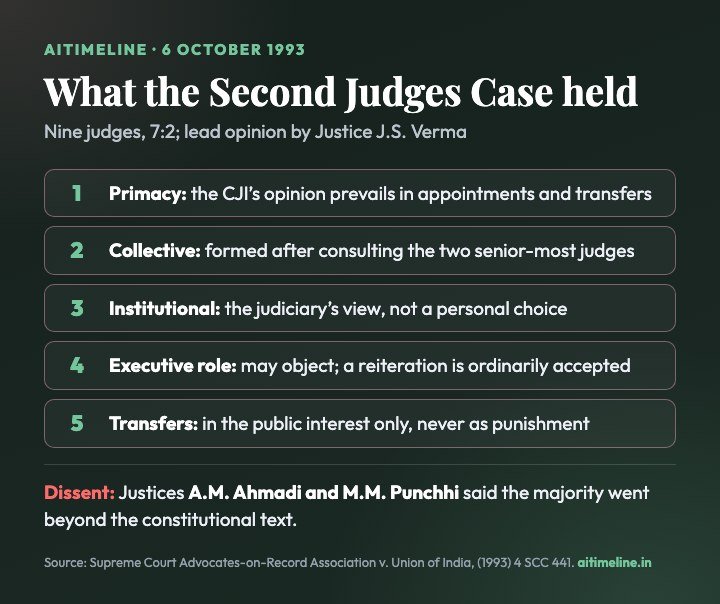
- Judicial primacy: in appointments and transfers, the opinion of the Chief Justice of India prevails over the executive’s.
- Collective consultation: the Chief Justice’s opinion must be formed after consulting the two senior-most judges of the Supreme Court; it is not a personal choice.
- Institutional view: the recommendation expresses the judiciary’s view as an institution.
- Executive role kept: the government can share information, raise objections and ask for reconsideration; a reiterated recommendation should ordinarily be accepted.
- Transfers: High Court judges can be transferred only in the public interest, never as punishment, and with the Chief Justice’s primacy.
- The dissent: Justices A.M. Ahmadi and M.M. Punchhi held that this went beyond the constitutional text and diminished the President’s role.
The majority’s reasoning rested on judicial independence as a basic feature of the Constitution. If the government, the largest litigant before the courts, could choose judges at will, it argued, independence would be at risk. The court also said seniority should carry due weight, a principle that has since shaped the choice of Chief Justices.
Timeline: The Collegium System, 1950 to 2026
Newest first. Colour shows which track each event belongs to.
Where things stand Judges Cases & rulings
Settled: Judicial primacy, created by the Second Judges Case on 6 October 1993 and shaped by the Third Judges Case in 1998, is still the law. The 2015 NJAC judgment struck down Parliament’s replacement, and a 2019 attempt to reopen the 1993 ruling was dismissed.
Not settled: The supplemented Memorandum of Procedure that the Supreme Court asked for in December 2015 has still not been publicly finalised. How much the collegium should disclose about its reasons, and how long the government may sit on its recommendations, remain live disputes.
New High Court recommendations Collegium at work
What happened: Statements dated 30 October 2026 recorded the collegium’s approval of five judicial officers for the Madhya Pradesh High Court and six names, four advocates and two judicial officers, for the Chhattisgarh High Court. Nine advocates were approved for the High Court of Jammu and Kashmir and Ladakh at a meeting reported as held on 29 October.
Why it matters: These are recommendations, not appointments. Each still needs the Union government to process and notify it, which is where many past delays have arisen.
Three new Supreme Court judges sworn in Collegium at work
What happened: Justices Sunita Agarwal, Devendra Kumar Upadhyaya and Aparesh Kumar Singh, until then Chief Justices of the Gujarat, Delhi and Telangana High Courts, took oath eight days after the collegium recommended them.
Why it matters: The quick notification showed the system working without friction. Justice Agarwal’s appointment took the number of women judges on the Supreme Court from two to three.
A “statement” instead of a reasoned resolution Transparency & reform
What happened: The collegium recommended the three High Court Chief Justices for the Supreme Court. It published a short statement, while the resolution setting out the candidates’ details stayed confidential, according to the Supreme Court Observer.
Why it matters: From 2017 the court had published resolutions that sometimes explained seniority, expertise and representation. The shorter format revived the old complaint that outsiders cannot see why one judge is chosen over another.
Researchers chart the collegium’s history Transparency & reform
What happened: The Supreme Court Observer published a history of the collegium tracing executive primacy in 1981, judicial primacy in 1993, the five-judge collegium of 1998 and the NJAC challenge of 2015.
Why it matters: The series argued that the lack of accessible data on collegium decisions is itself a barrier to judging how well the system works.
Surya Kant becomes Chief Justice of India Collegium at work
What happened: Justice Surya Kant was sworn in as Chief Justice of India, and with it took charge of the Supreme Court collegium.
Why it matters: Because membership follows seniority, each change of Chief Justice reshapes the collegium. Its composition, not any fixed rulebook, sets much of its approach to disclosure and pace.
Parliament asks about delayed recommendations Parliament, law & MoP
What happened: A starred question in the Rajya Sabha took up delays in notifying collegium recommendations. Government replies of this period described appointments under Articles 124, 217 and 224 as following the 1998 Memorandum of Procedure, and as a continuous, collaborative process between constitutional authorities.
Why it matters: The government has repeatedly declined to set a deadline for itself. Pending names sit between the collegium and the executive with no fixed time limit.
Collegium makes government objections public Collegium at work
What happened: The collegium published resolutions reiterating several names the government had returned, quoting and answering objections drawn from intelligence inputs, including in the case of senior advocate Saurabh Kirpal.
Why it matters: It was the most open the collegium had been about a dispute with the executive. The government objected to intelligence reports being made public.
Law Minister seeks a government nominee Parliament, law & MoP
What happened: Law Minister Kiren Rijiju wrote to the Chief Justice proposing that government nominees sit on committees that shortlist candidates, as part of the unfinished Memorandum of Procedure.
Why it matters: It followed months of public criticism, in which Rijiju called the collegium “alien” to the Constitution, and Supreme Court benches criticised the Centre for sitting on recommendations.
Government says the MoP is still under finalisation Parliament, law & MoP
What happened: Answering in the Rajya Sabha, the government described its correspondence with the Supreme Court collegium on the supplemented Memorandum of Procedure, released by the Press Information Bureau the same day.
Why it matters: More than six years after the 2015 order, the revised procedure was still not settled. Appointments continued under the 1998 version.
Review of the 1993 judgment dismissed Judges Cases & rulings
What happened: The court dismissed, in chambers, a review petition seeking to declare the Second Judges Case void and restore executive primacy. It cited an unexplained delay of 9,071 days and found no merit. The order became public in November 2019.
Why it matters: The dismissal left the 1993 judgment untouched. The brief we worked from placed this event in the 2000–2014 period; it belongs in 2019.
Four collegium judges go public Collegium at work
What happened: The four senior-most judges after the Chief Justice, all collegium members, publicly questioned how cases were allocated and referred to delay over the Memorandum of Procedure.
Why it matters: It showed that the collegium itself could be divided, and fed the argument that judicial self-governance needed clearer rules. Our Supreme Court judges’ press conference timeline covers the episode.
Collegium decides to publish its decisions Transparency & reform
What happened: The collegium resolved to upload its decisions on appointments, confirmations, elevations and transfers, with reasons, on the Supreme Court website, to ensure “transparency and yet maintain confidentiality”.
Why it matters: It was the first standing disclosure in 24 years of collegium appointments. Later practice narrowed it: in 2019 the court held that only final signed resolutions need be public.
Collegium finalises its view on the MoP Parliament, law & MoP
What happened: After a year of exchanges, the collegium settled its version of the supplemented Memorandum of Procedure. The government had sent its draft in 2016 and disagreed with parts of the collegium’s response, including on national security grounds for rejecting names.
Why it matters: Neither side accepted the other’s version as final, so the 1998 procedure stayed in force.
Court asks for a supplemented MoP Judges Cases & rulings
What happened: Having restored the collegium, the bench directed that the government finalise the Memorandum of Procedure in consultation with the Chief Justice, who would act on the unanimous view of the collegium. It listed eligibility criteria, transparency, a secretariat and a complaints mechanism as matters to cover.
Why it matters: The court accepted that the collegium needed reform even while defending it. The brief we worked from called this an invitation for suggestions; those were sought in November, and this was the resulting order.
NJAC struck down; collegium restored Judges Cases & rulings
What happened: Justices J.S. Khehar, Madan B. Lokur, Kurian Joseph and A.K. Goel held the 99th Amendment and the NJAC Act unconstitutional for breaching judicial independence, a basic feature. Justice J. Chelameswar dissented.
Why it matters: The system created in 1993 and 1998 was revived. Justice Kurian Joseph, while joining the majority, wrote that the collegium lacked “transparency, accountability and objectivity”. Our NJAC timeline covers the case in full.
NJAC comes into force Parliament, law & MoP
What happened: The government notified both laws, replacing the collegium with a six-member commission: the CJI, the two next senior judges, the Law Minister and two eminent persons.
Why it matters: For six months, the collegium formally ceased to exist. The Chief Justice declined to take part in the commission while the challenge was pending.
Parliament passes the NJAC amendment Parliament, law & MoP
What happened: Both Houses passed the 99th Amendment and the NJAC Bill by large majorities, and the amendment was ratified by more than half the state legislatures.
Why it matters: It was the first time Parliament directly set out to reverse the Judges Cases.
The Memorandum of Procedure Parliament, law & MoP
What happened: The government prepared a Memorandum of Procedure setting out the stages through which a recommendation moves: from the High Court collegium, through the state, to the Union government and the Supreme Court collegium, and back.
Why it matters: It is the working rulebook of the collegium system and is still cited by the government in Parliament.
Third Judges Case expands the collegium Judges Cases & rulings
What happened: Answering the President, the court said the Chief Justice must consult the four senior-most puisne judges for Supreme Court appointments and for transfers of High Court judges, and the two senior-most for High Court appointments. Recommendations made without that process would not bind the government.
Why it matters: This produced the five-member collegium known today. The brief we worked from said High Court transfers needed only two judges; the opinion requires four.
President K.R. Narayanan seeks the court’s opinion Executive action
What happened: After disputes over recommendations sent by the Chief Justice, the President referred nine questions on the meaning of consultation and the number of judges to be consulted.
Why it matters: The government did not seek to overturn the 1993 judgment; it asked the court to clarify it. That framing helped the court entrench the system.
The Second Judges Case Judges Cases & rulings
What happened: Justice J.S. Verma, for himself and Justices G.N. Ray, A.S. Anand, Yogeshwar Dayal and S.P. Bharucha, held that in appointments and transfers the Chief Justice’s opinion, formed after consulting the two senior-most judges, has primacy. Justices Kuldip Singh and S. Ratnavel Pandian concurred separately; Justices A.M. Ahmadi and M.M. Punchhi dissented.
Why it matters: It overruled S.P. Gupta and moved the decisive voice from the executive to the judiciary. The government could raise objections, but a recommendation reiterated by the Chief Justice and senior judges would ordinarily be accepted.
A smaller bench doubts S.P. Gupta Judges Cases & rulings
What happened: Hearing a petition about vacancies, the bench said the majority view in S.P. Gupta needed reconsideration and asked for a nine-judge bench on two questions: the Chief Justice’s primacy, and whether fixing judge strength could be challenged in court.
Why it matters: Only a larger bench could overrule a seven-judge decision. This order set up the 1993 hearing.
Advocates-on-Record Association goes to court Executive action
What happened: The association filed a writ petition over unfilled judicial vacancies and the appointment and transfer process.
Why it matters: The petition was later heard with others by the nine-judge bench, and gave the Second Judges Case its formal name.
The First Judges Case Judges Cases & rulings
What happened: Writing the lead opinion, Justice P.N. Bhagwati held that “consultation” with the Chief Justice did not mean his concurrence. The executive could disagree and had the final word, for “cogent reasons”.
Why it matters: Executive primacy became the law for 12 years. The judgment also opened up correspondence on appointments to scrutiny in court.
Justice Khanna superseded Executive action
What happened: The government passed over Justice H.R. Khanna, the senior-most judge, who had dissented in ADM Jabalpur in 1976 by holding that the right to life could not be suspended. Khanna resigned.
Why it matters: The second supersession in four years confirmed fears that the executive would reward or punish judges through appointments.
Three judges superseded Executive action
What happened: The government appointed Justice A.N. Ray over Justices J.M. Shelat, K.S. Hegde and A.N. Grover, who had been in the majority in Kesavananda Bharati. All three resigned.
Why it matters: It ended the convention that the senior-most judge becomes Chief Justice and began the argument that led to judicial primacy. See our Kesavananda Bharati timeline.
The Constitution says “consultation” Parliament, law & MoP
What happened: The Constitution provided that the President appoints Supreme Court judges after consultation with judges the President thinks necessary, always including the Chief Justice for judges other than the Chief Justice; High Court judges after consulting the CJI, the Governor and the High Court Chief Justice.
Why it matters: The word “consultation” was not defined. Every Judges Case is, at root, a fight over what it means.
1993 vs 1998: Who Sits in the Collegium
The single most common confusion about the collegium.
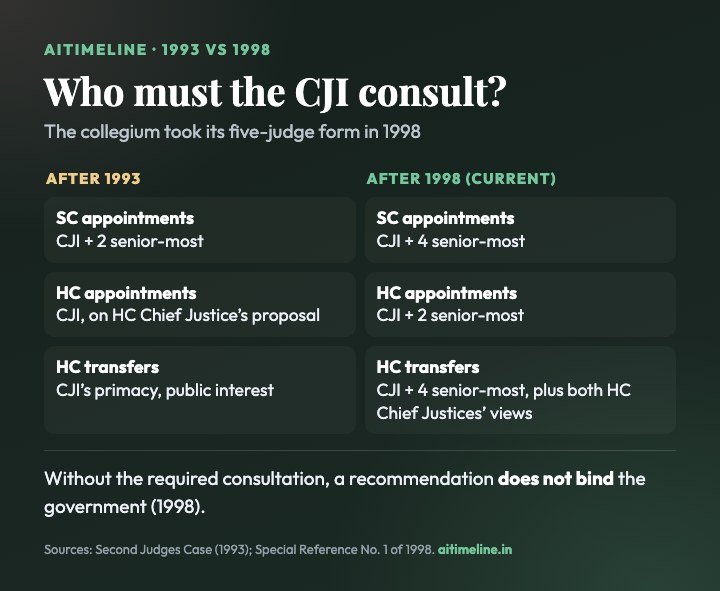
| Decision | After 1993 | After 1998 (current) |
|---|---|---|
| Supreme Court appointments | CJI + two senior-most judges | CJI + four senior-most puisne judges |
| High Court appointments | CJI, with the High Court Chief Justice’s proposal | CJI + two senior-most judges, after the High Court collegium’s proposal |
| High Court transfers | CJI’s primacy; public interest only | CJI + four senior-most judges, with views of both High Court Chief Justices |
| Status of a recommendation | Reiteration ordinarily binding | Not binding if made without the required consultation |
The brief we worked from said the 1998 opinion required only the two senior-most judges for High Court transfers. The opinion requires four. Two suffice for High Court appointments.
The NJAC Challenge, 2014–2015
Parliament’s attempt to replace the collegium, and why it failed.
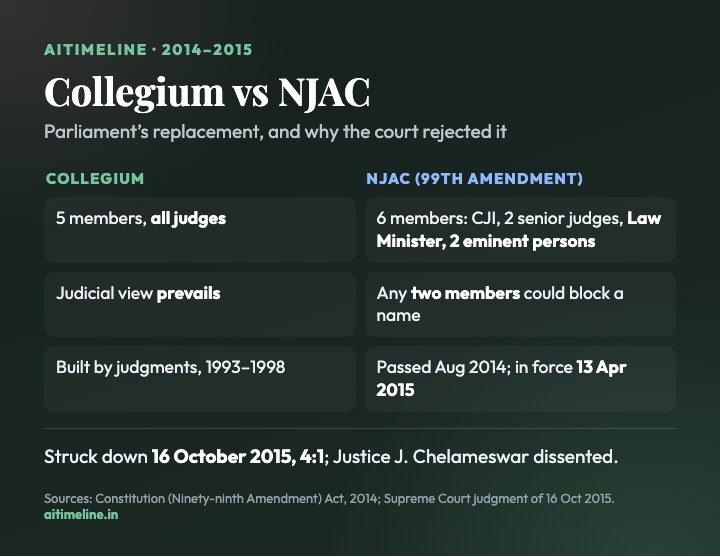
Parliament passed the 99th Amendment and the NJAC Act in August 2014 with near-unanimous support. The commission was to include the Law Minister and two “eminent persons” alongside three judges, and any two members could block a candidate. On 16 October 2015 the Supreme Court held 4:1 that this gave non-judicial members a capacity to override the judiciary that breached judicial independence. The majority restored the collegium; it did not say the collegium was beyond improvement, and soon ordered a revised procedure. For the full story see our NJAC timeline.
How the Collegium System Works Today
The stages a recommendation passes through under the 1998 Memorandum of Procedure.
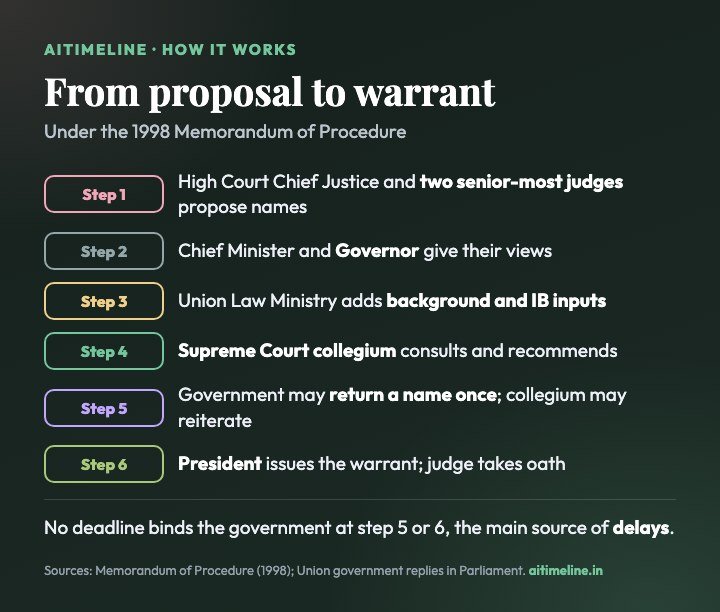
- Proposal: for a High Court, the Chief Justice and the two senior-most judges recommend names; for the Supreme Court, the collegium of the CJI and four senior-most judges considers candidates.
- State input: for High Court names, the Chief Minister and Governor give their views.
- Union input: the Law Ministry adds background material, including Intelligence Bureau reports, and forwards the file.
- Collegium decision: the Supreme Court collegium, after consulting judges familiar with the candidate’s court, makes its recommendation.
- Reconsideration: the government may send a name back once with reasons; the collegium may drop or reiterate it.
- Appointment: the President issues the warrant on the government’s advice, after which the judge takes oath.
There is no deadline for the government at the last stage, which is why delays remain the most frequent flashpoint between the executive and the judiciary.
Why the Collegium Is Controversial
Arguments for vs arguments against
- Independence: courts decide cases against the government, so the government should not pick judges.
- Expertise: serving judges know candidates’ work and conduct first-hand.
- History: the supersessions of 1973 and 1977 show what executive control can mean.
- Opacity: deliberations and selection criteria are not published.
- Accountability: no body outside the judiciary reviews its choices.
- Diversity and delay: limited representation and long vacancies.
The two sides agree on more than they admit. Defenders accept that the collegium should publish criteria and reasons; critics accept that any replacement must keep the judiciary’s decisive role. The 2015 order on the Memorandum of Procedure was meant to bridge that gap, and it is still unfinished. Questions about how judges are held to account, as in the Justice Yashwant Varma cash row, keep the debate alive.
Where Things Stand
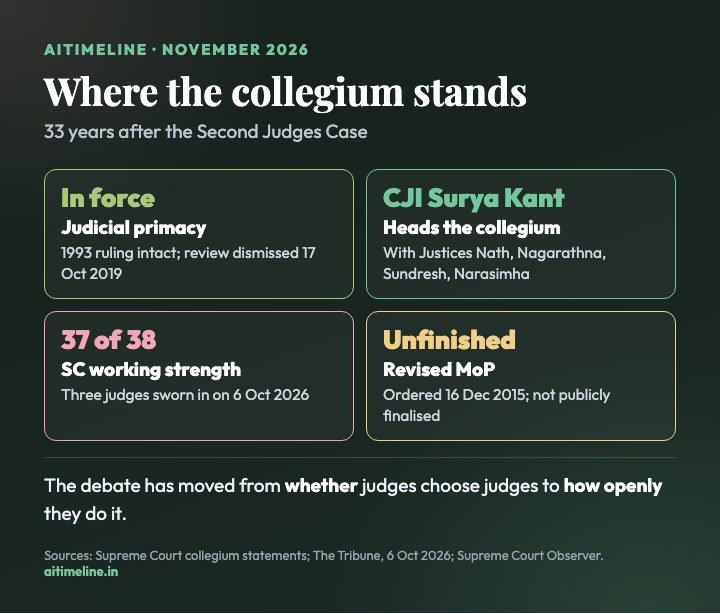
Thirty-three years after the Second Judges Case, the system it founded is fully in force. What has changed is the argument around it: from whether judges should choose judges to how openly and how quickly they should do so. Recommendations published on 28 September and 30 October 2026 show the collegium working at a steady pace, but the disclosure that began in 2017 has narrowed again.
Key People and Institutions
| Person or institution | Role |
|---|---|
| Justice J.S. Verma | Wrote the main majority opinion in the Second Judges Case; later Chief Justice |
| Justices A.M. Ahmadi and M.M. Punchhi | Dissented in 1993; both later became Chief Justice |
| Justice P.N. Bhagwati | Wrote the lead opinion in the 1981 First Judges Case |
| Chief Justice Ranganath Misra | Led the 1990 bench that sought a nine-judge reconsideration |
| Justice S.P. Bharucha | Part of the 1993 majority; wrote the 1998 advisory opinion |
| President K.R. Narayanan | Made the 1998 Presidential Reference |
| Justice J. Chelameswar | Sole dissent in the 2015 NJAC case |
| Supreme Court Advocates-on-Record Association | Lead petitioner in 1993 and 2015 |
| Chief Justice Surya Kant | Heads the collegium since 24 November 2025 |
Facts at a Glance
| Question | Answer |
|---|---|
| Formal name | Supreme Court Advocates-on-Record Association v. Union of India |
| Common name | Second Judges Case |
| Judgment date | 6 October 1993 |
| Citation | (1993) 4 SCC 441 |
| Bench and vote | Nine judges, 7:2 |
| Central issue | Meaning of “consultation” in appointments |
| Overruled | First Judges Case, 1981 |
| Collegium expanded | Third Judges Case, 28 October 1998 |
| Attempted replacement | NJAC, in force 13 April 2015 |
| NJAC struck down | 16 October 2015 |
| Review dismissed | 17 October 2019 |
Explore More Timelines
People Also Ask
Frequently Asked Questions
Based on the judgments and official records to 13 November 2026.
⚠️ Editorial Note
The Second Judges Case established judicial primacy and the principle of collective consultation; the five-member Supreme Court collegium took its present form after the Third Judges Case in 1998. The collegium is a judicially evolved system, not a mechanism written into the Constitution, and the 2015 judgment restored the pre-NJAC position. Checking the record, we corrected several points in the brief we worked from: the 1998 opinion requires the Chief Justice to consult four senior-most judges, not two, on High Court transfers; the review of the 1993 judgment was dismissed in 2019, not in the 2000–2014 period; and the court’s 16 December 2015 order directed a supplemented Memorandum of Procedure after suggestions had been invited in November. We added the 7:2 vote and the names of the majority and dissenting judges. We did not read the full text of the 2022 and 2024 parliamentary replies; we describe them by their subject and the government’s stated position in that period. This page is not legal advice.
Related Reading on AiTimeline
Sources & further reading
Every dated entry above was checked against these references. Last reviewed 13 November 2026.
- Supreme Court Advocates-on-Record Association v. Union of India (Second Judges Case), 6 October 1993
- S.P. Gupta v. Union of India (First Judges Case), 30 December 1981
- In re Special Reference No. 1 of 1998 (Third Judges Case), 28 October 1998
- Supreme Court Advocates-on-Record Association v. Union of India (NJAC judgment), 16 October 2015
- Collegium to upload its decisions on SC website (PTI, 6 October 2017)
- SC issues guidelines to improve collegium system; directs Centre to draft MoP (16 December 2015 order)
- SC dismisses review petition against judgment in Second Judges Case
- Stand of Government on appointment of judges, 21 March 2022
- Filling in the blanks | The Collegium story, part 2 (21 April 2026)
- From 'Resolution' to 'Statement' (4 October 2026)
- CJI Surya Kant administers oath of office to three newly appointed Supreme Court judges (6 October 2026)
- SC Collegium recommends 9 advocates as judges of Jammu & Kashmir and Ladakh High Court (30 October 2026)
- SC Collegium recommends 11 judicial officers and advocates for Chhattisgarh and Madhya Pradesh High Courts