JMM Bribery Case: A Timeline of India’s Political Controversy
Explore the JMM bribery case timeline: the 1993 no-confidence vote, the 1998 Supreme Court immunity ruling and its landmark reversal in Sita Soren, 2024.
Latest Story
On 28 July 1993 P.V. Narasimha Rao’s minority government survived a no-confidence motion by 14 votes. Three years later the CBI alleged that some of those votes had been bought, including the four votes of the Jharkhand Mukti Morcha. The JMM bribery case produced the first conviction of a former Prime Minister, an acquittal on appeal, and a 3:2 Supreme Court ruling in 1998 that MPs who took bribes and voted as paid could not be prosecuted. That ruling stood until 4 March 2024, when seven judges, hearing an appeal by Shibu Soren’s daughter-in-law, unanimously overturned it. This page follows the case from 1991 to November 2026.
Three different things happened in this case and they are easy to confuse. The allegations were made in CBI complaints and chargesheets from 1996; they were never finally proved against the MPs. The 1998 judgment was a ruling on constitutional immunity, not a finding that bribes were or were not paid. The 2002 acquittal of Rao and Buta Singh was a decision on the evidence. The 2024 judgment changed the law on immunity but did not reopen the 1993 case or decide anyone’s guilt. Where common accounts get a fact wrong, we say so in the entry and in the editorial note.
💡 Short Answer
The JMM bribery case concerns allegations that four Jharkhand Mukti Morcha MPs were paid to vote against a no-confidence motion that the Rao government survived on 28 July 1993, by 265 votes to 251. In 1998 the Supreme Court held 3:2 that bribe-taking MPs who voted were immune under Article 105(2). On 4 March 2024 a seven-judge bench unanimously overruled that, in Sita Soren v. Union of India.
JMM Bribery Case: Key Questions
The JMM Bribery Case in Ten Points
- The vote: on 28 July 1993 the Rao government survived a no-confidence motion, 265 votes to 251.
- The allegation: a February 1996 complaint said MPs had been paid to vote with the government.
- The accused: four JMM MPs, the Ajit Singh group, and alleged bribe-givers including Rao and Buta Singh.
- The approver: JMM MP Shailendra Mahto was pardoned in April 1997 and testified for the prosecution.
- The 1998 ruling: 3:2, bribe-taking MPs who voted were immune under Article 105(2).
- The exceptions: Ajit Singh, who abstained, and the bribe-givers had no immunity.
- The trial: Rao and Buta Singh were convicted in September 2000 and sentenced to three years.
- The appeal: the Delhi High Court acquitted both on 15 March 2002.
- The new case: JMM MLA Sita Soren was accused of taking a bribe in the 2012 Rajya Sabha poll.
- The reversal: on 4 March 2024 seven judges held there is no immunity for bribery at all.
From a Confidence Vote to a Constitutional Reversal
The whole case on one page, 1991 to 2026.
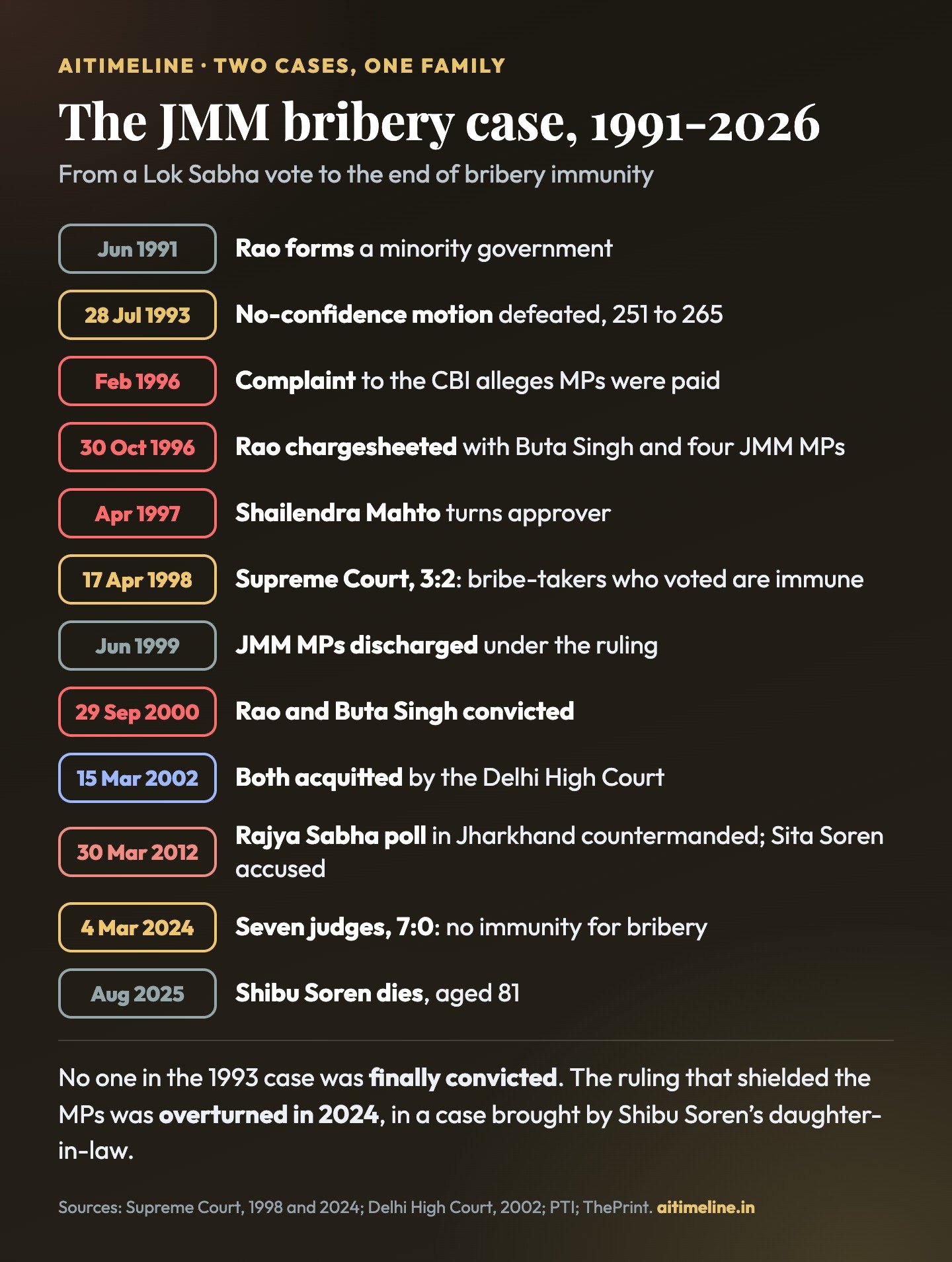
The JMM bribery case is really two cases, separated by almost twenty years and joined by one family. The first began with a vote in the Lok Sabha in 1993 and ended, for the MPs accused of taking money, with a Supreme Court ruling in 1998 that they could not be prosecuted at all. The second began with a Rajya Sabha poll in Jharkhand in 2012, when Shibu Soren’s daughter-in-law Sita Soren claimed the protection her father-in-law had received, and ended with the Supreme Court withdrawing it.
In between, the prosecution of the alleged bribe-givers ran its own course. P.V. Narasimha Rao, who had no immunity because he was accused of paying rather than taking, was convicted in 2000 and acquitted in 2002. No one in the 1993 case was finally convicted of anything.
The 1993 Vote
A minority government, a three-day debate and a margin of 14.
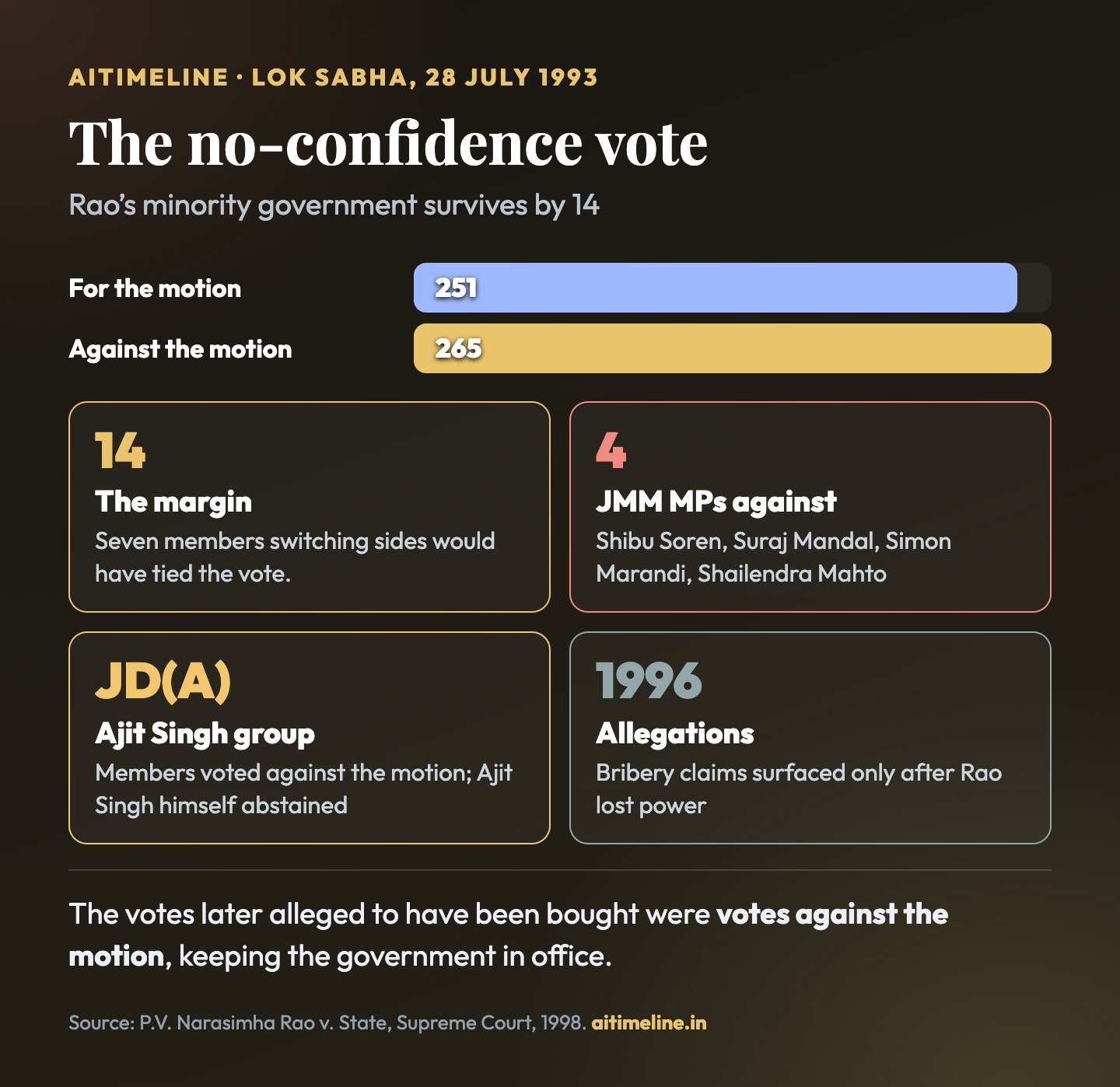
The Congress had won the most seats in 1991 but not a majority, and Rao governed with the help of smaller parties and breakaway groups. The no-confidence motion moved on 26 July 1993 was the most serious threat it faced. When the House divided on 28 July, 251 members voted for the motion and 265 against. The four JMM MPs and members of Ajit Singh’s Janata Dal group were among those who voted with the government; Ajit Singh himself abstained.
Nothing about the vote was challenged at the time. The allegation that some of those votes had been paid for surfaced only in 1996, after the Rao government had lost power.
The Investigation, 1996-1997
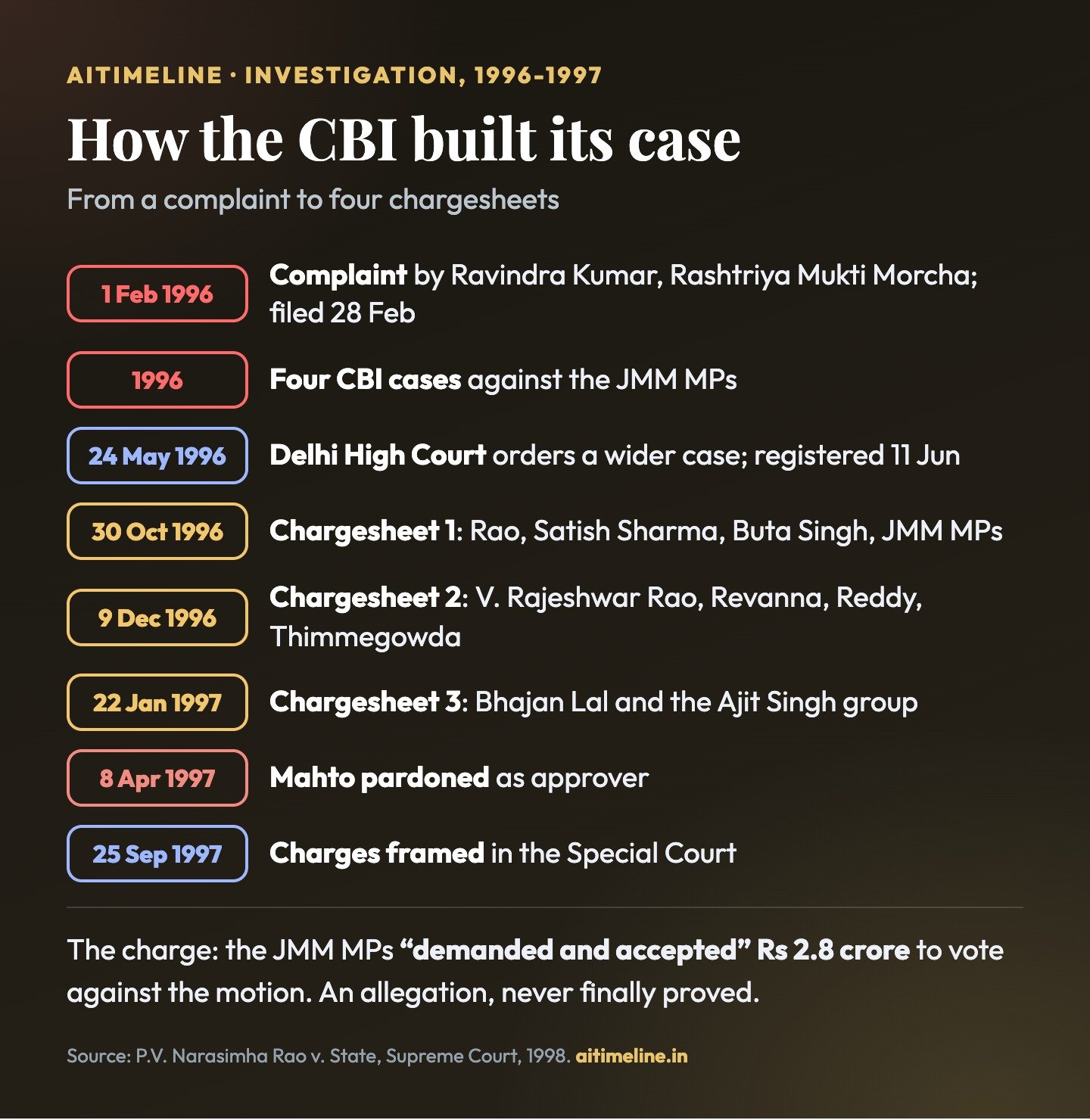
From a complaint to four chargesheets and an approver.
The case started with a complaint by Ravindra Kumar of the Rashtriya Mukti Morcha, dated 1 February 1996 and filed with the CBI on 28 February. It alleged that more than Rs 3 crore had been paid to MPs, of which Rs 1.10 crore went to JMM MP Suraj Mandal. The CBI registered four cases against the JMM MPs. In May 1996 the Delhi High Court ordered a wider case covering the alleged payers.
The first chargesheet, in October 1996, named Rao himself. Two supplementary chargesheets followed, and in April 1997 one of the four MPs, Shailendra Mahto, was pardoned in return for his testimony. The charges alleged that the JMM MPs had “demanded and accepted” Rs 2.8 crore.
The 1998 Ruling: Who Was Protected
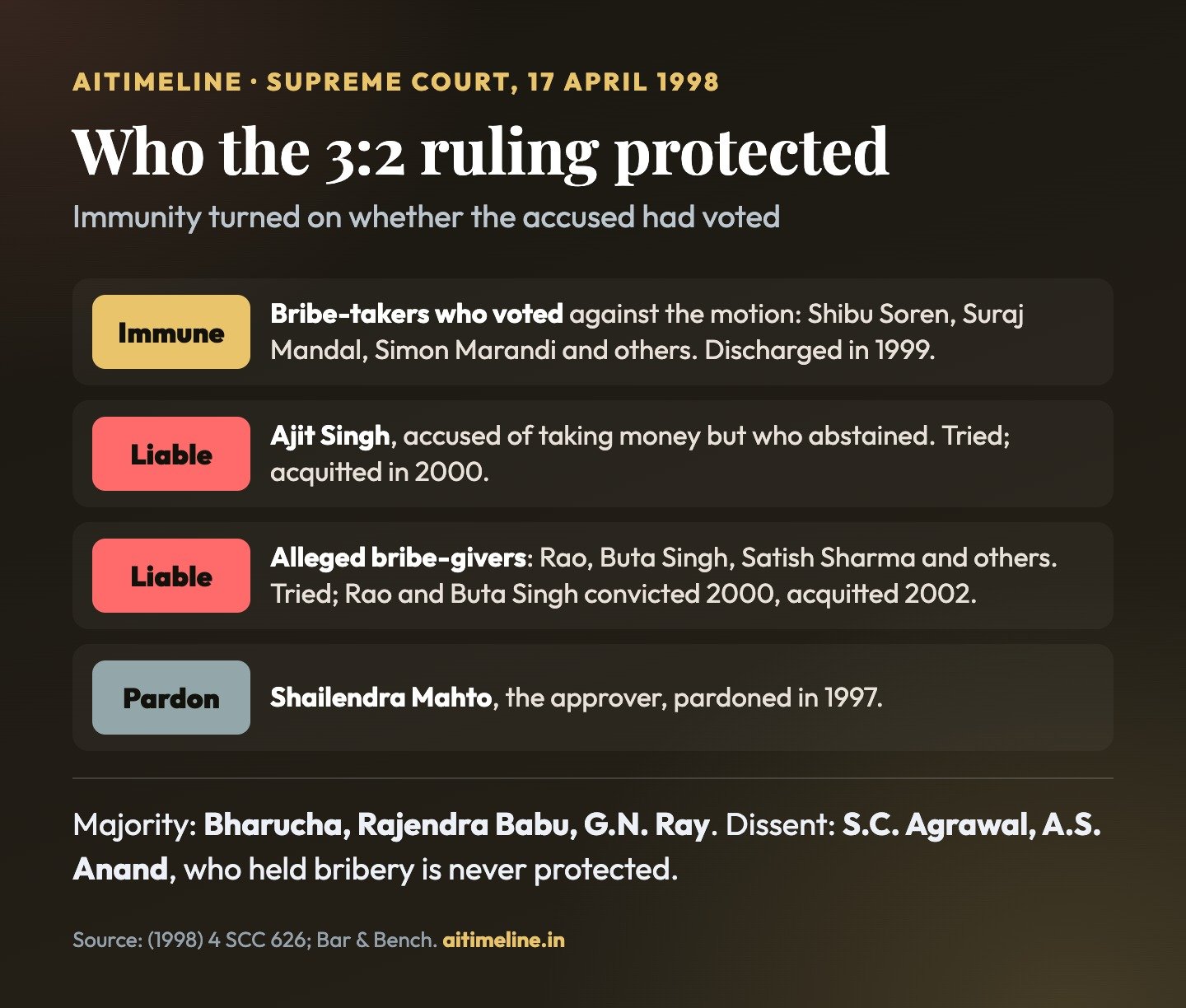
P.V. Narasimha Rao v. State (CBI/SPE), 17 April 1998.
The accused MPs argued that Article 105(2), which says no MP is liable to proceedings in any court “in respect of” any vote given in Parliament, protected them. The majority agreed. Justice S.P. Bharucha, writing for himself and Justice S. Rajendra Babu, with Justice G.N. Ray agreeing, held that because the alleged bribe was connected to the vote, the bribe-takers who voted were immune. “The charges against them must fail.”
The result was a set of distinctions that critics found hard to defend. An MP who took money and voted as paid was protected. Ajit Singh, accused of taking money but who abstained, was not. Nor were the people accused of paying. Justices S.C. Agrawal and A.S. Anand dissented: privilege, they said, protects what an MP does in the House, not a corrupt bargain made outside it.
Timeline: The JMM Bribery Case, 1991-2026
Newest first. Colour shows the strand: the 1993 vote, the investigation and trial, the Supreme Court, the Sita Soren case, or the aftermath.
Where things stand Aftermath
Settled: The constitutional question is closed. Since 4 March 2024, MPs and MLAs cannot use Articles 105(2) or 194(2) to escape prosecution for taking a bribe linked to a vote or speech in the House. The 1998 majority view no longer stands.
Not reopened: The 1993 prosecution is over. The JMM MPs were discharged in 1999, P.V. Narasimha Rao and Buta Singh were acquitted on appeal in 2002, and most of the main figures, including Rao, Buta Singh, Ajit Singh and Shibu Soren, have since died. The 2024 ruling did not revive any of those charges.
Still running: The 2012 Rajya Sabha case against Sita Soren, which produced the 2024 judgment, is back before the Special CBI Court in Ranchi. We found no reported verdict in it.
Shibu Soren dies Aftermath
What happened: JMM founder Shibu Soren, one of the four MPs at the centre of the 1993 allegations, died after a long illness. He was the father-in-law of Sita Soren, whose own case ended the immunity that had shielded him.
His case: He was discharged in the JMM bribery case in 1999 because of the 1998 immunity ruling. ThePrint, reporting his death, noted that his own family’s litigation undid the ruling that had protected him.
Sita Soren loses Jamtara Aftermath
What happened: Contesting the Jamtara assembly seat for the BJP, Sita Soren lost to Congress’s Irfan Ansari by 43,676 votes, according to Election Commission results. The JMM-led alliance won the state.
Context: It was her second defeat of 2024 after leaving the JMM in March, days after the Supreme Court ruling in her case.
High Court quashes the case against the candidate Sita Soren case
What happened: Justice Rajesh Kumar quashed the criminal proceedings against Raj Kumar Agarwal, the independent Rajya Sabha candidate accused of paying bribes in 2012, because an income-tax appellate order had deleted the Rs 1.5 crore addition on which much of the money trail rested. The court said the chance of conviction was “very bleak”.
The trial: The order records that charges were framed in the Special CBI Court on 14 February 2014 and that, by CBI’s account, 85 of 114 prosecution witnesses had been examined. The proceedings against the other accused, including Sita Soren, were not quashed.
Defeat in Dumka Aftermath
What happened: Fielded by the BJP in Dumka, the seat her father-in-law had held for decades, Sita Soren lost to the JMM’s Nalin Soren by 22,527 votes.
Why it matters: The litigant whose appeal ended legislative immunity for bribery had by then switched parties. The case itself continued regardless of her political affiliation.
Sita Soren joins the BJP Aftermath
What happened: Days after the Supreme Court decided the reference in her case, Sita Soren, the widow of Shibu Soren’s elder son Durga Soren, resigned from the JMM and joined the BJP ahead of the Lok Sabha election.
Why it matters: The case is still against her personally. Changing parties has no legal effect on a prosecution under the Prevention of Corruption Act.
Seven judges overrule the 1998 judgment Supreme Court
The bench: Chief Justice D.Y. Chandrachud wrote for a unanimous bench with Justices A.S. Bopanna, M.M. Sundresh, P.S. Narasimha, J.B. Pardiwala, Sanjay Kumar and Manoj Misra. “We disagree with and overrule the judgment of the majority on this aspect,” the Court said of P.V. Narasimha Rao.
The holding: A legislator cannot claim immunity under Articles 105 or 194 from prosecution for bribery in connection with a vote or speech. Such a claim fails the Court’s two-fold test: privilege must be tied to the collective functioning of the House and necessary to a legislator’s essential duties. Taking a bribe is neither.
When the offence is complete: “The offence of bribery is complete at the point in time when the legislator accepts the bribe.” It does not matter whether the vote is later cast as agreed, or cast at all. The Court called the 1998 outcome “paradoxical”: an MP who took money and delivered was protected, while one who took money and did not was not.
What it did not decide: The Court expressly did not rule on whether Sita Soren committed the offence. It held that voting in a Rajya Sabha election is covered by Article 194(2), but that the privilege does not extend to bribery.
Bharat Ratna for Narasimha Rao Aftermath
What happened: The government announced the Bharat Ratna, India’s highest civilian honour, for P.V. Narasimha Rao, chiefly for the 1991 economic reforms.
The connection: Rao was the only Prime Minister to be convicted in a criminal case, in the JMM bribery case in 2000, before his acquittal in 2002. Less than a month after the award, the Supreme Court overruled the judgment that bears his name.
Seven-judge bench reserves judgment Supreme Court
What happened: After hearing arguments, the seven-judge bench headed by Chief Justice Chandrachud reserved its verdict. The Union government, through the Attorney General and Solicitor General, argued that bribery was never protected by privilege.
The live issue: The Attorney General also argued that Rajya Sabha elections fall outside Article 194(2) altogether. The Court later rejected that point while still ruling against immunity for bribery.
Five judges refer the question to seven Supreme Court
What happened: A five-judge bench recorded prima facie doubts about the correctness of the 1998 majority view and referred the question to a seven-judge bench, the only size of bench able to overrule a five-judge decision.
Why it matters: This was the first time since 1998 that the Court formally reopened the immunity question.
Three judges point to the 1998 precedent Supreme Court
What happened: A three-judge bench found that the precise question had already been decided in the 1998 P.V. Narasimha Rao judgment, and called it a matter of “substantial public importance”.
The result: Because only a larger bench could reconsider a five-judge ruling, the bench referred the matter to a five-judge Constitution Bench.
Sita Soren’s appeal sent to a larger bench Supreme Court
What happened: A two-judge bench hearing Sita Soren’s appeal against the High Court ruling found the issue “substantial and of general public importance” and placed it before a bench of three judges.
Custody: She had surrendered in the trial court in February 2014 and spent about seven months in jail. The Jharkhand High Court granted her bail in September 2014.
Jharkhand High Court refuses to quash Sita Soren case
What happened: The Jharkhand High Court declined to quash the chargesheet against Sita Soren. Applying the 1998 judgment, it held that she was not protected because she had not voted for the alleged bribe-giver.
The irony: Under the 1998 rule, a legislator who took money and voted as paid was immune; one who took money and voted the other way was not. That was the gap the Supreme Court later called paradoxical.
CBI takes over the Rajya Sabha case Sita Soren case
What happened: On 5 April 2012 the Jharkhand High Court transferred the investigation to the CBI, which registered its case on 19 April 2012. The charges were under Sections 7 and 13 of the Prevention of Corruption Act and Sections 120B and 171E of the IPC. The Special Judge took cognisance on 7 June 2013.
The accused: Those charged included Sita Soren, candidate Raj Kumar Agarwal, her father-in-law Badnaran Majhi and others.
A Rajya Sabha poll is countermanded Sita Soren case
What happened: Hours before polling, income-tax officials and police seized Rs 2.15 crore from a vehicle on the NH-33 ring road near Namkum, Ranchi. Sita Soren, a JMM MLA, was later accused of accepting money to vote for the independent candidate Raj Kumar Agarwal.
How she voted: In the open ballot she did not vote for him. She voted for her own party’s candidate, Sanjiv Kumar. The Election Commission countermanded the poll and a fresh election was held, in which she again voted for her party’s candidate.
Narasimha Rao dies Aftermath
What happened: P.V. Narasimha Rao died at 83, less than three years after the Delhi High Court acquitted him in the JMM bribery case.
His record: He remained the only Prime Minister ever convicted in a criminal case, though that conviction did not survive appeal. Buta Singh died on 2 January 2021 and Ajit Singh on 6 May 2021.
Delhi High Court acquits Rao and Buta Singh Investigation & trial
The order: “I allow Crl.A. 638 of 2000 and Crl.A. 621 of 2000, set aside the judgment of conviction and sentence of the Special Judge dated 29.9.2000 and 12.10.2000 and acquit the appellants of all charges.”
Why: The case against them rested on approver Shailendra Mahto, whose statements the defence showed to be inconsistent. The High Court found his evidence unreliable without independent corroboration.
The others: The same order dismissed the Rashtriya Mukti Morcha’s revision petition challenging the acquittal of Satish Sharma, V. Rajeshwar Rao, H.M. Revanna, Ramalinga Reddy, M. Veerappa Moily, D.K. Audikesavulu, M. Thimme Gowda, Bhajan Lal and Ajit Singh.
Three years’ rigorous imprisonment Investigation & trial
What happened: The Special Judge sentenced Rao and Buta Singh to three years’ rigorous imprisonment and a fine under the conspiracy and corruption charges, the sentences to run concurrently.
The appeal: Buta Singh’s appeal was admitted by the Delhi High Court on 18 October 2000. Rao appealed too.
Rao and Buta Singh convicted Investigation & trial
What happened: Special Judge Ajit Bharihoke convicted P.V. Narasimha Rao and Buta Singh of criminal conspiracy and abetment of bribery under the Prevention of Corruption Act. “Rao, Buta convicted in JMM bribery case,” The Tribune reported.
Acquitted: The court acquitted the other accused tried with them, including Satish Sharma, Bhajan Lal and Ajit Singh. Reporting at the time said the approver’s evidence was corroborated against Rao and Buta Singh only.
The JMM MPs are discharged Investigation & trial
What happened: Following the Supreme Court ruling, the trial court dropped the conspiracy and corruption charges against the JMM MPs and others protected by the immunity. A separate perjury charge under Section 193 IPC against Suraj Mandal, Shibu Soren and Simon Marandi was sent to another court.
What it meant: The discharge followed from the constitutional ruling. It was not a finding that no money had changed hands.
Review petition dismissed Supreme Court
What happened: A CBI review petition against the April 1998 judgment, filed on 12 November 1998, was dismissed on 16 December 1998. Special leave petitions in the case were disposed of in May 1999.
Effect: The 3:2 ruling became binding precedent, and it stayed that way for more than 25 years.
The Supreme Court’s 3:2 immunity ruling Supreme Court
The majority: Justice S.P. Bharucha, for himself and Justice S. Rajendra Babu, with Justice G.N. Ray agreeing, held that MPs who allegedly took bribes and then voted against the motion were protected by Article 105(2). “The charges against them must fail.”
The exceptions: Ajit Singh, who abstained, was not protected: “not having cast a vote on the no-confidence motion, [he] derives no immunity from Article 105(2).” The alleged bribe-givers, including Rao, were not protected either.
The dissent: Justice S.C. Agrawal, for himself and Justice A.S. Anand, held that there is no immunity for bribe-takers or bribe-givers, that an MP is a public servant under the Prevention of Corruption Act, and that prosecutors should seek the Speaker’s or Chairman’s permission before filing a chargesheet.
Referred to a Constitution Bench Supreme Court
What happened: The accused challenged the charges in the Supreme Court. A three-judge bench sent two questions to a five-judge Constitution Bench: whether Article 105 gives MPs immunity from prosecution for bribery linked to their votes, and whether an MP is a “public servant” under the Prevention of Corruption Act, 1988.
Why it mattered: If either answer favoured the MPs, the prosecution of the bribe-takers would collapse.
Charges framed Investigation & trial
What happened: On 6 May 1997 the Special Judge held there was “sufficient evidence on record to justify framing of charges” against Rao and the other accused. The charges were formally framed on 25 September 1997.
The charges: Conspiracy under Section 120B IPC and offences under the Prevention of Corruption Act, 1988. The JMM MPs were charged with having “demanded and accepted” Rs 280 lakh, Rs 2.8 crore, to vote against the motion.
Shailendra Mahto turns approver Investigation & trial
What happened: Mahto, one of the four JMM MPs, applied for a pardon in March 1997 and made a statement before a magistrate. On 8 April 1997 the court granted him a conditional pardon in return for testifying for the prosecution.
Why it mattered: His evidence became the core of the case. It persuaded the trial court in 2000 and failed to persuade the High Court in 2002.
Bhajan Lal and the Ajit Singh group charged Investigation & trial
What happened: The CBI’s second supplementary chargesheet named former Haryana Chief Minister Bhajan Lal and members of the Janata Dal (Ajit) group, including Ajit Singh and MPs such as Ram Lakhan Singh Yadav and Roshan Lal.
The allegation: That members of Ajit Singh’s breakaway group were also paid to help the government survive.
Supplementary chargesheet Investigation & trial
What happened: The CBI named V. Rajeshwar Rao, N.M. Revanna, Ramalinga Reddy and M. Thimmegowda, alleging they had arranged funds and paid the JMM MPs.
Later accused: M. Veerappa Moily and D.K. Audikesavulu were also among the accused acquitted at trial in 2000.
First chargesheet names the Prime Minister Investigation & trial
What happened: The CBI chargesheeted P.V. Narasimha Rao (accused No. 1), Satish Sharma, the four JMM MPs and Buta Singh. By then Rao was no longer Prime Minister, having resigned after the Congress lost the May 1996 election.
The allegation: That Rao, Satish Sharma and Buta Singh conspired to pay the JMM MPs to vote against the no-confidence motion, and that the MPs accepted the money.
High Court orders a wider case Investigation & trial
What happened: On 24 May 1996 the Delhi High Court, hearing a writ petition, ordered the CBI to register a case on the wider conspiracy. The CBI registered it on 11 June 1996.
Why it mattered: It moved the investigation from the MPs who allegedly took money to the people alleged to have paid it, including the Prime Minister.
A complaint reaches the CBI Investigation & trial
What happened: Ravindra Kumar of the Rashtriya Mukti Morcha complained that MPs had been paid to vote against the 1993 motion, alleging payments of over Rs 3 crore, of which Rs 1.10 crore was handed to Suraj Mandal.
The cases: The CBI registered four cases under the Prevention of Corruption Act against the JMM MPs Suraj Mandal, Shibu Soren, Simon Marandi and Shailendra Mahto.
The government survives by 14 votes The 1993 vote
The result: The no-confidence motion was lost, “251 members having voted in support and 265 against”, as the Supreme Court later recorded.
The swing votes: The four JMM MPs, Shibu Soren, Suraj Mandal, Simon Marandi and Shailendra Mahto, and members of the Janata Dal (Ajit) group voted against the motion. Ajit Singh himself abstained.
The no-confidence motion The 1993 vote
What happened: A motion of no confidence was moved in the Lok Sabha against Rao’s minority government, and debated over three days.
The stakes: Rao’s Congress did not have a majority of its own. The vote of every small group, including the JMM, mattered.
A minority government The 1993 vote
What happened: After the 1991 general election, held in the shadow of Rajiv Gandhi’s assassination, the Congress emerged as the single largest party and formed a minority government with P.V. Narasimha Rao as Prime Minister.
Why it matters: A government short of a majority depends on smaller parties and defectors. That dependence is the background to the 1993 vote.
Trial and Acquittal, 2000-2002
The prosecution of the alleged bribe-givers.
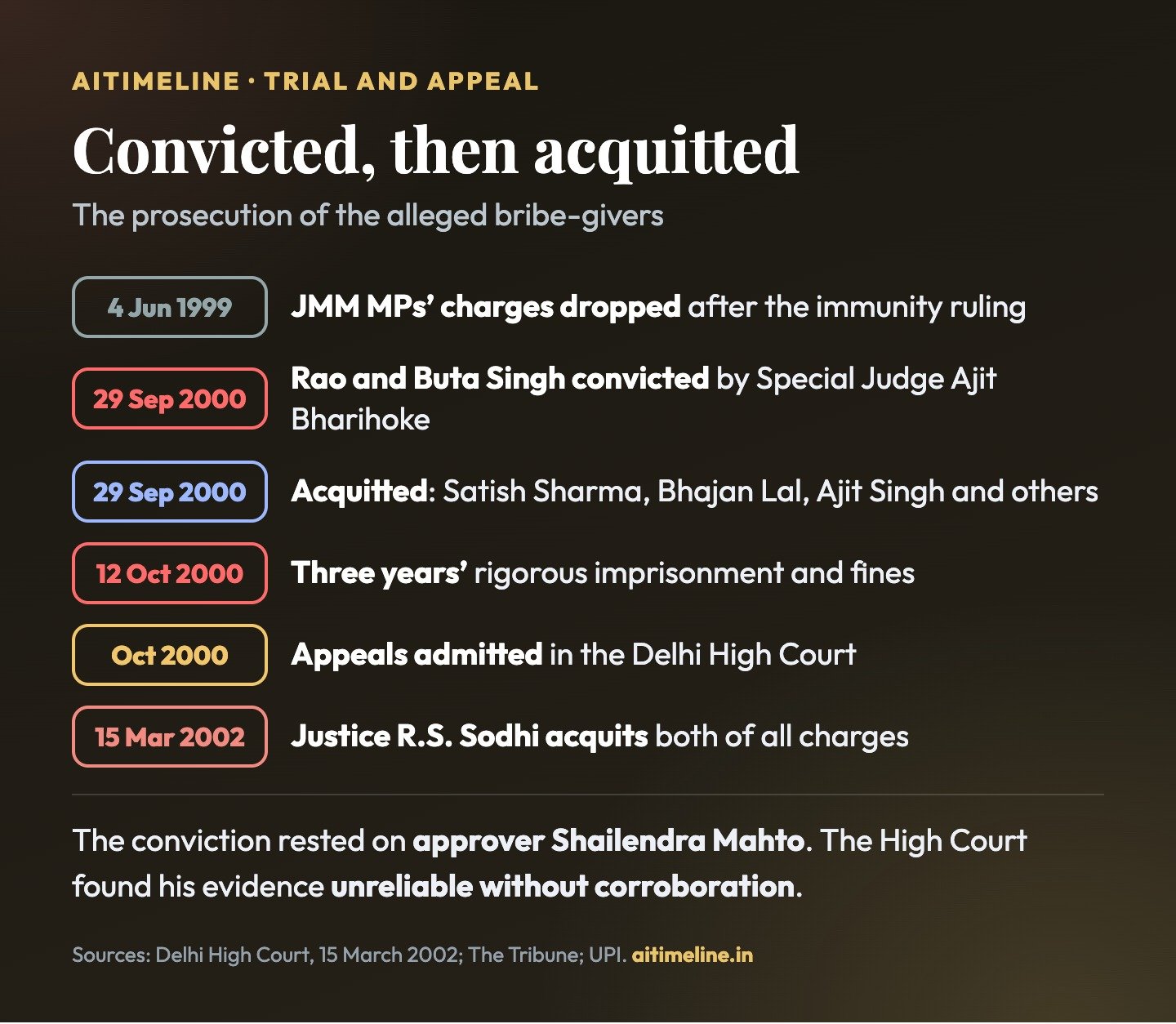
With the JMM MPs discharged, the trial in the Special CBI Court in Delhi went ahead against those the 1998 ruling did not protect. On 29 September 2000 Special Judge Ajit Bharihoke convicted Rao and Buta Singh, the first criminal conviction of a former Prime Minister, and acquitted the others, including Satish Sharma, Bhajan Lal and Ajit Singh. On 12 October he sentenced Rao and Buta Singh to three years’ rigorous imprisonment.
The conviction rested largely on the evidence of approver Shailendra Mahto. On appeal, Justice R.S. Sodhi of the Delhi High Court found that evidence unreliable and, on 15 March 2002, acquitted both men of all charges. He also dismissed the Rashtriya Mukti Morcha’s challenge to the other acquittals.
The Sita Soren Case, 2012-2024
How a Rajya Sabha poll in Jharkhand reopened the 1998 ruling.
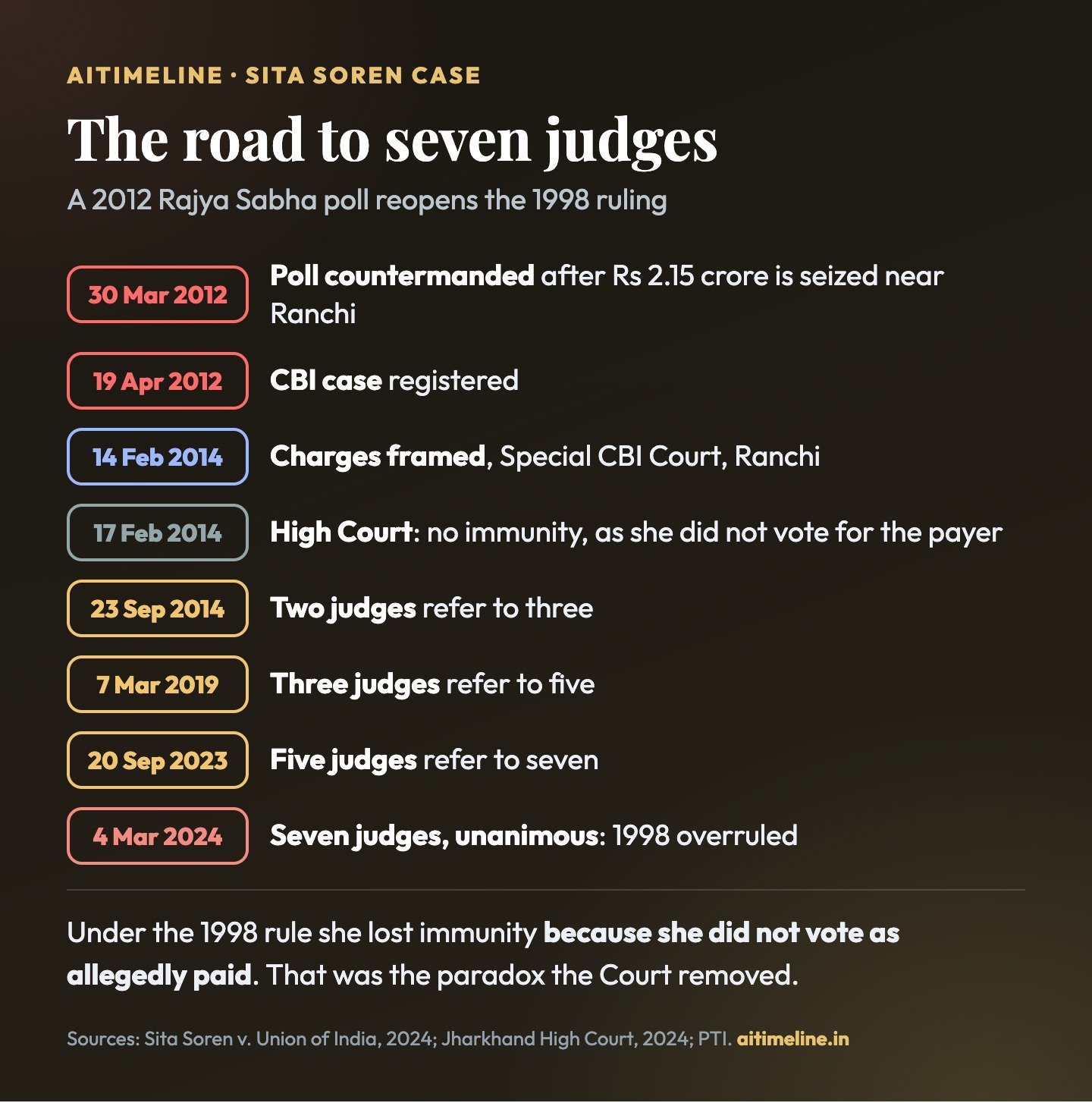
On 30 March 2012, as Jharkhand’s MLAs voted for two Rajya Sabha seats, income-tax officials and police seized Rs 2.15 crore from a vehicle near Ranchi. The Election Commission countermanded the poll. The CBI later charged JMM MLA Sita Soren with accepting money to vote for the independent candidate Raj Kumar Agarwal. The open ballot showed she had not voted for him.
That fact cut against her. Applying the 1998 judgment, the Jharkhand High Court held in February 2014 that immunity covered only a legislator who voted in the way connected with the bribe, so she had none. Her appeal moved up through benches of two, three and five judges until, in September 2023, a seven-judge bench was set up to reconsider the 1998 ruling itself.
What the Supreme Court Changed in 2024
The 1998 majority view against the 2024 judgment.
| Question | 1998: P.V. Narasimha Rao (3:2) | 2024: Sita Soren (7:0) |
|---|---|---|
| MP takes a bribe and votes as agreed | Immune under Article 105(2) | No immunity; can be prosecuted |
| Legislator takes a bribe but abstains or votes otherwise | Not immune (Ajit Singh; applied to Sita Soren in 2014) | No immunity; offence complete on acceptance |
| Person who pays the bribe | Not immune | Not immune |
| Test for privilege | Anything “in respect of” the vote, read broadly | Tied to the House’s functioning and necessary to a legislator’s duties |
| Rajya Sabha polls by MLAs | Not addressed | Covered by Article 194(2), but not for bribery |
| House discipline and criminal courts | Prosecution of voting MPs barred | Both can act, in distinct spheres |
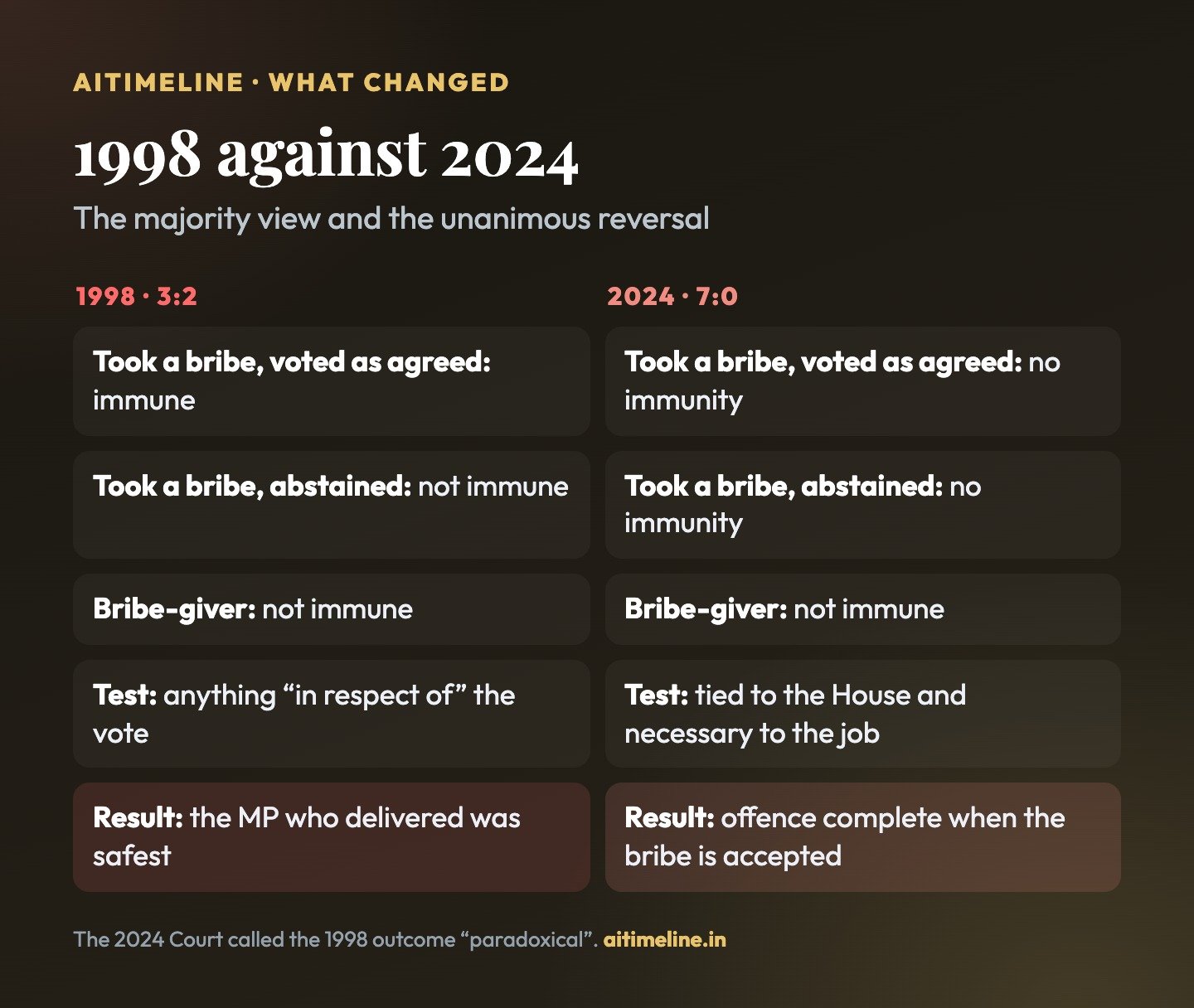
The core of the 2024 judgment is a change in the question asked. In 1998 the majority asked whether the bribe was connected to the vote. In 2024 the Court asked whether protecting the conduct was necessary for the House to function and for the member to do their job. A bribe, it held, is “agnostic to the performance of the agreed action”: the crime is complete when the money is accepted, so it cannot depend on what happens later in the House.
Why the JMM Bribery Case Still Matters
It defined the limits of privilege. Parliamentary privilege exists to let legislators speak and vote without fear. The 2024 Court held that it was never meant to place them above the criminal law on corruption.
It ended a perverse incentive. Under the 1998 rule, a legislator who took money was safer if they delivered the vote than if they did not. The Court named this the central flaw.
It extends to every House. The same rule now applies to MPs under Article 105 and to state legislators under Article 194, including MLAs voting in Rajya Sabha elections, where allegations of cross-voting for money recur.
It did not deliver a verdict on 1993. No one in the original case was finally convicted. The ruling changed the law long after the people it would have applied to had been discharged, acquitted or had died.
Key People
| Person | Role |
|---|---|
| P.V. Narasimha Rao | Prime Minister 1991-96; accused as a bribe-giver; convicted 2000, acquitted 2002; died 2004 |
| Buta Singh | Former Union minister; convicted with Rao in 2000, acquitted in 2002 |
| Satish Sharma | Congress leader; chargesheeted in 1996, acquitted at trial in 2000 |
| Shibu Soren | JMM founder and MP; discharged in 1999 under the immunity ruling; died 2025 |
| Suraj Mandal, Simon Marandi | JMM MPs; discharged in 1999 under the immunity ruling |
| Shailendra Mahto | JMM MP who turned approver in 1997 |
| Ajit Singh | Janata Dal (Ajit) leader; abstained, so not immune; acquitted in 2000 |
| Ravindra Kumar | Rashtriya Mukti Morcha convener whose 1996 complaint began the case |
| Sita Soren | JMM MLA accused over the 2012 Rajya Sabha poll; her appeal led to the 2024 ruling |
| Justice S.P. Bharucha / Justice S.C. Agrawal | Wrote the 1998 majority and dissent |
| Chief Justice D.Y. Chandrachud | Wrote the unanimous 2024 judgment |
Key Dates at a Glance
| Milestone | Date |
|---|---|
| No-confidence motion defeated | 28 July 1993 |
| Complaint to the CBI | Dated 1 February 1996; filed 28 February 1996 |
| First chargesheet | 30 October 1996 |
| Mahto pardoned as approver | 8 April 1997 |
| Charges framed | 25 September 1997 |
| Supreme Court 3:2 ruling | 17 April 1998 |
| JMM MPs discharged | 4 June 1999 |
| Rao and Buta Singh convicted / sentenced | 29 September / 12 October 2000 |
| Delhi High Court acquittal | 15 March 2002 |
| Jharkhand Rajya Sabha poll | 30 March 2012 |
| Jharkhand High Court refuses to quash | 17 February 2014 |
| Reference to seven judges | 20 September 2023 |
| Seven-judge judgment | 4 March 2024 |
Explore More Timelines
People Also Ask
Frequently Asked Questions
Based on the 1998 and 2024 Supreme Court judgments, the 2002 Delhi High Court and 2024 Jharkhand High Court orders, and reporting to 15 November 2026.
⚠️ Editorial Note: What We Corrected and What We Could Not Confirm
This page separates allegations in the CBI’s complaints and chargesheets from judicial findings. The 1998 judgment decided immunity, not whether bribes were paid; the 2002 acquittal was on the evidence; the 2024 judgment changed the law but did not reopen the 1993 case or decide Sita Soren’s guilt. Several details in common accounts are wrong. The complaint that began the case was dated 1 February 1996 and filed with the CBI on 28 February 1996; we found no 1994 newspaper report as the starting point. The 9 December 1996 supplementary chargesheet named V. Rajeshwar Rao, N.M. Revanna, Ramalinga Reddy and M. Thimmegowda; M. Veerappa Moily was among those acquitted in 2000, but the Supreme Court’s account does not place him in that chargesheet. Charges were ordered on 6 May 1997 and framed on 25 September 1997. The matter went to the Constitution Bench on 9 December 1997, not in November. The sentence was pronounced on 12 October 2000. In 2014 the two-judge bench referred Sita Soren’s appeal to three judges. We could not confirm the exact dates of the CBI’s first four case registrations, the arrests of the JMM MPs, a public admission by Shailendra Mahto in February 1996, or the date of the Delhi High Court’s 1997 revision order, so we do not give them. As of 15 November 2026 we found no reported verdict in the Sita Soren trial.
Related Reading on AiTimeline
Sources & further reading
Every dated entry above was checked against these references. Last reviewed 15 November 2026.
- Indian Kanoon: Sita Soren v. Union of India, Supreme Court seven-judge bench (4 March 2024), 2024 INSC 161
- Indian Kanoon: P.V. Narasimha Rao v. State (CBI/SPE), Supreme Court (17 April 1998), (1998) 4 SCC 626
- Indian Kanoon: P.V. Narasimha Rao v. State through CBI, Delhi High Court (15 March 2002)
- Indian Kanoon: Raj Kumar Agarwal v. Union of India through CBI, Jharkhand High Court (21 August 2024)
- Bar & Bench: What did the 1998 Supreme Court judgment in the P.V. Narasimha Rao case say? (4 March 2024)
- Siasat / PTI: SC ends lawmakers' immunity on taking bribes, a chronology of events (4 March 2024)
- ThePrint: An SC verdict shielded Shibu Soren in JMM bribery case of 1990s, but his own family undid the ruling (5 August 2025)
- The Tribune: Rao, Buta convicted in JMM bribery case (30 September 2000)
- UPI: Ex-Indian PM gets jail in vote-buying scandal (12 October 2000)
- Wikipedia: Sita Soren v. Union of India