Maneka Gandhi: Tracing Her Political Journey in India
Maneka Gandhi's political journey from the Rashtriya Sanjay Manch and Janata Dal to the BJP, Union ministries, animal welfare and the 2024 election.
Latest Story
Few Indian politicians have changed sides as often, or held on as long, as Maneka Gandhi. She entered public life in 1974 as the daughter-in-law of Prime Minister Indira Gandhi, was widowed at 23, left the Prime Minister’s house in 1982 and then spent four decades in opposition to the family she had married into: with her own party, the Janata Dal, as an Independent and, since 2004, in the BJP. Along the way she won eight Lok Sabha elections, served under four prime ministers, gave her name to a landmark Supreme Court ruling on personal liberty and built India’s largest animal-welfare network. This timeline traces Maneka Gandhi’s political career from 1974 to her 2024 defeat in Sultanpur and the disputes that have kept her in the news since. Every date, vote count and court ruling has been checked against official records and contemporary reports.
She married Sanjay Gandhi on 23 September 1974, not 29 September. She launched the Rashtriya Sanjay Manch on 3 April 1983, after announcing it in late March. In 1996 she won Pilibhit as a Janata Dal candidate; she was an Independent only in 1998 and 1999. And her remark to Muslim voters in Sultanpur was made in April 2019, not during the 2024 campaign; it earned a 48-hour campaign ban from the Election Commission.
💡 Short Answer
Maneka Gandhi, born 26 August 1956, is the widow of Sanjay Gandhi. After leaving Indira Gandhi’s household in 1982 she founded the Rashtriya Sanjay Manch (1983), lost to Rajiv Gandhi in Amethi (1984), joined the Janata Dal (1988) and first entered the Lok Sabha from Pilibhit in 1989. She won eight Lok Sabha elections, was a minister under V.P. Singh, Chandra Shekhar, Atal Bihari Vajpayee and Narendra Modi, joined the BJP in 2004 and was Union Minister for Women and Child Development from 2014 to 2019. She lost Sultanpur to the Samajwadi Party’s Ram Bhual Nishad by 43,174 votes in 2024. She founded People for Animals in 1992.
Maneka Gandhi’s Political Career: Key Questions
Maneka Gandhi’s Journey in Ten Lines
- The marriage: she married Sanjay Gandhi on 23 September 1974 and was widowed on 23 June 1980, aged 23.
- The landmark case: Maneka Gandhi v. Union of India (25 January 1978) rewrote Article 21.
- The break: she left Indira Gandhi’s house in March 1982 and launched her own party on 3 April 1983.
- The first fight: she lost to Rajiv Gandhi in Amethi in 1984 by 3,14,878 votes.
- The breakthrough: Janata Dal MP for Pilibhit and environment minister from 1989.
- The Independent years: won Pilibhit in 1998 and 1999 and served under Vajpayee.
- The BJP: joined in 2004 with her son Varun; the two swapped seats three times.
- The Cabinet: Women and Child Development, 2014-19, including the 2015 juvenile justice law.
- The defeat: lost Sultanpur by 43,174 votes in 2024; her petition was ruled out of time.
- The other career: People for Animals since 1992, and repeated clashes over stray dogs and lab animals.
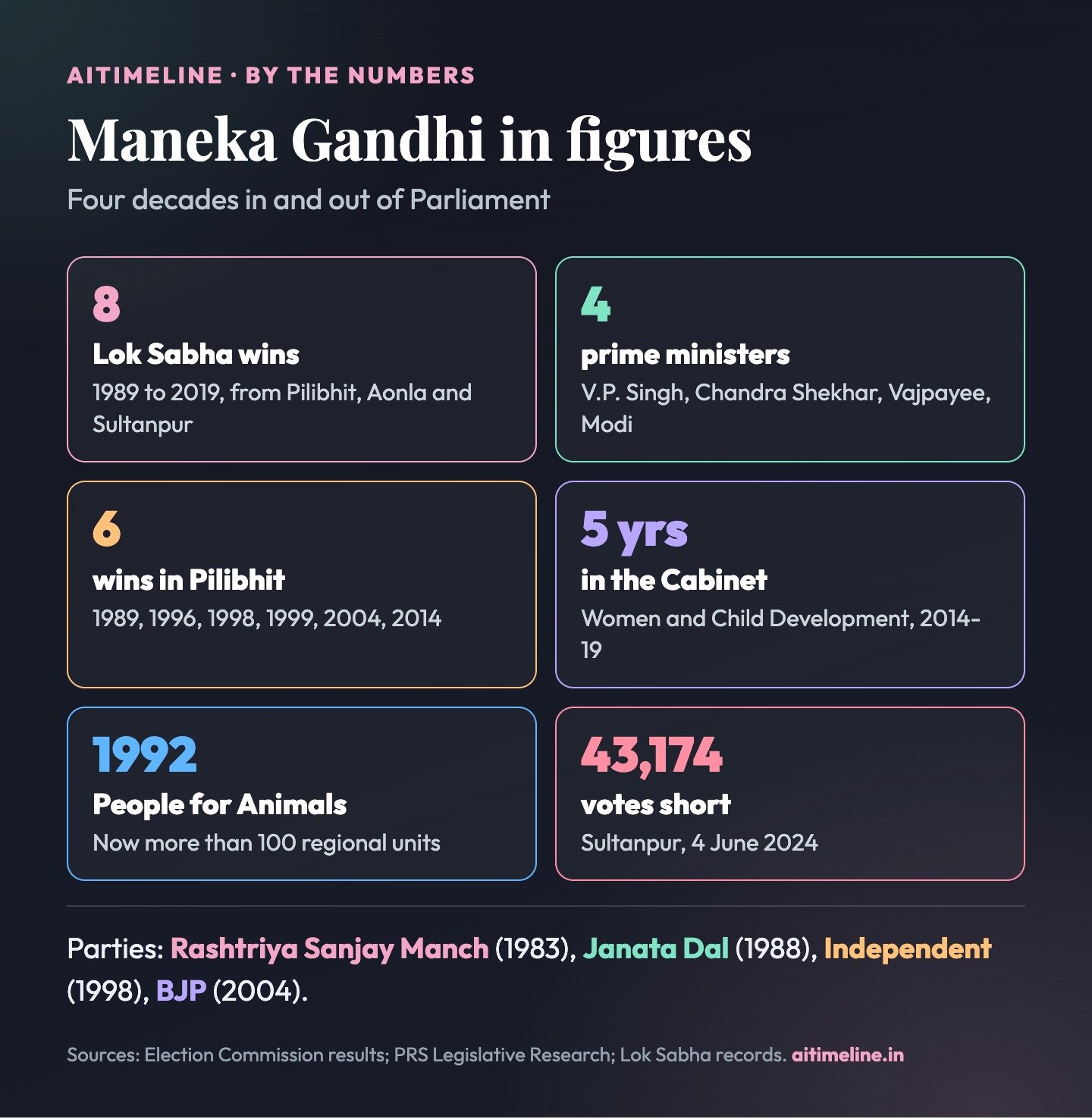
Early Life and the Gandhi Household
From a Sikh army family to the Prime Minister’s house, and out again.
Maneka Anand was born in New Delhi on 26 August 1956, the daughter of an Indian Army officer, Lt Col Tarlochan Singh Anand. She studied at the Lawrence School, Sanawar, and Lady Shri Ram College, and later took German at Jawaharlal Nehru University. She met Sanjay Gandhi, the younger son of Prime Minister Indira Gandhi, in 1973 and married him on 23 September 1974, when she was 18.
During the Emergency of 1975-77 she travelled with Sanjay on his tours. After the Congress was voted out in 1977 she launched Surya, a news magazine that attacked the Janata government. That government’s decision to impound her passport on 2 July 1977 gave India one of its most important constitutional rulings. In Maneka Gandhi v. Union of India, decided on 25 January 1978, a seven-judge Supreme Court bench held that any procedure that takes away personal liberty under Article 21 must be “right, just and fair”, and that Articles 14, 19 and 21 must be read together. The ruling has been cited in nearly 2,000 later judgments.
Sanjay Gandhi was killed in a plane crash on 23 June 1980, when their son Varun was about 100 days old. Maneka’s relations with Indira Gandhi then broke down over her links with Sanjay’s supporters and her own ambitions, and in late March 1982 she was asked to leave 1 Safdarjung Road. The details of that night are still disputed; Sonia Gandhi’s 2026 memoir gives one account, Maneka has given others.
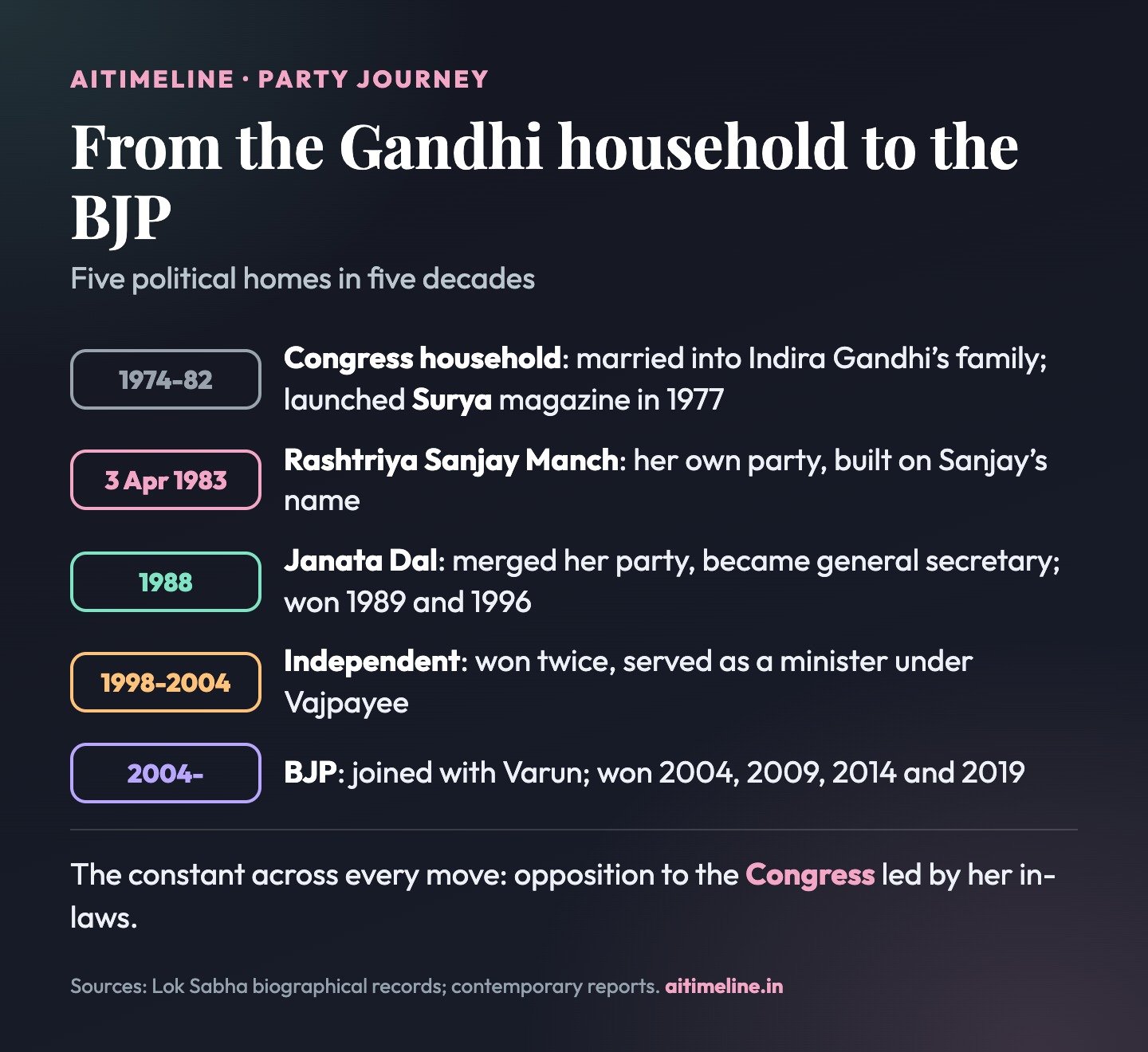
Five Political Homes
The one constant: opposition to the Congress led by her in-laws.
| Period | Party | What she did |
|---|---|---|
| 1983-1988 | Rashtriya Sanjay Manch | Founded it; contested Amethi in 1984 as an Independent |
| 1988-1998 | Janata Dal | General secretary; won Pilibhit in 1989 and 1996, lost in 1991 |
| 1998-2004 | Independent | Won Pilibhit in 1998 and 1999; minister under Vajpayee |
| 2004-present | Bharatiya Janata Party | Won 2004, 2009, 2014, 2019; Cabinet minister 2014-19; lost 2024 |
Maneka Gandhi Timeline, 1956 to 2026
Newest first. Each entry is tagged by type.
Sonia Gandhi’s memoir reopens the family rift Family
What happened: Sonia Gandhi’s memoir was released on 10 November 2026. Its chapters on the early 1980s describe Maneka’s marriage to Sanjay, the arguments that followed his death and her exit from the Prime Minister’s house in 1982. Press reports quoted Sonia as writing that, as far as Maneka was concerned, “we were enemies”, and that Maneka spread stories about her and Rajiv through journalists.
How to read it: This is one side’s memory of a private quarrel more than 40 years old. It is not a record that any court or inquiry has tested, and Maneka has given different accounts of the same events in the past.
Campaigns against draft laboratory-animal rules Animal welfare
What happened: The Committee for Control and Supervision of Experiments on Animals (CCSEA) published draft rules to replace the 1998 rules on breeding and experimenting on animals. Maneka and People for Animals said the draft would let each institution’s own ethics committee clear ‘mild’ and ‘moderate’ experiments, which are most experiments, leaving only severe ones to the central committee.
Her objections: She argued that this amounts to self-regulation, that looser sourcing rules could let dogs and cats picked up from streets or markets end up in laboratories, and that researchers should first have to show that no validated alternative exists. She asked for the draft to be redone, not just amended.
Supreme Court says her remarks amounted to contempt, but takes no action Courts and controversies
What happened: Hearing the stray dogs case, the three-judge bench objected to comments Maneka had made on her podcast and at public events calling the Court’s orders impractical. The bench said her remarks amounted to contempt of court, but that it was not starting contempt proceedings. It called this its ‘magnanimity’.
What it was not: It was an oral observation during a hearing. No contempt case was opened, no notice was issued and there was no finding after a trial. Justice Mehta also asked what budget she had secured for the problem when she was a Union minister.
Criticises the Court’s order on dogs in public institutions Animal welfare
What happened: The Supreme Court directed authorities to remove stray dogs from the premises of institutions such as schools, hospitals and transport hubs, and to keep them in shelters rather than release them back. Maneka publicly called the order impractical.
Why it mattered: It was her criticism of this order, and of the August 2025 order before it, that the bench objected to two months later.
Opposes the order to move Delhi’s stray dogs to shelters Animal welfare
What happened: On 11 August 2025 a two-judge bench ordered that stray dogs be picked up from all localities of Delhi-NCR and kept in shelters. Maneka called the order unworkable: Delhi had no government-run shelters, she said, building enough would cost thousands of crores, and removing dogs would only pull in more from neighbouring areas.
What changed: On 22 August 2025 a larger bench of Justices Vikram Nath, Sandeep Mehta and N.V. Anjaria modified the order. Dogs were to be sterilised, vaccinated and released back where they were picked up, except those with rabies or showing aggressive behaviour, and feeding was restricted to designated spots. Maneka welcomed the change.
Supreme Court issues notice on her appeal over Sultanpur Courts and controversies
What happened: The Supreme Court refused to hear her challenge to the 45-day time limit for filing an election petition, saying the court could not legislate. It did issue notice on her appeal against the High Court’s dismissal and asked Ram Bhual Nishad to reply.
Status: We found no final decision on the appeal as of 20 November 2026.
High Court dismisses her election petition as time-barred Courts and controversies
What happened: Maneka had alleged that Ram Bhual Nishad did not fully disclose pending criminal cases in his nomination papers. The High Court held that the petition was filed about seven days after the 45-day deadline and dismissed it under Sections 81 and 86 of the Representation of the People Act.
What it did not decide: The Court did not rule on whether the disclosure allegation was true. Until a petition is within time, it said, the merits cannot be considered. Her plea that she had been unwell was not enough to extend the deadline, which the Act does not allow courts to condone.
Loses Sultanpur to the Samajwadi Party Elections and parties
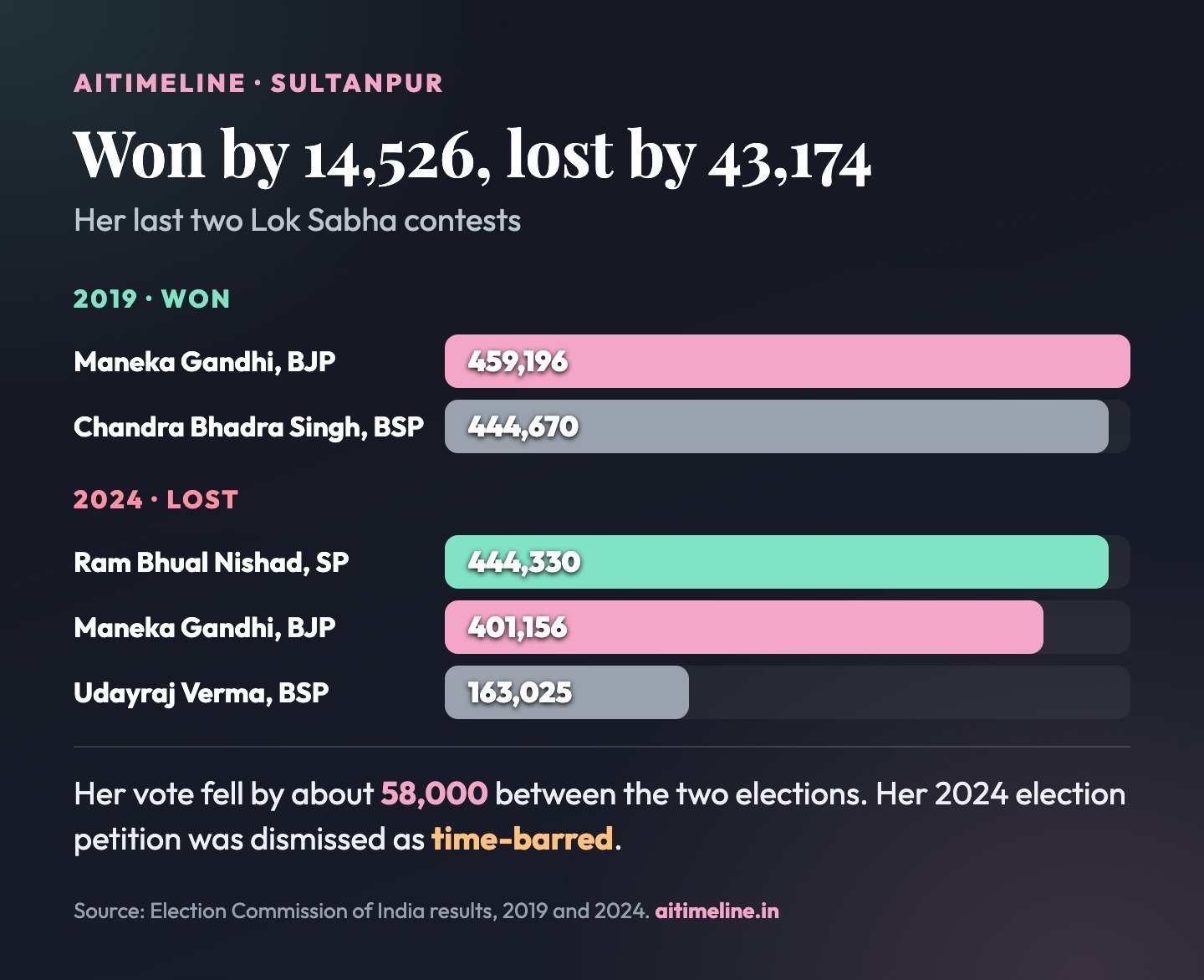
Result: Ram Bhual Nishad of the Samajwadi Party won 4,44,330 votes (43.0%). Maneka, the sitting MP, won 4,01,156 (38.8%), and Udayraj Verma of the BSP 1,63,025 (15.8%).
Why it matters: It was the first time since 1991 that she had lost a Lok Sabha election. The defeat came as the BJP lost ground across Uttar Pradesh, where the Samajwadi Party and Congress together won 43 of the 80 seats. Her son Varun had already been left out of the BJP’s list for Pilibhit.
Her record in the 17th Lok Sabha Elections and parties
The numbers: PRS records 78% attendance (national average 79%), 117 questions asked (national average 210), no debates and no private member’s bills. ThePrint’s analysis of PRS data listed her among 14 MPs who took part in no debate in the whole term.
Context: Attendance is not recorded for ministers or the Speaker. Maneka was a backbench MP throughout the term, so all five years count.
Booked in Kerala over remarks on an elephant’s death Courts and controversies
What happened: After a pregnant elephant died from an injury caused by explosive-packed fruit, Maneka called Malappuram “India’s most violent district”. The elephant had died in Palakkad, a different district. Police in Malappuram registered a case over complaints that the remark promoted ill-will against the Muslim-majority district.
Reaction: A group calling itself the Kerala Cyber Warriors defaced the People for Animals website in protest.
Wins Sultanpur, but is left out of the new Cabinet Elections and parties
Result: The BJP swapped mother and son between seats: Varun moved to Pilibhit and Maneka took his seat of Sultanpur. She won 4,59,196 votes to 4,44,670 for Chandra Bhadra Singh ‘Sonu’ of the BSP, one of the closest results of her career.
Afterwards: When the second Modi ministry was sworn in on 30 May 2019 she was not included. Smriti Irani took over Women and Child Development.
Campaign remark to Muslim voters draws a 48-hour ban Courts and controversies
What happened: At a campaign meeting in a Muslim-majority area of Sultanpur, Maneka was recorded telling voters that she would win anyway, and that if Muslims did not vote for her and later came to her for work she would think, ‘let it be’. The district administration issued a show-cause notice.
Consequence: The Election Commission found that she had broken the Model Code of Conduct by appealing to communal feelings and on 15 April 2019 barred her from campaigning for 48 hours. She said the remark had been taken out of context.
Pushes the death penalty for rape of children under 12 Ministries
What happened: After public anger over the rape and murder of an eight-year-old girl in Kathua, Maneka said her ministry would seek to amend the POCSO Act to allow the death penalty for the rape of children under 12. The Union Cabinet then cleared an ordinance making rape of a girl under 12 punishable with death, which the President signed on 21 April 2018.
Why it was debated: Child-rights groups warned that the death penalty could make families less likely to report abuse, much of which is committed by relatives.
Maternity leave rises from 12 to 26 weeks Ministries
What happened: Parliament extended paid maternity leave for women in establishments with ten or more employees from 12 weeks to 26 weeks; the Lok Sabha passed the bill on 9 March 2017. The law belongs to the Labour Ministry, but Maneka had publicly pressed for the extension, at one stage arguing for eight months.
Why it matters: It put India among the countries with the longest statutory maternity leave, though it covers only the formal workforce.
Juvenile justice law allows adult trials for 16-18 year olds Ministries
What happened: Her ministry piloted the new juvenile justice law. Its most contested clause lets the Juvenile Justice Board send a 16- or 17-year-old accused of a ‘heinous’ offence, one punishable with seven years or more, for trial as an adult after a preliminary assessment. The Rajya Sabha passed the bill on 22 December 2015, days after the juvenile convicted in the 2012 Delhi gang rape was released.
The debate: Maneka defended the change as a response to serious crimes by older teenagers. Critics, including child-rights groups, said it went against the principle that children are to be reformed, not punished as adults.
Beti Bachao, Beti Padhao is launched Ministries
What happened: Prime Minister Narendra Modi launched Beti Bachao, Beti Padhao in Panipat to address the falling child sex ratio and promote girls’ education. Her ministry was the nodal ministry for the scheme.
Why it matters: It became the government’s best-known programme for girls, though a parliamentary committee reported in 2021 that most of its spending in 2016-19 had gone on media campaigns.
Becomes Union Cabinet Minister for Women and Child Development Ministries
What happened: In her first Cabinet-rank post, Maneka took charge of Women and Child Development, which runs programmes on nutrition, child protection, adoption and women’s safety, including the anganwadi network.
Why it matters: Five years in one ministry was the longest single assignment of her career; her previous longest, Social Justice, lasted about three and a half years.
Returns to Pilibhit with her biggest win Elections and parties
Result: Maneka won 5,46,934 votes against 2,39,882 for Budhsen Verma of the Samajwadi Party, as the BJP won 71 of Uttar Pradesh’s 80 seats.
The family seats: Varun moved to Sultanpur and won there, so mother and son swapped constituencies for the first time.
Wins Aonla as Varun takes Pilibhit Elections and parties
What happened: Maneka moved to neighbouring Aonla and won, while Varun Gandhi made his debut from Pilibhit and also won. It was the first time mother and son sat in the Lok Sabha together.
In Parliament: She was made chairperson of the Committee on Government Assurances on 23 September 2009 and joined the Committee on Railways.
Joins the BJP and wins Pilibhit on its ticket Elections and parties
What happened: After six years as an Independent supporting the Vajpayee government, Maneka formally joined the BJP early in 2004, together with Varun. She held Pilibhit with 2,55,615 votes, though the BJP lost power nationally.
Why it matters: It ended her journey across the party map, from the Congress household to her own party, the Janata Dal and independence. She has stayed with the BJP since.
Culture, then Statistics, with charge of Animal Care Ministries
What happened: On 1 September 2001 she moved from Social Justice to Culture, with an additional charge of Animal Care. From 18 November 2001 to 30 June 2002 she held Statistics and Programme Implementation, still with Animal Care.
Why it matters: The Animal Care charge followed her from Culture to Statistics, a sign of how closely the cause was tied to her.
Minister for Social Justice in the Vajpayee government Ministries
What happened: Re-elected from Pilibhit as an Independent in 1998 (3,90,381 votes) and 1999 (4,33,421 votes), she joined the Vajpayee government as Minister of State with independent charge of Social Justice and Empowerment, serving to 1 September 2001.
A lasting law: Her ministry steered the National Trust for the Welfare of Persons with Autism, Cerebral Palsy, Mental Retardation and Multiple Disabilities Act, 1999, which created a trust to support people with those disabilities and their families.
Back in the Lok Sabha from Pilibhit Elections and parties
Result: Standing as a Janata Dal candidate, she won 3,95,827 votes against 1,12,517 for the BJP’s Parshuram Gangwar, who had beaten her in 1991.
Correction: Some biographies say she won in 1996 as an Independent. Election records show she was the Janata Dal candidate in 1996, and an Independent only in 1998 and 1999.
Heads the committee that oversees animal experiments Animal welfare
What happened: She was appointed chairperson of the Committee for the Purpose of Control and Supervision of Experiments on Animals. Under her, CPCSEA inspectors made unannounced visits to laboratories that used animals.
Why it matters: The committee’s power to inspect and register labs is the oversight that the 2026 draft rules would partly devolve to institutions, which is why she has opposed them.
Founds People for Animals Animal welfare
What happened: Maneka founded People for Animals, which grew into India’s largest animal-welfare network, with hospitals, shelters and ambulance services run by regional units. She remains its chairperson.
Her methods: Through public interest litigation she helped replace the municipal killing of street dogs with sterilisation (Animal Birth Control) programmes, and pushed for curbs on airgun sales and travelling zoos. She also hosted the Doordarshan programmes Heads and Tails and Maneka’s Ark.
Loses Pilibhit after one term Elections and parties
Result: As the Janata Dal splintered and the BJP surged in Uttar Pradesh, Parshuram Gangwar of the BJP took Pilibhit. Maneka polled 1,39,710 votes.
Why it matters: It was her last Lok Sabha defeat for 33 years.
Stays on as minister under Chandra Shekhar Ministries
What happened: When the V.P. Singh government fell in November 1990, Maneka was kept on as Minister of State (Independent Charge) for Environment and Forests in Chandra Shekhar’s government, according to the Cabinet Secretariat notification of 21 November 1990.
Why it matters: It kept her in charge of the same ministry across two prime ministers in one Lok Sabha.
Minister of State for Environment and Forests Ministries
What happened: Weeks after her first election, she became Minister of State with independent charge of Environment and Forests. From 20 January to 23 April 1990 she also held Programme Implementation.
Why it matters: The environment portfolio linked her politics to the conservation and animal-protection causes she was already known for.
First election win, from Pilibhit Elections and parties
Result: She won Pilibhit with 2,69,044 votes against 1,37,824 for the Congress’s Bhanu Pratap Singh.
Context: The Janata Dal-led National Front formed the government under V.P. Singh, with outside support from the BJP and the Left.
Merges her party into the Janata Dal and becomes its general secretary Elections and parties
What happened: The Rashtriya Sanjay Manch merged into the new Janata Dal, which brought together V.P. Singh’s Jan Morcha, the Janata Party and the Lok Dal against Rajiv Gandhi’s Congress. Maneka became a general secretary of the party.
Why it matters: It moved her from a personal party built on Sanjay’s name into the main anti-Congress coalition.
Contests Amethi against Rajiv Gandhi Elections and parties
Result: In Sanjay’s old constituency, Rajiv Gandhi won 3,65,041 votes and Maneka 50,163 (11.5%). His margin of 3,14,878 votes was the largest ever won by a sitting Prime Minister.
Context: The election came weeks after the assassination of Indira Gandhi on 31 October 1984, and the Congress won more than 400 seats.
Launches the Rashtriya Sanjay Manch Elections and parties
What happened: Having announced the party in late March, Maneka launched the Rashtriya Sanjay Manch at a convention of about 5,000 delegates. It drew on Sanjay’s following and promised to focus on young people and jobs.
Early support: Its forerunner, the Sanjay Vichar Manch, had allied with N.T. Rama Rao’s Telugu Desam in the January 1983 Andhra Pradesh election and won four of the five seats it contested. By April the new party claimed two MPs and several MLAs.
Leaves the Prime Minister’s house Family
What happened: Relations with Indira Gandhi worsened after Sanjay’s death, as Maneka associated with his supporters and spoke of her own political role. In late March 1982, after a confrontation, she was told to leave the Prime Minister’s residence, and left with Varun.
Accounts differ: Contemporary reports, Khushwant Singh’s memoir and, in 2026, Sonia Gandhi’s book describe the night in different ways. Each reflects its author’s position.
Sanjay Gandhi dies in a plane crash Family
What happened: Sanjay Gandhi, MP for Amethi since January 1980, was killed when the light aircraft he was flying crashed near Safdarjung airport. Their son, born on 13 March 1980, was about 100 days old.
Why it matters: His death set off the struggle over his legacy that would push Maneka out of the family home and into politics on her own.
Maneka Gandhi v. Union of India transforms Article 21 Courts and controversies
What happened: On 2 July 1977 the Janata government impounded her passport ‘in public interest’ and declined to give reasons. She challenged the order. The Supreme Court held that a law depriving a person of personal liberty under Article 21 must be ‘right, just and fair’, not arbitrary, and must be read together with Articles 14 and 19.
Why it matters: The judgment overturned the narrow reading of A.K. Gopalan (1950) and became the foundation of modern Indian rights law, cited in cases on privacy, legal aid and speedy trial. It is probably her most lasting mark on Indian public life.
Founds Surya magazine Family
What happened: After the Congress lost the March 1977 election, Maneka launched Surya, a news magazine that attacked the Janata government and helped rebuild the Gandhi family’s image before Indira’s return in 1980.
Why it matters: It was her first independent public role, separate from Sanjay’s.
Marries Sanjay Gandhi Family
What happened: Maneka Anand met Sanjay Gandhi in 1973 at a party hosted by her uncle and married him a year later, on 23 September 1974, joining the household of Prime Minister Indira Gandhi.
Correction: Some accounts give the date as 29 September 1974; contemporary sources and standard biographies give 23 September.
Born Maneka Anand in New Delhi Family
Early life: She was born to an army officer and Amardeep Kaur Anand. She studied at the Lawrence School, Sanawar, and Lady Shri Ram College, and later studied German at Jawaharlal Nehru University.
Before politics: As a student she did some modelling, including a well-known advertisement for Bombay Dyeing.
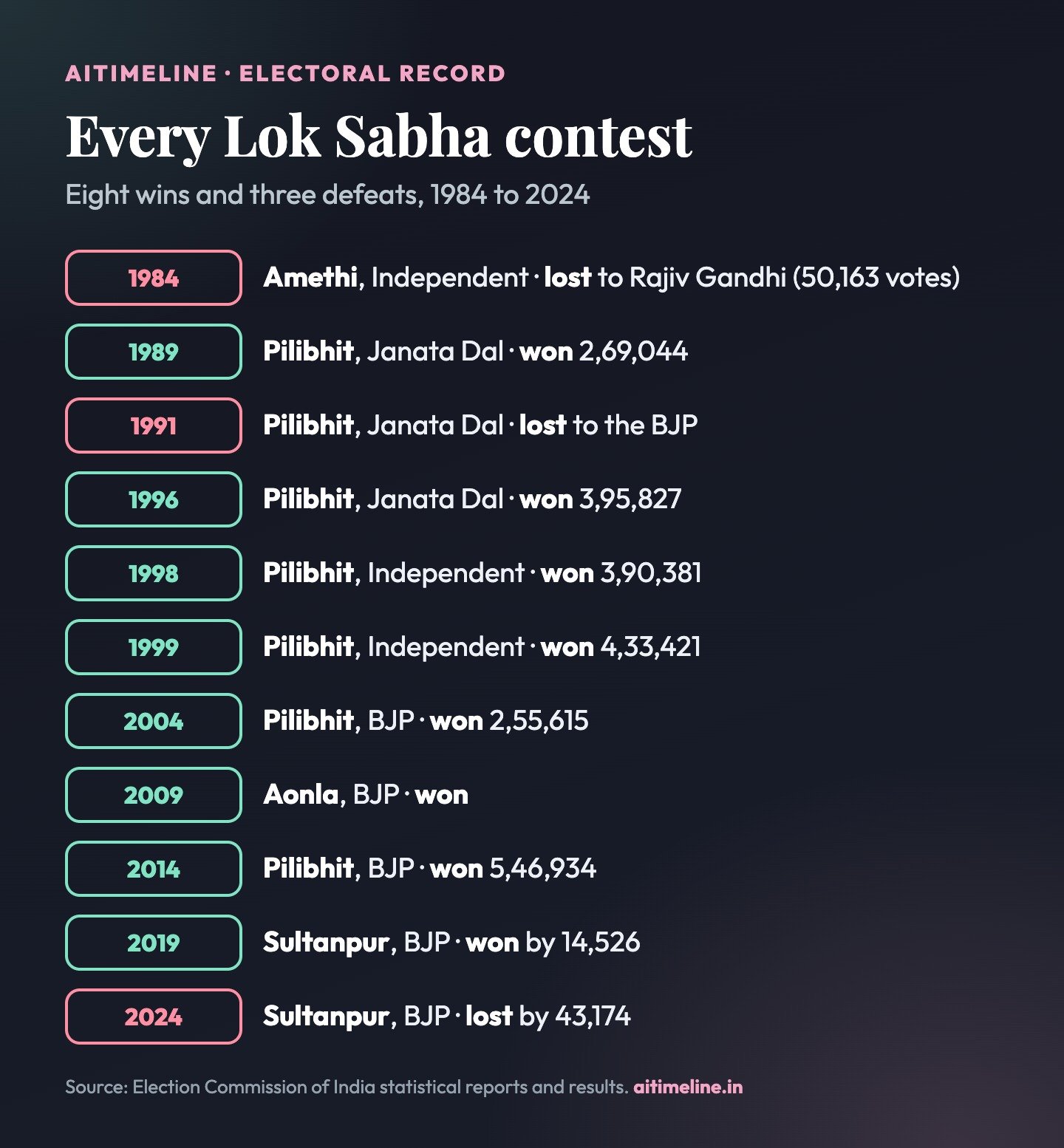
Every Lok Sabha Election She Fought
Eleven contests, three constituencies in Uttar Pradesh plus Amethi.
| Year | Seat | Party | Result | Main opponent |
|---|---|---|---|---|
| 1984 | Amethi | Independent | Lost (50,163) | Rajiv Gandhi, Congress (3,65,041) |
| 1989 | Pilibhit | Janata Dal | Won (2,69,044) | Bhanu Pratap Singh, Congress (1,37,824) |
| 1991 | Pilibhit | Janata Dal | Lost (1,39,710) | Parshuram Gangwar, BJP |
| 1996 | Pilibhit | Janata Dal | Won (3,95,827) | Parshuram Gangwar, BJP (1,12,517) |
| 1998 | Pilibhit | Independent | Won (3,90,381) | Anis Ahmed Khan (1,78,505) |
| 1999 | Pilibhit | Independent | Won (4,33,421) | Anis Ahmad Khan (1,93,566) |
| 2004 | Pilibhit | BJP | Won (2,55,615) | Satyapal Gangwar (1,52,895) |
| 2009 | Aonla | BJP | Won | — |
| 2014 | Pilibhit | BJP | Won (5,46,934) | Budhsen Verma, SP (2,39,882) |
| 2019 | Sultanpur | BJP | Won (4,59,196) | Chandra Bhadra Singh, BSP (4,44,670) |
| 2024 | Sultanpur | BJP | Lost (4,01,156) | Ram Bhual Nishad, SP (4,44,330) |
Pilibhit, a Terai constituency on the Nepal border, was the base of her career: she won it six times, and she or Varun held it in every general election from 1996 to 2019. Her strongest result came in 2014, when she won by 3,07,052 votes in the BJP wave. Her closest win, by 14,526 votes, and her final defeat both came in Sultanpur, the seat she took from Varun in 2019.
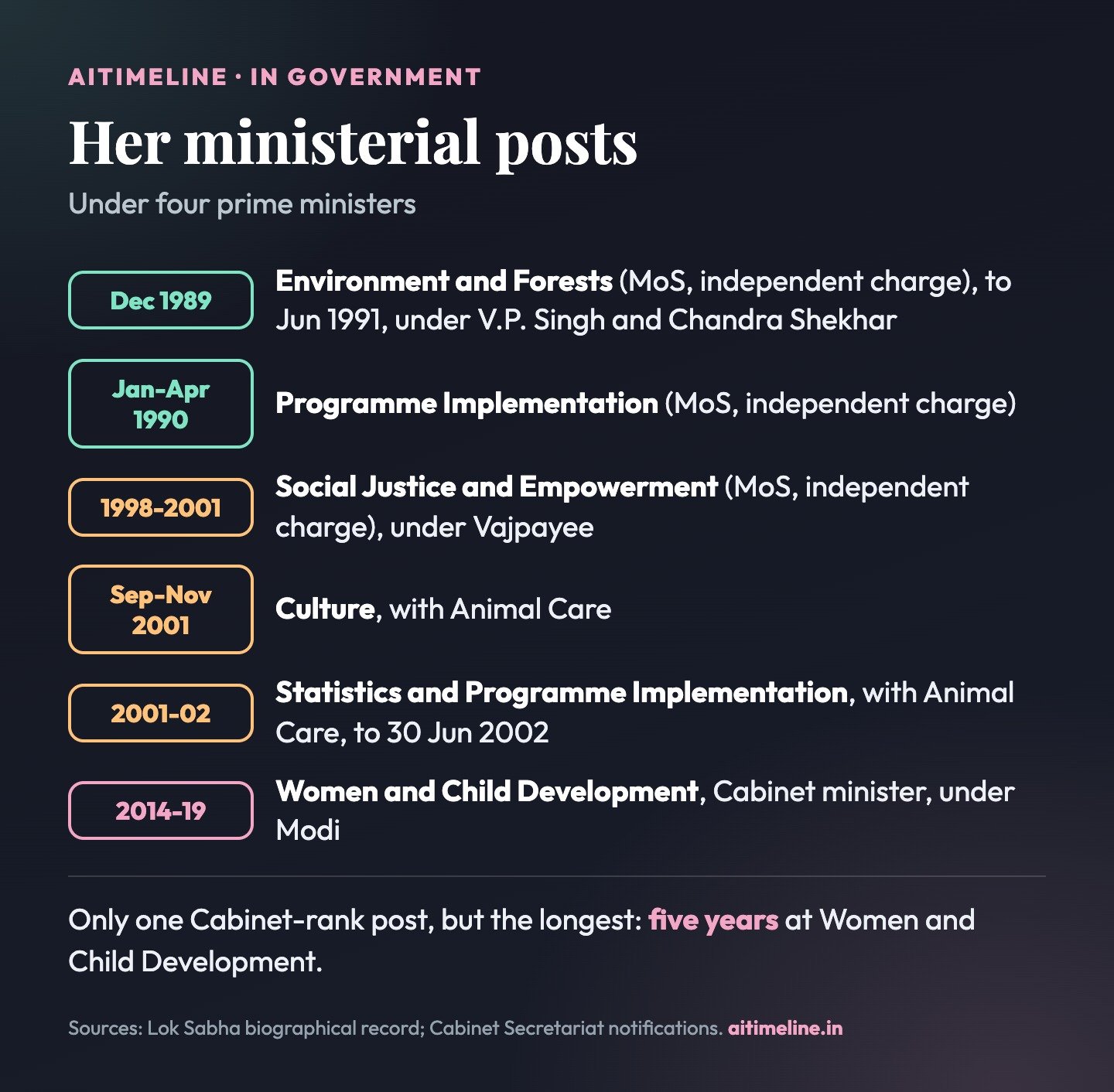
Maneka Gandhi in Government
Six portfolios under four prime ministers.
| Period | Portfolio | Rank | Prime Minister |
|---|---|---|---|
| 6 Dec 1989 – Jun 1991 | Environment and Forests | MoS (independent charge) | V.P. Singh; Chandra Shekhar |
| 20 Jan – 23 Apr 1990 | Programme Implementation | MoS (independent charge) | V.P. Singh |
| 1998 – 1 Sep 2001 | Social Justice and Empowerment | MoS (independent charge) | Atal Bihari Vajpayee |
| 1 Sep – 18 Nov 2001 | Culture, with Animal Care | MoS (independent charge) | Atal Bihari Vajpayee |
| 18 Nov 2001 – 30 Jun 2002 | Statistics and Programme Implementation, with Animal Care | MoS (independent charge) | Atal Bihari Vajpayee |
| 26 May 2014 – May 2019 | Women and Child Development | Cabinet Minister | Narendra Modi |
Her five years at Women and Child Development were the most consequential. The ministry was the nodal ministry for Beti Bachao, Beti Padhao, launched on 22 January 2015. It piloted the Juvenile Justice (Care and Protection of Children) Act, 2015, whose clause allowing 16- and 17-year-olds accused of heinous offences to be tried as adults was passed by the Rajya Sabha on 22 December 2015, days after the release of the juvenile convicted in the 2012 Delhi gang rape. She pressed for the 2017 law that raised maternity leave from 12 to 26 weeks, and after the Kathua case in 2018 she backed the death penalty for the rape of children under 12, which became law by ordinance on 21 April 2018.
Each of these drew criticism as well as support. Child-rights groups opposed adult trials for juveniles and warned that the death penalty could deter families from reporting abuse by relatives. A 2021 parliamentary committee report found that most Beti Bachao, Beti Padhao spending in 2016-19 had gone on media campaigns rather than on the ground. Her record in the Vajpayee years is quieter but durable: the National Trust Act, 1999, for people with autism, cerebral palsy and intellectual disabilities.
Animal Welfare: A Parallel Career
The cause that defines her outside Parliament.
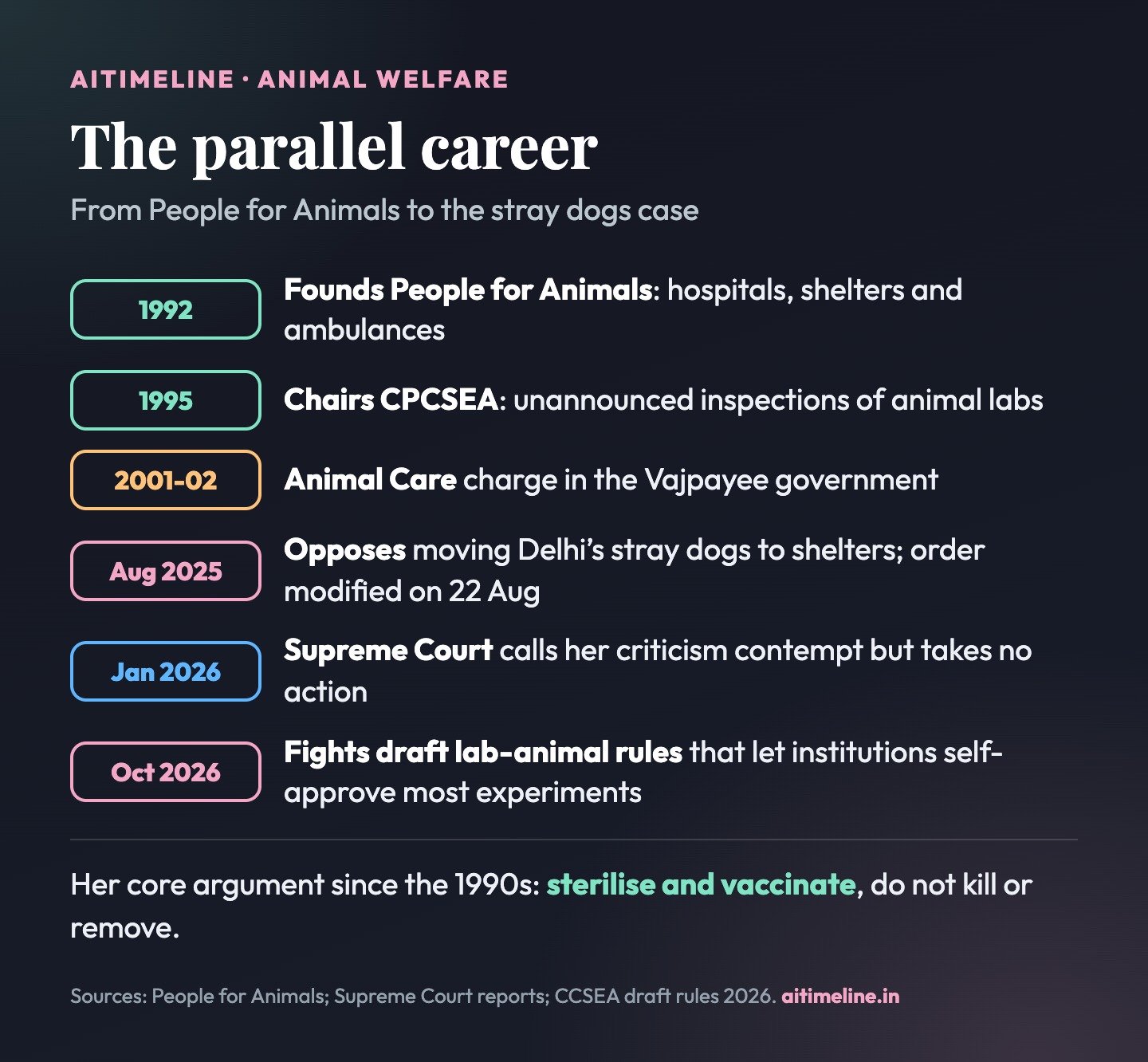
Maneka founded People for Animals in 1992. It is now India’s largest animal-welfare organisation, with more than 100 regional units running hospitals, shelters and ambulances, and she remains its chairperson. In 1995 she became chairperson of the Committee for the Purpose of Control and Supervision of Experiments on Animals (CPCSEA), whose inspectors made unannounced visits to laboratories. Her public interest litigation helped replace the municipal killing of street dogs with Animal Birth Control sterilisation programmes, and she hosted the Doordarshan programmes Heads and Tails and Maneka’s Ark.
That record put her at the centre of the 2025-26 stray dogs case. When a two-judge bench ordered on 11 August 2025 that stray dogs across Delhi-NCR be moved to shelters, she called it unworkable; a three-judge bench modified the order on 22 August to let sterilised and vaccinated dogs go back to their localities. Her continuing criticism, including of a 7 November 2025 order on dogs in public institutions, led the bench on 20 January 2026 to say her remarks amounted to contempt, though it took no action. In October 2026 she turned to the CCSEA’s draft rules on laboratory animals, arguing that letting institutions approve their own mild and moderate experiments would amount to self-regulation.
Her advocacy has also drawn criticism, from those who say it underplays public-safety concerns over dog bites to the 2020 case filed against her in Kerala after she called Malappuram “India’s most violent district” over an elephant that died in Palakkad.
The 2024 Defeat in Sultanpur
Her first loss in 33 years, and a petition ruled out of time.
| Candidate | Party | Votes | Share |
|---|---|---|---|
| Ram Bhual Nishad | Samajwadi Party | 4,44,330 | 43.0% |
| Maneka Gandhi | BJP | 4,01,156 | 38.8% |
| Udayraj Verma | BSP | 1,63,025 | 15.8% |
Ram Bhual Nishad won by 43,174 votes on 4 June 2024, as the Samajwadi Party and Congress took 43 of Uttar Pradesh’s 80 seats. It was Maneka’s first Lok Sabha defeat since 1991. Varun had already been dropped by the BJP in Pilibhit, so neither of them sat in the Lok Sabha for the first time since 1996.
Maneka then filed an election petition alleging that Nishad had not fully disclosed pending criminal cases in his nomination papers. On 14 August 2024 Justice Rajan Roy of the Allahabad High Court’s Lucknow Bench dismissed it because it was filed about seven days after the 45-day limit in the Representation of the People Act, 1951; the Court did not examine the allegation itself. On 7 January 2025 the Supreme Court refused to hear her challenge to the time limit but issued notice on her appeal, which we found still pending as of 20 November 2026.
Courts and Controversies
From a landmark ruling to a contempt rebuke.
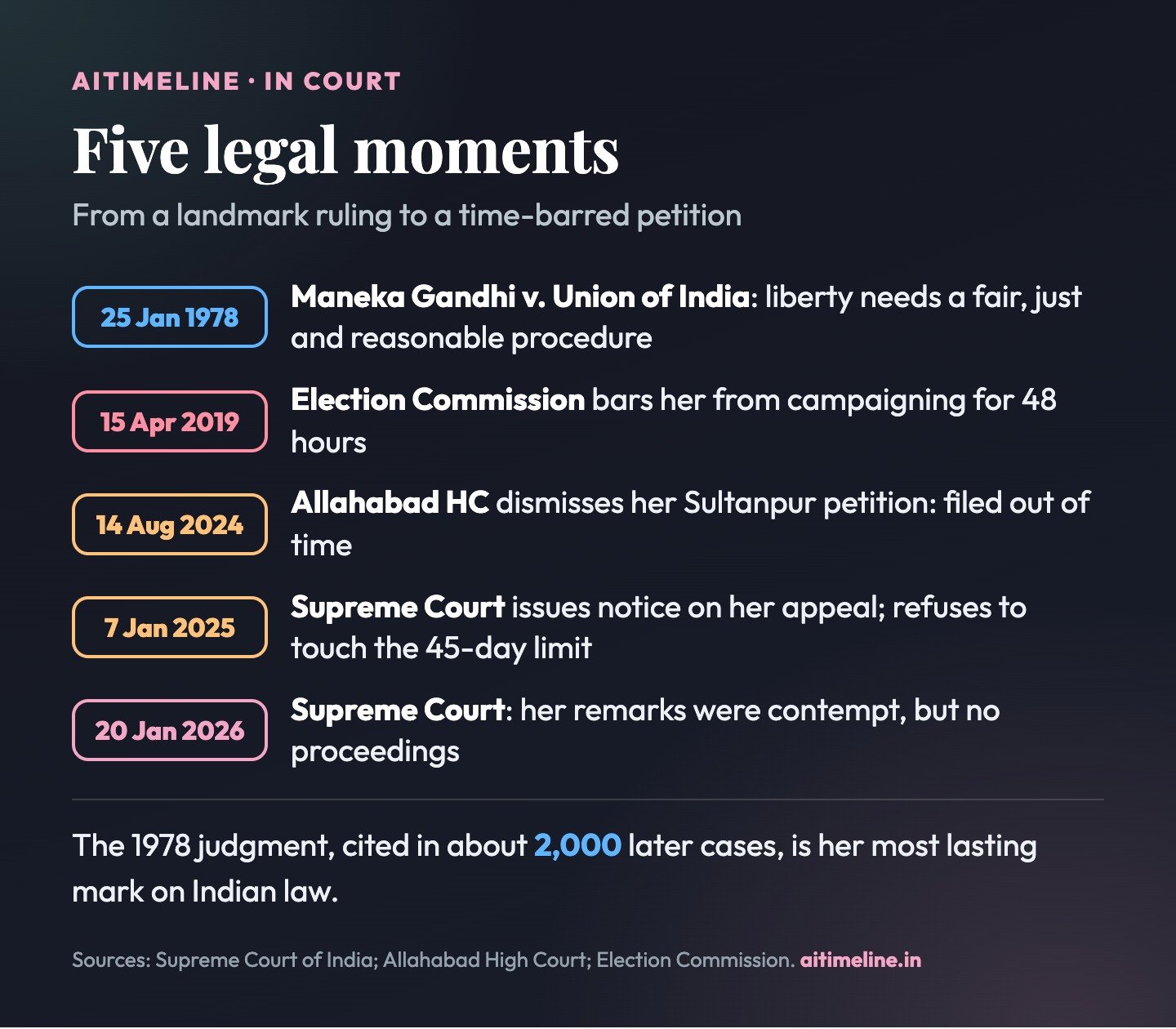
The most quoted controversy of her electoral career came on 12 April 2019 in Sultanpur, when she told a gathering in a Muslim-majority neighbourhood that she would think ‘let it be’ if Muslims who had not voted for her later came to her for work. The Election Commission held that she had appealed to communal feelings and on 15 April barred her from campaigning for 48 hours. She said the remark was taken out of context. The episode is sometimes misdated to the 2024 campaign.
The 20 January 2026 hearing is also often overstated. The bench said her criticism of its stray dog orders amounted to contempt, but it opened no proceedings and recorded no formal finding; it described its restraint as magnanimity.
The Family Feud, Revisited
Sonia Gandhi’s memoir, November 2026.
Sonia Gandhi’s memoir Belonging: A Journey of Love, released on 10 November 2026, revisits the years when the two women lived under Indira Gandhi’s roof. As reported, it describes arguments between Sanjay and Maneka, Indira’s worry that Maneka was encouraging Sanjay’s politics, stories that Maneka is said to have passed to journalists about Sonia and Rajiv, and her exit in 1982. Sonia is quoted as writing that, as far as Maneka was concerned, “we were enemies”.
These are one participant’s memories of a private quarrel, written more than four decades later. No court or inquiry has tested them, and Maneka has told the story differently over the years. What the book does confirm is how long the split has shaped Indian politics: Maneka and Varun spent their careers opposing the Congress that Sonia and then Rahul Gandhi led.
Key Political Phases
| Phase | Defining development |
|---|---|
| 1974-1980 | Marriage to Sanjay Gandhi; Surya; the 1978 passport ruling |
| 1980-1988 | Widowhood, the break with Indira Gandhi, the Rashtriya Sanjay Manch |
| 1989-1991 | First term from Pilibhit; Environment and Forests |
| 1996-2004 | Return to Parliament; Independent minister under Vajpayee |
| 2004-2014 | BJP membership; Pilibhit and Aonla |
| 2014-2019 | Cabinet Minister for Women and Child Development |
| 2019-2024 | Sultanpur MP; out of government |
| 2024-2026 | Defeat, the election petition and animal-welfare campaigns |
Facts at a Glance
| Detail | Information |
|---|---|
| Full name | Maneka Sanjay Gandhi (née Anand) |
| Born | 26 August 1956, New Delhi |
| Spouse | Sanjay Gandhi (married 23 Sep 1974; died 23 Jun 1980) |
| Son | Varun Gandhi (born 13 March 1980) |
| Own party | Rashtriya Sanjay Manch, launched 3 April 1983 |
| First Lok Sabha win | Pilibhit, 1989, Janata Dal |
| BJP member since | 2004 |
| First ministry | Environment and Forests, from 6 December 1989 |
| Cabinet post | Women and Child Development, 2014-19 |
| Last term | Sultanpur, 2019-24 |
| 2024 result | Lost to Ram Bhual Nishad by 43,174 votes |
| Organisation | People for Animals (founded 1992) |
| Landmark case | Maneka Gandhi v. Union of India, 25 January 1978 |
Legacy: Politics, Public Service and Animal Protection
Maneka Gandhi’s career crossed party lines and political eras. She began with a personal party built on Sanjay Gandhi’s name, moved into the Janata Dal coalition, served Vajpayee as an Independent and became a long-serving BJP parliamentarian. In each phase she stood against the branch of the family led by Rajiv, Sonia and Rahul Gandhi.
Her lasting marks are uneven. The 1978 passport case, which she brought as a private citizen, reshaped Indian rights law more than any law she later steered. As a minister she left the National Trust Act and the 2015 juvenile justice law. Outside government, People for Animals and her litigation changed how Indian cities deal with street dogs. Since her 2024 defeat, it is that second career, in the stray dogs case and the fight over laboratory-animal rules, that has kept her in public debate.
Explore More Timelines
People Also Ask
Frequently Asked Questions
Based on Election Commission results, Lok Sabha records, PRS data and court reports.
⚠️ Editorial Note: What We Checked
We checked the brief we started from against Election Commission results, the Lok Sabha and Cabinet Secretariat records of her posts, the Supreme Court’s 1978 judgment, PRS Legislative Research and contemporary reports. The marriage date is 23 September 1974, not 29 September. The Rashtriya Sanjay Manch was launched on 3 April 1983. In 1996 she won as a Janata Dal candidate, not an Independent. The remark to Muslim voters was made in April 2019, not 2024. We did not find a vote count for her 2009 Aonla win in the sources we could verify, so none is given. The account of Sonia Gandhi’s memoir is based on press reports of the book. This article is a political biography, not an endorsement of any party or candidate.
Related Reading on AiTimeline
Sources & further reading
Every dated entry above was checked against these references. Last reviewed 20 November 2026.
- PRS Legislative Research: MP Track, Maneka Gandhi, 17th Lok Sabha
- Supreme Court of India: Maneka Gandhi v. Union of India, judgment of 25 January 1978 (Indian Kanoon)
- Cabinet Secretariat: change in portfolios, No. 55/1/1/90-Cab, 21 November 1990 (Internet Archive copy)
- LiveLaw: Allahabad High Court rejects Maneka Gandhi's election petition against Sultanpur MP as barred by limitation
- LiveLaw: 'Contempt of Court': Supreme Court flays Maneka Gandhi for remarks on stray dog case order, 20 January 2026
- Scroll: BJP's Maneka Gandhi ekes out a narrow victory in Sultanpur, 2019
- ThePrint: Maneka Gandhi saw Rajiv-Sonia as 'enemies' - Sonia in memoir Belonging, November 2026
- Wikipedia: Maneka Gandhi