Constitution Day India: Samvidhan Diwas History and Timeline
Explore Constitution Day history, the Constituent Assembly timeline, Dr B.R. Ambedkar's role and why India celebrates Samvidhan Diwas on November 26.
Latest Story
Every year on 26 November, India marks Constitution Day (Samvidhan Diwas) to remember the day in 1949 when the Constituent Assembly adopted the Constitution. It was not the day the Constitution took full effect: that was 26 January 1950. This timeline follows the document from the Assembly’s first meeting in 1946 to the 12th Constitution Day observance in 2026.
26 November 1949 is adoption. 26 January 1950 is commencement. One nuance most summaries skip: under Article 394, 16 articles, including those on citizenship and elections, did take effect on 26 November 1949. The rest of the Constitution waited until 26 January.
💡 Short Answer
Constitution Day is celebrated on 26 November because the Constituent Assembly adopted the Constitution on that day in 1949. It came into force on 26 January 1950, when India became a republic. The government decided in 2015 to observe the day every year, and 2026 is the 12th observance and the 77th anniversary of adoption. Dr B.R. Ambedkar chaired the Drafting Committee, and Dr Rajendra Prasad presided over the Assembly.
26 November vs 26 January
Adoption is not commencement.
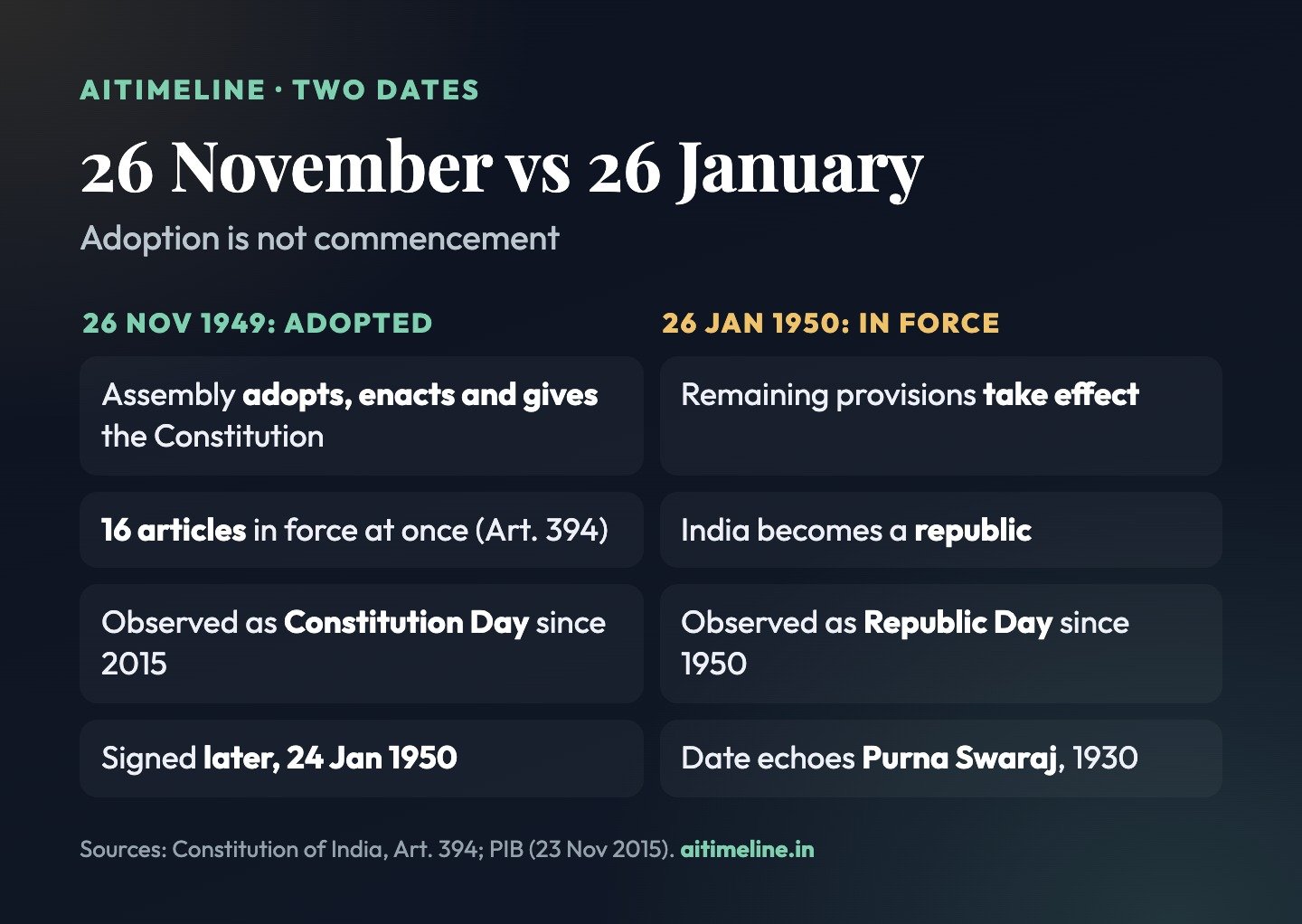
| Feature | Constitution Day | Republic Day |
|---|---|---|
| Date | 26 November | 26 January |
| Year of event | 1949 | 1950 |
| What happened | Constitution adopted | Constitution came into force |
| Annual observance | Since 2015 | Since 1950 |
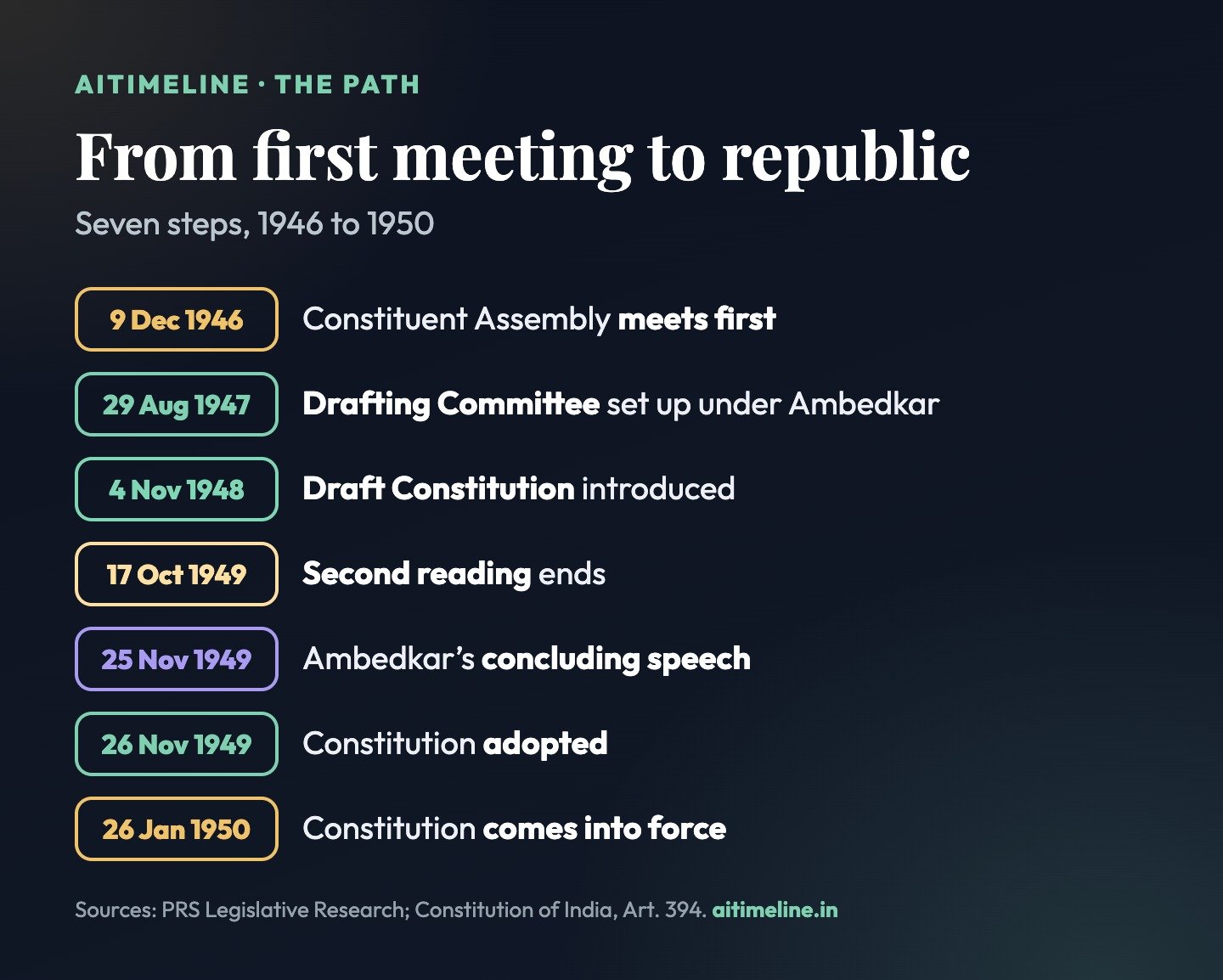
Constitution Day India: Key Questions
The Constitution in Eight Points
- Adoption date: 26 November 1949, the day Constitution Day marks.
- Commencement: 26 January 1950, the day Republic Day marks.
- Early articles: Article 394 put 16 articles into force at once.
- Time taken: about 2 years, 11 months and 17 days of work.
- Collective work: a seven-member Drafting Committee, but the whole Assembly debated it.
- Scale of debate: 165 sitting days; about 7,635 amendments tabled, 2,473 moved.
- Preamble changed: Socialist, Secular and unity and integrity were added in 1976.
- Newer tradition: Constitution Day dates only from 2015.
Timeline: Constitution Day and the Making of the Constitution, 1946 to 2026
Newest first. Labels mark foundation, drafting, adoption, milestones and observance.
India observes the 12th Constitution Day Observance
What is happening: The Ministry of Parliamentary Affairs is facilitating an online reading of the Preamble through MyGov in 23 languages: the 22 Scheduled Languages and English. A Constitution Quiz runs on MyGov and MyBharat from 18 to 26 November.
Youth outreach: Viksit Bharat Yuva Samvad is being organised across 786 districts in all 36 States and Union Territories from 24 to 26 November. Schools and colleges are holding assemblies, debates and essay contests.
President Murmu at Samvidhan Sadan Observance
The event: President Droupadi Murmu attended the Constitution Day celebration in the Central Hall of Samvidhan Sadan in New Delhi.
What she said: She recalled that in 2015, Ambedkar’s 125th birth anniversary year, it was decided to celebrate 26 November every year as Constitution Day, and called the decision meaningful.
75th anniversary of adoption Observance
The programme: The main function was held in the Central Hall of Samvidhan Sadan, attended by the President, Vice-President, Prime Minister, Speaker and others.
Four pillars: PIB said the year-long celebrations centred on the Preamble, Know Your Constitution, Making of the Constitution and Celebrating the Glory of the Constitution.
Hamara Samvidhan, Hamara Samman launched Observance
The campaign: A year-long campaign launched at the Dr B.R. Ambedkar International Centre in New Delhi to deepen citizens’ understanding of the Constitution, their rights and their duties.
Who launched it: PIB records that the Vice-President launched it; the Ministry of Law and Justice ran it. It is not a Constitution Day programme as such, but it feeds into the awareness drive.
Parliament and Vigyan Bhawan programmes Observance
The events: The Prime Minister addressed a Constitution Day programme at the Central Hall of Parliament and inaugurated the celebrations organised by the Supreme Court at Vigyan Bhawan, per the PMO’s advance release.
70th anniversary of adoption Observance
The event: President Ram Nath Kovind addressed an inaugural function of Constitution Day in the Central Hall, recalling that the Constituent Assembly had adopted the Constitution there 70 years earlier.
First official Constitution Day Observance
What happened: India observed 26 November as Constitution Day for the first time. The government’s plan listed Preamble readings, discussions and awareness programmes in schools.
Government announces Constitution Day Observance
The decision: PIB published the government’s decision to observe 26 November as Constitution Day, as a tribute to Dr Ambedkar, who chaired the Drafting Committee. The Ministry of Social Justice and Empowerment was named nodal ministry.
A date discrepancy: The brief we received dates the announcement to 19 November. The PIB release we could open is dated 23 November 2015, so we use that.
The Constitution comes into force Milestone
What happened: The remaining provisions of the Constitution took effect on 26 January 1950, called the commencement of the Constitution. Dr Rajendra Prasad became the first President.
Why that date: The date echoes the Purna Swaraj declaration adopted by the Indian National Congress in 1930.
Members sign the Constitution Milestone
The signing: Members of the Constituent Assembly signed the handwritten Constitution two days before it came into force. The figure usually cited is 284 signatories.
Constitution adopted, enacted and given Adoption
What happened: The Constituent Assembly adopted the Constitution. The original had 395 Articles, 22 Parts and eight Schedules.
Partly in force at once: Article 394 brought itself and 15 other articles into force at once: 5, 6, 7, 8, 9 (citizenship), 60, 324, 366, 367, 379, 380, 388, 391, 392 and 393. So the usual line that nothing took effect on 26 November is not quite right. The bulk of the text waited until 26 January.
Ambedkar’s concluding speech Adoption
The speech: Dr Ambedkar reflected on the work of the Assembly and on the responsibilities of democratic citizenship. He argued that political democracy must be backed by social democracy and urged the use of constitutional methods.
Third reading begins Adoption
What happened: The Assembly began the third and final reading, considering the completed text before adoption.
Second reading ends Drafting
What happened: The Assembly finished going through the draft article by article. PRS counts 101 sitting days for this clause-by-clause stage.
The amendments: Dr Ambedkar told the Assembly that about 7,635 amendments had been tabled, of which 2,473 were actually moved.
Draft Constitution introduced Drafting
What happened: Dr Ambedkar introduced the Draft Constitution in the Assembly. The second reading, starting 15 November 1948, took the draft apart clause by clause.
Drafting Committee appointed Drafting
Members: Ambedkar, N. Gopalaswami Ayyangar, Alladi Krishnaswami Ayyar, K.M. Munshi, Syed Mohammad Saadulla, B.L. Mitter and D.P. Khaitan.
Changes: Most accounts say N. Madhava Rau replaced Mitter, who fell ill, and T.T. Krishnamachari filled the place left by Khaitan, who died in 1948. One reference work disputes the second replacement.
Independence and Partition reshape the Assembly Foundation
What changed: After Partition the Assembly’s intended membership of 389 fell to 299. After independence it also acted as the country’s legislature while continuing its constitutional work.
Objectives Resolution adopted Foundation
What it did: The Assembly adopted the resolution setting out sovereignty, democracy and protection of people’s rights as the guiding principles.
Constituent Assembly meets for the first time Foundation
The first days: Dr Sachchidananda Sinha presided at the opening as the senior member. Dr Rajendra Prasad was elected permanent president on 11 December.
Who Made the Constitution?
Roles, not a single author.
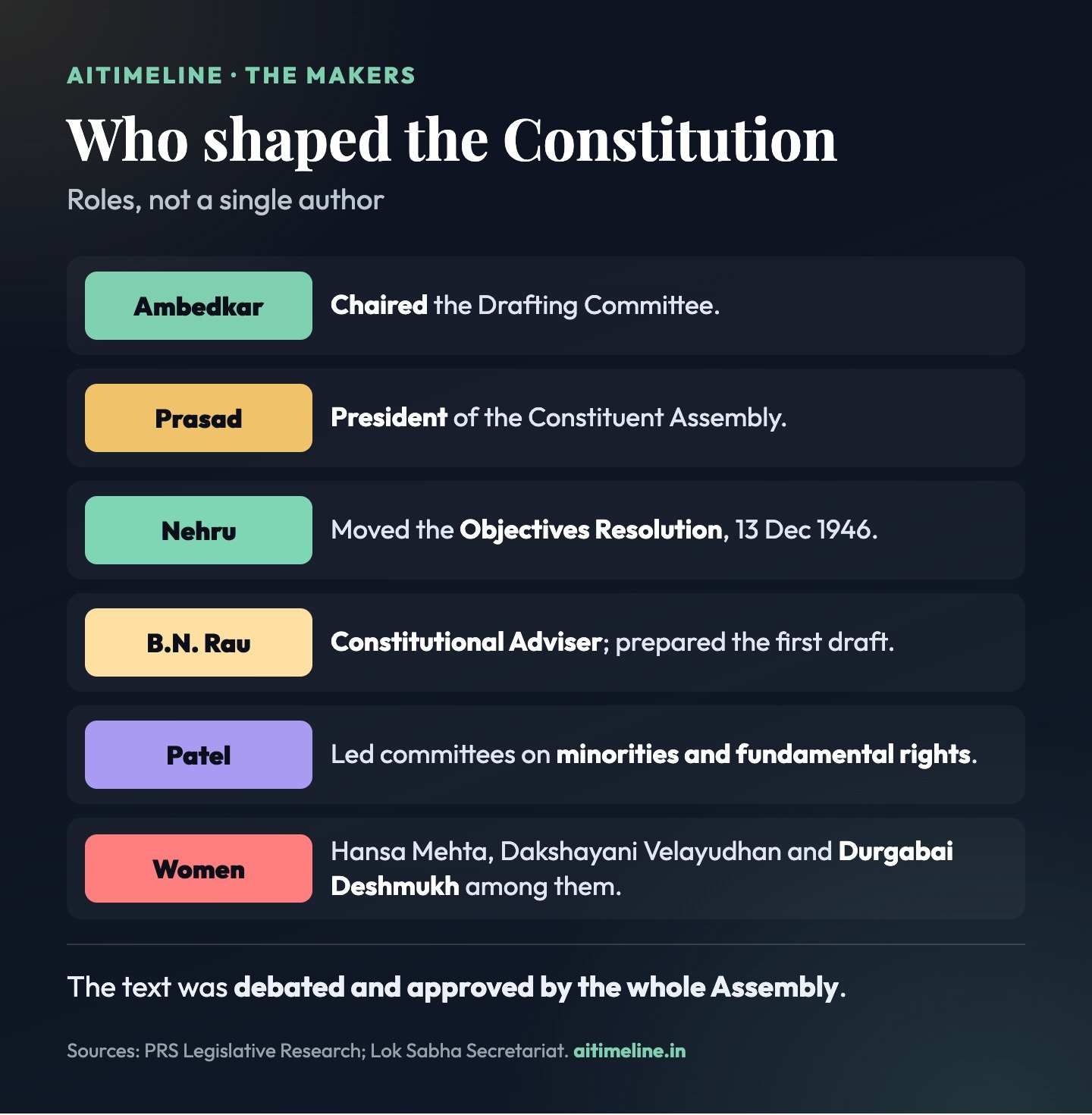
| Person | Contribution |
|---|---|
| Dr B.R. Ambedkar | Chairman, Drafting Committee |
| Dr Rajendra Prasad | President, Constituent Assembly |
| Jawaharlal Nehru | Moved the Objectives Resolution |
| B.N. Rau | Constitutional Adviser |
| Sardar Vallabhbhai Patel | Led key committees, including on fundamental rights and minorities |
| K.M. Munshi, Alladi Krishnaswami Ayyar, N. Gopalaswami Ayyangar | Drafting Committee members |
| Hansa Mehta, Dakshayani Velayudhan, Durgabai Deshmukh | Women members who contributed to debates on rights and social questions |
Ambedkar is widely called the Father of the Indian Constitution because he chaired the Drafting Committee and piloted the draft through the Assembly. The committee’s work rested on material prepared by B.N. Rau, and the final text was debated and approved by the whole Assembly.
The Constitution by the Numbers
What the Assembly produced and how long it took.
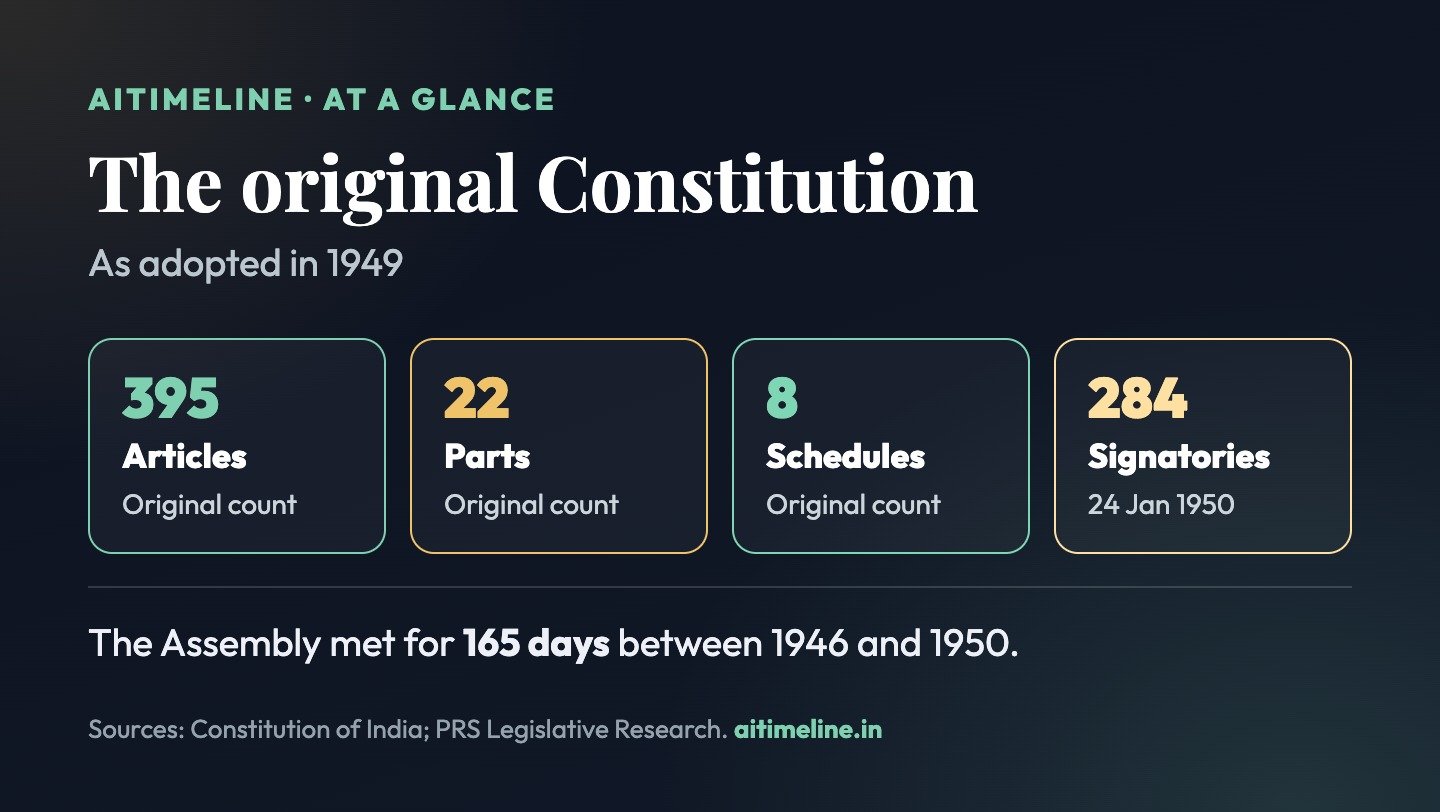
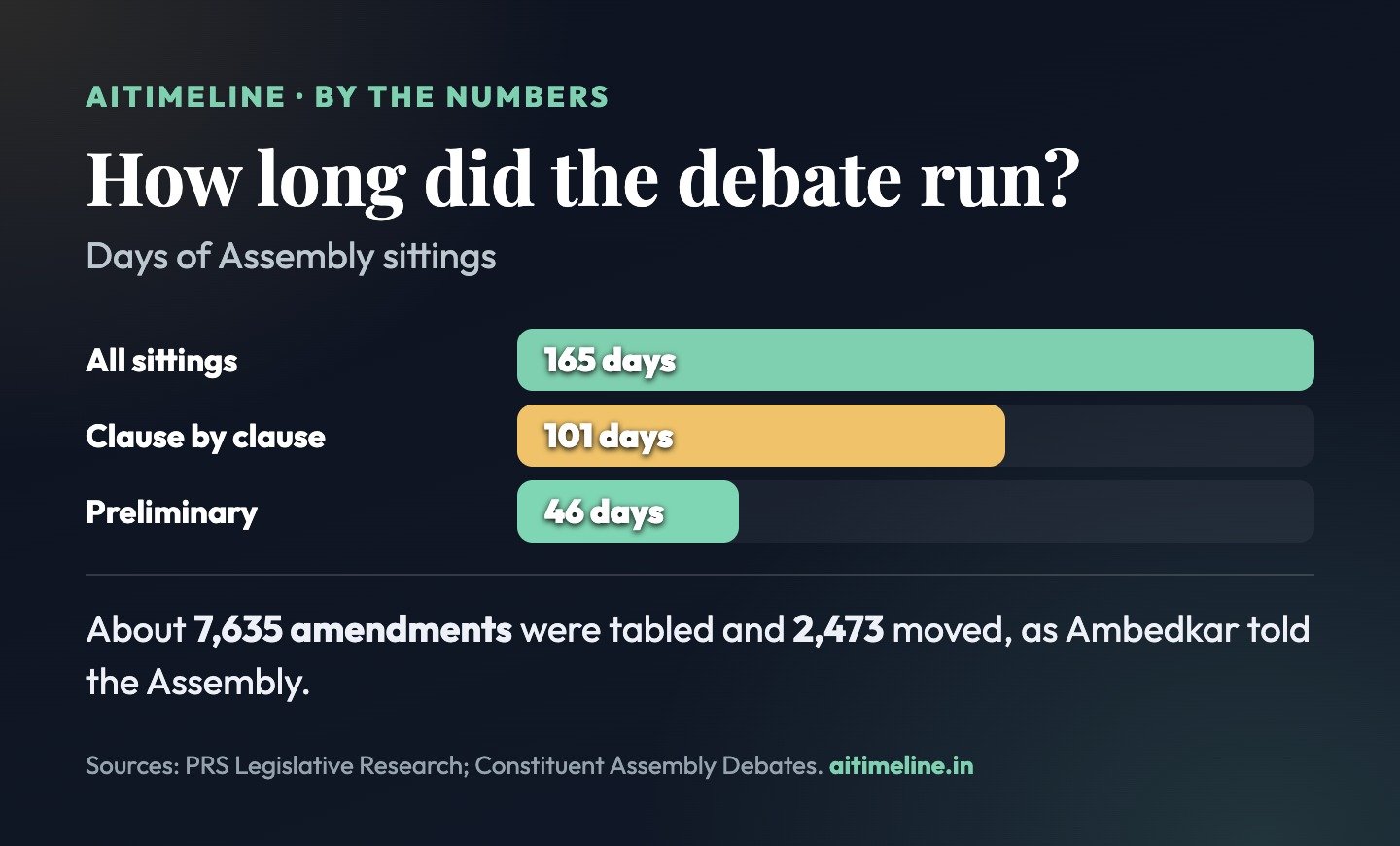
PRS Legislative Research counts 165 sitting days between 1946 and 1950, of which 101 were spent on the clause-by-clause reading of the draft. Dr Ambedkar told the Assembly that about 7,635 amendments had been tabled and 2,473 moved. The span from the first meeting on 9 December 1946 to adoption is 2 years, 11 months and 17 days; many sources say 18, counting both end dates. A 141-day figure for the Drafting Committee’s meetings appears widely, but we did not find it in a primary record we could open, so we leave it out of the numbers above.
The Preamble: What Changed in 1976
The 42nd Amendment.
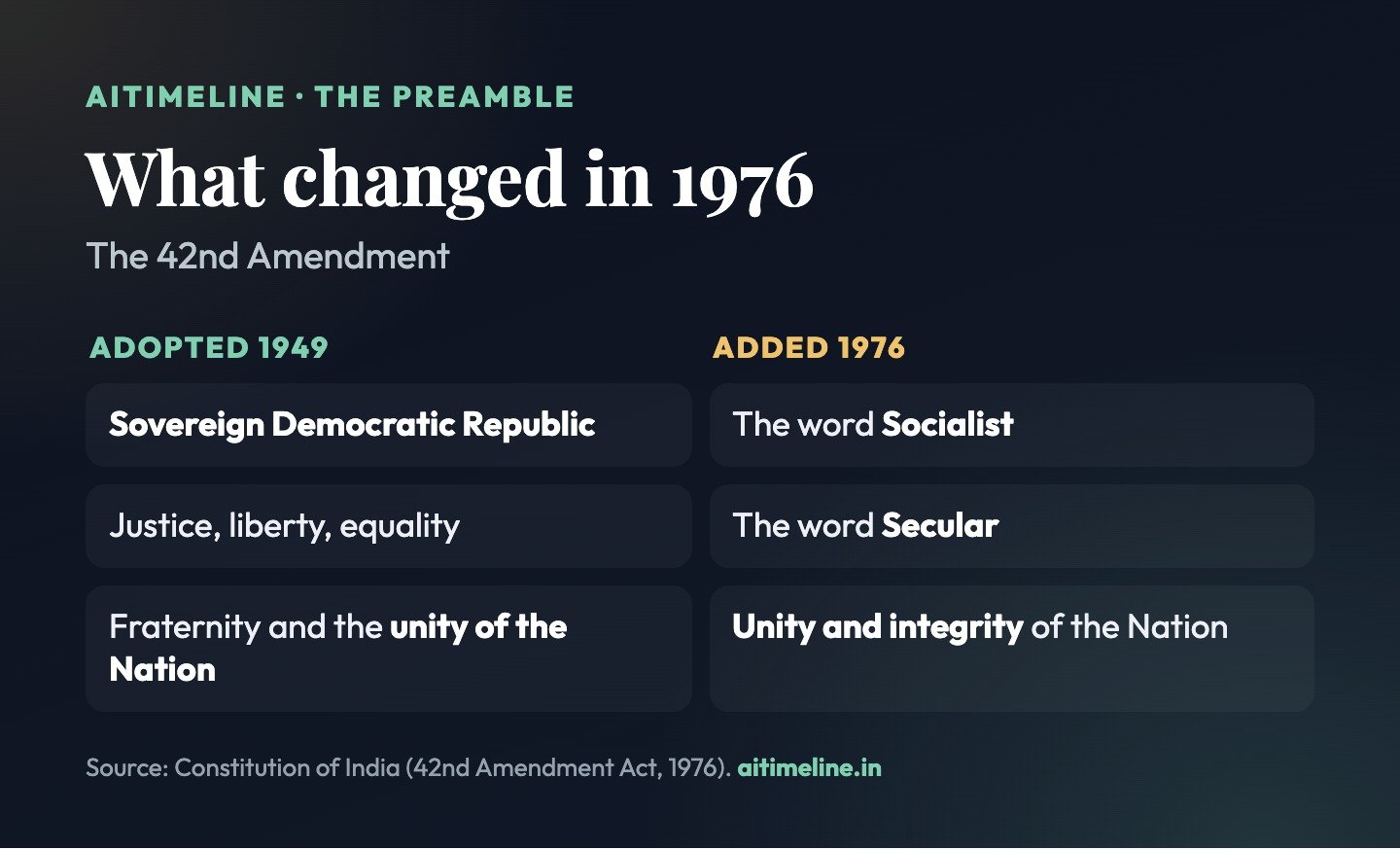
| Value | Meaning in the Preamble |
|---|---|
| Sovereign | Independent authority to govern |
| Socialist (1976) | Added by the 42nd Amendment |
| Secular (1976) | Added by the 42nd Amendment |
| Democratic | Government by the people |
| Republic | Elected head of state |
| Justice, Liberty, Equality, Fraternity | Social, economic and political justice; liberty of thought and belief; equality of status; dignity and unity |
How Constitution Day Is Observed
From the 2015 decision to 2026.
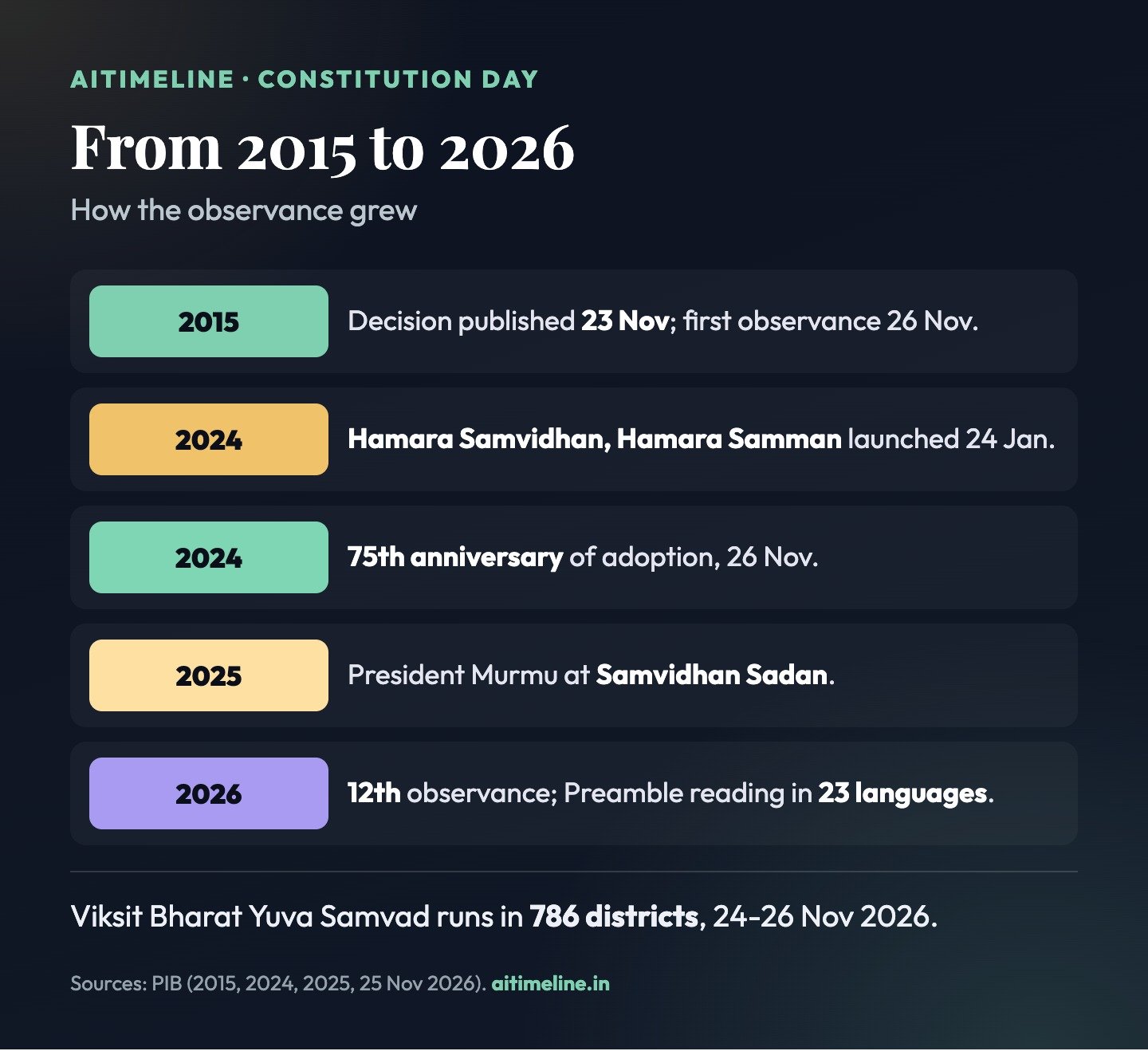
Common activities are collective readings of the Preamble, school assemblies, quizzes, debates and seminars. For 2026 the Ministry of Parliamentary Affairs lists an online Preamble reading in 23 languages through the MyGov pledge page, a quiz on MyGov and MyBharat from 18 to 26 November, and Viksit Bharat Yuva Samvad in 786 districts from 24 to 26 November.
Conclusion: A Document Finished in 1949, Working Since 1950
The Constitution emerged from almost three years of debate, and its adoption on 26 November 1949 is what Constitution Day remembers. Its force began on 26 January 1950.
The observance itself is young: it began in 2015. As India marks the 77th anniversary of adoption, the day is an occasion to read the text and understand the institutions and rights it created.
Explore More Timelines
People Also Ask
Frequently Asked Questions
⚠️ Editorial Note
Dates and counts come from the Constitution of India, PRS Legislative Research and PIB releases. Two details differ from the brief we received: PIB dated the Constitution Day announcement 23 November 2015, not 19 November, and Article 394 put 16 articles into force on 26 November 1949, so the Constitution did not wholly wait until 26 January. We did not find a primary source for a 141-day Drafting Committee figure, so we do not state it as fact. The 284 signatories and the 7,635 and 2,473 amendment counts are widely cited, and we attribute the amendment figures to Dr Ambedkar’s statement. This article is editorial information, not legal advice.
Related Stories
Sources & further reading
Every dated entry above was checked against these references. Last reviewed 26 November 2026.
- Constitution of India, Article 394 and Preamble (Legislative Department)
- PRS Legislative Research: Analysis of the Constituent Assembly Debates
- PIB: 26th November to be observed as 'Constitution Day' (23 Nov 2015)
- PIB: Address by President Ram Nath Kovind at the inaugural function of Constitution Day (26 Nov 2019)
- PIB: PM to participate in Constitution Day celebrations (24 Nov 2021)
- PIB: Hamara Samvidhan, Hamara Samman (22 Nov 2024)
- PIB: Celebrations on Samvidhan Diwas 2024, 75th anniversary of adoption
- PIB: President graces Constitution Day celebration at Samvidhan Sadan (26 Nov 2025)
- PIB: Constitution Day, 2026 to be observed on 26th November (25 Nov 2026)
- MyGov: Read the Preamble, Constitution Day 2026