Canada Supreme Court Upholds Quebec’s Religious-Symbol Restrictions: What It Means for Muslim Women
Canada's Supreme Court upheld most of Quebec's Bill 21, restricting religious symbols for some public workers. Explore the ruling and its impact.
Latest Story
On 27 November 2026 the Supreme Court of Canada largely upheld Quebec’s Bill 21, the 2019 law that bars designated public employees in positions of authority from wearing religious symbols at work. It covers hijabs, turbans, kippahs and visible crosses alike, and it falls hard on Muslim women who teach in public schools. The court found Quebec had validly used the notwithstanding clause, but struck one rule: the face-covering requirement as applied to members of the National Assembly. This page traces the law from the Quiet Revolution to the ruling, separates what the court found from what groups and governments said, and flags where sources disagree.
It is a Quebec law, not a national ban, and the court ruled on power, not on wisdom. Bill 21 applies only to designated roles in Quebec. The court held that Quebec could shield it with section 33, and said courts may still declare a law inconsistent with Charter rights; it made no such declaration here. Reports of the vote split conflict, so we give it by question.
💡 Short Answer
Canada’s Supreme Court ruled on 27 November 2026 (2026 SCC 41) that Quebec validly used the notwithstanding clause to protect Bill 21, so the ban on religious symbols for covered public employees stands. It found one provision unconstitutional: section 8’s face-covering rule, as applied to members of Quebec’s National Assembly, which infringes democratic rights under section 3. It is a Quebec law, not a nationwide ban on hijabs.
The Lead Picture: Key Dates, 2007 to 2026
Nine dates in order.
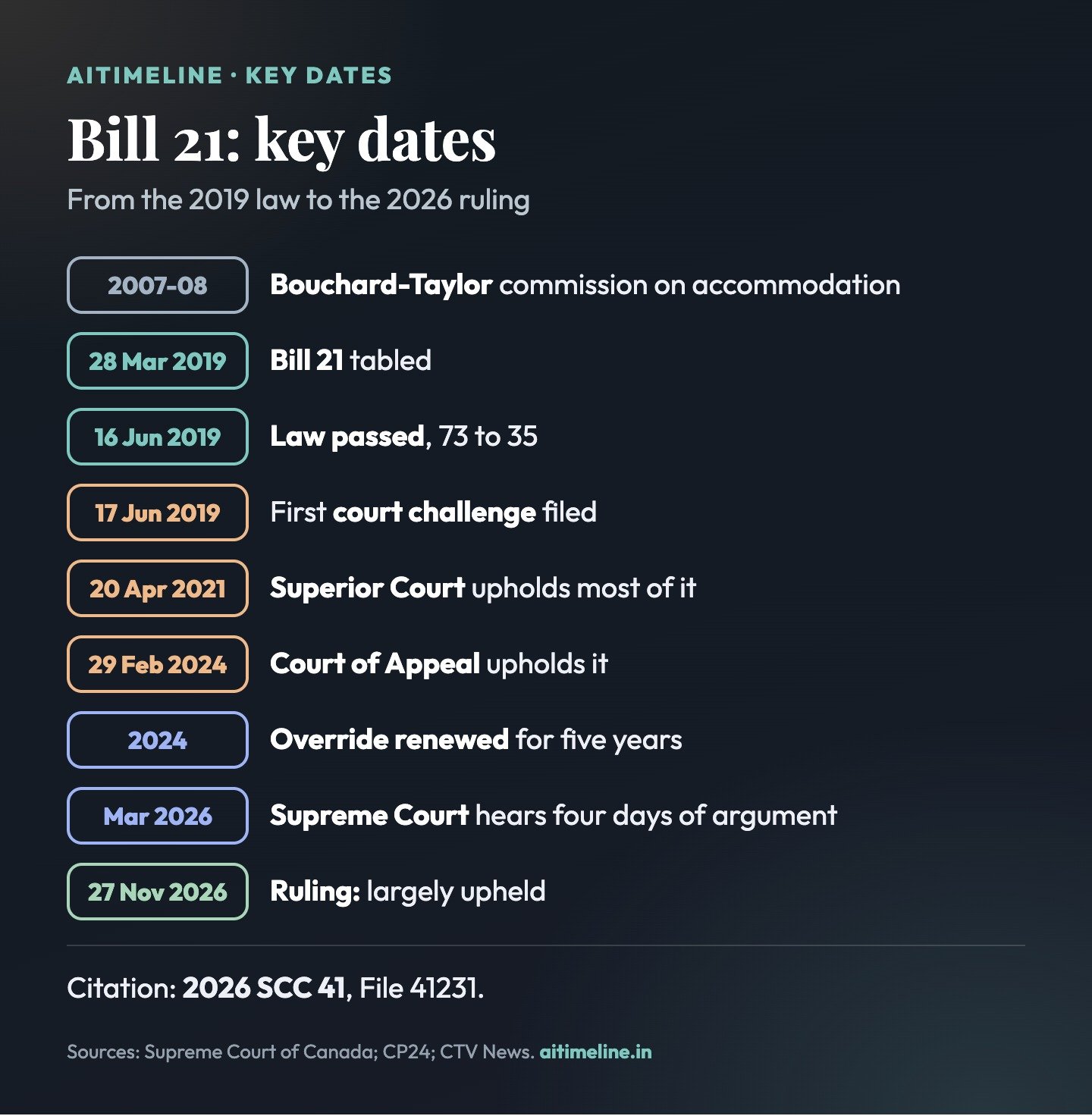
Quebec Bill 21: Key Questions
What the Record Shows
- The law stands: the appeals of the English Montreal School Board and others were dismissed on 27 November 2026.
- One provision fell: section 8, for members of the National Assembly, infringes section 3.
- The override held: section 33 of the Charter and section 52 of Quebec’s Charter were validly used.
- Courts keep a voice: they can declare inconsistency despite an override, but did not here.
- Section 28 is not a trump card: it guides interpretation but does not create a separate right.
- English schools lost: section 23 harm was not shown.
- It is not national: Bill 21 applies in Quebec, to designated roles.
- Reactions split: Quebec welcomed it; rights groups vowed to continue.
- The vote line-up is unclear: outlets disagree on counts, so we report by question.
Timeline: Bill 21, 2007 to 2026
Newest first. Labels mark background, the law, politics, courts and reactions.
Supreme Court largely upholds Bill 21 Courts
What it held: The court confirmed the validity of the Act respecting the laicity of the State, except one provision. It found Quebec had validly used the override in section 33 of the Canadian Charter and its counterpart in section 52 of Quebec’s own Charter, and it dismissed the appeals of the English Montreal School Board and other parties, and Quebec’s cross-appeal.
The exception: Section 8, which requires faces to be uncovered when public services are given or received, infringes the democratic rights in section 3 of the Canadian Charter to the extent that it applies to members of Quebec’s National Assembly. Section 33 cannot override section 3.
Two other findings: Section 28 (equal rights for women and men) does not create a separate right that can strike down a law on its own. The court also found it had not been shown that Bill 21 undermines the specific linguistic and cultural interests protected by section 23 for English-speaking Quebecers.
Quebec welcomes it; rights groups vow to continue Reaction
Quebec: Premier Paul St-Pierre Plamondon called it a “good day for secularism in Quebec” (CP24). Al Jazeera quotes him: “We worried about social peace if such a fundamental choice were to be invalidated by the Supreme Court.”
Ottawa: Mr Carney told CBC: “The core of the judgment is that the use of the notwithstanding clause for virtually all of the applications of what is called Bill 21 was appropriate.” Global News headlined that he committed to not using the clause himself; we could not confirm his exact wording.
Groups and provinces: The National Council of Canadian Muslims (NCCM) called the ruling a dark moment and said it would not stop its fight. The World Sikh Organization said it was deeply disappointed. Alberta’s Danielle Smith called it a win for provincial rights; Manitoba’s Wab Kinew called the law “legislative racism” while welcoming the ruling on declarations.
The justices split on religion, equality and declarations Courts
On section 3: CP24 and Yahoo report that all seven found the National Assembly face-covering rule unconstitutional. Al Jazeera reports that four of the seven agreed courts can formally declare a law inconsistent with Charter rights even when an override keeps it in force; only three would have issued such a declaration here, so none was made.
The dissent: Al Jazeera reports a partial dissent by Justices Andromache Karakatsanis and Michelle O’Bonsawin, who said there was no serious question that the law violates freedom of religion, adding that its effects “fall most heavily on Muslim women”. Chief Justice Richard Wagner wrote for three justices.
A caution: Outlets give different counts (4-3 on some questions, six of seven on the override). The Case in Brief gives no tally. We describe the split by question and avoid a single score.
The Supreme Court hears the appeals Courts
The issues: The court heard challenges on freedom of religion, equality rights, minority-language education and the reach of the notwithstanding clause. The appellants included the English Montreal School Board and individuals and groups opposed to the law.
What we could not confirm: The brief we were given listed 51 interveners and six attorneys general and exact hearing dates. One report we read puts outside intervener groups at 38. We use neither figure.
Top court agrees to hear the case Courts
The step: After the Court of Appeal upheld the law, the Supreme Court granted leave to appeal. As is its custom, it gave no reasons for doing so.
Date caution: The brief placed this in January 2025 and showed other steps in December 2021. We could not source those dates and say only 2025.
Quebec renews the override for five years Politics
Why it was needed: An override lapses after five years unless renewed, and the first one was due to expire in June 2024. Premier François Legault’s government tabled a bill to extend it; the Liberals opposed it.
What follows: A five-year renewal in 2024 runs into 2029. The Supreme Court’s ruling means the renewal also stands. We did not find the final vote count.
Quebec Court of Appeal upholds the law Courts
The ruling: In a decision of about 290 pages, the Court of Appeal held the law did not violate the Charter. It struck down the Superior Court’s exemption for English-language school boards.
What survived: Only the provision applying the face-covering rule to members of the National Assembly was judged unconstitutional, a result the Supreme Court later confirmed.
Superior Court upholds most of Bill 21 Courts
The ruling: The judge upheld most of the law because Quebec had invoked the override, but found that the face-covering rule could not apply to members of the National Assembly and that English-language school boards were exempt under minority-language education rights.
The human cost: He acknowledged that the law forces some people to choose between their religious beliefs and a career.
Challengers go to court a day after the law passes Courts
The claim: The groups argued the law violated freedom of religion and equality rights and harmed women who wear a hijab, as well as religious minorities.
Date caution: The brief said attempts to suspend the law were refused between July and November 2019. We found no source for those dates and omit them.
Bill 21 becomes law The law
The text: The Act respecting the laicity of the State bars designated public employees in positions of authority from wearing religious symbols at work. It also sets rules on uncovered faces for giving and receiving certain public services.
The override: Quebec used the notwithstanding clause in section 33 of the Canadian Charter and the matching clause in its own Charter, and added a grandfathering arrangement for some existing staff.
The Coalition Avenir Québec tables Bill 21 The law
The pitch: The government presented it as a way to entrench state secularism, restricting religious symbols for specified public employees.
The reaction: Civil-liberties groups, religious communities and critics raised equality and religious-freedom objections right away.
Bill 62 sets a religious-neutrality and face-covering rule Background
What it did: The law dealt with religious neutrality and with face coverings in public services and drew legal challenges over how it affects people who cover their faces for religious reasons.
Why it matters: It is part of the political background to Bill 21, which went further.
The Charter of Values proposal, Bill 60 Background
The proposal: Bill 60 would have prohibited public employees from wearing conspicuous religious symbols.
The outcome: It drew wide debate and lapsed before it could be passed, as the government lost power in the 2014 election.
Bill 94 proposes face-covering rules Background
The idea: The bill would have set rules on face coverings when giving or receiving certain public services.
Name warning: A much later bill also carries the number 94. This entry is the 2010 proposal, not that one.
Bouchard-Taylor Commission studies accommodation Background
The mandate: Quebec set up a commission on accommodation practices related to cultural differences. It examined religious accommodation, multiculturalism and relations between institutions and faith communities.
The legacy: Its work shaped the later argument over religious symbols and secularism.
The Quiet Revolution reshapes church and state Background
What changed: Quebec moved away from the Catholic Church’s wide influence over schools, hospitals and public institutions.
Why it is cited: Supporters of Bill 21 point to this history. Critics say it does not justify limiting what individual employees may wear.
What the Court Decided
Five findings in 2026 SCC 41.
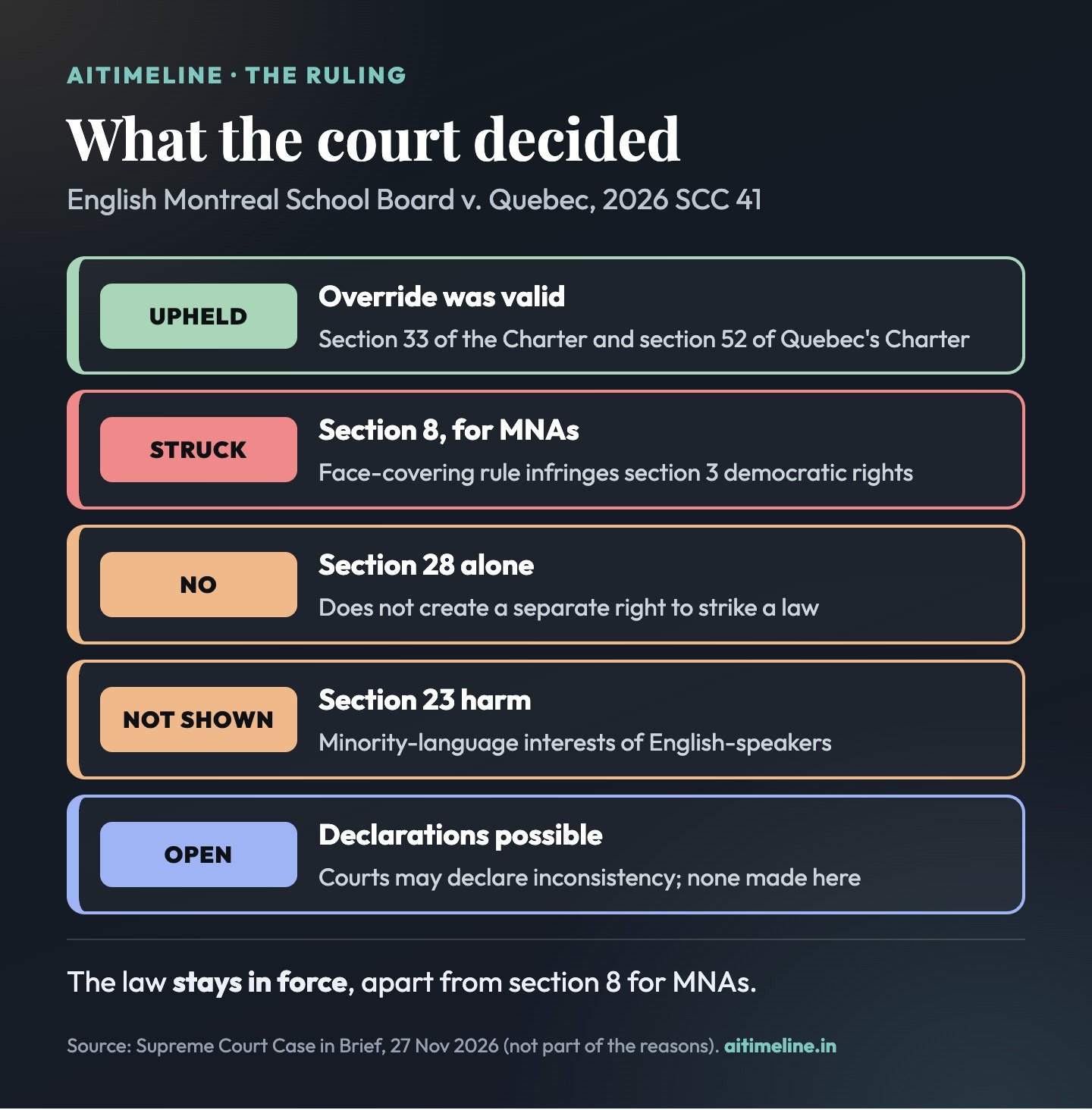
The summary comes from the court’s Case in Brief, which is a staff summary and does not form part of its reasons. The full reasons are on the court’s decisions site.
How the Court Divided
Counts differ by outlet.
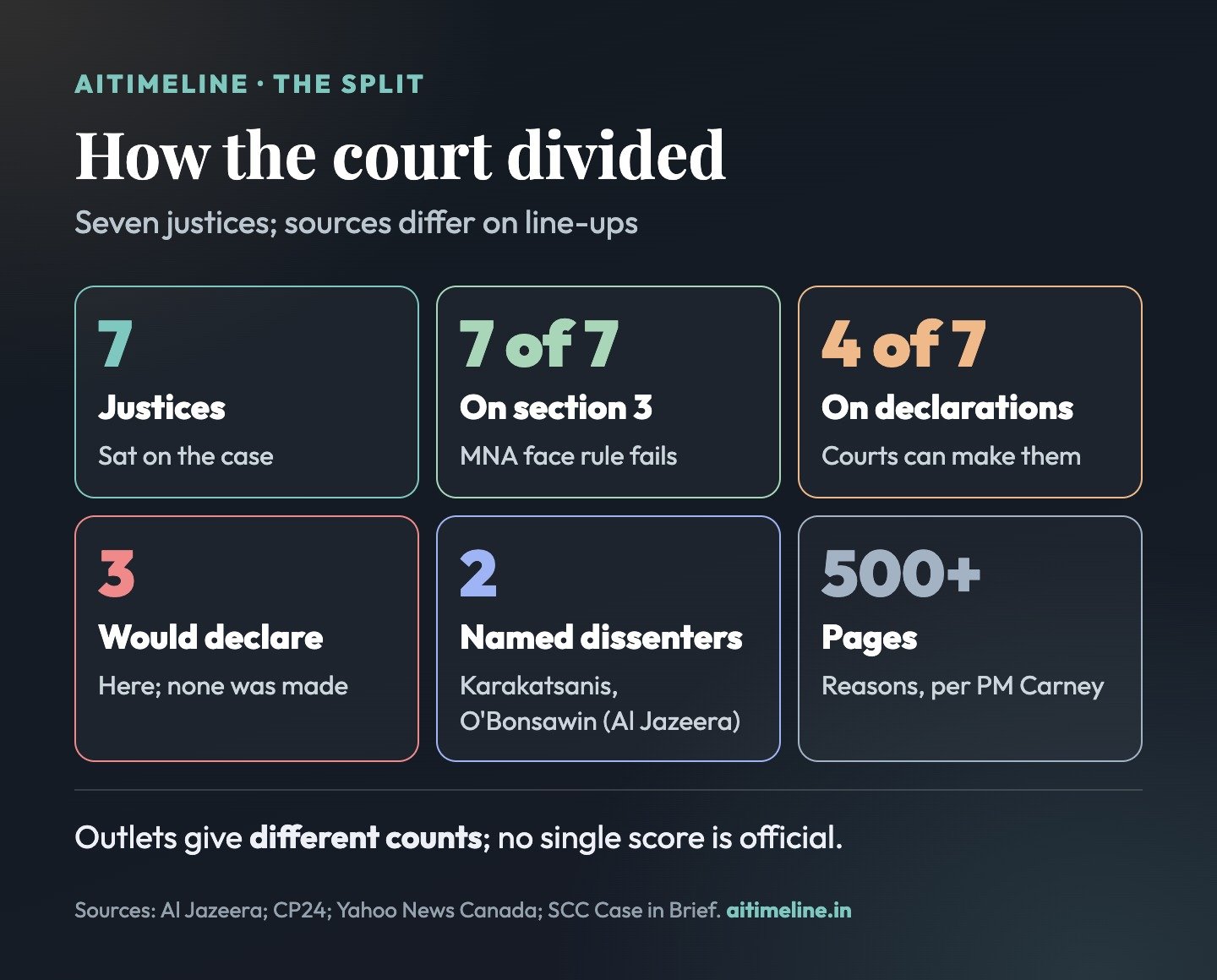
Al Jazeera, CP24, Yahoo News Canada and the Globe and Mail report different counts, including 4-3 on some questions and six of seven on the override. The Case in Brief lists groupings by question without a tally. We do not give a single score.
Who Said What
Reactions on the day.
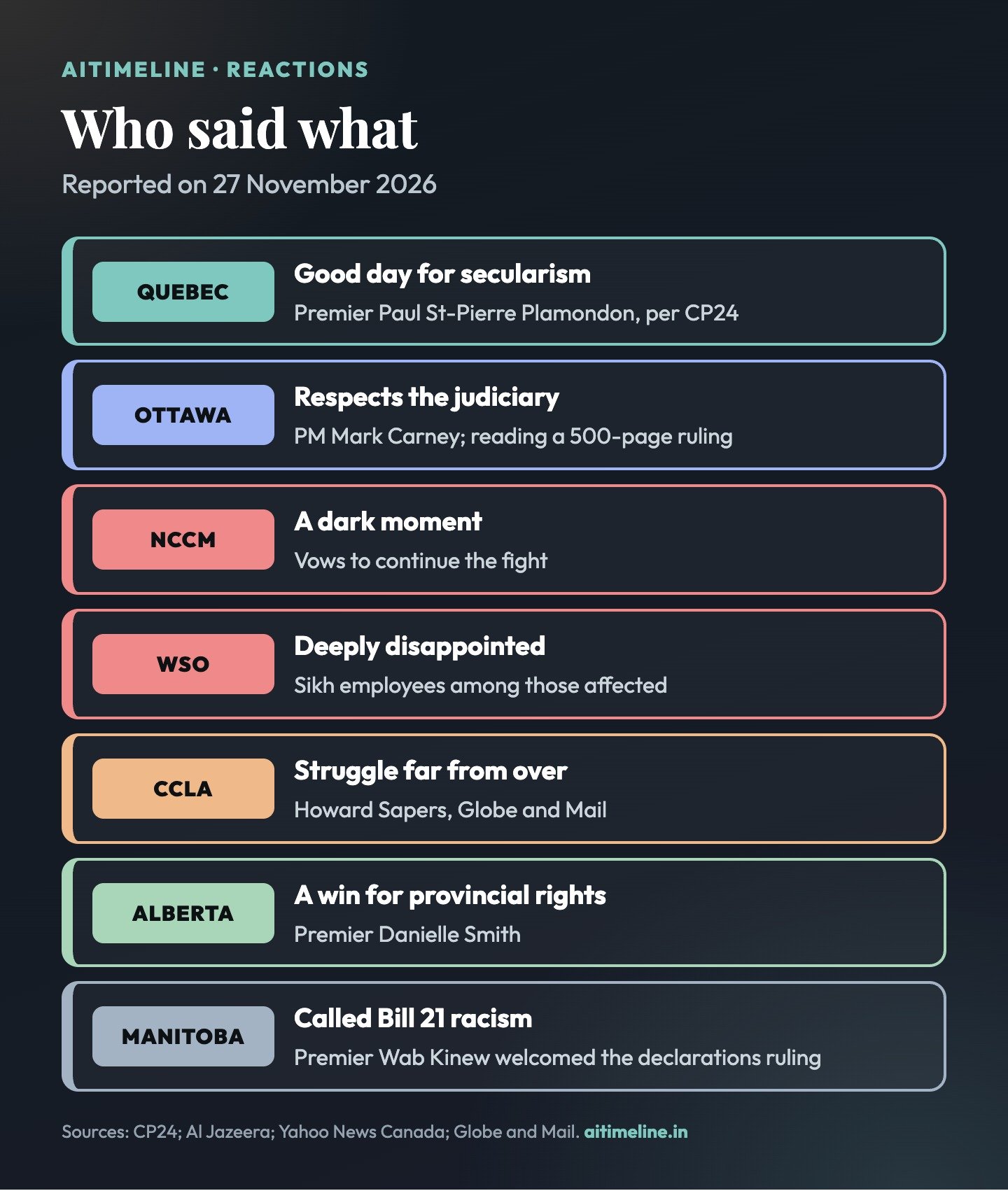
All reactions are as reported by Al Jazeera, CP24, Yahoo News Canada and the Globe and Mail on 27 November 2026. We could not confirm the exact wording of Mr Carney’s reported commitment not to use the notwithstanding clause himself; the Global News headline is the only source we read for it.
Who Bill 21 Covers
A Quebec law with a defined reach.
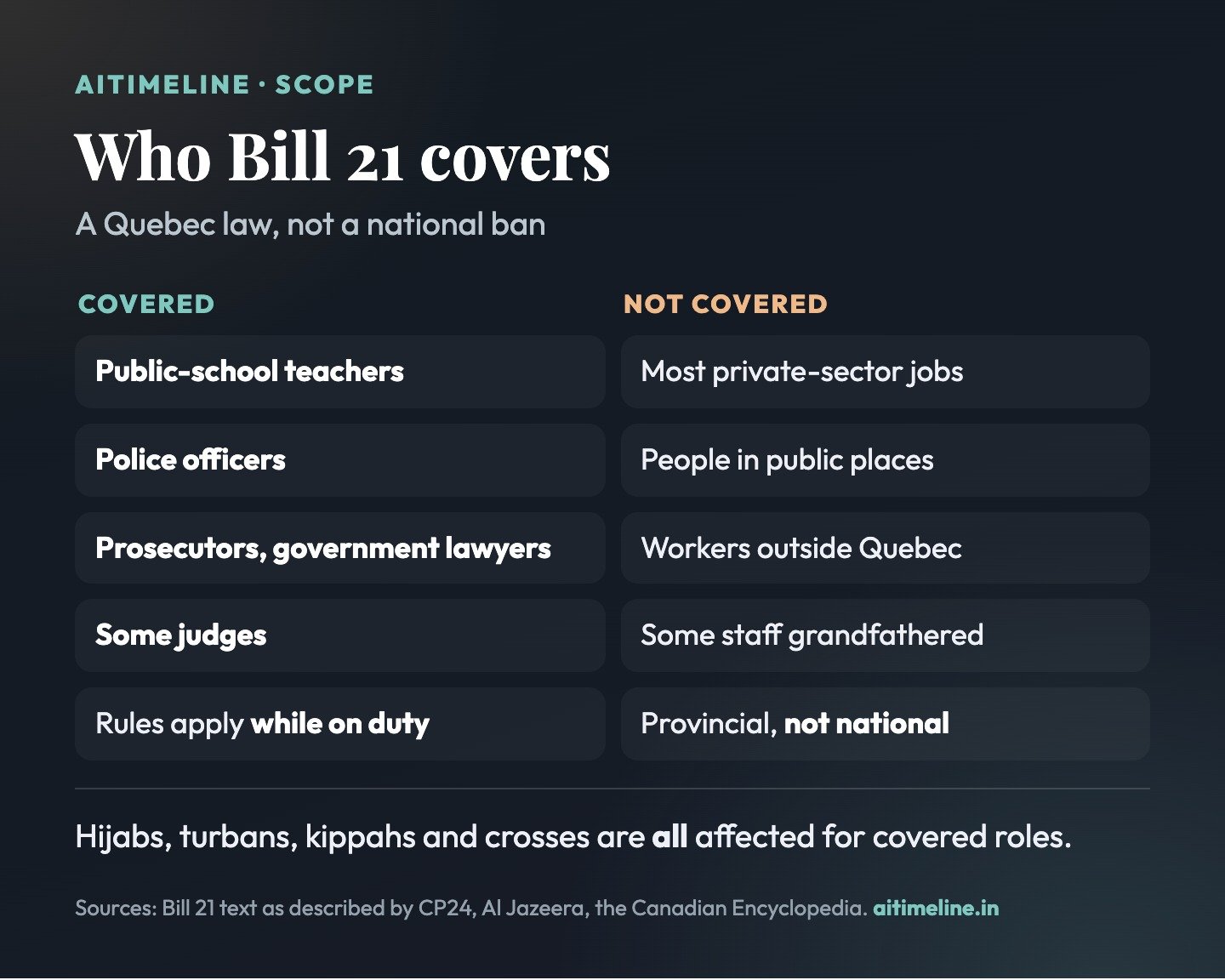
The exact reach depends on the role and the statute. The law also contains a grandfathering arrangement for some employees already in post when it was tabled, subject to conditions.
The Notwithstanding Clause
What section 33 can and cannot reach.
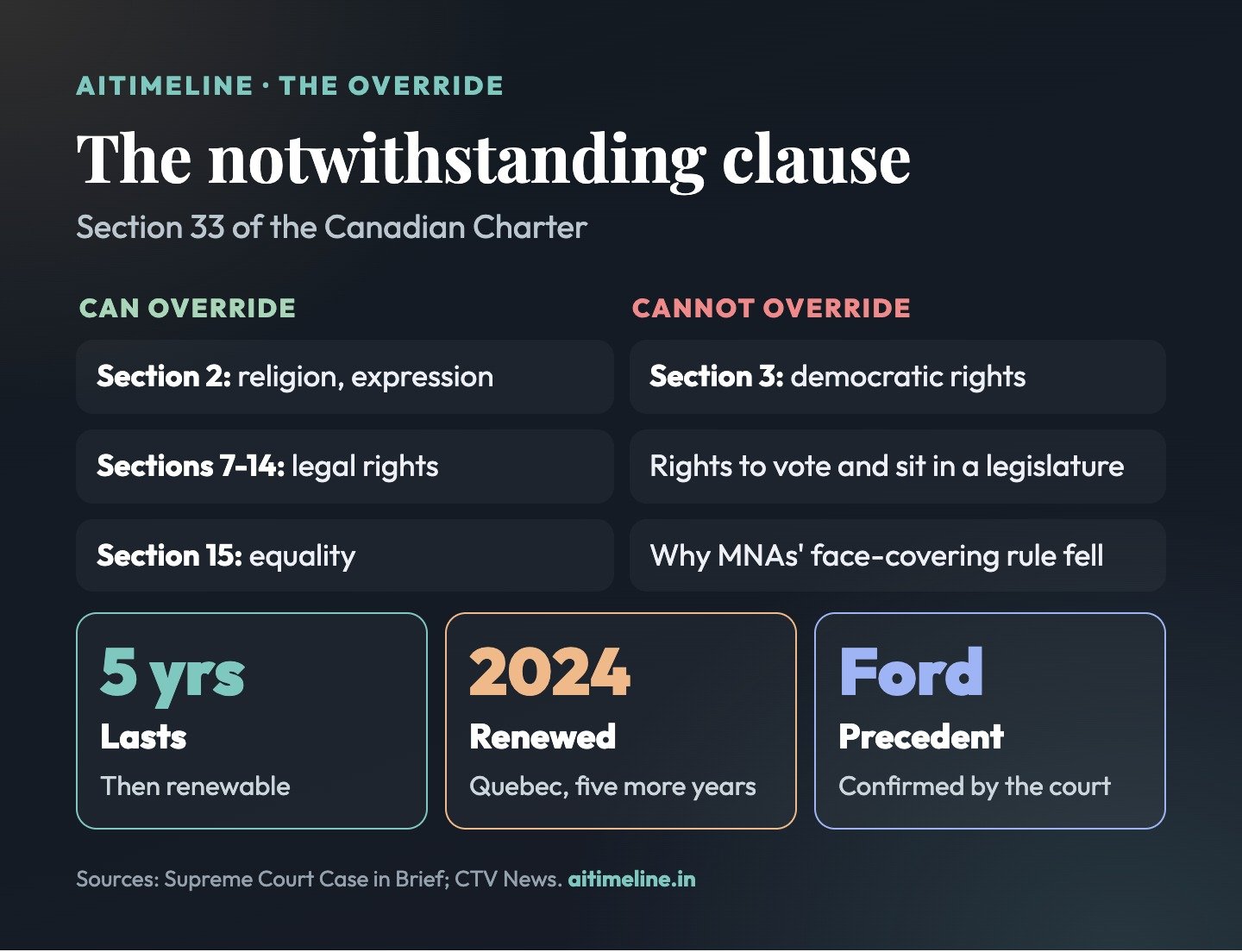
The court relied on the text, context and purpose of section 33 and confirmed the reading in Ford v. Quebec (Attorney General). The limit on section 3 is why the one provision could not be saved.
The Road to Bill 21
Four bills in nine years.
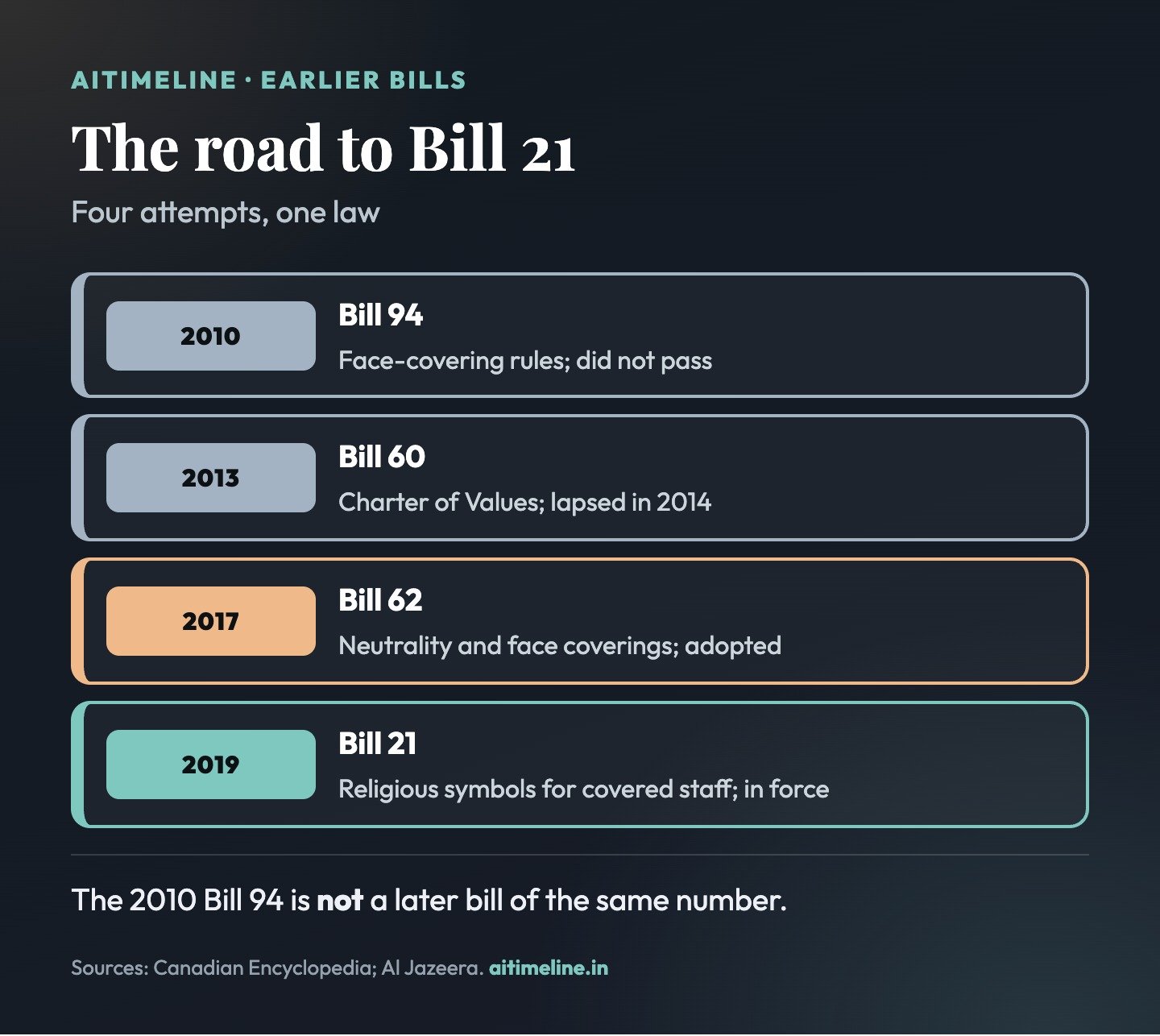
A later Bill 94 and a Bill 9 also appear in coverage of Quebec’s newer restrictions (Al Jazeera). They are separate from the 2010 proposal and are outside this timeline.
Source Gaps and Corrections
| Claim in the brief | What we found | Status |
|---|---|---|
| 51 interveners and six attorneys general | One report puts outside intervener groups at 38; no primary source read | Dropped |
| Hearing 23 to 26 March 2026 | Reported as four days in March | Hedged |
| Carney: government will not use the notwithstanding clause | Global News headline only; exact wording unconfirmed | Attributed |
| Single vote line-up | Outlets give 4-3, six of seven and unanimous on different questions | Given by question |
| Suspension requests refused July to November 2019 | No source found for those dates | Dropped |
| December 2021 appeals step; January 2025 leave | No source found; leave granted in 2025 | Hedged |
| Muslim women forced out of teaching (NCCM) | Only a reader comment cited a statistic | Dropped |
| Comparison table: France, Belgium, Austria, Netherlands, UK | No sources read; outside the ruling | Not used |
| Reuters, AP and Guardian coverage | Could not be opened here; not cited | Not cited |
Conclusion: A Constitutional Win for Quebec, an Open Argument for Canada
The Supreme Court’s ruling settles who may decide: a legislature that uses section 33 can protect a law like Bill 21 from most rights challenges. It does not say the law is good policy, and a partial dissent said its effects fall most heavily on Muslim women.
The law stays, apart from the National Assembly face-covering rule. The next questions are political: whether other provinces use the override more, how premiers and Ottawa respond, and whether challengers can use a declaration in future. The override is due for renewal again in 2029.
Explore More Timelines
People Also Ask
Frequently Asked Questions
⚠️ Editorial Note
This page draws on the Supreme Court of Canada’s Case in Brief, Al Jazeera, CP24 (CTV), Yahoo News Canada, the Globe and Mail, Global News and CTV Montreal. The Case in Brief is a staff summary and not part of the reasons. Quotes are as reported by those outlets. Reports of the vote split conflict and are given by question. Updated 29 November 2026. This is not legal advice.
Related Stories
Sources & further reading
Every dated entry above was checked against these references. Last reviewed 29 November 2026.
- Supreme Court of Canada: Case in Brief, English Montreal School Board v. Quebec (Attorney General), 2026 SCC 41 (27 November 2026)
- Supreme Court of Canada: full reasons, English Montreal School Board v. Quebec (Attorney General), 2026 SCC 41
- Al Jazeera: Canada's top court largely upholds Quebec's religious symbols ban (27 November 2026)
- CP24 / CTV News: Supreme Court of Canada upholds Quebec's secularism law (27 November 2026)
- Yahoo News Canada: Supreme Court ruling on Quebec's Bill 21 sparks fierce reaction across Canada (27 November 2026)
- The Globe and Mail: Bill 21 Supreme Court ruling reaction, live updates (27 November 2026)
- Global News: Carney commits to not using notwithstanding clause after Bill 21 ruling (November 2026)
- The Canadian Encyclopedia: Bill 21
- CTV News Montreal: Quebec Appeal Court Bill 21 ruling fuels debate on notwithstanding clause (March 2024)
- CTV News Montreal: Bill 21, Quebec set to renew notwithstanding clause for another five years (February 2024)