8th Pay Commission Timeline 2025–2027: Salary Hike, Fitment Factor, DA & Arrears
The 8th Pay Commission was constituted November 3, 2025 under Justice Ranjana Prakash Desai, with 18 months to report. Track what is officially confirmed
Latest Story
If you search for the 8th Pay Commission today, you can find almost any salary number you want. ₹46,260. ₹54,000. ₹58,500. ₹69,000. The problem: none of those figures is the government’s final 8th Pay Commission minimum salary. The Commission is real. Its Chairperson — Justice Ranjana Prakash Desai — is appointed. Consultations are underway across the country. Employee unions have submitted detailed demands. But the final fitment factor, pay matrix, allowances, pension formula, implementation date and arrears rules have not yet been decided. That gap between what is official and what is being demanded is what this 8th Pay Commission timeline tracks.
Data last verified: 2 September 2026. Every salary figure below is labelled OFFICIAL, UNION DEMAND, MEDIA/EXPERT SCENARIO, CALCULATOR EXAMPLE or UNKNOWN. No fitment factor, salary hike, arrears amount, implementation month, DA merger, HRA revision or pension increase is presented as official unless the Government of India or the 8th Central Pay Commission has formally announced it.
🧠 AI Overview Summary
The 8th Central Pay Commission was formally constituted on November 3, 2025, chaired by Justice Ranjana Prakash Desai, with 18 months to submit recommendations — pointing to around May 2027 if it uses the full period. The government has said the effect of its recommendations would normally be expected from January 1, 2026, based on the usual ten-year cycle, but no fitment factor, minimum salary or implementation date has been officially announced. Dearness Allowance for central employees is confirmed at 60% of basic pay effective January 1, 2026. The widely quoted ₹69,000 minimum-pay figure comes from the NC-JCM Staff Side’s proposed 3.833 fitment factor — a union demand, not a government decision.
What Is Official, and What Isn’t?
What is actually settled as of September 2026
- The Commission exists and is working. Constituted November 3, 2025, under Justice Ranjana Prakash Desai, it has spent 2026 collecting data, receiving union memoranda and holding stakeholder consultations across multiple cities.
- No fitment factor has been announced. Every number circulating — 2.86, 3.00–3.25, 3.833 — is a union demand or historical reference, not a government figure.
- DA is confirmed at 60%, effective January 1, 2026 — the one genuinely official 2026 salary-related update on this page.
- January 1, 2026 is an expectation, not a guarantee. The government has said the effect would “normally” begin from that date based on the ten-year cycle — that is different from a legally notified effective date.
- Arrears are not yet confirmed. Whether employees receive retrospective pay from January 1, 2026 depends entirely on the final implementation order, which has not been issued.
- DA does not automatically merge into basic pay at any threshold — there is no rule requiring it, though a new pay structure typically absorbs accumulated DA into the revised base.
- Pre-2026 pensioners face a genuine open question. The Commission’s Terms of Reference do not explicitly cover pension revision for employees who retired before January 1, 2026 — pensioner bodies have flagged this to the PMO.
- The Commission Chairperson has a second major assignment. Justice Desai’s appointment to head Uniform Civil Code drafting committees has raised employee-body concern about possible delay to the 8th CPC’s own report.
🔴 Reading the labels used throughout this article
🟢 OFFICIAL — announced by the Government of India, Department of Expenditure, Cabinet or the 8th CPC itself. 🟡 UNION DEMAND — a figure proposed by an employee federation or association. 🟠 MEDIA/EXPERT SCENARIO — an outside estimate or analyst projection. ⚪ CALCULATOR EXAMPLE — an illustrative number generated by this article’s own scenario tool. ❓ UNKNOWN — genuinely undecided, with no credible figure to report.
The 8th Pay Commission Exists — So Why Haven’t Salaries Changed Yet?
A pay revision is a process, not an instant event
As of September 2026, this process sits at step 4/5 — consultation and data collection. Steps 7 through 10 have not happened yet.
THE 8TH PAY COMMISSION IS OFFICIAL.
THE SALARY HIKE IS NOT YET FINAL.
Commission Constitution: The Correct Chronology
Three separate events, often merged into one in headlines
In January 2025, the government announced its intention to form the 8th Central Pay Commission. That announcement alone did not create a working commission — it took ten more months for the Terms of Reference to be approved and the Commission to be formally notified. On 28 October 2025, the Union Cabinet approved the Commission’s Terms of Reference, instructing it to examine emoluments, allowances and working conditions for central government employees and to recommend a pay structure balancing employee retention with fiscal prudence. On 3 November 2025, the 8th CPC was formally constituted through a government notification, starting its 18-month clock.
Who Decides? The Commission’s Composition
| Role | Name | Background |
|---|---|---|
| Chairperson | Justice Ranjana Prakash Desai | Former Judge, Supreme Court of India |
| Part-Time Member | Prof. Pulak Ghosh | IIM Bengaluru |
| Member-Secretary | Pankaj Jain | IAS officer |
These three study, consult and recommend. Their recommendations do not automatically become law — final acceptance requires government examination, Cabinet decision and formal notification.
The 18-Month Clock — and the Interim Report Clause
The Commission’s Terms of Reference give it 18 months from 3 November 2025 to make its recommendations — pointing to approximately May 2027 if the full period is used. That is an indicative window implied by the mandate, not a confirmed report date; the Commission could finish earlier or, per employee-body concerns below, risk running later.
The Terms of Reference also allow the Commission to submit interim reports when recommendations on specific matters are finalized ahead of the rest. That means the final report is not necessarily the Commission’s first output — but no specific interim salary revision should be assumed until the Commission actually issues one.
January 1, 2026 — Expected Effective-Date Anchor
The most misunderstood date in this entire story
Going by the usual ten-year pay-commission cycle, the government has said the effect of 8th CPC recommendations would normally be expected from January 1, 2026. This is a real, government-stated expectation — but it is not the same as “all revised salary and allowances are legally guaranteed from January 1, 2026.” No implementation order has been issued, so nothing has actually taken effect on that basis yet.
It is also incorrect to say the 7th Pay Commission “expired” on December 31, 2025. The 7th CPC pay structure continues until new rules are formally notified. Central government employees are, as of September 2026, still drawing salary under the 7th CPC pay matrix, current DA and existing allowances.
✅ Accurate framing
- Jan 1, 2026 is the government’s stated normal-cycle expectation
- 7th CPC pay structure remains in force until superseded
- Actual effective date depends on final notification
❌ Inaccurate framing
- “7th CPC expired Dec 31, 2025”
- “Salaries changed automatically from Jan 1, 2026”
- “Arrears from Jan 2026 are guaranteed”
DA Status: The One Confirmed 2026 Update
Up from 58% to 60%, effective January 1, 2026
As of January 1, 2026, Dearness Allowance for central government employees rose from 58% to 60% of basic pay. The Department of Expenditure, Ministry of Finance, issued the formal order on 22 April 2026, benefiting an estimated 50.46 lakh employees and 68.27 lakh pensioners (via the matching Dearness Relief hike). This is a routine, twice-yearly cost-of-living adjustment under the existing 7th CPC formula — separate from, and not dependent on, the 8th CPC’s still-pending recommendations.
Will DA Merge With Basic Pay?
Not automatically. There is no rule stating that DA must merge into basic pay once it crosses 50% or 60%. A future pay commission typically accounts for accumulated inflation compensation when constructing a new pay structure — and when a new structure is implemented, the fitment methodology commonly absorbs existing DA into the revised base, after which a new DA series can restart from a lower point. But no rule requires DA to reset to a specific percentage on a specific date for the 8th CPC until official implementation rules say so.
What Is the Fitment Factor?
Existing basic pay × fitment factor = indicative revised basic pay
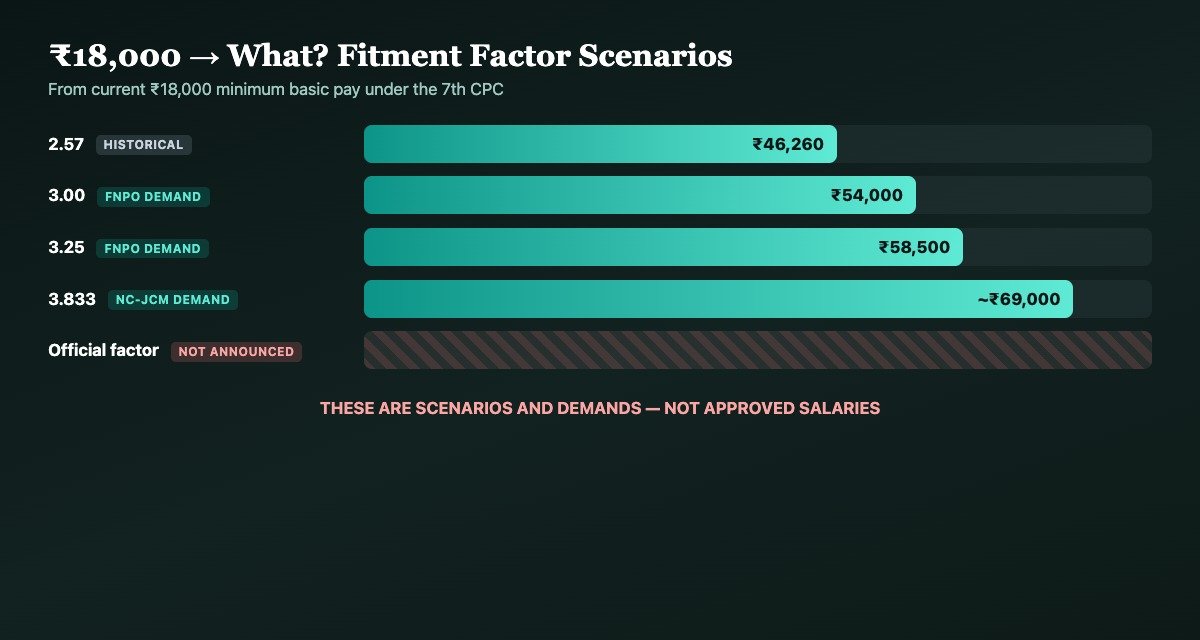
A fitment factor is a single multiplier applied to existing basic pay to construct a new, revised basic pay. For example, ₹18,000 × 2.57 = ₹46,260 — that 2.57 is the 7th CPC’s historical factor, not an 8th CPC prediction. The actual pay matrix that emerges from any fitment exercise also involves rounding, level restructuring, scale mergers and minimum-pay methodology — a single multiplication is only ever an indicative starting point, not the final number.
| Scenario | Fitment Factor | ₹18,000 Example | Status |
|---|---|---|---|
| 7th CPC historical factor | 2.57 | ₹46,260 | Historical comparison only |
| FNPO demand (Levels 1–5) | 3.00 | ₹54,000 | Union demand |
| FNPO demand (Levels 16+) | 3.25 | ₹58,500 | Union demand |
| NC-JCM demand | 3.833 | ~₹69,000 | Union demand |
| Official 8th CPC factor | Not announced | Unknown | Pending |
These are scenarios and demands — not approved salaries. No ranking of “most likely” is implied by table order.
Why a 3.8× Fitment Factor Doesn’t Mean Your Salary Quadruples
If ₹18,000 × 3.833 = ₹68,994, that does not mean take-home pay would rise 283%. The current ₹18,000 basic already carries 60% DA on top of it (₹10,800), for ₹28,800 before HRA, TA and other allowances. When a new pay structure begins, the treatment of that existing DA changes — some of the inflation compensation already being paid gets absorbed into the new, larger basic figure. So the correct comparison is total compensation before vs. after, not new basic against old basic alone.
Does a 3.83 fitment factor mean a 283% salary hike?
No. A fitment factor is used to construct revised basic pay. The current basic already has DA paid separately on top of it. When a new pay structure begins, the treatment of DA changes, so the percentage increase in basic pay is not the same as the increase in total take-home salary.
8th Pay Commission Scenario Calculator
Illustrative only — this is not an official salary calculator
NC-JCM and FNPO: What Are Unions Actually Demanding?
The NC-JCM (National Council – Joint Consultative Machinery) Staff Side held its first Standing Committee meeting with the 8th CPC on 28 April 2026, following an earlier memorandum proposing a fitment factor of 3.833, implying a minimum basic pay of roughly ₹69,000 from the current ₹18,000. NC-JCM also proposed a 6% annual increment, two increments on promotion (subject to a minimum benefit of ₹10,000), and calculated its minimum-wage estimate using a five-member family unit instead of the three-member unit used for the 7th CPC.
The Federation of National Postal Organisations (FNPO) separately proposed a level-dependent fitment factor: 3.00 for Levels 1–5 (to correct wages for the lowest-paid cadres), 3.05–3.10 for Levels 6–12, and up to 3.25 for Levels 16 and above — based on the Akroyd Formula for calculating a minimum living wage.
These are demands and proposals submitted to the Commission, not figures the Commission has accepted. Other federations, including the Central Government Employees’ Confederation and the All India Defence Employees’ Federation, have submitted their own charters of demands covering pay, allowances and service conditions.
🔴 Demanded ≠ Recommended ≠ Accepted
A union proposing 3.833 does not mean the Commission will recommend 3.833. A Commission recommendation does not mean the government will accept it unmodified. Each step in that chain requires a separate, real decision that has not yet happened.
Will 8th Pay Commission Arrears Start From January 1, 2026?
Not yet confirmed
The government has said the effect of 8th CPC recommendations would normally be expected from January 1, 2026, based on the usual ten-year cycle. Historically, pay revisions can be implemented later with retrospective effect — but employees could receive arrears only if the government ultimately gives the revised pay and pension structure retrospective effect from January 1, 2026, once the final recommendations are accepted and notified. That has not happened. There is no fixed length for the government’s review period after the Commission reports, so no date should be assumed for when this decision itself will be made.
Will 8th Pay Commission arrears be paid from January 2026?
Arrears from January 1, 2026 have not yet been formally guaranteed. The government has said the effect would normally be expected from that date based on the ten-year cycle, but the actual effective date and arrears rules depend on the final recommendations and the government’s implementation order — neither of which has been issued as of September 2026.
The Arrears Question Most Employees Are Missing: HRA
A historical precedent worth tracking — not a guarantee
Under the 7th Pay Commission, revised basic pay took effect from January 1, 2016, and the Cabinet approved the main pay recommendations in June 2016. But revised allowances — including House Rent Allowance — did not become effective until July 1, 2017, a full 18 months later, following the Ashok Lavasa Committee’s review. Employees did not receive retrospective revised-HRA arrears back to January 2016.
If the 8th CPC follows a similar pattern, revised basic pay could potentially be given retrospective effect while revised allowances start later — creating a real difference between “pay arrears” and “allowance arrears.” This has not yet been decided for the 8th CPC — the 7th CPC’s history does not guarantee the 8th CPC will follow the same treatment.
| 7th CPC (historical) | 8th CPC (current) | |
|---|---|---|
| Pay effective date | January 1, 2016 | Expected Jan 1, 2026 (unconfirmed) |
| Cabinet approval of pay | June 2016 | Not yet reached |
| Revised allowances (incl. HRA) effective | July 1, 2017 | Unknown |
What About Pensioners?
The 8th CPC’s Terms of Reference cover retirement benefits and service conditions, and pensioner organizations have submitted their own demands. But as of September 2026, a genuine controversy remains unresolved: the Commission’s Terms of Reference notification does not explicitly state that pensions of employees who retired before January 1, 2026 will be revised. Bharat Pensioners Samaj (BPS) and the All India Defence Employees’ Federation (AIDEF) flagged this “vague language” in a letter to the Prime Minister’s Office, and the Department of Personnel and Training has forwarded representations seeking an amendment to the ToR to the Department of Expenditure. In November 2025, Union Minister Jitendra Singh gave a verbal assurance that old pensions would be revised and pensioners’ interests protected — but as of this writing, no written amendment to the Terms of Reference has been issued.
Do not interpret the forwarding of a representation as government approval. It means the request is under consideration, not that it has been granted.
Why the Fitment Factor Is a Political and Fiscal Number — Not Just a Math Formula
The Terms of Reference explicitly instruct the Commission to weigh fiscal prudence, development and welfare spending, non-contributory pension costs, state-government finances, and comparisons with public and private sector pay alongside employee purchasing power. A pay commission recommendation is therefore never simply an inflation calculation — it is a balance between employee compensation and the government’s overall fiscal position.
States, Railways, Defence and Other Services
8th CPC recommendations apply directly to central government pay structures. State governments typically adopt central recommendations with their own modifications and timelines — not automatically or simultaneously. Different central services (Railways, Defence and others) may also carry their own specific allowances, risk/hardship pay or special pay structures beyond a single uniform calculation.
2026: The Data and Consultation Year
Rather than moving toward implementation, 2026 has been the Commission’s data-collection and consultation year. The Commission invited memoranda and suggestions from employees, pensioners and their associations, and requested employee/manpower data from every Ministry, Department and Union Territory.
The memorandum-submission deadline was extended twice — from 30 April 2026 to 31 May 2026, and finally to 15 June 2026. The Ministries/Departments/UTs data-submission deadline, originally 30 June 2026, was further extended to 31 July 2026 in an order issued on 30 June 2026.
Through July–September 2026, the Commission held or scheduled in-person stakeholder consultations: Jaipur (31 August–1 September), Chennai (7–8 September), Puducherry (9 September) and Chandigarh (16–18 September), with employee and pensioner organizations required to request appointments in advance of each visit.
⚠️ A New Delay Risk: Justice Desai’s Additional UCC Assignments
Justice Ranjana Prakash Desai, while chairing the 8th CPC, has also been appointed to head Uniform Civil Code drafting committees for Uttarakhand, Maharashtra and, most recently, West Bengal. The All India NPS Employees Federation (AINPSEF) has publicly raised concern about the cumulative workload on the Chairperson and its potential to delay the 8th CPC’s report, and employee organizations have urged the government to confirm the Commission’s 18-month timeline will not be affected. As of September 2026, no delay has been officially confirmed — but the concern itself is real and worth tracking.
8th Pay Commission: Full Timeline
Formation of 8th CPC Announced
What happened: The government announced its intention to form the 8th Central Pay Commission.
Why it matters: Marked the start of a process that would take almost a year to formally constitute.
28 ’25
Cabinet Approves Terms of Reference
What happened: The Cabinet approved the Commission’s Terms of Reference, naming Justice Ranjana Prakash Desai as Chairperson.
3 ’25
8th CPC Formally Constituted
What happened: Government notification formally constituted the Commission, starting its 18-month recommendation window.
DA Raised to 60%; NC-JCM Submits 3.833 Demand
What happened: DA rose from 58% to 60% effective Jan 1, 2026 (order issued 22 April); NC-JCM’s Standing Committee met the 8th CPC on 28 April, proposing a 3.833 fitment factor and ~₹69,000 minimum pay.
Memorandum and Data Deadlines
What happened: Memorandum submissions closed 15 June (after two extensions); the Ministries/Departments data-portal deadline of 30 June was further extended to 31 July.
State-Level Stakeholder Consultations
What happened: The Commission’s in-person consultation tour began in Jaipur (31 August–1 September) — already completed as of this update. Chennai (7–8 September), Puducherry (9 September) and Chandigarh (16–18 September) are scheduled but had not yet taken place as of September 2, 2026.
Current Status: Consultation, Not Implementation
What happened: No fitment factor, minimum pay, arrears rule or implementation date has been announced. The Commission continues data analysis and consultation, with concerns raised about the Chairperson’s added UCC workload.
2027
Indicative Full 18-Month Window Ends
What happened (projected): If the Commission uses its full 18 months, this is when recommendations would be due — followed by government review, Cabinet decision, notification and implementation, each on an unknown timeline.
✅ What Is Official Today
- Commission constituted (3 Nov 2025)
- Chairperson and members appointed
- 18-month recommendation mandate
- Jan 1, 2026 normal-effect expectation stated
- DA = 60% from Jan 1, 2026
- Consultations and union submissions underway
❌ What Is Not Yet Decided
- Fitment factor
- New minimum salary
- Arrears rules and dates
- HRA and TA treatment
- Pre-2026 pensioner revision
- Implementation date
📝 8th CPC Update Log
- September 2026 — Commission continues regional stakeholder consultations (Chennai, Puducherry, Chandigarh); Justice Desai’s UCC workload flagged as a delay risk.
- 30 June 2026 — Ministries/Departments data-submission deadline extended to 31 July 2026.
- 15 June 2026 — Final extended memorandum-submission deadline.
- 28 April 2026 — NC-JCM Standing Committee’s first meeting with the 8th CPC; 3.833 fitment factor and ~₹69,000 minimum-pay demand submitted.
- 22 April 2026 — DA raised from 58% to 60%, effective 1 January 2026.
- January 2026 — 8th CPC’s official website (8cpc.gov.in) operational.
- 3 November 2025 — Commission formally constituted.
- 28 October 2025 — Terms of Reference approved by Cabinet.
- January 2025 — Formation of 8th CPC announced.
Explore More Timelines
People Also Ask
Frequently Asked Questions
Related AiTimeline Coverage
⚠️ Editorial & Sources Disclaimer
This article is editorial coverage of publicly available government and union information, not financial or legal advice. Every fitment factor, salary figure and date is labelled OFFICIAL, UNION DEMAND, MEDIA/EXPERT SCENARIO, CALCULATOR EXAMPLE or UNKNOWN, and figures were verified against 8cpc.gov.in, the Department of Expenditure, PIB, NC-JCM’s own memoranda and reputable financial publications as of 2 September 2026. Nothing here should be treated as a confirmed salary, arrears or pension amount until the Government of India or the 8th CPC formally announces it.
Sources & further reading
Every dated entry above was checked against these references. Last reviewed 15 September 2026.
- 8th Central Pay Commission — Official Website
- 8th Central Pay Commission — Chairperson
- 8CPC: Last date for submission of responses to memorandum extended upto 15.06.2026
- Department of Expenditure, Ministry of Finance — Government of India
- Business Standard: Cabinet approves 8th Pay Commission, names Justice Desai chairperson