Dark Matter Timeline 1933–2026: From Fritz Zwicky to the LZ Detector Anomaly
Follow the dark matter timeline from Fritz Zwicky's 1933 missing-mass idea to Vera Rubin, WIMPs, XENON, LUX and the intriguing 2026 LUX-ZEPLIN anomaly.
Latest Story
Add up every star, planet, galaxy and person you can see, and it still comes to roughly a sixth of the matter that gravity says must be there. The rest — dark matter — does not emit, absorb or reflect light, and after more than 90 years no one has identified the particle or object it is made of. This dark matter timeline runs from Fritz Zwicky’s 1933 “missing mass” in the Coma Cluster through Vera Rubin’s rotation curves, the WIMP era, and the deep-underground xenon detectors — to September 2026, when the LUX-ZEPLIN (LZ) experiment revealed a single event it cannot yet explain.
Last updated: 3 September 2026. The September 2026 LZ result is an intriguing anomaly at 2.6 sigma global significance — not a confirmed dark-matter detection. Every claim below is tagged for what kind of evidence backs it.
🧠 AI Overview Summary
Dark matter is invisible matter inferred from its gravity on galaxies, galaxy clusters, gravitational lensing and the cosmic microwave background. It makes up about 85 percent of all matter (roughly 27 percent of the universe’s total mass-energy). Its gravitational effects are firmly established; the particle responsible has never been directly identified. In September 2026, the LUX-ZEPLIN experiment reported one unexplained nuclear-recoil-like event of about 248 keV, with a global statistical significance of 2.6 sigma — below the 5-sigma discovery standard. If it were dark matter, some models imply a WIMP heavier than about 200 GeV/c². Scientists need more data and independent confirmation before any discovery claim.
📑 How to read the evidence labels in this article
🟢 OBSERVED — measured directly and reproduced. 🔵 ESTABLISHED EVIDENCE — supported by multiple independent observations. 🟡 HYPOTHESIS / CANDIDATE — a proposed explanation still being tested. 🟠 ANOMALY / HINT — a real result that does not fit expectations but is not confirmed. ⚪ FUTURE EXPERIMENT — planned, not yet delivering results. 🔴 NOT DISCOVERED — no confirmed detection exists.
We have never seen dark matter. We have spent 90 years watching what its gravity does. The mystery is no longer “does something invisible exist?” — it is “what is it made of?”
Dark Matter: Key Questions
What the dark matter story is really about
- Gravity, not sight. For 90 years scientists have measured what dark matter’s gravity does; no one has identified the thing itself.
- 85% is a share of matter, not of everything. Of the total cosmic mass-energy budget, dark matter is roughly 27 percent; dark energy is the larger ~68 percent.
- Dark matter is not dark energy. Dark matter adds gravitational attraction and helps structures form; dark energy is associated with the accelerating expansion of the universe.
- WIMPs are still hypothetical. They remain one of the most studied candidate classes, but they are not confirmed and not the only viable option; axions and light dark-sector particles are major active candidates too.
- Null results are progress. Every “nothing found” from LUX, XENON and LZ erases part of the possible parameter space.
- The Sept 2026 LZ event is one event. Global significance 2.6 sigma, max local 3.4 sigma, discovery threshold ~5 sigma.
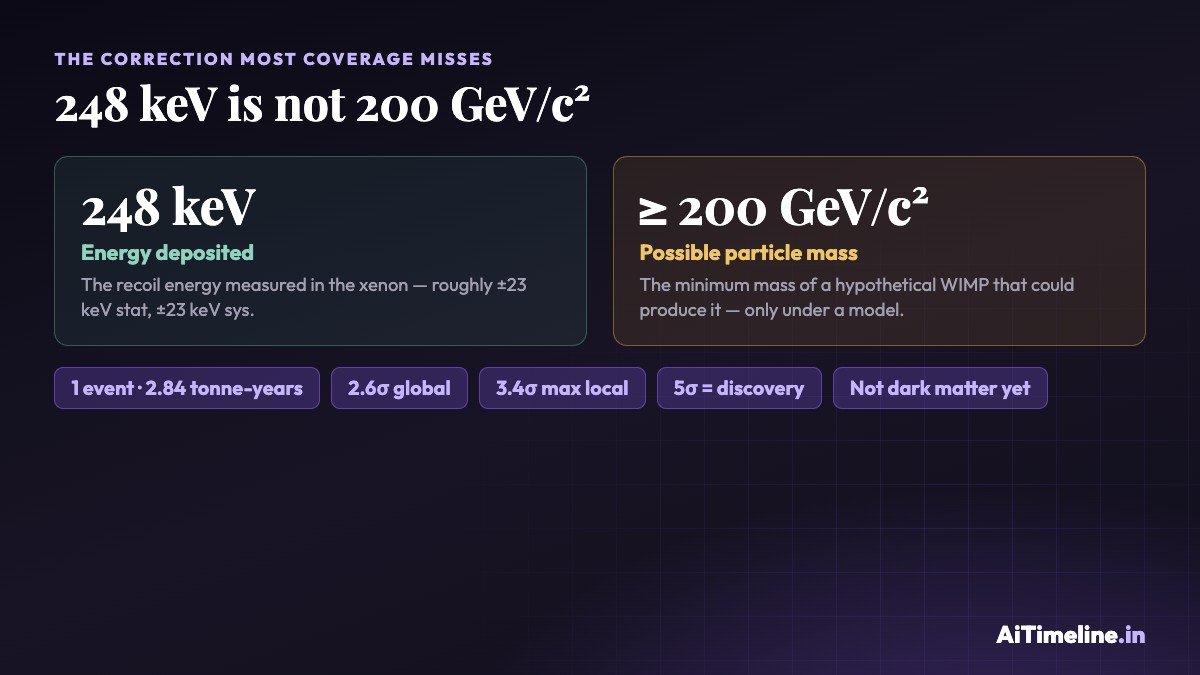
- 248 keV is not 200 GeV. 248 keV is the recoil energy deposited in the xenon; 200+ GeV/c² is the possible mass of a WIMP that could have produced it.
- 2.6 sigma is not a probability that dark matter is real. It measures tension with the background-only model, after correcting for how many places were searched.
- The event is old data, new analysis. It sits in data taken March 2023–April 2024; September 2026 was the announcement of a new high-energy analysis.
- The next data matter more than the first event. A discovery needs repeated events, a consistent spectrum and independent confirmation.
The Missing Universe: 85% or 27%?
Two correct numbers that measure different things
Both figures are right; they answer different questions. If you count only matter, dark matter is roughly 85 percent and ordinary matter about 15 percent. If you count the universe’s whole mass-energy budget, which also includes dark energy, then — using Planck-based cosmological values — dark matter is about 27 percent, ordinary matter around 5 percent, and dark energy about 68 percent.
🔭 Everything that is matter
- Ordinary (baryonic) matter: ~15%
- Dark matter: ~85%
- This is the “85 percent” headline figure
🌐 The full cosmic recipe
- Ordinary matter: ~4.9%
- Dark matter: ~26.8%
- Dark energy: ~68.3% (Planck-based)
⚠️ Dark matter and dark energy are not the same thing
Dark matter adds gravitational attraction and helps galaxies and cosmic structure form. Dark energy is associated with the accelerating expansion of the universe. They are distinct components with opposite effects on structure; do not combine them into one “dark” number.
After decades of seeing nothing, one event is enough to make physicists look twice — but one event can start a discovery, it cannot finish one.
September 1, 2026 — LZ Reveals One Event It Cannot Yet Explain
Announced at the TeV Particle Astrophysics conference, Tendo, Japan
On 1 September 2026, at the 2026 TeV Particle Astrophysics (TeVPA) conference in Tendo, Japan, the LUX-ZEPLIN collaboration presented results from a new analysis of data it already had. Over an exposure of roughly 2.8 tonne-years (about 220 live days of running, collected March 2023 to April 2024), the analysis found one event in a high-energy region where the expected background is very low.
The event has characteristics consistent with a nuclear recoil — a xenon nucleus being knocked, which is the signature a dark-matter particle would produce. Its reconstructed recoil energy is about 248 keV, with statistical and systematic uncertainties of roughly ±23 keV each. LZ co-spokesperson Rick Gaitskell put it plainly: “With only one event, we don’t want to get ahead of ourselves. We are not claiming to have seen dark matter.” A colleague described it as the first outlier in his career that “appears valid in every way” — which is exactly why it is being scrutinised rather than celebrated.
Why did it surface now? The standard LZ WIMP search focuses on lower recoil energies and classic spin-independent scattering. The new 2026 analysis extended the nuclear-recoil search window up to about 270 keV to test other kinds of interactions — effective-field-theory and inelastic dark-matter models — where higher-energy recoils can matter. The event fell inside that extended window. So the anomaly does not simply mean “classic WIMPs are back.”
📈 Not a particle that struck on September 1
The event was recorded during the 2023–2024 data-taking run. September 2026 was the date of the analysis and announcement, not the date a particle hit the detector. As of 1–3 September 2026, LZ says the paper will be posted to arXiv and submitted to Physical Review Letters — it is not a peer-reviewed, published discovery.
248 keV Is Not 200 GeV/c²
The single correction most news coverage gets wrong
These are two different quantities and confusing them is the most common error in coverage of this result.
⚡ 248 keV — energy deposited
- The recoil energy the xenon nucleus received in the collision
- Measured directly by the detector
- Uncertainty roughly ±23 keV (stat) ±23 keV (sys)
⚖️ 200+ GeV/c² — possible particle mass
- The minimum mass of a hypothetical WIMP that could produce such a recoil
- Depends on interpreting the event through a dark-matter interaction model
- A proton is ~0.938 GeV/c², so this is more than 200 proton masses
🔸 Say it precisely
The detector did not measure a “200 GeV event.” It measured a ~248 keV recoil. If a WIMP caused it, some models imply that WIMP is heavier than about 200 GeV/c², with interaction properties beyond the simplest standard WIMP scenario.
What Does 2.6 Sigma Mean?
Sigma measures how unusual the data are under a background-only statistical model — how hard the known backgrounds have to work to fake the result. It is not the probability that the dark-matter hypothesis is true. The collaboration reports a global significance of 2.6 sigma after correcting for the look-elsewhere effect, and a maximum local significance of 3.4 sigma across the models tested. Particle physics treats about 5 sigma as the discovery threshold.
🎲 The look-elsewhere effect, in one image
Roll one die once and get a six — notable. Roll hundreds of dice and then point at the strangest one — much less so. Scientists correct for how many places and models they searched. That correction is what turns the local 3.4 sigma into the global 2.6 sigma. Do not read “2.6 sigma” as “99.5% chance it is dark matter” — the ~0.5% figure is a background-model probability, not a posterior on the dark-matter hypothesis.
The September 2026 Anomaly: Exciting — But Not Dark Matter Yet
LZ has found one nuclear-recoil-like event that its current background model has difficulty explaining. That matters because the detector runs nearly a mile underground behind extreme shielding and ultrapure xenon, so rare events get intense scrutiny. Three facts prevent a discovery claim:
- It is one event.
- The global significance is 2.6 sigma, well below the 5-sigma standard.
- Rare backgrounds still need to be excluded, and more events with compatible properties need to appear.
If the event eventually proves to be dark matter, it could point toward a WIMP heavier than roughly 200 GeV/c² with interaction properties beyond the simplest scenario. If no similar events appear, the anomaly may fade. This is one of the most intriguing direct-detection hints in the modern WIMP search — not, on the current evidence, “the strongest WIMP evidence in history.”
Dark Matter: Hype vs Reality
| The hype | The reality |
|---|---|
| Dark matter has been discovered | One unexplained event; no confirmed detection |
| 99.5% chance it’s dark matter | 2.6σ is background-only tension, not a probability the hypothesis is true |
| The detector saw a 200 GeV energy event | ~248 keV recoil; 200+ GeV/c² is a possible particle mass |
| WIMPs are confirmed | WIMPs remain hypothetical |
| Dark matter is 85% of the universe | ~85% of matter; ~27% of total mass-energy |
| A particle struck LZ on September 1, 2026 | Event is in 2023–2024 data; Sept 2026 was the analysis announcement |
Scientists Have Seen Dark Matter’s Gravity for Decades. Why Have They Never Seen the Thing Itself?
Gravitational evidence tells you how much dark matter there is and where it sits. It does not tell you what it is made of. Four independent lines of gravitational evidence all point to extra, unseen mass:
The Bullet Cluster (2006) is the classic case: in this cluster collision, the hot ordinary gas (mapped in X-rays by NASA’s Chandra) ended up spatially separated from most of the mass (mapped by gravitational lensing). That separation is hard to explain without dark matter that does not interact like ordinary gas.
That is why particle physicists built detectors. Gravitational maps of dark matter keep getting better — in January 2026, a JWST team published one of the most detailed dark-matter maps yet, using gravitational lensing across about a quarter-million galaxies to trace filaments between clusters. We can map dark matter better than we can identify it.
Three Ways to Hunt Something Invisible
The Candidate Matrix
No single candidate is confirmed; several families are actively searched
| Candidate | Basic idea | 2026 status | How scientists search |
|---|---|---|---|
| WIMPs | New massive particles interacting very weakly with ordinary matter | Major long-standing candidate; simple models increasingly constrained; LZ anomaly intriguing but unconfirmed | Xenon/argon direct detection, colliders, indirect searches |
| Axions / ALPs | Extremely light particles motivated partly by particle-physics problems | Major active candidate family | Resonant cavities, strong magnets, astrophysical searches |
| Light dark matter / dark sector | Particles lighter than classic WIMPs with new weak interactions | Rapidly growing search area | Low-threshold detectors, accelerators, electron-recoil searches |
| Primordial black holes | Black holes formed in the early universe | Strongly constrained across many masses; some allowed windows remain | Microlensing, gravitational waves, evaporation signatures |
| MACHOs / compact objects | Dim stars, remnants, planets and other ordinary compact bodies | Cannot account for all dark matter across broad mass ranges | Microlensing and astronomical surveys |
WIMPs — chased for decades, still hypothetical
WIMPs were attractive historically because some particle models naturally produced roughly today’s dark-matter abundance — the “WIMP miracle” — and because weak-scale interactions make direct detection possible in principle. Decades of searches have ruled out large regions of the simplest WIMP parameter space. WIMPs are still one of the most studied candidate classes, but calling them “the undisputed leading candidate” overstates the case.
Axions are a major candidate, not a footnote
Axions were originally proposed to solve the strong CP problem in particle physics and are potentially very light. Search techniques include haloscopes, helioscopes, resonant cavities and quantum sensors. This is a large, active field.
Primordial black holes — not “microscopic”
Their possible mass range spans many orders of magnitude. Some surviving dark-matter windows involve asteroid-scale masses; other mass ranges are strongly constrained by microlensing, gravitational waves and cosmology. JWST is not a primordial-black-hole detector. NASA’s Roman Space Telescope is particularly relevant to future microlensing searches for compact objects.
To See the Invisible, Remove Everything Else
A dark-matter collision could be extraordinarily rare, so detectors go deep underground where rock blocks most cosmic rays. Then they strip out every other background they can.
How a two-phase xenon detector works
A particle enters and strikes a xenon nucleus. The nucleus recoils, producing a prompt flash of light (called S1) and freeing electrons. An electric field drifts those electrons upward into a thin gas layer, where they make a second, larger flash (S2). The timing between S1 and S2 gives depth; the S2 pattern gives horizontal position; the ratio of light to charge helps separate a nuclear recoil from an electron recoil. Xenon is used because it is a heavy, dense target that can be purified to extreme levels and has no long-lived radioactive isotope dominating the natural mix.
🧰 LZ scale — get it right
LZ contains roughly 10 tonnes of xenon overall, with about seven active tonnes inside its two-phase time projection chamber. It is not correct to say “10 tonnes form the active target.” The facility sits 4,850 feet — nearly one mile — underground at the Sanford Underground Research Facility (SURF) in Lead, South Dakota, in the former Homestake gold mine.
The Xenon Arms Race, and Why Null Results Matter
LUX (Large Underground Xenon), 4,850 feet down at SURF, produced its first major results in 2013 as the world’s most sensitive WIMP search at the time — and found no WIMP. Instead it set strong limits. LUX finished in 2016 and LZ succeeded it in the same cavern. “Nothing found” does not mean an experiment failed: a null result eliminates part of the parameter space and tells physicists dark matter is not interacting that strongly at those masses.
Into the Neutrino Fog
As detectors get more sensitive, they eventually reach a point where neutrinos — especially from the Sun — produce nuclear recoils that can look like dark-matter events. This creates a statistical background often called the neutrino fog. It is not an absolute wall: with more data, directionality, multiple target materials and better statistics, dark-matter signals may still be extracted. In February 2026, XENONnT reported a first search for light dark matter operating in this neutrino-fog regime, together with a measurement of solar-neutrino nuclear scattering — a milestone in its own right, and it found no light dark matter.
Dark Matter Timeline (Newest First)
From the September 2026 LZ anomaly back to Zwicky in 1933
LZ reveals one anomalous high-energy event
What happened: A new LZ analysis of 2023–2024 data, over about 2.8 tonne-years, found one nuclear-recoil-like event at ~248 keV in a low-background region.
Why it matters: Global significance 2.6 sigma (max local 3.4 sigma) — the most compelling LZ direct-detection hint so far, but far below the 5-sigma discovery standard.
XENONnT searches for light dark matter in the neutrino fog
What happened: XENONnT reported a first light-dark-matter search in the solar-neutrino-fog regime, alongside a measurement of coherent solar-neutrino nuclear scattering.
Why it matters: Detectors are now sensitive enough that solar neutrinos are a genuine background. No light dark matter was found.
JWST publishes a high-resolution dark-matter map
What happened: A JWST team used gravitational lensing across roughly 250,000 galaxies to map dark-matter filaments and clusters at unprecedented resolution.
Why it matters: It sharpens where dark matter is — it does not identify the particle.
–26
Next-generation xenon detectors reach the neutrino fog
What happened: Sensitivity improved to the point where solar-neutrino recoils became a measurable background.
Why it matters: It changes how future dark-matter limits are interpreted — and raises the value of multiple target materials.
LZ 280-day analysis: no evidence for WIMPs
What happened: LZ released a combined analysis of about 280 days of data and found no WIMP signal in the standard search above roughly 9 GeV/c², setting world-leading constraints.
Why it matters: This is the contrast that makes 2026 interesting — the standard search saw nothing; a different extended analysis later found one event.
XENONnT first WIMP nuclear-recoil search
What happened: XENONnT reported its first WIMP search results with a low-background ton-scale detector.
Why it matters: It kept two independent xenon programmes (LZ and XENONnT) probing overlapping parameter space — essential for cross-checks.
LZ first results
What happened: With only a small fraction of its planned exposure, LZ reported world-leading WIMP sensitivity and no dark-matter detection.
Why it matters: It confirmed the detector was working at design-level backgrounds.
LZ first science run begins
What happened: After a 2020 project-completion milestone, LZ started taking physics data in 2021.
Why it matters: It began the exposure that would eventually contain the 2026 anomalous event.
LUX ends; LZ succeeds it
What happened: LUX completed operations after setting strong WIMP limits; the larger LZ experiment took over the same underground cavern.
Why it matters: Continuity of site, expertise and technique across detector generations.
LUX becomes the world’s most sensitive WIMP hunter
What happened: LUX’s first major results, 4,850 feet underground, set the strongest WIMP limits of the time. No detection.
Why it matters: Established the two-phase liquid-xenon technique as the leading direct-detection method.
–18
WMAP and Planck fix the cosmic recipe
What happened: Precision maps of the cosmic microwave background pinned ordinary matter at about 4.9 percent, dark matter about 26.8 percent and dark energy about 68.3 percent.
Why it matters: It made the Lambda-CDM model the standard framework and gave dark matter a precise cosmic abundance.
The Bullet Cluster
What happened: In this cluster collision, the hot ordinary gas and the bulk of the gravitational mass ended up spatially separated.
Why it matters: One of the strongest pieces of evidence that dark matter exists as something distinct from ordinary matter, and hard to explain with modified gravity alone.
MACHO and EROS microlensing searches
What happened: Microlensing surveys looked for dim compact objects in the galactic halo.
Why it matters: Results increasingly constrained ordinary compact objects as the dominant halo component, pushing attention toward new particles.
Cold dark matter becomes the framework
What happened: Simulations showed that slow-moving (“cold”) dark matter reproduces the observed growth of cosmic structure.
Why it matters: It set the theoretical template that later CMB and lensing data would test and support.
–80
Galaxy rotation evidence expands
What happened: Larger samples of spiral galaxies showed the same flat rotation curves Rubin and Ford had found in Andromeda.
Why it matters: It moved unseen mass from a curiosity to a general feature of galaxies.
Vera Rubin and Kent Ford measure Andromeda
What happened: Rubin and Ford found that stars in the outer parts of Andromeda orbit about as fast as inner stars — not slowing down as visible mass alone predicts.
Why it matters: Rubin’s rotation work provided some of the most convincing evidence that large amounts of unseen mass surround galaxies. It is better described that way than as “first irrefutable proof.”
Fritz Zwicky and the Coma Cluster
What happened: Zwicky measured galaxy velocities in the Coma Cluster and found the visible matter appeared insufficient to gravitationally bind the fast-moving galaxies. He proposed unseen “dunkle Materie.”
Why it matters: It is the origin of the missing-mass problem. Zwicky inferred unseen mass — he did not discover a dark-matter particle, and the idea did not immediately establish the modern paradigm.
What Would Make the LZ Event Convincing?
Cross-checks come from XENONnT (also liquid xenon, so a direct comparison — though backgrounds, exposure and analysis differ), PandaX-4T, and argon detectors, which use different nuclei and different backgrounds. If a different target material finds compatible physics, confidence rises sharply. History urges caution: signals such as DAMA/LIBRA’s long-running annual-modulation claim have never been independently established as dark matter. A signal is not a discovery until other evidence agrees.
E-E-A-T: What Is Confirmed vs What Is Hypothetical
🟢 Confirmed / established
- Dark matter’s gravitational effects — from rotation curves, cluster dynamics, lensing, the CMB and structure formation.
- The cosmic recipe from Planck: ~4.9% ordinary matter, ~26.8% dark matter, ~68.3% dark energy.
- LZ, LUX and XENON null results, which set world-leading limits on WIMP interactions.
- The existence of one anomalous LZ event at ~248 keV in the 2023–2024 dataset.
🟡 Hypothetical / unresolved
- The identity of the dark-matter particle or object — WIMP, axion, dark-sector particle, primordial black hole or something else.
- Whether the September 2026 LZ event is dark matter, a rare background, or a statistical fluke.
- Any implied WIMP mass (≥ ~200 GeV/c²) — this depends entirely on interpreting the event through a model.
📏 How we interpret sigma, and the matter-percentage methodology
Sigma: a measure of tension with a background-only model, not a probability that a hypothesis is true; ~5 sigma is the physics discovery convention. Percentages: “~85%” is dark matter’s share of matter; “~27%” is its share of the total mass-energy budget including dark energy. Both use Planck-based cosmological values. Dark matter vs dark energy: distinct components — one clumps and attracts, the other is linked to accelerating expansion.
Dark Matter Update Log
- 3 September 2026 — LZ anomaly coverage updated; evidence labels and the 248 keV vs 200 GeV/c² distinction added.
- 1 September 2026 — LZ high-energy analysis revealed at TeVPA, Tendo, Japan: one event, 2.6 sigma global.
- February 2026 — XENONnT light-dark-matter search inside the neutrino fog.
- January 2026 — JWST high-resolution dark-matter map published.
- August 2024 — LZ 280-day analysis: no WIMP evidence in the standard search; world-leading limits.
- July 2022 — LZ first results.
- 2013 — LUX first major results; no detection.
- 2006 — Bullet Cluster.
- 1933 — Zwicky proposes “dunkle Materie.”
Key Entities in the Dark Matter Hunt
Fritz Zwicky
Swiss astrophysicist who inferred missing mass in the Coma Cluster in 1933 and coined “dunkle Materie.”
Vera Rubin
Astronomer whose galaxy rotation-curve work (with Kent Ford) provided powerful evidence for unseen mass around galaxies.
LUX-ZEPLIN (LZ)
Liquid-xenon direct-detection experiment at SURF; reported the September 2026 anomalous event.
Sanford Underground Research Facility
Former Homestake gold mine in Lead, South Dakota; hosts LZ 4,850 feet underground.
XENON (XENONnT)
Liquid-xenon experiment at Gran Sasso, Italy; a key independent cross-check and neutrino-fog pioneer.
ESA Planck
Space mission that measured the cosmic microwave background and fixed the ~4.9 / 26.8 / 68.3 percent cosmic recipe.
Explore More Timelines
People Also Ask
Dark Matter Timeline: Frequently Asked Questions
Explore More AiTimeline Stories
⚠️ Editorial Note
This article separates established scientific consensus (dark matter’s gravitational effects) from open questions (its particle nature) and from an unconfirmed 2026 anomaly. Figures for the September 2026 LZ result are drawn from the LZ Collaboration, Lawrence Berkeley National Laboratory and the US Department of Energy; cosmological values are Planck-based. The result had not been peer-reviewed at the time of writing. This is science explanation, not investment, policy or academic advice.
Sources & further reading
Every dated entry above was checked against these references. Last reviewed 15 September 2026.