Europe’s Space Race Timeline 1979–2030: Ariane’s Rise, Launcher Crisis and Reusable Pivot
How Europe built independent access to space with Ariane, faced a 2022–24 launcher crisis, restored Ariane 6 and now pivots to reusable rockets and IRIS².
Latest Story
Satellites quietly run the modern world — they steer ships and farm machinery, forecast storms, monitor melting ice, carry emergency communications and keep militaries and civilians connected when ground networks fail. Getting them into orbit is not a side detail; it is autonomous access to space: the ability to launch a nation’s or a continent’s most important satellites without waiting on another country’s rocket, export licence or launch queue. Europe could, in theory, always buy a launch from somewhere else. But owning a reliable launcher — the way it owns Ariane and Vega — gives it control over timing, security and continuity that buying alone can never fully replace. This is the story of how Europe built that capability, nearly lost it, and is now racing to modernise it.
Why does Europe need its own rockets?
Because satellites for navigation, weather, climate monitoring, defence-related resilience, communications and science are strategic infrastructure, not just commercial cargo. From 1979’s Ariane 1 through the 2022–24 launcher crisis to Ariane 6’s 2024 return and today’s push into reusability (Themis), new competition (the European Launcher Challenge) and secure connectivity (IRIS²), Europe’s space effort has always centred on one goal: reaching orbit on its own terms, not on someone else’s schedule.
Key Facts at a Glance
Infographic 7 — where each European launch system stands today, verified 4 September 2026
| Area | Current European position | Why it matters |
|---|---|---|
| Heavy launch | Ariane 6 operational — 6 flights completed by 1 Sept 2026, targeting 6–8 for the year | Large satellites and institutional missions |
| Light launch | Vega-C operational since its November 2024 return to flight; 5 missions planned for 2026 | Smaller payloads and Earth observation |
| Reusability | Themis and Prometheus in development — first low-altitude hop test targeted for 30 September 2026 | Cost and launch-cadence competitiveness |
| New entrants | European Launcher Challenge — 4 companies active after one 2026 withdrawal | More suppliers and more competition |
| Secure connectivity | IRIS² in deployment — implementation agreement signed 7 August 2026 | Strategic communications resilience |
| Navigation | Galileo — Ariane 6 resumed carrying Galileo satellites from December 2025 | Independent positioning and timing |
| Launch site | Europe’s Spaceport, Kourou, French Guiana | Near-equatorial site gives an efficiency boost for geostationary launches |
Source: ESA, Arianespace, European Commission — verified September 2026
European Space Race: Key Questions
What to hold onto
- This is not a two-horse race. Europe’s goal is autonomous access to space for its own satellites — not beating any single country to a finish line.
- Ariane 1’s first successful launch was 24 December 1979 from Kourou, French Guiana — the start of Europe’s independent path to orbit.
- The 2022–24 crisis was a convergence, not one failure. Ariane 5’s retirement, Ariane 6’s delays, Vega-C’s grounding and the loss of Soyuz overlapped within about 18 months.
- Ariane 6’s 9 July 2024 maiden flight restored independent access, though an auxiliary propulsion unit anomaly on the upper stage needed further investigation.
- Vega-C returned to flight in November 2024 after a nearly two-year grounding following the December 2022 VV22 failure.
- Galileo launches came back to Ariane 6 in December 2025, after two SpaceX Falcon 9 missions carried four Galileo satellites in 2024 to cover the gap.
- Reusability is still a demonstrator, not a product. Themis’s first hop test is targeted, not yet flown, as of this update.
- IRIS² is a secure-connectivity programme, not a copy of any single existing constellation — its implementation agreement was only finalised in August 2026.
- Ariane 6 is expendable by design, not “already obsolete” — it operates in a market reshaped by reusable, high-cadence competitors, which is a genuine commercial challenge, not a verdict on the rocket itself.
Infographic 1 — Europe’s Route to Space: 1979–2030
Newest first. Every future entry is labelled Planned or Target — nothing is presented as done before it is confirmed.
Future reusable launcher architecture Concept / Study
What it is: Europe’s long-term goal is a partially reusable successor to Ariane 6, sometimes referred to informally as “Ariane Next,” intended to roughly halve launch costs. As of this update it remains a study and demonstrator-stage direction, not a funded, scheduled flagship programme with a locked design.
IRIS² targets first launches and early services Target
What it is: First satellite launches for the EU’s IRIS² secure connectivity constellation are targeted for 2029, with initial services planned from around 2030 and full operational status targeted for the early 2030s.
European Launcher Challenge milestones Target
What it is: Each selected commercial launch provider must complete a successful orbital launch by 2027 and demonstrate an increased launch-capacity upgrade by 2028 to keep its ESA contract. ESA continues contributing to their operational launches through 2030.
2026
Themis T1H hop-test target date Target
What it is: The first low-altitude vertical takeoff-and-landing “hop” of the Themis T1H reusable-stage demonstrator, up to roughly 100 metres, is targeted for this date at ESA’s newly inaugurated Launch Complex 3B. A wet dress rehearsal — a full simulated countdown under cryogenic conditions — was completed on 23 July 2026.
Recovery and industrial pivot In development
Ariane 6 ramp-up: Arianespace targeted 6–8 Ariane 6 flights for 2026 (6 completed by 1 September), with 10 planned for 2027 and a longer-term ambition of around 11 flights a year.
Vega-C missions: Four Vega-C launches were planned for 2025 and five for 2026, restoring Europe’s light-launch cadence.
Galileo’s return to Ariane 6: On 17 December 2025, Ariane 6 launched two Galileo navigation satellites — the first Galileo mission back on a European rocket after two SpaceX Falcon 9 launches covered the gap in 2024.
European Launcher Challenge selection: Proposals opened in March 2025; challengers were selected that summer, and frame contracts were signed in 2026.
Vega-C returns to flight Completed
What happened: Vega-C returned to flight carrying the Sentinel-1C Earth observation satellite, restarting commercial operations after an investigation traced its December 2022 VV22 failure to thermo-mechanical over-erosion of a nozzle component on the second-stage motor. The vehicle’s design was corrected before this flight.
2024
Ariane 6 completes its maiden flight Completed
What happened: Ariane 6 lifted off on its first flight, successfully deploying eight satellite payloads and demonstrating its reignitable Vinci upper-stage engine with two in-flight restarts. This restored Europe’s independent access to space for the first time since Ariane 5’s retirement almost a year earlier.
The honest complication: An auxiliary propulsion unit on the upper stage aborted a planned third reignition, so the stage could not perform its intended controlled deorbit burn; the vehicle safely passivated itself instead. ESA called the overall mission a success while opening a formal investigation into the anomaly — it was neither an unqualified perfect flight nor a failure.
SpaceX launches Europe’s Galileo satellites Completed
What happened: With Ariane 6 not yet flying, ESA booked two Falcon 9 missions to launch four Galileo First Generation navigation satellites (two per flight) so the constellation would not fall behind on replacements. This was ESA’s 20th and final Falcon 9 launch under that contract — not the whole Galileo programme, and not a permanent shift away from European rockets.
Europe’s launcher-capacity gap Completed (historical)
What happened: Four pressures converged in under eight months: Vega-C’s VV22 failure (20 December 2022) grounded Europe’s light-lift rocket; Ariane 6’s development ran years behind its original schedule; Ariane 5 flew its final mission on 5 July 2023 after 27 years of service; and Soyuz launches from Kourou had already ended after Russia’s cooperation with the European Space Agency was suspended following its February 2022 invasion of Ukraine. Europe could still buy launches from foreign providers during this period — it was a capacity gap, not a total loss of access to space.
SpaceX lands its first orbital-class booster Completed
What happened: SpaceX successfully landed a Falcon 9 first stage after an orbital-class launch, the first time this had been achieved. Reusability, combined with SpaceX’s scale and rapidly increasing launch cadence, went on to reshape commercial launch economics over the following decade. It was one important factor among several that reframed the competitive landscape Ariane 6 was designed into — not the single cause of every later European setback.
ESA approves Ariane 6 development Completed
What happened: ESA member states approved development of Ariane 6, prioritising affordability, reliability for institutional and commercial missions, and continued European autonomy in a market where Ariane 5 was starting to face new commercial pressure. The chosen architecture was expendable, built around lowering cost-per-launch through simplified production rather than reusability, which was not yet proven at any operational scale.
1990s
Ariane becomes a commercial launch power Completed
What happened: Arianespace, the world’s first commercial launch services company, was founded in 1980 to market Ariane rockets. Over the following two decades, the Ariane family built a leading position in the global commercial launch market, particularly for geostationary telecommunications satellites, at a time when it faced far less competition than it does today.
1979
Ariane 1 launches — Europe’s independent path to orbit begins Completed
What happened: Ariane 1 completed its first successful launch from the Guiana Space Centre, giving Europe independent access to orbit for the first time. Before this, European satellite operators depended entirely on launch services from the United States or the Soviet Union.
The European Launcher Crisis Explained
Infographic 3 — what went wrong, and why it was a convergence, not one failure
Why did Europe face a launcher crisis in 2022–24? Because five separate pressures landed on top of each other in under two years, none of which alone would have been a crisis.
| Pressure point | What happened | Effect |
|---|---|---|
| Vega-C grounding | VV22 failure, 20 December 2022, traced to nozzle over-erosion; investigation and redesign followed | Light-launch disruption lasting about 23 months |
| Ariane 6 delay | The new rocket’s development ran years behind its original schedule, finally flying in July 2024 | Reduced heavy-lift capacity through 2023–24 |
| Ariane 5 retirement | Final mission (VA261) completed 5 July 2023 after 27 years of service | Heavy-launch transition gap opened before Ariane 6 was ready |
| Soyuz withdrawal | Cooperation between ESA and Roscosmos ended after Russia’s February 2022 invasion of Ukraine | Fewer available launch options from Kourou |
| Foreign launch bookings | ESA booked SpaceX Falcon 9 for Euclid (2023) and four Galileo satellites (2024) | Strategic and commercial pressure, though not a loss of access |
Source: ESA press releases, spaceflightnow.com, europeanspaceflight.com — verified September 2026
None of these five pressures was, by itself, unusual for a launcher industry that regularly deals with delays and the occasional failure. What made 2022–24 a genuine crisis was that they overlapped: for months, Europe had no heavy-lift rocket flying, its light-lift rocket was grounded, and its usual medium-lift backup (Soyuz) was politically unavailable, all at once.
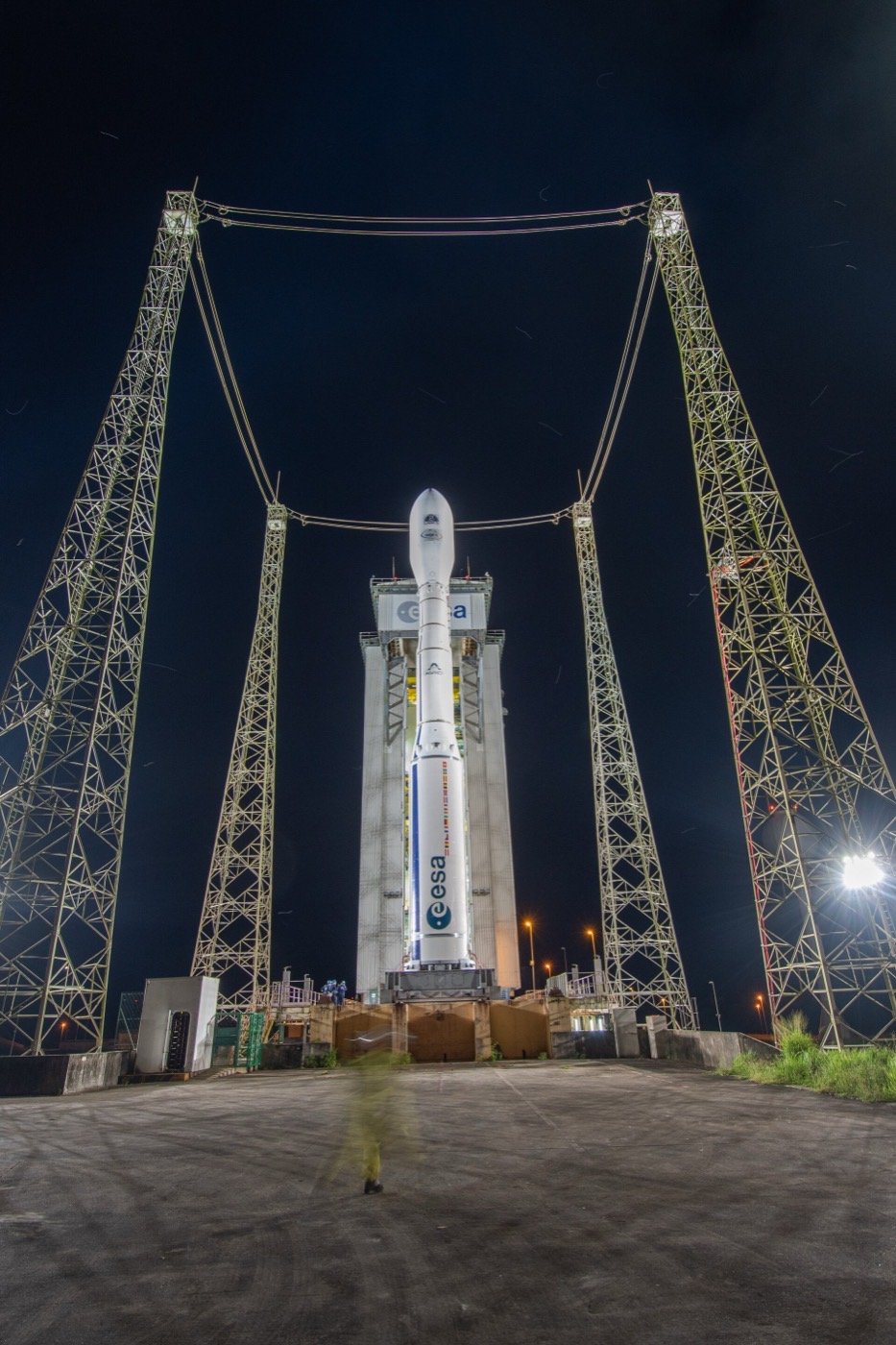
Vega-C on the launch pad at Europe’s Spaceport. Credit: ESA – S. Corvaja
Ariane 6: Recovery, Not a Finished Answer
Is Ariane 6 obsolete? No — it is expendable by design, operating in a market reshaped by reusable, high-cadence competitors
Expendable by design
Ariane 6 does not recover or reuse its boosters or core stage. This was a deliberate 2014 choice prioritising cost predictability and reliability over unproven reusability — not an oversight.
Institutional backbone
Ariane 6 carries EU flagship missions — Galileo navigation satellites and, over time, Copernicus Earth-observation satellites — where launch security and schedule certainty matter as much as price.
A market that moved
Competitors that reuse boosters and fly far more often can offer lower marginal costs and faster manifests. Ariane 6 competes on reliability and sovereignty, not on matching that cadence yet.
Cadence is the current lever
ESA and Arianespace are focused on ramping flight rate — from 6–8 in 2026 toward roughly 11 a year longer-term — while reusability is developed in parallel through Themis, not bolted onto Ariane 6 itself.
Calling Ariane 6 “already obsolete” misreads what it was built to do. It restored something Europe did not have for a year: guaranteed, sovereign access to heavy-lift orbit. Its limitation is commercial, not technical — competing with reusable, high-cadence providers on price per launch is a genuinely hard problem that Ariane 6’s architecture was not designed to solve, and Europe’s own reusability programme exists precisely because of that gap.
The Reusable Pivot: Themis, Prometheus and SALTO
Infographic 5 — from expendable to reusable, one demonstrator at a time
| Programme | Purpose | Current status | What success would demonstrate |
|---|---|---|---|
| Prometheus | Reusable liquid-oxygen/methane rocket engine, 100–120 tonne thrust class | In development — powers the Themis T1H demonstrator | Lower-cost, reusable propulsion |
| Themis | Full-scale reusable vertical-takeoff/vertical-landing stage demonstrator | Planned — wet dress rehearsal completed 23 July 2026; first hop targeted 30 September 2026 at Esrange, Sweden | Recovery and landing technologies |
| SALTO | EU Horizon Europe project (26 partners, €39M) funding Themis’s flight-test campaign | Current phase: T1H low-altitude flight campaign, up to three planned hops | Flight testing and recovery operations |
| Future launcher studies | Next-generation partially reusable vehicle, informally called “Ariane Next” in some coverage | Concept / study phase, no locked design or funding commitment | Competitive, sovereign access to orbit in the 2030s |
Source: ESA, DLR, SSC (Esrange), europeanspaceflight.com — verified September 2026
Important distinction
A 100-metre hop test is a genuine and necessary engineering milestone — it validates the hardest part of reusability, controlled vertical landing — but it is not equivalent to a commercial orbital rocket flying to space and landing back. Treat every step between here and an operational reusable Ariane successor as its own separate, unconfirmed milestone.
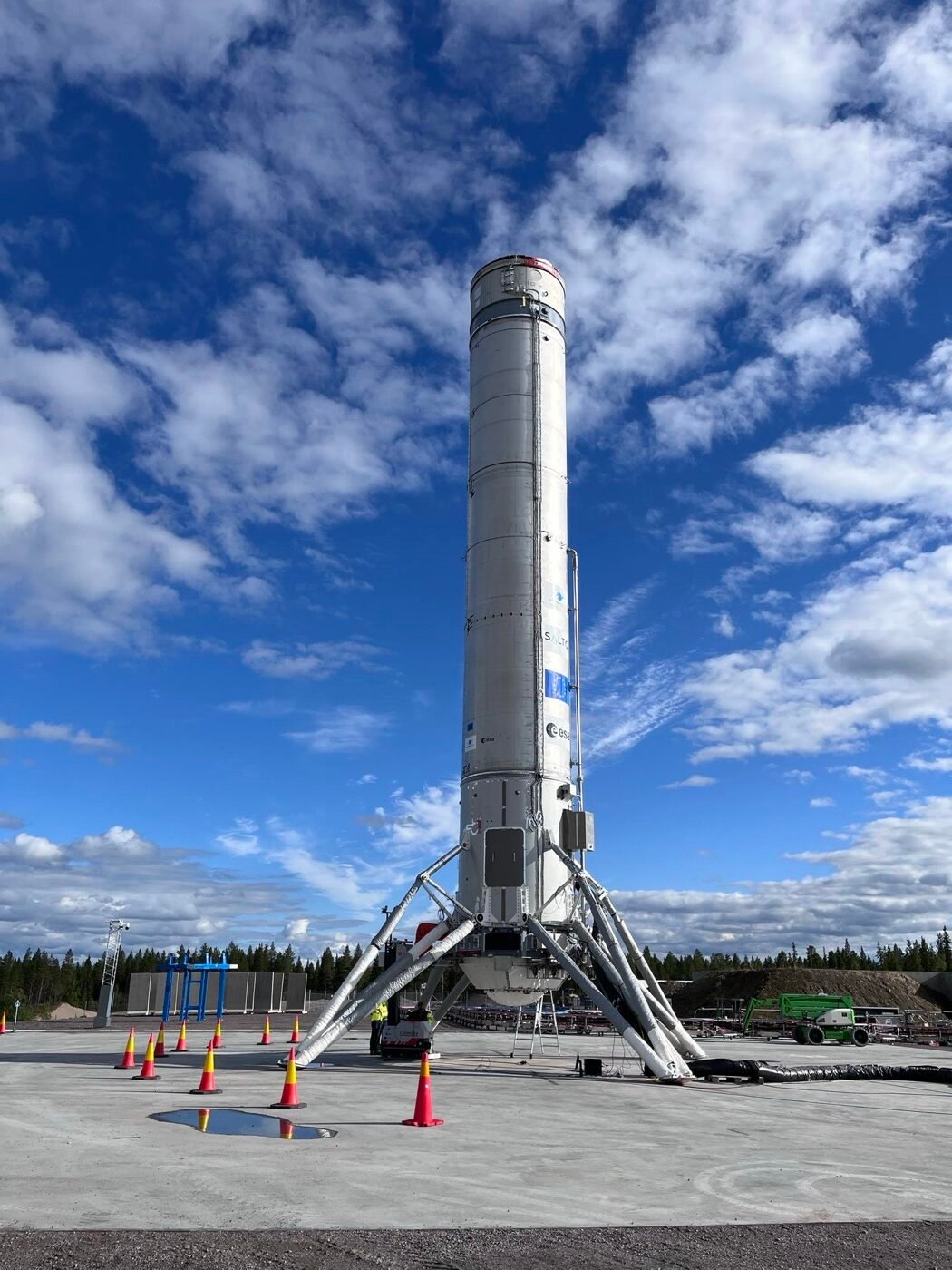
The Themis T1H demonstrator on its launch pad at Esrange, northern Sweden. Credit: ESA
Europe’s Answer to the NewSpace Model
The European Launcher Challenge, explained in plain language
What is the European Launcher Challenge? It is ESA becoming a paying customer of qualifying European commercial launch companies — the same model that helped SpaceX grow in the United States — rather than funding one state-led rocket alone.
Isar Aerospace
German small-launcher developer, one of four companies still active in the Challenge after ESA’s shortlisting process.
MaiaSpace
French launcher startup (a spin-off of ArianeGroup) developing a small, partially reusable rocket under the Challenge.
PLD Space
Spanish launch company developing small launch vehicles, among the four companies still under contract.
Rocket Factory Augsburg
German small-launcher developer completing the current group of four active Challenge participants.
ESA has earmarked more than €900 million for the Challenge, with capacity upgrades requiring at least 40 percent private co-funding — public money alone does not carry a company through the programme. Each company must complete a successful orbital launch by 2027 and demonstrate an increased-capacity flight by 2028 to remain eligible for ESA’s continued support through 2030. A fifth company, Orbital Express Launch, was originally shortlisted but withdrew in February 2026. None of the four remaining companies has yet completed an orbital mission, so none should be described as a “proven” orbital launch provider until that happens — the Challenge is designed to test exactly that.
IRIS²: Secure Connectivity, Not Simply “Europe’s Starlink”
What the EU’s satellite constellation actually is
IRIS² (Infrastructure for Resilience, Interconnectivity and Security by Satellite) is an EU-run, multi-orbit secure connectivity programme — built primarily for government, security and resilience communications, with commercial connectivity as a secondary layer, not the main pitch. Of its 348 satellites, 66 carry enhanced security features for the most sensitive government and defence-related traffic. It is designed to complement, not replace, commercial broadband constellations: IRIS² does not aim to make Europe fully independent of every foreign satellite provider, but to guarantee that Europe’s most sensitive communications — during a disaster, an infrastructure failure or a security crisis — do not depend on any single non-European operator.
Why this matters beyond government use
Secure, sovereign connectivity is not an abstract concern. When ground networks fail during floods, wildfires or grid outages, satellite links are often the only way emergency services, hospitals and local authorities stay connected — which is exactly the resilience case IRIS² is built around.
The Geo-Return Debate
What is geo-return, and is it actually holding Europe back?
Geo-return is ESA’s industrial policy of distributing contract work across participating member states roughly in proportion to what each state contributes financially to a programme. It is not a single company’s or country’s mistake — it is a structural feature of how ESA has always operated, and the debate over it is genuinely unsettled, not one-sided.
✅ Why supporters value it
- Builds real technical capability and supply-chain depth across many European countries, not just one or two
- Sustains political support for expensive, multi-decade space programmes across 20+ member states
- Spreads investment and jobs, which keeps smaller member states committed to funding ESA at all
⚠️ Why critics question it
- Can make programme management and supplier coordination more complex than a single-prime model
- May slow decisions when work has to be split across many national suppliers rather than the most efficient one
- Makes industrial consolidation — merging suppliers for efficiency — politically harder to negotiate
Both sides have a real point, and ESA itself has acknowledged the trade-off in its own procurement reforms, including the more commercial, competitive-tender model behind the European Launcher Challenge. Geo-return is a genuine factor in how quickly Europe’s space industry can move — but treating it as the sole cause of any single delay (Ariane 6’s schedule, for instance, also involved technical redesign, funding negotiations and a changed market) oversimplifies a genuinely multi-causal history.
What Europe Must Solve by 2030
An evidence-led assessment, not a prediction
- Reliable cadence: hold Ariane 6 and Vega-C to their planned flight rates without repeat groundings.
- Competitive pricing: narrow the cost-per-launch gap with reusable, high-cadence providers.
- Reusability that ships: carry Themis and Prometheus from hop tests to an operational follow-through, not just demonstrators.
- More launch providers: get at least one European Launcher Challenge company to a proven orbital track record by 2027.
- Supply-chain resilience: reduce single-source dependencies exposed by the Vega-C nozzle failure.
- Institutional demand: keep Galileo, Copernicus and IRIS² flying on European rockets as the default, not the exception.
- Faster procurement: continue reforming decision-making without abandoning the political buy-in geo-return provides.
- Sustainable practices: manage launch cadence growth alongside debris-mitigation and environmental commitments.
Europe has regained a core capability it briefly lost: the ability to launch its own heaviest and lightest satellites without waiting on anyone else. That was the urgent problem of 2022–24, and it is solved. The next test is different and slower — converting that recovery into sustained commercial competitiveness against providers that already fly reusable rockets at high cadence. Neither outcome is guaranteed by what has happened so far; both are visible, trackable goals with real dates attached.
Explore More Timelines
People Also Ask
Frequently Asked Questions
⚠️ Editorial Note — Methodology
This article separates confirmed facts from stated targets throughout, using explicit labels: Completed, Operational, In development, Planned and Target. All 2026–2030 dates are program targets set by ESA, the European Commission, Arianespace or ArianeGroup as of this update and are subject to schedule change — spaceflight programmes routinely slip, and a target date here is not a guarantee. Facts were checked against ESA, European Commission, Arianespace and independent spaceflight-press sources listed below; where sources disagreed or a figure could not be verified precisely (for example, exact per-launch pricing), this article says so rather than estimating.
Sources & further reading: ESA – Autonomous access to space · ESA – Ariane 6 post-launch update · ESA – Vega-C operations · ESA – Themis · ESA – European Launcher Challenge · European Commission – IRIS² · ESA – VV22 enquiry conclusions
Sources & further reading
Every dated entry above was checked against these references. Last reviewed 15 September 2026.
- ESA — Ensuring autonomous access to space for Europe
- ESA — Ariane 6 post-launch update
- ESA — Vega-C contracts for future operations and development
- ESA — Themis reusable-stage demonstrator
- ESA — European Launcher Challenge
- European Commission — IRIS2 secure connectivity
- ESA — Loss of flight VV22: Independent Enquiry Commission conclusions