Why Do People Pass Out on Roller Coasters? The G-Force Science, Explained
The real physiology of gray-out, blackout and G-LOC on roller coasters, from 1884's first ride to WWII anti-G suit research and why duration matters.
Latest Story
A viral clip shows a rider’s eyes closing on a roller coaster and the caption calls it G-LOC — G-induced loss of consciousness, the same event that has downed fighter pilots. But gray-out, blackout and true G-LOC are three different physiological events, and a video alone cannot tell you which one happened, or whether it was G-force at all rather than ordinary fainting (syncope) triggered by fear, heat or dehydration. This is the real science — from the 1884 Switchback Railway at Coney Island to the World War II anti-G suit research that first mapped human G-tolerance — and why “how many Gs does it take to pass out” has no single answer.
⚡ Does 5G Make You Pass Out on a Roller Coaster?
Not reliably, and not from magnitude alone. Sustained positive head-to-foot acceleration (+Gz) can reduce blood flow to the eyes and brain, producing a documented sequence of gray-out (dimmed, narrowed vision, fully conscious) then blackout (vision gone, often still conscious) and, if it continues long enough, G-LOC (true unconsciousness). But a landmark analysis of 888 centrifuge-induced G-LOC episodes in healthy subjects found consciousness was never lost in under five seconds of exposure, no matter how fast the G came on. Roller-coaster high-G moments are typically brief — IAAPA, the amusement-industry safety body, notes the higher-G sections of modern rides generally last only fractions of a second, engineered around published biodynamic tolerance data. A viral “blackout” clip more often reflects ordinary fainting (vasovagal syncope) from fear, heat, dehydration or anticipation — not G-LOC.
Roller Coaster G-Force: Key Questions
What the science actually says
- Gray-out, blackout and G-LOC are three distinct events, not synonyms — the first two can happen while a person stays fully conscious.
- Acceleration, not speed, is what your body reacts to. A steady 100 km/h in a straight line produces almost no unusual force; a sharp turn at much lower speed can produce strong, rapidly-changing acceleration.
- Duration matters as much as magnitude. In 888 studied centrifuge G-LOC episodes, consciousness was never lost in under five seconds — regardless of how fast the G came on.
- Roller-coaster high-G moments are brief by design. IAAPA states the higher-G portions of modern rides generally last only fractions of a second.
- The anti-G suit came out of World War II research — Canadian scientist Wilbur Franks built the first working G-suits in 1940–41, and Mayo Clinic’s Aero Medical Unit built a human centrifuge for the same problem in 1942.
- Roller coasters didn’t need G-force science to get safer — they needed better geometry. The 1976 clothoid (“teardrop”) loop, designed by Werner Stengel, cut the harsh forces of a perfectly circular loop by varying its radius through the turn.
- A real published study found no dangerous heart rhythms in healthy children monitored on four high-speed, high-G commercial coasters — heart rate rose sharply (average 81 to 158 bpm) but stayed a normal sinus rhythm throughout.
- Fear starts before the drop. The same study found anticipatory heart-rate increases in the minutes before boarding — the body’s stress response, not the ride’s physics, kicks in first.
- Dehydration, heat and fear can cause ordinary fainting (vasovagal syncope) with no unusual G-force involved at all — a common, non-G explanation for on-ride footage that looks alarming.
The G-Force Chain: From 1G to Gray-Out
What actually happens inside the body during a strong turn
At rest, your cardiovascular system is already fighting gravity — the heart continuously pumps blood upward toward the brain against Earth’s normal 1G pull, and it does this well enough that you never notice. A roller coaster changes the equation by introducing +Gz: acceleration acting broadly along the body’s head-to-foot axis, which encourages blood to pool toward the lower body and makes it harder to maintain blood pressure at brain level.
Gray-Out vs Blackout vs G-LOC
Three distinct events on the same physiological curve
| Stage | What happens | Conscious? |
|---|---|---|
| Gray-out | Dimming, desaturated color or narrowing (tunnel) vision as retinal blood flow drops | Yes |
| Blackout | Complete loss of vision as retinal perfusion becomes inadequate | Often still yes |
| A-LOC (almost-LOC) | Disorientation, confusion or brief memory gaps without full unconsciousness — first described by the US Navy in the 1980s | Impaired but present |
| G-LOC | Cerebral blood flow falls enough that brain regions supporting consciousness stop getting adequate oxygenated blood | No |
Not All Fainting on a Ride Is G-LOC
Ordinary syncope needs no unusual G-force at all
People can lose consciousness through vasovagal syncope — a sudden drop in heart rate and blood pressure triggered by fear, pain, heat or emotional stress — with no extreme acceleration involved whatsoever. A theme park supplies several of its known triggers at once.
Fear & anticipation
Heart rate can rise well before a ride starts moving — documented anticipatory tachycardia in riders waiting to board.
Heat & dehydration
Long queues in direct sun with limited fluid intake reduce circulating blood volume, making it harder to sustain blood pressure.
Restraint pressure & posture
Tight harnesses, head position and body orientation all influence how easily blood returns to the brain, independent of the ride’s own G-forces.
Underlying health conditions
Cardiovascular, blood-pressure or neurological conditions can lower tolerance for stress, heat or acceleration well below the general population’s.
✅ A viral clip CAN show
- Ordinary vasovagal fainting from fear, heat or dehydration
- Gray-out or blackout while the rider stayed conscious
- A brief, expected physiological response within engineered ride limits
❌ A viral clip CANNOT reliably show
- Measured cerebral blood flow or blood pressure
- Confirmation that G-LOC specifically occurred
- Whether an undisclosed medical condition was the real cause
⚠️ When to take it seriously
A genuine, unexplained loss of consciousness on a ride is not “just G-force” and should not be dismissed. Anyone who faints and shows chest pain, severe headache, weakness, confusion, seizure-like activity or persistent dizziness needs medical evaluation, and ride-warning signs for cardiovascular, blood-pressure, pregnancy or neck/back conditions should always be followed — they exist for a documented reason, not as decoration.
1884–2026: A Brief History of G-Force Research
How gravity coasters and military aviation ended up solving the same problem
Roller coasters and G-force science developed on separate tracks for most of the 20th century — one built by amusement engineers chasing thrill, the other by military physicians trying to keep pilots conscious in combat turns. They only really converge in the last few decades, once ride designers began applying published biodynamic tolerance data to coaster engineering.
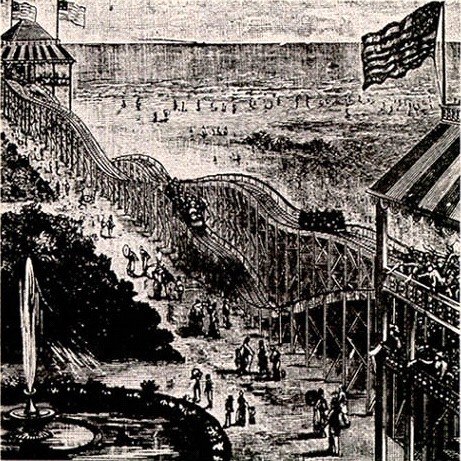
LaMarcus Thompson’s Switchback Railway, Coney Island — opened June 16, 1884, the first roller coaster in the United States. (Public domain, via Wikimedia Commons)
On June 16, 1884, LaMarcus Adna Thompson opened the Switchback Railway at Coney Island: a gravity-powered wooden ride running about 6 mph. It was slow by any modern measure, but it proved the idea — gravity, a controlled drop, and paying passengers — and Thompson patented his “Roller Coasting Structure” the following year. By the early 1900s hundreds of coasters operated across the United States, all still built from wood and steel angle-iron track, which limited how tightly a curve could bend without derailing.
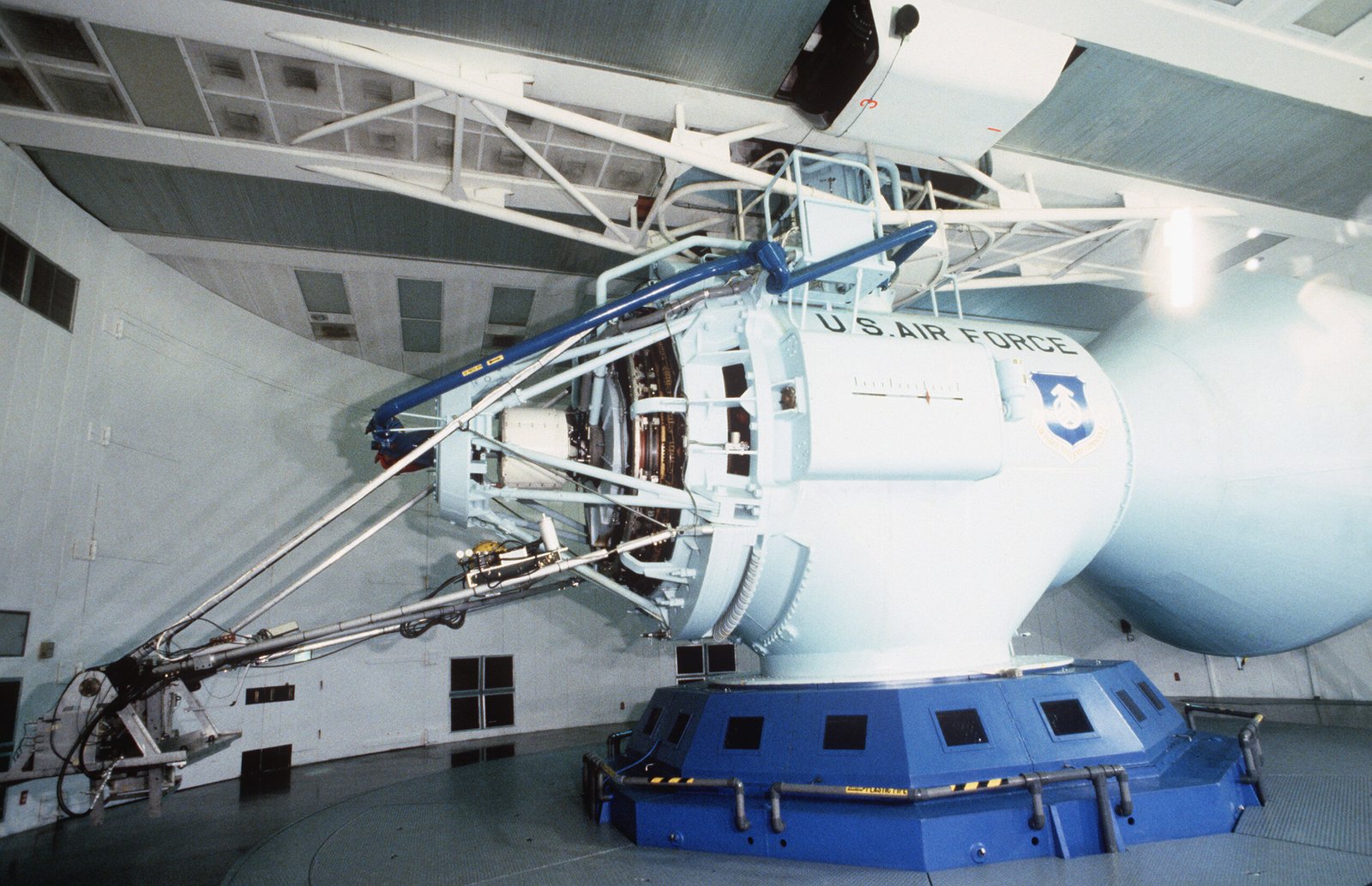
A USAF human centrifuge (dynamic environment simulator) used to study sustained acceleration on pilots, Wright-Patterson Air Force Base, Biodynamics and Bioengineering Division. (Public domain, US Department of Defense, via Wikimedia Commons)
Military aviation created the urgent version of this problem decades later. As fighter aircraft became faster and more maneuverable, pilots in hard turns began experiencing narrowing vision and sudden unconsciousness — a pilot blacking out for even a few seconds could lose the aircraft. Canadian scientist Wilbur Franks, working at the University of Toronto’s Banting and Best Medical Institute, had proposed a water-filled anti-G garment as early as 1938; by 1940–41 his team had built the first working G-suits (“Franks Flying Suits”), tested using a Spitfire supplied by the UK. In the spring of 1942, three Mayo Clinic physicians — Charles Code, Edward Baldes and Walter Boothby — formed a secret Aero Medical Unit and built their own human centrifuge, spun by an automobile engine and two 20-ton flywheels, to study the problem independently and refine an inflatable, multi-bladder G-suit that could be worn like a garment.
That WWII-era centrifuge research became the foundation of modern acceleration physiology: gray-out, blackout, A-LOC and G-LOC as distinct, measurable stages; G-suits and anti-G straining maneuvers (tensing the legs and abdomen while breathing in a specific pattern) as countermeasures; and a large body of data on how magnitude, onset rate and duration interact to determine human tolerance.
Roller coasters, meanwhile, kept innovating on geometry rather than physiology. Matterhorn Bobsleds opened at Disneyland on June 14, 1959, engineered by Karl Bacon and Ed Morgan of Arrow Development as the world’s first tubular steel track coaster — steel tube could bend into far tighter curves than angle iron, opening up designs wood and old-style steel simply couldn’t build. Vertical loops had existed even earlier as circular loops, but circular geometry concentrates crushing force at the top of the loop, and early attempts were rough and occasionally dangerous. That changed in the mid-1970s: Ron Toomer‘s Corkscrew opened at Knott’s Berry Farm in 1975 as the first modern multi-inversion looping coaster, and in 1976, engineer Werner Stengel introduced the clothoid (teardrop-shaped, Euler-spiral) loop on Revolution at Six Flags Magic Mountain — a loop whose radius of curvature shrinks as it rises, keeping the force at the top much closer to the force at the bottom instead of spiking. It remains the geometry nearly every looping coaster uses today.
Switchback Railway
First American roller coaster, Coney Island — gravity, a drop, and nothing more.
Anti-G suit & centrifuge research
Franks’ G-suit and Mayo Clinic’s Aero Medical Unit centrifuge, built independently to solve the same wartime problem.
Tubular steel track
Matterhorn Bobsleds proves steel tube can bend into curves wood and angle iron never could.
The clothoid loop
Werner Stengel’s teardrop geometry replaces the punishing circular loop with a variable-radius curve.
Roller Coaster vs Fighter Jet: Same Unit, Different Exposure
“5G” means very different things depending on how long it lasts
People frequently compare coaster G-forces to fighter-pilot G-forces because both are reported in the same unit. But the unit is where the similarity ends — magnitude without duration is an incomplete comparison, and it is duration that separates these two experiences most sharply.
| Factor | Roller coaster | Fighter aircraft (sustained maneuver) |
|---|---|---|
| Typical high-G duration | Fractions of a second (IAAPA) | Several seconds or longer |
| Direction | Constantly changing through the track layout | Can remain sustained in one axis through a maneuver |
| Body support | Restraint system, often reclined/supported seating | Trained posture, G-suit, anti-G straining maneuver |
| Countermeasures | None needed — ride engineered within tolerance limits | G-suit, muscle tensing, breathing technique, training |
| Design goal | Thrill within published biodynamic limits | Combat performance, sometimes at the edge of human tolerance |
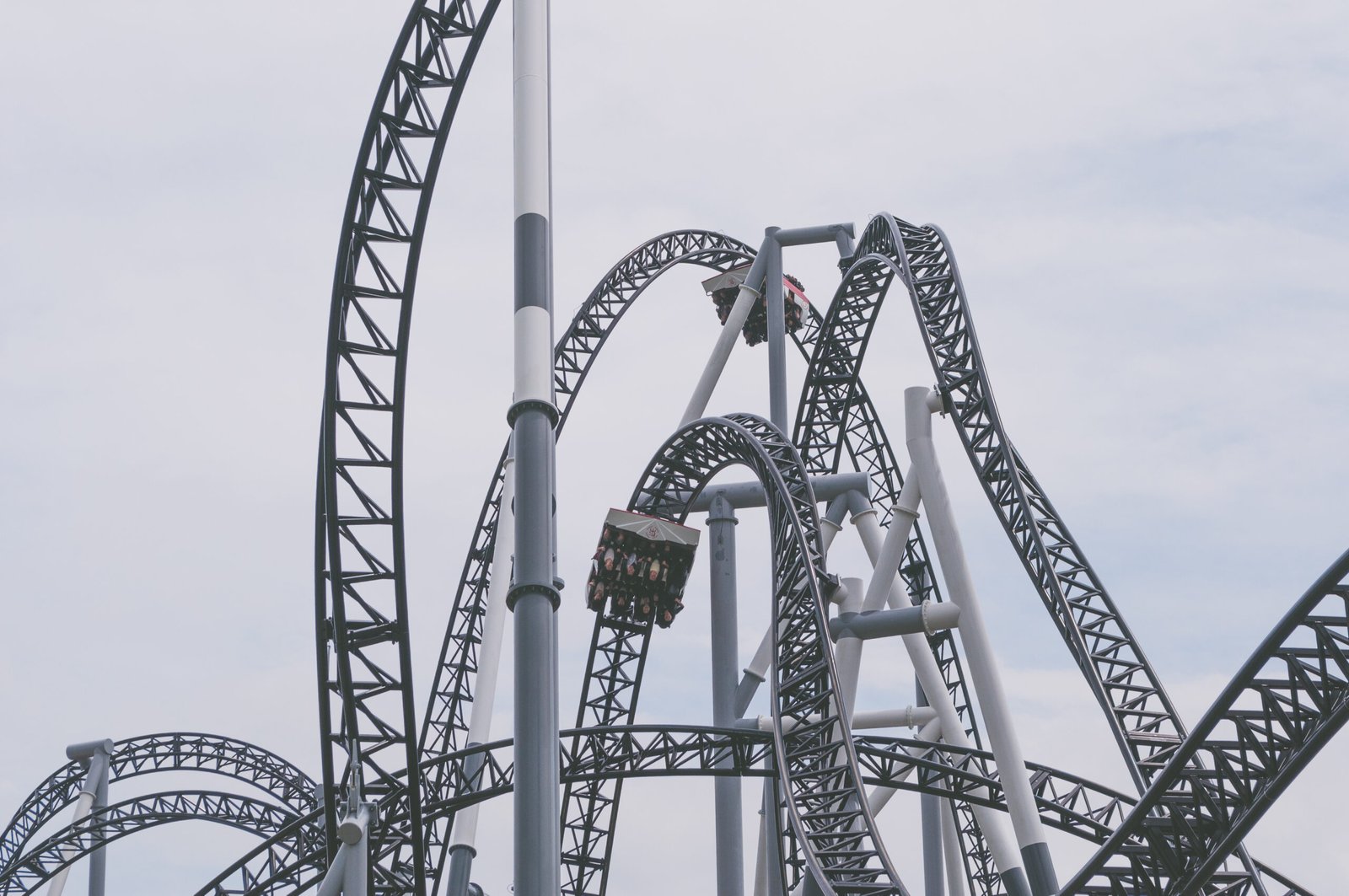
A modern steel coaster loop — today’s clothoid geometry keeps peak force near the loop’s top close to the force at the bottom, rather than spiking. (CC0, via Wikimedia Commons)
What Happens to a Healthy Rider’s Heart
Real monitoring data, not assumption
A published study continuously monitored 20 healthy children, aged 11–15, with 2-lead ECG from five minutes before boarding until ten minutes after riding four different high-speed (>50 km/h), high-g-force (>4G) commercial roller coasters. Resting heart rate averaged 81 ± 10 bpm and rose to 158 ± 20 bpm during the rides — a sharp increase, but the study found no arrhythmic events: sinus tachycardia (a fast but normal, healthy rhythm), not a dangerous rhythm disturbance. Heart rate was already elevated before boarding (126 ± 15 bpm, anticipatory tachycardia) and remained 56% above resting ten minutes after the ride ended.
Why this study matters
- Theme parks and clinicians have long advised against rides for people with heart conditions — the study’s authors note that guidance largely predates evidence like this.
- The heart rate response starts in the queue, driven by adrenaline and anticipation, before the ride’s own physics apply any force at all.
- Sinus tachycardia in healthy riders is an expected stress response, not evidence of danger — the distinction between “elevated” and “abnormal” is exactly what continuous ECG monitoring is designed to catch.
Full Timeline: 1884 to 2026
Reverse chronological — newest first
ASTM F24 and IAAPA biodynamic guidance remain the industry baseline
What happened: Modern amusement-ride design and inspection in the US and dozens of countries continues to run on ASTM F24 committee standards, which incorporate biodynamic tolerance data into force limits for both sustained accelerations (driven by cardiovascular response) and brief impact events (driven by neuro-muscular response). Ride heights and speeds have grown for decades, but overall G-force levels have stayed roughly constant — IAAPA notes rider tolerance hasn’t changed even as engineering has.
Computer-aided design lets engineers model rider G-force before anyone boards
What happened: Computer modelling let designers simulate speed, acceleration, jerk (the rate of change of acceleration) and structural loads throughout an entire track layout before construction — turning “how will this feel” from a post-build discovery into a pre-build calculation.
A-LOC formally described by the US Navy
What happened: “Almost loss of consciousness” (A-LOC) — disorientation, confusion or memory gaps under +Gz stress insufficient to cause full G-LOC — was formally identified, refining the gray-out/blackout/G-LOC framework into a more complete clinical picture.
The 888-episode centrifuge dataset is compiled
What happened: Researchers Whinnery and Forster analysed 888 centrifuge-induced G-LOC episodes (and 760 G-ROC, recovery-of-consciousness, episodes) drawn from exposures at Brooks AFB, Texas and Warminster, Pennsylvania between 1978 and 1992. The minimum +Gz threshold across the 888 individuals was 4.7G, mean time to G-LOC was about 9.1 seconds for onset rates above 1G/second, and G-LOC never occurred in under five seconds regardless of how fast the G came on.
The clothoid loop arrives on Revolution
What happened: Werner Stengel replaced the punishing circular loop with a teardrop-shaped (clothoid, or Euler-spiral) curve whose radius shrinks as the track rises, spreading the force more evenly through the loop instead of concentrating it near the top.
Corkscrew reintroduces the modern looping coaster
What happened: Corkscrew opened as the first modern coaster with two inversions, reviving vertical inversions after decades of near-absence following early, rough circular-loop rides. Arrow Development followed in 1976 with a three-inversion Corkscrew at Cedar Point.
Tubular steel track debuts on Matterhorn Bobsleds
What happened: Matterhorn Bobsleds opened as the world’s first roller coaster built on tubular steel track, engineered because conventional angle-iron track couldn’t bend tightly enough to fit the ride’s footprint. Steel tube track unlocked curve geometry wood and angle iron simply could not build.
Mayo Clinic builds its own human centrifuge
What happened: Three Mayo Clinic physicians formed a secret Aero Medical Unit and built a human centrifuge powered by an automobile engine and two 20-ton flywheels, independently pursuing the anti-blackout problem and helping devise an inflatable, multi-bladder G-suit design.
The first working anti-G suit is built
What happened: Canadian scientist Wilbur Franks, who had proposed a water-filled anti-G garment as early as 1938, led a team at the Banting and Best Medical Institute that built the first working G-suits — “Franks Flying Suits” — tested in 1940 using a Spitfire the UK supplied for the research.
Military aviation turns G-force into a life-or-death question
What happened: As fighter aircraft became faster and more maneuverable, pilots pulling hard turns began experiencing narrowing vision and sudden blackouts in combat — a problem urgent enough that several countries’ air forces began funding centrifuge-based research into human acceleration tolerance around the same period.
The Switchback Railway opens at Coney Island
What happened: Thompson’s gravity-powered Switchback Railway opened at Coney Island, running around 6 mph — slow by modern standards, but it proved the commercial idea of a gravity thrill ride. Thompson patented his “Roller Coasting Structure” the following year, and by 1900 hundreds of coasters operated across the United States.
Explore More Timelines
People Also Ask
Fast answers to the most common follow-ups
Frequently Asked Questions
G-force, gray-out, blackout and G-LOC — in depth
Related Reading on AiTimeline
⚠️ Editorial Note
This article compiles established aerospace-medicine physiology (gray-out, blackout, A-LOC, G-LOC), published amusement-industry safety guidance, and peer-reviewed monitoring research, cited below. It is educational content, not medical advice, and does not diagnose any specific viral video or individual rider’s experience. Always follow posted ride warnings and consult a doctor about pre-existing conditions before riding high-intensity attractions.
Sources & further reading
Every dated entry above was checked against these references. Last reviewed 22 September 2026.
- Aerospace Gravitational Effects — StatPearls (NCBI Bookshelf)
- The +Gz-induced loss of consciousness curve (888-episode centrifuge dataset)
- IAAPA — Ride Design & Technology (biodynamic G-force guidance)
- IAAPA — ASTM Safety Standards for Amusement Rides (F24 committee)
- High g-Force Rollercoaster Rides Induce Sinus Tachycardia but No Cardiac Arrhythmias in Healthy Children (NCBI)
- University of Toronto — The secret science of World War II (Wilbur Franks, G-suit)
- HISTORY — First roller coaster in America opens, June 16 1884
- Coaster101 — Vertical Loops: the clothoid loop explained