Republic Day Parade History: Evolution of India’s Celebration
Republic Day parade history: from the 1950 Irwin Stadium parade and Rajpath in 1955 to colour TV, Kartavya Path in 2022 and the 2026 Battle Array.
Latest Story
The first Republic Day parade was not held on Rajpath. On 26 January 1950, the day the Constitution came into force, about 3,000 officers and men of the armed forces and police paraded at the Irwin Amphitheatre, now the Major Dhyan Chand National Stadium, before a crowd of roughly 15,000. President Rajendra Prasad arrived in a 35-year-old horse-drawn coach, and Indonesia’s President Sukarno was the chief guest. For its first five years the parade moved between venues. Only in 1955 did the ceremonial avenue once called Kingsway, then Rajpath, become its permanent home, and in 2022 it was renamed Kartavya Path. This is the full history of the Republic Day parade: how it moved, what it added, what television and security did to it, and why the 2026 parade looked so different from the first.
🧠 AI Overview Summary
India’s first Republic Day parade was held on 26 January 1950 at the Irwin Amphitheatre (now the Major Dhyan Chand National Stadium), with about 3,000 armed forces and police personnel, around 15,000 spectators and Indonesia’s President Sukarno as chief guest. Between 1950 and 1954 the parade moved between the National Stadium, Kingsway Camp, the Red Fort and Ramlila Ground. Rajpath became its permanent venue in 1955. Colour television carried it live from 1983, the avenue was renamed Kartavya Path in 2022, and the 2026 parade marked 150 years of Vande Mataram with 30 tableaux and the Army’s first Battle Array format.
Republic Day Parade: Key Questions
76 Years of the Parade in Ten Lines
- It began in a stadium: the 1950 parade was held at the Irwin Amphitheatre, with about 3,000 personnel and 15,000 spectators.
- The venue moved for five years: National Stadium, Kingsway Camp, Red Fort and Ramlila Ground all hosted it between 1950 and 1954.
- 1955 fixed the stage: the Central Vista avenue became the permanent route, and Pakistan’s Governor-General Malik Ghulam Muhammad was chief guest.
- Culture joined the military early: Nehru pushed for a cultural pageant beside the march-past, and it became part of the parade from 1953.
- War changed its mood: Indira Gandhi inaugurated the Amar Jawan Jyoti on 26 January 1972, after the 1971 war.
- Television made it national: Doordarshan’s first live colour telecast of the parade came in January 1983.
- 1984 closed the open carriage: the presidential buggy was withdrawn after Indira Gandhi’s assassination and did not return until 2024.
- The avenue changed its name twice: Kingsway became Rajpath after Independence, and Rajpath became Kartavya Path in September 2022.
- Recent parades added firsts: 100 women musicians in 2024, a tri-service tableau in 2025, the Army’s Battle Array format in 2026.
- The guest list widened: about 10,000 special guests, including farmers, scientists and start-up founders, were invited in 2026.
26 January 1950: The Parade That Wasn’t on Rajpath
A new Republic, a stadium and a borrowed coach.
India became independent on 15 August 1947, but it did not become a republic until the Constitution came into force on 26 January 1950. Until then it was a dominion, still governed under a framework adapted from the Government of India Act, 1935. The date itself was chosen on purpose: the Congress had observed 26 January as Purna Swaraj Day since 1930, so bringing the Constitution into force on that day tied the new state to the freedom movement.
The day ran on a precise schedule. The Republic was proclaimed at 10:18 am in the Durbar Hall of Government House, and Rajendra Prasad was sworn in as the first President minutes later. A 31-gun salute announced the proclamation. At 2:30 pm Prasad left Government House in a 35-year-old coach, renovated for the occasion, bearing the new Ashoka emblem and drawn by six Australian horses. Crowds lined the route. He reached the Irwin Amphitheatre at about 3:45 pm.
The parade itself was held in the afternoon. The amphitheatre, built in 1933, held about 15,000 people, and roughly 3,000 officers and men of the three services and the police took part. The parade was commanded by Brigadier Moti Sagar, and President Sukarno of Indonesia, himself leader of a newly independent Asian country, was the chief guest. The flypast included Harvards, B-24 Liberators, Dakotas, Hawker Tempests, Spitfires and jets, more than 100 aircraft in all.
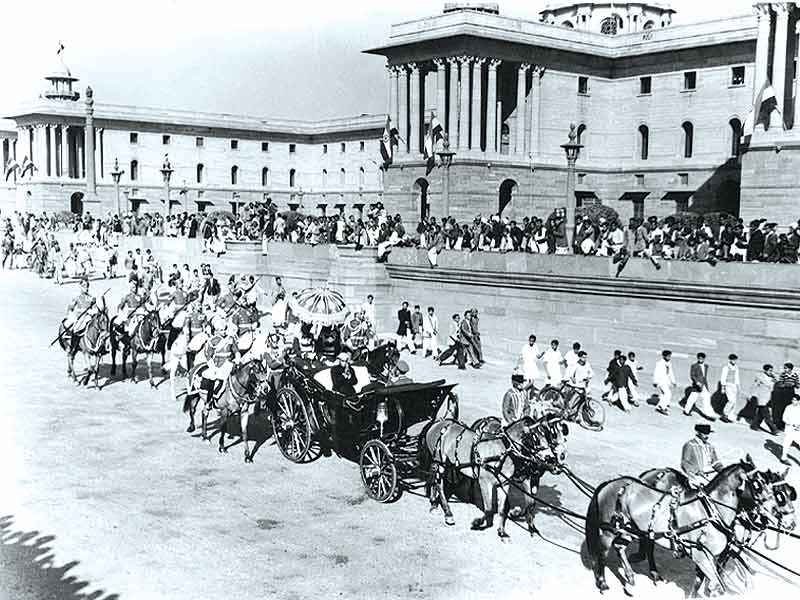
🔫 31 guns in 1950, 21 guns today
The 1950 proclamation was marked by a 31-gun salute. The ceremony at today’s parade uses a 21-gun salute, fired by the Regiment of Artillery as the President unfurls the flag and the National Anthem plays. Since 2023 it has been fired from indigenous 105-mm Indian Field Guns, replacing the vintage British-era 25-pounders.
1950–1955: A Republic Still Looking for Its Stage
Four venues in five years, then a permanent route.
The parade did not move straight onto the ceremonial avenue. According to the Central Vista project’s own history, between 1950 and 1954 the celebrations were held at the National Stadium, Kingsway Camp, the Red Fort and Ramlila Ground. The 1951 celebration, the Republic’s first anniversary, was again held at the Irwin Stadium.
Sources disagree on one detail. The official Central Vista history lists Kingsway Camp, an area in north Delhi near the old Durbar grounds, as one of the early venues. Other accounts list Kingsway, the avenue between Government House and India Gate that later became Rajpath. What is not supported is the popular line that the parade “moved to Kingsway in 1951” and stayed: the 1951 celebration, with King Tribhuvan of Nepal as chief guest, was at the Irwin Stadium, and every source agrees that 1955 is the year the avenue became the parade’s permanent home.
That year’s chief guest was Pakistan’s Governor-General, Malik Ghulam Muhammad. From then on the route ran from Rashtrapati Bhavan down Raisina Hill through Vijay Chowk and along Rajpath to India Gate, and for much of the parade’s history on toward the Red Fort. The avenue gave the parade what a stadium could not: room for columns of troops, vehicles and floats, and kilometres of roadside for spectators.
| Name | Period | What it meant |
|---|---|---|
| Kingsway | 1911–1947 | Named after George V; imperial ceremonial axis of New Delhi |
| Rajpath | 1947–2022 | Hindi rendering after Independence; parade venue from 1955 |
| Kartavya Path | September 2022– | Renamed with the Central Vista redevelopment; first parade January 2023 |
Tableaux: How the Parade Learned to Tell a Story
Military display plus cultural pageant.
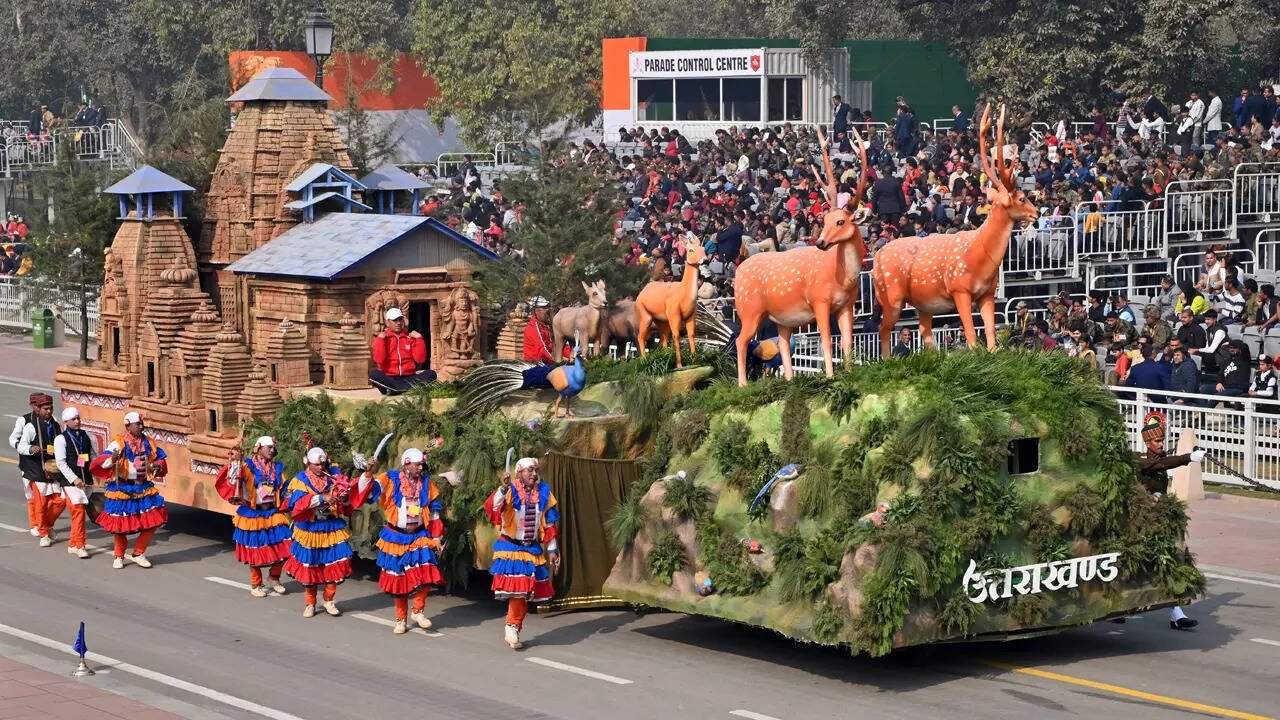
Military parades on Republic Day were, in part, a legacy of the Raj’s ceremonial display of power. What made India’s version different was the cultural pageant. Jawaharlal Nehru argued that the parade should combine the military march-past with a pageant showing that the country valued cultural progress “no less than military strength”. His proposals were built into the parade of 1953, and folk dancers and state floats became a fixture.
The tableaux grew into the parade’s most watched segment. Today the Ministry of Defence invites proposals from states, Union Territories and central ministries, and an expert committee from the arts reviews them in two rounds: first sketches and designs, then three-dimensional models. Tableaux may not carry logos and are expected to include some animation and sound. Because only some can be chosen each year, a system introduced in 2024 gives every state and UT a slot at least once every three years.
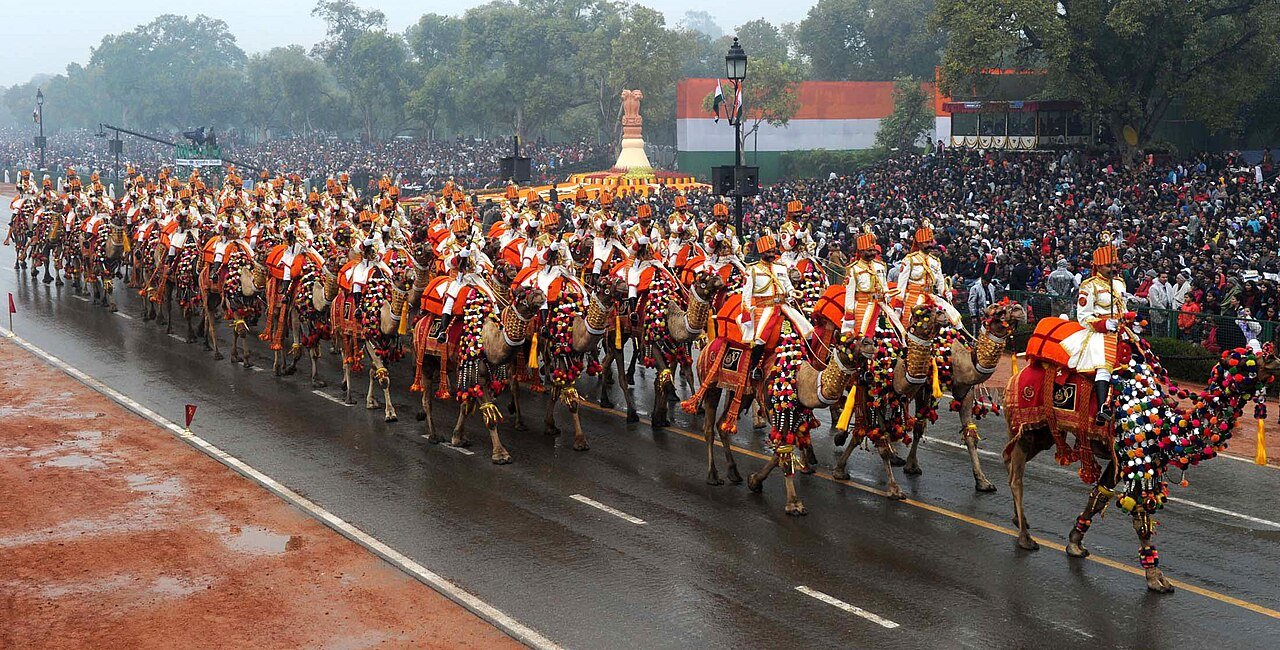
Some older elements survived. The Border Security Force camel contingent, described as the only camel-mounted force of its kind in the world, marches in full regalia alongside tanks and missile carriers. Children who win National Bravery Awards once rode past on decorated elephants; they now ride in vehicles.
1972: Celebration Meets Remembrance
After the 1971 war, the parade gained a memorial.
The December 1971 war with Pakistan and the creation of Bangladesh changed the parade’s mood. On 26 January 1972, Prime Minister Indira Gandhi inaugurated the Amar Jawan Jyoti, an eternal flame beneath India Gate for soldiers killed in the war. For almost five decades, laying a wreath there was the Prime Minister’s first act on Republic Day morning.
In 2019 the National War Memorial opened nearby, and in January 2022 the Amar Jawan flame was merged with the memorial’s flame. The Prime Minister now pays homage at the National War Memorial before the parade. Gallantry awards, including living Param Vir Chakra and Ashoka Chakra recipients, have long been a centrepiece of the ceremony.
For more on the war itself, see our Vijay Diwas 1971 war timeline.
1983: The Parade Goes Live in Colour
From a Delhi crowd to a national audience.
For its first three decades the parade was mostly experienced by people who could get to Delhi, and by radio listeners through All India Radio. Doordarshan’s colour service began on 15 August 1982 with the Independence Day broadcast, and the Asian Games in Delhi that November pushed colour sets into more homes. On 26 January 1983 Doordarshan carried the Republic Day parade live in colour for the first time.
That changed what the parade had to be. Uniforms, tableaux and the flypast now had to work on a screen as well as on the road, and camera positions became part of the plan. By the 2000s the broadcast used many camera angles, aerial shots and commentary, and by the 2010s clips and photographs spread online within minutes. Background on the broadcaster is in our Doordarshan history.
🔒 1984: the open carriage disappears
After Prime Minister Indira Gandhi was assassinated in October 1984, the President stopped travelling to the parade in the open horse-drawn buggy, and security around the route tightened sharply over the following decades. The buggy returned only in 2024, when President Droupadi Murmu and chief guest Emmanuel Macron rode in it, about 40 years later. It was used again in 2025 with Indonesia’s Prabowo Subianto.
Chief Guests: A Foreign-Policy Signal Every January
Selected chief guests, 1950–2026.
Inviting a foreign leader as chief guest began with the first parade, and the choice is read every year as a signal of India’s diplomatic priorities. The guest list has included neighbours, former colonial powers, Cold War partners and, in recent years, groupings rather than single countries.
| Year | Chief guest | Why it stood out |
|---|---|---|
| 1950 | President Sukarno, Indonesia | First chief guest; Asian solidarity |
| 1951 | King Tribhuvan, Nepal | Second chief guest; again at Irwin Stadium |
| 1955 | Governor-General Malik Ghulam Muhammad, Pakistan | First parade on the permanent route |
| 1961 | Queen Elizabeth II, United Kingdom | Former colonial power as guest |
| 2015 | President Barack Obama, United States | First US President as chief guest |
| 2018 | Leaders of the ten ASEAN countries | Largest group of chief guests |
| 2021, 2022 | None | Pandemic-scaled parades |
| 2023 | President Abdel Fattah el-Sisi, Egypt | First parade on Kartavya Path |
| 2024 | President Emmanuel Macron, France | Presidential buggy returns |
| 2025 | President Prabowo Subianto, Indonesia | Indonesia again, 75 years after Sukarno |
| 2026 | Antonio Costa and Ursula von der Leyen, EU | Heads of the European Council and Commission |
2022–2023: Rajpath Becomes Kartavya Path
Same axis, new name, new public space.
In September 2022 the redeveloped Central Vista avenue was renamed Kartavya Path and inaugurated by Prime Minister Narendra Modi. The government presented the renaming as a step away from colonial-era symbolism, turning “the path of the ruler” into “the path of duty”. The redevelopment added new lawns, walkways, seating, canals and public amenities along the route.
The 74th parade, on 26 January 2023, was the first held under the new name, with Egypt’s President el-Sisi as chief guest and an Egyptian military contingent marching. It was also the first time the 21-gun salute was fired from indigenous 105-mm Indian Field Guns instead of 25-pounders. The avenue remained the same ceremonial axis, now with its third name: Kingsway, Rajpath, Kartavya Path.
2021–2026: Five Parades, Five Different Firsts
Pandemic, women-led columns, jointness and battle arrays.
2021. The pandemic shrank the parade and there was no chief guest. The Air Force’s Rafale made its Republic Day flypast debut, and the shortened route ended at the National Stadium, where the first parade had been held in 1950.
2024. The 75th parade was explicitly women-centric. For the first time it opened with 100 women artists playing Indian instruments such as the shankh, nadaswaram and nagada. An all-women tri-service contingent marched, and the Ministry of Culture’s installation Anant Sutra displayed about 1,900 sarees and drapes on wooden frames.
2025. For the first time a single tri-services tableau represented the Army, Navy and Air Force together, reflecting the push for jointness. About 5,000 artists performed more than 45 dance forms along Kartavya Path.
2026. The 77th parade was built around 150 years of Vande Mataram. Tableaux rolled under two themes, “Swatantrata ka Mantra – Vande Mataram” and “Samriddhi ka Mantra – Atmanirbhar Bharat”: 30 in all, 17 from states and UTs and 13 from ministries, departments and services, including an Air Force veterans’ tableau. The Army showed a Battle Array Formation for the first time, arranging tanks, missile systems, drones and armoured platforms as they would be deployed rather than as a line of separate exhibits. Paintings by Tejendra Kumar Mitra from the 1923 Bande Mataram Album lined the route, and around 10,000 special guests, from natural farmers and self-help-group women to ISRO scientists and start-up founders, were seated at Kartavya Path.
| Year | Parade | Headline change |
|---|---|---|
| 2021 | 72nd | Rafale debut; no chief guest; route ends at National Stadium |
| 2022 | 73rd | No chief guest; Amar Jawan flame merged with National War Memorial |
| 2023 | 74th | First on Kartavya Path; 105-mm guns fire the salute |
| 2024 | 75th | 100 women musicians; all-women tri-service contingent; buggy returns |
| 2025 | 76th | First tri-services tableau; ~5,000 artists |
| 2026 | 77th | Vande Mataram at 150; 30 tableaux; Battle Array; ~10,000 special guests |
The Flypast: From Spitfires to Rafales
The sky changed as much as the road.
The 1950 flypast was a snapshot of an air force built from wartime aircraft: Harvard trainers, B-24 Liberators, Dakotas, Hawker Tempests and Spitfires, with a few early jets, more than 100 aircraft in total. By 2019 the flypast included the Su-30MKI, Jaguar, MiG-29, C-17 Globemaster and HAL Rudra. The 2026 flypast listed the Rafale, Su-30, P-8I, C-295, MiG-29, Apache, Light Combat Helicopter, ALH and Mi-17.
On the ground the change is just as clear. The 2026 mechanised columns included the T-90 and Arjun tanks, BrahMos, Akash and MRSAM missile systems, ATAGS and Dhanush guns, drones, unmanned ground vehicles and robotic mules, alongside a mounted column of the 61st Cavalry and an animal contingent of Zanskar ponies, Bactrian camels and dogs.
Beating Retreat: The Musical Finale
29 January, Vijay Chowk.
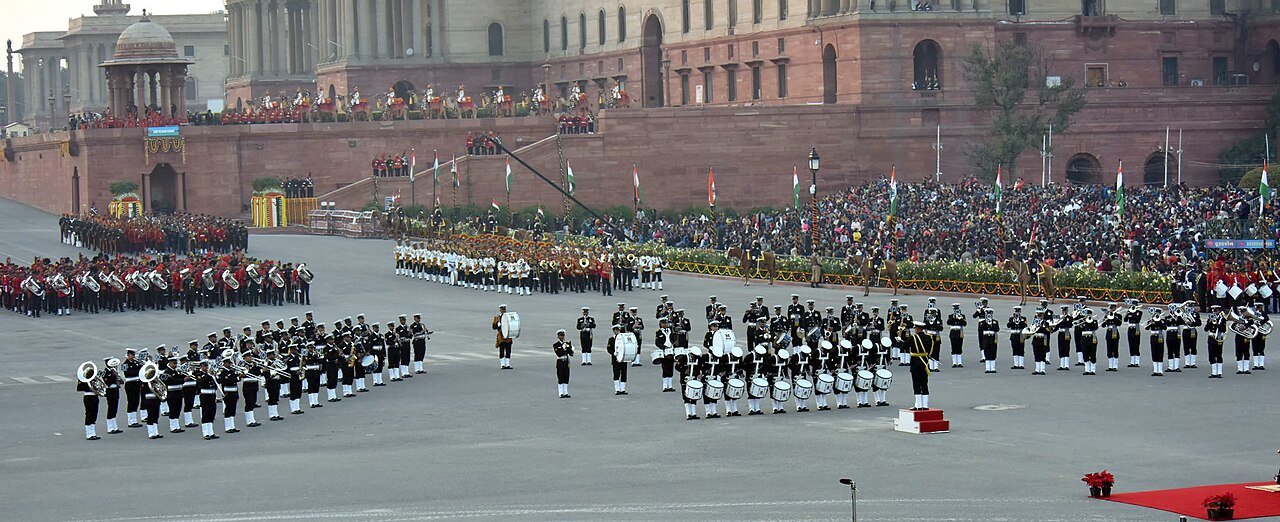
The Republic Day celebrations formally end three days later, on the evening of 29 January, with Beating Retreat at Vijay Chowk, between North and South Block. The ceremony draws on the old military custom of troops sounding the retreat at sunset and returning to camp. In India it dates to the 1950s. Massed bands of the Army, Navy and Air Force, and in recent years other forces, play marches and Indian compositions before the President. In 2022 the ceremony added a show of about 1,000 drones over Raisina Hill.
1950 vs 2026: The Same Day, a Different Parade
First parade vs 77th parade
Republic Day Parade Full Timeline, 1930–2026
Newest first.
77th Parade: Vande Mataram at 150
30 tableaux (17 states/UTs, 13 ministries and services), the Army’s first Battle Array Formation, about 10,000 special guests, and EU leaders Antonio Costa and Ursula von der Leyen as chief guests.
First Tri-Services Tableau
Army, Navy and Air Force share one tableau for the first time. About 5,000 artists perform; Indonesia’s Prabowo Subianto is chief guest, 75 years after Sukarno.
75th Parade Is Women-Centric
100 women musicians open the parade, an all-women tri-service contingent marches, Anant Sutra shows about 1,900 sarees, and the presidential buggy returns after about 40 years.
First Parade on Kartavya Path
The 74th parade is the first under the new name. Indigenous 105-mm Indian Field Guns replace 25-pounders for the 21-gun salute. Egypt’s el-Sisi is chief guest.
Rajpath Renamed Kartavya Path
The redeveloped avenue is renamed and inaugurated. Earlier that year the Amar Jawan flame was merged with the National War Memorial flame, and Beating Retreat featured about 1,000 drones.
Rafale Debut in a Pandemic Year
A scaled-down parade with no chief guest. The Rafale joins the flypast for the first time, and the route ends at the National Stadium, where it all began.
Ten Chief Guests
The leaders of all ten ASEAN member states attend together, the largest group of chief guests in the parade’s history.
Foreign Troops March
French Army soldiers and a French band become the first foreign contingent to march in the parade. The Army’s dog squad returns after 26 years.
First US President as Chief Guest
Barack Obama becomes the first sitting US President to be chief guest at the parade.
The Buggy Is Withdrawn
After Indira Gandhi’s assassination, the President stops using the open horse-drawn buggy, and security around the parade tightens in the decades that follow.
Live in Colour
Doordarshan telecasts the parade live in colour for the first time, months after its colour service began in August 1982.
Amar Jawan Jyoti
Indira Gandhi inaugurates the eternal flame under India Gate for soldiers killed in the 1971 war, adding remembrance to the celebration.
Queen Elizabeth II Attends
The British monarch is chief guest, a sign of how quickly the Republic had normalised ties with its former colonial ruler.
Rajpath Becomes Permanent
The avenue from Rashtrapati Bhavan to India Gate becomes the parade’s permanent venue. Pakistan’s Governor-General Malik Ghulam Muhammad is chief guest.
The Cultural Pageant Joins
Nehru’s idea of pairing the military parade with a cultural pageant is built into the celebrations, the start of the folk-dance and tableau tradition.
First Anniversary, Still in a Stadium
The Republic’s first anniversary is again marked at the Irwin Stadium, with King Tribhuvan of Nepal as chief guest. Between 1950 and 1954 the venue rotates among the stadium, Kingsway Camp, the Red Fort and Ramlila Ground.
The First Republic Day Parade
The Constitution comes into force, Rajendra Prasad is sworn in, a 31-gun salute is fired, and about 3,000 personnel parade before some 15,000 spectators, with Sukarno as chief guest.
Purna Swaraj Day
The Congress observes 26 January as Purna Swaraj (complete independence) Day. Twenty years later the Constitution is brought into force on the same date.
Myths and Mix-Ups, Checked
Claims that circulate about the parade, against the record.
What the record says
- “The first parade was on Rajpath.” No. It was held at the Irwin Amphitheatre. The President’s procession did pass along the Central Vista on the way.
- “The parade moved to Kingsway in 1951.” Not supported. The 1951 celebration was at the Irwin Stadium. The official Central Vista history names Kingsway Camp in north Delhi, not the Kingsway avenue, among the 1950–54 venues, and all sources agree the avenue became the permanent venue in 1955.
- “There has always been a 21-gun salute.” The 1950 proclamation was marked with 31 guns. The 21-gun salute is the modern ceremonial standard.
- “The buggy is an unbroken tradition.” It was withdrawn after 1984 and only returned in 2024.
- “Rajpath was renamed in 2023.” The renaming came in September 2022. January 2023 was the first parade under the new name.
Quiz: How Well Do You Know the Republic Day Parade?
Tap a question to reveal the answer.
1. Where was the first Republic Day parade held?
2. Who was the first Republic Day chief guest?
3. When did Rajpath become the permanent venue?
4. How many guns were fired to mark the 1950 proclamation?
5. When was the parade first broadcast live in colour?
6. What was Rajpath called before Independence?
7. When was Rajpath renamed Kartavya Path?
8. What first did the 2024 parade open with?
9. What did the 2025 parade show for the first time?
10. What was the Army’s first in 2026?
Explore More Timelines
People Also Ask
Frequently Asked Questions
Related AiTimeline Stories
⚠️ Editorial Note
Details of the 1950 ceremony (timings, the coach, 3,000 personnel, 15,000 capacity, 31-gun salute) follow The Tribune’s archive reporting; the 1950–1954 venues and 1955 start on Rajpath follow the Central Vista project’s official history; 2024–2026 details follow Ministry of Defence releases on PIB. Several claims that circulate about the parade are not used or are corrected here: that it “moved to Kingsway in 1951” (the 1951 celebration was at the Irwin Stadium; the official list of early venues names Kingsway Camp, though some accounts say Kingsway), and anecdotes such as a named elephant in 1962 and a crowd of “more than a million” in 1972, which we could not verify. This is editorial, AI-assisted content.
Sources & further reading
Every dated entry above was checked against these references. Last reviewed 27 September 2026.
- Central Vista: Evolution of the Central Vista (Republic Day parade venues)
- PIB: 150 years of Vande Mataram to be the theme of Republic Day Parade 2026
- PIB: The Journey of India as a Republic (January 2026)
- The Tribune: First Republic Day celebrations held at Irwin Amphitheatre
- PIB: 100 women artists to commence Republic Day Parade 2024
- The Tribune: 105-mm Indian Field Guns replace 25-pounders for 21-gun salute (2023)
- The Shillong Times: First joint tri-services tableau (2025)
- Kiran Kumbhar: Nehru, Diversity, and the Origins of India's Republic Day Parades
- Wikipedia: List of chief guests at the Delhi Republic Day parade