Why France Is Sending Troops to Protect Saudi Arabia’s Yanbu Oil Port
Why is France sending troops, radars and air defence to Saudi Arabia's Yanbu oil port? The East-West Pipeline, Hormuz, the 2026 attacks and what is known.
Latest Story
On the evening of 24 September 2026, in a television interview on TF1 and France 2, Emmanuel Macron said France would send soldiers, radars and defence systems to Saudi Arabia to protect Yanbu, the kingdom’s main oil export terminal on the Red Sea. “Not to get us involved in any conflicts,” he said, “but to protect this site.” To see why a French president is guarding a Saudi port, you need three things: a 1,201-kilometre pipeline built in 1981 to dodge the Strait of Hormuz, a war that closed Hormuz in 2026, and a Saudi–French defence relationship that is older, and deeper, than most people realise. This page explains all three, and is careful to separate what has been confirmed from what has only been claimed.
💡 Short Answer
France is sending soldiers, radars and air-defence systems to Yanbu because the Red Sea port has become Saudi Arabia’s main way to export oil while the Strait of Hormuz is disrupted by the 2026 Iran war. Oil reaches Yanbu through the 1,201 km East-West Pipeline, which drones from Iraq shut down in September 2026, while Yemen’s Houthis have claimed missile and drone strikes on Yanbu. Macron announced the mission on 24 September 2026 and called it strictly defensive.
France, Yanbu and the Oil Route: Key Questions
The Yanbu Story in Ten Lines
- The bypass: Saudi Arabia opened the East-West Pipeline in 1981, during the Iran–Iraq war, so oil could reach the Red Sea without passing Hormuz.
- The war: After 28 February 2026, traffic through Hormuz fell below 10% of normal, according to the IEA, and Yanbu became the kingdom’s lifeline.
- The surge: Western Saudi exports hit a record 5.9 million barrels a day on 9 March 2026, more than three times the 2025 average.
- The second front: Yemen’s Houthis declared a naval blockade of Saudi Arabia on 20 July 2026 after a years-long truce collapsed.
- The pipeline hit: Drones launched from Iraq struck pumping stations on 10–11 September 2026 and the pipeline was shut.
- The restart: Saudi Arabia restarted the line on 22 September at a low rate. A full return was expected to take six to eight weeks.
- The offer: The same day, a French diplomatic source said France was ready to help secure Yanbu and the pipeline, “strictly defensive”.
- The pledge: On 24 September Macron promised soldiers, radars and defence systems for Yanbu.
- The context: France and Saudi Arabia signed a strategic partnership in December 2024 and a new defence declaration on 24 August 2026.
- The limits: Troop numbers, systems, timing and rules of engagement are still undisclosed. France is adding to, not replacing, the US role.
Why Yanbu Matters
A port that exists because of a chokepoint on the other side of the country.
Most of Saudi Arabia’s oil comes out of the ground in the Eastern Province, close to the Gulf. For decades most of it left the country the obvious way: by tanker from Gulf terminals such as Ras Tanura, then out through the Strait of Hormuz, a channel that Iran borders on its northern side. In 2025, according to the International Energy Agency, about 15 million barrels a day of crude and 5 million barrels a day of oil products passed through it.
Yanbu is the answer to the obvious question: what happens if Hormuz closes? It sits on the Red Sea coast, about 1,200 km west of the oil fields. The old town, Yanbu al-Bahr, was for centuries the sea gate for pilgrims and trade heading to Medina. The modern industrial city, Yanbu al-Sinaiyah, was built from the late 1970s under the Royal Commission for Jubail and Yanbu. Today it holds crude export terminals, storage and several large refineries, including the Aramco joint ventures SAMREF and YASREF.
The connection between the two coasts is the East-West Pipeline, also called Petroline. As long as it runs, Saudi oil can reach customers in Europe and Asia without a single tanker going near Hormuz. That is why Yanbu’s importance rises and falls with the danger in the Gulf. In a normal year it is useful. In 2026 it became essential.
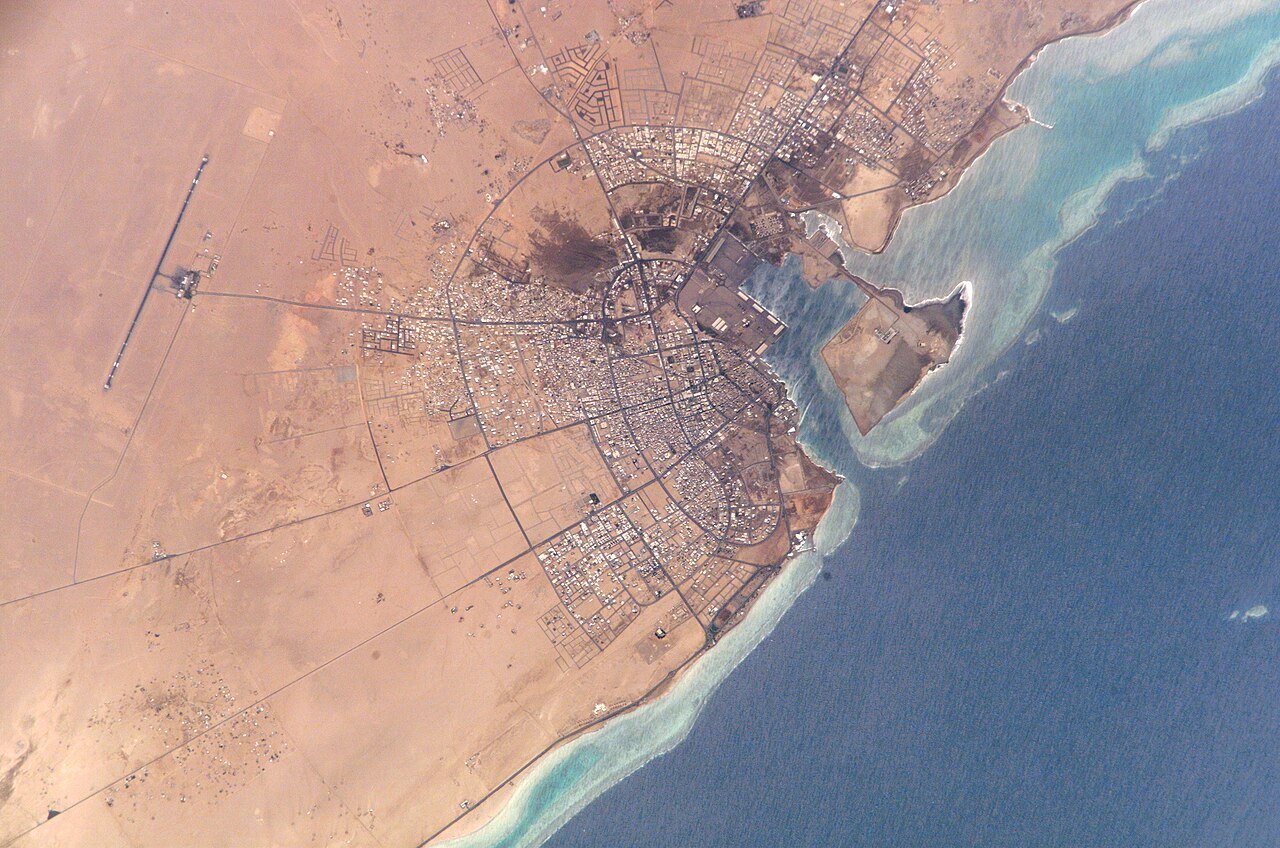
The Oil Route France Is Protecting
From the eastern fields to the Red Sea, with Hormuz as the route being bypassed.
1981: A Pipeline Built for Exactly This Crisis
The Iran–Iraq war taught Riyadh not to rely on one sea.
The East-West Crude Oil Pipeline was commissioned in 1981, a year into the Iran–Iraq war, when both sides were already attacking oil facilities and the “tanker war” in the Gulf was about to begin. It runs 1,201 km from Abqaiq, Aramco’s giant processing centre near the Gulf, to Yanbu, pushed along by 13 pumping stations. The system has two large lines: one built for crude, and a second, originally for natural gas liquids, that Aramco has moved over to crude. By March 2026 the IEA was describing it as a 7 million barrels a day pipeline; in 2018 its stated capacity was 5 million.
The design logic has never changed: if Hormuz is blocked, pump the oil the other way. What the pipeline cannot do is make itself safe. In May 2019, Houthi drones hit pumping stations near Afif and briefly shut it down. In September 2019, the attack on Abqaiq and Khurais knocked out about half of Saudi output for days. Both showed that a bypass route is only as strong as its weakest pumping station.
For the full engineering and operational history of the line, see our Saudi East-West Pipeline timeline. This page focuses on what happened at its western end in 2026, and why France got involved.
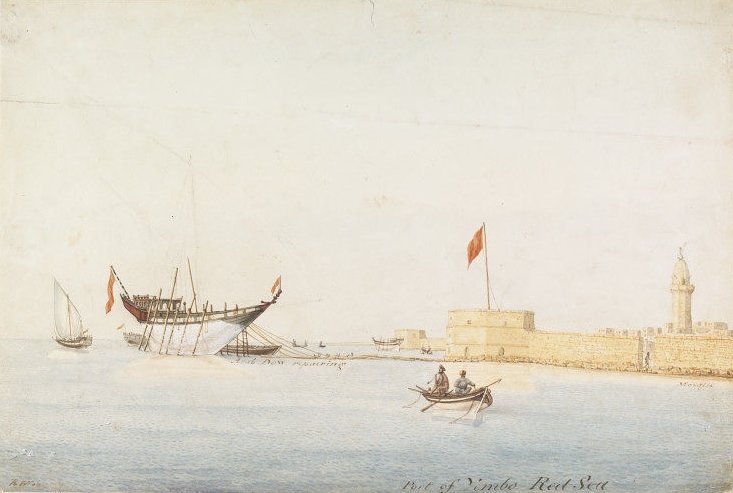
1932–2026: How France Became a Saudi Security Partner
Yanbu is new. The relationship is not.
France was among the first countries to recognise the Kingdom of Saudi Arabia, in 1932, and had kept a consulate in Jeddah since 1839. The security relationship came later, and it was built around exactly the things Macron is now sending: air defence and naval power.
Air defence, 1970s–1980s. French industry built the Shahine short-range air-defence system, a version of the Crotale missile developed for Saudi Arabia, which entered Saudi service around 1980.
The Grand Mosque, 1979. When armed militants seized the Grand Mosque in Mecca in November 1979, a small team from France’s GIGN gendarmerie unit advised Saudi forces on retaking it. It remains one of the most sensitive episodes in the relationship.
The navy, 1980 and 1994. Under the Sawari I programme, signed in 1980, France supplied four frigates and two replenishment tankers to the Royal Saudi Navy’s western fleet, which is based on the Red Sea. Sawari II, signed in 1994, added three Al Riyadh-class air-defence frigates delivered in the early 2000s. In other words, France has been equipping the Saudi Red Sea fleet for more than 40 years.
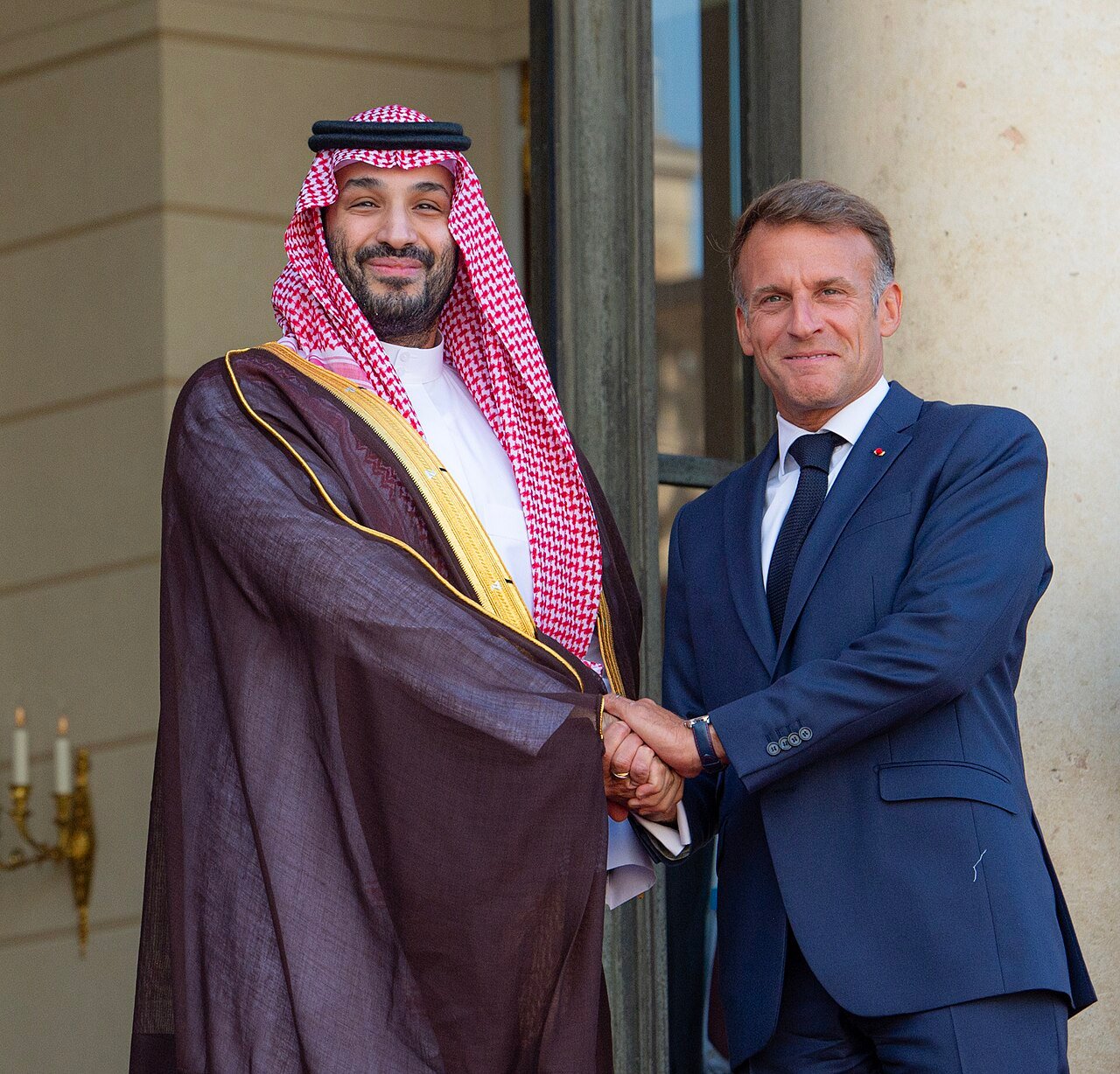
Macron’s era. Macron made a surprise stop in Riyadh in November 2017, days after a Houthi missile was fired at the capital. Crown Prince Mohammed bin Salman came to Paris in April 2018, when Saudi and French firms signed about $18 billion in deals. Macron met him in Jeddah in December 2021, and hosted him at the Elysée in July 2022.
December 2024: the strategic partnership. During Macron’s state visit to Saudi Arabia on 2–4 December 2024, the two countries announced a formal strategic partnership covering defence, energy, culture, investment and mobility.
24 August 2026: the council. Mohammed bin Salman returned to the Elysée on 24 August 2026. The two leaders chaired the first meeting of a new Saudi-French Strategic Partnership Council, and, in the words of their joint statement, “adopted a declaration strengthening their defence cooperation, including in the field of armaments and training”. The same statement called for Hormuz to return to “its normal state as it was before February 28, 2026”. One month later, French soldiers were promised to Yanbu.
France Already Had a Red Sea Role
Bases, frigates and an EU mission.
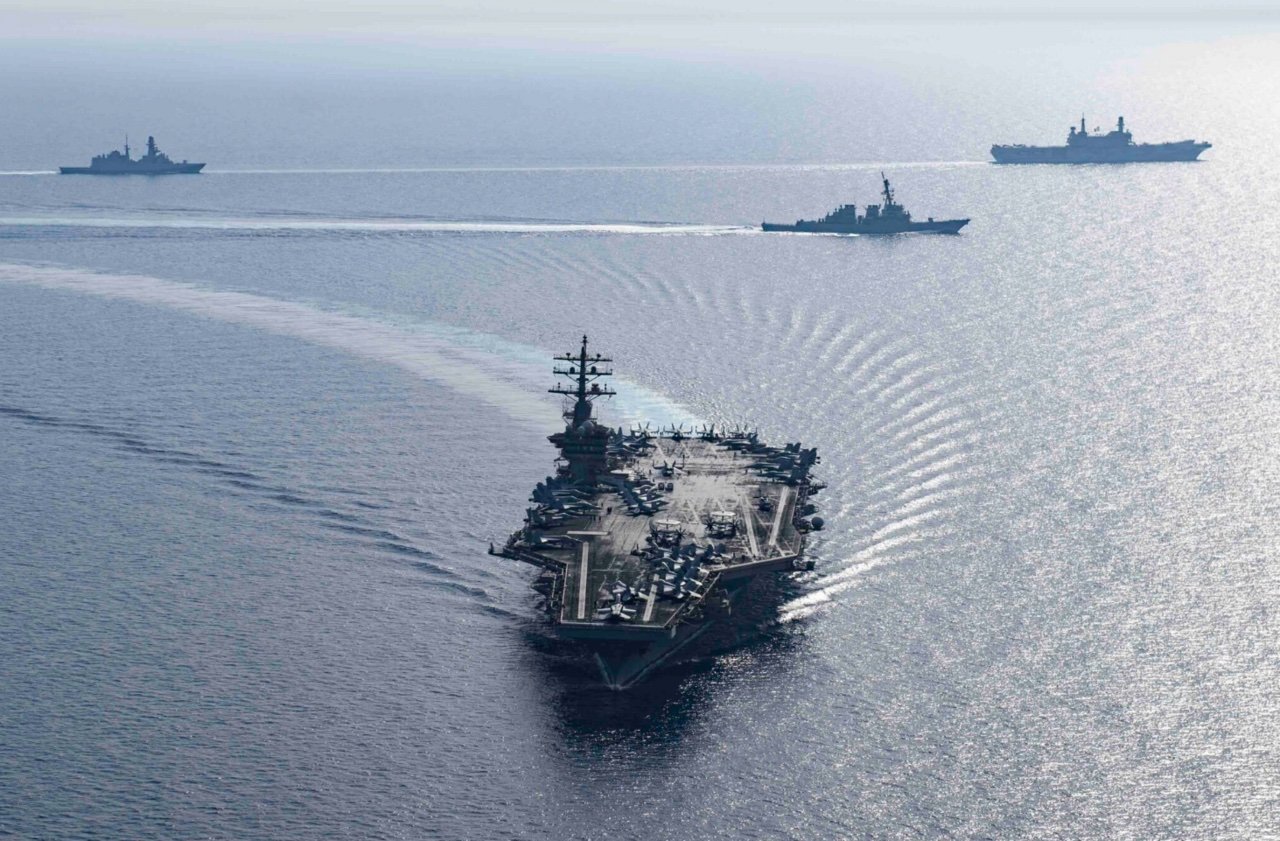
France is not arriving in the region from nowhere. It keeps about 1,500 personnel in Djibouti, at the southern mouth of the Red Sea, and about 750 in the United Arab Emirates, where it opened a permanent base in Abu Dhabi in 2009, according to figures cited by Arab News.
At sea, French warships were already shooting down drones in the Red Sea before the EU acted. The frigate Languedoc destroyed two drones heading towards it in December 2023. On 19 February 2024, the EU launched Operation ASPIDES (Greek for “shields”) to protect merchant ships from Houthi attacks. France has been one of its main contributors, and describes the mission as purely defensive: escorting and protecting ships, not striking Yemen.
That is the model France is now applying on land. ASPIDES shields ships; the Yanbu mission is meant to shield a port. In both cases Paris draws a line between defending against missiles and drones and attacking the people who launch them.
February–August 2026: The War That Made Yanbu Essential
First Hormuz closed. Then the Red Sea turned hostile.
28 February 2026: war. The US-Israeli war with Iran began on 28 February. Within days, Iran had effectively shut the Strait of Hormuz. The IEA’s March report said flows through the chokepoint were running at less than 10% of pre-crisis levels.
March: the pivot west. Aramco began pushing as much crude as it could through the East-West Pipeline. Before the war, the IEA said, the line was carrying only about 2–2.5 million barrels a day, much of it for Red Sea refineries and power plants. On 9 March 2026, Saudi exports from western ports hit a record 5.9 million barrels a day, against an average of 1.7 million in 2025.
April: the first hit. On 9 April, an Iranian drone attack cut the pipeline’s throughput by about 700,000 barrels a day. Saudi Arabia said full capacity was restored on 12 April.
July: the Red Sea front opens. Saudi Arabia and the Houthis had kept an informal truce for years. It broke on 13 July 2026, when Saudi Arabia struck the runway at Sanaa airport to stop an Iranian aircraft carrying Houthi officials from landing. The Houthis fired missiles and drones at southern Saudi Arabia, and on 20 July they declared a naval blockade of Saudi Arabia, threatening ships carrying Saudi exports through Bab el-Mandeb. They also claimed attacks on Aramco sites in Jizan and Yanbu.
The result was a trap. Saudi Arabia had moved its exports west to escape Iran’s grip on Hormuz, only to find Iran’s Yemeni allies threatening the western route too.
September 2026: The Pipeline Is Hit and Yanbu Is Targeted
Three weeks that set up the French decision.
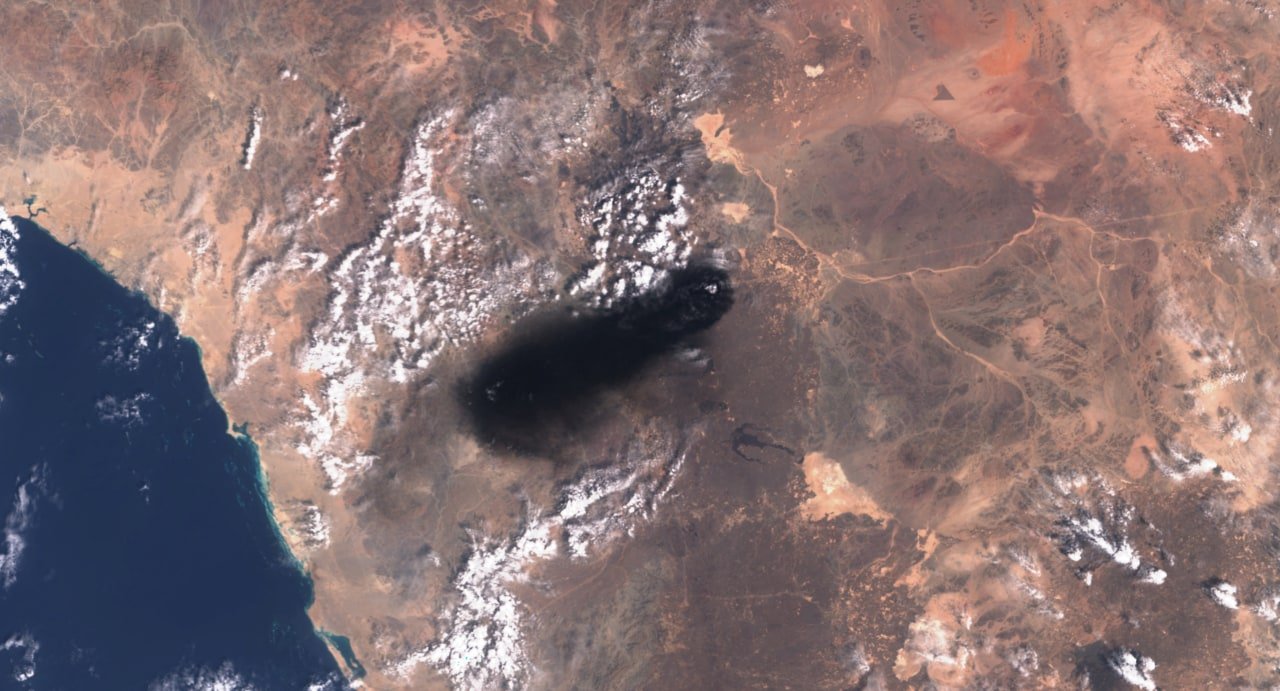
10–11 September: drones from Iraq. Several drones struck pumping stations on the East-West Pipeline in the Riyadh and Medina regions. The Saudi Press Agency said they came from Iraq. Satellite images showed black smoke along the route between Medina and Mahd al-Dhahab, and several people were injured. The energy ministry shut the pipeline “as a precautionary measure”. (Reuters later dated the full shutdown to 13 September; reports differ by two days.) At the time the line was moving roughly 4 million barrels a day to Yanbu, around 4% of world supply. Brent crude went back above $100 a barrel.
12–13 September: Iraq responds. Saudi Arabia chose not to retaliate after Iraq’s prime minister asked for time to act. Iraq said its investigation traced the launches to Maysan province and dismissed a military commander there.
16 September: first Houthi claim on Yanbu. The Houthis said they had struck an Aramco facility in Yanbu with “dozens of ballistic missiles and attack drones”, causing a large fire. They gave no evidence, and neither Riyadh nor Aramco confirmed any damage.
19 September: second claim. The Houthis claimed strikes on Riyadh and again on an Aramco facility in Yanbu. Reuters witnesses reported explosions and smoke near Riyadh airport after an air-raid warning. There was no Saudi confirmation of damage at Yanbu.
22–24 September: France Offers, Then Commits
From a diplomatic source to a presidential pledge in 48 hours.
22 September: two things happen on one day. Saudi Arabia restarted the East-West Pipeline, pumping at a low rate. One tanker was due to load at Yanbu that day, bound for China. Sources told Reuters that reaching 40% of capacity would take a couple of days and a full return six to eight weeks. The same day, a French diplomatic source said: “France is ready to contribute to securing Saudi energy infrastructure in Yanbu and along the East-West Pipeline, within the framework of a strictly defensive approach.” It added that this “in no way” meant taking part in the conflict with the Houthis.
24 September: Macron on television. In a prime-time interview on TF1 and France 2, Macron said: “We are going to send military resources, that is to say, soldiers, radar systems and defence systems, to protect this site — not to get us involved in any conflicts, but to protect this site.” He tied it directly to prices at home: the Middle East war had pushed French fuel prices to historic highs, and he wanted to keep energy flowing as winter approaches.
24–25 September: the Houthis answer. Within hours, the Houthis claimed new missile and drone attacks on Riyadh and Aramco facilities in Yanbu. The Saudi-led coalition said it had intercepted six ballistic missiles aimed at Taif and Yanbu, and civil-defence alerts sounded in Mecca, Yanbu, Taif, Jeddah and Tabuk. This time Saudi Arabia did confirm that Yanbu had been targeted, though it reported interceptions, not damage.
Who Protects the Oil Route?
Follow a barrel from the field to the sea, and see which threats France’s mission covers.
Can you keep Saudi oil flowing?
Tap each stage. For every threat, see what defends against it, and whether the French deployment at Yanbu is part of the answer.
Stage 1: Choose the route
Stage 2: A drone swarm hits a pumping station
Stage 3: Missiles aimed at the terminal
Stage 4: The loaded tanker sails
There is no single safe route. Modern energy security means defending the whole network, and France’s mission covers one important node of it.
Claimed vs Confirmed: What We Actually Know
A war produces claims faster than evidence.
| Date (2026) | Event | Status |
|---|---|---|
| 10–11 Sep | Drones from Iraq hit East-West Pipeline pumping stations | Confirmed Saudi govt, satellite images |
| 11–13 Sep | Pipeline shut down | Confirmed Energy ministry |
| 16 Sep | Houthi strike on Aramco facility in Yanbu | Claim only no Saudi confirmation |
| 19 Sep | Houthi strikes on Riyadh and Yanbu | Claim only blasts heard near Riyadh |
| 22 Sep | Pipeline restarted at low rate | Confirmed Reuters sources |
| 22 Sep | France ready to help secure Yanbu and pipeline | Confirmed French diplomatic source |
| 24 Sep | Macron pledges soldiers, radars, defence systems | Confirmed TF1 / France 2 |
| 24–25 Sep | Six ballistic missiles aimed at Yanbu and Taif intercepted | Confirmed Saudi-led coalition |
| 24–25 Sep | Houthi hits on Aramco facilities in Yanbu | Claim only no damage confirmed |
The Yanbu Equation in Numbers
Every figure below has a named source.
| Indicator | Figure | Source |
|---|---|---|
| East-West Pipeline length | 1,201 km, 13 pumping stations | Aramco / Wikipedia |
| Pipeline capacity, 2026 | ~7 mb/d (5 mb/d in 2018) | IEA, March 2026 |
| Pipeline flows before the war | 2–2.5 mb/d | IEA, March 2026 |
| Western Saudi exports, 2025 average | 1.7 mb/d | IEA, March 2026 |
| Western Saudi exports, 9 Mar 2026 | 5.9 mb/d (record) | IEA, March 2026 |
| Flows to Yanbu before Sept attack | ~4 mb/d (~4% of world supply) | Reuters |
| Saudi Red Sea refining capacity | 1.8 mb/d | IEA, March 2026 |
| Hormuz flows, 2025 average | ~15 mb/d crude + ~5 mb/d products | IEA |
| French troops in Djibouti / UAE | ~1,500 / ~750 | Arab News |
| French personnel for Yanbu | Not disclosed | As of 27 Sep 2026 |
Is France Replacing the United States?
No. But the shape of Saudi security is changing.
The United States is still Saudi Arabia’s main security partner, and is itself at war with Iran. A few hundred or even a few thousand French personnel at one port do not change that. What the Yanbu mission does show is a pattern Riyadh has pursued for years: more than one partner. France’s foreign ministry describes Saudi Arabia’s effort to diversify its defence partnerships and build its own defence industry, with French cooperation focused on training and capability development.
Yasmine Farouk, who directs the Gulf and Arabian Peninsula project at the International Crisis Group, told Arab News that European governments are not against deploying to the Gulf, but that their forces are limited. France’s move, she said, “might help operationalize that European will to help the Kingdom”, and fits a wider French ambition to be a Gulf power through defence ties with the UAE, Kuwait and Qatar.
So the change is less “America out, France in” and more one dominant partner becoming several, each covering a piece of the map.
What the French Mission Is, and Is Not
What Is Still Unknown
As of 27 September 2026.
Five open questions
- How many? France has given no figure for the soldiers it will send.
- Which systems? Macron said radars and defence systems, but did not name them. France’s main ground-based long-range system is the SAMP/T, but no specific system has been confirmed for Yanbu.
- When, and for how long? No arrival date or end date has been announced.
- Rules of engagement. Will French crews fire their own interceptors, or only share radar data with Saudi units? Not yet public.
- Scope. The 22 September statement mentioned the pipeline as well as Yanbu. Whether French help will extend inland is unclear.
The Bigger Story: Oil Infrastructure Is Now Defence Infrastructure
For most of the oil age, energy security meant one question: how much can you produce? In 2026 the question became: can you move it? Pipelines, pumping stations, terminals and tanker lanes are now military targets, and radars and interceptors have become part of the export system.
Yanbu shows the paradox clearly. The East-West Pipeline was built so that one chokepoint could not strangle Saudi exports. When that chokepoint closed, the bypass carried the load, and became the new target. A route designed to avoid danger became indispensable, and being indispensable made it vulnerable. France’s mission is a bet that defending one node of that network is worth the political risk of standing next to it.
Key Players
Emmanuel Macron
Announced the Yanbu deployment on 24 September 2026 and framed it as defensive and tied to French energy prices.
Mohammed bin Salman
Launched the Saudi-French Strategic Partnership Council with Macron in Paris on 24 August 2026.
Saudi Aramco
Runs the East-West Pipeline and Yanbu export terminals, and rerouted crude west after Hormuz closed.
The Houthis
Declared a naval blockade of Saudi Arabia on 20 July 2026 and claimed repeated strikes on Yanbu.
Yahya Saree
Announced the blockade and the Houthi claims of missile and drone attacks on Aramco sites.
Yasmine Farouk
International Crisis Group. Sees France’s move as a way to turn European goodwill into real help.
France, Yanbu and the Oil Route: Full Timeline
Newest first.
Six missiles aimed at Yanbu and Taif intercepted
Hours after Macron’s pledge, the coalition reports intercepting six ballistic missiles. The Houthis claim hits on Riyadh and Aramco facilities in Yanbu; no damage is confirmed.
Macron announces the Yanbu deployment
France will send soldiers, radars and defence systems “to protect this site”, not to join any conflict. Numbers and timing are not given.
Pipeline restarts; France offers help
The East-West Pipeline restarts at a low rate, with a full return expected in six to eight weeks. A French diplomatic source says France is ready to help secure Yanbu and the pipeline, “strictly defensive”.
Second Houthi claim on Yanbu
The Houthis claim strikes on Riyadh and a Yanbu Aramco facility. Explosions are heard near Riyadh airport; Yanbu damage is not confirmed.
First Houthi claim on Yanbu in September
The Houthis say “dozens” of missiles and drones hit an Aramco facility in Yanbu. Riyadh and Aramco confirm nothing.
Iraq traces launches to Maysan
Iraq dismisses a military commander in Maysan province after tracing the drones there. Saudi Arabia holds back from retaliating.
Drones from Iraq shut the pipeline
Drones hit pumping stations; the line, carrying about 4 million barrels a day, is shut. Brent rises back above $100.
Strategic Partnership Council launched
Macron and Mohammed bin Salman adopt a declaration strengthening defence cooperation “including in the field of armaments and training”.
Houthis declare a naval blockade of Saudi Arabia
A Saudi strike on Sanaa airport on 13 July ends the truce. On 20 July the Houthis announce a blockade and threaten Saudi export shipping.
Iranian drone attack on the pipeline
Throughput falls by about 700,000 barrels a day; full capacity is restored three days later.
Record exports from the Red Sea
Western Saudi ports export 5.9 million barrels a day, against 1.7 million on average in 2025.
War with Iran; Hormuz closes
Flows through the Strait of Hormuz fall below 10% of pre-crisis levels, according to the IEA.
France-Saudi strategic partnership
The two countries announce a strategic partnership covering defence, energy, culture and investment.
EU launches Operation ASPIDES
A defensive naval mission to protect merchant ships from Houthi attacks. France is a leading contributor.
Mohammed bin Salman at the Elysée
The crown prince is hosted by Macron, seven months after Macron’s visit to Jeddah in December 2021.
The bypass is attacked for the first time
Houthi drones hit pipeline pumping stations in May; the Abqaiq and Khurais attack follows on 14 September.
Macron’s surprise Riyadh stop
Days after a Houthi missile was fired at the Saudi capital. MBS visits France in April 2018, with about $18 billion in deals.
Sawari II naval deal
Three French-built Al Riyadh-class air-defence frigates for the Saudi fleet, delivered in the early 2000s.
East-West Pipeline commissioned
Built during the Iran–Iraq war so Saudi oil could reach the Red Sea without passing Hormuz.
Sawari I and Shahine
France contracts four frigates and two tankers for the Saudi Red Sea fleet, and Shahine air-defence systems enter service.
GIGN at the Grand Mosque
French gendarmes advise Saudi forces retaking the Grand Mosque from armed militants.
France recognises Saudi Arabia
Among the first countries to recognise the new kingdom.
Explore More Timelines
People Also Ask
Frequently Asked Questions
Related AiTimeline Stories
⚠️ Editorial Note
This is a developing story, current to 27 September 2026. Figures are checked against the IEA Oil Market Report of 12 March 2026, the Saudi Press Agency, the Elysée’s 24 August 2026 joint statement, Reuters reporting (via Defense News, Hydrocarbon Processing and others), France 24, Euronews, Arab News and Wikipedia. Several claims in circulation were corrected: the pipeline attack began on 10–11 September, not 11–13; Saudi Arabia did not confirm interceptions at Yanbu on 19 September (the confirmed interception of six missiles aimed at Yanbu and Taif came on 24–25 September); the pipeline restarted on 22 September, which many summaries omit; and the peak Red Sea export figure used here is the IEA’s 5.9 million barrels a day on 9 March 2026. Houthi claims are reported as claims. This is editorial, AI-assisted content.
Sources & further reading
Every dated entry above was checked against these references. Last reviewed 27 September 2026.
- IEA: Oil Market Report, 12 March 2026
- Elysee: Joint statement by France and Saudi Arabia, August 2026
- Saudi Press Agency: Saudi Arabia condemns drone attack on East-West Pipeline launched from Iraq
- Defense News: France to send military to protect Saudi Arabia on Red Sea oil route, Macron says
- Gulf News: France ready to help secure Saudi energy infrastructure
- Hydrocarbon Processing (Reuters): Saudi Arabia restarts East-West oil pipeline
- France 24: Saudi reports fresh Houthi attacks as France pledges to defend key oil port
- Arab News: Why France is sending troops to protect Saudi Arabia's Yanbu oil port