Hungarian Revolution of 1956: Timeline of the Uprising Against Soviet Rule
Hungarian Revolution of 1956 timeline: from student protests in Budapest to Soviet tanks, Imre Nagy's government, reprisals and the uprising's legacy.
Latest Story
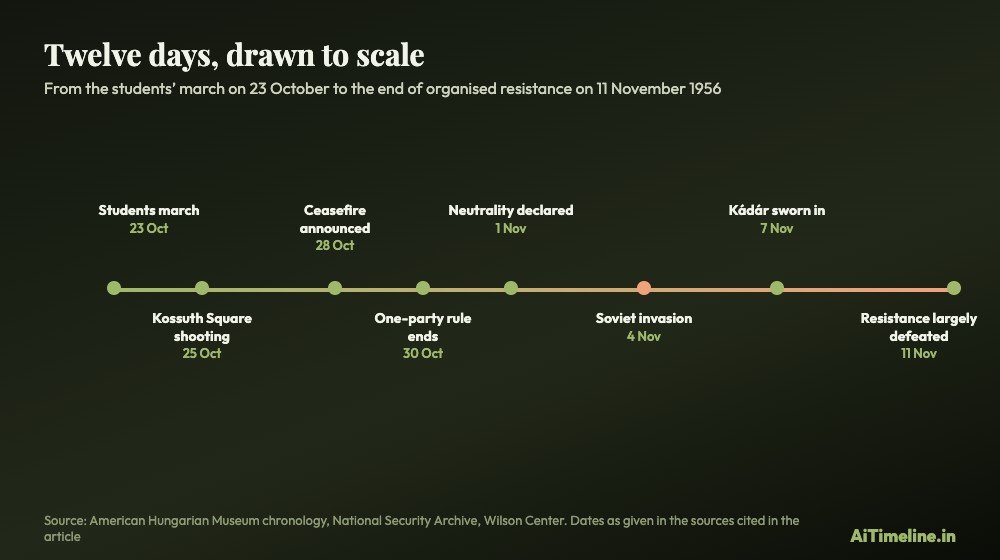
The Hungarian Revolution of 1956 began on 23 October 1956, when students took to the streets of Budapest demanding political reform, freedom of expression and an end to Soviet domination. A peaceful demonstration became an armed uprising after gunfire at the Radio building and the arrival of Soviet tanks. Within days the uprising spread across Hungary: workers formed revolutionary councils, political prisoners were released, and Imre Nagy’s government announced a ceasefire, then the end of one-party rule. On 1 November Nagy declared neutrality and announced Hungary’s withdrawal from the Warsaw Pact. On 4 November Soviet forces launched a massive assault. Thousands died, about 200,000 Hungarians fled, and the Soviet-backed Kádár government carried out years of reprisals; Nagy was executed in 1958. Yet the uprising became one of the defining moments of the Cold War, rehabilitated in 1989 and remembered on its 70th anniversary on 23 October 2026. This page keeps archival records, agency accounts, museum chronologies and estimates apart. For related reading, see AiTimeline’s timelines of the Berlin Wall, the Soviet collapse, the Berlin Airlift and the Cuban Missile Crisis.
Tap a stage. The key point: twelve days of hope, then 33 years before the revolution could be called by its name.
Choose a stage above.
💡 Short Answer
The Hungarian Revolution of 1956 was a nationwide uprising against communist rule and Soviet domination that began on 23 October 1956 with a student march in Budapest. Imre Nagy’s government ended one-party rule on 30 October and declared neutrality on 1 November. Soviet forces invaded on 4 November and crushed organised resistance by 10–11 November. About 2,500–3,000 Hungarians were killed, about 200,000 fled, and Nagy was executed on 16 June 1958. He was acquitted by the Supreme Court on 6 July 1989.
What Is Settled and What Is Disputed, as of 24 October 2026
Last updated: 24 October 2026. Kept separate from the timeline because each question has its own level of agreement among sources.
| Question | Position of the sources | Status |
|---|---|---|
| When did it start and end? | Began 23 Oct 1956 with the student march; Soviet assault 4 Nov; most organised armed resistance defeated by 10–11 Nov; a Mecsek rebel group fought to 16 Nov; strikes continued into Dec | Settled |
| Who fired the first shots at the Radio building? | The museum chronology says it has never been clarified; the Wilson Center account says secret police fired on unarmed demonstrators | Disputed |
| Who fired on the crowd at Kossuth Square on 25 Oct? | The museum chronology reports Soviet tanks firing amid confusion; other accounts blame secret-police fire. More than 100 killed per the museum | Disputed |
| Did Hungary invite Soviet troops? | The UN Special Committee could not determine whether any invitation was issued; Khrushchev later cited a request from Gerő on 23 Oct | Unresolved |
| When did Moscow decide to invade? | The National Security Archive and the Wilson Center place the reversal on 31 Oct, before the neutrality declaration of 1 Nov; some historians give the declaration more weight | Mostly settled |
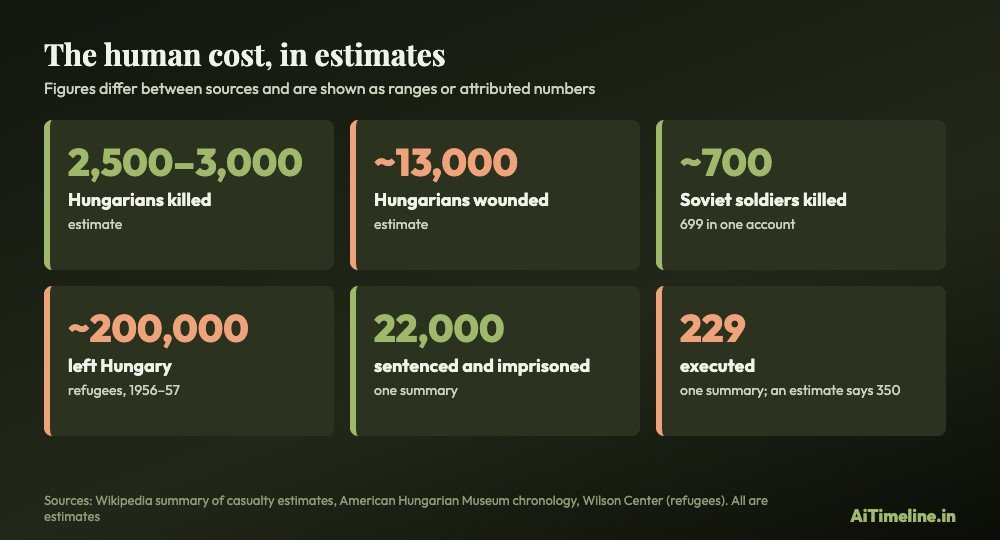
| How many died? | Commonly 2,500–3,000 Hungarians and about 700 Soviet soldiers (699 in one account); executions 229 in one summary, 350 in an estimate | Estimates differ |
| Was Nagy rehabilitated? | Reburied 16 Jun 1989; Supreme Court acquittal 6 Jul 1989 | Yes |
The Hungarian Revolution of 1956: Key Questions
The Hungarian Revolution in Ten Points
- The thaw: Khrushchev’s February 1956 speech, Poznań in June and Rákosi’s fall in July made reform seem possible.
- The spark: students drafted 16 demands on 22 October and marched on 23 October.
- The escalation: gunfire at the Radio building on the night of 23 October turned a march into an uprising.
- The bloodshed: on 25 October more than 100 were killed at Kossuth Square, according to one museum chronology; responsibility is disputed.
- The opening: a ceasefire on 28 October, the ÁVH dissolved and one-party rule ended on 30 October.
- The reversal: Moscow decided on 31 October to crush the revolution, before the 1 November neutrality declaration.
- The invasion: the Soviet assault began about 04:00 on 4 November; organised resistance was largely beaten by 10–11 November.
- The cost: about 2,500–3,000 Hungarians and roughly 700 Soviet soldiers killed, about 200,000 refugees.
- The reprisals: more than 230 death sentences; Nagy executed on 16 June 1958.
- The verdict of history: Nagy reburied and acquitted in 1989; Soviet troops left in 1991.
Hungarian Revolution Timeline, Latest First
Each entry is tagged by type and ends with why it matters. Disputed and second-hand figures are labelled as such.
Show only the prelude, the uprising, the Soviet response, repression and exile, or rehabilitation and memory.
–
2026
Seventy years on: a national holiday and a state ceremony Rehabilitation and memory
23 October has been a national holiday in Hungary since May 1990 (Hungarian National Archives). On 23 October 2026 the revolution turned 70. A published programme for the day listed a flag-raising at Kossuth Square at 09:00, a ceremonial session of Parliament at 14:00, a state ceremony in front of Parliament in the afternoon and a torch march from the Technical University to Bem Square on the eve (Hungary Unlocked).
That programme is a travel guide’s preview, not a report of the day. AiTimeline did not find a verified account of the speeches or attendance on 23 October, so none is given here. The facts above the anniversary—the 1956 dates, figures and rehabilitation—rest on the archives and agencies linked in this timeline.
1991
The last Soviet soldier leaves Hungary Rehabilitation and memory
UPI reported that the Soviet military occupation of Hungary officially ended on 19 June 1991 when the last Soviet commander walked out (UPI). Because the agreed withdrawal deadline was 30 June 1991, some English-language sources give that date instead.
The date matters because the first demand of the students of 22 October 1956 was the evacuation of Soviet troops. It took 35 years, and it happened under a government elected after communist rule ended.
1989
The Republic of Hungary is proclaimed from the Parliament balcony Rehabilitation and memory
On the 33rd anniversary of the uprising, Speaker Mátyás Szűrös proclaimed the Republic of Hungary, dropping “People’s” from the state’s name (CVCE). The announcement was made from the Parliament balcony in the square where crowds had gathered on 23 October 1956.
The choice of date tied the new constitutional order to the revolution that communist authorities had called a counter-revolution for three decades.
1989
The Supreme Court acquits Nagy, and Kádár dies the same day Rehabilitation and memory
On 6 July 1989 Hungary’s Supreme Court acquitted Imre Nagy of the high-treason charge for which he had been executed. János Kádár, who had led the government that crushed the revolution and ruled Hungary for more than three decades, died in hospital the same day (American Hungarian Museum chronology).
The ruling broke with the official account that had justified the 1958 executions. It was part of a wider reassessment of communist-era political trials.
1989
Nagy and his comrades are reburied before tens of thousands Rehabilitation and memory
On 16 June 1989, thirty-one years to the day after his execution, Imre Nagy, Miklós Gimes, Pál Maléter, Géza Losonczy and József Szilágyi were honoured in a funeral ceremony at Heroes’ Square attended by tens of thousands. Nagy’s body had been buried in an unmarked, unknown location in 1958. A symbolic tomb had already been raised for him at Père Lachaise cemetery in Paris in 1988 (American Hungarian Museum chronology).
For three decades, mentioning Nagy’s name in public risked punishment, and the history of 1956 was effectively sealed from Hungarians (National Security Archive). The reburial ended that silence. Later that year the one-party system was dismantled; see AiTimeline’s Berlin Wall timeline for the wider 1989 picture.
1958
Imre Nagy, Pál Maléter and Miklós Gimes are executed Repression and exile
Nagy and his associates had been brought back from Romania to Budapest in April 1957 and tried in secret. The tribunal concluded its trial on 9–15 June 1958, sentencing Nagy, Gimes and Maléter to death. They were executed on 16 June and buried in unknown places; the verdicts were made public on 17 June (American Hungarian Museum chronology).
Critics have long regarded the proceedings as politically driven. The executions were followed by years of arrests; the Soviet-backed government sought to show the cost of resistance.
1957
A United Nations committee calls 1956 “a spontaneous national uprising” Repression and exile
The Special Committee created by General Assembly Resolution 1132 (XI) published its report on 20 June 1957. It concluded that the events were “a spontaneous national uprising” driven by long-standing grievances, rejected the thesis that it was “fomented by reactionary circles” or “Western Imperialism”, and found the uprising was led by students, workers and intellectuals, many of them communists or former communists (FRUS 1955–57, vol. XXV, doc. 255).
The committee also said it was unable to determine whether any invitation was issued by the Hungarian government for Soviet help, and that the secret-police firing on 23 October, followed within hours by Soviet tanks, did much to unite opposition. The committee’s members came from Australia, Ceylon, Denmark, Tunisia and Uruguay.
1957
Reprisals, arrests and a refugee exodus Repression and exile
The Kádár government and its Soviet backers moved against participants. Summary justice and internment camps came back; the first execution tied to the uprising took place on 15 December 1956; workers’ councils were outlawed on 9 December. More than 230 death sentences and several thousand prison terms followed, with reprisals continuing until a 1963 amnesty (American Hungarian Museum chronology). Wikipedia’s summary gives 26,000 people brought before courts, 22,000 imprisoned, 13,000 interned and 229 executed, while noting an estimate of 350 executions by a former foreign minister (Wikipedia).
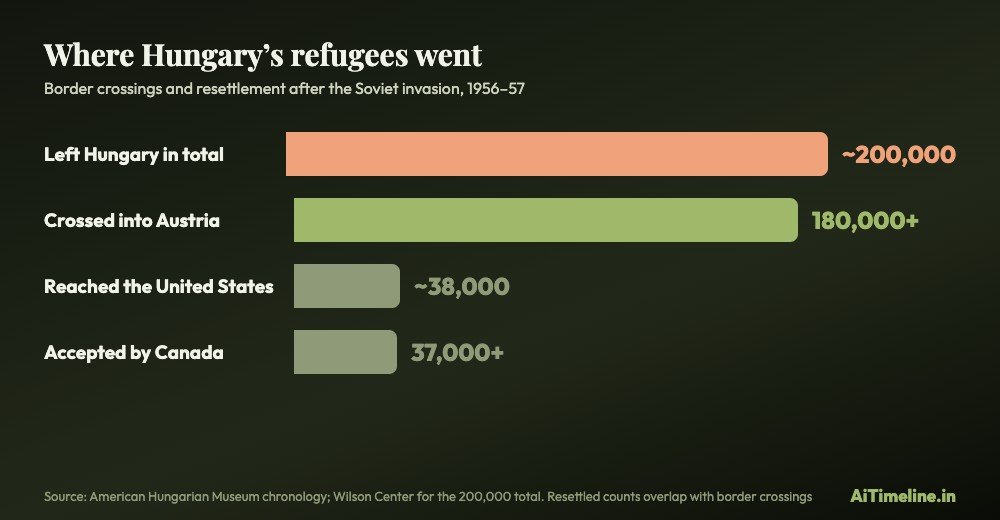
At the same time, about 200,000 Hungarians left the country (Wilson Center). More than 180,000 crossed into Austria before the border closed in early 1957. Canada took more than 37,000 and the United States about 38,000 via Camp Kilmer, New Jersey (American Hungarian Museum chronology). Exact totals differ between sources, so figures are attributed rather than treated as settled.
1956
Nagy leaves the Yugoslav Embassy and is seized Repression and exile
Imre Nagy and his group had taken refuge in the Yugoslav Embassy on 4 November. On 22 November, after assurances of safe passage from Kádár and the Soviets, they agreed to leave. They were arrested at once by Soviet security officers and flown to a secret location in Romania (National Security Archive).
The American Hungarian Museum chronology adds that Yugoslavia insisted on maintaining its guarantee but agreed to let the group depart for Romania, and that Nagy and his associates left “against their objections” (chronology). The episode became the best-known example of a promise broken.
1956
Organised armed resistance is largely defeated Soviet response
By 10–11 November the Soviet forces had overcome most major pockets of armed resistance in Budapest. The Hungarian Revolutionary Worker-Peasant Government issued concessions: a pay increase of up to 15% and legal restoration of the Kossuth coat of arms. A group of rebels in the Mecsek hills near Pécs fought on, breaking through a Soviet encirclement on 16 November (American Hungarian Museum chronology).
Strikes and workers’ councils kept up non-military pressure into December. Soviet losses are given as 699 killed and 1,450 wounded in one account, with about 80% in the fighting in Budapest’s 8th and 9th districts (Wikipedia). Hungarian deaths are usually put at 2,500–3,000 with about 13,000 wounded; treat both sets as estimates.
1956
Kádár takes the oath in Parliament Soviet response
János Kádár took the oath of office in the Parliament building on 7 November, the anniversary of the Bolshevik revolution, even though the Nagy government had never formally resigned (National Security Archive). Kádár had taken the party leadership on 25 October and publicly backed the uprising before leaving for Moscow on 31 October.
The new authorities promised order and economic concessions while suppressing opposition. The process of “normalisation” that followed kept Hungary inside the Soviet sphere for 33 more years.
1956
Soviet forces launch the decisive invasion Soviet response
Soviet forces attacked at about 04:00–04:15. At 05:20 Nagy broadcast a 35-second announcement: “Our troops are fighting. The Government is in its place” (National Security Archive). Five Soviet divisions attacked Budapest, occupied the defence and interior ministries and surrounded Parliament; Nagy and members of his government took refuge in the Yugoslav Embassy (American Hungarian Museum chronology).
One count lists about 31,550 Soviet troops and 1,130 tanks involved (Wikipedia). Hungarian fighters, mostly lightly armed, resisted in districts such as the 8th and 9th. The same day the Soviet Union vetoed a Security Council resolution criticising the invasion; Resolution 120 then sent the matter to the General Assembly.
1956
Withdrawal talks continue while the Hungarian delegation is arrested Soviet response
Hungarian and Soviet representatives met to discuss the withdrawal of Soviet troops. At 22:00 the Soviets arrested the Hungarian military delegation led by Defence Minister Pál Maléter. In Moscow a counter-government headed by Kádár and Ferenc Münnich was formed (American Hungarian Museum chronology).
Troops had been surrounding Budapest since 2 November, and Soviet headquarters had been established at Szolnok. The arrests removed the officer best placed to coordinate any military response and showed that the talks were cover for a decision already made.
1956
Nagy declares neutrality and Warsaw Pact withdrawal Soviet response
Nagy announced that Hungary was withdrawing from the Warsaw Pact and declaring neutrality, and appealed to UN Secretary-General Dag Hammarskjöld and the diplomatic corps for protection (Wikipedia). The Suez crisis had come to a head two days earlier, when Israel attacked Egypt on 29 October; Britain and France followed. Western powers and the UN were preoccupied, and Washington feared an unpredictable Soviet response if it intervened (American Hungarian Museum chronology).
Historians disagree about how much the declaration mattered. Some see it as the factor that convinced Khrushchev to attack (chronology); but the National Security Archive says the Soviet leadership had already reversed itself on 31 October (National Security Archive). The simplest reading: neutrality made compromise impossible but was not the first cause.
1956
Moscow reverses course and decides to crush the revolution Soviet response
On 30 October the Soviet government issued a declaration “On Friendship and Cooperation between the Soviet Union and other Socialist States”, promising respect for sovereignty and more equal relations (Wilson Center). CIA Director Allen Dulles called it a “miracle”. The day it appeared in Pravda, the Soviet leadership reversed itself and decided on a violent end to the rebellion (National Security Archive).
Declassified records list the factors: the belief that the rebellion threatened communist rule itself (unlike Poland’s challenge a week earlier), fear that the West would read inaction as weakness after the Suez attack, worry that anti-communist feeling would spread to neighbouring regimes, and pressure inside the Soviet party. Soviet troops had completed a regrouping out of Budapest by noon; further forces entered Hungary that night.
1956
Nagy ends one-party rule as violence flares in Budapest The uprising
Nagy announced the end of the one-party system and a coalition cabinet of the Independent Smallholders, Social Democrats and National Peasants parties. The same day, fighting broke out at the Hungarian Workers’ Party headquarters in Budapest; defenders fired at the crowd, and after the building was stormed a number of defenders were lynched (American Hungarian Museum chronology).
The revolution was not uniformly peaceful. Civilians, security staff and suspected collaborators were among the victims of mob violence, and the political transition remained fragile.
1956
A ceasefire and a reform programme raise hopes The uprising
Nagy and his new cabinet were sworn in on 28 October. At 14:00 he announced by radio that Soviet troops would be withdrawn, the state security service ÁVH dissolved and the Kossuth coat of arms restored to the flag. Former leaders including Ernő Gerő and András Hegedüs fled to Moscow aboard Soviet planes (American Hungarian Museum chronology).
Some revolutionaries assumed the ceasefire did not apply to Soviet forces, and heavy fighting continued in Budapest’s 8th and 9th districts. In Ózd, rumours that disbanded security men were firing at rebels led a crowd to lynch three people. For a short period it looked as if Hungary might win greater independence without a full-scale invasion.
1956
The uprising spreads across the country The uprising
Demonstrations were recorded in more than twenty towns, among them Eger, Győr, Miskolc and Szeged. At Mosonmagyaróvár, border guards fired on demonstrators, killing 52 and wounding 86; at Esztergom soldiers fired from a tunnel, causing 15 deaths (American Hungarian Museum chronology). In Miskolc, police and ÁVH fired on a crowd, after which miners and workers stormed the building.
Workers’ and revolutionary councils took over administration where the old authorities lost control. The breadth of participation showed that this was no student disturbance in the capital but a challenge to the whole system.
1956
Gunfire at Kossuth Square and Gerő is replaced by Kádár The uprising
A large crowd, joined by a Hungarian tank draped with the national flag, gathered in front of Parliament. Shooting broke out. The American Hungarian Museum chronology says Soviet tanks were ordered to fire amid confusion with Hungarian troops guarding Parliament, with more than 100 killed and more than 300 injured (chronology). Other accounts blame secret-police fire; the exact sequence and responsibility for individual shots are still debated.
The same day Soviet envoys initiated the removal of Ernő Gerő as First Secretary, and János Kádár took the party leadership (chronology). The deaths deepened anger toward the security apparatus, and many soldiers began to fight on the rebels’ side.
1956
Soviet tanks enter Budapest; Nagy is named prime minister The uprising
In the early morning Soviet tanks rolled into Budapest, a curfew was imposed and assemblies were banned. Nagy was nominated prime minister and at noon announced reforms and an end to the curfew. The tanks had come without infantry support and suffered heavy losses (American Hungarian Museum chronology). Zhukov later admitted heavy losses and a temporary withdrawal (Wilson Center).
Khrushchev later spoke of a request from Gerő on 23 October for Soviet intervention (Wikipedia), but the UN Special Committee said it could not determine if any invitation was issued (FRUS). The presence of foreign troops hardened the sense that Hungarians were being denied the right to decide their own future.
1956
Fighting at the Radio building and the fall of the Stalin statue The uprising
A crowd gathered at the Radio building to have the students’ demands broadcast. A speech by First Secretary Gerő, broadcast that evening, called the demonstration hostile and nationalist and rejected all concessions (Hungarian National Archives). An armed clash followed; who fired first has never been clarified, though the Wilson Center account says secret police fired on unarmed demonstrators (American Hungarian Museum chronology; Wilson Center).
The Radio building was besieged and finally captured by early morning. Elsewhere, protesters toppled the giant Stalin statue on Dózsa György út, one of the students’ demands, and dragged it to the National Theatre where it was broken up. Insurgents obtained weapons from sympathetic soldiers, police posts and depots.
1956
Students march and the 16 demands are read out The uprising
In the afternoon large crowds of students demonstrated at Bem Square and Petőfi Square, where the 16 demands were read. Demonstrators cut the communist emblem out of the Hungarian flag, creating the “flag with a hole” that became the revolution’s symbol. Many then went to Kossuth Square in front of Parliament, where at about 21:00 Nagy made a speech the museum chronology calls disappointing and ineffective (American Hungarian Museum chronology).
The demands called for a new government under Nagy, free elections, freedom of opinion and press, a revision of economic policy and Hungarian–Soviet relations, and the evacuation of Soviet troops. A central demand was political freedom and national independence.
1956
Students at the Technical University draft 16 points Prelude
On the night of 22 October students of the Technical University of Budapest drafted 16 demands: immediate evacuation of Soviet troops, a government under Nagy, general elections by secret ballot with all parties, the right to strike, and the removal of the Stalin statue. They announced a demonstration for the following day in solidarity with workers and students in Poland (American Hungarian Museum chronology; Hungarian National Archives).
They also proposed that 15 March become a national holiday and 6 October a day of mourning, and planned a Youth Parliament on 27 October. The common programme brought together people with different political aims.
1956
Student unions and Poland’s October set the signal Prelude
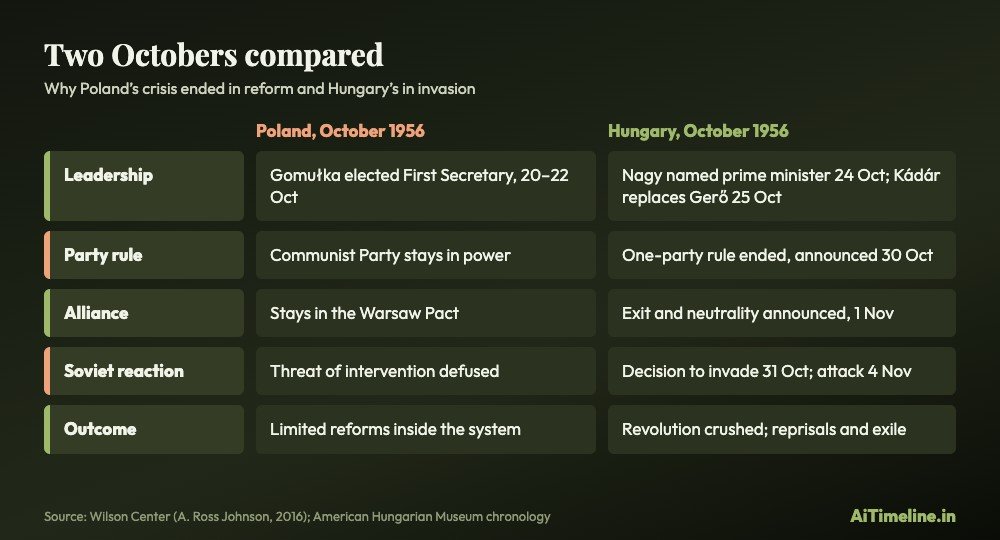
In Szeged students re-established the independent MEFESZ student union, meeting on 16 October and issuing a manifesto that included free elections and anti-Soviet demands (Wikipedia). Days later, in Poland, Władysław Gomułka was elected First Secretary of the Polish party; he openly criticised past mistakes, and Hungarian students began solidarity demonstrations (American Hungarian Museum chronology).
Poland shows why Hungary was different. Gomułka defused a threat of Soviet intervention and party rule stayed in place; in Hungary protest turned into revolution on 23 October and later demanded an end to party rule and a Warsaw Pact exit (Wilson Center).
1956
László Rajk is reburied and a crowd follows the coffin Prelude
László Rajk, György Pálffy, Tibor Szőnyi and András Szalai, victims of the Stalinist show trials of 1948–49, were reburied at Budapest’s Kerepesi cemetery. Student demonstrations took place after the funeral (American Hungarian Museum chronology).
The reburial was an official acknowledgement of past injustice and became a focus for public anger. Nagy was among those present. A day of national mourning on 6 October was one of the students’ later demands.
De-Stalinisation, Poznań and the fall of Rákosi Prelude
In February 1956 Soviet leader Khrushchev denounced Stalin at the 20th Party Congress, which Moscow formalised as de-Stalinisation and which put pressure on Hungary’s leader Mátyás Rákosi to examine the crimes of the Stalin era (American Hungarian Museum chronology). The Petőfi Circle held a large press debate on 27 June, and Polish workers revolted in Poznań on 28 June.
Mounting pressure forced Rákosi out as First Secretary in mid-July (18 July in most accounts, 21 July in the museum chronology); Ernő Gerő replaced him. Earlier, after Stalin’s death in 1953, Nagy had been made prime minister and begun a “New Course” of easing collectivisation and partial amnesty, before being removed in 1955. His record explains why students asked for him in 1956.
Five Common Claims, Checked
Each claim rests on something real. Each stops short of what it is often taken to show.
| Claim | What it rests on | What it does not show |
|---|---|---|
| Hungary’s neutrality declaration caused the Soviet invasion | Nagy announced neutrality and Warsaw Pact exit on 1 Nov; the invasion came on 4 Nov | That it was the first cause. The National Security Archive says Moscow reversed course on 31 Oct. Historians weigh the declaration differently |
| It was a spontaneous student protest that spiralled | Students drafted the 16 points and the UN committee called it a spontaneous national uprising | That it stayed student-only. Workers, soldiers and reform communists joined within days; aims differed between groups |
| The revolution was a Western-fomented counter-revolution | The official communist account for over 30 years | Evidence. The 1957 UN committee rejected the thesis; the Wilson Center says US radio output in autumn 1956 was cautionary |
| The West abandoned Hungary despite promises | Radio Free Europe tone and campaign rhetoric about liberation | A Western commitment. The Wilson Center says liberation was only rhetoric; the National Security Archive says RFE broadcasts sometimes raised false hopes, leaving many Hungarians embittered |
| Soviet troops simply entered when asked | Moscow described its action as help to the Hungarian government | A verified invitation. The UN committee could not determine whether one was issued |
Why Did the Hungarian Revolution Happen?
Five causes, each tied to the record.
1. Soviet domination and national sovereignty. Hungary was governed by a communist regime aligned with Moscow, and Soviet troops stayed after the war. The students’ first demand was the evacuation of Soviet troops, and their points called for relations on the basis of equality (American Hungarian Museum chronology).
2. Political repression. After 1948 Rákosi’s Stalinist dictatorship replaced the multi-party government; opposition, including inside the party, was suppressed, and communists such as László Rajk were tried and executed (chronology). The reburial of Rajk on 6 October 1956 reopened that memory.
3. Economic hardship. The chronology records heavy-industry priorities, food and goods shortages, inadequate housing, low wages and stifled agriculture under collectivisation. The 16 points called for a re-examination of the planned economy and a minimum wage.
4. De-Stalinisation and hope for reform. Stalin’s death in 1953, Nagy’s “New Course” and Khrushchev’s February 1956 speech suggested change was possible. Rákosi was forced out in July, but demands had already moved past leadership changes.
5. The Polish example. Poznań workers revolted in June and Gomułka came to power in October, defusing a Soviet intervention. Hungarian students held solidarity demonstrations (Wilson Center). For how another Soviet-bloc crisis unfolded, see AiTimeline’s Berlin Airlift timeline.
Why Did the Soviet Union Crush the Revolution?
What declassified records say.
The National Security Archive lists the factors in Moscow’s decision: the belief that the rebellion threatened communist rule itself (unlike Poland’s challenge, which targeted Kremlin rule but not the system); the fear that the West would read inaction as weakness after the British, French and Israeli attack on Suez; the worry that anti-communism would spread and threaten neighbouring leaders; and pressure inside the Soviet party (National Security Archive).
The Wilson Center adds that Moscow had used the same method in East Germany in 1953, and that Khrushchev in effect applied the doctrine later named after Brezhnev twelve years early (Wilson Center). The West did not intervene: a US Army study had advised against it, the Eisenhower administration judged little could be done short of war, and Suez absorbed attention. The outcome showed the limits of Western support for uprisings behind the Iron Curtain. For the other great Cold War standoff of that era, see AiTimeline’s Cuban Missile Crisis timeline.
The Human Cost and International Impact
Estimates, attributed to their sources.
Hungarian deaths are commonly put at 2,500–3,000 with about 13,000 wounded; Soviet losses at roughly 700 killed in one account. Afterwards 26,000 people were brought before courts, 22,000 imprisoned, 13,000 interned and 229 executed in one summary (Wikipedia); the museum chronology counts more than 230 death sentences, and a former foreign minister has estimated 350 executions. About 200,000 Hungarians fled the country.
Internationally, the uprising damaged Moscow’s claim that Eastern European governments ruled by consent, and it showed how hard it was to leave the bloc. The 1957 UN report called it a spontaneous national uprising (FRUS). It remained a symbol of resistance to authoritarian rule and foreign domination. For how the bloc ended, see AiTimeline’s Berlin Wall timeline.
What Remains Uncertain?
As of 24 October 2026, on the sources AiTimeline reviewed.
Who fired first. At the Radio building on 23 October and at Kossuth Square on 25 October, accounts differ on who fired and in what order.
Whether Hungary invited the Soviets. The UN committee could not determine this; Khrushchev later cited a request on 23 October.
The size of the toll. Death, execution and refugee figures differ by source and method.
The role of Western broadcasts. The National Security Archive says RFE sometimes raised hopes of support; the Wilson Center says its fall 1956 output was cautionary.
The 2026 anniversary. A programme was published, but AiTimeline did not verify reports of the day itself.
Figure, Estimate or Account?
The same story, sorted by who said it and how strong it is.
| Figure or statement | Source | Type | Caution |
|---|---|---|---|
| 2,500–3,000 Hungarians killed, about 13,000 wounded | Wikipedia summary (citing Bercovitch and Jackson) | Secondary estimate | Method and cut-off dates differ between counts |
| 699 Soviet killed, 1,450 wounded, 51 missing | Wikipedia summary of a Soviet-era count | Secondary figure | Other sources give about 720 killed |
| 229 executed; 22,000 imprisoned; 13,000 interned | Wikipedia summary | Secondary summary | Former foreign minister Géza Jeszenszky estimated 350 executions |
| More than 230 death sentences | American Hungarian Museum chronology | Museum chronology | Sentences are not the same as executions |
| About 200,000 fled; more than 180,000 via Austria | Wilson Center; American Hungarian Museum | Agency and museum figures | Resettlement counts overlap with crossings |
| 100+ killed and 300+ wounded at Kossuth Square, 25 Oct | American Hungarian Museum chronology | Museum chronology | Responsibility disputed; figures vary between accounts |
| 31,550 Soviet troops and 1,130 tanks on 4 Nov | Wikipedia summary | Secondary figure | One count; Soviet forces had also been in Hungary since 24 Oct |
| “A spontaneous national uprising” | UN Special Committee, 20 Jun 1957, via FRUS | Official inquiry | Findings of a committee; Hungary’s government rejected UN observers |
The Story at a Glance
Oldest first, with the type of each entry.
| Date | Event | Type |
|---|---|---|
| Feb–Jul 1956 | De-Stalinisation, Poznań and the fall of Rákosi | Prelude |
| 6 Oct 1956 | László Rajk is reburied and a crowd follows the coffin | Prelude |
| 16–21 Oct 1956 | Student unions and Poland’s October set the signal | Prelude |
| 22 Oct 1956 | Students at the Technical University draft 16 points | Prelude |
| 23 Oct 1956 | Students march and the 16 demands are read out | The uprising |
| Late 23 Oct 1956 | Fighting at the Radio building and the fall of the Stalin statue | The uprising |
| 24 Oct 1956 | Soviet tanks enter Budapest; Nagy is named prime minister | The uprising |
| 25 Oct 1956 | Gunfire at Kossuth Square and Gerő is replaced by Kádár | The uprising |
| 26–27 Oct 1956 | The uprising spreads across the country | The uprising |
| 28–29 Oct 1956 | A ceasefire and a reform programme raise hopes | The uprising |
| 30 Oct 1956 | Nagy ends one-party rule as violence flares in Budapest | The uprising |
| 31 Oct 1956 | Moscow reverses course and decides to crush the revolution | Soviet response |
| 1 Nov 1956 | Nagy declares neutrality and Warsaw Pact withdrawal | Soviet response |
| 3 Nov 1956 | Withdrawal talks continue while the Hungarian delegation is arrested | Soviet response |
| 4 Nov 1956 | Soviet forces launch the decisive invasion | Soviet response |
| 7 Nov 1956 | Kádár takes the oath in Parliament | Soviet response |
| 10–11 Nov 1956 | Organised armed resistance is largely defeated | Soviet response |
| 22 Nov 1956 | Nagy leaves the Yugoslav Embassy and is seized | Repression and exile |
| Nov 1956– 1957 | Reprisals, arrests and a refugee exodus | Repression and exile |
| 20 Jun 1957 | A United Nations committee calls 1956 “a spontaneous national uprising” | Repression and exile |
| 16 Jun 1958 | Imre Nagy, Pál Maléter and Miklós Gimes are executed | Repression and exile |
| 16 Jun 1989 | Nagy and his comrades are reburied before tens of thousands | Rehabilitation and memory |
| 6 Jul 1989 | The Supreme Court acquits Nagy, and Kádár dies the same day | Rehabilitation and memory |
| 23 Oct 1989 | The Republic of Hungary is proclaimed from the Parliament balcony | Rehabilitation and memory |
| 19 Jun 1991 | The last Soviet soldier leaves Hungary | Rehabilitation and memory |
| 23 Oct 2026 | Seventy years on: a national holiday and a state ceremony | Rehabilitation and memory |
| Term | Meaning | Why it matters here |
|---|---|---|
| ÁVH | Hungary’s state security police (Államvédelmi Hatóság) | Its firing on crowds helped turn protest into revolution; Nagy announced its dissolution on 28 Oct |
| Warsaw Pact | Soviet-led military alliance created in May 1955 | Nagy announced Hungary’s exit on 1 Nov 1956 |
| De-Stalinisation | The Soviet leadership’s break with Stalin’s methods after 1953 | Khrushchev’s February 1956 speech made reform seem possible |
| Workers’ councils | Local bodies formed by workers during the revolution | Ran local administration and strikes; outlawed on 9 Dec 1956 |
| MEFESZ | Hungarian Federation of University and College Students’ Associations | The independent student union re-founded in Szeged on 16 Oct 1956 |
| Brezhnev Doctrine | Later name for Soviet policy of armed defence of communist rule in the bloc | The Wilson Center says Khrushchev in effect applied it in 1956 |
| Normalisation | Kádár’s process of suppressing dissent and co-opting society after 1956 | Characterised Hungary until 1989 |
Who Is Who
Imre Nagy
Communist reformer and prime minister, 1953–55 and from 24 Oct 1956. Ended one-party rule, declared neutrality, was seized on 22 Nov and executed on 16 Jun 1958.
Pál Maléter
Defence minister who led the military delegation arrested on 3 Nov 1956. Executed with Nagy on 16 Jun 1958.
Miklós Gimes
Reform journalist tried with Nagy and executed on 16 Jun 1958.
János Kádár
Took the party leadership on 25 Oct, left for Moscow on 31 Oct and was sworn in on 7 Nov as head of the Soviet-backed government. Led Hungary for over three decades; died 6 Jul 1989.
Ernő Gerő
First Secretary from July 1956. His broadcast on 23 Oct rejected the demands; replaced on 25 Oct and fled to Moscow on 28–29 Oct.
Mátyás Rákosi
Stalinist leader forced out in July 1956; students demanded his trial.
Nikita Khrushchev
Soviet leader. Denounced Stalin in Feb 1956, then ordered the crackdown on 31 Oct.
The 16-point drafters
Students at the Technical University of Budapest who wrote the demands on 22 Oct 1956.
The Popular Story vs the Record
| Popular version | What the record shows |
|---|---|
| It lasted exactly twelve days | The march was 23 Oct and the invasion 4 Nov, 12 days apart. Fighting went on to 11 Nov, a rebel group in the Mecsek hills to 16 Nov and strikes into December |
| It was only a student protest | Students began it, but workers, soldiers and reform communists drove it. Revolutionary councils appeared in provincial towns within days |
| The West was neutral but could have helped | US studies concluded little could be done short of risking global war; the Suez crisis absorbed attention. Condemnation and refugee help came, not military aid |
| Nagy was a lifelong anti-communist | No. He was a communist reformer who had served as prime minister from 1953, was removed in 1955 and changed rapidly during the revolution |
| Kádár was always a Soviet puppet | He took the party leadership on 25 Oct, publicly backed the uprising and only left for Moscow on 31 Oct; he then led the government that crushed it |
| Hungary left the Warsaw Pact in 1956 | Nagy announced withdrawal on 1 Nov, but the Soviet assault came three days later, so the exit never took effect in 1956 |
| The revolution failed and left nothing | It was defeated in 1956 but rehabilitated in 1989, and Soviet troops left in 1991; its date is now a national holiday |
Explore More Timelines
People Also Ask
Frequently Asked Questions
A Revolution Defeated, but Never Forgotten
The Hungarian Revolution of 1956 began with students demanding reform and grew into a nationwide movement for freedom and national independence. For twelve days the communist government made major concessions and a different future seemed possible. The Soviet invasion of 4 November crushed it with overwhelming force; Nagy was executed, thousands were punished and about 200,000 people fled. Yet the revolution’s legacy survived defeat. It exposed the coercive foundations of Soviet control in Eastern Europe, and military power could defeat an uprising without erasing the aspirations that produced it.
Related AiTimeline Stories
⚠️ Editorial Note
Last updated 24 October 2026. The revolution included students, workers, intellectuals, reform communists and supporters of political pluralism, and their aims were not identical. Death tolls and estimates of repression vary among sources; figures are attributed and distinguished from deaths in the initial fighting. Casualty summaries come from secondary sources; chronologies come from the American Hungarian Museum and the Hungarian National Archives; Soviet decision-making comes from National Security Archive documents. The account of the 2026 anniversary rests on a published programme only. This is a historical overview, not legal or political advice.
Sources & further reading
Every dated entry above was checked against these references. Last reviewed 25 October 2026.
- American Hungarian Museum: 1956 Chronology of the Hungarian Revolution
- Wilson Center: Looking Back at the Cold War, 1956 (A. Ross Johnson, 21 October 2016)
- National Security Archive: The 1956 Hungarian Revolution, Electronic Briefing Book No. 76
- US Department of State, Office of the Historian: FRUS 1955-1957, Eastern Europe, Vol. XXV, Document 255 (UN Special Committee on Hungary report, 20 June 1957)
- Hungarian National Archives: Az 1956-os forradalomra emlékezünk (23 October 2025)
- Wikipedia: Hungarian Revolution of 1956 (casualty and reprisal summaries)
- UPI: Last Soviet soldier leaves Hungary (19 June 1991)
- CVCE: Proclamation by the Republic of Hungary (23 October 1989)
- Hungary Unlocked: 23 October 2026 in Budapest, the 1956 Revolution turns 70 (22 October 2026)