Pegasus Spyware Row: Timeline of Revelations and Court Hearings
Explore the Pegasus spyware row in India, from 2021 surveillance allegations to the Supreme Court probe, forensic findings and unresolved legal questions.
Latest Story
The Pegasus spyware row entered India’s politics on 18 July 2021, when a media consortium reported a leaked list of potential surveillance targets that included hundreds of Indian phone numbers, among them numbers of journalists, opposition leaders and activists. Pegasus is spyware made by Israel’s NSO Group that can covertly access a phone. The government rejected the allegations of illegal surveillance and NSO Group disputed the reports. In October 2021 the Supreme Court appointed an independent technical committee; in August 2022 the Court said the committee had found malware on five of 29 phones but it could not be said to be Pegasus, and that the Union had not cooperated. The reports stayed sealed, and hearings in 2025 revived the question of whether people can see parts of them. This page keeps a number on a list, a forensic finding, a remark from the bench and a court order apart. For related reading, see AiTimeline’s timelines of India’s data protection law, cybersecurity and digital privacy and the Radia tapes controversy.
Tap a stage. The key point: a number on a list is not an infection, and the Court found no Pegasus.
Choose a stage above.
💡 Short Answer
A media consortium reported on 18 July 2021 that a leaked list of potential targets of NSO Group clients included at least 300 Indian numbers; a number on the list is not proof of infection. The government denied illegal surveillance. The Supreme Court appointed a technical committee on 27 October 2021, and on 25 August 2022 said it found malware on five of 29 phones that could not be said to be Pegasus, and that the Union had not cooperated. The reports remain sealed. The case was last listed for 30 July 2025 and no final resolution has been found as of 24 October 2026.
Pegasus Case Status, as of 24 October 2026
Last updated: 24 October 2026. Kept separate from the timeline because each proceeding has its own position. “Not verified” means AiTimeline could not confirm the latest position from published reports.
| Question or proceeding | Court or authority | Latest position AiTimeline verified | Status |
|---|---|---|---|
| Petitions seeking an independent probe (Manohar Lal Sharma v. Union of India, W.P.(Crl.) No. 314 of 2021 and connected cases) | Supreme Court | Heard 29 Apr 2025 by Justices Surya Kant and N. Kotiswar Singh; listed for 30 Jul 2025. The Supreme Court Observer lists the case as pending, last updated 16 Jul 2025 | Pending; no final judgment found |
| What happened on or after the 30 Jul 2025 listing | Supreme Court | No published report found of a hearing, order or judgment | Not verified; check the Supreme Court case-status page |
| Disclosure of the committee’s sealed reports | Supreme Court | Reports re-sealed 25 Aug 2022. On 29 Apr 2025 the bench said national-security details would not be disclosed but portions about individuals could be; no order doing so found | Undecided on the record found |
| Whether any Indian agency acquired or used Pegasus | Supreme Court committee (term of reference) | The Union did not clearly answer; the committee found malware on 5 of 29 phones not shown to be Pegasus | Not established in public |
| West Bengal commission of inquiry (Justices Lokur and Bhattacharya) | West Bengal government | Announced 27 Jul 2021; its later status was not verified | Not verified |
| WhatsApp v. NSO Group (US) | US District Court, Northern District of California | Liability 20 Dec 2024; jury award about $167 million in May 2025; award cut to about $4 million and injunction granted 17 Oct 2025. NSO said it would appeal | Appeal status not verified |
Pegasus Spyware Row: Key Questions
The Pegasus Row in Ten Points
- The research: Citizen Lab mapped Pegasus infrastructure in 45 countries, India among them, in September 2018.
- The 2019 warning: WhatsApp fixed a flaw in May 2019 and told CERT-In on 5 September that about 121 Indian users may have been reached.
- The list: reported on 18 July 2021, with at least 300 Indian numbers; a number is not proof of infection.
- The denials: the government rejected illegal surveillance on 19 July 2021 and NSO Group called the reports unreliable.
- The committee: appointed on 27 October 2021; the Court said national security is no automatic bar to review.
- The finding: malware on 5 of 29 phones on 25 August 2022, not shown to be Pegasus.
- Cooperation: the Court said the Union had not cooperated with the committee.
- The report: the full reports were re-sealed in 2022 and remain sealed.
- 2025: the Court said portions about individuals could be disclosed; no order doing so has been reported.
- The caution: a list, a forensic result, an oral remark and an order prove different things.
Pegasus Spyware Row Timeline, Latest First
Each entry is tagged by type and ends with why it matters. Allegations, reports and court findings are labelled as such.
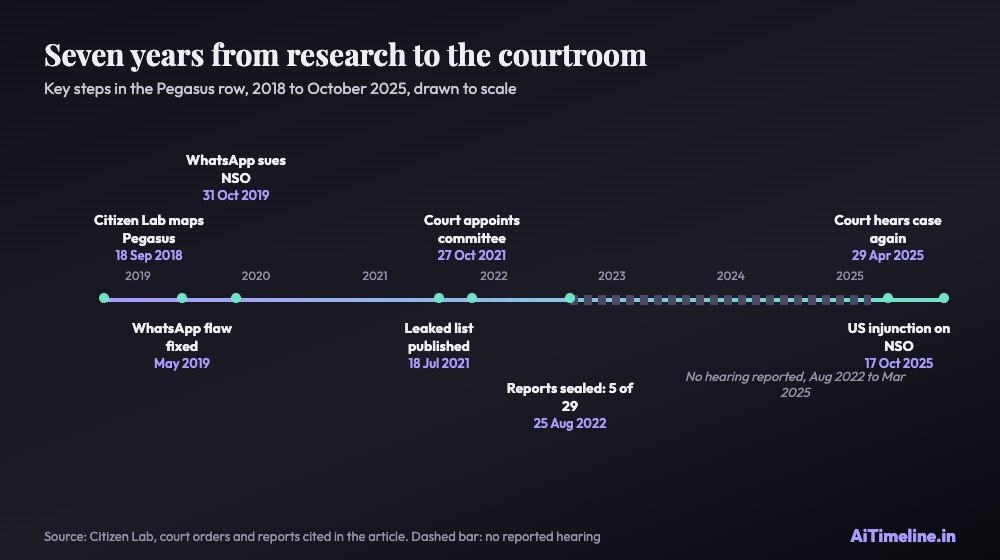
Show only Supreme Court hearings, the committee, the research and revelations, the government’s response, or the US litigation.
–
2025
A US judge bars NSO Group from targeting WhatsApp and cuts the damages award US litigation
In the case WhatsApp (owned by Meta) brought over the May 2019 attacks, Judge Hamilton granted a permanent injunction barring NSO Group from targeting WhatsApp users, saying its conduct “causes irreparable harm”. She found that trial evidence showed NSO reverse-engineered WhatsApp code to install Pegasus and repeatedly redesigned it to escape detection. She also called the jury’s earlier award of about $168 million “excessive” and cut it to about $4 million (Al Jazeera).
This is a US civil case between two companies about US and California computer-crime law. It does not say whether any Indian agency bought or used Pegasus, and it was not an order of any Indian court.
2025
The Supreme Court is due to hear the case again; no outcome has been reported Supreme Court hearing or order
The 29 April order listed the petitions for 30 July 2025 and gave senior advocate Kapil Sibal two weeks to circulate documents, including a US court judgment against NSO (LiveLaw). The Supreme Court Observer’s case page lists the matter as pending, last updated 16 July 2025, with no next-hearing date shown (Supreme Court Observer).
AiTimeline found no published report of what happened on or after 30 July 2025, no judgment on disclosure of the sealed report, and no order closing the case. That is not proof that no hearing took place; the Supreme Court’s own case-status page is the record to check.
A California jury awards WhatsApp about $167 million against NSO Group US litigation
After a damages-only trial, a jury ordered NSO Group to pay $444,719 in compensatory damages and about $167 million in punitive damages for using Pegasus against more than 1,400 WhatsApp users in 2019. NSO said it would examine the verdict and pursue “appropriate legal remedies, including further proceedings and an appeal” (Security Affairs). The judge later cut the punitive award (see 17 October 2025).
2025
The Supreme Court revisits the case: “against whom it is used” Supreme Court hearing or order
Justice Surya Kant said orally that possessing spyware for security is not improper in itself, and that “against whom it is used it is the question”. He asked what remained to be decided after the Court’s detailed 2021 judgment and the Raveendran committee, said national security cannot be compromised, and added that a private citizen’s privacy is protected by the Constitution (LiveLaw).
Senior advocate Kapil Sibal asked that the committee’s report be released to the affected individuals with sensitive portions redacted; Shyam Divan argued for full disclosure under the open-court principle; Solicitor General Tushar Mehta said portions touching national security could not be disclosed. Justice Kant said the report remained sealed and he had not seen it. The Court said it would not allow disclosure of national-security details but that portions relating to individuals could be disclosed, and listed the case for 30 July 2025 (Supreme Court Observer).
These were remarks from the bench in a hearing. No judgment followed that ordered the report to be disclosed.
2025
The Supreme Court lists the Pegasus petitions for 22 April Supreme Court hearing or order
A bench directed the registry to list all matters on the issue on 22 April, after a long gap since the committee’s 2022 report (Business Standard, PTI). Kapil Sibal told the Court only two petitions had been listed that day and the connected petitions also needed hearing (Deccan Herald). The hearing took place on 29 April (The Tribune).
2024
A US judge rules NSO Group liable for hacking WhatsApp users US litigation
On WhatsApp’s motion, Judge Hamilton found NSO Group liable for breaching WhatsApp’s terms of service and for violating US computer-fraud law, and sanctioned it for failing to produce key evidence, including Pegasus source code. The case moved to a trial on damages only (Security Affairs). The order described the key facts about the exploits as undisputed, drawn from testimony by NSO’s own witnesses.
2022
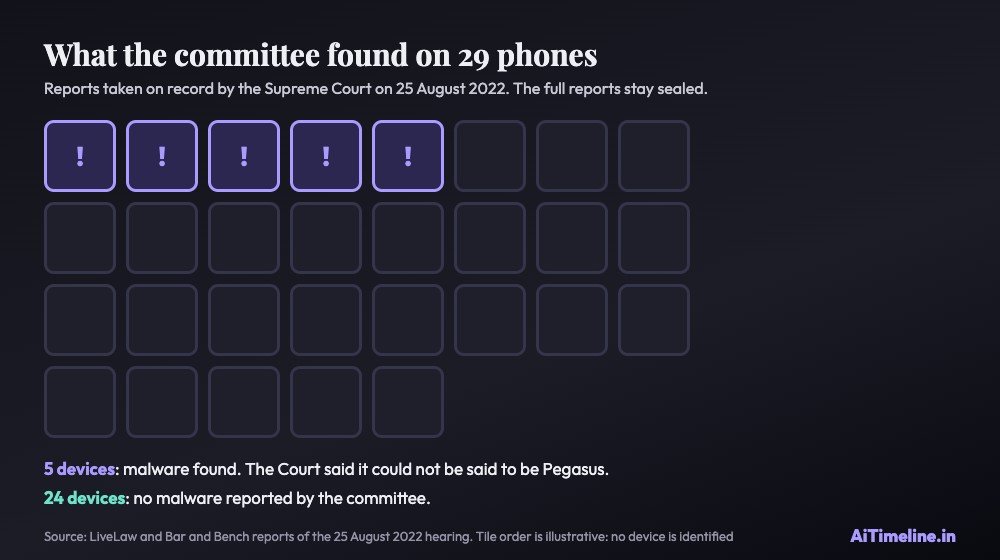
The Court takes the committee’s reports on record: malware on 5 of 29 phones, not shown to be Pegasus Technical committee
The bench noted that the technical committee had examined 29 devices submitted to it, found malware in five, and that it could not be said to be Pegasus. CJI Ramana said “Government of India has not cooperated”; he said the Union took before the committee the same stand it took in Court and did not clearly say whether it had bought the spyware (LiveLaw; Bar and Bench).
The committee’s report came in three parts, with a separate report by the overseeing judge, Justice R. V. Raveendran, covering protection of citizens, accountability, amending the law on privacy and a grievance mechanism. The Court had earlier said Raveendran’s report would be uploaded, but it re-sealed both reports in the custody of the Supreme Court’s Secretary General and said the case would be listed after four weeks (LiveLaw). Members who had submitted phones had asked that the report not be released.
The Court did not say Pegasus had been found, and it did not say it had been ruled out. It said the five infections could not be tied to Pegasus.
2022
The committee gets more time Technical committee
The Court extended the technical committee’s deadline to 20 June 2022 (Supreme Court Observer). The committee had held deposition hearings with experts and petitioners between December 2021 and February 2022, and submitted its report to the Court in late July 2022.
2022
The New York Times reports India bought Pegasus in 2017 Research or revelation
The New York Times reported that India bought Pegasus from Israel in 2017 as part of a roughly $2 billion defence package in which the spyware and a missile system were the “centrepieces” (Scroll). It was a newspaper report based on interviews; neither government confirmed the purchase at the time.
The Union government had declined to say in the Supreme Court whether it had acquired Pegasus, and the Court later recorded that it had taken the same stand before the committee.
2021
The Supreme Court appoints an independent technical committee Supreme Court hearing or order
The bench said the State “does not get a free pass every time the spectre of national security is raised”, and that any security concern must be specifically pleaded and proved on affidavit. It named a three-member technical committee (Dr Naveen Kumar Chaudhary, Dr Prabaharan P. and Dr Ashwin Anil Gumaste) overseen by former Supreme Court judge Justice R. V. Raveendran (Supreme Court judgment, Indian Kanoon).
The terms of reference asked whether Pegasus was used on citizens’ phones, who the victims were, what the Union did after the 2019 WhatsApp reports, whether the Union, any state or any agency acquired Pegasus, and if so under what law; and asked for recommendations on surveillance law, cyber security and a grievance mechanism. The order did not find that any agency had used Pegasus.
2021
The Court reserves its order Supreme Court hearing or order
After weeks of hearings, the Court reserved its interim order (Supreme Court Observer). The Union had said it was ready to have all questions examined by a committee of experts but did not want to put details in a public affidavit for reasons of national security (The Indian Express).
2021
The Court hears the first petitions and calls the allegations “serious” Supreme Court hearing or order
On 5 August the Court heard eight petitions and described the allegations as “serious”, while asking why no FIR had been filed if phones had been hacked. On 16 August the Union filed a limited affidavit offering to set up its own expert committee, and the Court said it could not compel the “reluctant” Centre to file a detailed one. On 17 August it issued a pre-admission notice, saying it would not ask the government to disclose information affecting national security (The Indian Express).
2021
West Bengal sets up its own inquiry commission Government response
Chief Minister Mamata Banerjee announced a commission of inquiry, with retired Supreme Court judge Madan B. Lokur and former Calcutta High Court Chief Justice Jyotirmay Bhattacharya as members (The Indian Express). The Supreme Court Observer reports that the Court refused to stay the commission’s activities at one of its hearings (Supreme Court Observer).
2021
The government and NSO Group reject the reports Government response
IT Minister Ashwini Vaishnaw told the Lok Sabha that illegal surveillance by unauthorised persons was not possible in India given its checks, called the report an attempt “to malign Indian democracy” and said its timing, a day before the Monsoon Session, could not be a coincidence (The Tribune). The government told ANI the allegations had “no concrete basis or truth” (BOOM). NSO Group called the Forbidden Stories report “full of wrong assumptions and uncorroborated theories” (The Indian Express).
These were denials of the reports. They did not say whether Indian agencies had ever bought or used Pegasus, a question the government declined to answer in court.
2021
The Pegasus Project publishes a leaked list of potential targets Research or revelation
A consortium reported on a leaked list of about 50,000 phone numbers said to have been selected as potential surveillance targets by clients of NSO Group. The Wire reported that it included at least 300 Indian numbers, among them numbers of journalists, opposition leaders, activists, lawyers and two serving ministers (The Indian Express). Forensic analysis of phones belonging to at least 10 of the journalists on the list showed a successful or attempted Pegasus hack (BOOM).
A number on the list is not proof of infection. Whether a phone was compromised depends on forensic examination of the device, which was possible only for phones whose owners handed them over.
2019
WhatsApp sues NSO Group and says Indian journalists and activists were targeted Research or revelation
WhatsApp said Pegasus had been used against about 1,400 users worldwide, including Indian journalists and activists, and sued NSO Group in California. In Parliament the IT ministry disclosed that WhatsApp had told CERT-In on 5 September 2019 that about 121 users in India may have been reached, after earlier saying it lacked details of the scale (MediaNama).
The ministry’s answer called reports of government purchase of Pegasus misleading. It did not say whether any agency had bought it.
WhatsApp fixes a vulnerability that could install Pegasus Research or revelation
CERT-In published a vulnerability note on 17 May 2019, and on 20 May WhatsApp told it that it had fixed a flaw in its calling feature that could let an attacker insert and execute code on a phone. The flaw was later tracked as CVE-2019-3568 (MediaNama; Security Affairs).
2018
Citizen Lab maps Pegasus infrastructure in 45 countries, including India Research or revelation
Citizen Lab scanned the internet from August 2016 to August 2018 for servers matching NSO Group’s Pegasus, found 1,091 IP addresses and 1,014 domain names, and identified 45 countries, India among them, where operators of Pegasus may be conducting operations (Citizen Lab). The report stressed the limits of country-level attribution; it did not identify who operated Pegasus in India or whom they targeted.
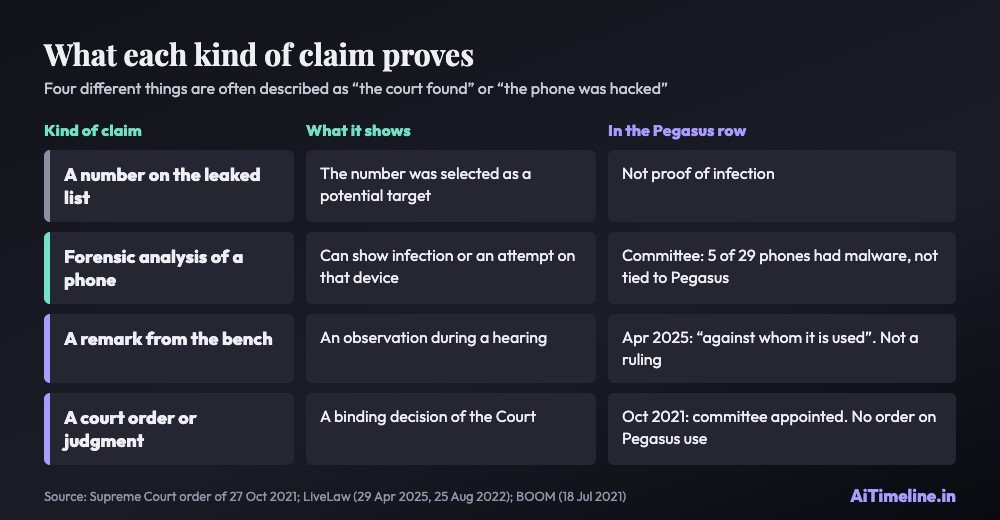
A List, a Forensic Result, a Remark or an Order?
Five things are often reported as “proof”. Each shows something different.
| Claim or step | What it rests on | What it does not show |
|---|---|---|
| A number on the leaked list | A leaked dataset of about 50,000 numbers reported by a media consortium, including at least 300 Indian numbers | That the phone was infected. Only forensic examination of the device can show that |
| Pegasus traces on phones of at least 10 journalists on the list | Forensic analysis reported in July 2021 (Amnesty International’s Security Lab, via The Wire) | Who operated Pegasus, or that an Indian agency did. It was not tested in an Indian court |
| Malware on 5 of 29 phones | The Supreme Court’s own committee, recorded by the Court on 25 Aug 2022 | That the malware was Pegasus. The Court said it could not be said to be Pegasus |
| Government “did not cooperate” | CJI Ramana’s remark in open court on 25 Aug 2022 | That the government used Pegasus. It describes the inquiry, not the surveillance |
| NSO Group liable to WhatsApp | US court rulings of Dec 2024 and Oct 2025 and a May 2025 jury verdict | Which government, if any, targeted which Indian. The case was about WhatsApp’s servers and users |
The accurate account is that the Supreme Court’s own inquiry produced a narrow public result: malware on five of 29 phones, not shown to be Pegasus, and a statement that the Union had not cooperated (LiveLaw; Bar and Bench). That does not show that Pegasus was used against those phones, and it does not show that it was not. Forensic evidence of infection on other phones, reported in 2021, was not tested in an Indian court (BOOM).
Why Did the Court Order an Independent Probe?
Four reasons, each tied to the record.
1. The right to privacy. Covert access to a phone can expose messages, contacts and location. The Court framed the questions as whether any surveillance was authorised by law and with safeguards, and asked its committee to recommend changes to surveillance and privacy law (Supreme Court judgment). For the legislative side, see AiTimeline’s data protection law timeline.
2. Freedom of the press. The reporting said journalists’ numbers were on the list and that forensic analysis of at least 10 journalists’ phones showed a successful or attempted hack (BOOM). Confidential sources depend on private communication. For the older history of the press and the state, see the Emergency of 1975–77 and the Indian Express blank editorial.
3. National security and judicial review. The Union argued that details could not be put in a public affidavit for reasons of national security. The Court answered that the State “does not get a free pass every time the spectre of ‘national security’ is raised” and that a security concern must be specifically pleaded and proved on affidavit (Supreme Court judgment). In April 2025 Justice Surya Kant said orally that having spyware for security is not improper and the question is against whom it is used (LiveLaw). The Court’s role in checking the executive is also the subject of the 2018 judges’ press conference.
4. Independent technical expertise. Whether a phone was compromised can only be shown by forensic work. The Court appointed three technical experts, overseen by a former judge, rather than leave the question to a committee the government proposed (The Indian Express).
What Remains Unresolved?
As of 24 October 2026, on the sources AiTimeline reviewed.
Whether an Indian agency acquired or used Pegasus. This was the committee’s central question. The Union did not clearly answer it in Court or before the committee, and the committee’s public result does not settle it (LiveLaw).
Which phones were infected with Pegasus. The Court said the malware on five phones could not be said to be Pegasus. Forensic findings reported in 2021 were not adjudicated.
Who authorised any surveillance, and on what legal basis. Terms of reference asked this; no public answer has been found.
The sealed reports. On 29 April 2025 the bench said national-security details would not be disclosed but portions about individuals could be; petitioners wanted a redacted copy or full disclosure (Supreme Court Observer). AiTimeline found no order giving effect to this, and no report of what happened on the 30 July 2025 listing. Non-public records may exist.
The safeguards. Justice Raveendran’s report recommended measures on protection of citizens, accountability, privacy law and a grievance mechanism (LiveLaw); the reports being sealed, what became of them is not public.
Claim, Allegation or Finding?
The same story, sorted by who said it and how strong it is.
| Statement | Who said it | Type | What the record shows |
|---|---|---|---|
| Phone numbers of Indian journalists, politicians and activists were on the list | Pegasus Project media consortium, 18 Jul 2021 | Reported dataset | A number on the list is not proof of infection |
| Forensic analysis found a successful or attempted hack on at least 10 journalists’ phones | The Wire, citing Amnesty’s forensic work, 18 Jul 2021 | Forensic finding, as reported | Not examined by a court; the Court’s own committee examined different devices |
| Illegal surveillance by unauthorised persons is not possible in India | IT Minister Ashwini Vaishnaw, 19 Jul 2021 | Government statement | The Court later said the Centre gave “no specific denial” |
| The reports are wrong assumptions and uncorroborated theories | NSO Group, 19 Jul 2021 | Company statement | Disputed by the consortium; not decided by an Indian court |
| India bought Pegasus in 2017 | The New York Times, 28 Jan 2022 | Newspaper report | Neither government confirmed it; the Union did not clearly answer the committee |
| Malware was found on five of 29 phones; it cannot be said to be Pegasus | Supreme Court, 25 Aug 2022, on the committee’s report | Court’s record of a committee finding | Full reports remain sealed |
| The Government of India has not cooperated | CJI N. V. Ramana, 25 Aug 2022 | Statement from the bench | Not a finding that Pegasus was used |
| Having spyware is not wrong; the question is against whom it is used | Justice Surya Kant, 29 Apr 2025 | Oral remark | Not a ruling; no judgment followed |
The Story at a Glance
Oldest first, with the type of each entry.
| Date | Event | Type |
|---|---|---|
| 18 Sep 2018 | Citizen Lab maps Pegasus infrastructure in 45 countries, including India | Research or revelation |
| May 2019 | WhatsApp fixes a vulnerability that could install Pegasus | Research or revelation |
| 31 Oct 2019 | WhatsApp sues NSO Group and says Indian journalists and activists were targeted | Research or revelation |
| 18 Jul 2021 | The Pegasus Project publishes a leaked list of potential targets | Research or revelation |
| 19 Jul 2021 | The government and NSO Group reject the reports | Government response |
| 27 Jul 2021 | West Bengal sets up its own inquiry commission | Government response |
| 5 Aug 2021 | The Court hears the first petitions and calls the allegations “serious” | Supreme Court hearing or order |
| 13 Sep 2021 | The Court reserves its order | Supreme Court hearing or order |
| 27 Oct 2021 | The Supreme Court appoints an independent technical committee | Supreme Court hearing or order |
| 28 Jan 2022 | The New York Times reports India bought Pegasus in 2017 | Research or revelation |
| 20 May 2022 | The committee gets more time | Technical committee |
| 25 Aug 2022 | The Court takes the committee’s reports on record: malware on 5 of 29 phones, not shown to be Pegasus | Technical committee |
| 20 Dec 2024 | A US judge rules NSO Group liable for hacking WhatsApp users | US litigation |
| 7 Mar 2025 | The Supreme Court lists the Pegasus petitions for 22 April | Supreme Court hearing or order |
| 29 Apr 2025 | The Supreme Court revisits the case: “against whom it is used” | Supreme Court hearing or order |
| May 2025 | A California jury awards WhatsApp about $167 million against NSO Group | US litigation |
| 30 Jul 2025 | The Supreme Court is due to hear the case again; no outcome has been reported | Supreme Court hearing or order |
| 17 Oct 2025 | A US judge bars NSO Group from targeting WhatsApp and cuts the damages award | US litigation |
| Term | Meaning | Why it matters here |
|---|---|---|
| Pegasus | Spyware made by NSO Group that can covertly access a phone | The subject of the controversy |
| NSO Group | Israeli company that says it sells Pegasus only to vetted government agencies | Defendant in the WhatsApp case; disputes the reports |
| Forensic analysis | Technical examination of a device for signs of compromise | The only way to show a specific phone was infected |
| Technical committee | Three experts appointed by the Court, overseen by Justice R. V. Raveendran | Examined 29 devices and reported in 2022 |
| Sealed cover | A report handed to the Court in a closed envelope and not published | Why the committee’s detailed reasoning is not public |
| Redaction | Removing sensitive passages before disclosure | What petitioners asked for in April 2025 |
| CERT-In | India’s Computer Emergency Response Team | WhatsApp reported the May 2019 flaw to it |
| Punitive damages | Money awarded to punish and deter, not to compensate | Cut from about $168 million to about $4 million in October 2025 |
Who Is Who in the Row
NSO Group
Israeli maker of Pegasus. It says it sells only to vetted government agencies and disputes the reports about the leaked list.
Forbidden Stories and Amnesty International
Obtained the leaked list and led the Pegasus Project with partner media including The Wire; Amnesty’s Security Lab did the forensic analysis.
Citizen Lab, University of Toronto
Mapped Pegasus infrastructure in 45 countries in September 2018.
Supreme Court of India
2021 bench: CJI N. V. Ramana, Justices Surya Kant and Hima Kohli. 2025 bench: Justices Surya Kant and N. Kotiswar Singh.
Technical committee under Justice R. V. Raveendran
Three experts from the National Forensic Sciences University, Amrita Vishwa Vidyapeetham and IIT Bombay, overseen by a former Supreme Court judge.
Editors Guild of India, N. Ram and others
Around ten petitioners, including senior journalists, sought an independent probe in 2021.
Union government and its IT ministry
Denied illegal surveillance, did not clearly say whether it bought Pegasus, and cited national security.
WhatsApp (Meta)
Fixed the May 2019 flaw, notified users and sued NSO Group in a California court.
The Popular Story vs the Record
| Popular version | What the record shows |
|---|---|
| The Supreme Court found Pegasus on Indian journalists’ phones | No. It recorded malware on five of 29 phones and said it could not be said to be Pegasus |
| The Court found the government spied on citizens | No. It said the Union had not cooperated with the committee; it made no finding of surveillance |
| Everyone on the leaked list was hacked | No. A number on the list shows a potential target; infection needs forensic proof on the device |
| The Court has ruled Pegasus illegal | No. The Court said national security is no automatic bar to review and set up an inquiry; it has not ruled on Pegasus use |
| The sealed report has been made public | No. It was re-sealed in August 2022; in April 2025 the Court said portions about individuals could be disclosed, but no order has been reported |
| A US court proved Indian agencies used Pegasus | No. The US case was about NSO’s attacks on WhatsApp. It did not identify any Indian government user |
| The case has ended | No final judgment has been found; the matter was listed for 30 July 2025 and its outcome was not reported |
Explore More Timelines
People Also Ask
Frequently Asked Questions
Related AiTimeline Stories
⚠️ Editorial Note
Last updated 24 October 2026. This is a historical overview, not legal advice. It separates a number on a leaked list, forensic findings, remarks from the bench and formal orders. A number on the list does not prove infection. The committee’s finding of malware on five phones does not establish Pegasus infection, and the Court’s remark that the Union had not cooperated is not a finding that the government deployed Pegasus. Remarks made in the 2025 hearing are not rulings. The Supreme Court’s status for the case was last updated on 16 July 2025 on the tracker AiTimeline checked; the outcome of the 30 July 2025 listing and any later order could not be verified, so check the Supreme Court’s own case-status page before describing the matter as closed. US court findings concern NSO Group’s attacks on WhatsApp. No individual is described here as hacked unless a source reports forensic evidence.
Sources & further reading
Every dated entry above was checked against these references. Last reviewed 24 October 2026.
- Supreme Court Observer: Manohar Lal Sharma v. Union of India (Pegasus spyware probe), case background and status
- Supreme Court of India: Manohar Lal Sharma v. Union of India, order constituting the technical committee (27 October 2021, via Indian Kanoon)
- The Indian Express: A timeline of the Pegasus snooping scandal (27 October 2021)
- The Indian Express: No evidence, government did not cooperate, Supreme Court panel on Pegasus (August 2022)
- LiveLaw: Supreme Court Pegasus, malware in 5 of 29 devices, says Centre did not cooperate: CJI Ramana (25 August 2022)
- LiveLaw: Pegasus probe committee report to remain sealed in Supreme Court (25 August 2022)
- Bar and Bench: No Pegasus spyware found in 29 mobile phones examined by Supreme Court panel; other malware in 5 devices
- LiveLaw: Nothing wrong in country using spyware for security; question is against whom it is used (29 April 2025)
- Supreme Court Observer: Pegasus Spyware Probe, petitioners seek disclosure of the sealed report (29 April 2025)
- Business Standard (PTI): SC to hear pleas seeking probe into Pegasus spyware use on April 22 (7 March 2025)
- The Tribune: Pegasus row, Supreme Court to hear petitions seeking probe on April 29 (2025)
- The Tribune: Pegasus report an attempt to malign Indian democracy, says IT Minister Vaishnaw in Lok Sabha (19 July 2021)
- BOOM: 40 Indian journalists in leaked list of potential targets of Pegasus snooping (18 July 2021)
- Scroll: India bought Pegasus spyware from Israel in 2017, New York Times (29 January 2022)
- MediaNama: WhatsApp told MeitY in September that 121 Indians were targeted by Pegasus (20 November 2019)
- Citizen Lab: Hide and Seek, tracking NSO Group's Pegasus spyware to operations in 45 countries (18 September 2018)
- Security Affairs: NSO Group must pay WhatsApp over $167M in damages (7 May 2025)
- Al Jazeera: US court bars Israeli spyware firm from targeting WhatsApp users (18 October 2025)