Sri Lanka Economic Crisis: Why It Defaulted in 2022 and How Far It Has Recovered
Sri Lanka economic crisis explained: the 2022 default, the IMF bailout (US$3bn approved, US$2.4bn paid), debt restructuring and recovery to 2026.
Latest Story
The Sri Lanka economic crisis was the worst in the country’s post-independence history. Reserves ran out, fuel and medicine queues grew, the government suspended foreign-debt payments in April 2022 and defaulted in May, and mass protests removed the president in July. An IMF programme, debt restructuring and tax reform followed. By October 2026 the World Bank said output was back at its pre-crisis level, while poverty and jobs were not. This page follows the Sri Lanka debt default 2022 and the Sri Lanka IMF bailout from the build-up to the latest data, and keeps money approved apart from money paid. For comparison see AiTimeline’s timelines of Argentina’s debt defaults, Venezuela’s collapse and the Turkish lira crisis.
💡 Why Did Sri Lanka Default?
Sri Lanka defaulted because it ran out of foreign currency to pay its debts and buy essentials. Tax cuts in December 2019 weakened revenue, foreign-currency borrowing had grown, the 2019 Easter bombings and COVID-19 cut tourism income, and a fertiliser ban hurt farm output. Reserves were about US$1.9 billion in March 2022 against roughly US$4 billion of obligations. Payments were suspended on 12 April and the grace period on bond interest ended on 18 May 2022.
Sri Lanka Economic Crisis: Key Questions
Sri Lanka’s Crisis in Ten Points
- Cause: no single mistake; revenue, debt, shocks and policy combined.
- Default: 12 April suspension; 18 May 2022 grace period ended.
- Politics: Gotabaya Rajapaksa resigned effective 14 July 2022.
- Approved: SDR 2.286bn, about US$3bn, on 20 March 2023.
- Paid: about US$2.4bn by 28 May 2026.
- Restructuring: domestic 2023, official creditors June 2024, bonds December 2024.
- Cyclone: Ditwah, late November 2025; US$206m emergency IMF loan.
- Output: back at pre-crisis level by October 2026.
- Households: poverty 16.9% in 2025, still above pre-crisis.
- Open: forecasts differ (World Bank 4.4%, IMF about 3% for 2026).
What Caused Sri Lanka’s Economic Crisis?
Last updated: 26 October 2026. Several causes that reinforced each other.
| Cause | What the sources show |
|---|---|
| Weak revenue | VAT cut from 15% to 8% and other levies abolished from 1 Dec 2019 |
| Heavy foreign debt | Foreign debt rose from US$11.3bn in 2005 to US$56.3bn in 2020 |
| Tourism and dollar earnings | Easter bombings (269 killed) in 2019, then COVID-19 in 2020 |
| Policy shocks | Chemical fertiliser ban cut rice output by about 20% in six months |
| Reserves exhausted | About US$1.9bn in March 2022 against roughly US$4bn of obligations |
No single factor explains the default. Low revenue left little room to borrow less; foreign-currency debt meant every dollar shortage became a repayment problem; tourism losses from the 2019 bombings and the pandemic shrank dollar earnings; and the fertiliser ban and money-financed spending worsened the squeeze. Sources differ on how much weight each deserves, and AiTimeline does not rank them.
How Did the Sri Lanka Debt Default of 2022 Unfold?
From the April suspension to a new president in July.
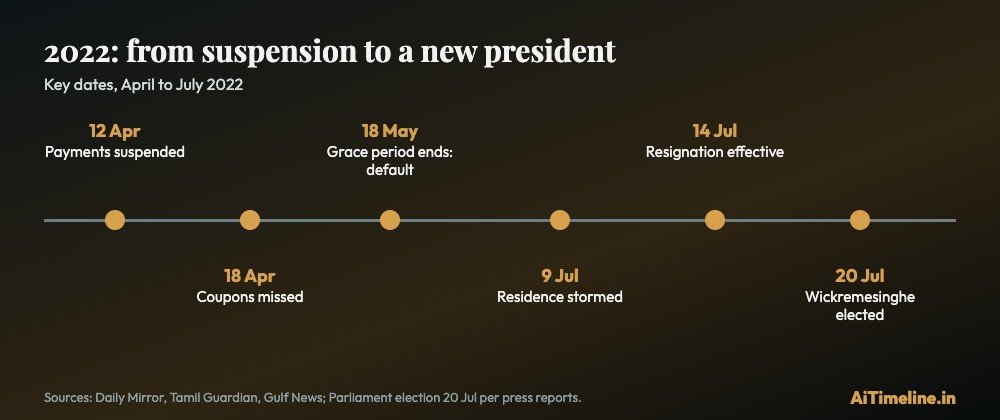
The default came in steps. On 12 April the Finance Ministry suspended payments on foreign-currency debt. The coupons due on 18 April were missed, and the grace period ended on 18 May. Ratings agencies followed, and the central bank governor described a pre-emptive default tied to restructuring. Inflation then reached 69.8% in September 2022, and the economy shrank by 7.8% over the year on the first official estimate.
How Much Has the IMF Actually Paid Sri Lanka?
Approved total versus money released, as of 26 October 2026.
| Step | Date | Released (SDR) | Released (about US$) | Source |
|---|---|---|---|---|
| Approval of the 48-month EFF | 20 Mar 2023 | 254 million | 333 million | Ada Derana |
| First review | 12 Dec 2023 | 254 million | 337 million | CBSL |
| Second review | 13 Jun 2024 | 254 million | 336 million | CBSL |
| Third review | 28 Feb 2025 | 254 million (implied by the total) | 334 million | IMF |
| Fourth review | 2 Jul 2025 | 254 million | 350 million | IMF |
| Combined fifth and sixth reviews | 28 May 2026 | 508 million | 695 million | IMF |
| Total disbursed | to 28 May 2026 | 1,778 million | about 2.4 billion | IMF |
| Total approved | 20 Mar 2023 | 2,286 million | about 3 billion | IMF |
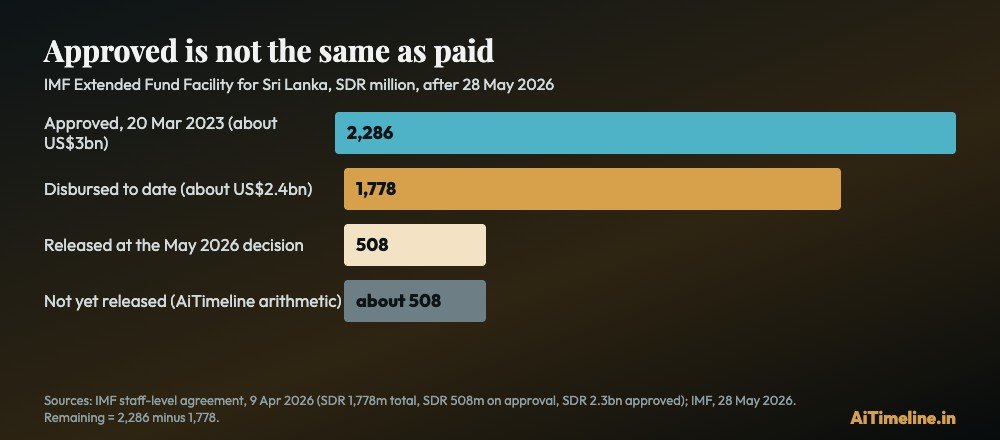
Approved is a ceiling; disbursed is a payment record. The IMF approved the programme at SDR 2.286 billion (about US$3 billion; some outlets say US$2.9 billion, depending on the exchange rate). Each tranche is released only after a review. Totals in the table are the IMF’s; the not-yet-released balance of about SDR 0.5 billion is AiTimeline’s subtraction, not an IMF-stated figure. The US$206 million emergency loan after Cyclone Ditwah is separate and not counted in the US$2.4 billion.
How Did Sri Lanka Restructure Its Debt?
Different creditor groups needed separate deals.
| Creditor group | Milestone | Date | Source |
|---|---|---|---|
| Domestic Treasury bondholders | Domestic debt optimisation settled; banks excluded | 14 Sep 2023 | Ada Derana |
| China Exim Bank (about US$4.2bn) | Agreement in principle | 11 Oct 2023 | Ada Derana |
| China Exim Bank | Debt treatment agreements signed | 26 Jun 2024 | Ada Derana |
| Official bilateral creditors (about US$5.8bn, as reported) | Final deal reported the same day | 26 Jun 2024 | Ada Derana |
| International sovereign bondholders | Agreement in principle with main holder groups | 19 Sep 2024 | Bloomberg |
| International sovereign bondholders | Exchange results 16 Dec; settled 20 Dec; 97.8% accepted | 20 Dec 2024 | Daily Mirror |
Restructuring changes the timing and value of debt; it does not erase it. The IMF said in May 2026 that debt-sustainability risks remain high but have improved. AiTimeline did not find a verified current public-debt-to-GDP ratio and does not state one.
Has Sri Lanka Recovered? The 2026 Picture
Updated 26 October 2026. This section is revised when new official GDP, debt and poverty data are published.
| Indicator | Latest figure | Source and date |
|---|---|---|
| Real GDP vs pre-crisis | Back at its pre-crisis level | World Bank, Oct 2026 |
| Growth, first half of 2026 | 4.7% | World Bank, Oct 2026 |
| Growth forecast, 2026 | World Bank 4.4%; IMF around 3% | World Bank; IMF, May 2026 |
| Growth forecast, 2027 | 4.2% | World Bank, Oct 2026 |
| Growth in 2025 | 5% | IMF, Apr 2026 |
| Poverty rate, 2025 | 16.9% (estimate), above pre-crisis | World Bank, Oct 2026 |
| Gross official reserves | About US$7 billion, end-March 2026 (about US$1.9bn in March 2022) | IMF; Wikipedia |
| Inflation | 5.4% (May 2026 statement), after 2.2% in March; peak was 69.8% in Sep 2022 | IMF; IMF |
| Public debt ratio | Not given: no verified current figure was found in the sources checked | Pending |
GDP recovery is not a full recovery in living standards. The World Bank says poverty is above its pre-crisis level, jobs lag, and renewed inflation has eroded part of the gain. The IMF flagged downside risks from higher oil prices, the cyclone’s aftermath and a weaker rupee. Update log: 26 October 2026, first version with the World Bank October update and the IMF May 2026 review.
Sri Lanka Economic Crisis Timeline, Latest First
Each entry is tagged and ends with why it matters.
World Bank: output is back at its pre-crisis level, but poverty is not Recovery
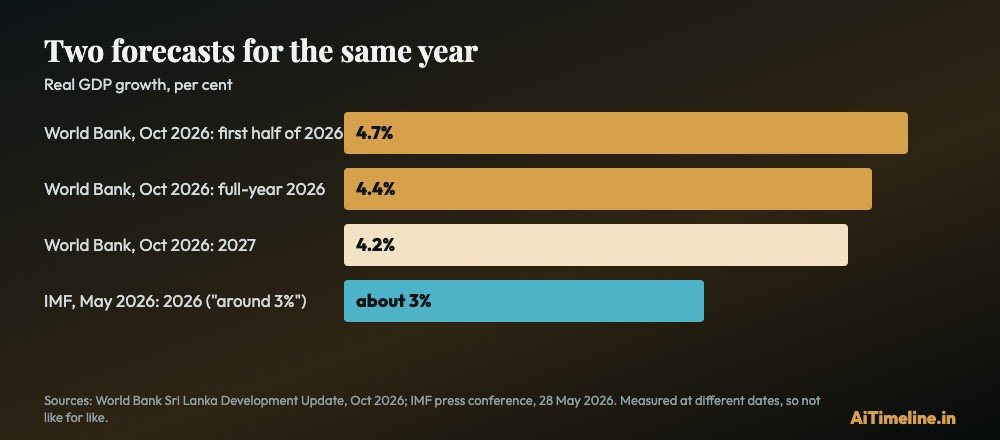
The World Bank’s October 2026 update says real GDP has returned to its pre-crisis level. The economy grew 4.7% in the first half of 2026, its twelfth straight quarter of expansion, and the Bank projects 4.4% for 2026 and 4.2% for 2027. Poverty in 2025 is estimated at 16.9%, still well above its pre-crisis level, labour-market indicators lag, and renewed inflation has partly eroded household gains (World Bank).
The IMF is less upbeat on the same year: in May it forecast growth moderating to around 3% in 2026. The two forecasts are shown side by side below. The page gives no pre-crisis GDP figure, so none is invented here.
2026
IMF completes the combined fifth and sixth reviews IMF
The IMF Executive Board completed the combined fifth and sixth reviews of the Extended Fund Facility (EFF), releasing about US$695 million (SDR 508 million). Total disbursements under the arrangement reach about US$2.4 billion (IMF).
Approved and disbursed are different numbers. The EFF approved in March 2023 is worth SDR 2.286 billion (about US$3 billion); money is released review by review, and SDR 1,778 million had been paid out after this decision (IMF). The gap, roughly SDR 0.5 billion by AiTimeline’s arithmetic, is not yet released.
The IMF reported strong performance on end-December 2025 targets, but two commitments were not observed: no new external payment arrears and no new import restrictions. It warned that risks are tilted to the downside, citing the Middle East war, higher oil prices, the cyclone’s aftermath and about 4.5% rupee depreciation year to date. Inflation had risen to 5.4%, from nearly zero a year earlier.
2026
IMF staff reach agreement on the two reviews IMF
IMF staff agreed with the authorities on the combined fifth and sixth reviews, subject to Board approval and two conditions: restoring cost-recovery electricity and fuel pricing while protecting vulnerable groups, and completing the financing-assurances review. The IMF said the economy grew 5% in 2025, gross official reserves were US$7 billion at end-March 2026, and March inflation was 2.2%. 2025 fiscal performance was strong, it said, mainly because of taxes on motor-vehicle imports (IMF).
Cyclone Ditwah adds a new bill to the recovery Shock
Cyclone Ditwah brought record rain, floods and landslides across all 25 districts. By 14 December the Disaster Management Centre counted 644 dead and 183 missing, with 1.34 million people affected and more than 118,000 houses damaged or destroyed (Ada Derana). On 19 December 2025 the IMF approved about US$206 million in emergency financing under its Rapid Financing Instrument, separate from the EFF, and deferred the fifth review (ETV Bharat/PTI).
The brief dates the cyclone to December; the rains began in late November, and the IMF’s emergency loan is what came in December.
Third and fourth reviews keep the money flowing IMF
The Board completed the third review on 28 February 2025, releasing about US$334 million (IMF), and the fourth review in early July 2025, releasing SDR 254 million, about US$350 million (IMF). Each tranche was tied to targets on revenue, reserves and governance.
The international bond exchange is completed Debt deal
Holders of about 97.8% of the outstanding bonds accepted the exchange, which Bloomberg reported as a roughly 27% haircut on nominal value. New bonds settled on 20 December 2024. One series, the 2022 bond, drew only 73% acceptance, and one holder with about a quarter of it challenged the restructuring (Daily Mirror).
Restructuring changes the timing and terms of debt; it does not erase it.
Dissanayake wins the presidency Politics
Anura Kumara Dissanayake won the presidential election in a run-off count, the first in Sri Lanka’s history, defeating Sajith Premadasa, and was sworn in on 23 September 2024 (Ada Derana). He had campaigned on anti-corruption and relief for households. His government endorsed the bondholder agreement reached two days before the vote and continued the IMF programme.
2024
Agreement in principle with bondholders Debt deal
Sri Lanka announced an agreement in principle with the main bondholder groups, days before the election. The deal kept macro-linked and governance-linked features and cut the nominal value; Bloomberg put the haircut at about 27% (Bloomberg). The brief puts this in September and the China Exim deal in November; the Exim deal was in fact reached earlier (next entry).
China Exim Bank and official creditors sign Debt deal
On 26 June 2024 Sri Lanka signed debt-treatment agreements with China’s Export-Import Bank covering about US$4.2 billion (Ada Derana); the agreement in principle had come on 11 October 2023 (Ada Derana). Reports the same day also described a final deal with the bilateral official creditor committee, put at about US$5.8 billion. The brief’s “November 2024” for Exim does not match this record.
Two weeks earlier, on 13 June 2024, the IMF released SDR 254 million (about US$336 million) after the second review (CBSL); the brief gives March 2024.
Domestic debt is restructured Debt deal
The domestic debt optimisation exchanged eligible Treasury bonds for new step-down coupon bonds, settled on 14 September 2023. Offers covering 37% of eligible principal were accepted, and 84% of eligible bonds held by superannuation funds took part (Ada Derana). Banks were excluded to protect deposits; pension funds such as the EPF were included, which made it politically sensitive.
2023
The IMF approves a four-year, SDR 2.286 billion programme IMF
The Board approved a 48-month EFF of SDR 2.286 billion (about US$3 billion) and released SDR 254 million, about US$333 million, immediately (Ada Derana). Some media wrote US$2.9 billion for the same facility, the difference being the exchange rate used. The remaining money depends on reviews.
2022
IMF staff agreement, as inflation peaks at 69.8% IMF
IMF staff and the authorities reached a staff-level agreement on a four-year programme on 1 September 2022, subject to financing assurances from creditors. That month headline inflation on the Colombo index hit 69.8%, and the economy shrank by 7.8% over 2022 on the first official estimate (Newsfirst); the brief gives 7.3%, which AiTimeline could not trace.
Protesters storm the president’s residence Politics
Protesters entered the presidential residence on 9 July. Gotabaya Rajapaksa fled to Singapore and his resignation was effective 14 July (Gulf News). Parliament elected Ranil Wickremesinghe president on 20 July 2022.
2022
Sri Lanka defaults for the first time Shock
A 30-day grace period expired on 18 May 2022 on about US$78 million of interest due on 18 April for bonds maturing 2023-28, making this the first sovereign default in the country’s history. The central bank governor called it a pre-emptive default tied to restructuring (Tamil Guardian).
2022
Sri Lanka suspends external debt payments Shock
The Finance Ministry announced a temporary suspension of payments on foreign-currency debt pending an IMF programme (Daily Mirror). Reserves were about US$1.9 billion in March, against roughly US$4 billion of obligations, with power cuts of up to 15 hours a day (Wikipedia). The brief says Sri Lanka formally sought IMF help in March; AiTimeline did not confirm that date.
A fertiliser ban and pandemic limits compound the strain Background
The ban on chemical fertilisers cut rice output by about 20% in six months and hurt tea exports (Wikipedia); it was later reversed. With tourism still depressed and official remittances down sharply in early 2022, dollars became harder to find.
COVID-19 empties the hotels Background
The pandemic sharply cut tourism earnings and employment in an economy that relied on visitors, tea, garments and remittances for foreign currency. Foreign debt had risen from US$11.3 billion in 2005 to US$56.3 billion by 2020 (Wikipedia).
Large tax cuts take effect Background
The new government cut VAT from 15% to 8% and abolished several other levies from 1 December 2019 (Washington Times/AP). Estimates of the cost differ: one projection in 2019 was Rs 450 billion, a later statement put it at about Rs 800 billion a year. The brief dates the cuts to November; they were announced then but took effect in December.
Easter Sunday bombings Background
Nine suicide bombers hit three churches and three hotels, killing 269 people and injuring more than 500 (UCA News). Tourist arrivals fell sharply, removing a key source of dollars.
2019
Low revenue, high debt and borrowing abroad Background
Sri Lanka entered the crisis with low tax revenue, recurring deficits, high debt-service needs, and reliance on foreign-currency borrowing including international sovereign bonds, while export earnings were too small to cover shocks. These weaknesses are why later shocks became a default rather than a downturn.
What Is Settled and What Is Open, as of 26 October 2026
| Question | Position of the sources | Status |
|---|---|---|
| Default date | 12 Apr suspension; 18 May grace period ended | Settled |
| Size of the IMF programme | SDR 2.286bn, about US$3bn (some outlets say US$2.9bn) | Settled |
| Money disbursed | SDR 1,778m, about US$2.4bn after 28 May 2026 | Settled, IMF |
| 2022 contraction | 7.8% first estimate (central bank, Reuters); brief says 7.3% | Disputed |
| China Exim final deal | 26 Jun 2024; the brief says Nov 2024 | Brief corrected |
| Second IMF review | 13 Jun 2024; the brief says Mar 2024 | Brief corrected |
| Cyclone Ditwah date | Late Nov 2025; the brief says Dec 2025 | Brief corrected |
| 2026 growth | World Bank 4.4% vs IMF around 3% | Forecasts differ |
| Formal IMF request in March 2022 | Not confirmed by the sources checked | Unverified |
| Current public debt ratio | No verified figure found | Not given |
The Story at a Glance
Oldest first.
| Date | Event | Type |
|---|---|---|
| Before 2019 | Low revenue, high debt and borrowing abroad | Background |
| Apr 2019 | Easter Sunday bombings | Background |
| Dec 2019 | Large tax cuts take effect | Background |
| 2020 | COVID-19 empties the hotels | Background |
| 2021 | A fertiliser ban and pandemic limits compound the strain | Background |
| 12 Apr 2022 | Sri Lanka suspends external debt payments | Shock |
| 18 May 2022 | Sri Lanka defaults for the first time | Shock |
| Jul 2022 | Protesters storm the president’s residence | Politics |
| 1 Sep 2022 | IMF staff agreement, as inflation peaks at 69.8% | IMF |
| 20 Mar 2023 | The IMF approves a four-year, SDR 2.286 billion programme | IMF |
| Sep 2023 | Domestic debt is restructured | Debt deal |
| Jun 2024 | China Exim Bank and official creditors sign | Debt deal |
| 19 Sep 2024 | Agreement in principle with bondholders | Debt deal |
| Sep 2024 | Dissanayake wins the presidency | Politics |
| Dec 2024 | The international bond exchange is completed | Debt deal |
| 2025 | Third and fourth reviews keep the money flowing | IMF |
| Nov-Dec 2025 | Cyclone Ditwah adds a new bill to the recovery | Shock |
| 9 Apr 2026 | IMF staff reach agreement on the two reviews | IMF |
| 28 May 2026 | IMF completes the combined fifth and sixth reviews | IMF |
| Oct 2026 | World Bank: output is back at its pre-crisis level, but poverty is not | Recovery |
| Term | Meaning | Why it matters here |
|---|---|---|
| Extended Fund Facility (EFF) | An IMF loan arrangement for medium-term structural problems, paid in tranches | The 48-month programme approved on 20 Mar 2023 |
| SDR | The IMF unit of account; its dollar value moves with exchange rates | Why US$2.9bn and US$3bn describe the same facility |
| Approved vs disbursed | Approved is the ceiling the Board committed; disbursed is what has been paid | About US$3bn approved, about US$2.4bn paid |
| Staff-level agreement | Agreement between IMF staff and the government, before Board approval | Reached 1 Sep 2022 and 9 Apr 2026 |
| Rapid Financing Instrument | IMF emergency loan with few conditions | US$206m after Cyclone Ditwah, outside the EFF |
| Haircut | A cut in the value creditors are owed | About 27% nominal on bonds, per Bloomberg |
Who Is Who
Gotabaya Rajapaksa
In office during the 2019 tax cuts and the 2022 default; resigned effective 14 July 2022.
Ranil Wickremesinghe
Elected by Parliament on 20 July 2022; led the IMF talks and restructuring.
Anura Kumara Dissanayake
Sworn in 23 September 2024; continued the IMF programme.
P. Nandalal Weerasinghe
Governor who called the May 2022 default pre-emptive and tied repayment to restructuring.
International Monetary Fund
Approved the SDR 2.286bn EFF and the US$206m emergency loan.
China Exim Bank
Agreed to treat about US$4.2bn of debt; signed 26 June 2024.
Explore More Timelines
People Also Ask
Frequently Asked Questions
Stabilised, Not Finished
Sri Lanka’s crisis showed how weak revenue, foreign-currency debt and external shocks can combine into a default. IMF support, debt restructuring and renewed growth stabilised the economy, and by October 2026 output was back at its pre-crisis level. Poverty, jobs and exposure to oil prices and disasters show that the recovery is incomplete.
Related AiTimeline Stories
⚠️ Editorial Note
Last updated 26 October 2026. The source brief was checked against the sources it cites and others. Corrections: the China Exim final agreement was 26 June 2024, not November 2024 (the agreement in principle was 11 October 2023); the second IMF review was completed on 13 June 2024, not March 2024; Cyclone Ditwah struck in late November 2025, with the IMF emergency loan approved on 19 December; the 2019 tax cuts were announced in November but took effect on 1 December; the 2022 contraction was first estimated at 7.8%, and the brief’s 7.3% could not be traced; the brief’s "formal IMF request in March 2022" was not confirmed; and the IMF’s May 2026 growth forecast (around 3%) is added next to the World Bank’s. The brief’s US$3 billion programme size and US$2.4 billion total are distinguished as approved and disbursed. The 2025 growth rate, the US$7 billion reserves figure and the World Bank poverty and growth figures are as published by those bodies. No photographs are used.
Sources & further reading
Every dated entry above was checked against these references. Last reviewed 26 October 2026.
- World Bank: Sri Lanka Development Update, October 2026
- IMF: Press conference, combined fifth and sixth EFF reviews, 28 May 2026
- IMF: Staff-level agreement on the combined fifth and sixth reviews, 9 April 2026
- IMF: Executive Board completes the fourth review, July 2025
- IMF: Third review completed, 28 February 2025
- Central Bank of Sri Lanka: IMF second review, June 2024
- Daily Mirror: Sri Lanka completes sovereign bond exchange, December 2024
- Ada Derana: Sri Lanka signs debt treatment agreement with China Exim Bank
- Ada Derana: Domestic debt optimisation, Sri Lanka Development Bonds
- Tamil Guardian: Sri Lanka defaults on debt for the first time
- Wikipedia: Sri Lankan economic crisis (2019-2024)