Arunachal Pradesh Protests: Siang Dam, Indigenous Rights and Activism
Protests over the proposed 11,200-MW Siang dam escalated in October 2026. A sourced timeline of the Siang movement, Indigenous land rights, refugee
Latest Story
Arunachal Pradesh protests over the proposed 11,200-MW Siang Upper Multipurpose Project escalated into clashes, arrests and renewed demonstrations in October 2026. For many residents, especially the Indigenous Adi community of the Siang valley, the dispute is about ancestral land, displacement and whether communities have a real say, while the government calls the project important for flood management, water security and strategic needs. The state’s protest history has other strands too: refugee settlement, the Inner Line Permit and identity.
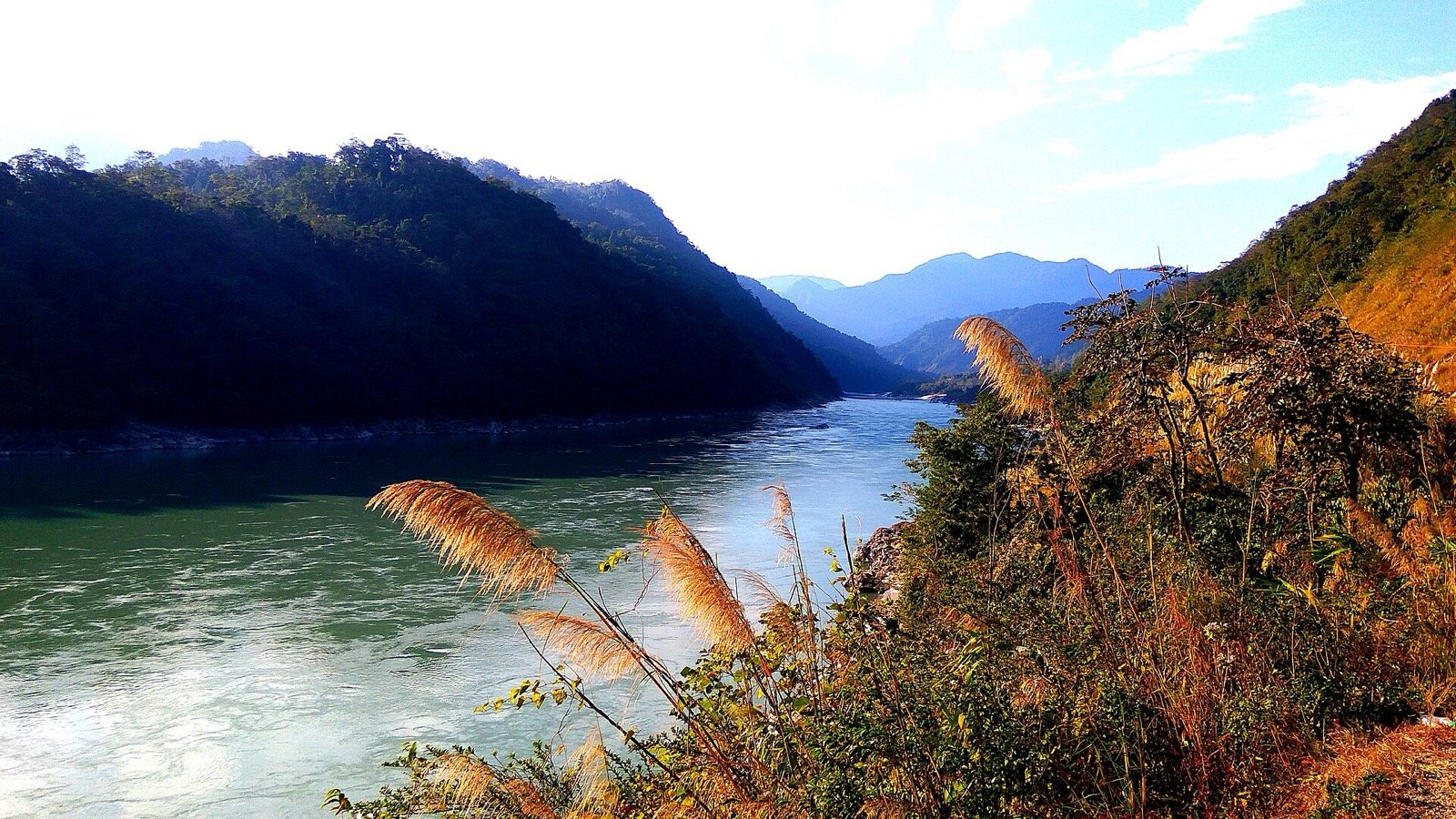
Status: protests against the proposed 11,200-MW Siang Upper Multipurpose Project escalated on 23 October. By 24 October police reported at least three FIRs and 15 people arrested or detained (Down To Earth).
- Talks: Chief Minister Pema Khandu met legislators and Indigenous organisations on 25 October.
- Project: NHPC is preparing a pre-feasibility report; this is a study stage, not final approval.
- Next update: when the status of the arrests, any talks or a decision on the report is clear.
💡 Short Answer
Opponents of the Siang Upper Multipurpose Project, led by Adi community groups, fear displacement, loss of land and river damage, and say consultation has been inadequate. The government says the 11,200-MW project would help manage floods and water, and answer China’s upstream dam plans. It is at pre-feasibility stage. On 24 October police reported 15 arrested or detained after clashes in Pasighat.
The Siang Project at a Glance
Capacity figures are proposals, not operating output, and they differ between reports.
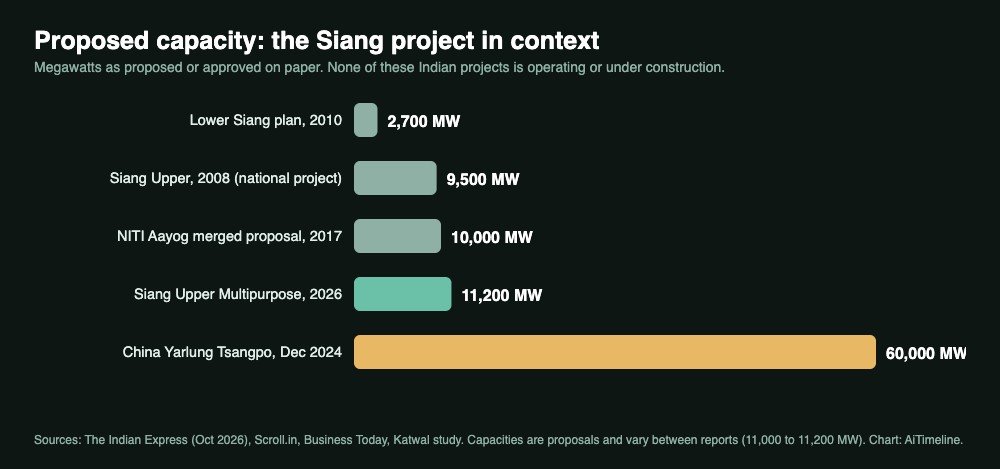
| Year | Proposal | Capacity | Notes |
|---|---|---|---|
| 2010 | Lower Siang Hydroelectric Project | 2,700 MW | Two stages (1,500 and 1,200 MW); reservoir 51.51 sq km |
| 2008 | Siang Upper | 9,500 MW | Declared a National Project |
| 2009 | Siang Upper, two stages | 6,000 + 3,750 MW | Split by NHPC to reduce submergence |
| 2017 | Siang Upper, merged | 10,000 MW | NITI Aayog proposal |
| 2026 | Siang Upper Multipurpose Project | 11,200 MW | Pre-feasibility stage; some reports say about 11,000 MW |
The Siang is the upper course of the Brahmaputra; upstream in Tibet it is the Yarlung Tsangpo. The government points to China’s 60,000-MW lower Yarlung Tsangpo project, approved in December 2024, as the reason for a large storage project on the Siang (The Indian Express). Community groups estimate the reservoir could submerge 27 villages and displace 1–1.5 lakh people; no official assessment has been published, since detailed studies come only if the pre-feasibility report finds the project feasible (Mongabay India).
Siang Dam Protests: Key Questions
The Siang Protests in Nine Points
- Project: the proposed 11,200-MW Siang Upper Multipurpose Project, at pre-feasibility stage.
- Opposition: led by Adi community groups and the Siang Indigenous Farmers’ Forum.
- Escalation: arrests from 9 October, a sit-in on 22 October, clashes on 23 October.
- Arrests: at least 15 arrested or detained by 24 October, per police; four held under a state anti-unlawful-activities law.
- Government case: floods, water security and China’s upstream dam.
- Local case: land, displacement, river ecology and consent.
- History: a dam on the Siang was first proposed in 1982; protests began around 2008–09.
- Not one movement: the Chakma-Hajong and Inner Line debates are separate strands.
- Next: talks, the arrests’ legal status and the pre-feasibility report.
Arunachal Pradesh Protests Timeline, Latest First
From the October 2026 clashes back to the 1873 Inner Line regulation. Each entry is tagged and ends with why it matters.
2026
Arrests, more forces and a first round of talks Latest
By 24 October police had registered at least three FIRs and said 15 people were arrested or detained, according to Inspector-General of Police Hibu Tamang; he said police had information that could identify others involved (Down To Earth). Police said around 40 security personnel were injured, and authorities restricted public gatherings (Business Today). Additional CRPF personnel, including two Rapid Action Force companies, were moved into the Siang valley, and demonstrations spread to Upper Subansiri district (Nation Path).
On 25 October Chief Minister Pema Khandu met legislators and Indigenous organisations (Business Today). Protesters’ demands include halting pre-feasibility work, releasing those held, quashing the FIRs and withdrawing central forces (Arunachal Times). Arrests are not findings of guilt, and the figures may change.
2026
Bandh turns into clashes in Pasighat Protest
Four organisations, the Siang Indigenous Farmers’ Forum, the SUMP Affected Area Youth Association, Adi Bane Kebang Youth and the Adi Galo Welfare Society, called a 12-hour bandh. The Bogong Banggo Kebang of Pasighat did not back it, saying it had not been told in advance (Down To Earth; Arunachal Times). It was largely peaceful by day. Between about 5pm and 6:30pm, police said 200–300 people threw stones at police and a magistrate, and police used tear gas.
Reports say an NHPC office was set on fire, part of Pasighat police station was damaged, at least nine police vehicles were damaged, and the homes of MLAs Oni Panyang and Ninong Ering and BJP state president Kaling Moyong were attacked (Down To Earth). Sit-in participant Otul Jerang said the violence was “completely contrary to our movement’s ideology and objectives.”
2026
24-hour sit-in at Miracle Ground Protest
A 24-hour dharna began at 2pm on Thursday 22 October at Miracle Ground, organised by the Save Siang, Save Indigenous Rights Committee, with the administration’s permission (Arunachal Times). Its demands: halt pre-feasibility reports and surveys, release detained activists, quash the FIRs and withdraw central armed police. Former chief minister Gegong Apang repeated his call to scrap the project and urged Adi-belt legislators to join the movement.
2026
Youth meeting in Pasighat, then a march Protest
A consultative meeting of young people in Pasighat on 18 October began the mobilisation. The East Siang administration denied permission for a rally on 19 October (Arunachal Times). A march nonetheless went from Daying Ering School ground to Gandhi Chowk on 20 October (Down To Earth).
2026
Arrests under a state anti-unlawful-activities law Official move
At least 10 people were arrested from 9 October, four of them under the Arunachal Pradesh Unlawful Activities (Prevention) Act, 2014 (Down To Earth). On 10 October protesters took to the streets in Geku, Upper Siang, demanding the release of the four; the SIFF Youth Wing urged a boycott of government consultations (The Indian Express). Two days before, Union minister Kiren Rijiju had called for dialogue with senior Adi members.
2026
Forces move in; MLA’s house attacked; lathi-charge alleged Protest
On 14 September the state sent hundreds of police and paramilitary personnel to Uggeng and Komkar, two of the three proposed dam sites, and residents blocked roads (Mongabay India). Summons were issued to at least three SIFF-linked protesters under the Prevention of Damage to Public Property Act, 1984. On 30 September, during Khandu’s visit, protesters allegedly attacked an MLA’s house and set vehicles on fire; on 4 October protesters alleged excessive force and security forces alleged arson at Uggeng (The Indian Express). On 5 October, news pages covering the protest sites were reported blocked.
MoU claim, and a CBI notice to a protest adviser Official move
In June Khandu said 110 households from Geku had signed an MoU backing the pre-feasibility report. On 20 August the CBI served a notice on Bhanu Tatak, legal adviser to the SIFF, in an FIR alleging ₹17.6 lakh in foreign contributions was received without FCRA permission; the SIFF Youth Wing called it harassment (Mongabay India). On 21 September Khandu said he had told the Chief Secretary to act against government employees opposing the project (The Indian Express).
Adi clans hold a supreme council after 25 years Protest
After a gap of 25 years, a Bogum Bokang Kebang, a supreme council bringing together Adi clans, was held at Geku in Upper Siang to oppose the dam and its pre-feasibility studies. The SIFF says the reservoir could submerge 27 villages, affect dozens more and displace 1–1.5 lakh Indigenous people (The Indian Express). Those figures are the community’s estimate, not an official assessment, which is still to be made.
2025
China approves its own giant dam; India says it is monitoring Official move
Beijing approved its 60,000-MW lower Yarlung Tsangpo project in December 2024, five cascade stations near the Indian border (The Indian Express). In March 2025 the Ministry of External Affairs told Parliament it was monitoring China’s plans (Business Today). Khandu has framed the Siang project as protection against sudden water releases (Deccan Herald). China says its project will not harm downstream areas.
2024
Activists detained before a minister’s visit Protest
Police detained activists Ebo Mili and Dugge Apang before Union power minister Manohar Lal Khattar’s visit; they had planned to hand over a memorandum opposing the project, and were released after a few hours. On 22 June the Upper Siang administration had asked panchayat members and headmen of 12 potentially affected villages to cooperate with pre-feasibility surveys, citing national interest (Scroll.in). In March 2024 about 1,500 residents had protested NHPC’s corporate-social-responsibility funding.
Survey complaint, a funding approval and a forest-law change Official move
On 24 May 2023 the Union power ministry approved ₹350 crore for social development works in the region; in July the SIFF filed a police complaint alleging NHPC surveyed Parong without villagers’ consent. The Forest (Conservation) Amendment Act, 2023 allows forest diversion for strategic projects within 100 km of international borders without forest clearance (Scroll.in). The Act does not by itself clear any project.
NHPC is assigned the pre-feasibility report Official move
The Ministry of Jal Shakti assigned NHPC to prepare the pre-feasibility report (Business Today). A pre-feasibility report is not final construction approval; the Social Impact Assessment, Environmental Impact Assessment and Detailed Project Report would follow if it finds the project feasible (Mongabay India).
NITI Aayog merges two stages into one large project Official move
NITI Aayog proposed replacing the planned Siang Upper Stage-I and Stage-II projects with a single storage project (The Indian Express), which would have been India’s largest hydropower project at 10,000 MW (Scroll.in). It has since grown into the 11,200-MW project now disputed.
Lower Siang protests and a lathi-charge Protest
On 10 March 2010 several organisations gathered at the District Collector’s office in Pasighat and submitted a memorandum against the Lower Siang Hydroelectric Project and other mega-projects on the Siang. Before the scheduled public hearings, strikes and demonstrations spread across Pasighat and the valley. On 26 May 2010 protesters and villagers from Pongging were lathi-charged by the CRPF; two women were seriously injured and the hearing was cancelled (Katwal study). The Lower Siang plan was 2,700 MW, developed by Jaypee Arunachal Power Limited, a Jaiprakash Associates subsidiary, with a reservoir of 51.51 sq km.
Siang Upper declared a National Project, then split Official move
In 2008 the 9,500-MW Siang Upper was declared a National Project; in 2009 NHPC divided it into two stages of 6,000 MW and 3,750 MW to reduce submergence (The Indian Express). Local protests against the dam began around this time (Scroll.in). Changes to the design did not settle whether the risks were acceptable to affected villages.
Supreme Court bars eviction of Chakmas pending citizenship Refugee dispute
In National Human Rights Commission v State of Arunachal Pradesh, decided 9 January 1996, the Supreme Court dealt with a petition for about 65,000 Chakma/Hajong people and a report that the All Arunachal Pradesh Students’ Union had issued “quit notices” to alleged foreigners to leave by 30 September 1995 (Indian Kanoon). The court directed that while an individual’s citizenship application is pending, the state shall not evict or remove that person.
On 17 September 2015 the court again said they could not be discriminated against pending formal conferment of citizenship (The Indian Express).
Arunachal Pradesh becomes a state Identity
Arunachal Pradesh became a state in 1987, and control of Inner Line Permit administration passed from the Centre-appointed Lieutenant Governor to the state government (Shiv Nadar University). By then the AAPSU had built a strong movement against settling Chakmas and Hajongs in the state (The Indian Express).
Chakma and Hajong families are settled in NEFA Refugee dispute
The Chakmas and Hajongs fled the Chittagong Hill Tracts in the 1960s after their land was submerged by the Kaptai dam; some also faced religious persecution. The Indian government moved most of them to what is now Arunachal Pradesh: 14,888 people in 2,748 families were settled in 1964–69 (The Indian Express). The 2011 census counted 47,073 Chakmas in the state (Wikipedia). Arunachal has opposed their citizenship, citing demography and resources; they have faced long uncertainty about status.
Brahmaputra Board proposes a dam on the Siang Official move
The Brahmaputra Board proposed a dam on the Siang in 1982, and Upper, Middle and Lower Siang dams followed in the 1990s (The Indian Express). The Katwal study notes that apprehensions about damming the Siang date from the Board’s plans in the late 1970s and 1980s (Katwal study).
The Inner Line system begins Identity
The Bengal Eastern Frontier Regulation of 1873 created the Inner Line Permit system, originally to protect rubber and elephant dealers in Cachar and Sylhet; it was not designed mainly to protect frontier tribes. After independence it was treated in NEFA as a tool for protecting Indigenous rights and culture, and Parliament debated its validity in the 1950s and 1960s, with Ram Manohar Lohia opposing it in 1958 (Shiv Nadar University). Arunachal still regulates the entry of Indian citizens who are not Indigenous residents.
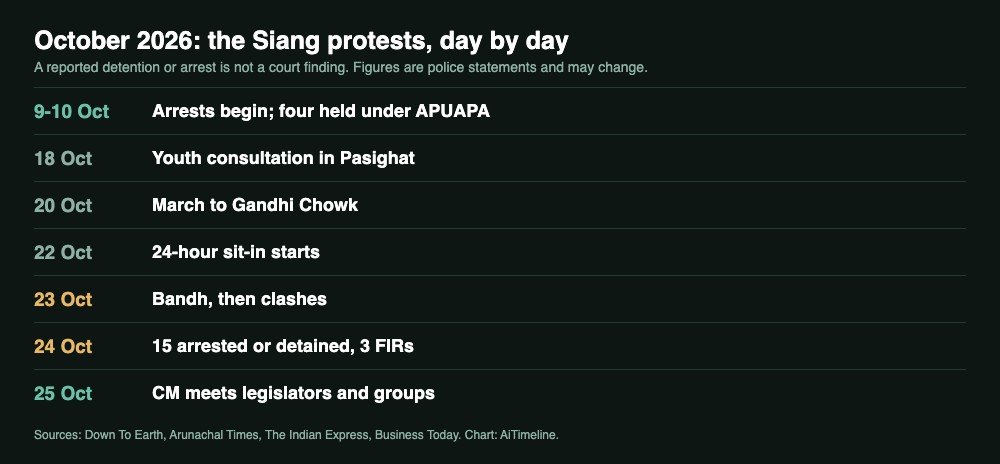
October 2026 at a Glance
Why Do People Protest in Arunachal Pradesh?
Five recurring reasons, described as the parties describe them.
1. Ancestral land and displacement. For the Adi, land is tied to family history and community identity; they revere it as belonging to Abo Tani, their primordial ancestor (The Indian Express). Large reservoirs can submerge fields, forests and homes.
2. Environmental concerns. The eastern Himalayas are ecologically sensitive. These are questions for project-specific assessment: activists’ concerns are not proof of a particular harm, and claims of national benefit do not remove the need for independent study.
3. Consultation and consent. Residents ask whether meetings represent all affected families and whether opposition can change a decision. The government says it will discuss benefits and risks; protesters want surveys halted first.
4. Indigenous identity and migration. The Inner Line Permit and the Chakma-Hajong dispute reflect concerns about land and demography; they also involve the rights of refugee families, who should not be blamed collectively for a political dispute.
5. National security versus local priorities. Supporters point to China’s upstream plans; opponents ask who bears the cost, and argue strategic importance does not remove the need for safeguards and engagement. Analyst Himanshu Thakkar argues India should seek joint impact assessment rather than force a dam on its own people (The Indian Express).
Who Is Involved
| Group | Role in 2026 | Reported position |
|---|---|---|
| Siang Indigenous Farmers’ Forum (SIFF) | Local organisation; called the 23 Oct bandh | Opposes the project; says 27 villages could be submerged |
| Adi Bane Kebang United / Youth | Adi community body; bandh organiser | Calls for scrapping the project and withdrawing armed forces |
| SUMP Affected Area Youth Association | Bandh organiser | Opposes the project |
| Save Siang, Save Indigenous Rights Committee | Organised the 22 Oct sit-in | Wants surveys halted, activists released, FIRs quashed |
| NHPC | State-owned developer preparing the report | Pre-feasibility study only; not final approval |
| Arunachal Pradesh government | Backs the project | Says it will discuss benefits and risks with communities |
Three Strands of Activism in Arunachal Pradesh
The dam row is one strand; the refugee and Inner Line debates are different.
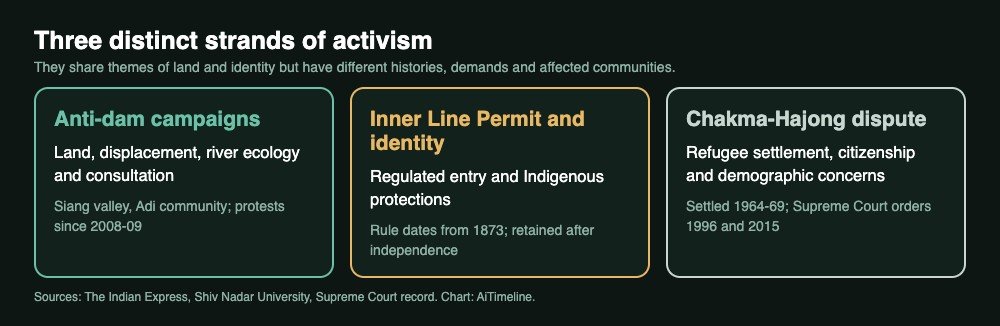
The anti-dam campaign concerns infrastructure, land and consultation. The Chakma-Hajong dispute concerns refugee settlement and citizenship: the Supreme Court has barred eviction while applications are pending, and the state has opposed permanent settlement. The Inner Line Permit regime concerns who may enter and settle. They share questions about identity and land, but should be read separately.
What Happens Next?
1. Talks. Khandu has offered discussion with communities and met legislators and Indigenous groups on 25 October (Business Today). Whether protesters join while surveys continue is unclear.
2. Arrests and cases. The legal status of those held, and the CBI FCRA case against an SIFF adviser, will play out in court. Arrests are not proof of guilt.
3. The report. The pre-feasibility report is the next technical step; if it is favourable, social and environmental impact assessments and a detailed project report would follow (Mongabay India).
4. Security presence. More central forces were moved in after 23 October (Nation Path); protesters demand their withdrawal.
Key People
Pema Khandu
Leads the state government; says the dam will be built only after all studies are complete and met legislators and Indigenous organisations on 25 October.
Hibu Tamang
Inspector-General of Police; reported at least three FIRs and 15 arrests or detentions by 24 October.
Gegong Apang
Repeated his call to scrap the project and urged Adi-belt legislators to join the movement.
Ebo Mili and Dugge Apang
Detained on 8 July 2024 before a minister’s visit; released after a few hours.
Kiren Rijiju
From Arunachal; on 8 October called for dialogue with senior members of the Adi community.
Bhanu Tatak
Served a CBI notice on 20 August in an FCRA case; the case is an allegation, not a finding.
Explore More Timelines
People Also Ask
Frequently Asked Questions About Arunachal Pradesh Protests
A Dispute About Who Decides
Across the dam, refugee and Inner Line debates, protest in Arunachal Pradesh has returned to one question: who decides, and who bears the cost. The October 2026 unrest brings it to a head. The outcome will depend on the technical studies and on whether authorities can answer local objections through transparent assessment, lawful procedure and dialogue. This page will be updated as the arrests, talks and the report develop.
Related AiTimeline Stories
⚠️ Editorial Note
Last updated 27 October 2026. Arrest figures, legal proceedings, project capacity and decisions may change; allegations are attributed to the parties, and arrests are not proof of guilt. Proposed impacts are distinguished from findings of formal assessments. We checked the source brief and corrected it: the first arrests began on 9 October, with four detained on 10 October under the state law; the 22 June 2024 village meeting involved 12 villages; the 2025 entry now rests on the August 2025 Adi council. We dropped brief claims we could not source, namely Assembly resolutions of 1992 and 1994 on the Chakmas and a general “2019 resistance” entry. The Chakma-Hajong entry cites the 1996 Supreme Court judgment and The Indian Express explainer of 2015.
Sources & further reading
Every dated entry above was checked against these references. Last reviewed 27 October 2026.
- The Indian Express: Once against dams, now backing one - China's shadow over Arunachal politics (13 October 2026)
- Down To Earth: Protests against Siang mega-dam in Arunachal Pradesh turn violent (25 October 2026)
- Mongabay India: Protests over dam heat up as crackdown on activists continues (October 2026)
- Arunachal Times: SUMP protest - Pasighat sit-in begins ahead of Siang valley bandh (23 October 2026)
- Business Today: China's mega dam, India's Siang project - why are Arunachal locals protesting (25 October 2026)
- Scroll.in: Why Arunachal Pradesh residents are stalling surveys for a mega dam (9 July 2024)
- The Indian Express: Why Chakmas and Hajongs are India's nowhere people (2 October 2015)
- Supreme Court of India: National Human Rights Commission v State of Arunachal Pradesh (9 January 1996), via Indian Kanoon
- Shiv Nadar University Centre of Excellence for Himalayan Studies: Between protection and integration - the Inner Line Permit regime in Arunachal Pradesh
- Katwal, A.: study of natural-resource conflict and Indigenous methods (Central University of Sikkim repository)