Karnataka 2018: How a Hung Assembly Led to a Three-Day Government
Karnataka 2018 government formation, step by step: the hung Assembly, the Governor's choice, Yediyurappa's 55-hour term, the floor test and the coalition.
Latest Story
On 15 May 2018 Karnataka’s voters gave the BJP 104 seats, the most of any party but eight short of a majority. Within hours the Congress, which had just lost power, offered the Chief Minister’s chair to the JD(S), the third-placed party. The Governor invited the BJP anyway; the Supreme Court sat through the night; and the new Chief Minister resigned 55 hours after taking the oath. This timeline sets out the Karnataka 2018 government formation step by step: the numbers, the Governor’s choice, the three Supreme Court orders, the coalition that followed, and how that coalition fell in July 2019.
We keep four things apart: the election result, the Governor’s decisions, the Supreme Court’s orders, and the separate 2019 collapse of the coalition. Accusations of horse-trading made by both sides are political allegations, not findings of any court. Dates and numbers come from the court’s orders, the Election Commission and reporting of the day; where sources differ, we say so.
💡 Short Answer
Karnataka’s May 2018 election produced a hung Assembly: BJP 104, Congress 78, JD(S) 37, with 112 needed. Governor Vajubhai Vala invited the BJP’s B.S. Yediyurappa, who was sworn in on 17 May with 15 days to prove a majority. The Supreme Court cut that to a floor test on 19 May, and Yediyurappa resigned before the vote. H.D. Kumaraswamy of the JD(S) became Chief Minister on 23 May and won a confidence vote on 25 May.
Karnataka 2018 Government Formation: Key Questions
Karnataka 2018 in Nine Points
- The verdict: BJP 104 of 222 seats, eight short of 112.
- The offer: the Congress backed the JD(S)’s Kumaraswamy for Chief Minister on counting day.
- The choice: the Governor invited the largest party and gave it 15 days.
- The night hearing: the Supreme Court sat from about 2 am and refused to stop the oath.
- The deadline: the court ordered an open floor test within about 30 hours.
- The resignation: Yediyurappa quit before the vote, after about 55 hours in office.
- The coalition: Kumaraswamy sworn in on 23 May and won a voice vote on 25 May.
- The collapse: defections brought it down, 99 to 105, on 23 July 2019.
- The open question: whom a Governor should invite first was never finally decided by the court.
The Numbers: Largest Party Versus Majority
Why 104 seats were not enough.
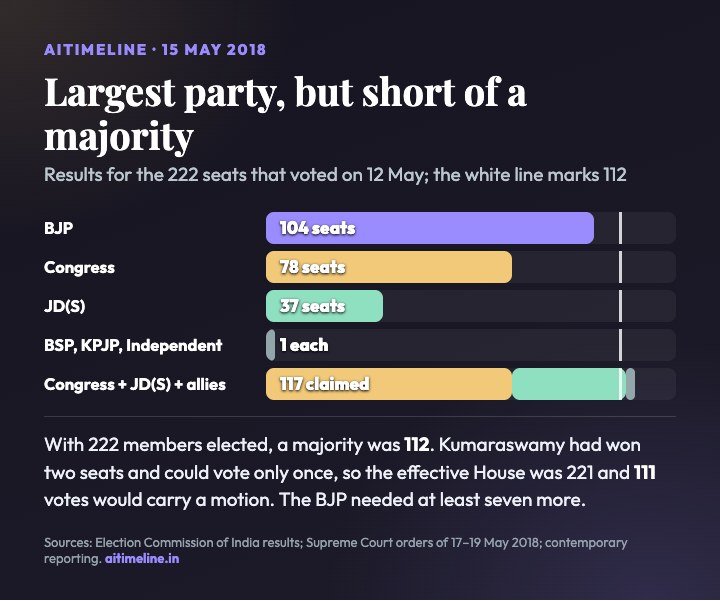
| Party | Seats, 15 May 2018 | Side in May 2018 |
|---|---|---|
| BJP | 104 | Claimed as largest party |
| Indian National Congress | 78 | Backed Kumaraswamy |
| Janata Dal (Secular) | 37 | Led the combination |
| Bahujan Samaj Party | 1 | JD(S) pre-poll ally |
| KPJP | 1 | Supported the coalition |
| Independent | 1 | Supported the coalition |
| Total declared | 222 | 2 seats voted later |
Two of the 224 constituencies did not vote on 12 May: Rajarajeshwari Nagar was deferred and Jayanagar countermanded. So the House that met in May had 222 elected members and a majority mark of 112, not the 113 needed in a full House. A further wrinkle cut the number again: Kumaraswamy had won both Ramanagara and Channapatna and could cast only one vote, so the effective strength for a confidence vote was 221.
For the BJP to survive, at least seven members from the other side would have had to vote for it, or stay away. That arithmetic explains the resorts, the buses to Hyderabad, the 15-day window, and why both sides fought so hard over how and when the vote would be held.
Two Claims, One Governor
Largest party or post-poll majority: who should go first?
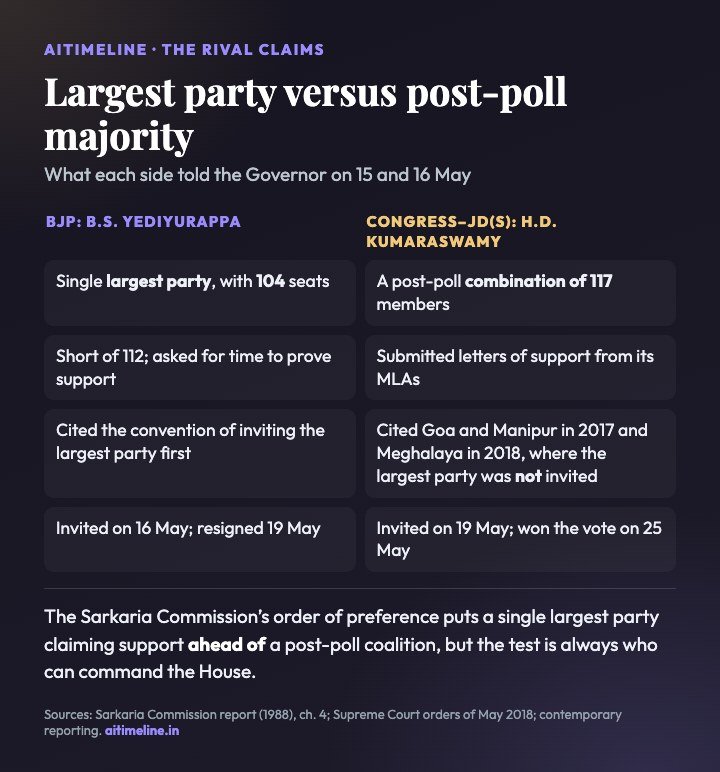
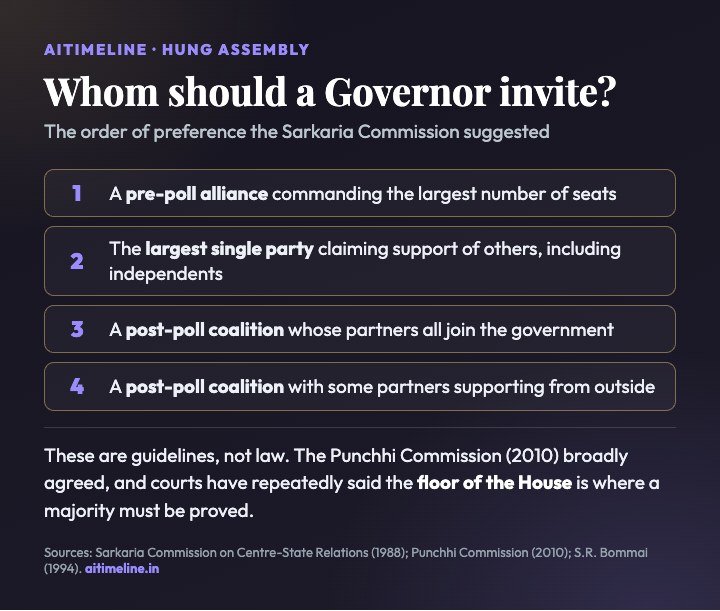
Article 164 says only that the Governor appoints the Chief Minister. There is no written rule for a hung Assembly, so Governors lean on convention and on the Sarkaria Commission’s 1988 order of preference, which places the largest single party claiming outside support above a post-poll coalition. That was the BJP’s case. The Congress replied that the guideline’s purpose is to find the person most likely to command a majority, and that in Goa, Manipur and Meghalaya Governors had invited post-poll combinations over the largest party only a year earlier.
The decisive point, which the Supreme Court underlined, is that whoever is invited must prove the claim in the House. The court did not say the Governor was wrong to call Yediyurappa; it said the claim would be tested quickly, openly and on camera.
Timeline: Karnataka’s Government Formation, 1988 to 2026
Newest first. Colour shows the type of event.
Where things stand Governor
The government: Karnataka has a Congress government with a large majority won in 2023. D.K. Shivakumar has been Chief Minister since 3 June 2026, and Thaawarchand Gehlot has been Governor since July 2021.
The 2018 case: The Supreme Court never gave a final ruling on the wider question it kept open in May 2018: whether a Governor should first invite the single largest party or a post-poll alliance that claims a majority. We found no judgment on that point by 12 November 2026.
What survives: The practical lessons of 2018 do: a short deadline for proving a majority, an open vote rather than a secret ballot, and live broadcast of the proceedings.
D.K. Shivakumar becomes Chief Minister Alliances & government
What happened: Siddaramaiah resigned on 28 May 2026, and Congress leader D.K. Shivakumar was sworn in on 3 June. G. Parameshwara, who had been Deputy Chief Minister in the 2018 coalition, took the oath as Deputy Chief Minister again.
Why it is linked: Shivakumar was the Congress strategist who kept the party’s MLAs together in a Bengaluru-area resort in May 2018, while both sides waited for the floor test.
Congress returns with a clear majority Alliances & government
What happened: In the Assembly election counted on 13 May 2023, the Congress won 135 seats, the BJP 66 and the JD(S) 19. Siddaramaiah was sworn in as Chief Minister on 20 May, with D.K. Shivakumar as his deputy.
The contrast with 2018: A single party crossed 113 on its own, so there was no hung Assembly, no competing letters of support and no case for the Supreme Court.
Basavaraj Bommai succeeds Yediyurappa Alliances & government
What happened: Yediyurappa resigned on 26 July 2021, the second anniversary of his 2019 swearing-in. Basavaraj Bommai, his Home Minister, was sworn in two days later.
The Governor: Vajubhai Vala, Governor through both the 2018 and 2019 crises, had been succeeded by Thaawarchand Gehlot, who took office in July 2021.
BJP wins 12 of 15 by-polls Election & numbers
What happened: By-elections were held for 15 of the 17 seats left vacant by the disqualifications. The BJP won 12, the Congress two and an Independent one. Most of the winners were former rebels who had joined the BJP.
Why it matters: The results gave the Yediyurappa government a majority of its own, closing the arithmetic question that had begun with the hung verdict of May 2018.
Supreme Court upholds the disqualifications Supreme Court
What the court held: The Speaker was right to disqualify the 17 MLAs under the Tenth Schedule, but he could not bar them from contesting until the end of the Assembly’s term. They were free to contest the by-polls.
A rebuke: The court criticised the MLAs for coming straight to the Supreme Court instead of first approaching the High Court, and said Speakers too were acting against the spirit of neutrality.
Yediyurappa wins a voice vote; 17 MLAs disqualified Assembly & floor
Disqualifications: Speaker Ramesh Kumar disqualified three rebels on 25 July and 14 more on 28 July, holding that their resignations were not voluntary and that they had defied party whips.
The vote: With the House reduced in size, Yediyurappa won a confidence vote by voice on 29 July. Ramesh Kumar then resigned as Speaker.
Yediyurappa sworn in for a fourth time Governor
What happened: Three days after the coalition fell, Yediyurappa staked his claim and was sworn in alone, before any ministers.
The echo of 2018: The same Governor that had invited him in May 2018 invited him again, this time after the House had voted the coalition out, so there was no rival claim to weigh.
Coalition loses the confidence vote, 99 to 105 Assembly & floor
What happened: After days of debate, the confidence motion moved by Kumaraswamy was defeated: 99 for and 105 against. About 20 members, mostly rebels, stayed away. Kumaraswamy resigned the same evening.
Why it matters: The coalition had proved its majority on 25 May 2018. The 2019 vote shows that a majority proved once can be lost later, and that the floor test settles that question too.
Rebel MLAs cannot be compelled to attend Supreme Court
What the court said: The Speaker was free to decide the resignations in his own time, but the 15 rebel MLAs could not be compelled to take part in the Assembly proceedings.
The effect: Party whips could not force the rebels to vote for the government, which made defeat on the confidence motion likely.
Resignations put the coalition in danger Alliances & government
What happened: Starting on 1 July, more than a dozen Congress and JD(S) legislators submitted resignations to the Speaker. Two Independents also withdrew support.
The dispute: The coalition accused the BJP of luring its MLAs; the BJP said the government had lost its majority and should prove it at once. These were political allegations from both sides, not findings of any court.
Lok Sabha rout for the coalition Election & numbers
What happened: The Congress and JD(S) contested the general election together but won only one seat each. Former Prime Minister H.D. Deve Gowda lost in Tumkur.
Why it matters: The defeat weakened the coalition and sharpened tensions between its partners, a month before the resignations began.
Cabinet expansion: 25 ministers sworn in Alliances & government
What happened: Twenty-five ministers from the Congress, the JD(S) and their allies were sworn in, taking the Council of Ministers to 27. The Congress took the larger share, in line with its larger number of MLAs.
Early strain: Congress legislators left out of the ministry protested openly, an early sign of the tensions that would bring the government down a year later.
Congress wins the two deferred seats Election & numbers
Why they were deferred: Polling in Rajarajeshwari Nagar was postponed after thousands of voter ID cards were found in a flat. In Jayanagar it was countermanded after BJP candidate B.N. Vijayakumar died during the campaign.
Result: The Congress won both: Munirathna in Rajarajeshwari Nagar and Sowmya Reddy in Jayanagar, where the JD(S) withdrew its candidate to back her.
Speaker elected; Kumaraswamy wins the confidence vote Assembly & floor
The Speaker: Congress MLA K.R. Ramesh Kumar was elected Speaker unopposed after the BJP’s candidate, S. Suresh Kumar, withdrew.
The vote: Kumaraswamy moved a confidence motion. After Yediyurappa spoke, the BJP walked out, and the motion was carried by voice vote. The coalition claimed the support of 117 members.
Why it matters: This was the first time in the 2018 crisis that majority support was actually shown on the floor of the House.
H.D. Kumaraswamy sworn in as Chief Minister Alliances & government
What happened: Kumaraswamy, leader of the JD(S), the third-largest party, took the oath on the steps of the Vidhana Soudha, with Congress state president G. Parameshwara as his deputy.
The guests: Leaders from across the opposition attended, including Sonia Gandhi, Rahul Gandhi, Mamata Banerjee, Mayawati, Akhilesh Yadav, Sitaram Yechury, Arvind Kejriwal and N. Chandrababu Naidu. The photo became an early image of opposition unity before the 2019 general election.
Governor invites Kumaraswamy Governor
What happened: After Yediyurappa’s resignation, Governor Vajubhai Vala invited Kumaraswamy, as leader of the Congress–JD(S) combination, to form the government and gave him 15 days to prove his majority.
In practice: Kumaraswamy did not use the full period. He proved his majority two days after taking office.
Yediyurappa resigns before the floor test Assembly & floor
What happened: After the newly elected MLAs took their oaths, Yediyurappa made an emotional speech in the House, said he would not face the vote, and went to Raj Bhavan to resign.
Why: The BJP had 104 members and needed at least seven more. It did not have them, and no Congress or JD(S) member broke ranks on the floor.
How long: His government lasted about 55 hours from the oath at 9 am on 17 May.
Pro tem Speaker stays; the vote will be broadcast live Supreme Court
The challenge: The Congress and JD(S) argued that, by convention, the senior-most member should be pro tem Speaker, and questioned K.G. Bopaiah’s impartiality.
The outcome: The court said it could not direct the Governor to appoint a particular person unless a convention had become law. After the Additional Solicitor General said the proceedings would be telecast live, the petitioners did not press their plea.
K.G. Bopaiah appointed pro tem Speaker Governor
What happened: Hours after the Supreme Court fixed the floor test, the Governor appointed BJP MLA K.G. Bopaiah, a former Speaker, as pro tem Speaker to swear in members and conduct the vote.
Why it was disputed: He was not the senior-most member of the House, and as Speaker in 2010 he had disqualified BJP rebels in a decision later set aside by the Supreme Court.
Supreme Court orders a floor test within a day Supreme Court
The order: The bench directed a floor test at 4 pm the next day, cutting the 15 days the Governor had allowed. It rejected requests for a secret ballot, said the vote would follow the rules of the House, barred the nomination of an Anglo-Indian member before the vote, and ordered the police chief to ensure security.
What it left open: The court said the wider question, whether the Governor had been right to invite the largest party, would be heard later.
Yediyurappa sworn in as Chief Minister Governor
What happened: Governor Vajubhai Vala administered the oath to Yediyurappa a few hours after the Supreme Court declined to stop it.
The open question: He took office without having shown a majority in the House, with 15 days to do so and a pending court case hanging over the appointment.
A post-midnight hearing in the Supreme Court Supreme Court
What happened: The Congress and JD(S) filed their petition late on 16 May, and the Chief Justice set up a special bench that sat through the night.
The order: The court refused to stay the swearing-in but said it would be subject to the outcome of the case, and asked for the letters of 15 and 16 May in which Yediyurappa had claimed support.
Governor invites Yediyurappa and gives him 15 days Governor
The decision: The Governor invited Yediyurappa, as leader of the largest party, to form the government, and gave him 15 days to prove his majority.
The objection: The Congress and JD(S) said a combination that had already shown letters from a majority should have been invited, and that 15 days invited attempts to win over their MLAs.
Both sides stake their claims Alliances & government
BJP: Yediyurappa met the Governor on 15 May and again on 16 May after being elected leader of the BJP legislature party, claiming he would show a majority.
Congress–JD(S): Kumaraswamy, elected leader of the JD(S) legislators, met the Governor with Congress leaders and handed over letters of support. The combination said it had 117 members.
Resort politics: Both camps moved their MLAs to resorts and hotels to keep them together, and the Congress and JD(S) later moved theirs to Hyderabad.
A hung verdict; Congress backs Kumaraswamy Election & numbers
The result: The BJP became the largest party with 104 of the 222 seats declared, eight short of 112. The Congress won 78 and the JD(S) 37; the BSP, the KPJP and an Independent won one each.
The offer: Before counting had finished, the Congress offered unconditional support to H.D. Kumaraswamy as Chief Minister. Siddaramaiah resigned as Chief Minister the same day.
Karnataka votes Election & numbers
What happened: Polling took place in 222 constituencies. Rajarajeshwari Nagar was deferred and Jayanagar countermanded.
The contest: The BJP, the Congress and the JD(S) fought separately. The JD(S) had a pre-poll alliance with the BSP, but there was no Congress–JD(S) alliance before the vote.
Election schedule announced Election & numbers
What happened: The Election Commission announced a single-phase election to the 224-member Assembly: polling on 12 May and counting on 15 May. The model code of conduct took effect at once.
Context: The term of the outgoing Assembly was due to end on 28 May 2018.
Goa, Manipur and Meghalaya: the precedents both sides cited Governor
What happened: In Goa and Manipur in March 2017, and in Meghalaya in March 2018, the Congress won the most seats but Governors invited post-poll combinations led or backed by the BJP, which proved their majorities.
Why it matters for Karnataka: In May 2018 the Congress argued that the same principle should apply: the combination with the numbers should be invited, not the largest party.
The first Kumaraswamy–Yediyurappa coalition Alliances & government
What happened: Kumaraswamy became Chief Minister in February 2006 at the head of a JD(S)–BJP coalition, with Yediyurappa as his deputy, on the understanding that power would pass to the BJP after 20 months.
How it ended: The handover broke down. Yediyurappa was sworn in on 12 November 2007, but the JD(S) withdrew support and he resigned on 19 November, seven days later.
S.R. Bommai: the floor test is the test Supreme Court
Origin: S.R. Bommai, a Janata Dal Chief Minister of Karnataka, was dismissed in April 1989 after the Governor reported that he had lost his majority, without letting him face the Assembly.
The ruling: The Supreme Court held that whether a government has a majority must be tested on the floor of the House, not decided by a Governor’s private assessment.
Sarkaria Commission’s order of preference Governor
What it said: In a hung Assembly, the Governor should invite, in order: a pre-poll alliance, the largest single party claiming support of others, a post-poll coalition whose partners all join the government, and then a post-poll coalition with outside support.
Its status: These are recommendations, not law. Both sides quoted them in May 2018: the BJP for the largest-party rule, the Congress for the principle that the person most likely to command a majority should be chosen.
Five Days in May: From Results to Resignation
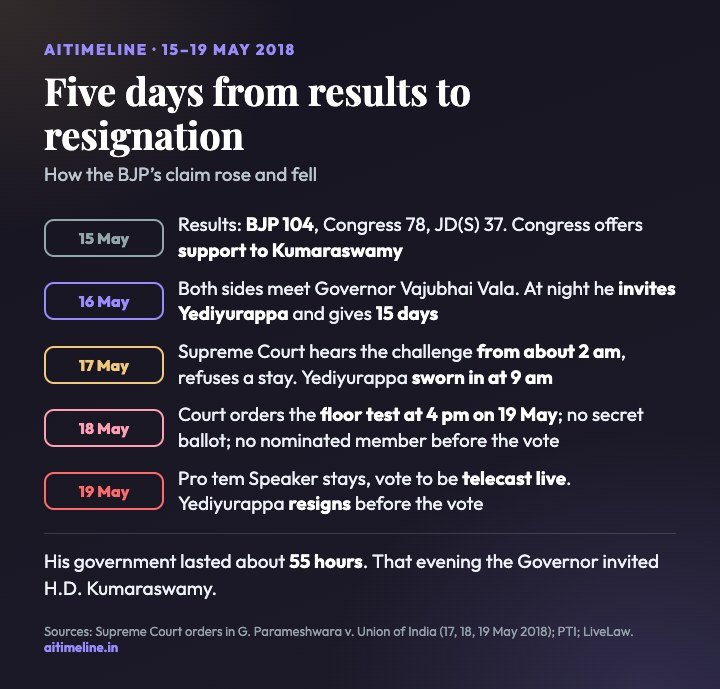
The pace was the story. The Governor’s invitation came on the night of 16 May; the petition was filed within hours; the court sat until dawn on 17 May; the oath went ahead at 9 am. On the morning of 18 May the court set a deadline of 4 pm the next day, and by the afternoon of 19 May the first government had gone. The coalition then took four more days to be sworn in, and two more to win its vote.
What the Supreme Court Did, and Did Not, Decide
G. Parameshwara v. Union of India, May 2018.
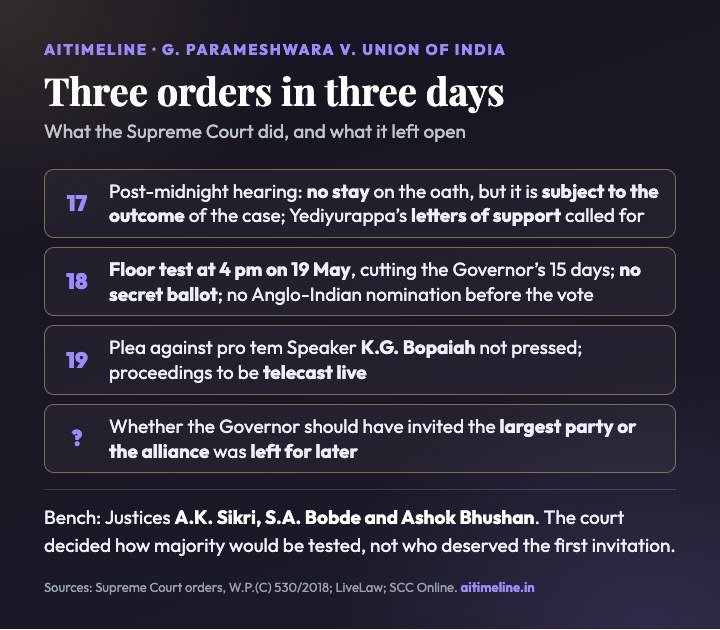
| Date | Request | Court’s response |
|---|---|---|
| 17 May | Stop the swearing-in | Refused, but the oath was made subject to the case |
| 18 May | Early floor test | Ordered for 4 pm on 19 May |
| 18 May | Secret ballot (sought by the BJP side) | Refused; rules of the House to apply |
| 18 May | No nominated member before the vote | Granted |
| 19 May | Replace pro tem Speaker K.G. Bopaiah | Not granted; plea not pressed after live telecast assured |
| Pending | Should the largest party be invited first? | Not decided |
The court’s method, used before in Goa in 2017 and again in Maharashtra in November 2019, was to leave the Governor’s choice alone and shrink the time in which it could be exploited. That avoided the court picking a Chief Minister itself, while removing the long window in which, critics feared, legislators could be won over. It also rested on S.R. Bommai, a 1994 judgment that began with a Karnataka government, which held that majorities are proved on the floor of the House.
The Coalition and Its Collapse in 2019
A majority proved in 2018 was lost 14 months later.
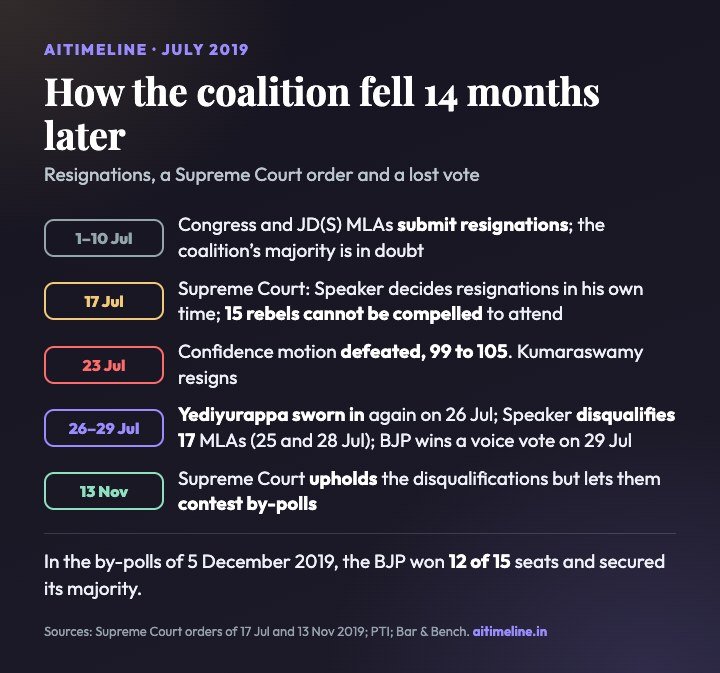
The 2018 crisis and the 2019 crisis are often run together, but they are different questions. In 2018 the issue was who should form a government after an election. In 2019 it was whether a sitting government still had a majority after its members resigned. In both, the answer came from the Assembly floor. The 2019 episode added a new layer: whether resignations were voluntary, whether a Speaker could sit on them, and whether disqualified members could stand again. The Supreme Court answered the last question in November 2019: yes, they could.
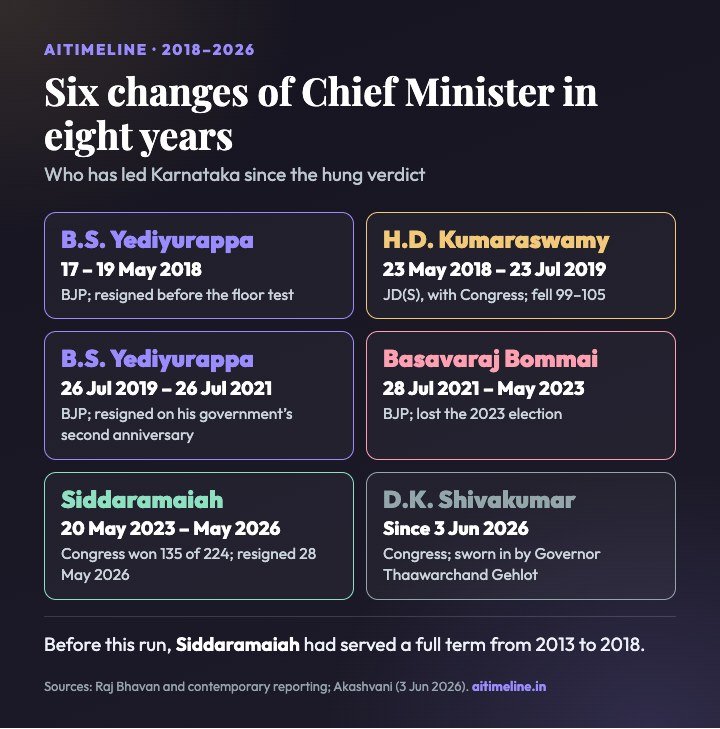
Karnataka’s Chief Ministers Since the Hung Verdict
Why the 2018 Formation Was Controversial
- Largest party or alliance: the BJP claimed the first chance as the largest party; the Congress and JD(S) said a combination with the numbers should be preferred.
- The 15-day deadline: critics said it left too long a window for winning over legislators; the court cut it to about 30 hours.
- The Governor’s background: Vajubhai Vala had been a BJP leader and Gujarat minister, which the opposition said coloured his choice.
- The pro tem Speaker: the choice of K.G. Bopaiah over the senior-most member was challenged, then accepted once a live telecast was promised.
- Allegations of inducements: both sides accused each other of trying to buy MLAs; these remained political allegations.
- Instability afterwards: the coalition’s collapse in 2019 showed that winning the first vote does not guarantee a full term.
What a Floor Test Establishes
A floor test is a vote in the Assembly on whether the Chief Minister and Council of Ministers have the confidence of the House. Under Article 164(2), the ministry is collectively responsible to the Assembly, which is why every disputed claim in this story ended there. Letters of support, lists of names and parades at Raj Bhavan can guide the Governor’s first invitation, but they cannot replace the vote. Karnataka 2018 added three practical lessons that courts have since repeated: the test should be early, it should be open, and it can be broadcast. For how the same questions played out elsewhere, see Uttarakhand’s President’s Rule case of 2016 and the long fights over Governors’ powers in Tamil Nadu.
Key People and Institutions
| Person or body | Role |
|---|---|
| Vajubhai Vala | Governor, 2014–2021; invited Yediyurappa in May 2018 and July 2019, and Kumaraswamy in May 2018 |
| B.S. Yediyurappa | BJP leader; Chief Minister 17–19 May 2018 and again from 26 July 2019 to 26 July 2021 |
| H.D. Kumaraswamy | JD(S) leader; Chief Minister 23 May 2018 – 23 July 2019 |
| Siddaramaiah | Outgoing Congress Chief Minister in 2018; Chief Minister again 2023–2026 |
| G. Parameshwara | Congress state president; Deputy Chief Minister 2018–19; lead petitioner in the Supreme Court |
| D.K. Shivakumar | Congress strategist in 2018; minister in the coalition; Chief Minister since 3 June 2026 |
| K.G. Bopaiah | BJP MLA appointed pro tem Speaker on 18 May 2018 |
| K.R. Ramesh Kumar | Speaker from 25 May 2018; disqualified 17 MLAs in July 2019 |
| Supreme Court | Justices A.K. Sikri, S.A. Bobde and Ashok Bhushan in May 2018 |
| Election Commission of India | Conducted the 12 May 2018 election |
Facts at a Glance
| Detail | Information |
|---|---|
| Schedule announced | 27 March 2018 |
| Polling | 12 May 2018 (222 seats) |
| Results | 15 May 2018 |
| Yediyurappa invited | 16 May 2018 |
| Yediyurappa sworn in | 17 May 2018, 9 am |
| Floor test ordered | 18 May 2018, for 4 pm on 19 May |
| Yediyurappa resigned | 19 May 2018 |
| Kumaraswamy sworn in | 23 May 2018 |
| Speaker elected, trust vote won | 25 May 2018 |
| Cabinet expanded | 6 June 2018 (25 ministers) |
| Coalition fell | 23 July 2019 (99–105) |
Explore More Timelines
People Also Ask
Frequently Asked Questions
Based on the court’s orders, Election Commission data and reporting to 12 November 2026.
⚠️ Editorial Note
This timeline separates the election result, the Governor’s invitation, the Supreme Court’s directions, the floor-test outcome and the separate 2019 collapse. Allegations of horse-trading are attributed to the parties that made them; no court found them proved. We corrected several points found in earlier summaries: a majority in the full 224-seat House is 113, not 112 (112 applied to the 222 members elected in May); the coalition claimed 117 members, not 118, in a House whose effective strength was 221 because Kumaraswamy had won two seats; the challenge to the pro tem Speaker was heard on the morning of 19 May; and the Governor also gave Kumaraswamy 15 days. The trust vote of 25 May was a voice vote, so no formal tally was recorded. We found no final Supreme Court ruling on the wider question of whom a Governor should invite first.
Related Reading on AiTimeline
Sources & further reading
Every dated entry above was checked against these references. Last reviewed 12 November 2026.
- Karnataka elections: SC to examine Yeddyurappa's letter to Governor showing majority; no stay of swearing-in (17 May 2018 order)
- Full text of Supreme Court order directing a floor test in the Karnataka Assembly (18 May 2018)
- SC refuses to interfere with appointment of Karnataka pro tem Speaker, orders live telecasting of floor test (19 May 2018)
- Karnataka: No stay on Yeddyurappa swearing-in after midnight battle in SC (17 May 2018)
- Facing defeat, Yeddyurappa quits without a trust vote (19 May 2018)
- Karnataka CM Kumaraswamy unanimously wins vote of confidence after BJP walks out; Ramesh Kumar elected Speaker (25 May 2018)
- Kumaraswamy expands Cabinet amid heartburn (6 June 2018)
- Rebel Karnataka MLAs can't be forced to attend trust vote: SC (17 July 2019)
- JD(S)-Cong govt in Karnataka falls; CM Kumaraswamy loses confidence vote (23 July 2019)
- Supreme Court upholds disqualification of 17 Karnataka MLAs (13 November 2019)
- Karnataka assembly election schedule announced (27 March 2018)
- D.K. Shivakumar sworn in as Karnataka Chief Minister (3 June 2026)