Godhra 2002: The Train Fire, Gujarat Riots and 24 Years of Legal Battles
Explore the Godhra train fire and Gujarat riots timeline, from the 2002 violence to the SIT, landmark trials, Supreme Court judgments and latest appeals.
Latest Story
On 27 February 2002, coach S-6 of the Sabarmati Express burned near Godhra station and 59 people died. From the next day, communal violence spread across Gujarat, and Muslim neighbourhoods were among the principal targets. What followed in the courts was not one case but many: a prosecution over the train fire, separate trials for each massacre, a Supreme Court investigation team, a commission of inquiry whose final report took 17 years to reach the Assembly, and a complaint alleging a conspiracy at the top of government. This Godhra train fire and Gujarat riots timeline follows each of those tracks from 2002 to the Supreme Court appeals still pending in 2026.
We keep the proceedings apart. A court conviction is not the same as a commission’s finding; an allegation is not a proven offence; bail is not acquittal; and a ruling in the wider-conspiracy complaint says nothing about convictions in individual cases. We do not attribute guilt to any community. Dates come from judgments and dated reports; where the brief we worked from was wrong, we say so in the entry.
💡 Short Answer
The Godhra train fire of 27 February 2002 killed 59 people; 31 were convicted in 2011, and the Gujarat High Court upheld those convictions in 2017 while commuting 11 death sentences. The riots that followed killed 1,044 people by official count. Each massacre was tried separately: there were convictions in Gulberg Society, Naroda Patiya, Best Bakery and Bilkis Bano, and acquittals in Naroda Gam. The Supreme Court rejected the wider-conspiracy complaint in 2022 and quashed the Bilkis Bano remission in 2024. The Godhra appeals are still pending.
Godhra and the Gujarat Riots: Key Questions
Godhra and the Gujarat Riots in Ten Points
- The fire: 59 died when coach S-6 burned at Godhra on 27 February 2002.
- The violence: official figures record 1,044 killed, 223 missing and 2,548 injured.
- Separate cases: each incident was investigated and tried on its own evidence.
- Godhra verdict: 31 convicted in 2011; 11 death sentences commuted in 2017.
- Trials moved: Best Bakery and Bilkis Bano were retried in Maharashtra to protect witnesses.
- The SIT: the Supreme Court set up a team in 2008 to reinvestigate nine cases.
- Mixed outcomes: convictions in Gulberg and Naroda Patiya; acquittals in Naroda Gam.
- Conspiracy complaint: rejected by the Supreme Court on 24 June 2022.
- Commission: Nanavati-Mehta found no evidence the CM or ministers instigated the riots.
- Remission: the Bilkis Bano convicts were freed in 2022 and returned to prison in 2024.
The Train Fire and the Godhra Case
From coach S-6 to the Supreme Court.
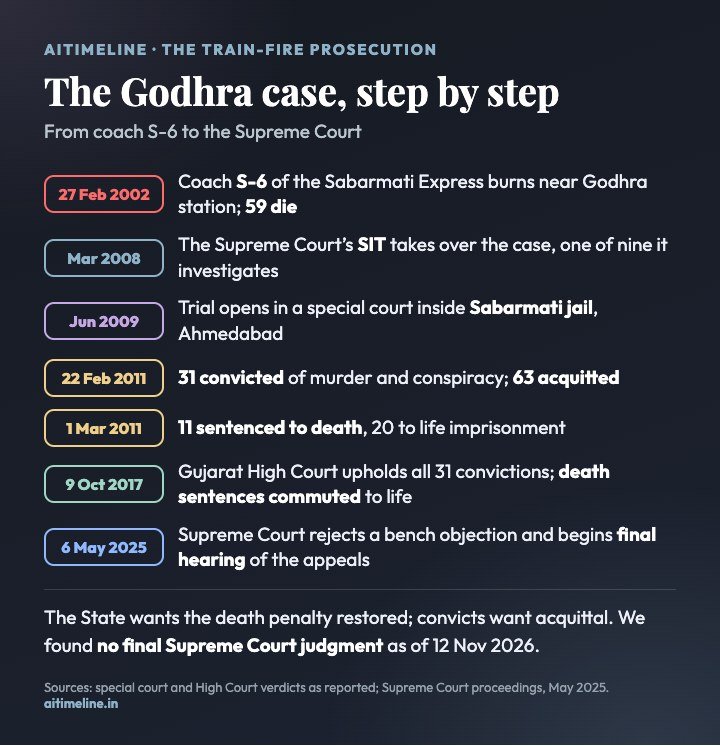
The Sabarmati Express was running towards Ahmedabad on the morning of 27 February 2002 when coach S-6 caught fire shortly after leaving Godhra. Fifty-nine people died. Within days the question of how the fire started became a political one, and two official inquiries reached opposite answers: a Railways committee under Justice U.C. Banerjee called it accidental, while the state’s commission called it pre-planned. The High Court quashed the Railways committee’s appointment in 2006.
The criminal case went the commission’s way. After the Supreme Court’s SIT reinvestigated, a special court inside Sabarmati jail found in February 2011 that a mob had set the coach alight as part of a conspiracy. It convicted 31 people and acquitted 63, including the man the prosecution had called a key conspirator. The High Court upheld every conviction in 2017 but spared the 11 who had been sentenced to death. Both sides appealed, and the Supreme Court opened its final hearing in May 2025.
The Official Toll
What the government told Parliament in 2005.
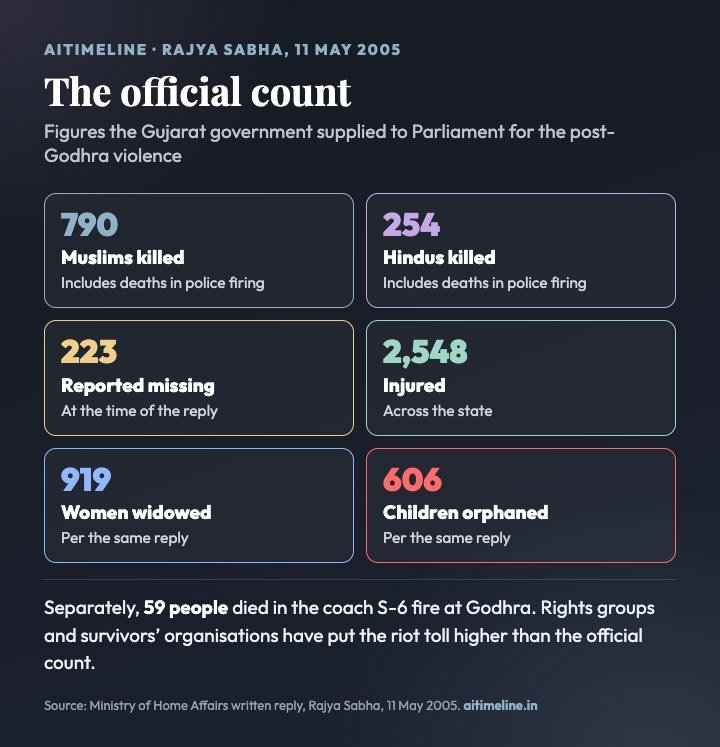
Violence began on 28 February, the day of a statewide bandh called over the Godhra deaths. It was worst in Ahmedabad but reached Vadodara, Panchmahal, Mehsana, Anand, Dahod and other districts, and continued for weeks. The Army was called in on 1 March. Tens of thousands of people, most of them Muslim, moved into relief camps. The official figures above are the ones the government gave Parliament; survivors’ groups and rights organisations have argued that the true toll was higher.
Timeline: Godhra and the Gujarat Riots, 2002 to 2026
Newest first. Colour shows which track each event belongs to.
Where the major proceedings stand Remission, bail & aftermath
Settled: The Supreme Court’s 2022 dismissal of Zakia Jafri’s appeal closed the wider-conspiracy complaint. Its January 2024 ruling sent the 11 Bilkis Bano convicts back to prison. Trial and High Court verdicts in Gulberg Society, Naroda Patiya, Naroda Gam and Best Bakery stand as decided.
Not settled: We found no final Supreme Court judgment in the Godhra train-fire appeals, which have been heard since May 2025. The 31 convictions upheld in 2017 remain in force until the court rules.
High Court upholds acquittals in a Vadodara killing Riot cases
What happened: The High Court dismissed the State’s appeal against a 2003 sessions court order acquitting five men of killing Samsuddin alias Kasamkhan, who was burned to death in Khodiarnagar, Vadodara, on 28 February 2002. A second appeal, from Panchmahal district, was decided the same way.
Why: The bench found witness identification unreliable and gaps in the medical and forensic evidence, and noted the limited scope for overturning an acquittal.
Supreme Court begins final hearing of the Godhra appeals Supreme Court
What happened: Some convicts argued that a three-judge bench should hear the case because the State wants death sentences restored. The two-judge bench rejected the objection, noting that the High Court had not imposed any death sentence, and began the hearing. On 7 May it questioned a convict’s challenge to evidence placing him in the mob.
Why it matters: Observations during a hearing are not a judgment. The bench said the full hearing would need at least two weeks.
“No more adjournments” Supreme Court
What happened: After years of the appeals being listed and adjourned, the Supreme Court fixed them for hearing in January 2025 and said it would not grant further adjournments. The date then moved to 13 February and finally to 6 and 7 May 2025.
Zakia Jafri dies at 86 Remission, bail & aftermath
What happened: Zakia Jafri, whose husband was killed in the Gulberg Society attack, died in Ahmedabad. For 16 years she had pursued her complaint that the riots resulted from a larger conspiracy.
Supreme Court quashes Bilkis Bano remission Supreme Court
What happened: The court set aside Gujarat’s 2022 remission orders for the 11 men convicted in the Bilkis Bano case. Because the trial was held in Maharashtra, it held, only Maharashtra could decide remission. It also found that a 2022 order allowing Gujarat to decide had been obtained by suppressing facts.
Aftermath: After the court refused more time, all 11 surrendered at the Godhra sub-jail by the night of 21 January 2024. Gujarat’s petition to review the judgment was dismissed in September 2024.
Everyone acquitted in Naroda Gam Riot cases
What happened: Special Judge Shubhada Baxi acquitted all the surviving accused, about 67 people, including former minister Maya Kodnani, former Bajrang Dal leader Babu Bajrangi and VHP leader Jaydeep Patel.
Why it matters: Naroda Gam was the last of the nine SIT cases to reach a verdict. The trial took about 13 years and passed through six judges.
Bail for some Godhra convicts Supreme Court
What happened: On 15 December 2022 the court granted bail to Farooque, a life convict who had served 17 years and whose role was described as stone-pelting. On 21 April 2023 it granted bail to eight more life convicts and refused it to four whose death sentences had been commuted.
What it does not mean: Bail recognises time served while an appeal is pending. It does not set aside a conviction.
Teesta Setalvad arrested a day after the Zakia Jafri ruling Remission, bail & aftermath
What happened: The day after the Supreme Court dismissed Zakia Jafri’s appeal, Gujarat Police arrested activist Teesta Setalvad, who had supported the petition, along with former DGP R.B. Sreekumar, on charges including fabricating evidence. Former IPS officer Sanjiv Bhatt was also named.
Later: The Supreme Court granted Setalvad interim bail in September 2022 and regular bail on 19 July 2023. The charges are allegations being tried, not findings.
Supreme Court dismisses Zakia Jafri’s appeal Supreme Court
What happened: The court upheld the magistrate’s acceptance of the SIT closure report on the complaint against 63 people, including Narendra Modi. It found the SIT’s investigation thorough and the material insufficient to show a larger criminal conspiracy at the highest level.
What it covers: Only the wider-conspiracy complaint. It did not disturb any conviction in an individual riot case.
Bilkis Bano convicts released Remission, bail & aftermath
What happened: Gujarat granted remission, by orders dated 10 August, to all 11 men serving life for the gang rape of Bilkis Bano and the murder of her relatives. They walked out on Independence Day.
Challenge: Bilkis Bano and others challenged the release in the Supreme Court, arguing Gujarat had no power to decide.
Nanavati-Mehta final report tabled Commissions & SIT
What it said: The commission found no evidence that the attacks were inspired, instigated or abetted by Chief Minister Narendra Modi or his ministers, and said the riots were not organised by the State. It recommended inquiries into some police officers and named local VHP and Bajrang Dal members in particular incidents.
Caveat: A commission of inquiry does not convict or acquit. Its findings are not binding on criminal courts.
Rs 50 lakh for Bilkis Bano Supreme Court
What happened: The court ordered Gujarat to pay Bilkis Bano Rs 50 lakh, and to give her a government job and accommodation.
Maya Kodnani acquitted on appeal Riot cases
What happened: The High Court acquitted former minister Maya Kodnani, giving her the benefit of the doubt over evidence of her presence at the scene, and acquitted several others. It upheld Babu Bajrangi’s conviction; his sentence was reported as reduced to 21 years.
Why it matters: Kodnani had been the most senior political figure convicted over the 2002 violence.
High Court upholds Godhra convictions, commutes death sentences Godhra case
What happened: The High Court upheld the conviction of all 31 people, commuted the death sentences of 11 to life imprisonment and upheld the life terms of the other 20. It rejected the SIT’s appeals against the 63 acquittals.
Compensation: The court said the State and the Railways had failed to maintain law and order and directed compensation of Rs 10 lakh to the family of each person killed.
High Court rejects Zakia Jafri’s challenge Commissions & SIT
What happened: The High Court upheld the magistrate’s acceptance of the SIT closure report but said Zakia Jafri could seek further investigation before an appropriate forum.
Next: She appealed to the Supreme Court in September 2018.
Bombay High Court upholds Bilkis Bano convictions Riot cases
What happened: The High Court upheld the life sentences of the 11 men and convicted five police officers and two doctors who had been acquitted at trial, for offences including failing to perform their duty and tampering with evidence.
Gulberg Society verdict Riot cases
What happened: The special court convicted 24 people and acquitted 36, including a sitting BJP corporator. On 17 June it sentenced 11 to life imprisonment, one to 10 years and 12 to seven years.
The conspiracy question: The court did not accept the prosecution’s charge of a pre-planned criminal conspiracy behind the attack.
Magistrate accepts the SIT closure report Commissions & SIT
What happened: The magistrate accepted the SIT’s report and rejected Zakia Jafri’s protest petition of 15 April 2013.
Naroda Patiya: 32 convicted Riot cases
What happened: Judge Jyotsna Yagnik convicted 32 people, including former minister Maya Kodnani and Bajrang Dal leader Babu Bajrangi, and acquitted 29. Kodnani was sentenced to 28 years and Bajrangi to life imprisonment for the rest of his natural life.
Bombay High Court rules in the Best Bakery appeals Riot cases
What happened: The High Court upheld the life sentences of four of the nine men convicted in the Mumbai retrial and acquitted five, finding no reliable evidence against them. It relied on four injured bakery workers who had identified the accused.
SIT files closure report Commissions & SIT
What happened: The SIT told the magistrate it had found no prosecutable evidence against those named in Zakia Jafri’s complaint. She was given the report and filed a protest petition in April 2013.
Sardarpura: 31 convicted Riot cases
What happened: In the first verdict among the SIT riot cases, a special court convicted 31 people and acquitted 42 for the killing of 33 people who had taken shelter in a house in Sardarpura village.
Zakia Jafri complaint sent back to the magistrate Supreme Court
What happened: The Supreme Court told the SIT to file its final report on Zakia Jafri’s complaint before the magistrate, rather than continue under the court’s monitoring.
Godhra verdict: 31 convicted, 63 acquitted Godhra case
What happened: The special court accepted the prosecution case that the burning of coach S-6 was a pre-planned conspiracy, convicted 31 people of murder and conspiracy and acquitted 63, including Maulana Umarji, whom the prosecution had called a key conspirator.
Sentences: On 1 March 2011 it sentenced 11 to death and 20 to life imprisonment.
Godhra trial begins Godhra case
What happened: After the Supreme Court lifted its 2003 stay and ordered special courts for the SIT cases in May 2009, the Godhra trial opened inside Sabarmati Central Jail in Ahmedabad.
The complaint: In April 2009 the court had also asked the SIT to look into Zakia Jafri’s complaint.
Nanavati Commission’s first report Commissions & SIT
What it said: The commission concluded that the fire was not an accident but a pre-planned act, and that petrol had been poured into the coach before it was set alight.
Caveat: These were the findings of an inquiry, not a court judgment.
Supreme Court sets up a Special Investigation Team Supreme Court
What happened: On petitions by the NHRC and others, the court constituted an SIT to reinvestigate the Godhra train fire and eight riot cases: Gulberg Society, Naroda Patiya, Naroda Gam, Sardarpura, two Ode cases, Deepda Darwaja and Prantij.
Bilkis Bano: 11 men sentenced to life Riot cases
What happened: A special CBI court in Mumbai convicted 11 men of gang rape and murder and sentenced them to life imprisonment. A head constable was convicted of deliberately recording the FIR wrongly; five other police officers and two doctors were acquitted.
High Court quashes the Banerjee committee Commissions & SIT
What happened: The Gujarat High Court held that the Railway Ministry’s appointment of a committee under retired judge U.C. Banerjee was illegal, as a commission was already inquiring into the same incident. Its interim report of January 2005 had called the fire accidental.
Zakia Jafri files her complaint Commissions & SIT
What happened: Zakia Jafri asked police to register a case against Chief Minister Narendra Modi, ministers, officials and others, alleging a conspiracy to allow the violence. Police declined, and the Gujarat High Court rejected her petition in 2007.
Best Bakery retrial: nine convicted Riot cases
What happened: In the retrial ordered by the Supreme Court, the court convicted nine of 17 accused and sentenced them to life imprisonment. Eight were acquitted.
The witness: In March 2006 the Supreme Court sentenced Zahira Sheikh, the key witness who had changed her testimony, to a year in prison for perjury.
Official toll given to Parliament Remission, bail & aftermath
The figures: Citing the Gujarat government, the ministry reported 790 Muslims and 254 Hindus killed in the post-Godhra violence, 223 missing and 2,548 injured, with 919 women widowed and 606 children orphaned.
Caveat: These are official figures and include deaths in police firing. Survivors’ groups have put the toll higher.
Bilkis Bano trial moved to Mumbai Supreme Court
What happened: After the CBI took over the investigation and charged 20 people, including police officers and doctors, the Supreme Court transferred the trial to Mumbai to protect its fairness.
Best Bakery retrial ordered outside Gujarat Supreme Court
What happened: The court set aside the acquittals, ordered a retrial in Maharashtra and directed protection for witnesses. Around the same time it asked Gujarat to review riot cases police had closed.
Supreme Court halts riot trials Supreme Court
What happened: Concerned about witness intimidation and the quality of investigation, the court stayed trials in the major riot cases, including Godhra, until it could decide how they should proceed.
All 21 acquitted in Best Bakery Riot cases
What happened: After most witnesses, including Zahira Sheikh, retracted their statements, the Vadodara court acquitted all 21 accused.
Commission of inquiry appointed Commissions & SIT
What happened: The state appointed retired High Court judge K.G. Shah to inquire into the Godhra fire and the violence that followed. In May 2002 retired Supreme Court judge G.T. Nanavati was added as chairman. After Shah’s death in March 2008, Justice Akshay H. Mehta joined.
Bilkis Bano and her family attacked Riot cases
What happened: Bilkis Bano, 21 and five months pregnant, was gang-raped and 14 members of her family and group were killed, including her three-year-old daughter.
Best Bakery, Vadodara Riot cases
What happened: A mob set fire to the Best Bakery, where the owner’s family, workers and others had taken shelter. Fourteen people were killed.
Gulberg Society, Naroda Patiya, Naroda Gam Riot cases
What happened: On the day of a statewide bandh called over the Godhra fire, mobs attacked Muslim neighbourhoods across Ahmedabad and other districts. At Gulberg Society 69 people were killed, including former MP Ehsan Jafri; at Naroda Patiya 97; at Naroda Gam 11.
Spread: Violence continued for weeks in Ahmedabad, Vadodara, Panchmahal, Mehsana, Anand and other districts, and tens of thousands moved into relief camps.
Coach S-6 burns at Godhra Godhra case
What happened: Coach S-6 of the Sabarmati Express caught fire shortly after leaving Godhra station in the morning. Fifty-nine people died, among them women and children; many passengers were kar sevaks returning from Ayodhya.
Disputed cause: The prosecution, the Nanavati Commission and later the courts concluded the coach was deliberately set on fire by a mob. A Railways committee called it accidental in 2005, but its appointment was quashed.
The Major Cases Compared: Different Evidence, Different Outcomes
The central point of the legal record: there was no single verdict on 2002.
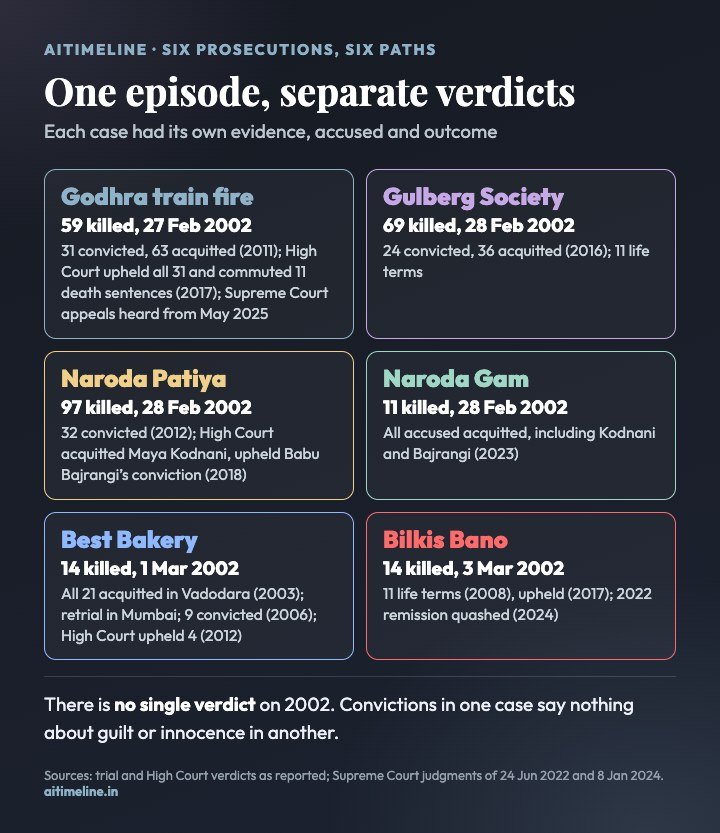
| Case | Killed | Trial outcome | On appeal |
|---|---|---|---|
| Godhra train fire | 59 | 31 convicted, 63 acquitted (2011) | Convictions upheld, death sentences commuted (2017); Supreme Court appeals pending |
| Gulberg Society | 69 | 24 convicted, 36 acquitted (2016) | Not verified |
| Naroda Patiya | 97 | 32 convicted, 29 acquitted (2012) | Kodnani acquitted, Bajrangi upheld (2018) |
| Naroda Gam | 11 | All acquitted (2023) | Not verified |
| Sardarpura | 33 | 31 convicted, 42 acquitted (2011) | 17 convictions upheld |
| Best Bakery | 14 | All 21 acquitted (2003); retrial: 9 convicted (2006) | 4 upheld, 5 acquitted (2012) |
| Bilkis Bano | 14 | 11 life terms (2008) | Upheld (2017); remission quashed (2024) |
The same day, 28 February 2002, produced 32 convictions at Naroda Patiya and none at Naroda Gam a few kilometres away. The difference was the evidence: identification, the reliability of witnesses who had waited years to testify, and what investigators had collected at the time. That pattern runs through the whole record and is one reason the Supreme Court moved two trials out of the state and set up its own investigation team. Riots in other states show the same split between scale and convictions, from Bhagalpur to Delhi in 1984.
The Supreme Court’s Investigation Team
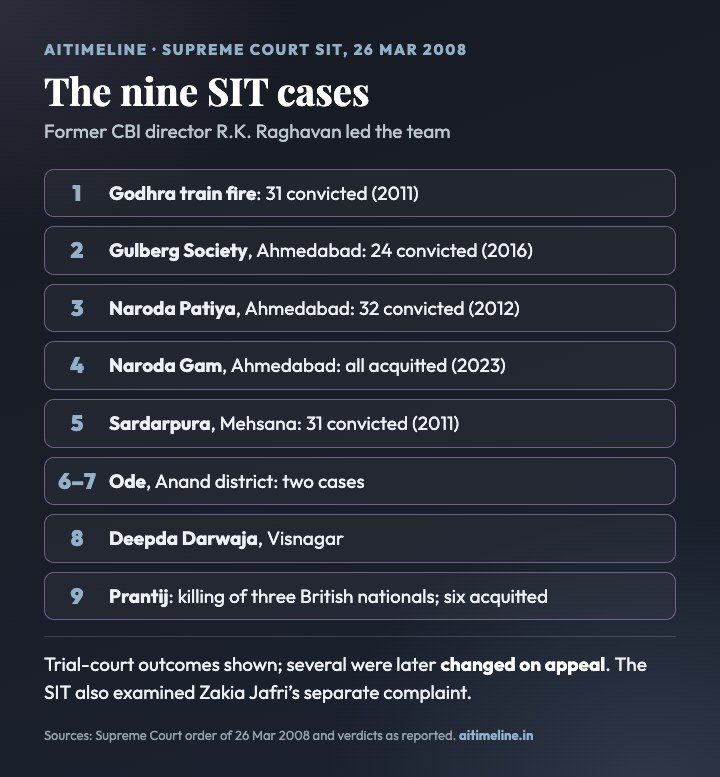
By 2003 the Best Bakery acquittals had shown what could happen when witnesses were frightened and investigations thin. On petitions by the National Human Rights Commission and victims’ groups, the Supreme Court stayed the major trials and, in March 2008, set up a Special Investigation Team under former CBI director R.K. Raghavan. The SIT reinvestigated, added accused and witnesses, and the trials restarted in special courts in 2009 under the court’s supervision.
The Wider-Conspiracy Complaint
A separate track from every massacre trial.
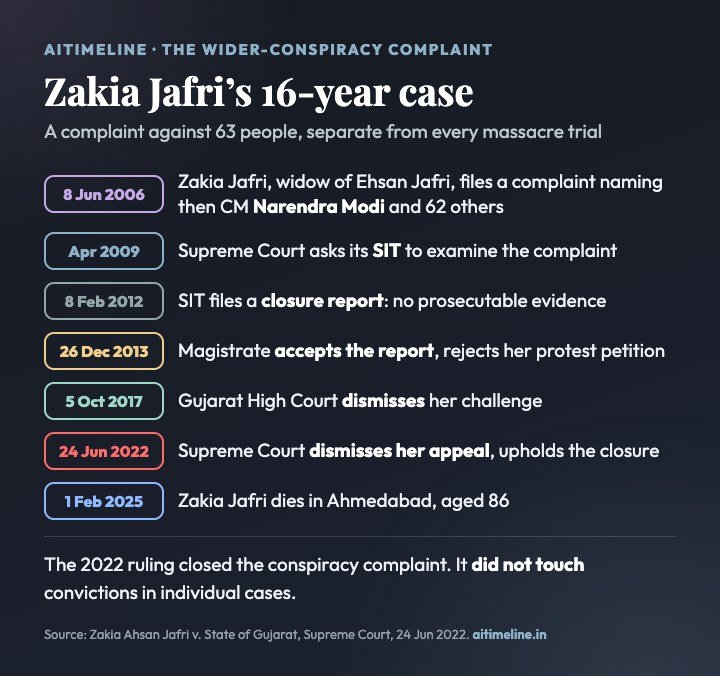
Zakia Jafri’s complaint did not concern who attacked Gulberg Society; that was a separate trial. It alleged that the violence across Gujarat was the result of a conspiracy involving the Chief Minister, ministers, officials and police. The SIT questioned Narendra Modi in 2010 and reported in 2012 that it found no prosecutable evidence. A magistrate, the Gujarat High Court and finally the Supreme Court agreed. The 2022 judgment is the last word on that complaint, and only on that complaint.
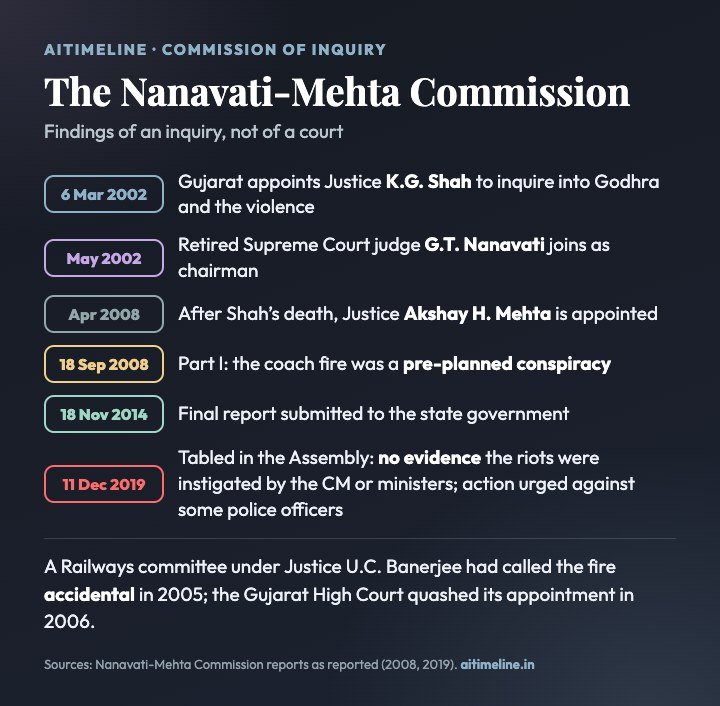
The commission sat for more than 12 years. Its first report, in 2008, dealt only with the fire and called it pre-planned. Its final report, submitted in 2014 and tabled in December 2019, found that the attacks were not inspired or instigated by the Chief Minister or ministers and that the state had not organised the riots, while recommending action against some police officers. A commission of inquiry does not convict or acquit anyone, and its conclusions are not binding on the courts.
Bilkis Bano: Conviction, Release and Return
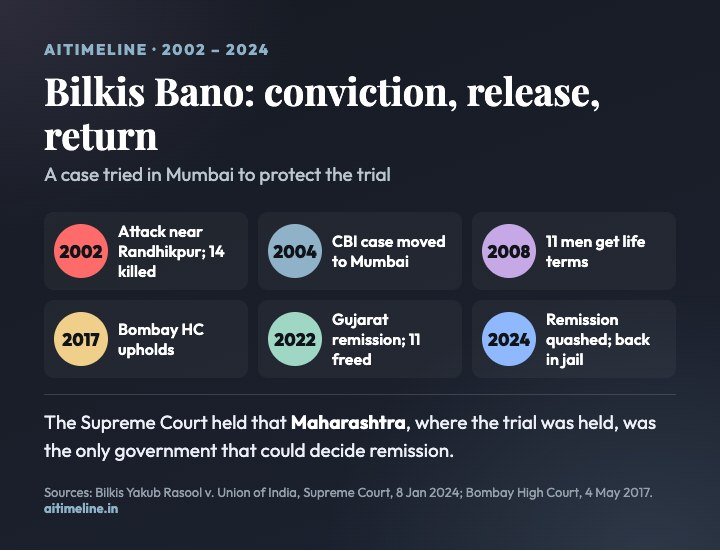
Gujarat Police closed the Bilkis Bano case in 2003 as “true but undetected”. She went to the Supreme Court, which handed the investigation to the CBI and moved the trial to Mumbai. Eleven men were sentenced to life in 2008. Their release under Gujarat’s remission orders on 15 August 2022 led to a second Supreme Court battle, which she won in January 2024. Our full Bilkis Bano case timeline covers each stage in detail.
Why the 2002 Cases Still Matter
- Fair trial beyond borders: moving Best Bakery and Bilkis Bano to Maharashtra became the template for transferring trials when witnesses are at risk.
- Court-supervised investigation: the SIT model, with the Supreme Court overseeing a reinvestigation, was used again in later cases.
- Victims’ standing: the 2024 Bilkis Bano ruling confirmed that a survivor can challenge an executive decision to free her attackers.
- The limits of a commission: the Nanavati-Mehta findings and the Banerjee report show why inquiry conclusions are not substitutes for verdicts.
- Conspiracy versus crime: the Zakia Jafri ruling and the individual convictions answer different legal questions.
- Delay: the Godhra appeals reached final hearing 23 years after the fire.
The Institutions Involved
| Institution | Role |
|---|---|
| Gujarat Police | First investigations of the Godhra fire and riot cases |
| National Human Rights Commission | Raised concerns over investigations and witness safety; petitioned the Supreme Court |
| Supreme Court of India | Stayed trials, transferred two to Maharashtra, set up the SIT, ruled on the conspiracy complaint and the Bilkis Bano remission; hearing the Godhra appeals |
| Special Investigation Team | Reinvestigated the Godhra fire and eight riot cases; examined Zakia Jafri’s complaint |
| CBI | Investigated the Bilkis Bano case |
| Nanavati-Mehta Commission | Inquired into the fire, the violence and the administration’s response |
| Gujarat and Bombay High Courts | Heard appeals in the Godhra, Naroda Patiya, Best Bakery and Bilkis Bano cases |
| Special courts | Tried the SIT cases in Ahmedabad, Mehsana and elsewhere |
Facts at a Glance
| Detail | Information |
|---|---|
| Godhra train fire | 27 February 2002, coach S-6 |
| Deaths in the fire | 59 |
| Official riot deaths | 790 Muslims, 254 Hindus |
| Missing / injured | 223 / 2,548 |
| Commission appointed | 6 March 2002 |
| SIT constituted | 26 March 2008 |
| Godhra verdict | 22 February 2011 |
| High Court Godhra judgment | 9 October 2017 |
| Nanavati-Mehta report tabled | 11 December 2019 |
| Zakia Jafri judgment | 24 June 2022 |
| Bilkis Bano remission quashed | 8 January 2024 |
| Godhra appeals hearing began | 6 May 2025 |
Explore More Timelines
People Also Ask
Frequently Asked Questions
Based on judgments and reporting to 12 November 2026.
⚠️ Editorial Note
This timeline treats the Godhra fire and the violence that followed as connected but legally separate, and keeps court verdicts apart from commission findings and allegations. It does not attribute collective responsibility to any community. Checking the record, we corrected several dates in the brief we worked from: the commission was appointed on 6 March 2002, not 27 February; the Bilkis Bano attack was on 3 March and the convictions on 21 January 2008; the magistrate accepted the SIT report on 26 December 2013, not in 2014; the High Court’s Naroda Patiya ruling came in April 2018, not 2017; and the Bombay High Court upheld four Best Bakery convictions, not eight or nine. We could not confirm a final Supreme Court judgment in the Godhra appeals, or the current appeal status of every riot case.
Related Reading on AiTimeline
Sources & further reading
Every dated entry above was checked against these references. Last reviewed 12 November 2026.
- Zakia Ahsan Jafri v. State of Gujarat, Supreme Court of India (judgment, 24 June 2022)
- Bilkis Yakub Rasool v. Union of India, Supreme Court of India (8 January 2024)
- India hands down Godhra verdict (22 February 2011)
- SC rejects convicts' plea against 2-judge bench hearing Godhra train burning appeals (May 2025)
- Godhra train burning case: Supreme Court grants bail to eight life convicts (21 April 2023)
- Gulberg Society massacre verdict: 11 imprisoned for life (17 June 2016)
- Maya Kodnani acquitted in Naroda Patiya riot case (20 April 2018)
- 2002 Naroda Gam massacre: Gujarat court acquits all 67 accused including Maya Kodnani (20 April 2023)
- Court orders retrial in Gujarat case (Best Bakery, 12 April 2004)
- Nanavati Commission clears Modi but raises questions about former IPS officers (11 December 2019)
- Gujarat HC upholds acquittal of five in Vadodara mob killing case (18 April 2026)