Jain Hawala Case: A Timeline of India’s Political Scandal
Explore the Jain Hawala case timeline, from the 1991 diary seizures and political allegations to the 1998 Supreme Court ruling and CBI reforms.
Latest Story
In May 1991 the CBI went looking for terror funding and found a set of diaries instead. The notebooks, kept by an employee of the Jain brothers of Delhi, appeared to record about Rs 65 crore in payments, many of them against the initials of senior politicians of almost every major party. The Jain Hawala case brought down three Union ministers and the BJP president in January 1996. Yet it ended without a single conviction, because the courts held that a diary entry on its own cannot put anyone on trial. This timeline follows the case from the 1991 raids, through the Vineet Narain litigation that rebuilt the rules for the CBI, to the 1998 Supreme Court ruling in CBI v. V.C. Shukla and the last foreign-exchange appeal in 2014. Each date is checked against the judgments themselves.
The Supreme Court did not reject the diaries as worthless. In 1998 it held that the notebooks and pads were books of account, overruling the High Court on that point, but that Section 34 of the Evidence Act forbids using such entries alone to charge anyone. The bench was three judges, not two: M.K. Mukherjee, S.P. Kurdukar and K.T. Thomas. Advani and Shukla were not the only ones cleared: on 5 May 1998 the Delhi High Court discharged 19 more politicians. And the separate foreign-exchange track did not survive: the Delhi High Court set aside the last FERA penalty on S.K. Jain in May 2014.
💡 Short Answer
The Jain Hawala case was a 1990s corruption investigation based on diaries the CBI seized from J.K. Jain on 3 and 4 May 1991. The CBI read them as recording about Rs 65.47 crore in payments between 1988 and 1991 to 115 people, including leading politicians. L.K. Advani, V.C. Shukla and others were charge-sheeted in January 1996, but on 2 March 1998 the Supreme Court held that the diary entries alone could not support charges without independent evidence, and no politician was convicted. The parallel Vineet Narain case, decided on 18 December 1997, gave the CBI Director a fixed tenure and put the agency under Central Vigilance Commission oversight.
Jain Hawala Case: Key Questions
The Case in Ten Lines
- The accident: a terror-funding inquiry after an arrest on 25 March 1991 led the CBI to the Jain brothers.
- The find: two notebooks, two pads and two files of loose sheets, seized on 3-4 May 1991.
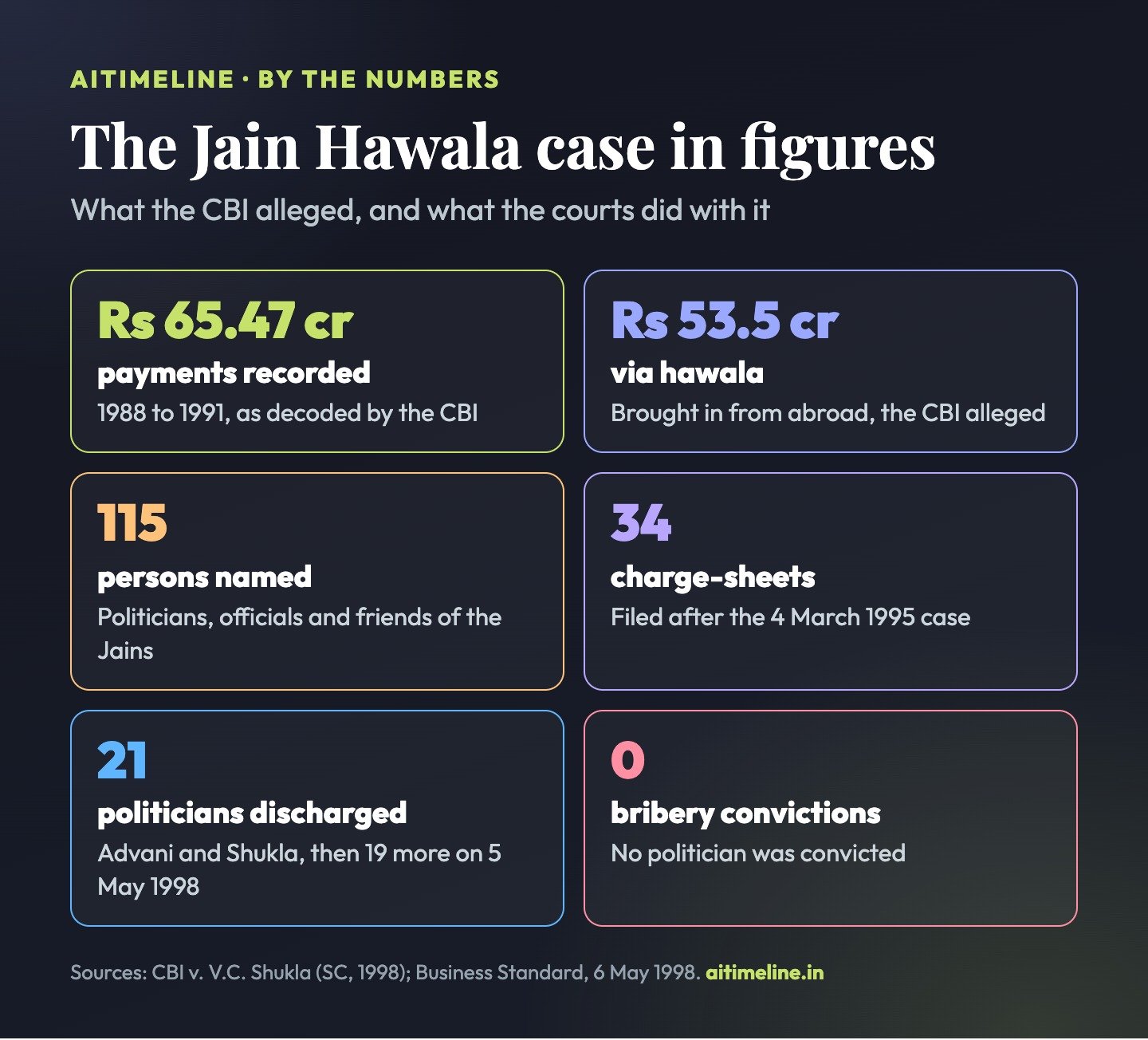
- The figure: the CBI read them as Rs 65.47 crore paid out between 1988 and 1991, Rs 53.5 crore of it via hawala.
- The delay: no corruption case was registered until 4 March 1995.
- The petition: Vineet Narain’s 1993 PIL put the investigation under Supreme Court watch.
- The fallout: in January 1996 Advani resigned his seat and three Union ministers quit.
- The ruling: on 2 March 1998 the Supreme Court said the diaries were account books, but not enough on their own.
- The end: 19 more politicians were discharged on 5 May 1998; nobody was convicted of bribery.
- The reform: the Vineet Narain directions gave the CBI Director a fixed tenure and the CVC a statutory role.
- The last word: the Delhi High Court set aside the only FERA penalty in May 2014.
The Diaries: What Was Found in 1991
A terror-funding search that turned into a political scandal.
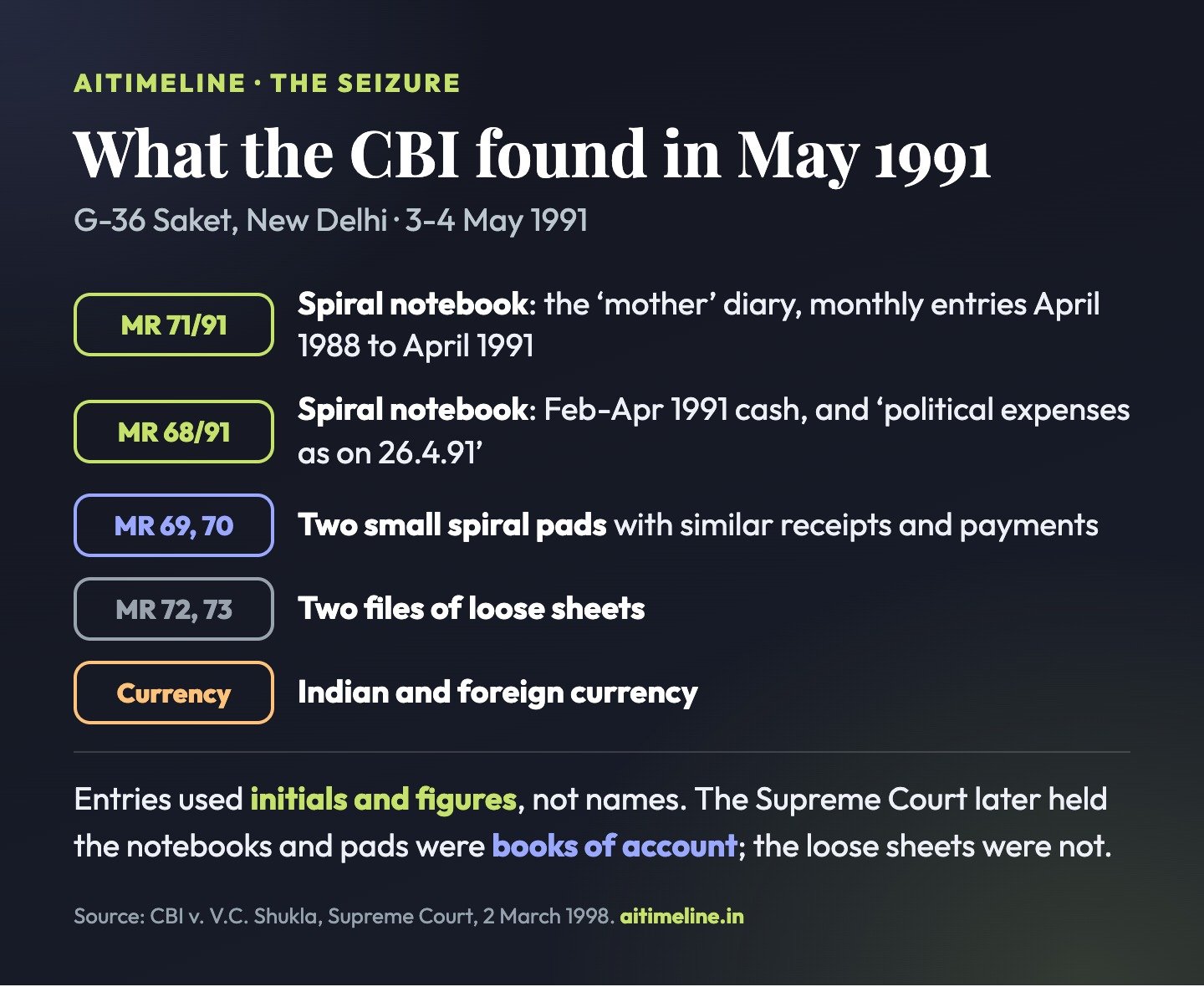
The trail began with Ashfak Hussain Lone, alleged to be an official of Hizbul Mujahideen, who was arrested in Delhi on 25 March 1991. His interrogation pointed to money reaching militants through hawala, and to the Jain family as a conduit. A case was registered on 20 April 1991, and on 3 and 4 May the CBI searched the house of J.K. Jain, an employee of the brothers S.K. Jain, B.R. Jain and N.K. Jain.
Besides currency, the searchers took six items. The most important was a spiral notebook later marked MR 71/91. Its first page carried monthly entries from January 1990 to April 1991, with the reverse covering April 1988 to December 1989, all in figures and initials. The CBI’s decoding produced the case’s headline numbers: Rs 65.47 crore paid out between 1988 and 1991, about Rs 53.5 crore of it brought in from abroad through hawala, to 115 people. They included politicians, officials of government and public-sector undertakings, and friends of the Jains.
The CBI also alleged a motive. It said the Jains acted as middlemen for foreign companies bidding for big power-sector projects, received kickbacks from them, and paid public servants to win favour. That too was an allegation, to be proved with evidence beyond the notebooks.
Then, for almost four years, very little happened. The Supreme Court later recorded that “nothing having been done in the matter of investigating the Jains or the contents of their diaries”, the petitions were filed in October 1993.
Jain Hawala Case Timeline, 1991 to 2014
Newest first. Each entry is tagged by type.
Delhi High Court sets aside the last FERA penalty on S.K. Jain Other courts
What happened: Hearing an appeal under the foreign-exchange law, the Delhi High Court set aside a 2001 Enforcement Directorate adjudication order and a 2008 Appellate Tribunal order against S.K. Jain, and directed that the penalty he had deposited be refunded.
Why it matters: The FERA proceedings had run separately from the bribery case, because FERA was treated as a complete code of its own. The judgment described them as an off-shoot of the ‘Jain Hawala Diaries’ case that “ended in the quashing of the criminal proceedings”. With this ruling, the regulatory track also ended in S.K. Jain’s favour.
Foreign-exchange tribunal upholds the penalty Other courts
What happened: The Appellate Tribunal dismissed S.K. Jain’s appeal. It held that, since he alone knew what the diary entries meant, he was bound to explain them, and that his failure to do so allowed an adverse inference against him.
What came next: S.K. Jain appealed to the Delhi High Court in 2008. That appeal was decided in his favour in May 2014.
Parliament passes the Central Vigilance Commission Act Reform and law
What happened: Parliament enacted the Central Vigilance Commission Act, 2003, putting the Commission on a statutory footing and giving it superintendence over the CBI’s anti-corruption work, as the Supreme Court had directed in Vineet Narain.
Why it matters: The Act is the most durable legal product of the hawala litigation. The criminal case against the alleged recipients had failed, but the institutional reform it set off became law.
Enforcement Directorate imposes a FERA penalty Other courts
What happened: In a common adjudication order, the Special Director of the Enforcement Directorate found contraventions of Section 8(1) of the Foreign Exchange Regulation Act and imposed penalties of Rs 75,000 in the proceedings arising from the seized diaries.
Why it matters: This was the only adverse finding of any kind in the hawala matter, and it was a civil penalty for foreign-exchange violations, not a bribery conviction. The Delhi High Court set it aside in 2014.
The government tells Parliament there is no new evidence Political fallout
What happened: Asked whether all the accused had been discharged and whether the case would be reopened, the Ministry of Home Affairs replied that the diary entries were admissible under Section 34 of the Evidence Act but were not enough to charge the alleged recipients without independent evidence of receipt, and that the charge-sheets had found no such evidence at trial, revision or appeal.
Why it matters: It was the government’s formal acknowledgement that the case against the politicians was over.
The CVC gets statutory status by ordinance Reform and law
What happened: The Union government promulgated an ordinance making the Central Vigilance Commission a statutory body, the first of the Vineet Narain directions to be put into law.
What followed: Parliament did not pass a permanent law until the Central Vigilance Commission Act of 2003.
Delhi High Court discharges 19 more politicians Other courts
What happened: Applying the Supreme Court’s 2 March judgment, the High Court discharged 19 politicians, among them Union ministers Yashwant Sinha and Madan Lal Khurana and Congress leaders including Madhavrao Scindia, Arjun Singh, N.D. Tiwari and Kamal Nath. CBI counsel conceded that the agency had no corroborative evidence against them beyond the diaries.
The exceptions: The cases of Sharad Yadav and Balram Jakhar were set apart. The CBI said it had more against them: in Sharad Yadav’s case, an alleged confession of receipt; in Jakhar’s, evidence that the Jains had bought foreign travel tickets for his relatives. Neither case produced a conviction.
Supreme Court: the diaries alone cannot convict Supreme Court
What happened: A three-judge bench dismissed the CBI’s appeals and upheld the discharge of Advani and Shukla. It disagreed with the High Court on one point: the two spiral notebooks and two spiral pads were books of account regularly kept in the course of business, so their entries were relevant under Section 34 of the Evidence Act. The loose sheets in the files were not.
The decisive point: Section 34 says such entries “shall not alone be sufficient evidence to charge any person with liability”. The Court found no independent evidence that Advani or Shukla had received the money, and no prima facie material that they had joined a conspiracy with the Jains. The statements the CBI relied on showed, at most, that Shukla knew the Jain brothers.
Advani returns to the Lok Sabha Political fallout
What happened: Having stayed out of the 1996 election, Advani was elected again in the February-March 1998 election, held as the Supreme Court was ending the case against him, and became Union Home Minister in the Vajpayee government.
Why it matters: His resignation in January 1996 and his return after discharge became part of his political identity. In 2015 he said he had resigned over the hawala case because he listened to his conscience.
The Vineet Narain judgment rewrites the rules for the CBI Supreme Court
What happened: Disposing of the 1993 petitions, the Supreme Court struck down Directive No. 4.7(3) of the government’s Single Directive, which had required prior sanction before the CBI could investigate senior officers, and issued binding directions for the CBI, the Central Vigilance Commission, the Enforcement Directorate and prosecution agencies.
The main directions: Statutory status for the CVC; a selection committee of the Prime Minister, Home Minister and Leader of the Opposition for the Central Vigilance Commissioner; the CVC to oversee the CBI; a CVC-led panel to shortlist the CBI Director, with a minimum two-year tenure and no transfer without the panel’s approval; the same two-year tenure for the Director of Enforcement; and time limits for prosecution sanction.
Government sets up the Independent Review Committee Reform and law
What happened: The Centre formed a committee of former Cabinet Secretary B.G. Deshmukh, N.N. Vohra and Central Vigilance Commissioner S.V. Giri to review the working of the CBI and the Enforcement Directorate.
Why it matters: The Supreme Court adopted much of this committee’s report when it framed its directions three months later.
Delhi High Court quashes the charges against Advani and Shukla Other courts
What happened: The High Court allowed petitions by Advani, Shukla and the Jains and quashed both cases. It held that the diaries were neither books of account nor kept in the regular course of business, that the entries used initials known only to their writer, and that even if admissible they could not alone fix liability.
Why it matters: The prosecution had conceded that it had little beyond the entries themselves. The CBI appealed; the Supreme Court upheld the result in March 1998 but not all of the reasoning.
Special Judge decides to frame charges against Advani Other courts
What happened: After examining the charge-sheet, witness statements and documents, the Special Judge held that a prima facie case existed and decided to frame charges against Advani and the Jains. Formal charges had already been framed against Shukla in the companion case.
Why it matters: At the trial-court stage the diaries carried the prosecution. That was the order the High Court reversed in April 1997.
The scandal shadows the general election Political fallout
What happened: The general election was fought months after the charge-sheets. Advani did not contest. The Congress lost power, and the episode fed a wider argument that the Narasimha Rao government had used the CBI to damage rivals.
Read with care: That argument was a political charge, made by opponents and commentators at the time. No court found that the charge-sheets were politically motivated.
Supreme Court presses on with the monitoring Supreme Court
What happened: In one of a series of reasoned orders in the pending petitions, the Court continued its supervision of the investigation, insisting that every allegation be investigated whatever the position of the person accused, and that charge-sheets be filed where the evidence justified them.
The wider method: The Court also directed the CBI not to report the progress of the investigation to the person holding the highest office in the political executive, to avoid any impression of bias.
Charge-sheet No. 8 names V.C. Shukla Investigation
The allegation: The CBI alleged that between February 1990 and January 1991, while an MP and, from 21 November 1990, Minister of External Affairs, V.C. Shukla conspired with the Jains and accepted Rs 38,85,834 as gratification for ‘general favour’.
Status: An allegation. The Delhi High Court quashed the case in 1997 and the Supreme Court upheld that in 1998.
Three Union ministers resign Political fallout
What happened: After initially resisting, Balram Jakhar, Madhavrao Scindia and V.C. Shukla resigned from the Union Cabinet as the CBI moved against them. The charge-sheets of January 1996 named, or were about to name, more than a dozen politicians across parties.
Why it matters: The case was one of the rare moments when sitting ministers and the main opposition leader fell to the same investigation in the same week.
Charge-sheet No. 4 names L.K. Advani; he resigns his seat Investigation
The allegation: The CBI alleged that Advani received Rs 25 lakh from the Jains while he was a Member of Parliament, besides Rs 35 lakh at a time when he was not an MP, as part of a conspiracy to buy influence.
The response: Advani denied the charge, resigned from the Lok Sabha and said he would not contest again until he was cleared.
S.K. Jain is questioned, then goes silent Investigation
What happened: S.K. Jain was questioned by the CBI while in police remand, including on 11 March 1995. When the Enforcement Directorate questioned him on 14, 20 and 25 April, he declined to answer, invoking Article 20(3) of the Constitution because he was already an accused.
Why it matters: What he told investigators was widely reported, but statements to police are not admissible evidence at trial. The diaries needed independent support that never came.
CBI registers the corruption case Investigation
What happened: Nearly four years after the raids, the CBI registered a case under Sections 7 and 12 of the Prevention of Corruption Act and Section 56 read with Section 8(1) of FERA against the Jains, public servants and others.
What followed: The investigation produced 34 charge-sheets in the court of the Special Judge, New Delhi, against politicians, government servants and the Jains.
Supreme Court issues its first reasoned order Supreme Court
What happened: The Court issued the first of the reasoned orders through which it kept the petitions pending and monitored the investigation. It made clear that its supervision would end once charge-sheets were filed and the ordinary criminal process took over.
Why it matters: The method let the Court push a stalled investigation forward without pronouncing on anyone’s guilt.
The Vohra Committee is set up Reform and law
What happened: The government constituted a committee under Home Secretary N.N. Vohra to take stock of information on crime syndicates with links to government functionaries and politicians.
Why it matters: The Supreme Court later cited this committee in Vineet Narain as evidence that the government itself saw the need to examine the agencies that investigate the powerful.
Vineet Narain takes the diaries to the Supreme Court Supreme Court
What happened: Journalist Vineet Narain and others petitioned the Supreme Court, alleging that the CBI and revenue authorities had failed to investigate the material seized from the Jains in order to protect influential people.
Why it matters: Without these petitions, the diaries might never have produced a case. With them, the Court took on a supervisory role that changed how the CBI is run.
CBI searches J.K. Jain’s house and seizes the diaries Investigation
What was found: Indian and foreign currency, two spiral notebooks, two small spiral pads and two files of loose sheets, recording receipts and payments in abbreviated forms and initials.
What the CBI later said they showed: Payments of Rs 65.47 crore between 1988 and 1991, of which about Rs 53.5 crore came through hawala channels, to 115 people including politicians, officials and friends of the Jain brothers. That was the CBI’s reading of coded entries, not a court finding.
A militant’s arrest leads to the Jains Investigation
What happened: Ashfak Hussain Lone, alleged to be an official of Hizbul Mujahideen, was arrested in Delhi. His interrogation pointed investigators to hawala funding and to S.K. Jain and his family.
What followed: A case, RC 5(S)/91, was registered on 20 April 1991, and the searches followed in May.
January 1996: The Charge-Sheets
Allegations that reached across party lines, three months before a general election.
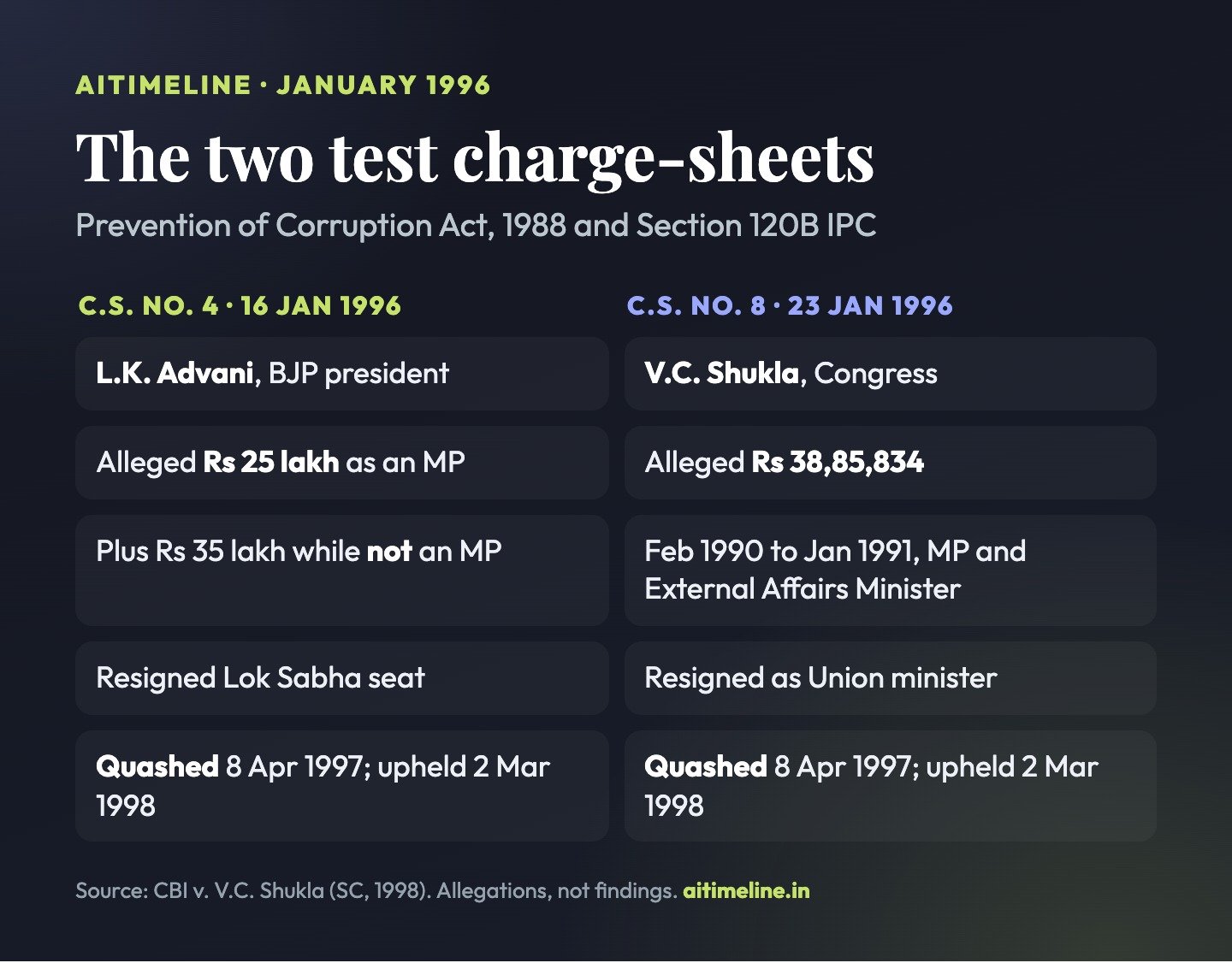
Once the CBI registered its case on 4 March 1995, the investigation moved quickly under the Supreme Court’s eye. It filed 34 charge-sheets in the Special Judge’s court in New Delhi. Two of them became the test cases. Charge-sheet No. 4, dated 16 January 1996, accused BJP president L.K. Advani of receiving Rs 25 lakh from the Jains as an MP. Charge-sheet No. 8, dated 23 January 1996, accused Congress leader V.C. Shukla of receiving about Rs 39 lakh while an MP and, briefly, Minister of External Affairs.
The political effect was immediate. Advani resigned his Lok Sabha seat and promised not to contest until cleared. In Narasimha Rao’s government, Balram Jakhar, Madhavrao Scindia and V.C. Shukla resigned after first resisting. Other names in the investigation included Arjun Singh, N.D. Tiwari, Sharad Yadav, Madan Lal Khurana and Yashwant Sinha.
Critics at the time saw a pre-election manoeuvre by Rao against rivals inside and outside his party. Others saw the opposite: a government that had sat on the diaries for years, forced to act by the Supreme Court. Both readings were arguments, not findings.
| Person | Party in 1996 | What happened in 1996 | Court outcome |
|---|---|---|---|
| L.K. Advani | BJP | Charge-sheeted 16 Jan; resigned Lok Sabha seat | Quashed 8 Apr 1997; upheld by SC 2 Mar 1998 |
| V.C. Shukla | Congress | Charge-sheeted 23 Jan; resigned as minister | Quashed 8 Apr 1997; upheld by SC 2 Mar 1998 |
| Madhavrao Scindia | Congress | Resigned as minister | Discharged 5 May 1998 |
| Balram Jakhar | Congress | Resigned as minister | Case heard separately in 1998; no conviction |
| Sharad Yadav | Janata Dal | Named | Case heard separately in 1998; no conviction |
| Yashwant Sinha, Madan Lal Khurana | BJP | Named | Discharged 5 May 1998 |
In Court: Why the Diaries Were Not Enough
Three courts, two different reasons, one result.
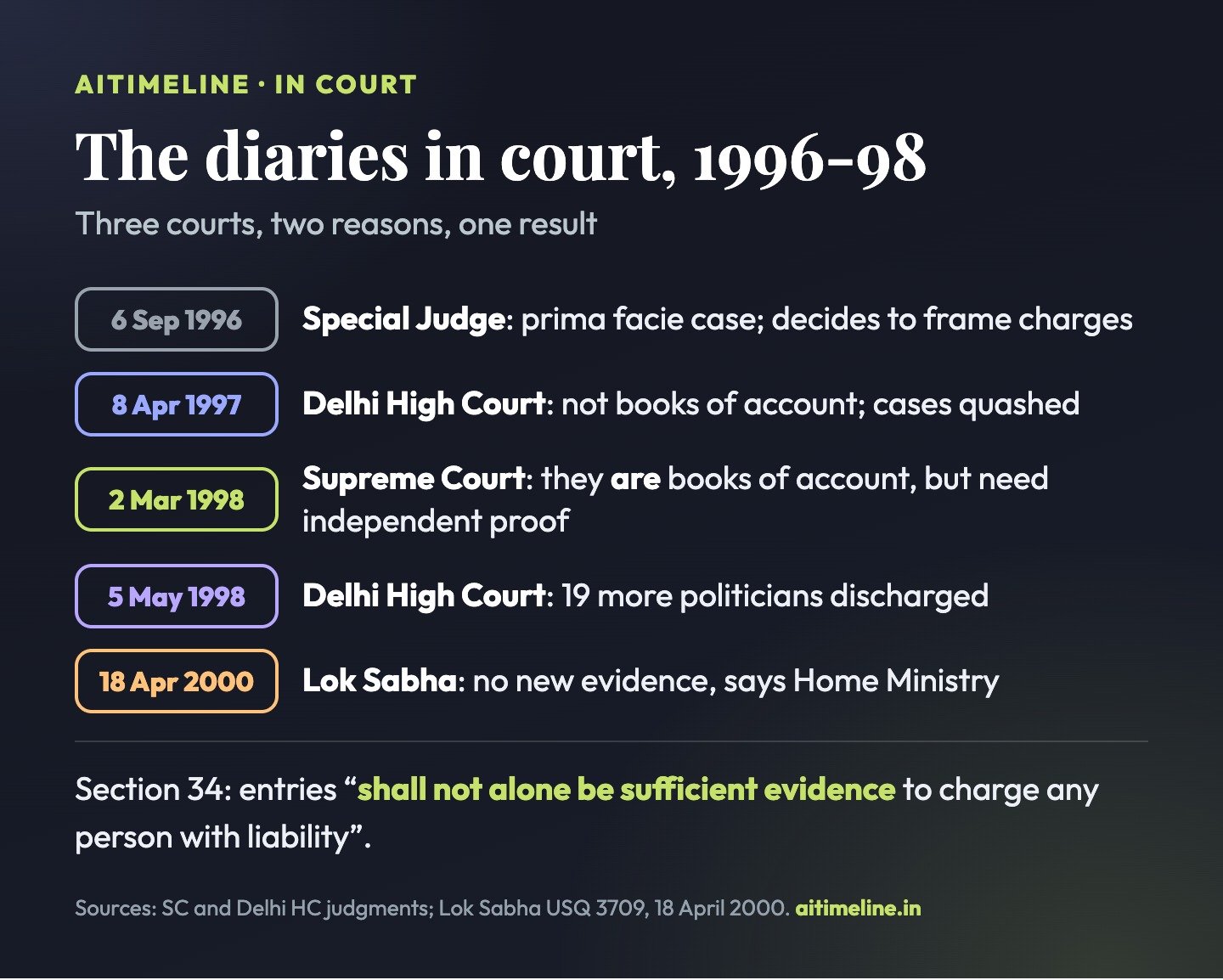
At the trial-court stage the diaries were enough. The Special Judge took cognisance, framed charges against Shukla and, on 6 September 1996, decided to frame charges against Advani too. The accused went to the Delhi High Court, which on 8 April 1997 quashed both cases. It said the documents were not books of account, since an account presupposes two parties, and were not kept in the regular course of business. Even if they were, Section 34 meant they could not alone fasten liability on anyone.
The CBI appealed. On 2 March 1998 a three-judge bench of the Supreme Court gave a more careful answer. MR 71/91 recorded receipts and payments, totalled and balanced, so it was a book of account. The Jains’ activities, as the prosecution described them, counted as ‘business’. So the entries were relevant evidence. But Section 34 ends with a proviso: such entries “shall not alone be sufficient evidence to charge any person with liability.” The prosecution needed something independent, such as a witness, a bank trail or a recovered sum, showing that Advani or Shukla had actually received the money. It had nothing of the kind.
The CBI also tried Section 10 of the Evidence Act, under which things said or written by one conspirator can be used against the others. That failed for a simpler reason. Section 10 first requires reasonable ground to believe a conspiracy existed, and the witness statements showed, at most, that Shukla knew the Jain brothers and had visited them on formal occasions.
The rest of the case fell quickly. On 5 May 1998, with CBI counsel conceding that there was no corroborative evidence, the Delhi High Court discharged 19 more politicians. The cases of Sharad Yadav and Balram Jakhar, where the CBI claimed to have more, were heard separately. Neither produced a conviction. On 18 April 2000 the Home Ministry told the Lok Sabha that no new evidence had emerged.
What the Jain Diaries Did, and Did Not, Prove
Allegation, investigative finding and judicial finding are three different things.
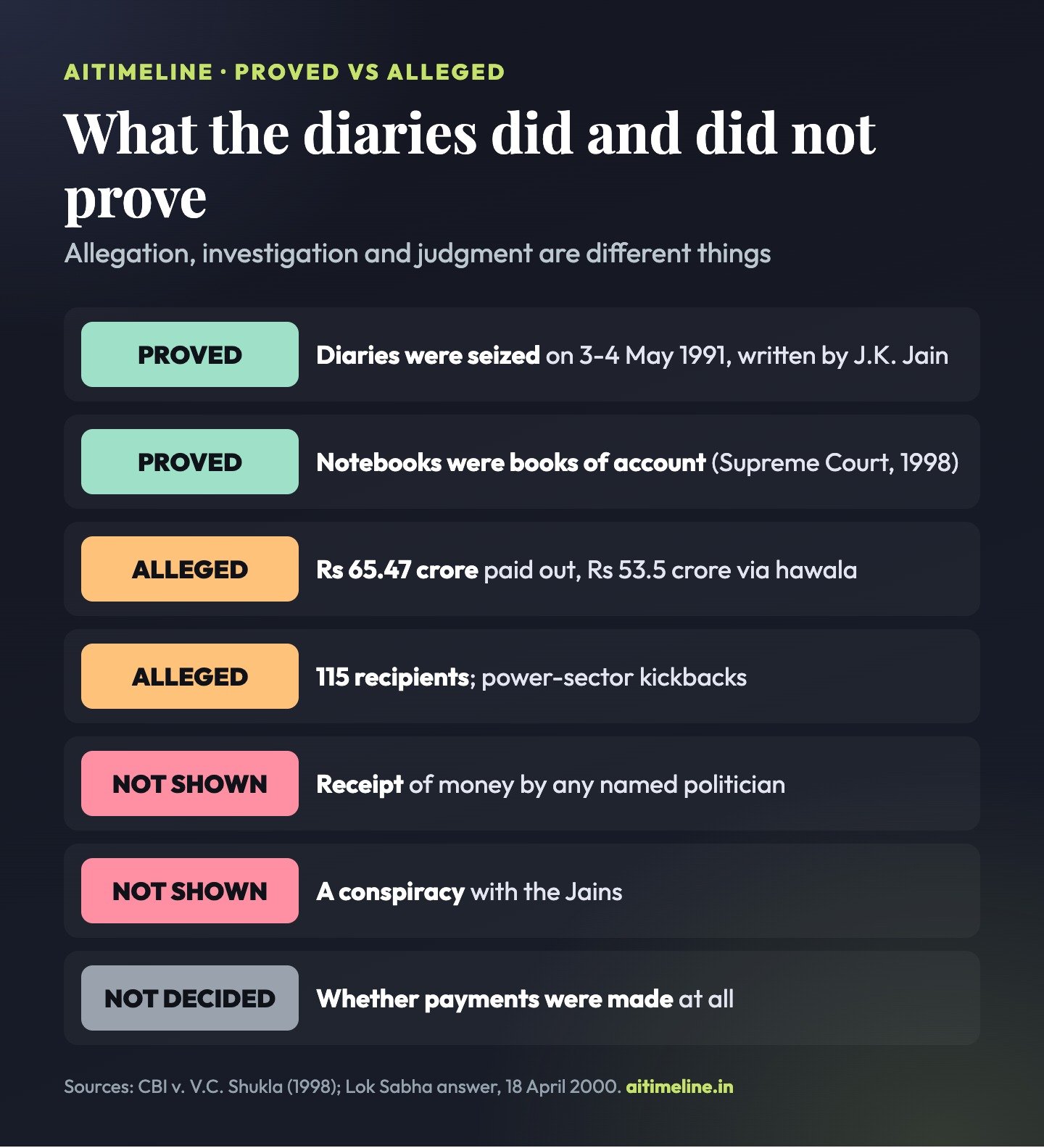
| Question | Answer | Who says so |
|---|---|---|
| Were diaries seized? | Yes, on 3-4 May 1991 | Supreme Court, 1998; Delhi HC, 2014 |
| Did they record Rs 65.47 crore in payments? | That was the CBI’s decoding | CBI case, as summarised by the Supreme Court |
| Were they books of account? | The notebooks and pads, yes; the loose sheets, no | Supreme Court, 1998 (High Court had said no) |
| Could the entries alone justify charges? | No | Section 34, Evidence Act; Supreme Court, 1998 |
| Was there independent evidence of receipt? | Not against Advani, Shukla or the 19 discharged in May 1998 | Supreme Court; Delhi HC; Home Ministry, 2000 |
| Did any politician get convicted? | No | Court record |
| Did the courts say no payments were made? | No: they did not rule on that | Supreme Court, 1998 |
The last row is the one most often blurred. The courts did not acquit anyone after a trial, and they did not find that the diaries were invented. They found that the law did not allow a trial on this evidence. Supporters of the accused called it vindication; critics called it a failure of investigation. Strictly, it was neither: it was a ruling on the standard of evidence needed to put someone on trial.
Vineet Narain: The Case That Outlived the Scandal
A petition about one investigation became a rulebook for the CBI.
Journalist Vineet Narain and others filed their petitions on 4 October 1993. They alleged that the CBI and the revenue authorities had failed to investigate the Jain material to protect powerful people, and that the seizures pointed to a nexus between politicians, bureaucrats and criminals funded from unlawful sources.
The Court did not decide the hawala case itself. Instead it kept the petitions open and, through orders from 18 April 1995 onwards, pressed the agencies to investigate. It took care not to steer the inquiry or comment on guilt, and it directed the CBI not to report its progress to the highest office in the political executive. It called this “continuing mandamus”. Its supervision of each matter ended once a charge-sheet was filed.
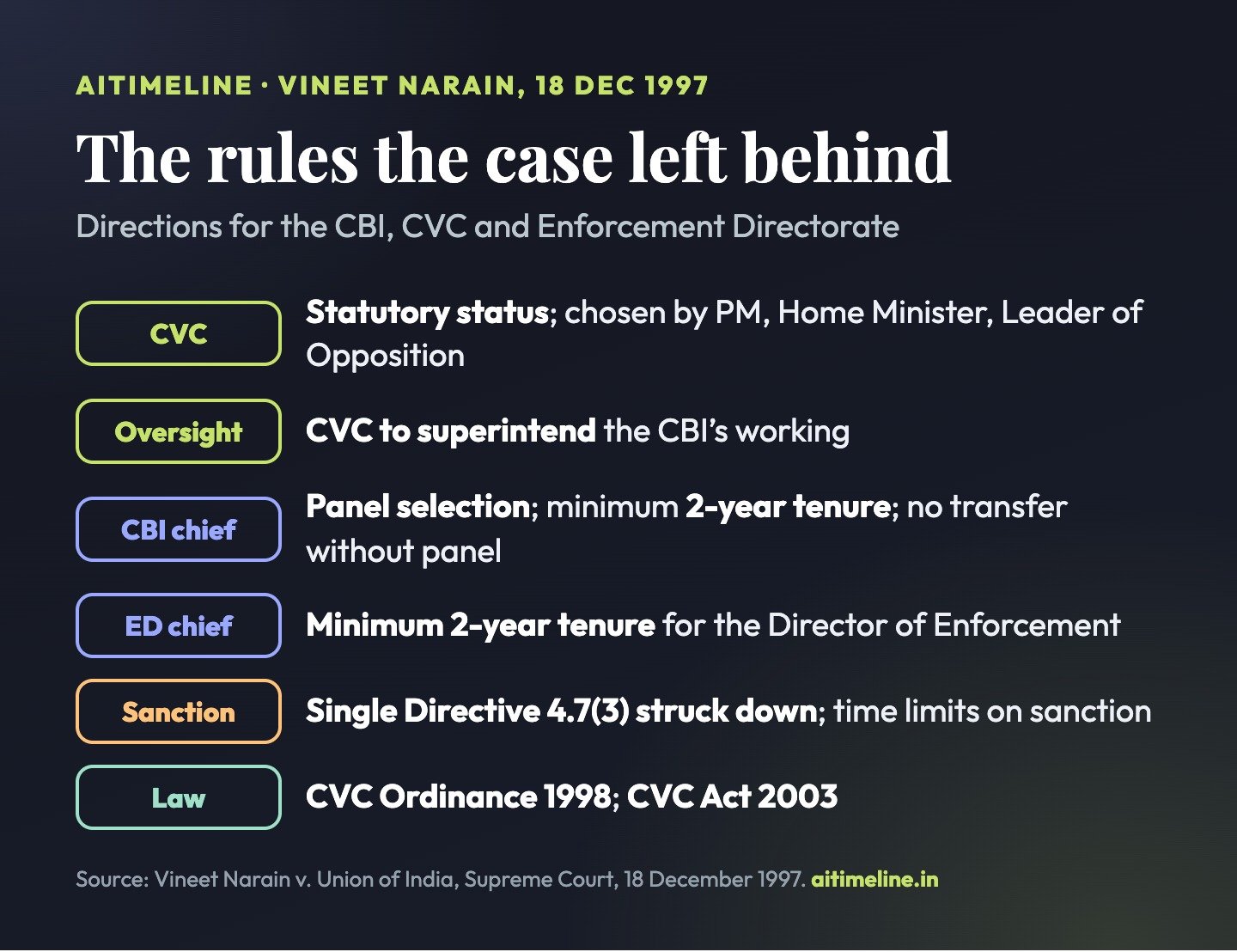
The final judgment, written by Chief Justice J.S. Verma on 18 December 1997, turned to the structure that had let the investigation stall. It struck down Directive No. 4.7(3) of the Single Directive, which required government sanction before the CBI could even begin investigating senior officers. It then laid down directions, drawing heavily on the Independent Review Committee of September 1997. They covered statutory status for the CVC, its selection by the Prime Minister, Home Minister and Leader of the Opposition, and its superintendence of the CBI. They gave a panel-based selection, a two-year minimum tenure and protection from transfer to the CBI Director, and the same tenure to the Director of Enforcement.
The government gave the CVC statutory status by ordinance in 1998, and Parliament passed the Central Vigilance Commission Act in 2003. The debate over how independent the CBI really is did not end there. It returned in the coal-block case of 2013 and in later disputes over the removal of CBI Directors. But nearly every argument since has started from the Vineet Narain directions.
The Separate FERA Track, 1995 to 2014
The foreign-exchange case ran on its own law and its own timetable.
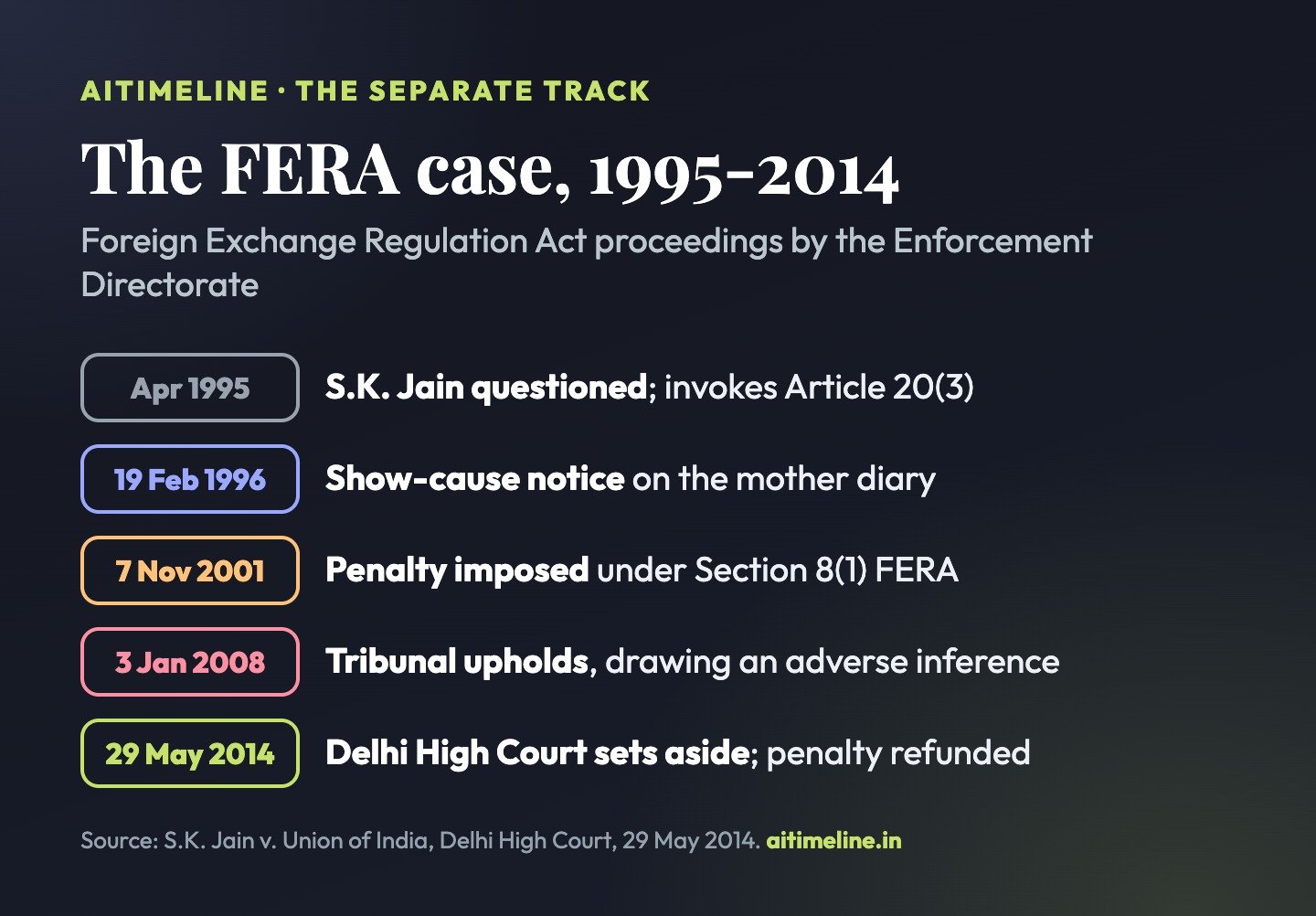
Hawala transactions were offences under the Foreign Exchange Regulation Act, 1973, and the Enforcement Directorate pursued them separately. Because FERA was treated as a complete code of its own, the collapse of the bribery case did not automatically end these proceedings.
The Directorate questioned S.K. Jain in April 1995; he refused to answer, citing his right against self-incrimination. Show-cause notices followed in 1996. On 7 November 2001 a Special Director imposed penalties for contravening Section 8(1) of FERA, and on 3 January 2008 the Appellate Tribunal upheld them. It reasoned that since only S.K. Jain knew what the entries meant, his silence justified an adverse inference.
On 29 May 2014 Justice S. Muralidhar of the Delhi High Court set both orders aside as not supported by the evidence, and directed a refund of the penalty. The judgment opens by calling the proceedings an off-shoot of a case that “ended in the quashing of the criminal proceedings”. Twenty-three years after the raids, that was the last reported ruling in the Jain hawala matter.
Who Was Who
S.K. Jain
One of the three Jain brothers, described by the CBI as the ‘master’ of the diaries; questioned in 1995, discharged in the bribery cases, and won his FERA appeal in 2014.
J.K. Jain
Employee of the Jain brothers who wrote the entries in his own hand; his house at Saket was searched on 3-4 May 1991.
Vineet Narain
Journalist whose 1993 public-interest petition kept the investigation alive and produced the 1997 directions on the CBI.
L.K. Advani
Charge-sheeted on 16 January 1996; resigned his Lok Sabha seat; discharged in 1997, upheld in 1998; returned to Parliament in 1998.
V.C. Shukla
Charge-sheeted on 23 January 1996 over an alleged Rs 38.86 lakh; his name is on the 1998 Supreme Court judgment.
J.S. Verma
Presided over the Vineet Narain bench and wrote the 18 December 1997 judgment.
M.K. Mukherjee
Wrote the Supreme Court’s 2 March 1998 judgment in CBI v. V.C. Shukla on the evidentiary value of the diaries.
P.V. Narasimha Rao
Headed the government when the charge-sheets were filed; critics accused him of using the CBI against rivals, which he denied.
Did You Know?
- It started with terrorism: the diaries surfaced in an inquiry into militant funding, not political corruption.
- A balanced book: the Supreme Court called MR 71/91 a book of account because its entries were totalled and balanced.
- Two numbers: the 1995 FIR counted 119 recipients; the Supreme Court’s summary counts 115.
- Only half the money counted: of the Rs 60 lakh alleged against Advani, only Rs 25 lakh fell in a period when he was a public servant.
- The silent witness: S.K. Jain’s refusal to answer in 1995 became the ground for a FERA penalty in 2001, and that penalty was undone in 2014.
- A durable rule: later diary-based cases, such as the 2016-17 pleas over the Sahara-Birla papers, were judged against the same principle.
Explore More Timelines
People Also Ask
Frequently Asked Questions
Based on the Supreme Court and Delhi High Court judgments and the parliamentary record.
⚠️ Editorial Note: What We Checked
We checked the brief we started from against the Supreme Court’s judgments in Vineet Narain v. Union of India (18 December 1997) and CBI v. V.C. Shukla (2 March 1998), the Delhi High Court’s judgment in S.K. Jain v. Union of India (29 May 2014), the Lok Sabha answer of 18 April 2000 and contemporary reports. The 1998 bench had three judges, and it held, against the High Court, that the notebooks were books of account; the case failed on the lack of independent evidence. The 2014 FERA appeal was decided for S.K. Jain: the High Court set aside the penalty, so the FERA track did not survive either. We added the 5 May 1998 discharge of 19 politicians, which the brief did not mention. Amounts and recipient counts are the CBI’s allegations, not court findings, and being named in the diaries is not evidence of wrongdoing. We could not open the full text of the Lok Sabha answer and rely on its published summary. Claims that the 1996 charge-sheets were politically timed are presented as arguments of the time. This article is a historical account and not legal advice.
Related Reading on AiTimeline
Sources & further reading
Every dated entry above was checked against these references. Last reviewed 20 November 2026.
- Supreme Court of India: Vineet Narain & Others v. Union of India, judgment of 18 December 1997 (Indian Kanoon)
- Supreme Court of India: Central Bureau of Investigation v. V.C. Shukla & Ors, judgment of 2 March 1998 (Indian Kanoon)
- Delhi High Court: S.K. Jain v. Union of India, FERA appeal decided 29 May 2014 (Indian Kanoon)
- Lok Sabha: Unstarred Question No. 3709 on the Hawala case, answered 18 April 2000 (Digital Library of Parliament)
- Business Standard: Jakhar, Sharad in hawala net, 19 discharged (6 May 1998)
- The Christian Science Monitor: Corruption Charges in India Throw Politics Into Chaos (22 January 1996)
- Wikipedia: Hawala scandal