KSrelief in Gaza and Yemen: A Complete Humanitarian Guide
Three hours before sunrise, a logistics coordinator in a warehouse checks a manifest against pallets stacked to the ceiling — rice, lentils, cooking oil, oral rehydration salts, boxes of therapeutic food for children under five. Nothing on this list is glamorous. Every item on it has been chosen because a needs assessment somewhere identified exactly this gap, in exactly this quantity, for exactly this number of families. By the time the sun is up, trucks will be moving toward a border crossing, their manifests already shared with the agencies that will receive them on the other side, their route already cleared through checkpoints that did not exist a decade ago and exist now because the conflict does.
This is what humanitarian aid actually looks like in the hours before anyone sees a headline about it: not a single dramatic delivery, but a supply chain built from hundreds of small, verified decisions, repeated daily, across years. Getting food, medicine and clean water to people in conflict-affected regions is one of the most logistically demanding tasks any organisation can undertake — and one of the most heavily scrutinised, because the cost of getting it wrong is measured in the health and safety of people who have almost no other options. This guide explains, as factually and completely as the public record allows, what one such organisation — Saudi Arabia’s King Salman Humanitarian Aid and Relief Centre, known as KSrelief — has done in two of the most difficult operating environments in the world: Gaza and Yemen. It is not the only organisation working in either place, and this guide makes no claim that it is; it is one documented, traceable case study in how a national humanitarian agency builds, sustains and reports on a decade-long relief effort under conditions no logistics textbook was written to anticipate.
Saudi Arabia's KSrelief in Gaza and Yemen: food, health, WASH and shelter aid explained, verified against official KSrelief and UN humanitarian sources.
Latest Story
KSrelief — the King Salman Humanitarian Aid and Relief Centre — is the agency established by Saudi Arabia on 13 May 2015 to coordinate and deliver the Kingdom’s international humanitarian assistance. Since then, KSrelief reports having implemented more than 2,400 projects across over 90 countries, spanning food security, healthcare, water and sanitation, shelter, nutrition and emergency relief. In Yemen, where a prolonged conflict has produced one of the world’s largest humanitarian crises, KSrelief has funded well over a thousand projects since 2015, spanning emergency food aid, mobile health clinics, cholera response and a prosthetics programme that has served more than 25,000 patients. In Gaza, KSrelief has implemented humanitarian programmes since 2015 and, through 2025 and 2026, has run recurring hot-meal distributions through a central kitchen and a food-basket programme, Sallat Al-Khair, launched in Khan Younis in May 2026. This guide separates what is officially reported, what UN agencies and independent humanitarian monitors have verified, and what remains context or interpretation — because in humanitarian reporting, as in the conflicts it responds to, that distinction matters.
Latest Update — August 2026
What changed since the last refresh
As of 2 August 2026, per Arab News, KSrelief’s Gaza central kitchen distributed a further round of roughly 25,000 hot meals to vulnerable families across central and southern Gaza, continuing the same recurring pattern reported through the year. Separately in Yemen, KSrelief-supported medical reporting for the same period detailed a year of activity at its Specialized Hospital for Ophthalmology in Marib: 42,167 patients examined, 8,491 cases diagnosed, 5,322 eye surgeries performed and 32,012 pairs of prescription glasses distributed, part of more than 100,000 free medical services delivered by the facility — a health-sector programme distinct from the Marib prosthetics centre covered elsewhere in this guide.
🧠 AI Overview Summary
KSrelief is Saudi Arabia’s official humanitarian aid agency, established in May 2015 to coordinate the Kingdom’s international relief efforts. It has implemented over 2,400 projects in more than 90 countries, spanning food security, healthcare, water and sanitation, shelter and emergency relief. In Yemen, KSrelief has funded over a thousand projects since 2015 across food, health, WASH and rehabilitation programmes. In Gaza, it operates a central kitchen distributing tens of thousands of hot meals and, since May 2026, a food-basket programme called Sallat Al-Khair, working alongside UN agencies including WFP, WHO and UNICEF.
Who, What, Why, When, Where and How
What to Understand Before Reading Further
- KSrelief is Saudi Arabia’s coordinating humanitarian agency, established in 2015, not a UN body itself — though it partners extensively with UN agencies.
- Its work spans far more than Gaza and Yemen — over 2,400 projects across more than 90 countries since 2015 — but this guide focuses specifically on those two regions.
- In Yemen, KSrelief’s footprint is large and long-running: over a thousand projects since 2015 across food security, health, WASH, shelter and rehabilitation.
- In Gaza, KSrelief’s most visible current activity is food security — a central-kitchen hot-meal programme and the Sallat Al-Khair food-basket initiative launched in May 2026.
- KSrelief works through documented partnerships with WFP, WHO, UNICEF, UNHCR, OCHA and UNDP, rather than operating entirely independently in conflict zones.
- Humanitarian aid delivery is a multi-stage logistics process — assessment, procurement, transport, warehousing, distribution, monitoring — not a single act of donation.
- Figures in this guide are drawn from KSrelief’s own statistics platform, UN reporting and independent outlets; where a number is an estimate rather than a verified count, this guide says so.
- This guide takes no position on the broader geopolitical conflicts in Gaza or Yemen. It documents humanitarian aid activity, separated from political commentary.
- Humanitarian access in active conflict zones is constrained by security conditions, and reported project numbers reflect what has been funded and implemented, not a claim that every identified need has been met.
- For the most current figures, always check KSrelief’s own statistics platform and official UN agency reporting directly, as humanitarian operations in active crises are updated frequently.
Executive Summary
The whole picture in about 150 words
KSrelief, established by Saudi Arabia on 13 May 2015, is the Kingdom’s coordinating body for international humanitarian assistance. Since its founding, it reports implementing more than 2,400 projects across over 90 countries, spanning food security, healthcare, water and sanitation, shelter, nutrition and emergency relief, in partnership with UN agencies including WFP, WHO, UNICEF, UNHCR and OCHA. In Yemen, where conflict has produced one of the world’s largest humanitarian crises, KSrelief has funded well over a thousand projects since 2015, including emergency food aid, mobile health clinics, a cholera response programme, and a prosthetics and rehabilitation initiative in Marib that has served more than 25,000 patients. In Gaza, KSrelief’s recent work has centred on food security: a central kitchen distributing tens of thousands of hot meals per round, and the Sallat Al-Khair food-basket programme, launched in Khan Younis in May 2026, reaching hundreds of thousands of vulnerable families.
⏱️ One-Minute Summary
- KSrelief was established 13 May 2015 as Saudi Arabia’s humanitarian coordinating agency.
- It reports 2,400+ projects in 90+ countries, worth over $8 billion cumulatively.
- In Yemen, over 1,000 projects since 2015 across food, health, WASH and rehabilitation.
- The Marib prosthetics programme has served more than 25,000 patients since 2018.
- In Gaza, KSrelief operates a central kitchen and the Sallat Al-Khair food-basket programme (launched May 2026).
- KSrelief partners formally with WFP, WHO, UNICEF, UNHCR, OCHA and UNDP.
What KSrelief Is, and Why This Aid Is Needed
The organisation, its mandate, and the humanitarian gaps it responds to
KSrelief — formally the King Salman Humanitarian Aid and Relief Centre — was established by Saudi Arabia’s leadership on 13 May 2015 to serve as the Kingdom’s humanitarian arm: a single body responsible for organising and monitoring Saudi Arabia’s international aid efforts, both public and privately donated, and ensuring that work is documented in line with international humanitarian standards on platforms used by the UN and other global reporting bodies. Its Supervisor General is Dr Abdullah bin Abdulaziz Al-Rabeeah, and the centre is headquartered in Riyadh. According to its own reporting, KSrelief has worked in more than 90 countries since establishment, with particular concentration in the Middle East and North Africa region, though its portfolio extends to Africa, Asia and beyond.
Why Humanitarian Aid Is Needed in These Contexts
Humanitarian assistance exists to meet basic survival needs — food, clean water, shelter, medical care — for people whose normal ability to meet those needs has been disrupted by conflict, displacement or disaster. In both Gaza and Yemen, that disruption has been severe and prolonged. Yemen has experienced sustained conflict since 2014-2015, which the United Nations has repeatedly described as having produced one of the world’s largest humanitarian crises, with millions of people requiring food assistance, healthcare and safe water access at any given time. Gaza has experienced repeated and, since October 2023, sustained conflict that UN agencies including OCHA and WHO have documented as severely straining food security, healthcare infrastructure and access to clean water for the civilian population.
The Core Sectors of Humanitarian Response
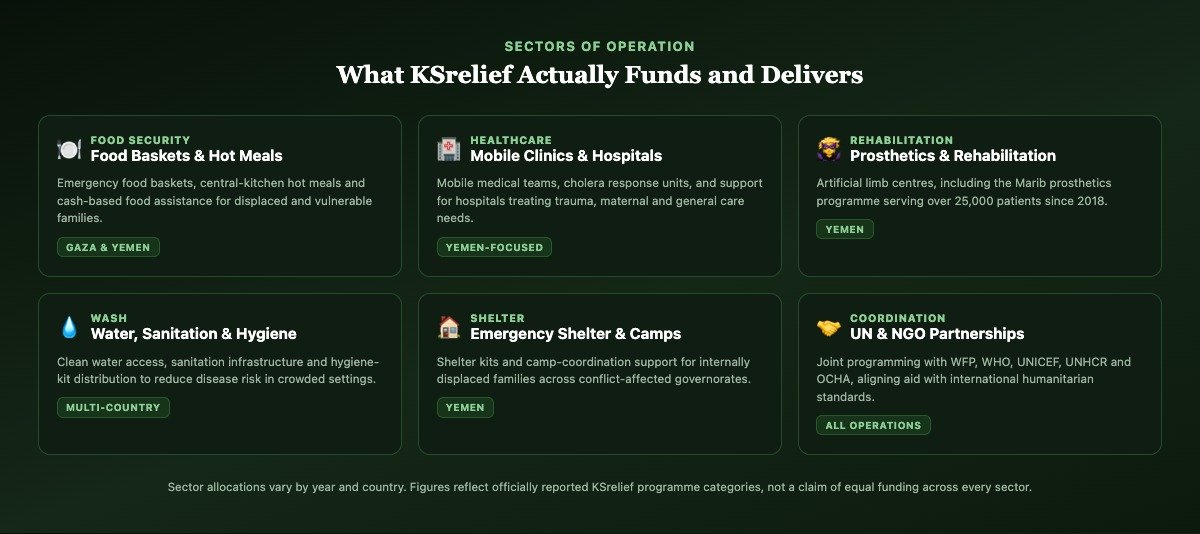
Food security programmes address immediate hunger through emergency food distribution and, where possible, longer-term support for households to meet their own food needs. Emergency healthcare covers trauma care, communicable disease response, maternal and child health, and general medical services, often delivered through mobile clinics when fixed health facilities are damaged or inaccessible. Shelter assistance provides temporary or transitional housing materials for people displaced from damaged or destroyed homes. Water and sanitation (WASH) programmes prevent disease outbreaks — particularly cholera and other waterborne illnesses — by ensuring access to clean water and functioning sanitation. Nutrition programmes specifically target malnutrition, especially in children under five and pregnant or breastfeeding women, who face the most severe long-term health consequences from inadequate diet. Medical support extends to rehabilitation services, including the prosthetics and physical therapy that conflict injuries frequently require.
Why International Partnerships Matter
No single national aid agency, however well resourced, can independently manage every stage of humanitarian delivery in an active conflict zone — from needs assessment through to last-mile distribution. This is why organisations like KSrelief work through formal partnerships with UN agencies that have established operational infrastructure, security protocols and local relationships in these regions: the World Food Programme for food logistics, the World Health Organization for health system support, UNICEF for child-focused programming, UNHCR for displacement response, and OCHA for overall humanitarian coordination.
This partnership model also serves an accountability function that operating alone would not. When a national donor funds a project implemented through an established UN agency’s existing systems, that project inherits the receiving agency’s monitoring standards, beneficiary registration protocols and reporting obligations — the same standards applied to that agency’s other funding sources. This is part of why KSrelief documents its contributions to WFP, UNICEF and other partners as distinct, attributable figures rather than folding them into an undifferentiated total: it allows each contribution to be tracked against the specific programme it supported, and cross-referenced against that programme’s own published outcomes.
🤝 Humanitarian Insight
Large-scale aid operations require coordination between governments, humanitarian agencies, NGOs and local partners. No delivery of food, medicine or shelter materials into a conflict zone happens in isolation — it depends on security clearances, established logistics corridors, local implementing partners who understand the terrain and community structure, and international agencies that can vouch for quality and accountability standards. This is why humanitarian organisations, including KSrelief, publish detailed statistics on their partnerships rather than simply on total spending: the coordination itself is part of what makes aid effective.
The Complete Timeline: From Establishment to Current Operations
Each entry labelled: official announcement, humanitarian reporting, UN coordination, or independent journalism
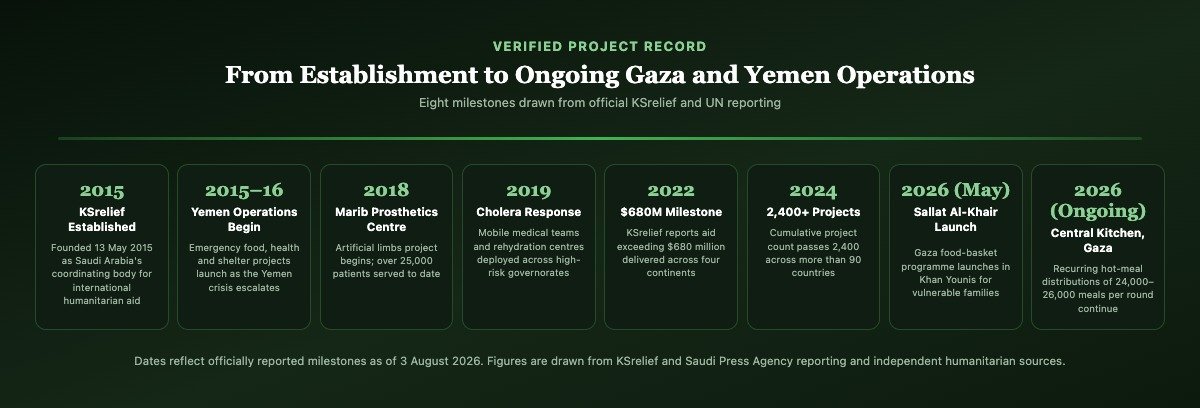
KSrelief Is Established
Background. Saudi Arabia’s leadership established the King Salman Humanitarian Aid and Relief Centre on 13 May 2015, creating a dedicated body to coordinate and monitor the Kingdom’s international humanitarian aid, both government-funded and privately donated, in line with international humanitarian standards.
Official announcement. The centre’s stated mandate covers relief, camp management, shelter, early recovery, protection, education, water and sanitation, nutrition, health, and humanitarian logistics support — a broad remit intended to let it respond across the full range of humanitarian need rather than a single sector.
Current relevance. Every project referenced later in this timeline operates under the mandate and reporting structure established in 2015.
Early Emergency Operations Begin in Yemen
Humanitarian context. As conflict in Yemen escalated from 2015, humanitarian needs grew rapidly across food security, healthcare, shelter and WASH sectors, prompting an early and substantial KSrelief response.
Project description. KSrelief’s own statistics record 56 Yemen projects in 2015, at a reported cost of over $254 million, rising to 73 projects the following year at a reported cost of over $374 million — among the earliest and largest components of its overall portfolio.
Current relevance. This established Yemen as one of KSrelief’s largest and most sustained country programmes, a position it has held in most years since.
Healthcare Programmes Expand, Marib Prosthetics Centre Launches
Humanitarian context. Conflict-related injuries, including amputations, created sustained demand for rehabilitation services in a health system already under severe strain.
Project description. KSrelief’s artificial limbs project, implemented at Marib General Hospital across multiple phases beginning around 2018, provides prosthetic limbs and rehabilitation services free of charge to patients with physical disabilities, regardless of how the injury occurred.
Verified outcomes. By later reporting, the programme had served more than 25,000 patients across its centres in Yemen — among the largest documented rehabilitation initiatives of its kind in the country.
Yemen Programme Peaks, Cholera Response Launches
Humanitarian context. Yemen experienced one of the largest cholera outbreaks recorded globally in this period, driven by damaged water and sanitation infrastructure and mass displacement.
Project description. KSrelief funded 156 Yemen projects in 2018 — its highest annual count to that point, at a reported cost exceeding $1.19 billion — and supported an emergency cholera response involving mobile medical teams, oral rehydration salt distribution and temporary treatment centres in high-risk areas.
Verified outcomes. Reporting on individual response weeks recorded medical services delivered to over 1,700 people through the cholera programme in a single documented week, illustrating the pace of the response during acute outbreak periods.
Nutrition, WASH and Mobile Health Expand Across Yemen
Humanitarian context. Sustained conflict and economic collapse drove rising acute malnutrition rates among children under five, alongside continued disruption to water and sanitation systems.
Project description. KSrelief expanded nutrition programming alongside continued WASH and health projects, including mobile clinics established in cooperation with local partners such as the Taiba Development Foundation, which alone recorded over 1,000 patient visits in Hajjah governorate.
Current relevance. This period established the multi-sector model — combining nutrition, WASH and mobile health under one country programme — that continues to characterise KSrelief’s Yemen operations.
KSrelief Reports $680 Million in Aid Across Four Continents
Official announcement. KSrelief published a cumulative figure describing more than $680 million in humanitarian aid delivered across projects on four continents, a milestone the organisation used to summarise its scale to that point.
Independent context. Figures of this kind describe cumulative reported spending rather than a single-year total, and should be read as a scale indicator rather than a precise measure of humanitarian outcomes, which depend on far more than dollar value alone.
Gaza Humanitarian Needs Intensify Sharply
Humanitarian context. Following the escalation of conflict in Gaza from October 2023, UN agencies including OCHA and WHO documented severe and rapidly worsening strain on food security, healthcare infrastructure, water access and shelter for the civilian population.
Independent context. This guide does not detail the broader conflict itself, which is covered in AiTimeline’s separate Gaza medical crisis and global geopolitical conflicts guides; here, the relevant fact is that humanitarian need in Gaza rose sharply from this point, shaping the scale of the response described in later entries.
Cumulative Project Count Passes 2,400
Official announcement. KSrelief reported having implemented more than 2,400 projects across more than 90 countries since 2015, with 531 projects recorded for 2024 alone at a reported cost of over $622 million.
Current relevance. This figure represents the organisation’s most recent comprehensive self-published scale summary ahead of the intensified 2025–26 Gaza food security response detailed next.
Sallat Al-Khair Food-Basket Programme Launches in Gaza
Project description. KSrelief launched the Sallat Al-Khair (“basket of goodness”) programme in Khan Younis in May 2026, distributing food baskets to displaced and vulnerable families as part of a wider Saudi campaign to support the Palestinian population.
Official partners. The launch was reported in the presence of representatives from the United Nations and other international and civil society institutions, consistent with KSrelief’s standard practice of coordinating major launches with UN humanitarian bodies.
Verified outcomes, as reported. Individual distribution rounds recorded through subsequent months included, for example, 531 food baskets distributed in one round reaching 3,186 individuals, with later rounds reported at 640 and 673 baskets — illustrating a sustained, recurring distribution pattern rather than a single event.
The Gaza Central Kitchen Continues Recurring Hot-Meal Distribution
Project description. KSrelief’s central kitchen in Gaza has continued regular hot-meal distributions to the most vulnerable groups across the central and southern Gaza Strip through 2026, with individual rounds reported at 25,880 meals in April, 24,800 in May, 24,500 in late July, and around 25,000 in early August.
Verified outcomes, as reported. The consistency of the reported figures — each round in the range of roughly 24,000 to 26,000 meals — indicates an established, repeatable operation rather than an ad hoc response, though this guide notes these are officially reported distribution figures, not independently audited consumption data.
Current relevance. Since its establishment in 2015, KSrelief’s cumulative work in Palestine is reported at 152 projects worth approximately $537 million, with food security the dominant focus of its most recent Gaza activity.
🏥 Health Insight
Emergency healthcare includes medicines, mobile clinics, maternal care and disease prevention. In a conflict-damaged health system, mobile clinics often substitute for fixed facilities that have been damaged, destroyed or made inaccessible by active fighting, bringing basic diagnostic and treatment capacity directly to displaced populations. Disease prevention — particularly around waterborne illness like cholera — is frequently as significant a component of emergency healthcare response as direct treatment, because outbreak prevention protects far more people than outbreak response alone.
A Humanitarian Aid Glossary
The terms this guide cannot be explained without
- Humanitarian Assistance
- Aid provided to meet immediate survival needs of people affected by conflict, displacement or disaster, guided by the principles of humanity, neutrality, impartiality and independence.
- Emergency Food Aid
- Immediate food assistance, typically as in-kind rations or ready meals, provided to prevent acute hunger during a crisis.
- Cash Assistance
- Direct cash or voucher transfers to affected households, allowing them to purchase what they need locally rather than receiving fixed in-kind goods.
- Medical Relief
- Emergency and ongoing healthcare provision in crisis settings, including trauma care, disease treatment and essential medicines.
- Nutrition Programme
- Targeted intervention addressing malnutrition, especially in children under five and pregnant or breastfeeding women.
- Shelter Kit
- A standardised package of materials (tarpaulins, tents, tools) enabling a displaced family to construct or repair temporary housing.
- WASH
- Water, Sanitation and Hygiene — the sector covering clean water access, sanitation infrastructure and hygiene supplies to prevent disease.
- Protection Services
- Programmes safeguarding vulnerable individuals, especially children and displaced persons, from violence, exploitation and rights violations.
- Needs Assessment
- The structured process of identifying what type and scale of assistance a crisis-affected population actually requires, before aid is planned.
- Implementing Partner
- An organisation, often a UN agency or NGO, that carries out on-the-ground delivery of aid funded or coordinated by another body.
- Central Kitchen
- A centralised food-preparation facility producing large volumes of ready-to-eat hot meals for distribution to displaced or crisis-affected populations.
- Logistics Cluster
- A coordination mechanism, often UN-led, that organises shared transport, warehousing and supply-chain infrastructure among multiple humanitarian actors in a crisis.
How Humanitarian Aid Actually Reaches People
The ten-stage process behind every delivery described in this guide
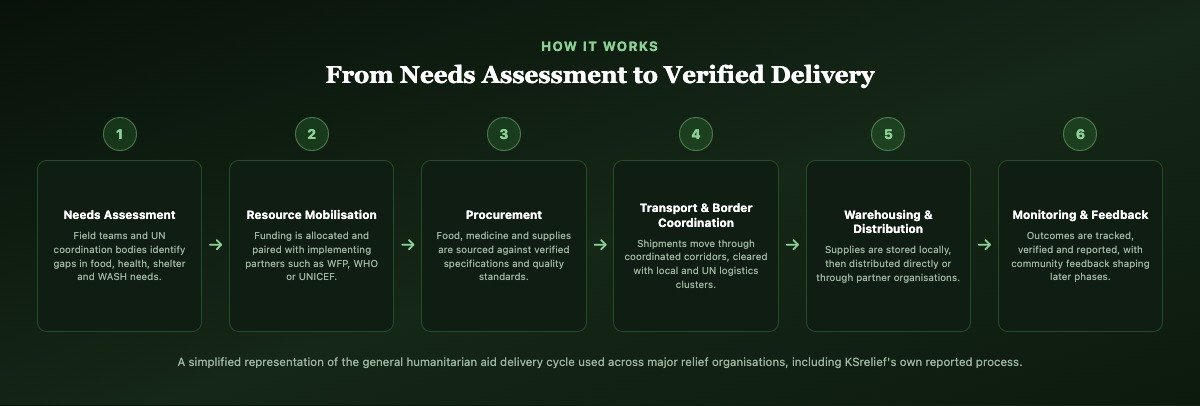
Delivering aid into a conflict zone is not a single transaction. It is a coordinated, multi-stage process, and understanding its stages is the clearest way to understand what an organisation like KSrelief is actually doing when it reports a project.
Needs Assessment
Before any aid is planned, field teams — often working alongside UN coordination bodies like OCHA — assess what a population actually needs: how many people, what sectors, what quantities, and what access constraints exist. This shapes every later decision.
Resource Mobilisation
Funding is allocated against the assessed need, frequently paired with a specific implementing partner whose existing operational presence makes them best placed to deliver in that location.
Procurement
Food, medicine and supplies are sourced against defined specifications and quality standards, whether purchased locally, regionally or internationally, depending on availability and cost.
Transportation
Goods move from procurement points toward the crisis area, typically via a combination of sea, air and road transport depending on distance and access.
Border Coordination
In conflict settings, crossing into the affected area requires coordination with relevant authorities and, frequently, UN or Red Cross/Red Crescent facilitation to ensure safe passage.
Warehousing
Supplies are stored locally, close to distribution points, in facilities that can be secured and that support onward distribution logistics.
Distribution
Aid reaches individuals or households, either directly by the funding organisation’s own teams or through an implementing partner’s established distribution network.
Monitoring
Field staff track what was actually distributed, to whom, verifying against distribution lists and beneficiary registration where possible.
Community Feedback
Established humanitarian practice includes channels for affected communities to report problems, request adjustments, or flag misconduct, feeding back into programme design.
Project Evaluation
Completed projects are assessed against their original objectives, informing whether and how similar interventions continue or are adjusted.
📦 Logistics Insight
Delivering aid safely depends on transport routes, security conditions, warehousing and local partnerships. A shipment’s journey from a procurement point to a family’s hands can involve multiple modes of transport, several jurisdictional crossings, and coordination with local security actors — any one of which can delay or reroute a delivery. This is why humanitarian logistics is treated as a specialised discipline in its own right, not simply an extension of commercial freight.
Five Things Worth Understanding in More Depth
Evergreen explainers that answer the questions behind the headlines
How Humanitarian Aid Is Delivered
Aid delivery follows a defined cycle: needs assessment, resource mobilisation, procurement, transport, border coordination, warehousing, distribution, monitoring, community feedback and evaluation. Each stage depends on the one before it, and a breakdown anywhere in the chain — a closed border crossing, a damaged warehouse, a security incident on a transport route — can delay or halt a delivery regardless of how much funding or supply is available. This is why humanitarian organisations report not just funding totals but operational statistics: projects implemented, meals distributed, patients treated.
Emergency Relief vs Long-Term Recovery
Emergency relief addresses immediate, life-threatening needs — food, water, emergency shelter, trauma care — typically within days to weeks of a crisis event or during an acute phase of ongoing conflict. Long-term recovery and development assistance address underlying resilience: rebuilding health systems, restoring livelihoods, reconstructing infrastructure. KSrelief’s portfolio includes both: the Gaza central kitchen and food-basket programmes are emergency relief; the Marib prosthetics centre, running continuously since 2018, sits closer to sustained recovery support.
How Food Distribution Actually Works
Food assistance takes two broad forms: in-kind distribution (food baskets, hot meals, ready-to-eat rations) and cash or voucher-based assistance, which lets recipients purchase food locally where markets still function. In-kind distribution is typically used when markets are disrupted or non-functional — as in Gaza during the most acute phases of the crisis — while cash assistance is preferred where markets remain viable, since it supports local commerce alongside meeting nutritional need. KSrelief’s Gaza operations, including the central kitchen and Sallat Al-Khair, have relied primarily on in-kind distribution.
Medical Relief in Conflict Zones
Delivering healthcare in an active conflict zone means adapting to damaged infrastructure, security risk to medical staff and patients, and disrupted supply chains for medicines. Mobile clinics address facility damage by bringing care directly to displaced populations. Disease outbreak response, like KSrelief’s Yemen cholera programme, requires rapid deployment of both treatment capacity and preventive measures like oral rehydration and clean water access, since outbreaks in crowded displacement settings can spread faster than in stable conditions.
Monitoring Humanitarian Impact
Credible humanitarian organisations report both outputs (meals distributed, patients treated, projects implemented) and, where possible, outcomes (nutritional status improvement, disease incidence reduction). Output figures, like KSrelief’s reported meal-distribution counts, are easier to verify and more commonly published; outcome data requires longer-term tracking and is less frequently available in real time. This guide reports the figures KSrelief and independent sources have published, while noting that output counts are not the same as a full impact evaluation.
Comparison Tables: Humanitarian Aid Side by Side
Seven reference tables covering aid types, sectors and regional focus
Emergency Relief vs Development Assistance
| Aspect | Emergency Relief | Development Assistance |
|---|---|---|
| Timeframe | Days to months | Years |
| Goal | Meet immediate survival needs | Build long-term resilience and capacity |
| Example in this guide | Gaza central kitchen hot meals | Marib prosthetics rehabilitation centre |
| Typical funding cycle | Rapid, often recurring rounds | Multi-year programme funding |
Food Aid vs Cash Assistance
| Aspect | Food Aid (In-Kind) | Cash Assistance |
|---|---|---|
| What’s provided | Physical food items or ready meals | Cash or vouchers |
| Best suited when | Markets disrupted or non-functional | Local markets remain viable |
| Logistics burden | High (storage, transport, spoilage risk) | Lower (banking/voucher infrastructure) |
| Used in Gaza by KSrelief | Yes (central kitchen, food baskets) | Not the primary reported method |
Healthcare vs Nutrition Programmes
| Aspect | Healthcare Programmes | Nutrition Programmes |
|---|---|---|
| Primary focus | Disease treatment, trauma care, maternal health | Preventing and treating malnutrition |
| Delivery method | Mobile clinics, hospital support | Supplementary feeding, therapeutic food |
| KSrelief Yemen example | Cholera response, mobile clinics | Nutrition programming for children under five |
| Typical population focus | General population, injury cases | Children under five, pregnant/breastfeeding women |
Gaza Projects vs Yemen Projects
| Aspect | Gaza | Yemen |
|---|---|---|
| KSrelief active since | 2015 | 2015 |
| Reported project count | 152+ (cumulative) | 1,000+ (cumulative) |
| Reported cumulative cost | ~$537 million | ~$4.68 billion (through 2022 data) |
| Current dominant focus (2025–26) | Food security (meals, food baskets) | Multi-sector (food, health, WASH, rehabilitation) |
| Notable flagship programme | Sallat Al-Khair, central kitchen | Marib prosthetics centre |
Project Categories
| Sector | Typical Activities | Example |
|---|---|---|
| Food security | Food baskets, hot meals, cash-based assistance | Gaza central kitchen |
| Health | Mobile clinics, hospital support, disease response | Yemen cholera response |
| Rehabilitation | Prosthetics, physical therapy | Marib artificial limbs centre |
| WASH | Clean water access, sanitation, hygiene kits | Yemen WASH projects |
| Shelter | Shelter kits, camp coordination | Yemen IDP shelter support |
Aid Delivery Stages
| Stage | Key Activity | Typical Actor |
|---|---|---|
| 1. Needs assessment | Identify scale and type of need | Field teams, OCHA coordination |
| 2. Resource mobilisation | Allocate funding, select partners | KSrelief, donor agencies |
| 3. Procurement | Source supplies to standard | KSrelief, implementing partners |
| 4. Transport & distribution | Move and deliver aid | WFP, local partners |
| 5. Monitoring & evaluation | Verify and assess outcomes | KSrelief, UN agencies |
Timeline Summary
| Year | Project | Humanitarian Importance |
|---|---|---|
| 2015 | KSrelief established | Creates coordinated channel for Saudi humanitarian aid |
| 2015–16 | Yemen operations begin | Establishes one of KSrelief’s largest country programmes |
| 2018 | Marib prosthetics centre launches | Sustained rehabilitation support beyond emergency relief |
| 2018–19 | Cholera response, peak Yemen funding | Addresses a major public health emergency |
| 2019–21 | Nutrition, WASH, mobile health expand | Shifts toward sustained multi-sector programming |
| 2022 | $680M cumulative milestone reported | Marks organisational scale at that point |
| 2023 | Gaza humanitarian needs intensify | Sets context for 2025–26 Gaza response scale |
| 2024 | 2,400+ cumulative projects reported | Confirms scale comparable to major relief agencies |
| 2026 (May) | Sallat Al-Khair launches, Khan Younis | Major new Gaza food security initiative |
| 2026 (ongoing) | Central kitchen recurring distributions | Demonstrates sustained operational capacity in Gaza |
The Scale of Need: What UN Data Shows
Independently verified figures from OCHA, WFP and the IPC — not KSrelief’s own reporting
To understand why KSrelief’s reported project counts and distribution figures matter, it helps to see the scale of need they respond to, as measured independently by UN humanitarian data systems rather than by KSrelief itself. This section draws exclusively on UN coordination data — OCHA, WFP and the Integrated Food Security Phase Classification (IPC), a globally recognised standard for measuring acute food insecurity — kept deliberately separate from KSrelief’s own project statistics discussed elsewhere in this guide.
Yemen: A Persistent, Large-Scale Crisis
According to 2026 IPC analysis, approximately 18.3 million people in Yemen are classified as acutely food insecure. In government-controlled areas specifically, roughly 47% of the population — around 5 million people — face Crisis-level food insecurity or worse (IPC Phase 3+), including 1.4 million people in Emergency conditions (IPC Phase 4). Projections for the June-to-September 2026 lean season indicate this could worsen to 51% of the population, or roughly 5.4 million people. Malnutrition figures are similarly severe: UN data records more than 2.2 million children under five as acutely malnourished, including over 516,000 with severe acute malnutrition, alongside an estimated 1.3 million pregnant or breastfeeding women also facing malnutrition risk. UN reporting attributes the deterioration to weak purchasing power, macroeconomic decline, high agricultural input costs, and a documented sharp decline in overall humanitarian funding — a funding gap that gives context to why sustained programmes like KSrelief’s remain significant, without this guide claiming they close that gap alone.
Gaza: A Fragile, Volatile Improvement
IPC analysis for Gaza in 2026 classifies the entire Gaza Strip in Phase 3 (Crisis) or worse, with an estimated 1.4 million people facing high levels of acute food insecurity through December 2026 — roughly 67% of Gaza’s population — a figure UN analysts note had actually risen from about 1.2 million in the preceding April-to-June period. Within that total, an estimated 212,000 people remain in Emergency conditions (IPC Phase 4), concentrated particularly in areas near militarily controlled lines where humanitarian access is most constrained. UN nutrition surveillance across four analysed governorates found acute malnutrition had improved from Phase 1 (Acceptable) toward a projected Phase 2 (Alert) for the second half of 2026 — UNICEF and IPC analysts have explicitly characterised this improvement as fragile, noting that aid coverage had already declined since February 2026 and that further reductions could trigger rapid deterioration given exhausted household coping mechanisms.
Why This Context Matters for Reading KSrelief’s Figures
Placed against this UN data, KSrelief’s reported activity — roughly 24,000 to 26,000 meals per central-kitchen round in Gaza, hundreds of food baskets per Sallat Al-Khair round, over a thousand cumulative Yemen projects — represents a meaningful but partial contribution to needs measured in the millions. This is not a criticism of KSrelief’s programming; it is the honest scale relationship that applies to every single humanitarian actor operating in these crises, none of which meets the full assessed need alone. Reading KSrelief’s own statistics alongside independent UN figures, rather than in isolation, is what allows an accurate rather than an inflated picture of what has been achieved and what remains outstanding.
This scale relationship is also why humanitarian response in both regions depends on many organisations operating in parallel rather than any single actor, however well-resourced, attempting to close the full gap alone. In Yemen, the UN’s 2026 Humanitarian Needs and Response Plan coordinates contributions from dozens of international NGOs, UN agencies and bilateral donors alongside national actors like KSrelief, each covering a share of an assessed need that has persisted, in some form, for over a decade. In Gaza, the fragility UNICEF and IPC analysts have flagged — food security gains achieved but explicitly described as reversible if aid coverage declines further — underscores why sustained, recurring programming matters more than single large deliveries: KSrelief’s central kitchen model, repeating a similar-scale distribution month after month rather than a one-off surge, is one small illustration of the kind of consistency UN coordination bodies have identified as necessary to prevent exactly the kind of rapid deterioration IPC analysis warns remains possible.
How KSrelief’s Sectors Compare in Practice
What actually gets funded, and how it differs by country
Reported sector allocation is not uniform across KSrelief’s country programmes, and understanding why illustrates something true of humanitarian response generally: aid follows assessed need, not a fixed template applied everywhere equally. In Yemen, where conflict has persisted for over a decade and produced widespread infrastructure damage, KSrelief’s reported portfolio spans nearly every major humanitarian sector — food security, health, WASH, shelter, rehabilitation and early recovery — reflecting a population with sustained, multi-dimensional need across nearly every basic service category. In Gaza, KSrelief’s most recently documented activity is heavily concentrated in food security specifically, through the central kitchen and Sallat Al-Khair programmes, which does not necessarily mean other sectors receive no attention, but does reflect where the organisation’s most visible, recurring, publicly reported activity has been concentrated through 2025 and 2026.
This pattern is consistent with how major humanitarian actors generally allocate resources during different phases of a crisis. In the most acute phase of an emergency, when markets, cooking infrastructure and food supply chains are most disrupted, food security programming tends to dominate visible activity because the need is both the most immediate and the most measurable — a meal distributed or a food basket delivered is a discrete, countable unit of assistance. Health, WASH and shelter programming, while equally essential, often require longer implementation timelines, fixed infrastructure, and coordination with a wider set of technical partners, which can make them less visible in short-term reporting even when substantial work continues in parallel.
The comparison also reflects something about KSrelief’s own institutional history in each country. Its Yemen programme, now over a decade old, has had time to mature into the multi-sector model described throughout this guide — a prosthetics centre that has operated continuously since 2018, nutrition programming that expanded through 2019-2021, WASH projects layered on top of ongoing food and health support. Its most recent Gaza expansion, by contrast, responds to a more recent and more acute intensification of need from late 2023 onward, and the food security focus of its 2025-26 reporting likely reflects both the urgency of that specific gap and the practical reality that food distribution can often be scaled and reported on a faster cycle than infrastructure-dependent sectors like WASH or shelter reconstruction.
Who’s Who: The Institutions Behind This Work
The organisations named throughout this guide, in one place
KSrelief
Saudi Arabia’s King Salman Humanitarian Aid and Relief Centre, established 2015, coordinating the Kingdom’s international humanitarian assistance.
World Food Programme (WFP)
The UN’s food assistance agency, a key KSrelief partner; KSrelief has reported contributing over $1.2 billion to WFP programmes across 24 countries.
World Health Organization (WHO)
The UN health agency, partnering with KSrelief on medical relief, disease response and health system support in crisis settings.
UNICEF
The UN children’s agency; KSrelief has contributed over $350 million to UNICEF-implemented programmes across more than 15 countries since 2016.
UNHCR
The UN Refugee Agency, partnering with KSrelief on displacement and refugee response programming.
OCHA
The UN Office for the Coordination of Humanitarian Affairs, which documents and coordinates overall humanitarian response in crises including Gaza and Yemen.
ReliefWeb
The UN-managed humanitarian information portal that publishes and archives official reports, including many referenced throughout this guide.
UNDP
The UN Development Programme, partnering with KSrelief on early recovery and livelihoods programming, including in Yemen.
Gaza Strip
The Palestinian territory where KSrelief’s most recent major activity has centred on food security programming since 2025.
Yemen
KSrelief’s largest and longest-running country programme, spanning food, health, WASH, shelter and rehabilitation since 2015.
Myth vs Fact
Common misconceptions, checked against the official record
✓ Verified Facts
- KSrelief was established on 13 May 2015 as Saudi Arabia’s official humanitarian coordinating body.
- KSrelief reports over 2,400 projects across more than 90 countries since establishment.
- The Marib prosthetics programme has served over 25,000 patients since its launch.
- Sallat Al-Khair, KSrelief’s Gaza food-basket programme, launched in Khan Younis in May 2026.
- KSrelief maintains documented, formal partnerships with WFP, WHO, UNICEF, UNHCR, OCHA and UNDP.
✗ Common Myths
- Myth: “KSrelief is a UN agency.” Fact: It is Saudi Arabia’s own national humanitarian body, which partners with UN agencies but is not part of the UN system.
- Myth: “KSrelief only works in Gaza and Yemen.” Fact: It has implemented projects in more than 90 countries across four continents; this guide covers two of its country programmes specifically.
- Myth: “Reported project figures are independently audited totals.” Fact: Most cumulative figures are self-published by KSrelief; this guide treats them as officially reported rather than independently verified unless a UN or third-party source confirms them.
- Myth: “Humanitarian aid figures reflect the full scope of unmet need.” Fact: Project and distribution counts describe what was funded and delivered, not a claim that all identified humanitarian need has been met.
- Myth: “Food basket and hot meal numbers are the same measure.” Fact: They are different metrics — food baskets are typically household-level distributions covering several days, while hot meals are individual, single-serving distributions.
💡 Interesting Facts
- Did You Know? KSrelief has supported projects in dozens of countries across sectors including health, food security, shelter, education and emergency relief — not only in active conflict zones, but also in disaster response settings.
- The Marib artificial limbs project is implemented in multiple phases at a single hospital, illustrating how a rehabilitation programme can operate continuously for years rather than as a single intervention.
- KSrelief’s reported Yemen project total (over 1,000 since 2015) makes it one of the country’s most consistently active single-source humanitarian funders across the conflict period.
- The name “Sallat Al-Khair” translates roughly to “basket of goodness,” reflecting the programme’s household food-basket distribution model.
- KSrelief’s own statistics platform (data.ksrelief.org) publishes project-level detail, including cost, sector and country breakdowns, making it one of the more granularly documented national humanitarian programmes.
🍪 Food Security Insight
Food assistance often combines emergency meals with longer-term nutrition support where conditions permit. In Gaza’s most acute phase, KSrelief’s central kitchen model — producing large volumes of ready-to-eat hot meals — addressed immediate hunger where cooking facilities and safe food storage were often unavailable to displaced families. The Sallat Al-Khair food-basket programme represents a complementary approach, providing household-level supplies that support meal preparation where some cooking capacity exists, illustrating how food security programming adapts to the specific conditions of the population it serves.
📊 Industry Insight
Humanitarian programmes are most effective when coordinated with local communities and international relief organisations. No national aid agency operates in isolation in a major crisis: local knowledge shapes where and how aid should be delivered, while international coordination through bodies like OCHA prevents duplication and ensures aid reaches the full range of affected communities, not only the most accessible ones.
👀 Future Watch
What to monitor going forward, from official sources only: further KSrelief project announcements and updated statistics on its own reporting platform; UN coordination updates from OCHA, WFP, WHO and UNICEF on humanitarian conditions in Gaza and Yemen; new humanitarian initiatives KSrelief may launch in either region; and published impact reports assessing outcomes rather than only outputs. This section deliberately excludes speculation about the broader conflicts’ political trajectory; it tracks only documented humanitarian programme developments.
Explore More Timelines
People Also Ask
Frequently Asked Questions
90 questions on KSrelief’s mission, history, and work in Gaza and Yemen
Why Humanitarian Assistance Depends on Coordination, Trust and Long-Term Commitment
Return to the warehouse before sunrise, the pallets checked against a manifest, the trucks about to move. Nothing about that scene is unique to any single organisation. It repeats, with different logos on different vehicles, wherever humanitarian actors work in conflict-affected regions — a routine that only looks unremarkable because so much coordination has already happened to make it possible: needs assessed, funding mobilised, supplies procured to standard, routes cleared, partners briefed. What this guide has tried to document, for one organisation working in two of the most difficult operating environments in the world, is exactly that machinery — not the headline figure alone, but the process, the partnerships and the verified record behind it. Reading the scale of UN-measured need against KSrelief’s own reported contribution, table by table and figure by figure, is deliberately unglamorous work. It is also, this guide would argue, the only honest way to read any single humanitarian actor’s record against a crisis measured in millions of people.
Humanitarian organisations such as KSrelief operate within complex environments where logistics, healthcare, food security and international cooperation are all essential, and none of those elements substitutes for the others. A fully funded food programme fails without secure transport routes. A well-run distribution fails without accurate needs assessment. A single agency’s efforts, however well resourced, achieve less in isolation than in coordination with the UN agencies, local partners and communities who understand the terrain and the need on the ground. KSrelief’s reported decade of work in Yemen, and its intensified recent programming in Gaza, reflect that same pattern: emergency response paired with sustained multi-year commitment, delivered through documented partnership rather than unilateral action.
Understanding humanitarian work requires consulting official reports, UN data and verified field updates while recognising the needs and dignity of affected communities. Figures like “25,000 patients” or “24,500 hot meals” describe real people whose immediate circumstances required exactly that intervention, not abstractions to be cited without context. This guide has aimed to present those figures precisely as they were reported, distinguished clearly by source, so that readers — whether journalists, researchers, students or the simply curious — can build an accurate picture of what humanitarian aid delivery in Gaza and Yemen has actually involved, and can verify any single claim against the primary sources this guide has drawn from throughout.
Related Reading on AiTimeline
Sources & further reading
Every dated entry above was checked against these references. Last reviewed 19 September 2026.